Most important takeaways…
- The University of Kentucky's 11-credit Clinical Certificate in Addictions launches fall 2026 with fully online coursework and 180 clinical hours.
- Roughly 80 percent of U.S. adults with a substance use disorder received no treatment in 2024, highlighting a critical workforce gap.
- The certificate covers behavioral addictions like gambling and social media alongside substance use disorders including opioids and alcohol.
- UK employee tuition benefits apply, making this one of the most affordable post-master's addiction credentials available to working NPs.
Roughly 80 percent of U.S. adults with a substance use disorder received no treatment in 2024, and states like Kentucky, which carries one of the nation's highest opioid overdose mortality rates, feel the gap most acutely. Formal addiction training in most PMHNP curricula remains thin, leaving nurse practitioners to learn on the job in settings where the stakes are highest.
The University of Kentucky College of Nursing is addressing that gap directly with an 11-credit Clinical Certificate in Addictions launching fall 2026. Applications close June 15, 2026. For working NPs weighing whether a short credential can meaningfully change their practice, the real question is how well a program's clinical hours, cost, and curriculum align with both patient needs and long-term credentialing goals like the CARN-AP. Understanding the PMHNP subspecialty comparison landscape can help you see where addiction care fits among emerging areas of advanced psychiatric practice.
Why Addiction Training Matters for Psychiatric Mental Health NPs
Why do psychiatric mental health nurse practitioners need specialized addiction training when basic pharmacology courses cover controlled substances?
Because the opioid crisis remains one of the nation's deadliest public health emergencies, and PMHNPs are on the front lines. In 2024, the United States recorded 79,384 overdose deaths, with opioids involved in 79,358 of those fatalities.1 While the nation saw a significant 32% decline in opioid overdose deaths from 2023 to 2024, the crisis is far from over.2 Kentucky continues to face severe challenges: the state ranked 11th nationally with an age-adjusted overdose death rate of 29.9 per 100,000 in 2024.3 Fentanyl was involved in 62.3% of Kentucky overdose deaths in 2024, and methamphetamine appeared in 50.8% of cases.4 These polysubstance use patterns demand clinical expertise that goes far beyond recognizing symptoms or prescribing naloxone.
Regulatory Changes Expand PMHNP Prescribing Authority
In 2023, the federal government eliminated the X-waiver requirement for prescribing buprenorphine, a critical medication-assisted treatment (MAT) for opioid use disorder. Before the change, nurse practitioners had to obtain a separate DEA waiver and complete eight hours of specialized training just to prescribe buprenorphine. Now, any NP with a standard DEA registration can prescribe buprenorphine after completing the same eight-hour training. This regulatory shift dramatically expands access to MAT, but it also places new responsibility on PMHNPs who may not have received formal addiction training in their graduate programs. These shifts are part of a broader pattern in which the NP role in modern healthcare continues to expand.
The Substance Abuse and Mental Health Services Administration (SAMHSA) maintains updated guidance on buprenorphine prescribing requirements, and the DEA provides resources on controlled substance registration. However, eight hours of training covers only the basics of pharmacology and legal requirements. It does not prepare you to assess complex addiction cases, manage withdrawal protocols, address co-occurring psychiatric disorders, or support long-term recovery.
The Gap Between General Psychiatric Training and Addiction Care
Most PMHNP programs include one or two lectures on substance use disorders within broader psychiatric coursework. You learn diagnostic criteria from the DSM-5-TR and perhaps prescribe naltrexone or disulfiram during clinical rotations. But comprehensive addiction care requires deeper knowledge: motivational interviewing techniques, harm reduction strategies, evidence-based psychotherapies for substance use disorders, and the ability to differentiate between substance-induced psychiatric symptoms and primary mental health conditions. A clinical certificate in addictions fills that gap, offering focused coursework and supervised clinical hours devoted entirely to addiction assessment, treatment, and recovery support. For NPs considering how this credential fits alongside ongoing professional development, nurse practitioner continuing education requirements may already require some substance-use-related coursework.
For PMHNPs practicing in states like Kentucky, where overdose rates remain elevated despite recent declines, this specialized training is not just a career enhancer. It is a clinical necessity.
UK College of Nursing's New Clinical Certificate in Addictions
Beginning fall 2026, the University of Kentucky College of Nursing, in partnership with UK Online, will launch a Clinical Certificate in Addictions designed to meet the growing demand for addiction-competent healthcare providers.1 If you have been waiting for a rigorous, flexible way to formalize your addiction care skills, this program deserves a close look.
Program Structure at a Glance
The certificate totals 11 credit hours and pairs fully online didactic coursework with a 180-hour supervised clinical practicum.1 That combination gives you the theoretical grounding to understand addiction science alongside the hands-on hours to translate that knowledge into real patient care. Because the didactic portion is entirely online, you can move through coursework around your existing schedule without relocating or stepping back from practice.
Applications for the inaugural cohort close June 15, 2026, so the window is tight. UK employees should note that standard university tuition benefits apply to this certificate, which can meaningfully reduce out-of-pocket costs.
The Faculty Behind the Program
Academic credibility matters when you are selecting a post-graduate certificate, and this program starts on solid footing. Julie Perry, D.N.P., an assistant professor and practicing psychiatric mental health nurse practitioner, will teach the initial courses. Andrew Makowski, D.N.P., coordinates the PMHNP track within the DNP program and brings direct program leadership experience. Having faculty who are both clinicians and educators means the curriculum reflects what actually happens in practice, not just what looks good in a course catalog. Addiction care is increasingly recognized as a distinct PMHNP subspecialty, and this certificate formalizes training in that direction.
A Curriculum That Goes Beyond Opioids
One of the clearest differentiators here is scope. Many addiction-focused trainings concentrate almost exclusively on opioid use disorder, which reflects the urgency of the opioid crisis but leaves providers underprepared for everything else they encounter. This certificate covers the full spectrum: substance-related addictions including alcohol, marijuana, and opioids, as well as behavioral addictions such as gambling and social media use.1
For adult-gerontology nurse practitioners working in primary care, that breadth is especially valuable. Older adults present with alcohol use disorder far more often than opioid misuse, and behavioral addictions are an emerging concern across age groups. If you are weighing how addiction care fits into your clinical focus, understanding the difference between AGNP and FNP scopes can help clarify where this credential adds the most value. Formal training across all these categories fills a gap that most graduate programs leave open.
Who the Certificate Is Designed For
The program welcomes both current graduate students and working healthcare professionals, including nurse practitioners, physician assistants, physicians, and licensed mental health professionals.1 That means you do not need to be enrolled in a degree program to apply. If you hold a graduate degree and want to add addiction care credentials to your practice, you can pursue this certificate as a standalone credential.
For AGNPs in particular, this is a concrete way to address substance use disorders with confidence rather than referring out every complex case. You can read the full announcement from the University of Kentucky for additional details on eligibility and next steps.
According to SAMHSA's National Survey on Drug Use and Health, roughly 80 percent of U.S. adults with a substance use disorder received no treatment in 2024. That staggering gap underscores why specialized addiction training for nurse practitioners is not just valuable, it is urgently needed.
Addictions Certificate Programs for NPs: A Side-By-Side Comparison
Specialized addiction certificates are emerging as a direct response to the national overdose crisis, giving working NPs a fast track to competency in substance use disorder care. As more schools launch these programs, comparing key details helps you identify the right fit for your schedule, budget, and career goals.
University of Kentucky vs. Emory University: Two Models for Addiction Training
The two programs with clearly published details in 2026 illustrate different approaches. University of Kentucky's Graduate Certificate in Clinical Addictions is a fully online, 11-credit program with a 180-hour supervised practicum, open to master's-prepared NPs and other clinicians.1 Emory University's APP Integrated Substance Use Disorder Program (APP-ISTP) uses a hybrid delivery model and is described as a clinical training program rather than a traditional course-credit certificate; it serves NPs and social workers, though specific credit hours, clinical hour requirements, and costs are not as readily available online.2
- Cost: UK's per-credit rate is $806, bringing the total program to $8,866, a relatively manageable price, especially for Kentucky employees using tuition benefits. Emory's cost structure is not publicly itemized, so interested NPs should contact the program directly.
- Format: UK is 100% online, ideal for NPs working full-time anywhere in the country. Emory uses a hybrid format, which may require some in-person sessions in Georgia.
- Eligibility: Both accept NPs; UK also extends eligibility to PAs, physicians, and other graduate-level clinicians, while Emory specifically includes social workers alongside NPs.
- Clinical practicum: UK's 180 hours cover a broad range of substance-related and behavioral addictions, with placements arranged in the student's local area when feasible. Emory's clinical training component is integrated into the APP-ISTP model, but hour totals are not published.
Other Certificate Options Worth Exploring
Several other well-regarded universities have offered post-master's addictions or substance use disorder certificates relevant to NPs, though exact 2025-2026 details may vary. Schools to watch include the University of Maryland, New York University, Rutgers University, University of Cincinnati, Drexel University, and Rush University. Because program structures can shift from year to year (credit requirements, delivery mode, and costs), the safest path is to visit each school's nursing or graduate certificate page for current information. If you are still deciding between graduate degree levels before pursuing a specialty certificate, our guide on MSN vs DNP vs PhD in nursing can help clarify your options. Many of these programs are designed to align with CARN-AP certification prerequisites, but clinical hour totals differ widely.
Matching Clinical Hours to CARN-AP Eligibility
A critical variable when comparing certificates is how clinical hours stack up against the Certified Addiction Registered Nurse, Advanced Practice (CARN-AP) credential from the Addictions Nursing Certification Board. The CARN-AP requires a minimum of 500 supervised clinical hours in addictions nursing, plus 1,500 advanced practice hours.3 UK's 180-hour practicum gives you a strong foundation, but you will likely need additional practice hours after the certificate to meet the 500-hour mark. Emory's APP-ISTP may also leave a gap; confirm directly with the program. When evaluating any certificate, ask for a breakdown of direct clinical hours and how they count toward ANCB eligibility. Also consider whether the curriculum covers the 45 continuing education hours required for initial CARN-AP certification. NPs interested in exploring other online post-master's ACNP certificate programs can compare format and credit structures across specialties to benchmark what to expect.
Related Articles
How Certificate Clinical Hours Map to CARN-AP Requirements
The CARN-AP credential issued by the Addictions Nursing Certification Board (ANCB) requires a minimum of 500 supervised clinical hours in addictions nursing, and that single number is where many NPs start doing the math on whether a certificate program gets them across the finish line.1
The 180-Hour Gap You Need to Plan For
UK's new Clinical Certificate in Addictions includes a 180-hour supervised clinical practicum. That practicum counts toward the 500-hour clinical requirement, but it covers roughly 36 percent of the total. If you complete the UK certificate with no prior addictions-focused clinical experience, you will need to accumulate the remaining 320 or more hours before you can apply to sit for the CARN-AP exam. Plan for that gap early: ANCB requires that qualifying clinical hours be earned within the four years preceding your application, so hours that are too old will not count.1
The Full Eligibility Picture
Beyond clinical hours, CARN-AP eligibility also requires:
- Active APRN license: You must hold a current, unrestricted advanced practice license in your state.
- Advanced practice hours: 1,500 hours of APN practice in the three years before you apply.1
- Continuing education: 45 CE hours completed within the prior three years, with at least 51 percent of those hours focused specifically on addictions content.1
- Application method: Since November 1, 2025, all CARN-AP applications are submitted online through ANCB.2
The exam itself is delivered by computer-based testing (CBT) at a standard fee of $400, or $350 with any applicable discount.1 Once you earn the credential, it renews on a four-year cycle.
CARN vs. CARN-AP: Not the Same Credential
A common source of confusion in online searches is the difference between the CARN and the CARN-AP. The CARN (Certified Addictions Registered Nurse) is designed for RNs practicing at the generalist level. The CARN-AP is the advanced practice version, built for APRNs including nurse practitioners, clinical nurse specialists, and certified nurse midwives. For a broader look at how specialty credentials fit into the NP landscape, see our guide to NP certification exams. If you are a PMHNP, the credential you are working toward is the CARN-AP, not the CARN. The eligibility pathways, hour requirements, and scope of practice recognition are distinct.
A Practical Checklist for PMHNP Certificate Graduates
Once you complete the UK certificate, here is what remains before you can apply for the CARN-AP:
- Clinical hours: Document and accumulate hours to reach the 500-hour minimum, counting both the practicum and any subsequent addictions practice.
- APN practice hours: Confirm you have 1,500 hours of advanced practice within the past three years.
- CE verification: Gather documentation showing 45 CE hours, with the majority in addictions content, earned within the past three years.
- Licensure check: Verify your APRN license is active and unrestricted in your state of practice.
- Exam registration: Apply online through ANCB and pay the applicable exam fee.
The UK certificate is a strong foundation, and its supervised practicum gives you structured, documentable hours from day one. The key is treating the certificate as the starting point for your CARN-AP timeline, not the endpoint.
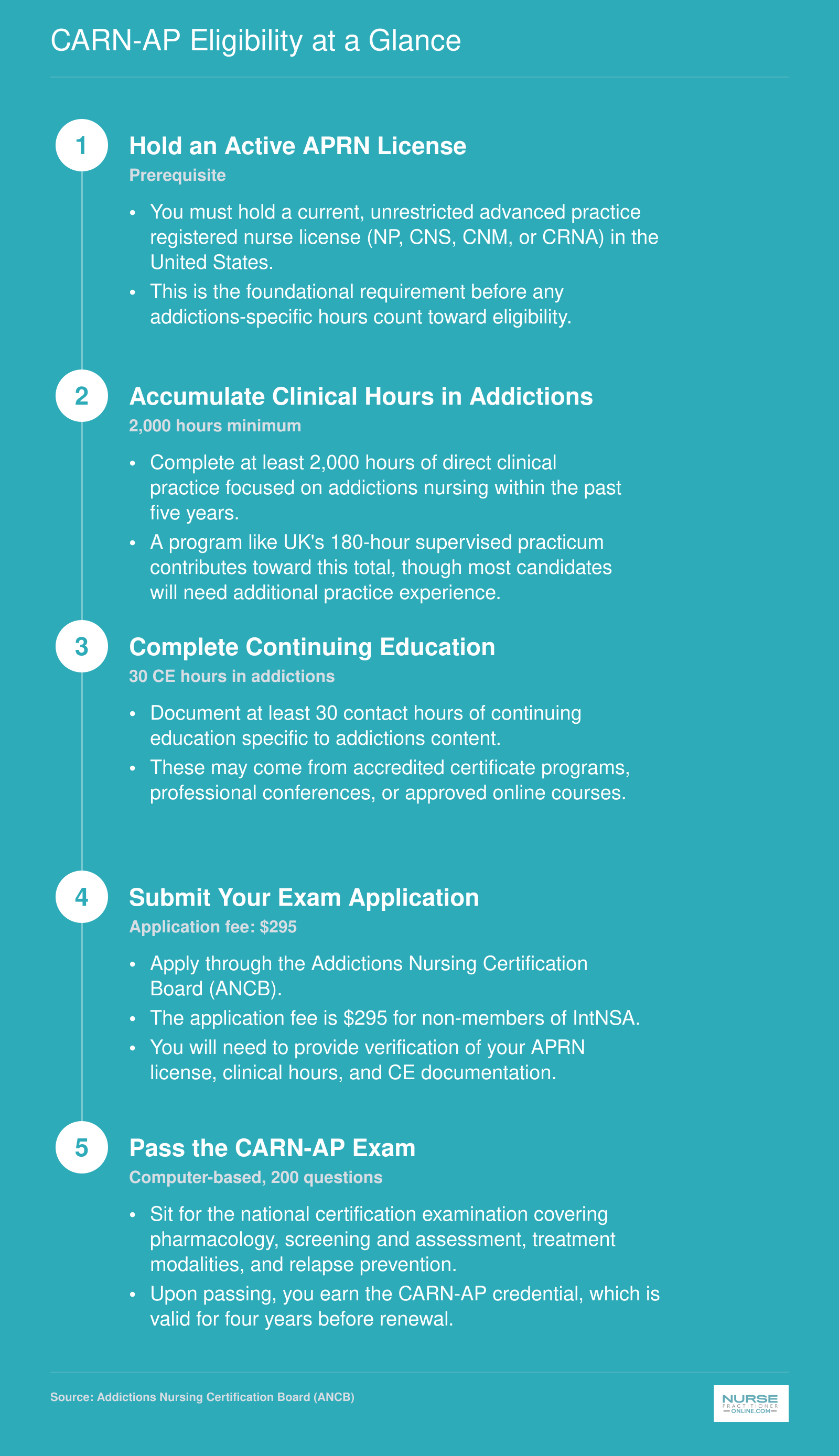
CARN-AP Eligibility at a Glance
Earning the Certified Addictions Registered Nurse, Advanced Practice (CARN-AP) credential signals deep expertise in substance use and behavioral addiction care. Here is the typical pathway from APRN licensure through certification, with key thresholds at each stage.
Costs, Financial Aid, and Employer Tuition Benefits
The UK College of Nursing's 11-credit Clinical Certificate in Addictions is one of the most affordable, high-impact credentials a working NP can pursue this year.
What You'll Pay for a Clinical Certificate in Addictions
Tuition for the UK certificate reflects a lean 11-credit structure, keeping total costs well below longer programs. At UK's 2026 graduate tuition rates, the certificate totals roughly $6,500 to $9,000 for in-state students, depending on fees. Out-of-state online learners often pay a flat per-credit rate without additional nonresident surcharges, making the program accessible nationwide.
By comparison, a 15- to 18-credit post-master's addictions certificate at other universities can range from $12,000 to $25,000 or more. Similar substance use disorder training tracks in the Mid-Atlantic and Northeast often require 15 to 20 credits, pushing the investment higher. The UK program's focused design means you cover core clinical competencies without paying for redundant coursework, a significant advantage for NPs already holding a master's or DNP. If you're still weighing whether the doctoral route makes sense for your goals, our breakdown of pros and cons of a DNP degree can help you compare the investment.
Employer Tuition Benefits and Reimbursement Strategies
UK employees, including those working at UK HealthCare, can apply their university tuition benefits directly to this certificate, potentially covering the full cost.1 Most academic medical centers structure tuition assistance as a per-semester credit cap, typically 6 to 9 credits per year, so an 11-credit program easily fits within a two-semester plan using standard benefits.
Outside of academic settings, many health systems actively reimburse NPs for addiction-focused training. Because substance use disorder treatment expands billable services, closes critical care gaps, and supports value-based contract metrics, employers see an immediate return. Reimbursement often covers tuition, fees, and sometimes travel for the required clinical practicum. Ask your human resources department about professional development funds or pipeline programs earmarked for behavioral health and addiction medicine, as these budgets are rarely publicized but frequently underutilized.
Connecting Cost to Career Return
The math works in your favor. A $7,000 to $9,000 certificate unlocks the ability to bill for medication-assisted treatment, behavioral interventions, and integrated care visits, services that typically raise an NP's visit productivity and, in many practice settings, lead to salary increases or incentive pay. Even a modest $5,000 annual bump repays the certificate within two years, while the expanded scope persists throughout your career. For NPs looking to broaden their impact beyond clinical work, exploring nurse practitioner advancement opportunities can reveal how addiction expertise opens doors to leadership and consulting roles. When you combine employer tuition benefits with the certificate's direct pathway to CARN-AP eligibility, the out-of-pocket expense often drops to near zero, making this one of the smartest career moves for psychiatric mental health and adult-gerontology NPs alike.
Questions to Ask Yourself
What You'll Learn: Curriculum Scope Beyond Opioids
The University of Kentucky's new 11-credit certificate explicitly includes behavioral addictions, such as gambling, social media, and gaming, alongside substance use disorders. That breadth is a distinguishing feature that prepares NPs for the full spectrum of addictive behaviors they encounter in primary and psychiatric care.
Medication-Assisted Treatment Prescribing Skills
The program builds day-one readiness in medication-assisted treatment (MAT) for opioid and alcohol use disorders. You'll learn buprenorphine induction and maintenance protocols, naltrexone (oral and injectable) for alcohol and opioid cravings, and methadone referral pathways. Coursework covers federal prescribing regulations, patient monitoring for diversion risk, and integrating MAT into routine follow-ups. These are skills that expand your scope whether you work in inpatient psychiatry, outpatient clinics, or telehealth for nurse practitioners.
Evidence-Based Interventions for Substance Use
You'll practice motivational interviewing techniques tailored to ambivalence about change, the SBIRT (Screening, Brief Intervention, Referral to Treatment) framework for early detection in general medical settings, and trauma-informed care approaches that address the high prevalence of adverse childhood experiences in SUD populations. Case studies span alcohol, marijuana, stimulants, and polysubstance use, ensuring you can adapt interventions to each patient's readiness and safety needs.
Co-Occurring Mental Health Disorders
Many patients present with anxiety, PTSD, or depression alongside addiction, so the curriculum emphasizes integrated assessment and treatment planning. You'll learn to untangle overlapping symptoms, for example, distinguishing substance-induced mood changes from independent major depressive episodes, and adjust pharmacotherapy accordingly. This dual-focus design aligns directly with PMHNP scope and prepares you for complex patient panels in integrated care teams. If you're considering a broader pivot into psychiatric practice, exploring how to transition from FNP to PMHNP can help you map a longer-term career path.
Online Practicum with Real-World Application
The 180-hour supervised clinical practicum lets you apply these skills under preceptor guidance in settings such as methadone clinics, residential treatment centers, or hospital addiction consult services. The hands-on component reinforces didactic material with immediate, real-world learning that fits your full-time practice schedule.
NP Salary Snapshot: What Addiction-Trained NPs Can Expect
Nurse practitioners across all specialties command strong salaries, and those with addiction-focused credentials are positioned to earn at or above the national median as demand for substance use disorder expertise continues to surge. According to the most recent data from the U.S. Bureau of Labor Statistics, roughly 307,390 NPs are employed nationwide, with projected job growth of about 40% through 2034. Below is a snapshot of current national NP earnings, which provide a useful baseline for addiction-trained practitioners entering psychiatric, primary care, or integrated behavioral health settings.
| Earnings Benchmark | Annual Salary |
|---|---|
| 25th Percentile | $109,940 |
| National Median | $129,210 |
| National Mean | $132,000 |
| 75th Percentile | $149,570 |
Career Outcomes and Demand for Addiction-Trained NPs
Where do nurse practitioners with addictions training actually end up working, and is the pay any better than a general NP role? The short answer: the salaries in the preceding table are a floor, not a ceiling, and the practice settings hungry for these skills are some of the fastest-growing corners of healthcare.
A Job Market That Is Already Underserved
The Bureau of Labor Statistics projects nurse practitioner employment to grow about 40 percent through the early 2030s, faster than nearly any other profession. Layered on top of that, the Health Resources and Services Administration (HRSA) has designated thousands of Mental Health Professional Shortage Areas across the country. Many of these shortage zones overlap with regions hit hardest by the opioid epidemic, including rural Appalachia, parts of the Mountain West, and pockets of the rural South. If you want to see which states need nurse practitioners the most, the overlap with substance use disorder demand is striking. SUD-capable providers are in short supply precisely where need is highest, a pattern that nurse practitioners in rural healthcare are uniquely positioned to address.
Typical Roles for Addiction-Trained NPs
- Outpatient MAT clinic provider: Prescribing buprenorphine, naltrexone, and managing co-occurring psychiatric conditions for office-based opioid treatment.
- Inpatient psychiatric consult-liaison with SUD focus: Supporting medical and surgical teams managing withdrawal, intoxication, and dual diagnosis admissions.
- Integrated primary care behavioral health: Embedded in family medicine or community health centers, screening and treating substance use alongside chronic disease.
- Telehealth addiction medicine: Virtual SUD programs that expanded sharply after federal prescribing flexibilities and now serve patients in shortage areas remotely.
- Correctional health: County jails and state systems increasingly contract NPs to run MAT programs as part of reentry planning.
Why Credentials Matter on the Job Posting
CARN-AP certification is showing up more often in job listings for addiction-focused NP roles, and some health systems attach modest salary differentials or sign-on bonuses to it. Even where the premium is informal, the credential signals readiness on day one, which matters when hiring managers are filling roles in clinics that cannot afford a long ramp-up period. For NPs considering where this niche fits within the broader salary landscape, a look at the highest paid nurse practitioner specialties can help put addiction medicine compensation in context.
How to Choose the Right Addictions Certificate as a Working NP
For a working NP, the decision often comes down to a single tradeoff: can you complete the clinical practicum without leaving your current job, or will the demands force you to pause your income? While the didactic portion of most addictions certificates is fully online and designed for full-time schedules, the practicum hours are where the real planning begins. The right program is the one that lets you keep practicing while you build new credentials.
Online Flexibility That Fits Your Caseload
Start by checking the program's delivery format. Many certificates, including UK's new 11-credit offering, deliver all coursework asynchronously online. If you manage a busy primary care or specialty clinic, asynchronous classes let you study early mornings, evenings, or weekends without disrupting patient care. Look for programs that explicitly state they are designed for working professionals and do not require on-campus intensives. A series of short, self-paced modules can be far more manageable than a cohort-based model with weekly live sessions. Ask about the time-to-completion window: can you extend the clinical requirement if your work schedule tightens, or is there a hard deadline?
Practicum Placement: Who Finds Your Preceptor?
This is the biggest practical hurdle. Some programs handle placement for you, matching you with an approved addiction treatment site. Others require you to secure your own preceptor, which can be especially challenging if you live in a rural area or a state with few addiction medicine practices. Before applying, confirm whether the program has a clinical placement coordinator and what their process entails. If you must self-source, ask what support they offer, such as affiliation agreements or letters of introduction. For NPs who already work in a substance use disorder setting, self-placement might be straightforward, but if you are new to the field, program-provided placement can save months of effort. Our guide to nurse practitioner student clinical rotations covers what to expect during supervised hours and how to prepare.
Stacking Hours Toward CARN-AP Certification
If your goal includes the Certified Addictions Registered Nurse-Advanced Practice (CARN-AP) credential from the Addictions Nursing Certification Board (ANCB), scrutinize the practicum design. ANCB requires a specific number of supervised clinical hours in direct addictions care, and not all certificate programs structure their hours to meet that requirement. Reach out to program coordinators and ask directly: do graduates of this certificate program successfully apply for CARN-AP, and do your practicum hours count toward ANCB's clinical experience mandate? A certificate that explicitly aligns its clinical experiences with ANCB criteria gives you a faster route to dual recognition, while one that does not can leave you with extra hours to earn later.
State Scope-of-Practice Realities
Even the best certificate is only as useful as your legal authority to practice. Nurse practitioner scope-of-practice laws vary widely by state. In some states, NPs can independently prescribe medications for opioid use disorder (such as buprenorphine) without a collaborative agreement; in others, you must have a supervising physician involved in addiction care decisions. Reviewing the current list of full practice authority states can help you understand where you stand. Before committing to a certificate, look up your state's NP prescribing rules for controlled substances and any restrictions on addiction treatment. If you practice in a restrictive state, ask potential programs whether their curriculum includes interprofessional team models that help you navigate collaborative requirements effectively.
Does Your Specialty Need to Be Psychiatric Mental Health?
You do not need a PMHNP certification to benefit from an addictions certificate. Most programs require an active APRN license, full stop. Family nurse practitioners (FNPs) and adult-gerontology NPs encounter substance use disorders in primary care every day, and the skills apply immediately. That said, PMHNPs have the most natural overlap with the content and often find their existing clinical hours complement the certificate's focus. For FNPs or AGNPs, the certificate fills a critical gap in training, giving you the confidence to screen, briefly intervene, and refer or co-manage addiction care alongside behavioral health colleagues. If you later pursue PMHNP certification, the certificate can also count as continuing education and enhance your application.
Choosing the right certificate means mapping each of these factors onto your current practice setting, your career timeline, and your long-term earning potential. A program that offers funded placement, aligns with CARN-AP, and respects your state's practice climate can transform an 11-credit certificate into a career differentiator.
Frequently Asked Questions About Addictions Certificates for NPs
Addictions certificates are still relatively new in advanced practice nursing, so it is natural to have questions about how they work, what they cost, and how they connect to professional certification. Below are answers drawn from the details covered throughout this guide.
- What is a clinical certificate in addictions for nurse practitioners?
- A clinical certificate in addictions is a focused, post-graduate credential that trains nurse practitioners to assess, diagnose, and treat substance use disorders and behavioral addictions. Programs typically combine online didactic coursework with a supervised clinical practicum. The University of Kentucky's new certificate, for example, is 11 credit hours and includes 180 clinical hours, covering topics from opioid and alcohol use disorders to behavioral addictions such as gambling.
- How do I become a certified addictions nurse practitioner (CARN-AP)?
- To earn the Certified Addictions Registered Nurse, Advanced Practice (CARN-AP) credential, you must hold an active advanced practice license, document clinical experience in addictions nursing, and pass the certification exam administered by the Addictions Nursing Certification Board. Completing a clinical certificate in addictions can help you build the specialized knowledge and supervised hours that strengthen your application.
- How many clinical hours do I need for CARN-AP certification?
- The Addictions Nursing Certification Board requires applicants to demonstrate substantial clinical experience in addictions care, with a minimum of 2,000 hours of direct practice in the specialty within a recent timeframe. A certificate practicum such as UK's 180 supervised hours counts toward that total and gives you documented, mentor-guided experience that meets the board's expectations for clinical competency.
- Can I complete an addictions certificate fully online while working as a PMHNP?
- Most addictions certificates offer fully online didactic coursework, making them practical for working PMHNPs. The clinical practicum does require in-person, supervised patient care, but you can often arrange placements at your current employer or a nearby facility. UK's certificate, launching in fall 2026, follows this hybrid model with online classes and a 180-hour practicum you schedule around your practice.
- How much does an addictions certificate cost for nurse practitioners?
- Costs vary by institution. Because UK's certificate is 11 credit hours, total tuition will depend on whether you qualify for in-state rates or employer tuition benefits. UK employees, for instance, can apply university tuition benefits to reduce out-of-pocket expenses. Other programs may range from a few thousand dollars to over $10,000, so compare per-credit costs, fees, and available financial aid before enrolling.
- Do I need a PMHNP certification before earning an addictions certificate?
- Not necessarily. UK's Clinical Certificate in Addictions is open to graduate students and licensed healthcare professionals, including nurse practitioners in any specialty, physician assistants, physicians, and mental health professionals. A psychiatric mental health background is helpful but not required. If you are an adult-gerontology NP looking to address addiction in primary care, you are eligible to apply and can benefit significantly from the training.