Most important takeaways…
- FNPs earn a median salary above $125,000 and face projected job growth exceeding 40% through the early 2030s.
- Twenty-eight states plus Washington, D.C. now grant FNPs full practice authority without physician oversight.
- Two national certifications, the ANCC FNP-BC and the AANP FNP-C, are accepted for licensure in every state.
- Working RNs with a BSN can typically complete an MSN FNP program in two to four years.
A family nurse practitioner is an advanced practice registered nurse (APRN) trained to deliver primary and specialty care across the entire lifespan, from newborn well-checks to geriatric chronic disease management. FNPs assess patients, diagnose conditions, order and interpret diagnostics, prescribe medications, and manage long-term treatment plans, often serving as a patient's primary care provider.
Certification comes through one of two national boards, yielding the FNP-C credential (AANP) or the FNP-BC credential (ANCC). Both require a master's or doctoral degree from an accredited program and a passing score on a rigorous board exam.
Nurse practitioners are among the fastest-growing occupations in the United States, with the Bureau of Labor Statistics projecting 40.1% employment growth through 2034, far outpacing nearly every other healthcare role. If you are considering this career path, understanding how to become a nurse practitioner is a great first step.
FNP Vs. NP Vs. APRN: Key Differences Explained
Umbrella credential or specialized role: understanding where each title sits in the hierarchy of advanced practice nursing is one of the most common sources of confusion for nurses planning their next move. The three terms (APRN, NP, and FNP) are not interchangeable, and knowing the distinctions will help you choose the right educational path.
APRN: The Umbrella Term
Advanced Practice Registered Nurse (APRN) is the broadest category. It covers four distinct roles: nurse practitioner (NP), certified nurse-midwife (CNM), certified registered nurse anesthetist (CRNA), and clinical nurse specialist (CNS).1 Every NP is an APRN, but not every APRN is an NP. Think of APRN as the umbrella and the four roles as the spokes underneath it. You can learn more about APRN certification requirements in our dedicated guide.
NP: A Role Within the APRN Framework
Nurse practitioner is one of the four APRN roles, and it is by far the largest in terms of enrollment and workforce size. NPs are licensed to diagnose conditions, order tests, prescribe medications, and manage patient care.2 Within the NP role, however, you must select a population focus, and that is where specialties like FNP, AGNP, PNP, and PMHNP come in.
FNP: The Generalist Population Focus
A Family Nurse Practitioner holds the broadest population focus available to NPs. FNPs care for patients of all ages, from infants through older adults, across the full lifespan. That generalist scope is the defining difference between an FNP and other NP specialties:
- AGNP (Adult-Gerontology NP): Focuses on adults and older adults, with a strong emphasis on geriatric and chronic disease management. Typical settings include internal medicine practices, long-term care facilities, hospitals, and ICUs.
- PNP (Pediatric NP): Cares for patients from infancy through adolescence. You will find PNPs in pediatric offices, school-based clinics, and children's hospitals.
- PMHNP (Psychiatric-Mental Health NP): Specializes in mental health and substance use disorders across all ages. PMHNPs practice in outpatient psychiatric clinics, community mental health centers, inpatient units, and increasingly through telehealth.
The FNP's lifespan approach means you can work in family practice, primary care clinics, urgent care, community health centers, schools, and home health settings without restricting your panel to a single age group. If you are ready to explore program options, browse our list of best online FNP programs.
Why the Distinction Matters for Your Career
Choosing a population focus determines which nurse practitioner certification exams you sit for, the types of patients you can legally treat, and the job markets open to you. Because FNPs serve patients across the lifespan, they tend to have the widest range of employment opportunities and the highest enrollment numbers among NP tracks. If you are not yet certain you want to specialize in a single patient population, the FNP pathway offers the most flexibility as you build your career.
Benefits of Being a Family Nurse Practitioner
Choosing the family nurse practitioner path means stepping into one of the most versatile, well-compensated, and autonomous roles in advanced nursing. FNPs enjoy clinical flexibility, financial rewards, and the deep satisfaction of guiding entire families through every stage of health.
Unmatched Lifespan Versatility
Unlike other nurse practitioner specialties that focus on a specific age group or setting, FNPs are trained to care for patients from birth through end of life. This cradle-to-grave scope lets you treat a newborn's first ear infection, manage a teenager's asthma, guide a middle-aged adult through chronic disease, and provide compassionate end-of-life support, all in the same week. That breadth makes you exceptionally adaptable and highly sought-after by employers, from rural clinics to large health systems.
Strong Earning Potential
Family nurse practitioners are rewarded for their expertise. In 2025, the U.S. Bureau of Labor Statistics reported a median annual salary of $126,260 for nurse practitioners, and FNPs in high-demand states like California, New York, or Massachusetts often exceed $150,000. Those who own independent practices or work in specialty settings (such as urgent care or telehealth) can push earnings even higher. Add in overtime, bonuses, and performance incentives, and the financial picture is compelling, especially when paired with a shorter training commitment.
Autonomy and Prescriptive Authority
In the growing number of full practice authority states, FNPs can evaluate patients, order and interpret diagnostic tests, initiate treatment plans, and prescribe medications, including controlled substances, all without physician oversight. That independence means you can open your own practice, serve as a primary care nurse practitioner, and shape patient care according to your clinical judgment. Even in reduced- or restricted-practice states, FNPs are steadily gaining more autonomy as outdated regulations evolve.
Work-Life Flexibility Across Settings
FNP careers offer a remarkable variety of workplaces and schedules. You might work three 12-hour shifts in a hospital-owned clinic, provide telehealth visits from home, pick up per-diem urgent care hours, or build a part-time private practice while raising a family. This flexibility stands in sharp contrast to the rigid, on-call demands many physicians face, letting you design a career that fits your life, not the other way around.
A Faster, More Rewarding Path to Advanced Practice
Becoming an FNP typically requires two to three years of graduate study after earning your BSN, far shorter than the seven-plus years of medical school and residency needed for an MD or DO. Exploring best online MSN FNP programs can help you find an accredited option that fits your schedule. That condensed timeline means less accumulated debt and a faster return on your educational investment. Combined with a well-documented high job satisfaction rate, driven by meaningful patient relationships and visible impact, the FNP route is a pragmatic, fulfilling choice for nurses ready to lead.
Questions to Ask Yourself
Explore By State
FNP Scope of Practice and Autonomy by State
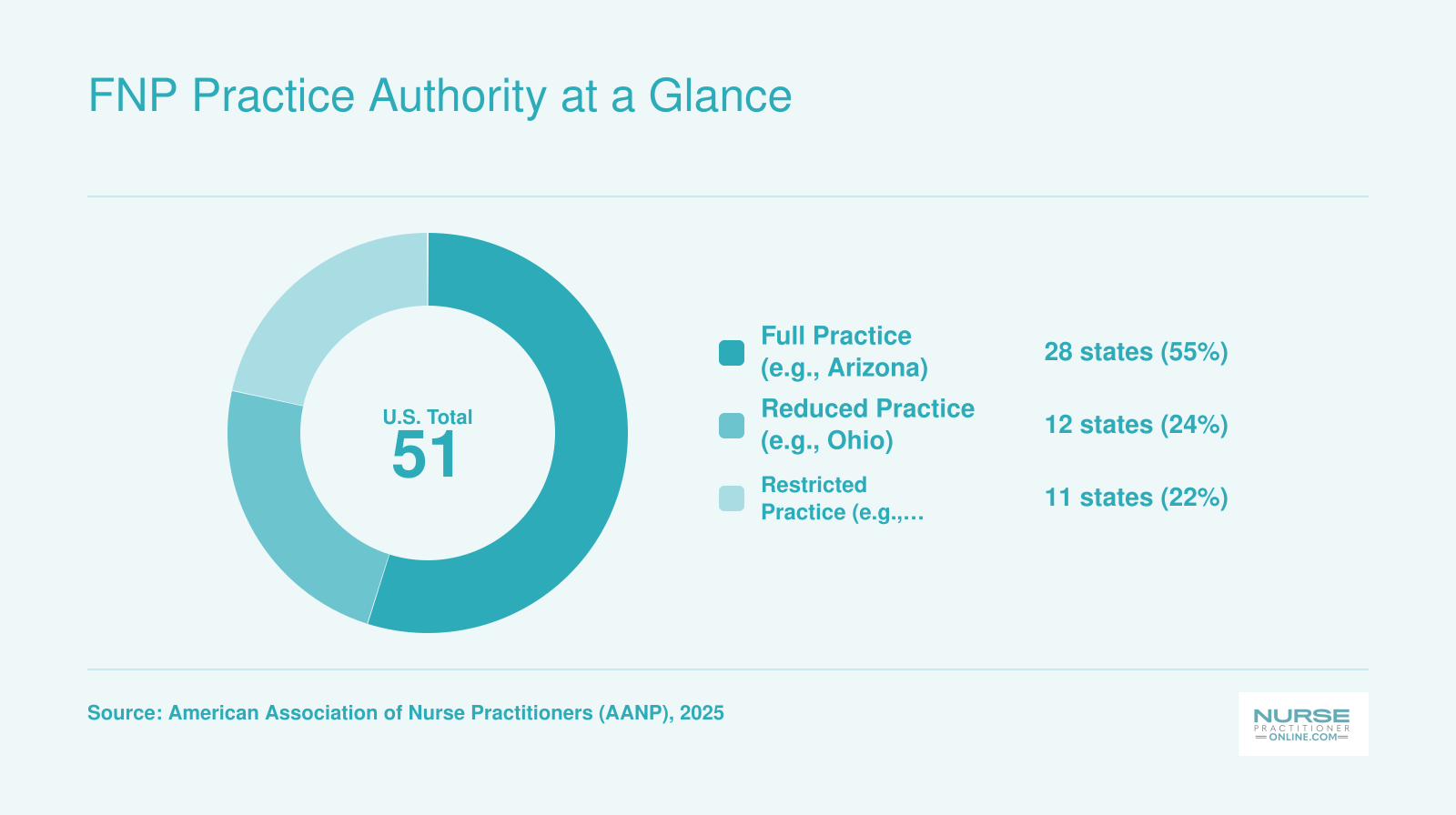
Twenty-eight states plus Washington, D.C. now grant nurse practitioners full practice authority, allowing FNPs to evaluate patients, diagnose conditions, order tests, and prescribe medications without physician oversight.1 This number has grown steadily over the past decade as lawmakers recognize that expanding NP autonomy improves healthcare access, particularly in underserved communities.
Understanding the Three Tiers of Practice Authority
The American Association of Nurse Practitioners classifies state practice environments into three categories:2
- Full practice: NPs can practice independently without a collaborative agreement or physician supervision. States in this tier include New York, Alaska, Colorado, and Arizona.
- Reduced practice: NPs must maintain a collaborative agreement with a physician to provide at least one element of practice, such as prescribing. Illinois and New Jersey fall into this category, with roughly 12 states total.
- Restricted practice: NPs require ongoing physician supervision to practice. California, Texas, and Florida currently operate under restricted models, though each has created pathways for experienced NPs to gain more independence after meeting specific requirements.
The trend clearly favors expansion. Several states have loosened restrictions in recent years, and legislative efforts continue in many restricted and reduced practice states.
The "4 Ps" and What They Mean for FNPs
Nursing students often hear warnings about the "4 Ps": pregnancy, psychiatric conditions, pediatrics, and pain management. These cautions stem from the complexity of these patient populations and the potential for liability. However, FNP education and certification explicitly prepare you to care for patients across the lifespan, including many situations within these categories.
FNPs routinely manage uncomplicated pregnancies for prenatal care, treat common mental health conditions like depression and anxiety, provide well-child visits and pediatric sick care, and address acute and chronic pain within evidence-based guidelines. For high-risk pregnancies, complex psychiatric disorders, or specialized pediatric conditions, FNPs collaborate with or refer to specialists, just as primary care physicians do.
Can an FNP Be Your Primary Care Provider?
In full practice authority states, FNPs absolutely can serve as a patient's primary care provider. Most insurance panels credential FNPs as PCPs, and Medicare allows NPs to bill independently for services.3 This means patients can establish care with an FNP for annual physicals, chronic disease management, preventive screenings, and acute illness visits.
In reduced and restricted practice states, FNPs still deliver primary care services, but the administrative structure differs. You might work under a collaborative agreement where a physician reviews a percentage of your charts, or your practice may require a supervising physician's name on file. The patient experience often remains similar since the FNP handles direct care while the physician provides backup for complex cases or regulatory compliance.
Credentialing as a PCP is common in full practice states and variable in reduced practice environments. In restricted states, some insurers credential FNPs as PCPs while others require the supervising physician to be the provider of record. Before accepting a position, verify how the practice handles billing and whether you can build your own patient panel.
Why State Laws Matter for Your Career
Your choice of where to practice shapes your professional autonomy, earning potential, and daily workflow. Full practice states often appeal to FNPs who want entrepreneurial opportunities, such as opening their own clinics. Reduced and restricted states may offer higher salaries in some markets to offset the administrative requirements, but they also limit your independence.
If you plan to relocate or practice via telehealth across state lines, research each state's requirements carefully. The AANP maintains an updated State Practice Environment map that tracks legislative changes, which is worth bookmarking as you plan your career.
FNP Practice Authority at a Glance
Nurse practitioner practice authority varies by state and falls into three tiers. The trend is clear: more states continue to move toward granting NPs full practice authority, giving FNPs greater autonomy to diagnose, treat, and prescribe independently. Understanding where your state falls can shape your career planning.
How to Become a Family Nurse Practitioner
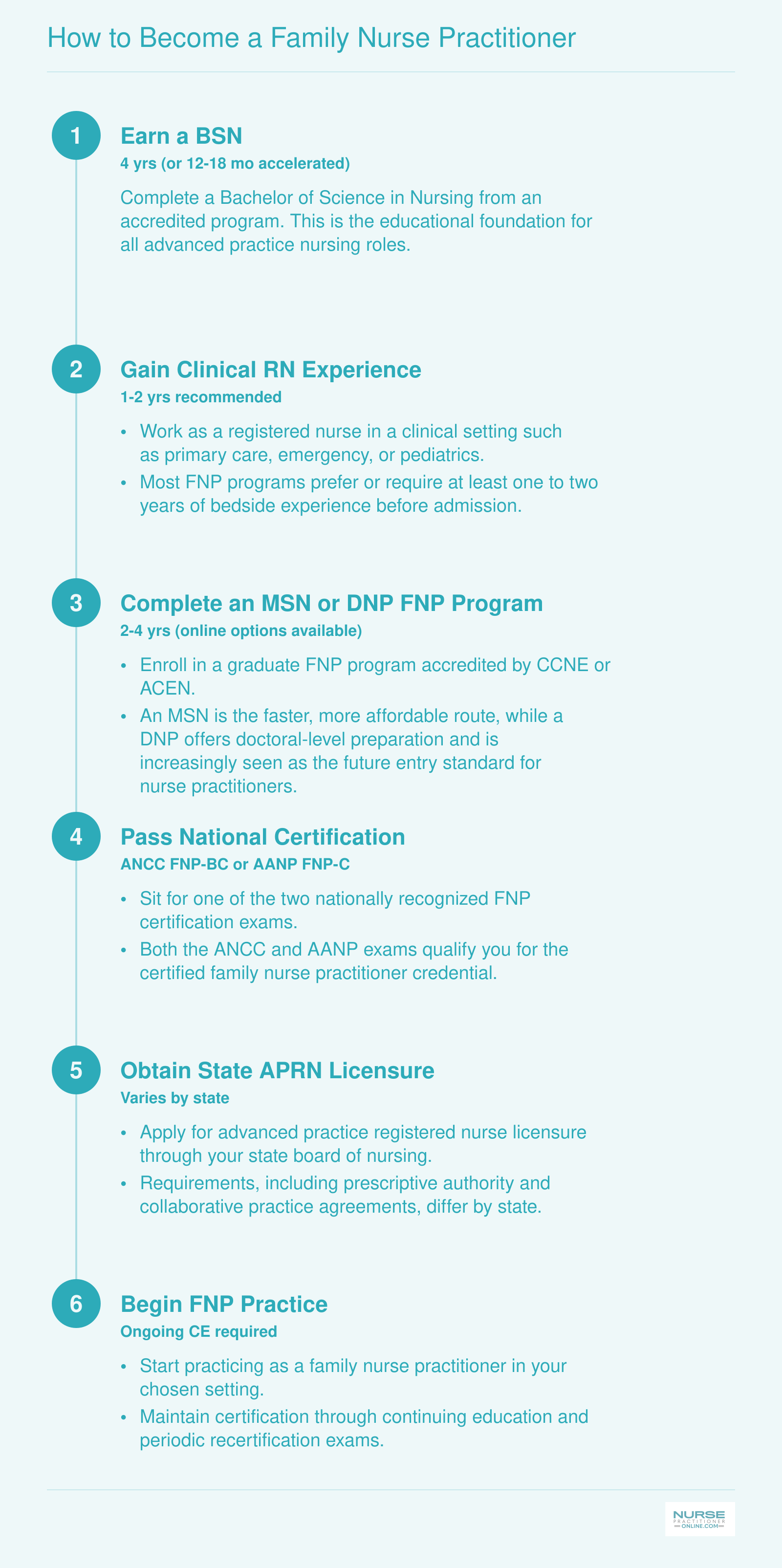
The path from registered nurse to certified family nurse practitioner follows a clear sequence. For a working RN who already holds a BSN, the journey typically takes two to four years. Starting from scratch with initial nursing education, expect roughly six to eight years total.
FNP Certification Requirements: ANCC FNP-BC Vs. AANP FNP-C
Two national boards certify family nurse practitioners in the United States, and both credentials qualify you for licensure and practice in every state.1 Your choice between the American Nurses Credentialing Center (ANCC) and the American Academy of Nurse Practitioners Certification Board (AANP) comes down to exam style and the letters you want after your name, not employer acceptance.
Shared Eligibility Requirements
Both pathways start from the same foundation. You need an active RN license and a graduate degree (MSN, DNP, or a post-graduate FNP certificate) from an accredited family nurse practitioner program.2 That program must include a minimum of 500 supervised clinical hours along with graduate-level coursework in advanced pathophysiology, advanced pharmacology, and advanced health assessment.3 If your program meets state and accreditation standards, you are eligible to sit for either exam.
The ANCC FNP-BC Exam
Passing the ANCC exam earns you the credential Family Nurse Practitioner, Board Certified (FNP-BC). The test runs 3.5 hours and uses a multi-format design, meaning you will see traditional multiple-choice items alongside alternate formats such as drag-and-drop, multiple-response, and hot-spot questions. You need a scaled score of 350 out of 500 to pass.1 ANCC questions tend to lean more heavily on professional issues, research, and policy alongside clinical content.
The AANP FNP-C Exam
The AANP exam awards the Family Nurse Practitioner, Certified (FNP-C) credential. It runs 3 hours, uses straight multiple-choice questions only, and requires a scaled score of 500 out of 800 to pass.1 The AANP test is widely viewed as more clinically focused, mirroring the diagnostic and management decisions you will make as a primary care nurse practitioner.
Renewal and Maintenance
Both credentials follow a 5-year renewal cycle.5 You will need to log continuing education hours, maintain clinical practice, and pay a renewal fee (or retake the exam) to keep your certification active throughout your career.
Related Articles
Family Nurse Practitioner Salary and Job Outlook
Family nurse practitioners earn significantly more than registered nurses, reflecting the advanced education and expanded clinical responsibilities the role demands. The Bureau of Labor Statistics projects that nurse practitioner employment will grow 40.1% from 2024 to 2034, a rate characterized as much faster than average and ranking it among the fastest growing healthcare occupations in the country. Below is a snapshot of how FNP compensation compares with related nursing roles.
| Occupation | Total Employment | 25th Percentile Salary | Median Salary | Mean Salary | 75th Percentile Salary |
|---|---|---|---|---|---|
| Nurse Practitioners | 307,390 | $109,940 | $129,210 | $132,000 | $149,570 |
| Registered Nurses | 3,282,010 | $78,610 | $93,600 | $98,430 | $107,960 |
| Nursing Instructors and Teachers (Postsecondary) | 74,250 | $62,210 | $79,940 | $87,090 | $102,020 |
Highest-Paying States for Nurse Practitioners
Geography plays a significant role in nurse practitioner compensation. The table below ranks the 15 highest-paying states (and the District of Columbia) for nurse practitioners by median annual salary, based on the latest Bureau of Labor Statistics data. California leads the pack by a wide margin, with a median salary topping $166,000. Keep in mind that higher pay in some of these states often reflects a higher cost of living, so weigh total compensation against local expenses when evaluating opportunities.
| State | Total Employment | 25th Percentile Salary | Median Salary | 75th Percentile Salary | Mean Salary |
|---|---|---|---|---|---|
| California | 20,980 | $140,260 | $166,610 | $205,400 | $173,190 |
| New Jersey | 9,590 | $126,030 | $149,620 | $162,250 | $140,470 |
| Alaska | 570 | $104,000 | $145,450 | $165,510 | $142,340 |
| New York | 20,430 | $128,190 | $145,390 | $164,670 | $148,410 |
| Oregon | 2,430 | $129,840 | $144,600 | $163,240 | $148,030 |
| Washington | 4,790 | $125,890 | $140,220 | $161,730 | $143,620 |
| Connecticut | 3,680 | $125,910 | $138,960 | $159,680 | $141,140 |
| Massachusetts | 8,920 | $125,590 | $138,890 | $160,310 | $145,140 |
| New Mexico | 1,870 | $113,240 | $138,440 | $156,000 | $136,620 |
| Arizona | 7,540 | $115,290 | $133,790 | $151,650 | $132,920 |
| Montana | 1,050 | $112,180 | $133,640 | $141,050 | $131,560 |
| New Hampshire | 1,790 | $120,270 | $132,440 | $143,010 | $133,660 |
| District of Columbia | 790 | $119,240 | $131,380 | $143,960 | $137,600 |
| Hawaii | 470 | $121,410 | $130,940 | $158,100 | $135,020 |
| Rhode Island | 1,200 | $126,200 | $130,710 | $160,030 | $139,600 |
FNP Work Settings and Day-To-Day Responsibilities
Family nurse practitioners practice across an exceptionally broad spectrum of clinical settings, giving you unmatched career flexibility and the ability to tailor your work environment to your lifestyle and professional goals.
Common FNP Practice Settings
The majority of FNPs work in primary care settings where they serve as the backbone of outpatient medicine. Private and group primary care clinics remain the largest employer, where FNPs often maintain their own patient panels and function as independent providers within a collaborative practice. Hospital outpatient departments offer similar opportunities with the added infrastructure of a larger health system. Community health centers and Federally Qualified Health Centers (FQHCs) actively recruit FNPs to serve underserved populations, frequently offering loan repayment incentives and full practice authority.
Urgent care centers provide faster-paced environments with higher patient turnover, while retail clinics inside pharmacies and grocery stores focus on episodic, protocol-driven care for acute minor illnesses. Independent practice represents a growing option in full-practice-authority states, where experienced FNPs open their own clinics and directly contract with payers or operate on a cash-pay model.
A Typical FNP Workday
In a primary care setting, most FNPs see between 18 and 25 patients per day, though volume varies by practice model and complexity. Your schedule typically includes a mix of well visits (annual physicals, preventive screenings), chronic disease management appointments (diabetes, hypertension, COPD follow-ups), acute sick visits (URIs, UTIs, injuries), and minor procedures (IUD insertions, skin biopsies, joint injections). You will order and interpret labs and imaging, prescribe medications, provide patient education, coordinate referrals to specialists, and manage the ongoing longitudinal relationships that define primary care.
In many states and settings, FNPs function identically to physician PCPs. Patients often do not distinguish between their FNP and MD providers, and insurance panels list FNPs as nurse practitioners as primary care providers who can independently manage a full scope of family medicine.
Emerging and Specialty Settings
Telehealth platforms have exploded in demand, offering FNPs remote work opportunities with flexible scheduling. Direct primary care (DPC) models, where patients pay a monthly membership fee for unlimited access, attract FNPs seeking lower patient volumes and deeper relationships. Increasingly, FNPs also staff specialty clinics in cardiology, endocrinology, dermatology, and women's health nurse practitioners, expanding their scope beyond traditional family medicine into focused areas of interest.
Common Questions About Family Nurse Practitioners
Whether you are considering an FNP career or simply trying to understand how family nurse practitioners fit into the healthcare system, these are the questions nurses and patients ask most often.
- Can a family nurse practitioner be my primary care provider?
- Yes. In all 50 states, FNPs are qualified to deliver primary care services, including annual physicals, chronic disease management, and prescribing medications. In states with full practice authority (more than half of U.S. states and Washington, D.C. as of 2026), FNPs can serve as your PCP without any physician oversight. In reduced or restricted practice states, a collaborative agreement with a physician may be required, but FNPs still provide direct patient care.
- What is the difference between an FNP and an NP?
- "Nurse practitioner" (NP) is the broad advanced practice title. "Family nurse practitioner" (FNP) is one population focus within that title. Other NP specialties include psychiatric mental health, pediatric, adult gerontology, and neonatal. The key distinction is scope: FNPs are educated and certified to treat patients across the entire lifespan, from newborns to older adults, making them one of the most versatile NP specialties.
- What does FNP-C stand for, and how is it different from FNP-BC?
- FNP-C stands for Family Nurse Practitioner, Certified, a credential awarded by the American Association of Nurse Practitioners (AANP). FNP-BC stands for Family Nurse Practitioner, Board Certified, awarded by the American Nurses Credentialing Center (ANCC). Both certifications require a graduate degree from an accredited program and a passing score on a national exam. The two credentials are recognized equally by state boards, employers, and insurers. Your choice may depend on exam format preference or employer recommendation.
- What are the 4 P's nurses should stay away from?
- The 4 P's refer to four high risk clinical situations sometimes cited in nursing risk management: psychiatry, pain management, personal relationships with patients, and prescribing controlled substances (particularly opioids). These areas carry elevated malpractice and regulatory risk. FNPs do encounter all four in primary care, so thorough documentation, evidence-based prescribing protocols, clear professional boundaries, and ongoing continuing education are essential safeguards.
- How long does it take to become a family nurse practitioner?
- Starting from an active RN license with a BSN, most nurses complete a Master of Science in Nursing (MSN) FNP program in two to three years. Direct entry BSN to Doctor of Nursing Practice (DNP) programs typically take three to four years. Online, part time formats allow working nurses to continue practicing while studying, though clinical hour requirements (a minimum of 500 supervised hours for most programs) must be completed in person.
- Do FNPs make more than RNs?
- Significantly more. According to the U.S. Bureau of Labor Statistics (May 2024 data), the median annual wage for nurse practitioners was approximately $126,260, compared with roughly $86,070 for registered nurses. That difference of about $40,000 per year reflects the additional education, certification, and clinical responsibility FNPs carry. The investment in a graduate degree often pays for itself within a few years of practice, especially given the strong job outlook projected through 2032.
Explore More
- Acute Care Nurse Practitioner (ACNP)
- Adult-Gerontology Nurse Practitioner (AGNP)
- Cardiology Nurse Practitioner (CNP)
- Critical Care Nurse Practitioner (CCNP)
- Dermatology Nurse Practitioner (DNP)
- Emergency Nurse Practitioner (ENP)
- Forensic Nurse Practitioner
- Functional Medicine Nurse Practitioner (FMNP)
- Holistic Nurse Practitioner (HNP)
- Neonatal Nurse Practitioner (NNP)
- Occupational Health Nurse Practitioner (OHNP)
- Oncology Nurse Practitioner (ONP)
- Orthopedic Nurse Practitioner
- Palliative Care Nurse Practitioner (PCNP)
- Pediatric ER Nurse
- Pediatric Nurse Practitioner (PNP)
- Psychiatric-Mental Health Nurse Practitioner (PMHNP)
- Trauma Nurse Practitioner (TNP)
- What Do Urgent Care Nurse Practitioners Do? Role Guide
- Women's Health Nurse Practitioner (WHNP)