
Most important takeaways…
- Georgia offers 16 NP programs for 2026, with the most affordable options concentrated at public University System of Georgia schools.
- Accelerated BSN-to-DNP tracks exist, though accreditation standards and clinical hour requirements set a firm floor on completion time.
- Median NP pay in Georgia reaches $126,060, with smaller metros like Gainesville and Columbus sometimes outpacing Atlanta salaries.
Nearly 40% of Georgia's 159 counties qualify as health professional shortage areas, creating persistent demand for nurse practitioners in primary care, behavioral health, and specialty clinics outside the Atlanta metro. For working nurses weighing an advanced practice degree, that demand translates into strong job prospects but also a crowded field of program options with widely varying tuition, clinical requirements, and delivery formats.
Sixteen Georgia institutions currently offer online or hybrid NP programs. Tuition gaps between the most and least expensive options can exceed $40,000, and completion timelines range from under two years for accelerated BSN-to-MSN tracks to four-plus years for part-time DNP pathways. Whether you are exploring online FNP programs in Georgia, PMHNP programs in Georgia, or another specialty track, choosing well means matching cost, pace, and clinical access to your specific situation, not just chasing a name.
Best Online Nurse Practitioner Programs in Georgia, Ranked for 2026
We evaluated every online-eligible NP program in Georgia against a composite of institutional outcomes, graduate earnings, and affordability to surface the strongest options for working nurses. The rankings below reflect a blend of graduation rate, net price, and post-graduation earnings, giving you a well-rounded picture of each school's overall value. Whether you are looking for a post-master's certificate to add a new population focus or a full BSN-to-DNP pathway, these ten programs represent the state's best options for 2026.
- Graduation rate and retention
- Net price after financial aid
- Post-graduation median earnings
- Program delivery flexibility
- Accreditation and certification outcomes
- Internal program database
- NCES-IPEDS federal institutional data — nces.ed.gov
- College Scorecard graduate earnings — collegescorecard.ed.gov
- Independent program research

Georgia Southern University
Georgia Southern University anchors its NP offerings in a mission to serve rural and underserved communities across the Southeast. The Statesboro-based university offers a broad suite of CCNE-accredited NP pathways, from online post-master's certificates in FNP, Adult-Gerontology Acute Care, and Adult-Gerontology Primary Care to hybrid BSN-to-DNP tracks with concentrations in FNP, PMHNP, and both AG primary and acute care. With an institutional net price around $15,267 and ten-year median earnings of $53,236, Georgia Southern balances affordability and outcomes well for in-state nurses.
- Online format with 19 credit hours required
- Fall-only admission with March 1 deadline
- Must hold current APRN certification and RN license
- Minimum 3.0 GPA on master's transcript
- Pharmacology course completed within past 5 years
- Credits may apply toward a future DNP
- Online program completable in three semesters
- 19 credit hours with asynchronous coursework
- Clinicals arranged in Georgia or South Carolina
- One year of critical care RN experience required
- CCNE accredited and prepares for national certification
- Personalized gap analysis shapes your study plan
- 19 credit hours, fully online delivery
- No GRE or MAT required for admission
- Individualized program of study after gap analysis
- Fall cohort entry with March 1 deadline
- Prepares graduates for national AGPCNP certification
- Statistics and health assessment prerequisites required
- Hybrid format: 80 total credit hours
- Cohort-based with fall start each year
- GRE required for admission
- Scholarships and financial aid available
- Focus on rural and underserved community practice
- Clinical preceptors secured by the student
- 80 credit hours, hybrid synchronous and asynchronous
- Clinical placements in Georgia and South Carolina
- Prepares for APRN certification in psychiatric care
- Leadership and systems-of-care skills emphasized
- Fall cohort with individualized gap analysis
- Scholarships from organizations such as GNA and AANP
- Hybrid format with flexible online curriculum
- CCNE accredited with four concentration options
- Capstone project required for graduation
- Prepares for national AGPCNP certification exam
- Graduates pursue NP, faculty, or executive roles
- 1,350 total clinical hours across the program
- 80 credit hours with fall-only cohort start
- Master's exit option available after 43 credits
- One year of critical care experience required
- Personalized study plan via gap analysis
- Clinical placements in Georgia and South Carolina
- CCNE accredited with capstone requirement
Post-MSN Certificate, Family Nurse Practitioner (FNP) — Online
Post-MSN Certificate, Adult-Gerontology Acute Care Nurse Practitioner — Online
Post-MSN Certificate, Adult-Gerontology Primary Care Nurse Practitioner — Online
BSN-to-DNP, Family Nurse Practitioner — On-Campus
BSN-to-DNP, Psychiatric Mental Health Nurse Practitioner — Hybrid
BSN-to-DNP, Adult-Gerontology Primary Care Nurse Practitioner — Hybrid
BSN-to-DNP, Adult-Gerontology Acute Care Nurse Practitioner — Online

Emory University
Emory University in Atlanta pairs an internationally recognized Nell Hodgson Woodruff School of Nursing with deep clinical partnerships across Georgia's largest metro area. NP tracks span MSN, post-graduate certificate, and BSN-to-DNP levels in specialties including FNP, Adult-Gerontology (primary and acute care), Women's Health, and Psychiatric Mental Health. The university reports a 91.1% institutional graduation rate and ten-year median earnings of $80,137, the highest among Georgia NP schools on this list. Ninety-two percent of nursing students receive some form of financial assistance, which helps offset Emory's private-school tuition.
- 49 credit hours over four semesters
- Over 600 supervised clinical hours at 40+ sites
- Full-time and part-time study options available
- Post-RN DNP format option for seamless progression
- Nationally certified faculty guide all coursework
- Fall semester start with specialty rotation opportunities
- 49 credits with 750+ clinical practice hours
- Full-time and part-time tracks offered
- Dual MSN/MPH degree pathway available
- Multiple clinical placement sites across Atlanta
- Prepares graduates for national AGPCNP certification
- Option to continue into DNP program
- 48 credit hours, four-semester program
- 700+ hours of clinical experience required
- One year of RN experience needed for admission
- Acute and critical care clinical focus
- Certification exam preparation built into curriculum
- Hybrid delivery with Atlanta-based intensives
- 46 credit hours with 630 clinical practice hours
- Fully online coursework plus periodic intensives
- Includes forensic nursing training component
- Inclusive healthcare focus across populations
- Part-time and full-time options available
- Prepares for national WHNP certification
- 26 credit hours completed in three semesters
- 720 precepted clinical hours included
- Hybrid format with onsite or virtual intensives
- Child and adolescent behavioral health concentration available
- Clinical training at Children's Healthcare of Atlanta
- Tuition support through the Blake Scholars Program
- Hybrid format completable in approximately 2.5 years
- $1,936 per credit with 92% receiving financial aid
- No standardized entrance exam required
- 1:1 faculty mentoring throughout the program
- Online coursework with Atlanta-based intensives
- 12,000+ alumni network for career connections
- Seven concentration options within the DNP
- Clinical learning embedded in top health systems
- Full-time and part-time scheduling available
- No standardized test required for admission
- $50 application fee with scholarships available
- Clinical experience required for AGAC NP track
MSN, Family Nurse Practitioner — Hybrid
MSN, Adult-Gerontology Primary Care Nurse Practitioner — Hybrid
MSN, Adult-Gerontology Acute Care Nurse Practitioner — Hybrid
MSN, Women's Health Nurse Practitioner — Hybrid
Post-Graduate Certificate, Psychiatric Mental Health NP — Hybrid
BSN-to-DNP, Family Nurse Practitioner — Hybrid
BSN-to-DNP, Adult-Gerontology Acute Care NP — Hybrid

Georgia Southwestern State University
Georgia Southwestern State University in Americus consistently appears on national lists of the most affordable CCNE-accredited online NP programs. Its fully online MSN with an FNP concentration requires 44 credit hours and can be completed in as few as 22 months of full-time study, making it one of the faster master's-level FNP pathways in the state. The program boasts a 100% FNP certification exam pass rate, and clinical sites are arranged near each student's location through the Georgia On My Line platform. With an institutional net price of roughly $12,019, GSW is a standout for budget-conscious nurses.
- 44 credit hours, completable in 22 months full-time
- Fully online delivery via Georgia On My Line
- 780 clinical hours with sites near your location
- 100% FNP certification exam pass rate reported
- Two admission cycles per year (summer/fall and spring)
- CCNE accredited with BSN and one year RN experience required
- Full-time and part-time study plans available
MSN, Family Nurse Practitioner — On-Campus

Georgia College & State University
Georgia College & State University in Milledgeville offers one of the broadest NP program portfolios among Georgia's public institutions, spanning MSN, post-master's certificate, and BSN-to-DNP levels. Specialties include FNP, Psychiatric Mental Health NP, and Women's Health NP. All programs are delivered primarily online with minimal campus visits and a cohort-based structure that starts each summer. GCSU emphasizes serving rural Georgia communities, particularly through its PMHNP track, and its competitive public tuition makes it an appealing choice for in-state nurses. The institution carries a 63.6% graduation rate and ten-year median earnings of $58,140.
- Fully online, 11 to 32 credit hours based on prior coursework
- Individualized study plan created with program coordinator
- Completable in up to two years for non-certified APRNs
- Board-certified APRNs may finish with as few as 11 credits
- CCNE accredited and prepares for AANPCERT or ANCC exams
- Covers physical assessment, pathophysiology, pharmacology
- Online format with 11 to 32 credit hours
- Individualized plan based on syllabi and gap review
- MSN, DNP, or PhD in Nursing accepted for admission
- Flexible for working nurses with minimal campus visits
- Prepares for PMHNP board certification
- CCNE accredited program
- Online with 570 clinical hours, all within Georgia
- Full-time (6 semesters) or part-time (9 semesters)
- One mandatory campus immersion week required
- Summer start with priority deadline in January
- Synchronous Thursday sessions plus asynchronous work
- Prepares for APRN certification with rural focus
- Online format with 675 clinical hours in Georgia
- Cohort-based summer start, CCNE accredited
- Preceptor assistance provided by the program
- Part-time and full-time scheduling available
- Minimal campus visits with hands-on simulation sessions
- Seven-year completion limit for all enrolled students
- Online with campus intensives, three-year full-time track
- Synchronous and asynchronous class sessions
- CCNE accredited with DNP translational research project
- One or more years of clinical experience required
- Prepares for national PMHNP certification exam
- Summer cohort start, application opens July 15
- Three-year full-time online program
- Family Nurse Practitioner concentration
- Quarterly on-campus lab sessions required
- Minimum 2.75 undergraduate GPA for admission
- CCNE accredited with research-focused curriculum
- Synchronous and asynchronous class delivery
- Three-year, nine-semester full-time plan
- Online format designed for working professionals
- On-campus orientation and periodic labs/simulations
- Classes held on Thursdays with cohort structure
- Requires Georgia RN license and work experience
- Interviews and writing exercise part of admission
Post-Master's Certificate, Family Nurse Practitioner — On-Campus
Post-Master's Certificate, Psychiatric Mental Health NP — On-Campus
MSN, Psychiatric Mental Health Nurse Practitioner — Online
MSN, Women's Health Nurse Practitioner — Online
BSN-to-DNP, Psychiatric Mental Health NP — Online
BSN-to-DNP, Family Nurse Practitioner — Online
BSN-to-DNP, Women's Health Nurse Practitioner — Online

Kennesaw State University
Kennesaw State University's Wellstar School of Nursing offers NP training shaped by one of the state's strongest health-system partnerships. The hybrid MSN-FNP program is marketed as one of the shortest NP programs in Georgia at just five semesters full-time, with classes meeting online or at most one weekend per month. KSU also offers a post-graduate PMHNP certificate designed to help address Georgia's mental health provider shortage. Located in the northwest Atlanta suburbs, KSU provides easy access to Wellstar's extensive clinical network. The net price sits at about $15,048, with ten-year median earnings of $57,552.
- 44 credit hours, 5 semesters full-time or 8 part-time
- Hybrid: online or max one weekend per month on campus
- No GRE required for admission
- Up to 9 transfer credit hours accepted
- Wellstar Health System clinical partnership
- BSN and one year Georgia RN experience required
- Priority application deadline December 15
- Prepares for FNP national certification exams
- Hybrid format completed in four semesters
- Three weekend on-campus intensives required
- Synchronous online weeknight class sessions
- Master's or doctoral RN degree prerequisite
- Addresses Georgia's mental health provider shortage
- Prepares for ANCC or AANP PMHNP exams
MSN, Family Nurse Practitioner — On-Campus
Post-Graduate Certificate, Psychiatric Mental Health NP — Hybrid

Albany State University
Albany State University, a public HBCU in southwest Georgia, offers a fully online MSN with an FNP concentration built around a mission to expand primary care access in underserved communities. The 44-credit program can be completed in six consecutive semesters, with flexible full-time or part-time plans and fall, spring, or summer entry options. At an institutional net price of approximately $11,898, Albany State is one of the most affordable NP programs in the state. Graduates are prepared for AANP or ANCC certification exams.
- 44 credit hours across six consecutive semesters
- Online delivery with fall, spring, or summer starts
- Full-time and part-time study plans available
- Minimum 3.0 GPA and BSN required for admission
- Prepares for AANP or ANCC certification exams
- Scholarly project and comprehensive exam required
- Clinical practicum hours included in curriculum
MSN, Family Nurse Practitioner — On-Campus

Augusta University
Augusta University is the state's only public academic health center, giving NP students direct access to a major hospital system and research infrastructure. Post-master's certificates span FNP, Pediatric NP, PMHNP, and Adult-Gerontology Acute Care NP, while DNP tracks cover the same specialties at the doctoral level. The PMHNP post-master's certificate is notable as a one-year, 22-credit accelerated option. All programs use a hybrid format with more than half of instruction delivered online, and clinical placements are arranged across Georgia and South Carolina. The institutional net price is approximately $13,787 with ten-year median earnings of $48,472.
- Hybrid format with >50% online instruction
- Part-time study, fewer than 9 credits per semester
- Clinical sites in Georgia or South Carolina
- Prepares for PNCB or ANCC PNP certification
- Covers birth through young adult primary care
- Gap analysis tailors coursework to each student
- Hybrid format for practicing APRNs
- Clinical experiences in Georgia or South Carolina
- Evidence-based, lifespan family care focus
- Customized coursework after gap analysis
- Georgia Board of Regents approved
- Prepares for national FNP certification exams
- Accelerated one-year program, 22 credit hours
- 504 clinical hours with hybrid delivery
- CCNE accredited, prepares for national certification
- Requires current NP certification for admission
- Advanced psychopharmacology coursework included
- Lifespan psychiatric care across individuals and families
- One-year program with 20 credit hours
- 585 clinical and lab hours included
- CCNE accredited, prepares for AGACNP certification
- Standalone or embedded certificate option available
- Complex illness and chronic disease management focus
- Five prerequisite courses required before entry
- CCNE accredited with four concentration options
- Hybrid online and in-person learning format
- Financial aid and scholarships available
- Residency in Georgia or South Carolina required
- Interactive web-based class sessions
- Capstone project in student's area of expertise
- 100% licensure pass rate reported
- CCNE accredited with hybrid delivery
- Full-time and part-time options available
- Region's only academic health center setting
- Must reside in Georgia or South Carolina
- Capstone project and financial aid available
- CCNE accredited hybrid program
- 100% licensure pass rate reported
- Capstone project in your expertise area
- Faculty are active clinical practitioners
- Financial aid and scholarships available
- Must reside in Georgia or South Carolina
- CCNE accredited with 100% licensure pass rate
- Hybrid format with interactive web-based classes
- Full-time and part-time scheduling available
- Curriculum includes health policy and leadership
- Prepares for AGACNP national certification
- Must reside in Georgia or South Carolina
Post-Graduate Certificate, Pediatric Nurse Practitioner — Hybrid
Post-Graduate Certificate, Family Nurse Practitioner — Hybrid
Post-Master's Certificate, Psychiatric Mental Health NP — Hybrid
Post-Master's Certificate, Adult-Gerontology Acute Care NP — Hybrid
DNP, Family Nurse Practitioner — On-Campus
DNP, Psychiatric Mental Health Nurse Practitioner — Hybrid
DNP, Pediatric Nurse Practitioner — Hybrid
DNP, Adult-Gerontology Acute Care Nurse Practitioner — On-Campus

University of North Georgia
The University of North Georgia in Dahlonega pairs some of the lowest tuition in the state with impressive outcomes: a reported 100% FNP certification pass rate and 100% job placement rate. The hybrid MSN-FNP program requires 46 credit hours and 750 clinical hours, with students choosing between a two-year accelerated plan or a three-year schedule that eases the load for working nurses. UNG's institutional net price of roughly $9,823 is among the lowest on this list, and various scholarship opportunities further reduce cost.
- 46 credit hours with 750 clinical hours
- Two-year or three-year plan of study options
- 100% FNP certification pass rate reported
- 100% job placement rate for graduates
- Summer start with February 28 application deadline
- BSN, 3.0 GPA, and Georgia RN license required
- 1 to 2 years clinical experience recommended
- Scholarship opportunities available
MSN, Family Nurse Practitioner — On-Campus

Middle Georgia State University
Middle Georgia State University in Macon focuses its NP offerings on the adult-gerontology acute care specialty, providing both an MSN and a post-master's certificate in AGACNP. The MSN runs across five consecutive semesters with online courses and just two on-campus immersion days, while the newer post-master's certificate (launched fall 2025) requires no on-campus attendance at all. Both programs are designed for working nurses and carry some of the lowest tuition among Georgia's public NP options, with a net price near $12,361.
- 24 credit hours, fully online instruction
- No on-campus attendance required
- Designed for APRNs certified in other specialties
- Prepares for AGACNP national certification
- Georgia nursing license with APRN certification required
- One recommendation letter and updated resume needed
- 45 credit hours completed in five consecutive semesters
- Online courses with only two on-campus immersion days
- 855 clinical practice hours included
- ACEN accredited, prepares for AGACNP certification
- One year RN experience and 3.0 GPA required
- Georgia RN license and three recommendations needed
Post-Master's Certificate, Adult-Gerontology Acute Care NP — Hybrid
MSN, Adult-Gerontology Acute Care Nurse Practitioner — Hybrid

Clayton State University
Clayton State University in Morrow sits in the heart of metro Atlanta and orients its MSN-FNP program toward the diverse urban and suburban populations of the region. The 47-credit hybrid program includes 585 clinical hours and prepares graduates for both ANCC and AANPCB national certification exams. With an institutional net price of approximately $8,365, Clayton State is the most affordable option on this list, making it particularly attractive for Atlanta-area nurses who want to advance without taking on heavy debt. Ten-year median earnings for graduates stand at $49,179.
- 47 credit hours with 585 clinical hours
- Hybrid delivery, clinicals within Georgia
- Lowest net price on this list at roughly $8,365
- Prepares for both ANCC and AANPCB certification
- Minimum 3.0 GPA and Georgia RN license required
- Focus on culturally competent care for diverse communities
- Clinical experience preferred but not required
- Advisor assigned to every enrolled student
MSN, Family Nurse Practitioner — On-Campus
The NP Workforce in Georgia: Demand, Practice Authority, and What It Means for You
Is Georgia a good state to practice as a nurse practitioner right now? The short answer is yes, but with important caveats about how much independence you will have on the job. Understanding both the demand picture and the regulatory environment before you enroll in a program can save you from surprises after graduation.
A Growing Need, Especially in Rural Areas
Georgia has a documented primary care access problem. As of 2024, the state carries more than 229 federally designated primary care Health Professional Shortage Areas, with roughly 2.7 million residents living in communities that do not have enough providers to meet demand.1 Rural counties in south and central Georgia face the steepest shortages, and nurse practitioners in rural healthcare are widely viewed as a practical answer to that gap.
BLS data places Georgia NP employment at approximately 10,580 positions as of 2024.1 While national projections for the NP occupation remain strong, specific state-level growth figures for Georgia should be verified against the most current Georgia Department of Labor releases, since BLS state projections are updated on a rolling cycle. What is consistent across sources is that demand in primary care, family practice, and rural health settings is outpacing supply across the Southeast.
Georgia's Restricted Practice Model
Here is the regulatory reality every prospective NP student in Georgia needs to understand: Georgia operates under a restricted practice authority model. That means you cannot practice independently after graduation. You must maintain a collaborative agreement with a physician, and your prescriptive authority is tied to a physician-approved protocol agreement.1
Schedule II controlled substance prescribing is tightly limited. Under House Bill 557, signed into law in April 2024, NPs may prescribe a Schedule II medication in a genuine emergency, but only a five-day supply, only for patients 18 and older, and only after accumulating at least one year of clinical experience.1 That bill also extended NP authority to sign disability parking permits, a small but practical expansion.
As of 2026, no full practice authority legislation has passed in Georgia. You can track which states have full practice authority and compare Georgia's position against the national trend. Advocacy efforts continue at the state level, but the collaborative agreement requirement remains in place.
Why This Matters When You Choose a Program
Georgia's regulatory environment shapes where you can realistically work after graduation. If you plan to open an independent primary care practice, you will need a collaborating physician before you can see a single patient. Some rural employers actively recruit NPs and offer built-in physician collaboration as part of the employment package, which can ease that burden. But it is still a structural constraint.
When comparing programs, look at how their curricula address collaborative practice models, interprofessional communication, and documentation practices aligned with protocol agreements. Programs that graduate students with strong physician-partnership skills tend to serve Georgia NPs better than those built around fully autonomous practice assumptions borrowed from full practice authority states. Neighboring states including South Carolina and Tennessee have moved further toward autonomous NP practice, which is worth noting if you have flexibility about where you ultimately settle.
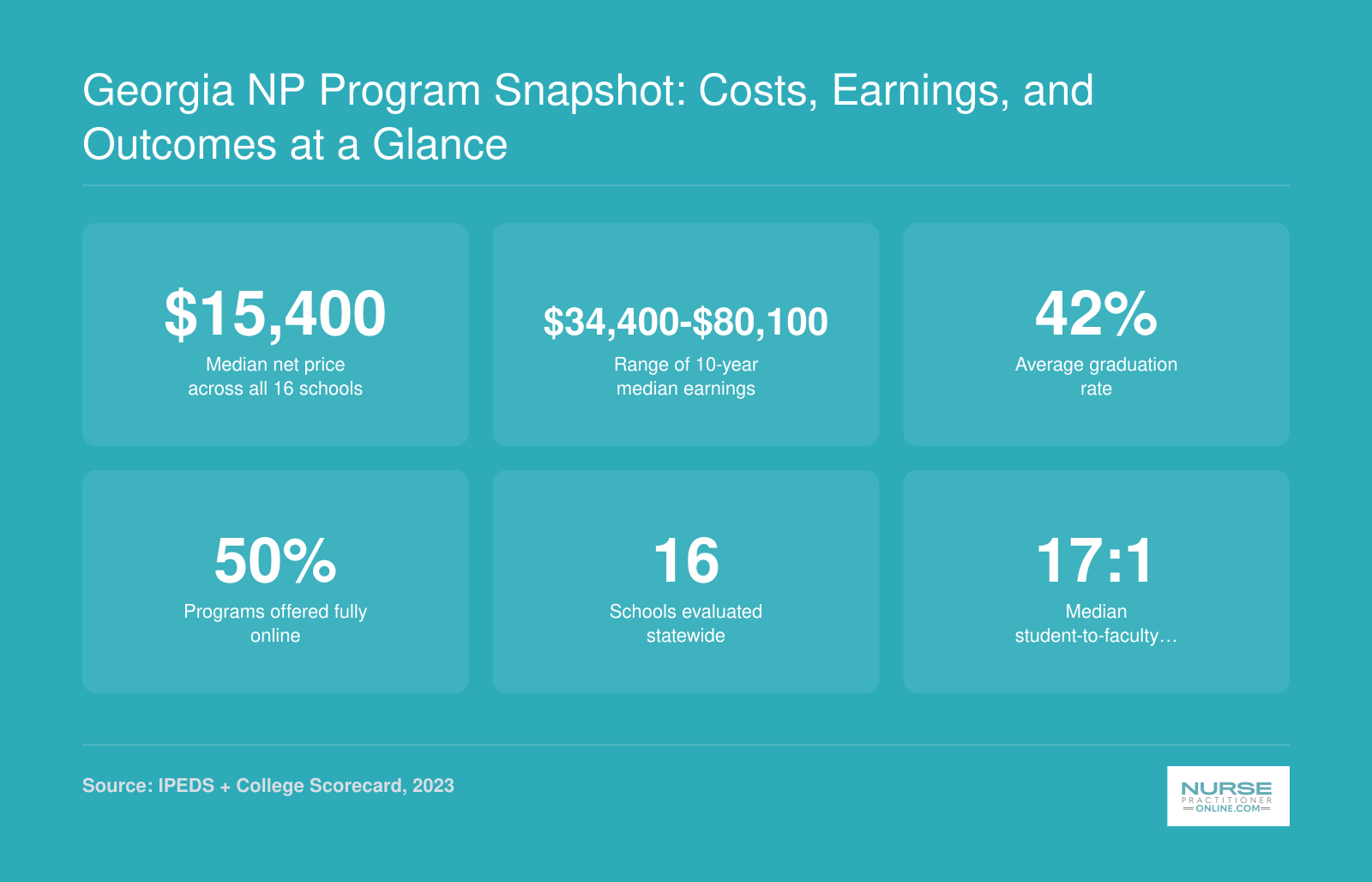
Georgia NP Program Snapshot: Costs, Earnings, and Outcomes at a Glance
Here is a bird's-eye view of the 16 Georgia institutions we evaluated for nurse practitioner programs in 2026. These aggregated figures can help you benchmark tuition, outcomes, and delivery format as you narrow your options.
Most Affordable NP Programs in Georgia
All three of the lowest-cost NP programs in Georgia are public universities, which is no coincidence: public institutions in the University System of Georgia consistently offer the most competitive graduate tuition rates, especially for in-state residents. The net price figures shown below represent institution-wide averages after financial aid and are not guaranteed quotes for any individual student. Your actual cost will depend on your residency status, aid package, and enrollment intensity. Beyond tuition, working RNs in Georgia can tap several financial aid pathways to bring costs down further. The NURSE Corps Loan Repayment Program covers up to 60% of qualifying nursing education debt in exchange for a two-year service commitment at an eligible facility in a Health Professional Shortage Area, with an additional 25% available for a third year. Federal Stafford and GradPLUS loans remain the backbone of graduate financing, and many Georgia hospital systems offer employer tuition reimbursement for nurses pursuing advanced degrees. The NHSC Loan Repayment Program can award up to $75,000 for a two-year commitment, and the Students to Service program offers up to $120,000 for three years of service. Be sure to also check with your school's financial aid office about institutional scholarships and assistantships.
| School | Net Price (Avg. After Aid) | In-State Tuition | Out-of-State Tuition | Graduation Rate | Format |
|---|---|---|---|---|---|
| Clayton State University | $8,365 | $6,493 | $12,779 | 39.9% | Hybrid |
| University of North Georgia | $9,823 | $5,416 | $18,484 | 37.3% | Hybrid |
| Valdosta State University | $10,945 | $6,316 | $18,934 | 42.4% | Hybrid |
Fastest and Accelerated NP Programs in Georgia
Balancing speed against depth of preparation is the central tension for nurses seeking the fastest path to NP practice in Georgia. Accelerated programs promise quicker entry into advanced practice, but clinical hour requirements and accreditation standards set a floor that every program must meet. Understanding how Georgia's major nursing schools structure their fast-track options helps you find a timeline that fits your life without compromising the training you need.
BSN-to-MSN and BSN-to-DNP Timelines
Georgia's flagship nursing programs offer several pathways for registered nurses who already hold a BSN. At Emory University, the BSN-to-MSN-FNP track typically spans about two years of full-time study, while the BSN-to-DNP option extends to three years for those seeking doctoral-level preparation from the start. You can explore BSN to DNP programs Georgia for a deeper comparison of doctoral pathways across the state. Georgia State University structures its BSN-to-DNP program similarly, with most students completing coursework and clinical requirements in roughly three years of full-time enrollment.
Kennesaw State University and Georgia Southern University both offer BSN-to-MSN pathways that can be completed in approximately two to two-and-a-half years, depending on enrollment status and clinical placement availability. Mercer University and Augusta University also provide BSN-to-DNP options, with timelines ranging from three to four years based on specialty track and cohort scheduling. Because program structures change, checking each school's official graduate nursing page for the most current semester-by-semester breakdown is essential.
Post-Master's FNP Certificates
For nurses who already hold an MSN in another specialty, post-master's FNP certificates offer the fastest route to family practice certification. These programs typically require 12 to 18 months of coursework and clinical hours. Availability varies by institution and academic year, so searching each school's graduate admissions or nursing program page for current offerings is worthwhile. Before committing, review common mistakes to avoid when enrolling in MSN program options, since many of the same pitfalls apply to certificate tracks. If a certificate program is not listed, contacting the program coordinator directly often reveals upcoming cohorts or waitlist options.
Clinical Hour Requirements
Regardless of program length, all Georgia NP programs must meet clinical hour standards set by accrediting bodies like the Commission on Collegiate Nursing Education and the Accreditation Commission for Education in Nursing. For a side-by-side breakdown of what each accreditor requires, see our nursing accreditation guide. Most FNP tracks require between 500 and 700 direct patient care hours, though some DNP programs exceed 1,000 hours total. You can verify specific requirements through each school's curriculum handbook or by cross-referencing with the Georgia Board of Nursing.
Related Articles
Choosing Between Online and Hybrid NP Programs in Georgia
What is the real difference between an online and a hybrid nurse practitioner program in Georgia for a working nurse?
Online vs. Hybrid: What the Terms Actually Mean
When Georgia schools label a program "online," they are referring to the didactic coursework, the lectures, discussions, and assignments you complete through a learning management system. Clinical rotations are always in person, no matter the program format. Hybrid programs add periodic on-campus intensives for skills labs, simulations, or cohort-building events. These intensives might happen once a semester or a few times during the entire program. For a deeper comparison of format trade-offs, see our guide on online vs on-campus NP programs.
Flexibility for Working RNs
Fully online tracks give you the most control over your weekly schedule. You can watch lectures after a 12-hour shift or review materials on weekends. Hybrid programs trade some of that flexibility for hands-on practice and face-to-face interaction with faculty and peers. For nurses balancing family and a full-time job, the online model often wins on convenience, but missing out on in-person networking can be a drawback.
Clinical Placement Logistics and Preceptor Support
This is where the format choice hits the pavement. In Georgia, most NP programs use a shared-responsibility or self-placement model for clinical sites. Emory University's Nell Hodgson Woodruff School of Nursing, for example, operates with shared responsibility: a dedicated Clinical Placement Team actively searches for affiliation agreements and provides coordinator support, but students are also expected to identify potential preceptors.1 Emory caps third-party placement reimbursement at $1,000 and does not guarantee a site.2
Other Georgia programs lean even more heavily on self-placement, meaning you must secure your own preceptor and clinical location. A program that offers robust placement assistance can significantly speed up your time to completion. When you are responsible for finding a preceptor, delays are common, especially in competitive specialties or rural areas. Ask any program directly: "What percentage of students secure a clinical site through school resources, and what is the average time from request to placement?"
Cost and the Bottom Line
Online programs often trim campus-based fees and commuting costs, but tuition rates themselves may not differ dramatically. Hybrid programs add travel expenses for on-campus intensives, which can add several hundred dollars per visit. When comparing costs, factor in these logistics and the potential loss of income if clinical placement delays push your graduation date back. If you are weighing a fully online approach, our step-by-step guide on how to enroll in NP school online walks you through the application process from start to finish.
Questions to Ask Yourself
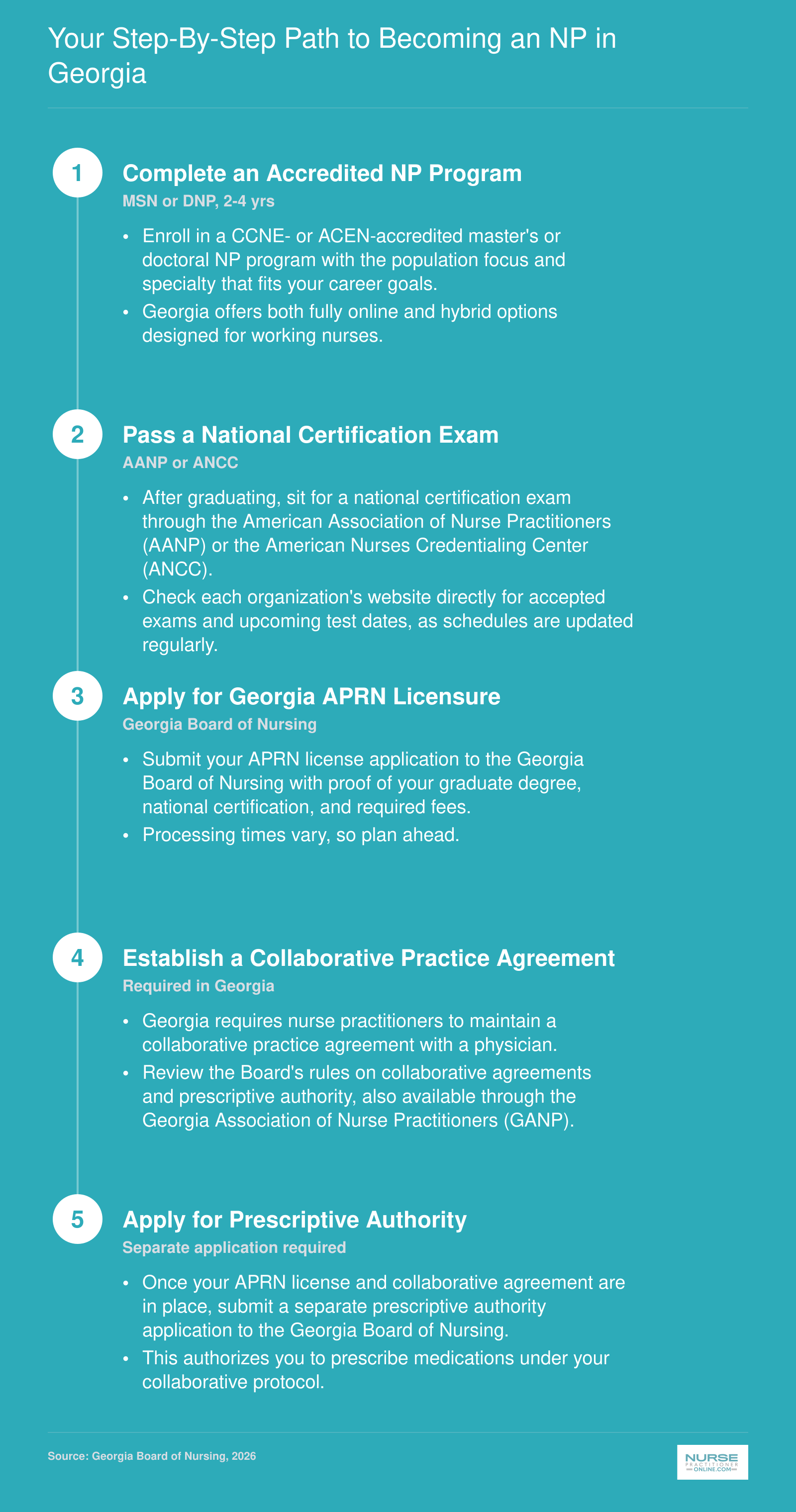
Your Step-By-Step Path to Becoming an NP in Georgia
Earning your nurse practitioner license in Georgia involves a clear sequence of milestones. Before you begin, visit the Georgia Board of Nursing website for the most current APRN application forms, fees, and requirements, as published guidelines may not always reflect the latest 2025-2026 changes. When in doubt, call or email the Board's licensure division directly.
Nurse Practitioner Salary in Georgia: Statewide and by Metro Area
Georgia employs roughly 10,580 nurse practitioners statewide, and the pay reflects the strong demand for advanced practice providers across the state. The median NP salary in Georgia sits at $126,060, which is competitive with the national median of approximately $126,260. For context, that represents a significant step up from the median registered nurse salary of $86,560 in the state, roughly a $39,500 increase that underscores the financial return on an NP education.
| Occupation | Total Employment in Georgia | 25th Percentile Salary | Median Salary | 75th Percentile Salary |
|---|---|---|---|---|
| Nurse Practitioners | 10,580 | $107,090 | $126,060 | $136,770 |
| Registered Nurses | 97,410 | $76,600 | $86,560 | $104,790 |
| Medical and Health Services Managers | 9,610 | $105,000 | $136,030 | $181,520 |
| Nursing Instructors (Postsecondary) | 1,610 | $60,480 | $75,950 | $82,740 |
Georgia NP Pay by Metro Area: Atlanta, Savannah, Augusta, and More
Atlanta employs the largest NP workforce in Georgia by a wide margin, yet it does not always offer the highest pay. Smaller metros facing critical provider shortages, such as Gainesville and Columbus, can match or exceed salaries in bigger cities. If you are studying near Augusta or Savannah, choosing a program with strong local clinical placement networks can give you a head start in the job market you plan to enter after graduation.
| Metro Area | Employed NPs | 25th Percentile | Median Salary | Mean Salary | 75th Percentile |
|---|---|---|---|---|---|
| Atlanta, Sandy Springs, Roswell | 6,280 | $115,690 | $128,640 | $129,710 | $140,140 |
| Augusta, Richmond County | 500 | $100,640 | $110,410 | $115,250 | $125,250 |
| Columbus | 410 | $103,230 | $118,680 | $122,130 | $131,090 |
| Macon, Bibb County | 360 | $107,400 | $109,170 | $115,900 | $126,410 |
| Gainesville | 350 | $108,190 | $127,100 | $126,820 | $134,480 |
| Savannah | 300 | $101,920 | $112,000 | $115,500 | $127,130 |
| Athens, Clarke County | 280 | $104,580 | $123,250 | $121,320 | $135,200 |
| Dalton | 170 | $105,640 | $114,130 | $113,970 | $125,000 |
| Albany | 110 | $101,560 | $111,350 | $114,730 | $127,670 |
| Rome | 110 | $97,120 | $105,500 | $111,430 | $127,640 |
According to the AANP Certification Board, the national first-time pass rate for the FNP certification exam was 81% in 2025, meaning roughly one in five candidates does not pass on the first attempt. Program quality, clinical preparation, and board-review resources can meaningfully shift those odds in your favor.
How We Evaluated Georgia's NP Programs
Three core metrics from the U.S. Department of Education's College Scorecard form the foundation of every ranking on this page: institution-wide graduation rate, average net price after financial aid, and reported graduate earnings. Programs had to offer online or hybrid delivery to qualify, then each school received a composite score weighted across these data points.
What the Ranking Measures
Graduation rate reflects how effectively an institution supports students through degree completion, though it captures the entire university rather than nursing programs specifically. Average net price gives you a sense of what students actually pay after grants and scholarships, though your individual cost may differ based on residency, aid eligibility, and enrollment status. Graduate earnings data, drawn from federal records, shows what former students earn after completing their programs, offering a reality check on return on investment.
What the Ranking Does Not Measure
This methodology has clear boundaries. Certification exam pass rates, which matter enormously for your career, are not captured in the Scorecard dataset. Neither is clinical placement quality, faculty-to-student ratios, or student satisfaction. These factors can make or break your experience, but they require program-specific research beyond federal data.
Why Transparency Matters
Being upfront about limitations builds trust. The graduation rates you see here apply institution-wide, not specifically to NP cohorts. Net price is an average across all aid recipients, not a promise of what you will pay. Graduate earnings reflect broad program categories, not necessarily the NP specialty you are pursuing.
Use this ranking as a starting point, not a final verdict. If you are comparing options across multiple states, our directory of best online nurse practitioner programs can help you broaden the search. Contact admissions offices directly to confirm current tuition, clinical site partnerships, and NCLEX or certification pass rates. Ask about preceptor support and whether the program helps secure clinical placements in your area. The data here narrows your search; your own due diligence completes it.
More Nurse Practitioner Programs in Georgia Worth Exploring
Beyond our top-ranked programs, Georgia offers many other excellent NP options. Whether you're looking for a specific location, a particular schedule format, or a more affordable tuition, these additional schools deserve consideration. Browse the directory below to discover programs that might better fit your personal and professional needs.
Middle Georgia
Mercer University Macon, GA · Hybrid
- BSN to DNP with Family Nurse Practitioner
- Post-Master's Doctor of Nursing Practice with Psychiatric-Mental Health Nurse Practitioner
- BSN to DNP with Adult-Gerontology Primary Care Nurse Practitioner
- BSN to DNP with Psychiatric-Mental Health Nurse Practitioner
Southwest Georgia
Valdosta State University Valdosta, GA · Hybrid
- Post-Master’s Certificate Program (Family Psychiatric Mental Health Nurse Practitioner)
- Master of Science in Nursing (Family Psych-Mental Health Nurse Practitioner)
- BSN to DNP (Family Nurse Practitioner)
- BSN to DNP (Family Nurse Practitioner (FNP))
West Central Georgia
Columbus State University Columbus, GA · Online
- Family Nurse Practitioner (MSN)
Northeast Georgia
Brenau University Gainesville, GA · Hybrid
- Family Nurse Practitioner Post-Graduate Certificate
- Adult-Gerontology Acute Care Nurse Practitioner Graduate Certificate
Coastal Georgia
South University-Savannah Savannah, GA · Online
- Master of Science in Nursing (Specialization in Family Nurse Practitioner)
- Master of Science in Nursing with a Specialization in Adult-Gerontology Primary Care Nurse Practitioner
South University-Savannah Online Savannah, GA · Online
- Master of Science in Nursing (MSN) with a Specialization in Family Nurse Practitioner
- Master of Science in Nursing (Specialization in Adult-Gerontology Primary Care Nurse Practitioner)