Most important takeaways…
- ENP post-master's certificates typically require 500 to 720 supervised clinical hours in emergency settings treating undifferentiated patients.
- Tuition ranges from roughly $15,000 to over $40,000, though employer stipends and financial aid can significantly reduce out-of-pocket cost.
- Most programs labeled "online" are actually hybrid, with didactic coursework remote and clinical rotations completed in person.
- The ENP-C board certification had 1,882 total certified practitioners as of 2023, reflecting a small but growing specialty.
Returning to school for a post-master's certificate looks very different from earning your original NP degree. A post-master's ENP certificate adds a clinical specialization on top of credentials you already hold, typically in 18 to 35 credit hours, without requiring a new degree program or years of full-time enrollment.
The ENP post-master's certificate is built for already-licensed, already-certified NPs who want to move into emergency practice. It is not a second master's or a DNP track. It is a focused credential designed to close the gap between your current scope and the procedural, trauma-focused competencies that emergency nurse practitioner programs demand.
As of 2026, fewer than 2,000 NPs hold the ENP-C board certification, which signals how niche this specialty remains and how much runway exists for practitioners willing to pursue it formally.
Understanding the ENP Post-Master's Certificate
An Emergency Nurse Practitioner (ENP) post-master's certificate is a focused training program that prepares nurse practitioners to work autonomously in emergency departments, handling trauma assessments, acute stabilization, and hands-on procedural skills that go well beyond what a standard family or primary care NP curriculum covers. Think of it as the bridge between your existing NP license and the specialized competence emergency medicine demands.
Who This Certificate Is Designed For
The typical ENP certificate candidate is a working family nurse practitioner with emergency department or urgent care experience who wants formal emergency credentialing without going back for another full degree. Many of these NPs already function in acute settings and have built practical skills on the job, but they want the structured clinical immersion and recognized credential that a certificate program provides. As one Reddit user exploring ENP options described, even with four years of ED experience as an RN and time spent in urgent care as an NP, the desire for formal emergency training remains strong. If you are weighing whether an ENP certificate or more hands-on ED time is the better investment, you are not alone, and we will cover that question later in this guide.
This is not a program for brand-new NPs. Admission typically requires an active FNP certification, and the coursework assumes you already have a solid foundation in advanced assessment and clinical decision-making.
Can Non-FNP Specialties Enroll?
If you hold an adult-gerontology acute care (AGACNP) or adult-gerontology primary care (AGPCNP) certification instead of an FNP, your options narrow but do not disappear entirely. Most ENP certificate programs, including the well-known program at Western University of Health Sciences, require FNP certification as a prerequisite.1 However, some programs accept AGACNPs on a case-by-case basis. This is genuinely a program-by-program question, so contact admissions directly before assuming you qualify or ruling yourself out. If you are still deciding between certification tracks, our comparison of AGNP vs. FNP programs can help clarify the differences.
Why AAENP Validation Matters
Not every ENP certificate carries the same weight. The American Academy of Emergency Nurse Practitioners (AAENP) maintains a national validation process that evaluates programs against established ENP competency and scope-of-practice standards.2 As of 2026, only 16 programs nationwide hold AAENP validation.3 This distinction matters because graduation from a validated program is a pathway to ENP board certification eligibility.2
It is important to understand that AAENP validation is not a replacement for institutional accreditation through bodies like the CCNE. Instead, it functions as a specialty-specific quality marker layered on top of regional or national accreditation.4 A program can be CCNE-accredited but still lack AAENP validation, and that gap may affect your ability to sit for the ENP board exam. We will dig deeper into this distinction later in the guide, but the short version is straightforward: if board certification is your goal, confirm that any program you are considering holds AAENP validation before you enroll.
Top Online ENP Post-Master's Certificate Programs for 2026
These programs were selected from accredited institutions offering online or hybrid acute care NP certificates that prepare nurses for emergency and high-acuity roles. Each was evaluated using a composite that prioritizes online accessibility alongside institutional quality indicators such as graduation rates and average net price. Important note: the tuition figures shown are graduate-level institutional rates, and the net price reflects a university-wide average. Neither should be read as an exact quote for a specific certificate program. Contact each school directly for current ENP or AGACNP certificate pricing.
- Online accessibility and format flexibility
- Institutional graduation rate
- Average net price for students
- Clinical placement relevance
- Program credit requirements and length
- NCES-IPEDS federal institutional data — nces.ed.gov
- Internal program database
- College Scorecard graduate earnings — collegescorecard.ed.gov
- Independent program research

University of North Carolina at Chapel Hill
UNC Chapel Hill pairs one of the nation's highest graduation rates with a robust health system that stretches across North Carolina, giving certificate students access to high-acuity and emergency department clinical sites throughout the state. The hybrid AGACNP certificate emphasizes advanced assessment and management of complex, rapidly changing conditions in adult and geriatric patients, skills that translate directly to emergency practice. UNC participates in NC-SARA for distance education, though out-of-state students should verify clinical placement eligibility.
- Hybrid format blending online coursework with clinical rotations
- Emphasizes high-acuity and emergency-relevant clinical scenarios
- Post-graduate level for nurses with an existing MSN or DNP
- Specialized gerontology focus alongside acute care training
- Clinical placements available within the UNC Health system
- Prepares graduates for national ANCC or AACN certification
Adult-Gerontology Acute Care Nurse Practitioner Post-Graduate Certificate — Hybrid

Florida State University
Florida State University delivers its AGACNP post-master's certificate primarily online with synchronous components, making it one of the more accessible options for working nurses. The 22-credit program covers complex illness management and critical care delivery, and clinical rotations are prioritized within Florida's hospital systems. FSU's curriculum has been updated in recent catalog cycles to align with AACN and ENP-adjacent practice competencies, including trauma stabilization and rapid patient assessment.
- 22 credit hours with online lectures and synchronous sessions
- CCNE-accredited through the College of Nursing
- Simulation exercises complement clinical rotation requirements
- Covers complex illness management and ICU-level skills
- Focuses on diagnosis and treatment of acutely ill patients
- Clinical placements prioritized in Florida hospital systems
- Multi-theoretical approach to acute care delivery
Adult Gerontology Acute Care Nurse Practitioner Post-Masters Graduate Certificate — Online

University of Central Florida
UCF leverages strong partnerships with Orlando Health, AdventHealth, and the VA Medical Center to offer hybrid AGACNP training with clinical placements in busy emergency departments and trauma centers across Central Florida. The 23-credit certificate emphasizes the full continuum of acute care, from ED admission through critical care and step-down. UCF is a strong pick for Florida-based FNPs looking to pivot toward emergency and hospitalist roles.
- 23 credit hours beyond a master's or DNP degree
- Hybrid format with online coursework and in-person clinicals
- Requires MSN or DNP and national APRN certification
- Focuses on evidence-based practice and diagnostic reasoning
- Clinical placements in ED, ICU, and specialty acute settings
- Prepares graduates for state licensure in acute care
Adult-Gerontology Acute Care Nurse Practitioner Post-Master's Certificate — Hybrid

University of Minnesota-Twin Cities
The University of Minnesota-Twin Cities offers the only AGACNP post-graduate certificate in the Twin Cities region, a critical distinction for emergency-focused APRNs in the Upper Midwest. A gap-analysis model tailors the program to 13 to 16 credits for DNP-prepared nurses, with clinical hours ranging from 240 to 600. Partnerships with M Health Fairview, Allina, and HealthPartners provide access to Level I trauma centers and high-volume emergency departments.
- 13 to 16 credits based on individualized gap analysis
- Hybrid format with asynchronous learning and biweekly Zoom sessions
- One on-campus skills course held during summer semester
- Clinical hours from 240 to 600 depending on prior experience
- Designed exclusively for APRNs holding a DNP degree
- Prepares for AACN or ANCC national certification
- Partnerships with Twin Cities Level I trauma centers
- Three-semester timeline for most students
Adult Gerontological Acute Care Nurse Practitioner Post-Graduate Certificate — Hybrid

University of Washington-Tacoma Campus
UW Tacoma's AGACNP certificate draws on the University of Washington's School of Nursing and Healthcare Leadership to serve nurses across the Pacific Northwest, with clinical placements in both urban and rural settings throughout Washington state. The 12- to 15-month program uses a faculty-guided gap analysis to customize each student's curriculum. Washington residents may benefit from a lower state-supported tuition rate when space is available.
- 12 to 15 months with a tailored curriculum plan
- Faculty-guided gap analysis adjusts required coursework
- Clinical placements in urban and rural Washington settings
- Graduates eligible for ANCC or AACNCC certification
- CCNE-accredited program with weekly in-person classes
- Emphasizes cultural sensitivity and evidence-based practice
- State-based tuition option may lower cost for WA residents
Adult-Gerontology Acute Care Nurse Practitioner Certificate — Hybrid

Rutgers University
Rutgers School of Nursing offers its hybrid AGACNP post-master's certificate across multiple New Jersey campuses, pairing online coursework with clinical experiences at major health systems like RWJBarnabas Health and Hackensack Meridian Health. The multi-campus format is especially convenient for working emergency and acute care RNs in the state who want to avoid long commutes. Recent program restructuring under a centralized Certificates and Non-Degree division has improved advising and outcome tracking for hospital-based and ED-focused graduates.
- Hybrid format with online courses and in-person clinicals
- Available across multiple Rutgers NJ campus locations
- Designed for master's- or doctorally-prepared nurses
- Clinical placements at major NJ hospital systems
- Emphasizes evidence-based practice and clinical decision-making
- Leads to specialty certification for acute care roles
- Enhanced advising through centralized certificate division
Adult-Gerontology Acute Care Nurse Practitioner Post-Master's Certificate — Hybrid

University of Pennsylvania
Penn Nursing's streamlined online AGACNP certificate is built for APRNs who want to manage acutely and critically ill adults in EDs, ICUs, and specialty units. The 12-month, part-time program offers year-round start dates, a relatively recent update that lets working ED nurses time enrollment around their shift schedules. With tuition around $7,178 per credit unit and no federal financial aid available, many students rely on employer stipends or alternative loans.
- Fully online delivery with part-time, 12-month timeline
- Year-round start dates in fall, spring, and summer
- Requires BSN, MSN, active RN and APRN licensure
- Minimum three months of APRN clinical experience
- Tuition approximately $7,178 per credit unit
- No federal aid; alternative loans and payment plans available
- Students arrange their own preceptor and clinical site
- Not currently available to residents of LA or TN
Streamlined Post Graduate APRN Adult Gerontology Acute Care NP Certificate — Online

Duke University
Duke's hybrid AGACNP post-graduate certificate combines distance-based learning with clinical placements arranged near the student's home community, often at Duke Health facilities and regional hospitals across the Southeast. The program stands out for its explicit emphasis on health equity and rural emergency care, encouraging rotations in underserved hospitals where AGACNPs frequently serve as primary emergency providers. A minimum of 12 months of acute care nursing experience is required for admission, and institutional financial aid is available, an uncommon benefit among post-graduate certificates.
- Hybrid format with distance learning and local clinical placements
- Requires 12 months of recent acute care nursing experience
- Emphasis on health equity and rural or underserved populations
- Financial aid options available for post-graduate students
- Clinical network includes Duke Health and regional hospitals
- Prepares for ICU, ED, and specialty acute care roles
- Expert faculty mentors guide flexible study plans
Adult-Gerontology Acute Care Nurse Practitioner Post-Graduate Certificate — Hybrid

University of Utah
The University of Utah's AGACNP post-graduate certificate serves the Mountain West region through partnerships with University of Utah Health, Intermountain Health, and regional trauma and ED facilities. A gap-analysis model creates individualized study plans, allowing FNPs with prior emergency or acute coursework to reduce didactic requirements. Recent program language highlights interdisciplinary collaboration in ED and ICU teams and evidence-based management of high-acuity emergencies.
- Hybrid format with individualized gap-analysis study plans
- For certified APRNs with a graduate nursing degree
- Minimum 3.0 GPA required for admission
- Variable program length based on prior coursework
- Clinical partnerships with Mountain West trauma and ED sites
- CCNE-accredited, non-degree-seeking program
- No federal financial aid; employer sponsorship often used
Adult/Gerontology Acute Care Nurse Practitioner Post-Graduate APRN Certificate — Hybrid

University of Connecticut
UConn's online AGACNP post-graduate certificate attracts nurses from across New England who want to add acute care and emergency skills to their practice. The program requires two years of acute care experience, meaning cohorts are largely composed of nurses already working in EDs and ICUs. Two campus intensives include cadaver lab and simulation sessions focused on rapid assessment and invasive procedures common in emergency and trauma resuscitation.
- Online delivery with two required on-campus intensives
- Requires BSN and two years of acute care experience
- 500 clinical hours for post-graduate certificate students
- Cadaver lab and simulation focus on high-acuity procedures
- Prepares for AACN or ANCC national certification exam
- CCNE-accredited with rolling admissions for fall entry
- Clinical placements in CT and New England acute care settings
Adult Gerontology Acute Care Nurse Practitioner Post-Graduate Certificate — Online

University of South Carolina
The University of South Carolina's online AGACNP post-master's certificate is one of the larger programs in the Southeast, requiring 30 to 32 credit hours with practicum components. The curriculum prepares nurses for direct patient management across critical care, trauma, cardiology, pulmonary, and surgical settings. An on-campus immersion is required alongside the primarily online coursework, and a gap analysis helps current APRNs determine their individualized credit load.
- Online delivery with required on-campus immersion sessions
- 30 to 32 credit hours including practicum courses
- Requires MSN degree and minimum 3.00 GPA
- Two entry points: new NP students and current APRNs
- Gap analysis adjusts credits for experienced APRNs
- Prepares for national certification in acute care
- Covers critical care, trauma, cardiology, and surgical settings
Adult Gerontology-Acute Care Nurse Practitioner Post-Master's Certificate — Online

University of Arizona
The University of Arizona's AGACNP certificate is a four-semester, part-time hybrid program requiring 30 credits and 810 clinical hours. It is designed for working RNs and includes a Clinical Skills Intensive held on the Tucson campus. Course content spans cardiac rhythm analysis, traumatic injury management, and chronic illness care. Note that this certificate is not offered every year, so prospective students should confirm availability before applying.
- 30 credits and 810 clinical hours over four semesters
- Hybrid format with online courses and on-campus intensives
- $1,053 per credit as listed by the program
- Requires MSN and RN experience in acute care settings
- Covers cardiac rhythm analysis and trauma management
- Prepares for national board certification exam
- Not offered every year; confirm availability with the school
Adult-Gerontology Acute Care Nurse Practitioner Graduate Certificate — Hybrid

Miami Regional University
Miami Regional University's 12-month hybrid certificate combines primarily online coursework with required on-campus skills sessions during the first semester in Miami Springs, Florida. The program requires 30 semester credits and 810 clinical hours. Applicants must hold an MSN, current RN license, and ACLS/BLS certification, and residency is limited to Florida or SARA member states.
- 12-month program with 30 semester credits
- 810 total clinical hours with preceptorship requirements
- Hybrid format: online courses plus on-campus skills sessions
- Requires MSN, current RN license, and ACLS/BLS certification
- Open to residents of Florida and SARA member states
- Three-day simulation weekend during first semester
- Students may secure their own preceptors or request placement
Adult Gerontology Acute Care Post-Master Certification — Hybrid

The University of Texas at El Paso
UTEP offers a fully online post-master's NP certificate with an Adult Gerontology Acute Care concentration. The credit range spans 28 to 40 hours with 630 to 775 clinical practicum hours, making it one of the more flexible programs in terms of adapting to a student's prior APRN background. UTEP is designated as a Hispanic-Serving Institution and serves a large border-region population in West Texas.
- Fully online delivery format
- 28 to 40 credit hours depending on prior coursework
- 630 to 775 clinical practicum hours required
- Requires master's in nursing and current RN or NP license
- Professional purpose statement part of application
- Hispanic-Serving Institution serving the West Texas region
Post-Master's Nurse Practitioner Certificate, Adult Gerontology Acute Care Concentration — On-Campus

University of Kentucky
The University of Kentucky's hybrid AGACNP certificate combines online coursework with up to six on-campus immersion days per semester in Lexington. The program uses a gap analysis to determine transfer credits and tailors the curriculum accordingly. Graduates are eligible for ANCC or AACN certification and are prepared for roles in ICUs, specialty clinics, and emergency settings across Appalachia and the broader Southeast.
- Hybrid immersion format with up to six campus days per semester
- On-campus sessions held in Lexington, KY
- Requires MSN, DNP, or PhD and prerequisite coursework
- Gap analysis determines transfer credits and remaining load
- Prepares for ANCC or AACN certification exams
- Application window: September 15 through January 15
- CCNE-accredited program focused on ICU and acute care roles
Adult Gerontology Acute Care Nurse Practitioner Postgraduate APRN Certificate — Hybrid

Texas Tech University Health Sciences Center
Texas Tech University Health Sciences Center's hybrid AGACNP certificate requires 36 semester credit hours and occasional travel to the Lubbock campus. Admission requires at least one year of ICU, ER, or flight nursing experience, making it one of the few programs that explicitly values emergency-department and pre-hospital backgrounds. The program is CCNE-accredited and prepares graduates for national certification exams.
- Hybrid format with online learning and Lubbock campus visits
- 36 semester credit hours required
- Requires MSN, 3.0 GPA, and unencumbered RN license
- One year ICU, ER, or flight nursing experience required
- ACLS or PALS certification needed for admission
- CCNE-accredited program with holistic admissions review
- Financial aid, loans, and scholarships available
Post-Graduate Adult-Gerontology Acute Care Nurse Practitioner Certificate — Hybrid

The University of Texas at Tyler
UT Tyler's two-year hybrid AGACNP certificate covers 30 credit hours and 750 clinical hours, preparing MSN-prepared nurses for advanced practice with adults and adolescents in acute and chronic illness scenarios. Prerequisites include advanced pathophysiology, health assessment, and pharmacotherapeutics. The program features sequential coursework with multiple practicum experiences and is located in East Texas.
- 30 credit hours over a two-year timeline
- 750 clinical hours with multiple practicum rotations
- Hybrid format combining online coursework and clinicals
- Requires MSN, RN licensure, and 3.0 GPA
- One year of RN experience required for admission
- Prerequisites in pathophysiology, assessment, and pharmacology
- $50 application fee, waived for UT Tyler alumni
Adult Gerontology Acute Care Nurse Practitioner (AGACNP) Certificate — Hybrid

East Carolina University
East Carolina University offers a 20-semester-hour online AGACNP post-master's certificate with clinical experiences arranged locally, making it a practical choice for nurses across North Carolina and compact states. The program requires an MSN, DNP, or PhD plus current APRN certification and a 3.2 GPA. ECU admits annually for spring start, and graduates are eligible for the ANCC certification exam.
- 20 semester hours delivered online
- Clinical experiences arranged in the student's local area
- Requires MSN, DNP, or PhD with APRN certification
- Minimum 3.2 GPA for admission
- NC or compact state RN license required
- Part-time study plan with spring admission only
- Prepares for the ANCC acute care certification exam
Post-Master's Certificate in Adult-Gerontology Acute Care Nurse Practitioner — Online

University of Cincinnati
The University of Cincinnati's hybrid AGACNP post-MSN certificate pairs online coursework with in-person labs and clinical practice, including hands-on training in procedures like suturing and airway management. The program admits for fall starts only and requires residency in Ohio, Kentucky, or Indiana. Tuition begins at $836 per credit for Ohio residents, and individualized study plans accommodate varied APRN backgrounds.
- Hybrid delivery with online courses and on-campus labs
- Tuition starting at $836 per credit for OH residents
- Fall semester start only; apply through NursingCAS
- Requires MSN, active RN license, and one year RN experience
- Residency in OH, KY, or IN required
- Hands-on procedural skills including suturing and airway management
- Prepares for ANCC or AACN national certification
- Individualized study plans for each student
Adult-Gerontology Acute Care Nurse Practitioner Post-MSN Certificate — Hybrid

University of Alabama at Birmingham
UAB's post-graduate APRN certificate with an AGACNP concentration is completed over four semesters and requires a minimum of 27 credit hours. The program is designed for MSN-prepared nurses with current APRN certification and uses a hybrid format with distance-accessible coursework. Tuition is $723 per credit hour for both in-state and out-of-state students, and entry is available in summer only.
- Minimum 27 credit hours over four semesters
- Hybrid format with distance-accessible coursework
- $723 per credit hour for all students
- Requires MSN and current APRN certification
- Summer entry only; gap analysis for prior coursework
- Includes clinical practicums in acute care settings
- Prepares for national AGACNP certification exam
Post-Graduate APRN Certificate, Adult-Gerontology Acute Care NP Concentration — Hybrid

University of Tulsa
The University of Tulsa stands out for its compact 18-credit online AGACNP post-master's certificate, completable in just three semesters with a total tuition cost of approximately $11,052. The program includes 600 clinical hours and one brief on-campus skills assessment visit. It is designed for licensed APRNs holding an MSN or DNP, and the school offers financial assistance and payment plans.
- 18 credit hours completable in three semesters
- $614 per credit hour; approximately $11,052 total tuition
- Online format with one brief campus visit for skills assessment
- 600 clinical hours with rotation placement assistance
- Requires active APRN license and MSN or DNP
- BLS and ACLS certification needed for admission
- Financial assistance and payment plans available
- Prepares for ANCC or AACN credentialing
Adult Gerontology Acute Care Nurse Practitioner Post Master's Certificate — Online

University of Louisville
The University of Louisville's hybrid AGACNP certificate requires on-campus attendance four to six times per semester in Louisville, with the remainder of coursework delivered online. Clinical hours range from 504 to 672 depending on prior APRN experience, and the curriculum spans acute critical care management from adolescents through aging adults. Prerequisites in advanced pathophysiology, pharmacology, and physical assessment must be completed before enrollment.
- Hybrid format with 4 to 6 campus visits per semester
- 504 to 672 clinical hours based on prior APRN experience
- Requires MSN or terminal nursing degree
- Prerequisites in pathophysiology, pharmacology, and assessment
- Focuses on acute critical care for adolescents through older adults
- CCNE-accredited; prepares for national certification
- Thursday in-person classes on the Louisville campus
Adult Gerontology Acute Care Nurse Practitioner Post-Graduate APRN Certificate — Hybrid

Rowan University
Rowan University's Certificate of Advanced Graduate Study in AGACNP features 100% online coursework with clinical components, making it accessible for New Jersey nurses seeking to add acute care credentials. At 22 credits and approximately $869 per credit, the program is completable in about 24 months with fall, spring, and summer start dates. Admission requires an MSN, a 3.0 GPA, and current RN licensure in New Jersey.
- 100% online coursework with clinical course requirements
- 22 graduate credits at approximately $869 per credit
- Completable in about 24 months
- Fall, spring, and summer start dates available
- Requires MSN, 3.0 GPA, and NJ RN licensure
- Two letters of recommendation and faculty interview required
- Eligible for AGACNP certification exam upon completion
Certificate of Advanced Graduate Study in Adult Gerontology Acute Care Nurse Practitioner — Hybrid

North Dakota State University
North Dakota State University offers a hybrid AGACNP certificate totaling 25 credits, specifically designed for graduates of accredited Family Nurse Practitioner programs who want to add acute care competencies. The curriculum combines distance learning with clinical experiences focused on advanced therapeutics, diagnostics, and management of adult-gerontology patients. NDSU's flexible format serves working professionals across the Upper Midwest, and its relatively low out-of-state graduate tuition makes it competitively priced for distant learners.
- 25 total credits in a hybrid distance-learning format
- Specifically designed for FNP program graduates
- Covers advanced therapeutics, diagnostics, and patient management
- Clinical experience included alongside didactic courses
- Requires a graduate degree in nursing for admission
- Prepares graduates for the Acute Care NP certification exam
- Flexible scheduling for working nurse practitioners
Adult-Gerontology Acute Care Nurse Practitioner Certificate — Hybrid
Fully Online or Hybrid? What ENP Certificate Formats Actually Look Like
Most ENP post-master's certificates advertised as online are actually hybrid programs that require meaningful time on campus, and understanding the structure upfront prevents unpleasant surprises when you enroll. The label "online" typically applies only to the didactic portion of the curriculum. Clinical rotations, procedural skill labs, and intensive simulation sessions almost always require in-person attendance at the university campus or designated partner sites.
Didactic Coursework: Asynchronous Lectures with Occasional Live Sessions
The classroom component of ENP certificates usually runs asynchronously. You watch recorded lectures, complete case studies, participate in discussion boards, and take exams on your own schedule within each week's window. Most programs layer in periodic synchronous sessions, typically one or two per course, for live case reviews, guest speakers from emergency medicine, or pharmacology deep dives. These live sessions are often recorded, but attendance policies vary. Programs built for working nurses generally schedule synchronous content in evenings or on weekends and provide recordings for nurses working night shifts.
On-Campus Immersions: The Reality of Procedural Training
Even the most flexible ENP certificates require at least two to four on-campus immersion weekends per term for hands-on procedural skill training. These intensive sessions cover advanced airway management (including direct laryngoscopy and video-assisted intubation), wound repair techniques, splinting and reduction of fractures, ultrasound-guided procedures, chest tube insertion, and lumbar puncture. Universities cannot certify competency in these psychomotor skills through video demonstration alone. Immersions typically run Friday evening through Sunday afternoon and are scheduled once at the start of the program and again near clinical completion. If you have experience navigating pediatric nurse practitioner clinical training, you already know how critical structured hands-on time is for building procedural confidence.
Questions to Ask Before You Enroll
Before committing to an ENP certificate, clarify the actual campus requirements:
- Total on-site days: How many immersion weekends are required per semester, and can any be completed virtually or at regional partner sites?
- Simulation hour credit: Do high-fidelity simulation hours count toward your total clinical requirement, or are they in addition to direct patient care hours?
- Partner site options: Can procedural intensives be completed at satellite campuses, regional medical centers, or contracted simulation centers closer to your home?
- Clinical placement support: Does the program arrange preceptors and clinical sites, or are you responsible for securing your own emergency department rotations?
These answers define how truly flexible the program is for a working nurse with limited time off.
Questions to Ask Yourself
ENP Certificate Admission Requirements & Who's Eligible
ENP post-master's certificate programs are designed for practicing nurse practitioners who want to specialize in emergency care. While exact requirements vary, most programs look for a similar set of credentials and experience before admitting candidates.
- Active NP CertificationYou will need current national certification, most commonly as a Family Nurse Practitioner through the AANPCB or ANCC. Some programs also accept Adult-Gerontology Acute Care NP (AGACNP) certification, so check each school's specific eligibility criteria before applying.
- Unencumbered RN and APRN LicensureAn active, unrestricted registered nurse license and advanced practice registered nurse license in your state of practice are standard requirements. If you plan to complete clinical hours in a different state, you may need additional licensure there as well.
- Emergency or Acute Care Clinical ExperienceMost programs require a minimum of one to two years of clinical experience in an emergency department, urgent care, or acute care setting, either as an RN or as a practicing NP. Programs weigh this heavily because hands-on emergency exposure is foundational to the curriculum.
- Graduate GPA ThresholdA cumulative GPA of 3.0 or higher from your prior master's program is the typical minimum. If your GPA falls slightly below that, some schools may consider your application with additional supporting materials or relevant clinical experience.
- Professional Application MaterialsExpect to submit a current resume or CV, two to three professional references (ideally from clinical supervisors or collaborating physicians), and a personal goal statement that outlines your interest in emergency practice and how the certificate fits your career trajectory.
- Current Life Support CertificationsSeveral programs require valid BLS, ACLS, and PALS certifications at the time of application. Even when not explicitly required for admission, you will almost certainly need them before starting clinical rotations, so it is wise to get them current early.
Clinical Hours, Preceptor Placement & Procedural Training
Every ENP post-master's certificate is built around one non-negotiable: you must log supervised hours treating undifferentiated emergency patients across the lifespan, and most programs set that bar between 500 and 720 direct clinical hours. The majority of those hours have to happen in an actual emergency department, not the clinic or urgent care setting where you may already work.
What Counts Toward Your Clinical Hours
Programs vary on what they'll credit, but the general rules are consistent. Direct patient care in a hospital ED is the gold standard and almost always required for the bulk of your hours. If you're unfamiliar with how NP clinical rotations are structured more broadly, it helps to understand the baseline before layering on ENP-specific requirements. Beyond that, programs typically allow a mix of settings to round out the lifespan and acuity exposure ENP certification demands.
- Emergency department shifts: The core of your training, usually 60% or more of total hours, ideally across community EDs and higher-acuity centers.
- Urgent care rotations: Accepted as supplementary hours at many programs, especially for low-acuity pediatric and orthopedic exposure.
- Trauma center time: Often required as a dedicated rotation (Level I or II) so you see major mechanisms and resuscitations.
- High-fidelity simulation: Useful for rare procedures, but typically capped at 10 to 25% of total clinical hours under AANP and ENA-aligned guidelines.
The Preceptor Problem Nobody Warns You About
This is the part current students complain about most, and it's worth taking seriously before you enroll. Some programs maintain ED preceptor networks and place you directly. Many do not, and instead hand you a packet and a deadline. Securing an emergency physician or experienced ENP willing to take a student is significantly harder than landing a primary care preceptor: EDs are fast, liability-sensitive, and not built around teaching. Before you commit to any certificate, ask the program coordinator point blank what percentage of students secure their own preceptors and what happens if you can't.
If your background is in acute care nurse practitioner programs, you may find the transition smoother since ACNP-trained NPs already have relationships in hospital settings that can help with preceptor placement.
Procedures You'll Need to Demonstrate
ENP programs require documented competency in the bedside procedures emergency providers own. Expect to log and be evaluated on suturing and complex wound repair, splinting and short-arm casting, incision and drainage, endotracheal intubation, chest tube placement, lumbar puncture, and procedural sedation. Some programs add central line placement, ultrasound-guided IV access, and basic point-of-care ultrasound to the list.
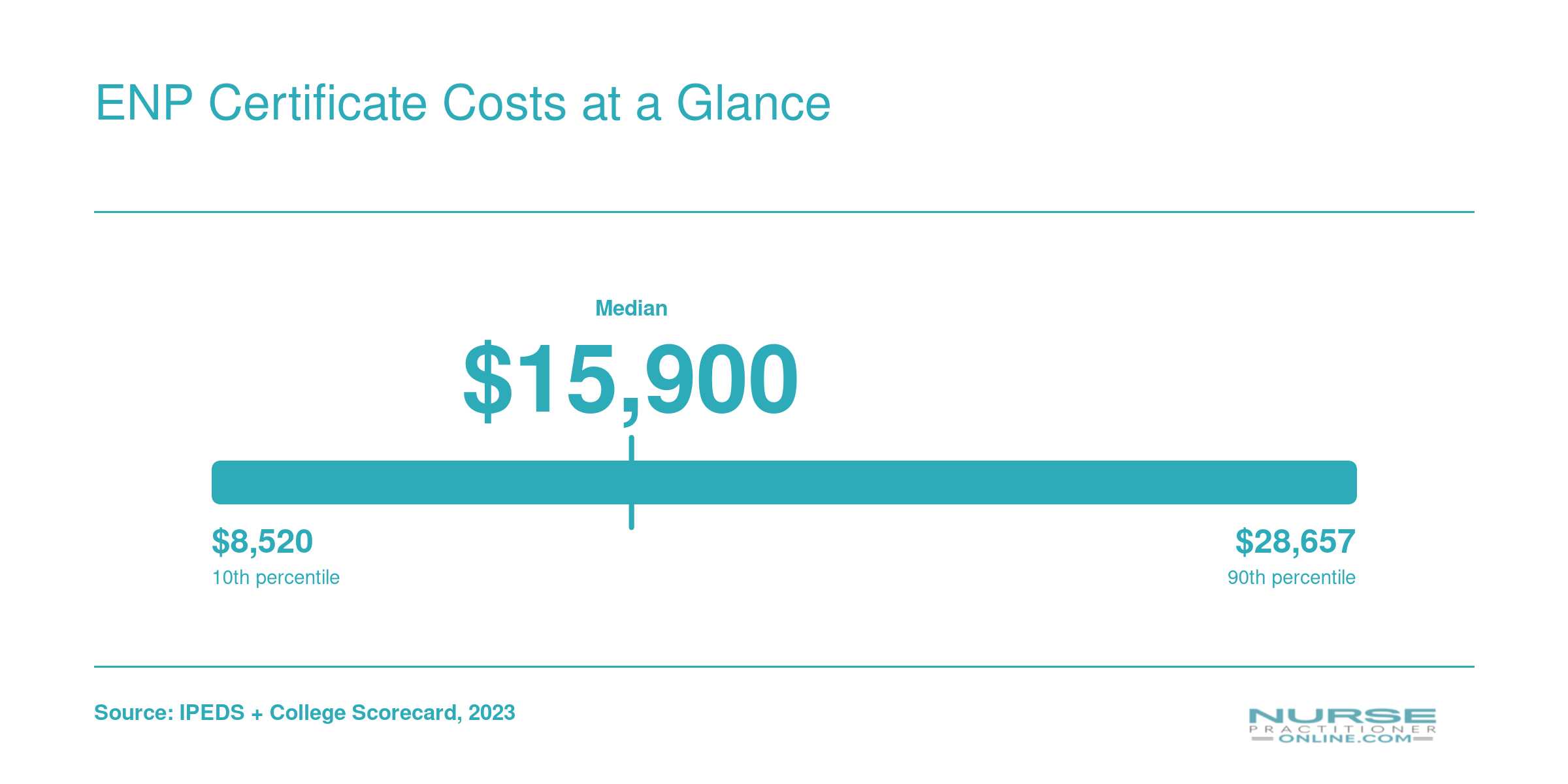
ENP Certificate Costs at a Glance
ENP and acute care NP post-master's certificate tuition varies dramatically depending on the school, credit count, and residency status. Programs typically range from 18 to 35 credit hours, so even a small difference in per-credit cost compounds quickly. At the low end, public universities charging in-state rates can land below $9,000, while premium programs at private or out-of-state institutions can exceed $30,000. Community discussions report ENP-specific certificates in the $15,000 to $20,000 mid-range, with schools like Vanderbilt topping $2,000 per credit hour.
ENP Certificate Tuition, Financial Aid & Employer Stipends
An ENP post-master's certificate can cost as little as $15,000 or as much as $40,000, but smart nurses rarely pay full sticker price. The real price tag depends on which program you choose, and how well you leverage employer tuition benefits, federal aid, and workforce grants.
What You'll Pay: Real-World ENP Certificate Costs
Online ENP certificate programs vary wildly. One nurse on Reddit found programs in the $15,000 to $20,000 range, while another commenter reported a full NP program costing $30,000 total, completely offset by a hospital education stipend.1 At the high end, Vanderbilt University charges over $2,000 per credit hour, which can push the total well past $40,000.1 On the more affordable side, a user noted their NP school now charges $800 per credit.1 These figures illustrate a critical point: public universities and smaller private programs often undercut big-name schools by tens of thousands of dollars for essentially the same credential. If budget is your primary concern, our guide to the most affordable nurse practitioner programs is a good starting point.
Graduate Debt Loads at ENP-Certificate Schools
When comparing programs, look beyond the sticker price to what graduates actually owe. Among institutions offering post-master's certificates similar to the ENP track, median federal graduate debt ranges from $12,268 at Texas Tech University Health Sciences Center to $18,190 at the University of Central Florida. Duke, a premium program, reports a median graduate debt of $13,000, while the University of Pennsylvania comes in at $15,715. These figures reflect all graduate students, not just ENP certificate holders, but they suggest that even at elite schools, debt loads stay manageable, especially if you qualify for repayment assistance through federal programs or employer incentives.
How to Slash Your Out-of-Pocket Cost
- Employer tuition reimbursement: Most hospital systems offer $3,000 to $10,000 per year in tuition benefits. Some will cover entire certificate costs if you commit to a service period.
- Federal loans: Graduate students can access Direct Unsubsidized Loans and Grad PLUS Loans, which cover the full cost of attendance. Because ENP certificates are shorter than full MSN or DNP degrees, total borrowing is typically lower.
- Military and VA benefits: Active-duty military, veterans, and their families often qualify for generous education benefits that can eliminate tuition entirely.
- State workforce development grants: Several states offer incentives for advanced practice nurses willing to serve in underserved areas, sometimes covering tuition in exchange for a post-graduation work commitment.
Keep in mind that per-credit costs at premium programs can be steeper than full-degree rates. But because you're only completing 15 to 25 credits instead of 45 to 70, the total bill is often less than half of a full NP degree. If you do take on loans, explore nurse practitioner loan forgiveness options before committing to a repayment plan. Pair employer support with these programs, and an ENP certificate becomes a relatively low-debt pathway into emergency care.
ENP Board Certification: Exam Eligibility, Prep Resources & Pass Rates
The ENP-C credential from the American Academy of Nurse Practitioners Certification Board remains the primary board certification for emergency nurse practitioners, with 1,882 total certified ENPs as of 2023 and growing interest from NPs seeking formal emergency specialization.1
ENP-C Exam Eligibility Requirements
To sit for the ENP-C exam, you must hold an active FNP certification and maintain a current nursing license. Beyond those baseline credentials, AANPCB offers three distinct pathways to eligibility:2
- Practice hours pathway: Complete at least 2,000 hours of emergency practice as an NP
- Continuing education pathway: Document 100 hours of emergency-focused CE plus 30 hours of procedural skill training
- AAENP-validated program pathway: Graduate from an ENP program that has been validated by the American Academy of Emergency Nurse Practitioners
Many nurses completing online ENP post-master's certificates will qualify through the validated program pathway, though combining practice hours with your certificate coursework can strengthen your application. If you're still weighing which primary np certification exam to pursue before adding the ENP-C, understanding the differences between ANCC and AANP is a worthwhile first step.
Exam Format and Structure
The ENP-C exam is computer-based and administered at testing centers nationwide. You will have 180 minutes to complete 150 questions, though only 135 of those are scored.2 The remaining 15 are pretest items being evaluated for future exams. Content domains cover the breadth of emergency practice, from acute illness and injury management to procedural competencies and patient stabilization.
Once approved, you have a 120-day scheduling window to take your exam.3 The 2023 exam cycle saw 261 initial exams administered, with an 86 percent pass rate, a figure that suggests solid preparation pays off but also that the exam presents genuine rigor.1
Study Resources That Work
Practicing NPs consistently recommend several resources for ENP and general NP board preparation. For a deeper look at strategies, see our guide on emergency nurse practitioner exam prep.
- Leik's review book and practice exams: A go-to resource praised for comprehensive coverage
- FNP Mastery app: Many NPs report relying solely on this app for exam prep
- APEA review course and practice exams: Described as thorough and often more difficult than the actual exam
- Sarah Michelle's comprehensive packet and crash course: Focused on need-to-know content
- Board Vitals: Valued for challenging questions with detailed rationales
- OnlineMedEd videos: Recommended for deeper pathophysiology understanding
Timing Your Preparation
The most common advice from certified ENPs echoes a simple principle: start early. Rather than cramming after graduation, integrate certification prep into your clinical rotations. Reviewing emergency-specific content while actively seeing patients helps reinforce concepts in context. Many emergency nurse practitioner programs build board preparation into their final semesters, but supplementing with the resources above throughout your certificate program tends to produce better outcomes than a last-minute review sprint.
ENP Vs. AGACNP: Which Emergency Path Fits Your Career?
The emergency nurse practitioner credential trains you to manage emergency presentations across the lifespan, from a febrile toddler to a geriatric stroke workup, while the AGACNP credential trains you to manage high-acuity adult patients across the continuum of acute care: ED, step-down, ICU, and inpatient hospitalist services.1 That single distinction (lifespan emergency versus adult acute care) drives almost every other decision between these two paths.
Scope, Population, and Setting
The ENP is a specialty credential layered onto FNP licensure in most states. You are credentialed to see all ages but only within the emergency and urgent care environment.1 The AGACNP is a primary population-focus credential in its own right, with a scope built around adults and older adults who are physiologically unstable or at risk of becoming so.2 If you are weighing the broader AGNP vs. FNP question before choosing either emergency path, clarifying that foundation first will save you time.
- Patient population: ENPs see all ages; AGACNPs see adolescents through older adults.
- Typical settings: ENPs work in emergency departments, freestanding EDs, and urgent care. AGACNPs work in EDs, trauma services, ICUs, step-down units, and hospitalist teams.
- Certification body: ENP certification is offered through AANPCB (as an FNP add-on) and AAENP. AGACNP certification is offered through ANCC and AANPCB.
State Practice Authority
Neither credential has a nationally uniform scope. State boards of nursing decide whether an FNP can practice in the ED with an ENP overlay, whether an AGACNP can treat pediatric ED patients (most states say no), and what supervision or collaborative agreements apply. Before committing tuition dollars, pull up your state board's scope language for both credentials. The American Association of Nurse Practitioners maintains current state-by-state scope summaries that are worth bookmarking.
Hiring Trends in 2026
Most EDs still hire FNPs and AGACNPs without requiring ENP certification, and that is the honest market reality. The ENP credential is growing as a differentiator in competitive urban markets, academic medical centers, and high-volume community EDs that want documented lifespan emergency training.1 Understanding the broader adult gerontology nurse practitioner scope can also help you gauge whether the AGACNP path opens doors beyond the ED. If you already work in an ED and your employer values internal experience over credential letters, an AGACNP may not unlock new doors; an ENP overlay on your existing FNP often will.
What ENPs Earn: Salary Data for Emergency Nurse Practitioners
Emergency nurse practitioner salaries are not tracked as a standalone category in most federal datasets, so we rely on a combination of BLS nurse practitioner figures and specialty compensation surveys to estimate what ENPs actually take home. The data below, drawn from the 2025 APRN Compensation Report published by Medscape and federal wage statistics, gives you a realistic picture of NP earnings by setting and region. Hospital inpatient roles, which include many emergency department positions, consistently command the highest average salaries among practice settings.
| Setting or Region | Average Annual Salary (2025) |
|---|---|
| Nurse Practitioners, National Average | $133,000 |
| Hospital Inpatient APRNs (includes ED roles) | $189,000 |
| Hospital-Based Outpatient APRNs | $149,000 |
| Non-Hospital Urgent Care APRNs | $132,000 |
| NPs in the Pacific Region | $170,000 |
| NPs in the West Region | $164,000 |
| NPs in the Midwest Region | $146,000 |
Commonly Asked Questions About ENP Certificates
Emergency nurse practitioner certificates can feel like a niche topic, and it's normal to have questions before committing time and tuition. Below are the answers to the most common questions we hear from working nurses considering this credential.
- Can you complete an ENP certificate fully online?
- Most ENP post-master's certificate programs deliver didactic coursework fully online, but clinical hours must be completed in person at an approved emergency department or acute care site. So the format is best described as hybrid: you'll attend lectures, complete assignments, and take exams from home, then fulfill hands-on clinical rotations locally. Programs vary in how much help they offer with preceptor placement, so ask about that before enrolling.
- How much does an ENP post-master's certificate cost?
- Tuition varies widely. Based on real practitioner reports, expect to pay somewhere between $15,000 and $20,000 for many programs. However, costs at some universities run significantly higher. Vanderbilt University, for example, charges over $2,000 per credit hour. Other schools come in closer to $800 per credit hour. Employer education stipends can offset a large share of the total, with some nurses reporting their hospital covered the full cost of their NP program (around $30,000).
- Do you need to be an FNP to enroll in an ENP certificate program?
- Not necessarily. Admission requirements differ by school, but most ENP certificate programs require an active nurse practitioner license and a master's or doctoral degree in nursing. Family nurse practitioners and adult-gerontology acute care nurse practitioners are common applicants. Some programs also accept emergency clinical nurse specialists. Check each program's prerequisites carefully, because population focus requirements vary.
- What is the difference between an ENP certificate and an AGACNP program?
- An AGACNP (Adult-Gerontology Acute Care Nurse Practitioner) program is a broader acute care track that prepares you for hospital-based roles across many specialties. An ENP certificate focuses specifically on emergency medicine: rapid assessment, trauma stabilization, procedural skills, and high-acuity decision-making in emergency departments. The ENP credential is a post-master's add-on rather than a standalone degree, making it a shorter, more targeted pathway for NPs who already hold an advanced degree.
- How many clinical hours are required for an ENP certificate?
- Clinical hour requirements range from roughly 200 to over 500 hours depending on the program and the certifying body's standards. These hours must be completed in emergency or acute care settings under an approved preceptor. Because procedural competency is central to emergency practice, programs typically require documentation of specific skill sets, including suturing, splinting, and interpretation of diagnostic imaging.