Most important takeaways…
- Disaster-focused ENP programs layer mass-casualty simulation and austere-environment coursework onto standard emergency curricula.
- Stacking ENP-C certification with credentials like the TCRN or CEN strengthens your disaster deployment profile significantly.
- The BLS projects nurse practitioner employment to grow 40 percent through 2032, with disaster roles adding hazard pay and per diem premiums.
- Federal agencies, FEMA corps teams, and NGOs like the Red Cross represent the primary employer landscape for disaster response ENPs.
Natural disasters displaced more than 32 million people worldwide in 2025 alone, and the U.S. saw record numbers of hurricanes, wildfires, and climate-driven public health crises that strained front-line emergency capacity. Emergency nurse practitioners trained in disaster response occupy a distinct niche: they combine the autonomous diagnostic and prescriptive authority of advanced practice with the field-deployment readiness demanded by mass-casualty incidents, pandemic outbreaks, and austere-environment care.
Most ENP programs emphasize urban emergency-department competencies, but a growing subset layers on disaster-specific coursework, extended simulation, and crisis-leadership training. Those additions matter when you deploy to a shelter clinic, triage in the field, or coordinate care under resource constraints that would paralyze a traditional provider.
The practical tension for working nurses is time and money. Full-time ENP programs run 18 to 36 months, cost $30,000 to $80,000, and require hundreds of clinical hours, often without a guarantee that your current employer will accommodate your rotation schedule. Online and hybrid formats ease the logistical burden, but not every program offers disaster-focused electives, and the certification landscape includes overlapping credentials from multiple bodies. Understanding how acute care vs primary care scopes differ is one useful starting point as you evaluate which track aligns with disaster-response goals.
Best Online ENP Programs for Disaster Response
These online and hybrid Emergency Nurse Practitioner programs are ranked using a composite that weighs graduation rate, post-completion earnings, net price, and institutional quality rather than any single metric. Each program prepares nurses to work in high-acuity emergency settings where disaster response skills are essential, from Gulf Coast hurricane zones to urban mass-casualty environments. If you are a working nurse exploring disaster-focused career advancement, these programs offer flexible pathways worth evaluating.
- Institutional graduation rate
- Post-completion median earnings
- Net price and affordability
- Overall institutional quality
- Program delivery flexibility
- NCES-IPEDS federal institutional data — nces.ed.gov
- Internal program database
- College Scorecard graduate earnings — collegescorecard.ed.gov
- Independent program research

The University of Texas Health Science Center at Houston
Situated inside the Texas Medical Center, UTHealth Houston places ENP students at the epicenter of one of the nation's busiest trauma and emergency ecosystems. Houston's recurring exposure to hurricanes, flooding, and industrial incidents means affiliated emergency departments routinely execute all-hazards disaster plans, surge triage, and interfacility evacuation protocols. A 5:1 student-to-faculty ratio ensures close mentorship, and student stipends of up to $10,000 help offset costs for working nurses pursuing this specialty.
- Unique Texas-based ENP specialty track
- 10 credit hour post-graduate program
- Mostly online education with occasional campus sessions
- $10,000 student stipends available to offset costs
- Two enrollment pathways with 2 to 3 semester completion
- Interprofessional training in major trauma center setting
- Prepares graduates for ENP certification examination
Emergency Nurse Practitioner (Emergency/Trauma Care) — Hybrid

Vanderbilt University
Vanderbilt's ENP specialty combines rigorous academics with nationally distributed clinical placements, giving students exposure to diverse disaster coalitions, mass casualty protocols, and federal surge planning across multiple regions. The program offers dual Family NP and Emergency NP certification pathways, and a 93.5% overall institutional graduation rate reflects the university's strong student support infrastructure. Flexible full-time and part-time scheduling options make the program accessible to nurses balancing emergency department shifts with coursework.
- Flexible full-time and part-time enrollment options
- Hybrid online and on-campus delivery format
- Robust nationwide clinical placement network
- Requires prior RN emergency department experience
- Dual FNP and ENP certification eligibility
- Low faculty-to-student ratios for close mentoring
- Comprehensive lifespan emergency care curriculum
Emergency Nurse Practitioner Specialty — Hybrid

University of Alabama at Birmingham
UAB pairs its ENP subspecialty with the resources of a Level I trauma center in a region frequently impacted by tornadoes and severe weather. The dual-option MSN allows students to earn both FNP and ENP credentials, making graduates versatile responders for sudden-onset mass trauma events. A hybrid, distance-accessible format and in-state tuition of approximately $8,640 per year make this one of the more affordable paths into disaster-relevant emergency practice.
- Emergency NP subspecialty within MSN framework
- Hybrid and distance education delivery format
- Interdisciplinary instruction from expert faculty
- Certification exam preparation integrated into coursework
- Requires at least one year of emergency experience
- Dual-option allows FNP and ENP credentials
- Affiliated Level I trauma center clinical rotations
MSN Family Nurse Practitioner and Emergency Nurse Practitioner Dual-Option Specialty — Hybrid

Drexel University
Drexel's fully online MSN combines family NP training with an emergency specialization, preparing graduates for both primary care surge roles and front-line ED disaster response in urban settings. Philadelphia-area clinical sites expose students to mass-gathering event planning, hazardous materials response, and urban violence surge protocols. The program boasts a 100% board exam pass rate and uses a state-of-the-art simulation lab well suited for disaster and mass-casualty scenario training.
- CCNE accredited with 100% board exam pass rate
- Online format with mandatory on-campus intensive sessions
- Eligible for both FNP and ENP certification exams
- Synchronous interactive lectures in quarterly terms
- State-of-the-art simulation lab for crisis scenarios
- 1 to 2 years emergency experience required for admission
- Experienced board-certified emergency faculty
MSN: Family/Individual Across the Lifespan with Emergency Specialization — Online

Samford University
Samford's MSN-to-DNP Emergency Nurse Practitioner program is designed for master's-prepared FNPs ready to advance into doctoral-level emergency practice. The DNP framework opens opportunities for scholarly projects focused on disaster preparedness, crisis standards of care, and ED surge planning. With 660 clinical practice hours and only one required on-campus intensive, the two-year online program fits nurses who need to keep working while earning advanced credentials in tornado-prone Alabama.
- Online two-year DNP program for certified FNPs
- 660 clinical practice hours in emergency settings
- National ENP certification exam preparation
- Only one required on-campus intensive session
- Flexible clinical placement across partner sites
- 100% FNP certification pass rate among graduates
- Minimum 3.5 GPA required for admission
MSN to DNP Emergency Nurse Practitioner — Online

University of South Alabama
Located on the U.S. Gulf Coast, the University of South Alabama prepares ENP students in an environment shaped by hurricane and coastal storm preparedness. The dual-role FNP/ENP structure is especially valuable for disaster response, as graduates can serve in both community clinic surge roles and emergency department front lines during and after major events. With 840 clinical practicum hours and a five-year completion window, the program accommodates nurses balancing demanding work schedules.
- 57 total credit hours with 840 clinical practicum hours
- Hybrid format with 2 to 3 on-campus clinical intensives
- Prepares for dual FNP and ENP national certification
- Five-year completion window for working nurses
- Career flexibility across EDs, urgent care, and shelters
- Comprehensive advanced nursing curriculum
- Gulf Coast clinical sites with hurricane preparedness exposure
Dual Role Family NP/Emergency NP — Hybrid

Rocky Mountain University of Health Professions
Rocky Mountain University's MSN with an Emergency NP focus is built for working nurses in Western and Intermountain states, where wildfire, extreme weather, and rural mass-casualty preparedness define the emergency landscape. The limited-residency hybrid design lets students remain employed in their home EDs while immediately applying coursework to disaster drills and crisis-management committees. The program spans five to six semesters and holds CCNE accreditation.
- Limited-residency hybrid program for working nurses
- CCNE accredited MSN degree
- 5 to 6 semester completion timeline
- Post-bachelor's entry pathway available
- Primarily online delivery with brief campus residencies
- Advanced practice RN tracks including ENP focus
- Designed around Intermountain and Western state contexts
Master of Science in Nursing, Emergency Nurse Practitioner — Hybrid
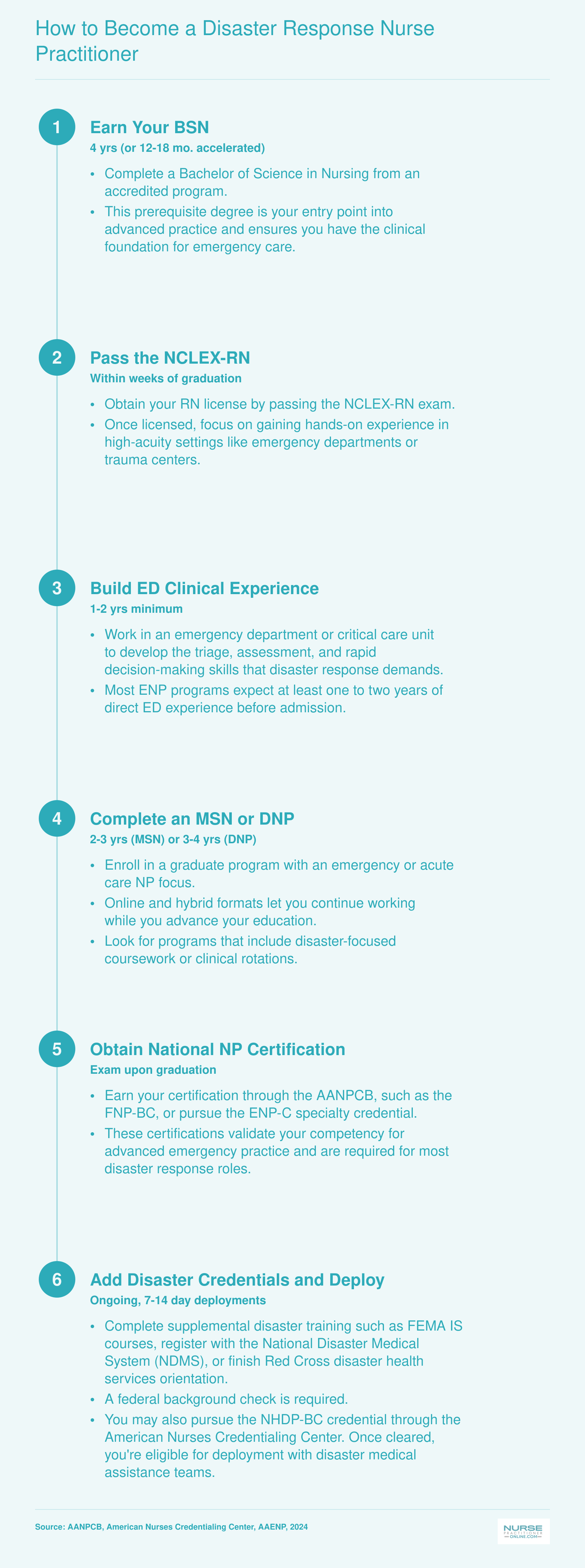
How to Become a Disaster Response Nurse Practitioner
If you're wondering how to become a disaster relief nurse, the path builds on your existing nursing foundation and layers in advanced practice training, national certification, and disaster-specific credentials. Here's the full career pathway from bedside RN to deployment-ready emergency nurse practitioner.
What Disaster-Focused ENP Programs Include in Their Curriculum
Choosing between a standard emergency nurse practitioner track and a disaster-augmented curriculum means weighing immediate clinical skill-building against specialized preparation for mass-casualty, austere-environment, and public-health emergencies. Most disaster-focused ENP programs layer crisis-management coursework and extended simulation onto the core emergency curricula familiar to all ENPs, rather than replacing fundamental assessment, diagnostics, and pharmacology training.1
Core Disaster and Crisis-Management Courses
Programs addressing disaster response typically integrate courses drawn from emergency-management and public-health disciplines that traditional emergency nurse practitioner programs omit. You may encounter mass-casualty triage systems (START, JumpSTART, SALT), disaster epidemiology covering outbreak surveillance and field data collection, CBRNE (chemical, biological, radiological, nuclear, and explosive) response protocols, and wilderness or austere-environment medicine. Some schools offer electives in population health and emergency management, while others embed these topics into required trauma and resuscitation courses. The University of Maryland Baltimore County's Emergency and Disaster Health Systems track, for example, integrates disaster health systems, incident command, disaster operations, and mass casualty management into its simulation labs and didactic content.2 Florida International University's Disaster Management faculty bring affiliations with FEMA, the United Nations, and state and county emergency management agencies, analyzing natural, man-made, and technical disasters with an emphasis on critical decision-making and lessons learned from actual incidents.3
Simulation Hours and Disaster Scenario Replication
Simulation intensity distinguishes disaster-focused ENP programs from conventional tracks. Standard ENP programs may allocate 40 to 80 hours of simulation across clinical courses; disaster-augmented programs often double that. Scenarios replicate active-shooter events, hurricane field hospitals, pandemic surges, and chemical exposures.1 Some schools run multi-day disaster drills in collaboration with local fire departments, public-health agencies, and hospital systems, requiring students to staff simulated incident-command posts or triage stations under realistic time pressure.
Field-Deployment Practicum and Partner Organizations
A subset of programs arranges field-deployment clinical components, partnering with FEMA regional training centers, military installations, or international NGOs for practicum rotations in disaster settings. Monroe University's Emergency Management undergraduate program, for instance, requires 160 hours of field experience, a model occasionally mirrored in graduate ENP tracks.4 These rotations may place students in mobile medical units during actual disaster responses, allowing supervised clinical practice in austere conditions. More commonly, ENP students complete standard clinical hours in hospital emergency departments and trauma centers (typically 600 to 750 hours total), then add elective rotations or capstone projects focused on disaster preparedness.
Contrasting Standard and Disaster-Augmented Clinical Requirements
Where a traditional ENP program meets accreditation minimums with 600 to 750 clinical hours, disaster-augmented tracks may require additional field hours beyond that floor, sometimes 50 to 100 hours in mobile health, community preparedness exercises, or EMS ride-alongs specifically targeting disaster scenarios.1 If you already hold a graduate degree and want to add disaster-focused emergency skills, online post-master's ACNP certificate programs can provide an accelerated pathway. Curriculum specifics vary widely by program. Always verify individual program catalogs to confirm whether disaster coursework is an elective concentration, a separate post-master's certificate, or woven directly into the required ENP core.
Questions to Ask Yourself
Online Vs. Hybrid ENP Programs: Flexibility for Working Nurses
Choosing between an online and a hybrid emergency nurse practitioner program comes down to how you learn best and how much flexibility your schedule demands. Among the top ranked ENP programs, Drexel University and Samford University deliver their coursework primarily online, while UTHealth Houston, Vanderbilt, UAB, the University of South Alabama, and Rocky Mountain University of Health Professions use a hybrid format. One critical point applies across both formats: every ENP program requires in-person clinical hours to meet certification eligibility, so no pathway is entirely remote.
Pros
- Online ENP programs let working ED nurses complete coursework on their own schedule without relocating, ideal for balancing shifts and study.
- Tuition and living costs are often lower with online programs because you avoid repeated travel to a campus for weekly classes.
- Hybrid programs offer immersive disaster simulation labs and hands-on skills intensives that build clinical confidence before you enter the field.
- Faculty mentorship during hybrid on-campus sessions fosters deeper professional relationships and stronger clinical site partnerships.
- Hybrid formats at schools like UTHealth Houston and South Alabama include structured clinical intensives that mirror real disaster triage environments.
Cons
- Even fully online programs, such as Drexel's, still require mandatory on-campus intensive sessions for simulation and clinical skills validation.
- Online students may find it harder to build a professional network with peers and faculty compared to those who attend regular in-person sessions.
- Hybrid programs require travel to campus multiple times, which adds flight, hotel, and time-off costs that working nurses need to budget for.
- Hybrid schedules are less flexible because on-campus intensives are set on fixed dates, which can conflict with ED shift rotations.
- Securing local clinical placements for online programs can be more challenging if you live far from an academic medical center or partner site.
ENP Program Costs and Financial Aid for Disaster Training
You know an advanced degree expands your scope and earning potential, but the upfront cost can stall even the most committed nurse. The good news is that targeted financial aid and service-linked programs can drastically reduce, or even eliminate, your out-of-pocket expense for disaster-focused ENP training.
Federal Scholarships and Loan Repayment
The HRSA NURSE Corps Scholarship Program covers tuition, fees, and a monthly stipend for nurse practitioner students who commit to work in a critical shortage facility after graduation. For disaster response, these placements often include clinics in federally designated health professional shortage areas, many of which overlap with disaster-prone regions. Loan repayment through HRSA's National Health Service Corps is another path: you work full-time at an approved site and receive funds to pay down qualifying educational loans. Eligibility requirements shift with congressional funding, so visit the HRSA website directly; third-party summaries can lag behind current application windows and service site lists.
School-Specific Cost Structures and Employer Support
ENP program costs vary widely. One online program may charge $30,000 total while another runs closer to $60,000. Instead of relying on aggregated lists, explore individual school websites: many post detailed estimated cost breakdowns, including per-credit rates and mandatory fees. You'll also find information on need-based institutional grants, scholarships earmarked for graduate nursing students, and payment plans tailored to working nurses. Don't overlook your employer's tuition reimbursement benefit either; hospitals and health systems desperate for advanced practice providers often cover a sizable portion of your coursework if you agree to stay on post-graduation.
Military Nurse Corps Funding
If you're open to uniformed service, the Army, Navy, and Air Force Nurse Corps offer fully funded ENP training in exchange for an active-duty service commitment. These programs cover tuition, books, equipment, and provide a monthly stipend while you study. After commissioning, you'll practice in military treatment facilities or deploy with expeditionary medical units, experiences that align naturally with disaster-response preparation. Each branch sets its own eligibility criteria, so contact a health professions recruiter early to understand the length of service obligation and application timelines.
Public Service Loan Forgiveness for Federal Disaster Roles
As a disaster-response nurse practitioner employed by a federal agency (think FEMA, the Department of Veterans Affairs, or the Indian Health Service), you may qualify for Public Service Loan Forgiveness (PSLF). After 120 qualifying monthly payments while working full-time for a qualifying employer, the remaining balance on your Direct Loans is forgiven. Use the official PSLF Help Tool on the Federal Student Aid website to confirm your employer's eligibility and to track your payments. Also review the disaster service provisions on that site; temporary disaster-response deployments with a qualifying agency can count toward PSLF even if your permanent assignment falls outside the typical scope.
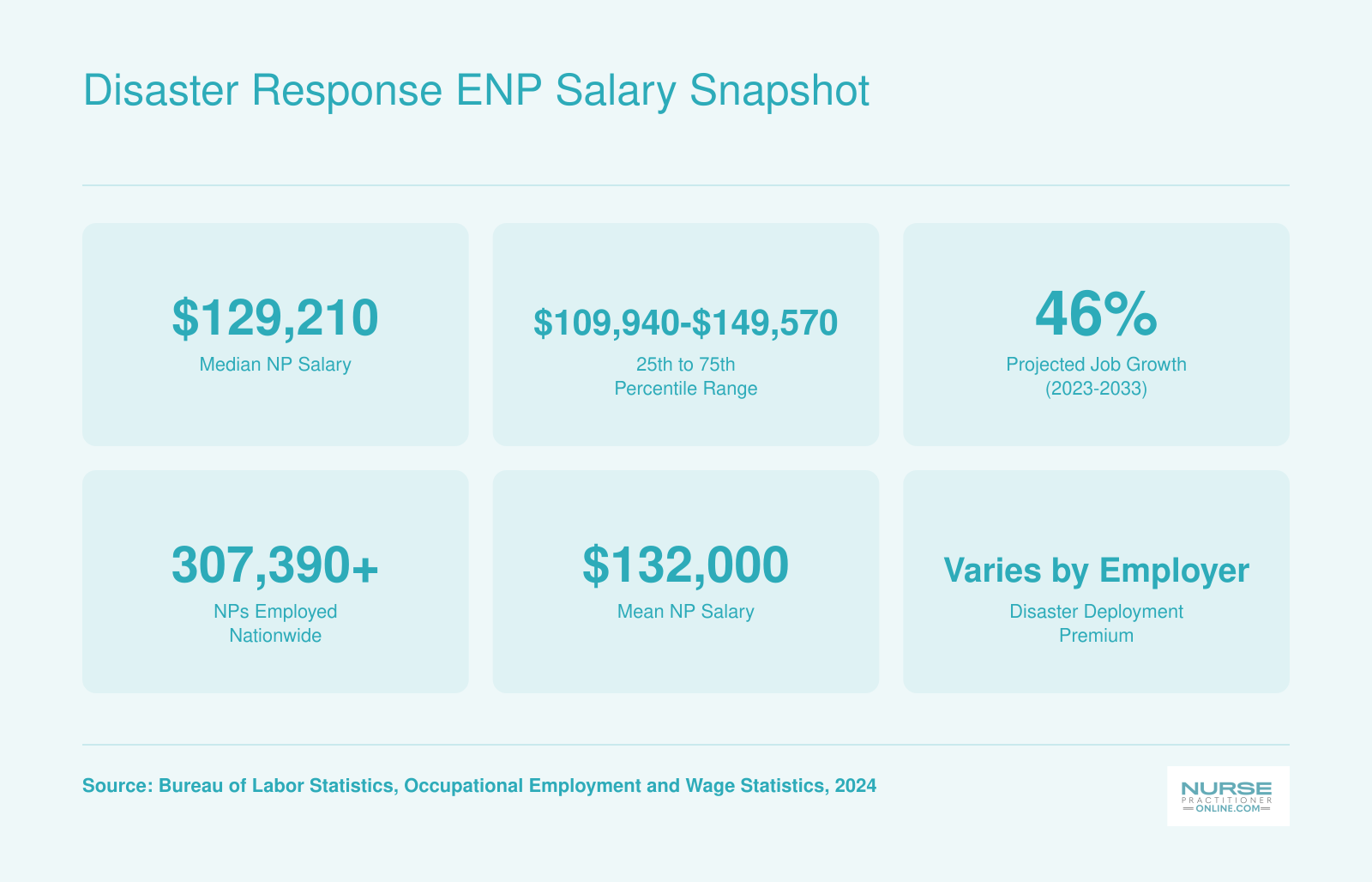
Disaster Response ENP Salary Snapshot
Nurse practitioners rank among the fastest-growing healthcare professions in the country, and disaster-focused ENPs can earn even more during deployments. Base salaries below reflect all NPs nationally. Disaster-response nurses often receive per diem allowances, hazard pay, and overtime premiums on top of these figures, though exact amounts vary by employer and deployment type.
Career Outcomes and Employer Landscape for Disaster Response ENPs
Full-time federal service versus intermittent volunteer deployment: those are the two career architectures most disaster-focused ENPs end up choosing between. One offers a uniform, a pension, and a posting you do not pick. The other lets you keep your home ED job and answer the call when a hurricane, wildfire, or outbreak demands clinicians on the ground.
Federal and Uniformed Pathways
The U.S. Public Health Service Commissioned Corps hires NPs as full-time uniformed officers, typically commissioning at the O-3 rank with standard uniformed services base pay. You must be a U.S. citizen, nationally certified, and under age 44 at commissioning. Officers deploy on a roughly 1-to-3-year interval for assignments lasting 7 to 30 days, but their day job is full-time federal clinical or public health work. Military reserve medical units (Army, Navy, Air Force Reserve) follow a similar model, blending civilian practice with deployable readiness. Many of these roles align closely with the skill set of an acute care nurse practitioner, given the high-acuity patient populations encountered during deployments.
Intermittent Deployment Roles
Most disaster NPs keep a primary emergency department position and deploy episodically. FEMA's National Disaster Medical System staffs Disaster Medical Assistance Teams (DMATs) with NPs who hold active RN and NP licenses, national certification, 2 to 3 years of experience, U.S. citizenship, and a cleared background check. Applications go through USAJOBS. Team members are paid at federal GS-12 hourly rates when activated, with typical deployments running 14 days and roughly one activation per year. American Red Cross Disaster Health Services follows a volunteer model: licensed NPs with at least 2 years of experience deploy for 10 to 14 days, usually once a year, with travel and lodging covered but no salary. International work through WHO, PAHO, or Médecins Sans Frontières typically requires French or Spanish fluency and a multi-month commitment.
Earnings and Emerging Roles
Program-level earnings data specifically for ENP graduates 1 and 4 years after completion is not yet published in the federal scorecard, so prospective students should look to the broader NP wage picture and employer pay scales rather than program-completer figures.
Beyond traditional ED roles, employers are now hiring ENPs into telehealth triage positions for pandemic surge response, climate-disaster preparedness coordinator roles inside health systems, and hospital emergency management director tracks that combine clinical credibility with incident command experience.
Certification and Licensure for Emergency Nurse Practitioners in Disaster Settings
Earning your ENP-C certification opens doors to disaster response work, but understanding how this credential fits alongside state licensure requirements and supplemental certifications helps you build the strongest possible profile for crisis deployment.
Understanding the ENP-C Certification
The American Academy of Nurse Practitioners Certification Board (AANPCB) offers the Emergency Nurse Practitioner Certification (ENP-C), which validates specialized competency in treating undifferentiated patients across the lifespan in emergency settings.1 This distinguishes ENPs from Acute Care Nurse Practitioners (ACNPC-AG), who focus specifically on acutely and critically ill adult populations. The ENP scope includes patients of all ages presenting with unknown conditions, making this certification particularly valuable for disaster scenarios where you encounter everything from pediatric injuries to geriatric medical emergencies.
To qualify for the ENP-C, you must already hold FNP certification and have completed at least 2,000 hours of direct emergency care experience.2 You also need 100 continuing education hours, with at least 30 of those focused on procedural skills.3 The AANPCB offers three eligibility pathways: clinical hours plus continuing education, completion of an academic ENP program, or fellowship training.2 The computer-based exam includes 150 questions, with 135 scored items determining your results.1 Once certified, you maintain your credential through practice hours and continuing education on a five-year recertification cycle.4
Supplemental Credentials for Disaster Work
While the ENP-C establishes your advanced practice foundation, additional certifications strengthen your disaster deployment candidacy:
- TCRN (Trauma Certified Registered Nurse): Offered through BCEN, this credential demonstrates expertise in trauma care across the injury continuum, highly relevant when responding to mass casualty events.
- CEN (Certified Emergency Nurse): This foundational emergency nursing certification validates your ability to manage diverse acute presentations.
- CFRN (Certified Flight Registered Nurse): Particularly valuable if you anticipate helicopter evacuation or austere transport scenarios during disaster deployments.
State Licensure and Scope of Practice
ENP-C certification does not replace state APRN licensure. You must hold an active license in any state where you practice, and scope-of-practice rules vary considerably. Some states grant full practice authority, allowing independent patient management, while others require collaborative agreements with physicians. For a broader look at these requirements, see our nurse practitioner licensing guide. Before accepting disaster assignments, verify how emergency declarations may temporarily modify these requirements.
Deployment Organization Credentialing
Federal and international organizations like FEMA and WHO maintain their own credentialing processes beyond clinical licensure. These typically include background checks, specialized training verification, and administrative documentation that can take weeks to complete. Starting this paperwork well before disaster season positions you for rapid deployment when crises occur.
Frequently Asked Questions About Disaster Response ENP Careers
Disaster response nursing is a rewarding but specialized career path, and it is natural to have questions before committing to advanced training. Below are answers to the most common questions working nurses ask about becoming an emergency nurse practitioner focused on crisis management.
- How do you become a disaster relief nurse?
- Start by earning your RN license and gaining clinical experience, ideally in emergency or critical care settings. Next, pursue a Master of Science in Nursing (MSN) or Doctor of Nursing Practice (DNP) with an emergency or acute care focus. Add disaster-specific training through FEMA courses, humanitarian organizations, or dedicated disaster nursing electives. Certifications in emergency nursing and disaster preparedness strengthen your readiness for deployment.
- What degree do you need to be a disaster nurse practitioner?
- You need at minimum an MSN with a focus on emergency or acute care. Many employers and deployment organizations prefer candidates who hold a DNP, which includes deeper training in clinical leadership and evidence-based practice. Programs that offer disaster-specific coursework, such as mass casualty triage and field medicine, will prepare you most directly for crisis response roles.
- What certifications do disaster response nurses need?
- The most relevant credentials include the Certified Emergency Nurse (CEN) designation and board certification as a Family Nurse Practitioner (FNP-BC) or Acute Care Nurse Practitioner (ACNP-BC). Additional certifications like the Trauma Certified Registered Nurse (TCRN) and FEMA Incident Command System (ICS) training are highly valued. Some nurses also pursue the Advanced Practice Registered Nurse certificate through humanitarian agencies.
- How much do disaster response nurse practitioners make?
- Salaries vary based on employer, deployment type, and geographic region. NPs working full time in emergency and trauma settings generally earn competitive salaries in line with other advanced practice nurses. Contract and deployment roles through federal agencies or humanitarian organizations may offer additional hazard pay, per diem allowances, or tax advantages depending on the mission location and duration.
- Are there online programs for emergency nurse practitioners?
- Yes. Several accredited universities offer MSN and DNP programs with emergency or acute care concentrations delivered primarily online. Didactic coursework, simulation labs, and some electives can be completed remotely, while clinical rotations are arranged at approved sites near your home. nursepractitioneronline.com profiles many of these programs to help you compare options that fit a working nurse's schedule.
- What is the difference between an emergency nurse practitioner and an acute care nurse practitioner?
- An emergency nurse practitioner (ENP) is specifically trained to manage undifferentiated patients across all ages in urgent and emergent settings, including disaster environments. An acute care nurse practitioner (ACNP) focuses on managing complex, acute, and critically ill patients, typically within hospital units. ENPs receive broader training in rapid triage, procedural skills, and field-based care that aligns closely with disaster response demands.
- Can you work as a disaster response NP part time while maintaining a regular ED position?
- Absolutely. Many disaster response NPs hold permanent emergency department positions and deploy on a voluntary or contract basis during crises. Organizations like the National Disaster Medical System (NDMS) and the Medical Reserve Corps allow part-time participation. Deployments typically last one to two weeks, and federal employers are often required to grant leave for these missions, making it feasible to balance both roles.