Most important takeaways…
- Only 7% of NPs are Black, far below patient population needs.
- Holistic admissions evaluate personal statements, not just GPAs and test scores.
- Minority NPs often lack mentorship and leadership opportunities despite seniority.
Only about 7% of nurse practitioners are Black, compared with more than 13% of the U.S. population, according to American Association of Colleges of Nursing data. This mismatch has direct consequences for health equity: studies show that patient-provider racial concordance improves communication, trust, and adherence to treatment plans, particularly in underserved communities where NPs often provide primary care. Research consistently links a diverse healthcare workforce to reduced health disparities and improved access to care in marginalized populations.
While NP programs are adopting holistic admissions and pipeline scholarships, minority practitioners still report feeling unseen and unsupported after earning advanced credentials, as Nagina Dar, a senior emergency NP, reflected in a July 2026 Nursing Times essay.
Closing the gap is not just about recruitment. It requires sustained support from classroom to practice.
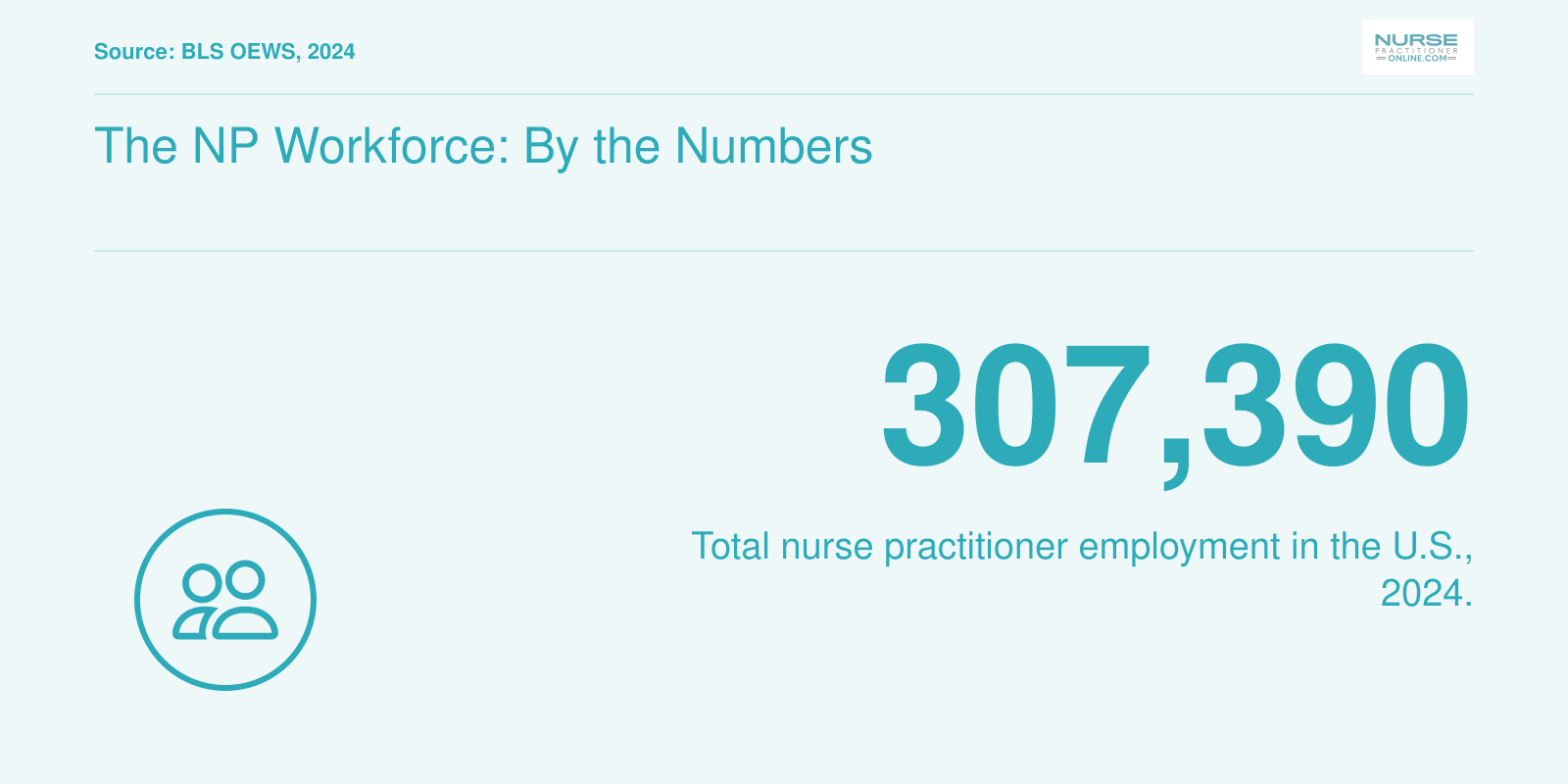
The NP Workforce: By the Numbers
With over 307,000 nurse practitioners employed across the United States, the NP workforce is a cornerstone of modern healthcare. As the patient population grows more diverse, ensuring that this workforce reflects a wide range of backgrounds is critical to improving health outcomes and access.
Current NP Student Demographics: Who's in the Pipeline?
The demographics of nurse practitioner students reveal who is entering advanced practice and, by extension, who will shape the future of patient care. Understanding this pipeline is essential because a diverse NP workforce can better address health disparities and cultural needs.
Racial and Ethnic Representation Among NP Students
Nationally, NP students remain predominantly white. According to 2024 data, 77.5% identify as white, while only 4.7% are Black, 6.7% Hispanic, and 6.3% Asian.1 These figures underscore a significant underrepresentation of Black and Hispanic students, particularly when compared to their shares of the U.S. population (13% Black and 19% Hispanic).2 Indigenous students and those identifying as two or more races face even deeper representation gaps, though precise data is often underreported.
How NP Student Diversity Compares to the Workforce and U.S. Population
The diversity gap in NP education mirrors that of the existing NP workforce, where only 8% are Black and 5% Hispanic.2 However, it lags behind the registered nurse workforce, which is 11% Black and 9% Hispanic.3 This suggests that minority nurses face additional barriers in transitioning to advanced practice roles. When set against general population demographics, the disparities are stark: Hispanic representation among NP students is roughly one-third of their population proportion, while Black representation is about one-third as well. Asian representation, at 6.3%, aligns more closely with the population but still falls short in some regions.
Gender and Other Diversity Dimensions
Gender diversity in NP programs is heavily skewed: 87% of NP students are female, mirroring the broader nursing field.4 This lack of male representation persists despite growing efforts to recruit men into nursing. Data on first-generation college students is not routinely tracked in national NP student surveys, but nursing school reports suggest that many minority students are the first in their families to pursue graduate education. Intersectional identities, such as LGBTQ+ status or disability, are rarely captured in pipeline metrics, leaving a critical gap in understanding the full scope of diversity challenges.
Closing these demographic gaps requires intentional recruitment, holistic admissions, and support systems that address the unique experiences of underrepresented students, including financial strategies for affording NP school. As the story of Nagina Dar illustrates, achieving advanced credentials does not automatically translate to visibility or belonging; ensuring diverse representation in NP classrooms is the first step toward a more equitable healthcare system.
Did you know? Only about 7% of nurse practitioners identify as Black, yet Black Americans make up more than 13% of the U.S. population, according to American Association of Colleges of Nursing data. This gap is even wider for Hispanic and Native American NPs.
How Holistic Admissions Are Opening Doors in NP Programs
What does a holistic nurse practitioner application look like beyond GPA and test scores?
Holistic admissions in NP programs evaluate the whole person, not just academic metrics. Programs look at your personal statement for evidence of cultural awareness and motivation, consider lived experiences such as socioeconomic challenges or community service, and value language skills that can bridge gaps in care. Programs weigh clinical experience, nurse practitioner letters of recommendation, and personal attributes like resilience and empathy. These are now common NP school requirements. Many programs also incorporate structured interviews to assess communication and commitment to underserved populations.
The Shift Away from Standardized Testing
Many NP programs have dropped the GRE requirement or made it optional, recognizing that standardized tests often create barriers for underrepresented students without predicting clinical success. For example, national data from 2026 shows that most nurse practitioner programs now offer a GRE waiver if you hold a GPA of 3.0 or higher and several years of RN experience.1 The University of Illinois Chicago College of Nursing reported that after moving to test-optional admissions, the program saw increased diversity among enrolled students with no decline in academic performance.2 This real-world evidence is driving more schools to follow suit.
Programs Seeing Real Results
The UC Davis Family Nurse Practitioner program provides a clear model: it requires no standardized tests at all. Instead, the school reviews applications through a comprehensive lens that weighs experiences, attributes, and metrics. While specific rubrics vary, some nursing programs use a framework, as outlined in the Campaign for Action's holistic admissions framework, weighing experiences at 45%, attributes at 45%, and metrics at only 10%. The result? Cohorts that better reflect the communities they serve. A 2024 study of a nursing program using this exact weighting found that the student body eventually matched local community ethnicities, a direct outcome of shifting focus from numbers to narratives.4 Nurse practitioner programs adopting similar holistic reviews are building pipelines that prioritize not just who can pass a test, but who will connect with and advocate for diverse patient populations.
Scholarships and Pipeline Programs for Underrepresented NP Students
Financing a nurse practitioner degree often feels like choosing between career advancement and financial stability. Scholarships and pipeline programs can tip the scales, but finding them requires a targeted approach. Here’s where to look.
Start with NP Program Websites
Many nursing schools list funding opportunities directly on their financial aid or scholarship pages. Look for awards designated for students from underrepresented racial and ethnic groups, first-generation graduate students, or those committed to primary care in underserved areas facing a nurse practitioner shortage. Some programs also offer pipeline initiatives that provide mentorship, application fee waivers, summer enrichment experiences, and even access to nurse practitioner residency programs alongside tuition support. Spending 20 minutes clicking through a program’s website can uncover options you would otherwise miss.
Tap into Professional Organizations
National associations like the American Association of Nurse Practitioners (AANP), the National Association of Pediatric Nurse Practitioners (NAPNAP), and the National Organization of Nurse Practitioner Faculties (NONPF) often maintain scholarship directories or list funding opportunities on their websites. These organizations recognize that a diverse NP workforce improves patient outcomes, so they intentionally invest in students from underrepresented backgrounds. Bookmark their scholarship pages and check back regularly, as deadlines cycle throughout the year.
Explore Federal and Foundation Funding
The Health Resources and Services Administration (HRSA) Nurse Corps program is a well-known federal initiative that offers substantial tuition support to NP students who agree to serve in designated Health Professional Shortage Areas after graduation. Beyond HRSA, private foundations and healthcare systems sometimes sponsor pipeline programs that pair financial aid with clinical placements. A quick search of .gov and .org domains can surface current offerings that match your career goals.
Connect with Campus Diversity Resources
Once you are admitted, or even while you are researching schools, reach out to the campus diversity office or minority student affairs center. These offices frequently curate lists of external scholarships, fellowships, and pipeline programs that may not be advertised on the main nursing school website. They can also connect you with current students who have successfully navigated the funding process, giving you a first-hand account of what works. Building that relationship early builds momentum before your first tuition bill arrives.
Cultural Competency Training: Beyond the Textbook
NP programs have long leaned on textbook chapters and lecture slides to check the box on cultural competence. But a more meaningful transformation is underway, one that moves beyond memorizing cultural traits and into the realm of cultural humility, where students learn to engage with patients as individuals within complex social contexts.
From Knowledge to Practice: Immersive Learning
- Simulation with diverse standardized patients: Many programs now use actors who portray patients from varied backgrounds, complete with language barriers, health beliefs, and social challenges. Students practice gathering histories, negotiating treatment plans, and recognizing their own assumptions in a safe, debriefed environment.
- Role-play and case-based discussions: Rather than simply reading about health disparities, learners work through unfolding scenarios that demand real-time cultural navigation, such as addressing vaccine hesitancy rooted in historical mistrust or accommodating religious dietary restrictions.
Community-Based Clinical Placements
A growing number of NP schools incorporate nurse practitioner clinical rotations in federally qualified health centers, rural clinics, or immigrant and refugee-serving organizations. These placements expose students to the day-to-day realities of patients who experience poverty, language isolation, and systemic barriers. Preceptors trained in culturally responsive care guide students to link social determinants to clinical decision-making, reinforcing that culture is not a checklist but a continuous, relational process.
Faculty Development and Institutional Commitment
Even the most innovative curriculum falls flat without faculty who are equipped to facilitate difficult conversations. Leading NP programs invest in workshops on implicit bias, microaggressions, and the historical context of healthcare inequities. These sessions help instructors move from a colorblind approach to one that actively acknowledges and respects difference. Yet, as recent narratives reveal, even senior clinicians from minority backgrounds may feel unseen and unsupported after achieving advanced roles.1 When faculty model cultural humility, students follow suit.
Curricular Frameworks That Guide Change
Professional organizations such as the American Association of Colleges of Nursing and the National Organization of Nurse Practitioner Faculties have emphasized competencies related to health equity, social justice, and cultural humility. Their guidelines encourage weaving these principles throughout every course, from pathophysiology to policy, rather than isolating them in a single diversity module. The result is a more integrated, authentic preparation that equips nurses for the evolving role of nurse practitioners and the richly diverse patient populations they will serve.
Questions to Ask Yourself
From Classroom to Practice: The Belonging Challenge for Minority NPs
Increasing the number of minority nurse practitioners is only the first step; the deeper challenge lies in fostering a sense of belonging and equitable career progression once they are practicing. While NP programs have made strides in diversifying student cohorts, the transition to practice often exposes persistent biases and structural barriers that undermine retention and advancement.
The Hidden Barriers After Graduation
Minority NPs frequently encounter implicit bias, microaggressions, and a lack of mentorship that can fuel imposter syndrome and undermine new nurse practitioner confidence. In clinical settings, they may find their competence scrutinized more heavily than that of white peers, or be overlooked for leadership roles and nurse practitioner advancement opportunities. This type of exclusion sends a clear message: you are hired, but not fully included. Over time, the cumulative weight of these experiences erodes job satisfaction and drives talented clinicians out of the workforce.
The 2026 Nursing Times essay by Nagina Dar, a senior emergency nurse practitioner at Manchester Royal Infirmary, personalizes these dynamics. Despite earning an MSc in Advanced Clinical Practice, Dar wrote about not being proactively offered the same growth opportunities that seemed to go to colleagues. Her story mirrors a widespread reality: many minority NPs, even with advanced qualifications, feel unseen and unsupported when it comes to career mobility.
How Mentorship Changes the Equation
Structured mentorship offers a powerful antidote. Studies show that effective mentorship programs improve first- and second-year retention1 and lead to higher job satisfaction.2 However, the quality of that mentorship matters. For Black women nurse leaders, access to mentoring has historically been unequal3, and race-concordant mentoring, where mentors share a similar cultural background, has been shown to significantly strengthen a sense of belonging.2 When mentorship is culturally responsive, it not only accelerates career advancement but also validates the unique experiences of minority clinicians.4
Without intentional support, the cycle of stalled advancement repeats.5 Early-career mentoring for Black nurses is associated with faster progression and greater workplace satisfaction3, but only when mentors actively address bias and microaggressions rather than ignoring them.4 Mentorship programs must do more than match numbers; they must equip mentors to listen, advocate, and create psychologically safe environments.6 Retention, not just recruitment, remains the critical test.6 When minority NPs feel that their contributions are recognized and their growth is championed, they stay, and the entire healthcare system benefits.
Success Stories: NP Programs That Are Getting It Right
A growing number of nurse practitioner programs are translating diversity commitments into measurable action, creating a stronger, more representative NP workforce.
Oklahoma Workforce Innovations in Nursing (OK-WINs)
With support from the National Institutes of Health, OK-WINs program awarded 55 scholarships to nursing students, including those in NP tracks. In its first year, eight graduates entered practice, achieving a 100% employment rate and 75% placement in underserved communities. The program's 2024 admissions rose 25% to 69 students, demonstrating that targeted financial support and mentorship can rapidly expand and diversify the advanced practice pipeline.
University of South Alabama's RISE ANEW Program
The RISE ANEW initiative at the University of South Alabama College of Nursing provides $25,000 awards to students committed to practice in underserved areas. With a target of enrolling 20 participants, the program combines financial aid with structured mentorship, directly addressing two persistent barriers for minority students: cost and lack of professional guidance.
Holistic Admissions and HBCU Pathways
At UC Davis' Betty Irene Moore School of Nursing, a holistic admissions policy evaluates applicants beyond test scores and GPAs, considering life experiences and commitment to underserved populations.4 Meanwhile, a dedicated pathway program connects two HBCU nursing schools with graduate NP programs, a bridge within HBCU NP programs that has boosted enrollment of underrepresented students in advanced practice nursing.5
National Shifts in NP Education Culture
Beyond individual schools, the National Organization of Nurse Practitioner Faculties (NONPF) has championed an Inclusive Language Assessment to help programs audit their communications and classroom materials for subtle biases.6 This type of systemic self-review is gaining traction as programs realize that recruitment alone is insufficient without a truly welcoming learning environment.
These examples show that intentional design, from admissions to mentorship to institutional self-audit, can significantly alter the demographics of the NP workforce.
Your DEI Evaluation Checklist for NP Programs
What to Look For: Key Criteria
When evaluating NP programs, go beyond mission statements. Request concrete data on student and faculty demographics. Ask for the percentage of underrepresented minority students and how that has changed over the past three years. Look for dedicated diversity scholarships or tuition waivers, programs that invest financially in equity send a clear signal.
Check for structural support services: affinity groups, peer mentoring, or faculty advisors trained in culturally responsive practices. An inclusive curriculum should weave social determinants of health, health equity, and cultural humility throughout clinical and didactic coursework, not just an elective.
Accreditation Standards: What They Require
Both CCNE and ACEN now mandate diversity, equity, and inclusion as part of their nursing accreditation. Since 2024, CCNE requires a written DEI policy, an inclusive environment, and curriculum content on health equity. Faculty expertise must include population health and social determinants. ACEN similarly demands a DEI policy, inclusive environment, and admission practices that actively recruit diverse applicants. Both accreditors require culturally responsive student services and explicit diversity goals.1
The National Task Force Standards for NP programs go further: they call for measurable DEI outcomes, a formal recruitment and retention plan for underrepresented students and faculty, and curriculum review that includes health equity at least every five years.2 Programs that meet these standards have already moved from words to action.
Questions to Ask During Your Interview
- Demographics: What is the current student and faculty diversity breakdown? How are you tracking retention and graduation rates by race and ethnicity?
- Scholarships and Support: Are there designated scholarships or stipends for underrepresented NP students? Is there a mentorship program that pairs minority students with practicing NPs?
- Curriculum: How are health equity and cultural competence threaded across all courses? Can you share a recent syllabus example?
- Outcomes: What are your diversity-related outcomes in the last self-study, not just goals, but actual data on recruitment, retention, and faculty hiring?
A program confident in its DEI efforts will answer these openly. If you encounter vagueness, dig deeper.
Related Articles
Intentional change in NP education rests on a fundamental tension: a diverse student body does not automatically yield equitable patient outcomes or inclusive workplaces. For prospective students, selecting a program that quantifies its DEI progress (not just highlighting isolated scholarships) is critical. The 7% Black NP representation compared to the 13% U.S. population reminds us that numbers matter, but fostering belonging matters, too. Educators need to replace performative statements with published diversity data, mentoring pipelines, and cultural humility training that demonstrably reduce health disparities.