Most important takeaways…
- BLS projects NP employment will grow 45 percent from 2022 to 2032, creating exceptional career momentum.
- Over half of U.S. states now grant full practice authority, directly boosting NP autonomy and earning potential.
- Layering specialty certifications such as CDE or AGACNP-BC onto a base credential opens higher paying niche roles.
- Choosing between a post-master's certificate and a DNP hinges on whether you prioritize clinical specialization or leadership.
Staying put in a single clinical role versus actively expanding your skill set leads to vastly different career trajectories, especially now. The Bureau of Labor Statistics projects nurse practitioner employment will grow 45 percent between 2022 and 2032, adding tens of thousands of new NPs to an already competitive workforce. That influx raises the bar for everyone.
The practical tension is clear: more NPs entering practice means differentiation matters more than ever. Specialty expansion, political advocacy, stackable certifications, advanced degrees, and smarter continuing education strategies each offer a distinct lever for career growth. NPs who also consider non-clinical NP jobs alongside traditional clinical roles tend to command broader career flexibility. Combining two or three of these approaches positions you for higher salaries, broader scope of practice, and stronger job security than relying on a single credential alone.
Why Lifelong Learning Matters for Nurse Practitioners
Lifelong learning for nurse practitioners means staying current with clinical evidence, regulatory changes, and emerging roles through formal education, certifications, professional reading, and hands-on practice experiences long after graduation. In a field where guidelines shift, scopes expand, and patient populations grow more complex, the knowledge that earned your first license will not sustain a thirty-year career.
Workforce Growth Demands Continuous Competence
The Bureau of Labor Statistics projects that nurse practitioner employment will grow much faster than average through 2034, driven by an aging population, expanded insurance coverage, and broader scope-of-practice laws in many states. This growth creates opportunity but also raises the bar for what employers expect. Healthcare systems increasingly favor NPs who pursue specialty certifications, quality-improvement training, and advanced degrees. Staying competitive in a larger labor pool requires demonstrating currency in your clinical knowledge and willingness to adapt to new models of care.
Evidence Shows NPs Deliver High-Quality, Cost-Effective Care
Peer-reviewed research consistently documents that nurse practitioners provide care comparable to physicians in quality, safety, and patient satisfaction while often reducing costs and improving access. Meta-analyses published in the Cochrane Library have found no significant differences in patient outcomes between NPs and physicians for chronic disease management and primary care. Studies in JAMA and Health Affairs report that NP-led care achieves similar or better results in patient satisfaction scores, preventive-service delivery, and adherence to clinical guidelines, particularly when NPs practice to the full extent of their education and training. This body of evidence is central to the growing discussion about whether a nurse practitioner can be a primary care provider on equal footing with physicians.
These findings are not static. New studies emerge each year examining NP performance in hospital settings, mental health, women's health, and acute care. Staying updated with this evidence base strengthens your clinical reasoning, informs policy discussions, and supports advocacy for full practice authority in restrictive states. Digital tools can help you keep pace; a curated list of nurse practitioner apps can streamline how you consume research on the go.
Where to Find the Latest Research
The American Association of Nurse Practitioners publishes annual workforce reports and state-by-state practice-environment data on its website. Academic databases such as PubMed, CINAHL, and your institution's library portal allow keyword searches for phrases like "nurse practitioner outcomes" or "NP versus physician care." Journals including the Journal of the American Association of Nurse Practitioners, the New England Journal of Medicine, and Health Affairs regularly feature studies on advanced practice roles, quality measures, and cost analyses. Setting up citation alerts or subscribing to table-of-contents feeds keeps new evidence flowing into your inbox without the need for manual searches each month.
Explore New NP Specialty Areas and Emerging Fields
The nurse practitioner workforce is shifting toward specialties that blend clinical expertise with technology, policy, and population health. As of 2026, the Bureau of Labor Statistics projects nurse practitioner employment will grow 45 percent from 2022 to 2032, far outpacing most other occupations. Within that overall growth, certain NP specialty areas are expanding faster than others, driven by demographic shifts, chronic disease prevalence, and the rapid adoption of telehealth models that began during the pandemic and have now become permanent fixtures of care delivery.
Check National Data Sources for Specialty Trends
The Occupational Outlook Handbook on BLS.gov provides detailed breakdowns of NP employment by practice setting and region. Review the most recent edition to identify which states and metropolitan areas report the highest demand for nurse practitioners, and note which clinical settings are hiring most actively. For a closer look at geographic demand, our analysis of states with the most need for nurse practitioners highlights where shortages are most acute. Psychiatric and mental health NP roles have grown sharply, as have positions in geriatrics and chronic disease management. The AANP and NONPF publish annual practice analysis surveys that track where NPs work, which specialties are growing, and how many practitioners are incorporating telehealth into their weekly caseloads. The 2025 AANP survey data show that more than 70 percent of NPs now deliver at least some patient care via telehealth, with psychiatric NPs reporting the highest rates of virtual visit adoption.
Investigate University Outcome Data and Curriculum Updates
Many accredited NP programs now publish graduate outcome data on their websites, including specialty choice, employment rates, and first-year practice settings. Browse several university nursing program sites to see which specialties are expanding enrollment and which schools have integrated telehealth training modules into clinical courses. Schools that embed simulation and virtual care competencies into their curricula are often responding to employer demand for NPs who can lead digital health initiatives and manage patients across hybrid care models.
Search the Literature for Evidence on NP-Led Telehealth
PubMed and CINAHL host systematic reviews and meta-analyses on NP-led telehealth interventions and their impact on access in underserved communities. Use search terms such as "nurse practitioner telehealth underserved access" or "APRN virtual care rural outcomes" to locate high-quality evidence. Recent studies document that NP-staffed telehealth programs improve appointment availability, reduce travel barriers, and maintain clinical quality comparable to in-person visits for conditions ranging from diabetes management to behavioral health. Understanding this evidence base positions you to advocate for role expansion in your own organization and to articulate the value of NP-led virtual care when pursuing leadership or policy opportunities.
Questions to Ask Yourself
Become a Political Advocate for Nurse Practitioners
Scope-of-practice law is not abstract policy. It determines whether you need a physician collaborator to prescribe, where you can open an independent practice, and ultimately how much you can earn. Advocacy is one of the most direct investments you can make in your own career.
The State of Full Practice Authority in 2026
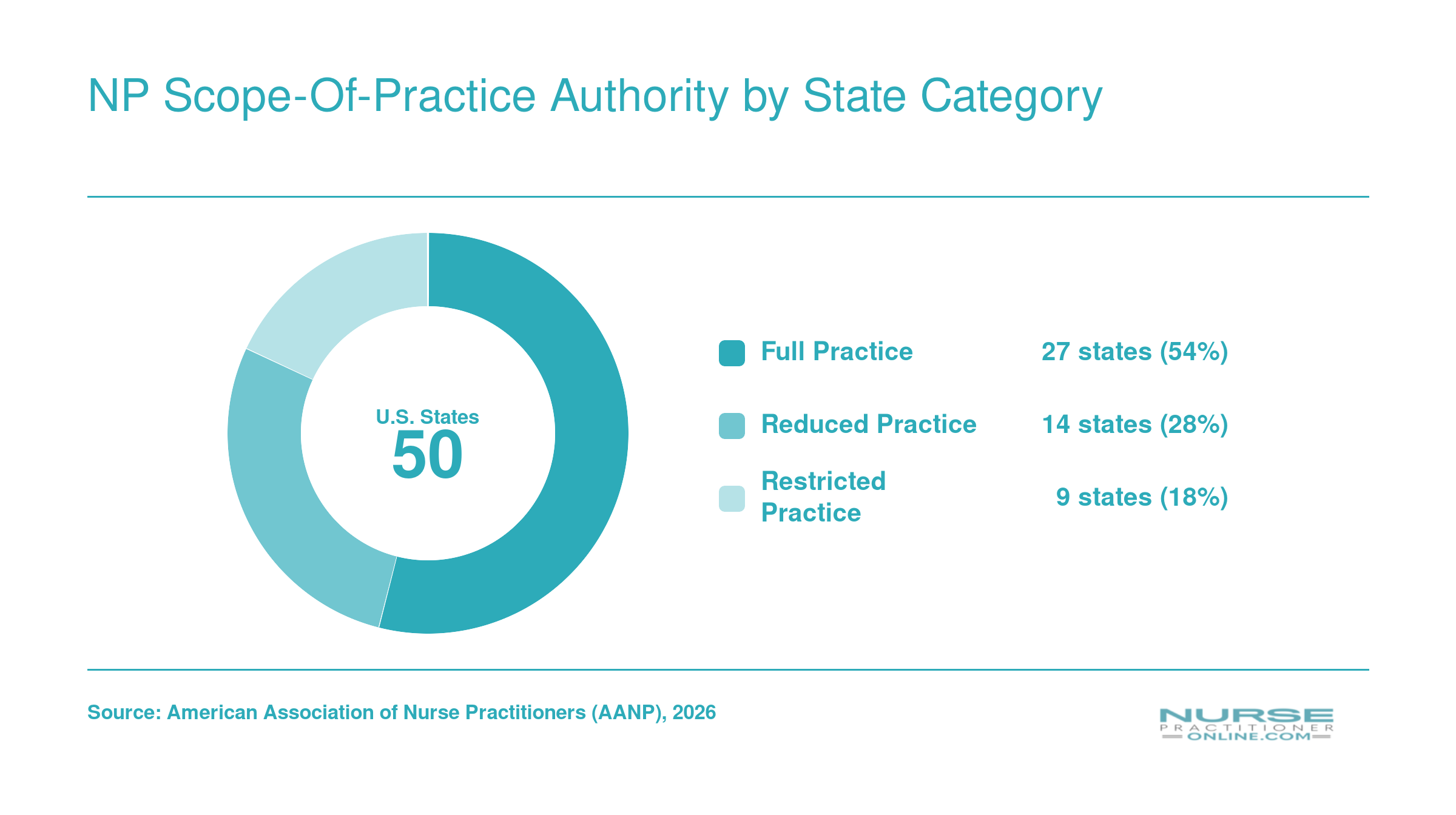
As of May 2026, 27 states plus Washington, D.C. grant full practice authority states, meaning NPs can evaluate, diagnose, prescribe, and practice without physician oversight requirements.1 That is up from 24 states just five years ago, and the momentum is real. New York, Kansas, and Massachusetts all moved from reduced practice to full practice authority in 2026, three significant wins that open new doors for thousands of NPs in densely populated states.
Still, 23 states impose reduced or restricted practice requirements. Thirteen require a collaborative agreement with a physician, and ten place even tighter limits on NP autonomy. If you practice in one of those states, advocacy is not optional. It is the mechanism by which your profession earns the authority it already demonstrates it deserves.
Why the Research Backs This Fight
The evidence connecting full practice authority to better patient access is consistent and growing. Rural counties in full practice authority states show higher NP-to-population ratios than comparable counties in restricted states.3 States with full practice authority also see faster NP workforce growth overall, and a greater share of NPs practicing in primary care rather than specialty or inpatient settings.3 In short, removing supervisory barriers does not just help NPs. It moves practitioners into underserved communities and into the primary care roles where the workforce shortage is most acute.
Four Ways to Get Involved Right Now
You do not need a policy background to make a difference. A practical nurse practitioner health policy toolkit can help you start, but here are four concrete steps:
- Join AANP or your state NP association: Both organizations track legislation, coordinate advocacy campaigns, and provide ready-made talking points you can use with legislators.
- Attend a legislative day: Most state NP associations organize annual Capitol Hill or statehouse visits. Showing up in person carries weight that emails simply cannot replicate.
- Write to your state legislators: A brief, personal letter from a practicing NP describing real patient-care barriers is more persuasive than form correspondence. Specific stories matter.
- Serve on a health policy committee: Hospital systems, federally qualified health centers, and state boards of nursing all seat advisory committees. Volunteering places your perspective directly inside the institutions that shape practice environments.
Political advocacy may feel outside the clinical lane, but nurse practitioner scope of practice law shapes every patient encounter you have. The NPs who helped push New York, Kansas, and Massachusetts across the finish line in 2026 did so by showing up consistently over years. That work is continuing in the remaining 23 states, and your voice belongs in it.
NP Scope-Of-Practice Authority by State Category
Where you choose to practice as a nurse practitioner directly shapes your day-to-day autonomy, prescriptive authority, and career flexibility. As of 2026, the majority of U.S. states grant full practice authority, but the landscape is far from uniform. Understanding these categories helps you make strategic decisions about geographic mobility and long-term career growth.
Obtain Additional Certifications to Stand Out
Additional certifications transform your resume from competitive to indispensable, opening doors to specialized roles, higher salaries, and legal protections that general NP credentials alone cannot deliver. While your base certification (FNP-C, AGACNP-BC, or PMHNP-BC) qualifies you to practice, layering on specialty credentials signals mastery, commitment, and readiness for complex patient populations that command premium compensation. For a deeper look at the foundational steps, see our nurse practitioner licensing guide.
Major Certification Pathways and Growth Areas
The two dominant credentialing bodies for nurse practitioners remain the American Academy of Nurse Practitioners Certification Board (AANPCB) and the American Nurses Credentialing Center (ANCC). AANPCB offers FNP-C, AGNP-C, and ENP-C credentials, while ANCC administers FNP-BC, AGPCNP-BC, AGACNP-BC, and PMHNP-BC exams.1 Both organizations report steady growth in family and psychiatric-mental health nurse practitioner certifications, with PMHNP-BC exams seeing the sharpest uptick as behavioral health access gaps widen nationwide. Research shows no salary difference between AANPCB and ANCC credentials for the same specialty, so choose based on exam content alignment and renewal requirements. AANPCB certification renewal requires 1,000 documented practice hours, while ANCC tracks continuing education credits more heavily.3
Beyond these foundational certifications, subspecialty boards offer advanced credentials. The AACN Certification Corporation issues the ACNPC-AG for adult-gerontology acute care nurse practitioner roles, the Pediatric Nursing Certification Board administers CPNP-PC and CPNP-AC exams for pediatric primary and acute care, and the National Certification Corporation oversees NNP-BC (neonatal) and WHNP-BC (women's health) credentials.1
Emerging Specialty Certifications and Micro-Credentials
High-demand micro-credentials now complement broad NP certifications. The Certified Diabetes Care and Education Specialist (CDCES) designation positions you for endocrinology and primary care diabetes clinics. The Advanced Oncology Certified Nurse Practitioner (AOCNP) credential opens oncology infusion centers and survivorship clinics. Palliative care certification (CHPN) qualifies you for hospital palliative teams and hospice medical director roles. Functional medicine nurse practitioner institutes offer certificates in integrative and root-cause approaches, popular in direct primary care models. Point-of-care ultrasound credentials (offered through emergency medicine and hospitalist societies) are increasingly required for acute care NPs performing procedural sedation or central line placement.
Concrete Outcomes: Salary, Access, and Legal Positioning
While causality between additional certifications and salary premiums remains unclear in aggregated datasets, niche roles explicitly require subspecialty credentials and pay accordingly.4 Oncology NPs with AOCNP certification routinely earn 10 to 15 percent more than generalist NPs in the same metropolitan area. Dual-certified NPs (for example, FNP-C plus PMHNP-BC) command higher locum tenens rates and can pivot between primary care and behavioral health contracts. Malpractice insurers also recognize specialty certification: underwriters often reduce premiums or expand coverage limits when NPs hold credentials directly tied to their scope of practice.
Practical Tip: Leverage Employer Reimbursement and Dual Certification Strategy
Many health systems and large practices reimburse certification exam fees and renewal costs as part of professional development budgets. Before paying out of pocket, confirm whether your employer offers tuition assistance or a continuing education stipend that covers board exams. Maintaining dual certifications in complementary specialties (family and psychiatric, or adult-gerontology primary and acute care) positions you for cross-coverage opportunities, telehealth contracts, and leadership roles that require breadth. Plan your certification timeline around renewal cycles to avoid overlapping study periods and maximize the return on your investment.
Post-Master's Certificate Vs. DNP: Which Path Fits Your Goals?
The conversation around doctoral preparation for nurse practitioners has intensified, making this one of the more consequential choices you will face as you plan your next career move.
What Each Path Actually Offers
A post-master's NP certificate is built for speed and focus. Completed in roughly 12 to 24 months and requiring around 20 to 30 credits, it lets you add or change a specialty without starting a full degree program over.12 If you are a family NP who wants to pivot into psychiatric-mental health practice, or an adult NP who sees opportunity in pediatrics, this is the pathway designed for that kind of targeted expansion.
A Doctor of Nursing Practice with an NP focus runs longer, typically 18 to 36 months, and carries 30 to 40 credits of graduate work.45 The clinical content is there, but the program also wraps around leadership, health policy, systems thinking, and evidence-based practice at an organizational scale. It is less about adding a certification and more about fundamentally repositioning what you do in a healthcare system.
The DNP Requirement Question
As of 2026, the DNP is not yet a mandatory entry-level requirement for NP practice, despite the American Association of Colleges of Nursing having long advocated for that shift.5 That said, the trajectory of the field suggests doctoral preparation will carry increasing weight, particularly in academic and executive roles. If you have any interest in teaching, healthcare administration, or health policy leadership, the DNP closes doors far less often than the master's does.
Choosing the Right Fit
Ask yourself what the next five years look like, not just the next hiring cycle. If you are still weighing the foundational steps, our guide on how to become a nurse practitioner can help you map the full timeline. The certificate makes sense when:
- Your goal is clinical: You want to treat patients in a new population or specialty.
- Your timeline is tight: You cannot step back from full-time practice for two or three years.
- Your employer supports it: A focused credential aligns with an immediate role change or promotion.
The DNP makes sense when:
- Leadership is on the horizon: You see yourself shaping systems, not just navigating them.
- Academia interests you: Many nursing programs now prefer or require doctoral credentials for faculty.
- Long-term credentialing matters: As the field evolves, a terminal degree insulates your resume.
Neither path is inherently superior. Both are legitimate investments in your career. The certificate accelerates your clinical reach; the DNP widens your professional influence. Knowing which one matches where you actually want to land is the real work before you apply anywhere.
Innovative Continuing Education Strategies for APRNs
State boards and certifying agencies now require 75 to 150 hours of continuing education every three to five years, but smart NPs treat those minimums as a starting floor, not a ceiling. The challenge is not simply logging hours but building a CE strategy that genuinely sharpens clinical judgment, expands scope, and signals expertise to employers and credentialing bodies. For a broader look at requirements by certification type, see our guide to APRN continuing education options.
Beyond the Webinar: Evidence-Based Practice Integration
Traditional online modules fulfill license renewal, yet they rarely change practice patterns. Journal clubs offer a practical alternative. Many academic medical centers and professional societies host monthly virtual journal reviews where NPs dissect new trials, compare clinical guidelines, and debate applicability. Participating in a monthly journal club gives you 12 hours of interactive CE per year while keeping you current on evolving evidence.
Clinical fellowships represent another high-impact format. Post-graduate fellowships in cardiology, palliative care, and hospitalist medicine typically run six to twelve months and blend didactic sessions with supervised clinical rounds. Although they require protected time, these fellowships produce measurable gains in procedural competence and diagnostic confidence.
Interprofessional simulation training rounds out the roster. Working through mock codes, sepsis alerts, or difficult-conversation scenarios alongside physicians, pharmacists, and respiratory therapists builds teamwork skills that asynchronous webinars cannot replicate. Organizations like the American Association of Critical-Care Nurses increasingly incorporate simulation into their specialized tracks, and many hospital systems now offer simulation CE credits for staff NPs. If critical care is your focus, our critical care nurse practitioner overview covers the certification pathway in detail.
Evaluating Online CE Platforms and Quality Signals
The AANP CE Center, Medscape NP, and Clinical Advisor dominate the online landscape. All three carry ANCC or AANP accreditation, but quality varies. Look beyond the accreditation seal and examine author credentials, citation density, and publication date. High-quality modules cite peer-reviewed sources published within the past three years, disclose conflicts of interest, and include post-test questions that require application, not simple recall.
Micro-credentials and digital badges are emerging as portable proof of competence. Organizations such as the American Association of Critical-Care Nurses and the Gerontological Advanced Practice Nurses Association now issue digital badges for completing specialized CE tracks. Employers and credentialing committees increasingly recognize these badges as objective signals of focused expertise.
A Practical Quarterly Framework
Dedicate 10 to 15 hours per quarter to structured learning. Allocate two-thirds to clinical topics aligned with your patient population, one-sixth to health policy and reimbursement updates, and one-sixth to leadership or quality-improvement content. This mix keeps clinical skills sharp while building the nonclinical competencies that differentiate senior NPs from early-career peers. Track your hours in a simple spreadsheet and flag any gaps three months before your renewal deadline.
NP Salary and Job Growth Outlook by Specialty
Advanced practice nursing roles vary widely in compensation, employment volume, and growth trajectory. According to the Bureau of Labor Statistics, the combined category of nurse anesthetists, nurse midwives, and nurse practitioners is projected to grow roughly 35% from 2024 to 2034, with an estimated 32,700 annual openings. Nurse practitioners alone are projected to see approximately 40% job growth over the same period. These figures make APRN careers some of the fastest growing in all of health care. Below is a snapshot of national salary data and employment for the three primary APRN specialties. Salary differences largely reflect the length of training, procedural complexity, and high-acuity settings associated with each role. Nurse anesthetists, for example, work in surgical and procedural environments that command premium compensation, while nurse midwives, though critically important, represent a smaller workforce with a correspondingly different pay scale. Keep in mind that individual earnings can vary based on geographic location, practice setting, years of experience, and whether a state grants full practice authority.
| APRN Specialty | Total National Employment | Median Annual Salary | 25th Percentile Salary | 75th Percentile Salary |
|---|---|---|---|---|
| Nurse Practitioners | 307,390 | $129,210 | $109,940 | $149,570 |
| Nurse Anesthetists | 50,350 | $223,210 | $187,110 | N/A |
| Nurse Midwives | 8,280 | $128,790 | $104,260 | $146,520 |
Highest-Paying States for Nurse Practitioners
Geography plays a significant role in NP compensation. The states that top the earnings charts tend to share two traits: a high cost of living and, in many cases, full practice authority that lets NPs work independently. As you weigh relocation or remote opportunities, consider both the salary figure and what it actually buys you locally. States like California and New York offer impressive pay but come with steep housing and living costs, while states like New Mexico and Montana may stretch your dollar further despite slightly lower median salaries. Below are the ten highest-paying states for nurse practitioners based on the latest Bureau of Labor Statistics data.
| State | Median Annual Salary | Mean Annual Salary | Total Employment |
|---|---|---|---|
| California | $166,610 | $173,190 | 20,980 |
| New Jersey | $149,620 | $140,470 | 9,590 |
| Alaska | $145,450 | $142,340 | 570 |
| New York | $145,390 | $148,410 | 20,430 |
| Oregon | $144,600 | $148,030 | 2,430 |
| Washington | $140,220 | $143,620 | 4,790 |
| Connecticut | $138,960 | $141,140 | 3,680 |
| Massachusetts | $138,890 | $145,140 | 8,920 |
| New Mexico | $138,440 | $136,620 | 1,870 |
| Arizona | $133,790 | $132,920 | 7,540 |
Which Careers Are Considered Advanced Practice Nursing?
Nurses exploring career advancement often have questions about advanced practice roles, credentials, and professional growth. Below are answers to some of the most common questions we hear from working nurses considering the next step in their careers.
- Which careers are considered advanced practice nursing?
- Advanced practice registered nurses (APRNs) include four recognized roles: nurse practitioners (NPs), certified registered nurse anesthetists (CRNAs), certified nurse midwives (CNMs), and clinical nurse specialists (CNSs). Each role requires graduate-level education, national certification, and state licensure. Within these categories, NPs alone can specialize in more than a dozen population foci, including family, adult-gerontology, pediatric, psychiatric-mental health, and neonatal care.
- What are the benefits of lifelong learning for nurse practitioners?
- Lifelong learning helps NPs deliver safer, more effective patient care by keeping clinical knowledge current. It also opens doors to role expansion, leadership positions, and higher earning potential. Research consistently shows that NPs who pursue ongoing education report greater job satisfaction and professional confidence. In a field where guidelines, pharmacology, and technology evolve rapidly, continuous learning is not optional. It is essential for maintaining certification and staying competitive in a growing job market.
- How can advanced practice nurses stay updated with new evidence?
- APRNs can stay current by subscribing to peer-reviewed journals, attending professional conferences, and completing accredited continuing education modules. Joining professional organizations such as AANP or NONPF provides access to clinical updates, policy briefs, and networking. Many NPs also participate in journal clubs, quality improvement projects, or interprofessional grand rounds at their practice sites. Online platforms now make it easier than ever to integrate evidence-based learning into a busy clinical schedule.
- What certifications can nurse practitioners add to their credentials?
- NPs can earn subspecialty certifications to differentiate themselves and expand their scope. Popular options include the Certified Diabetes Educator (CDCES), Certified Anticoagulation Care Provider (CACP), Dermatology Nurse Practitioner Certified (DNPC), and various oncology or palliative care credentials. Procedural certificates in areas like aesthetic injectables, point-of-care ultrasound, and suturing also add clinical versatility. Each certification typically requires specific clinical hours and a passing exam score.
- How is the nurse practitioner role expanding in healthcare?
- NP roles are expanding through broader scope-of-practice legislation, growing demand in primary care, and new specialty fields such as genomics, telehealth, and lifestyle medicine. As of 2026, more than half of U.S. states grant NPs full practice authority, allowing independent prescribing and patient management. Health systems increasingly hire NPs for hospitalist, emergency, and surgical teams. This growth reflects a national strategy to address physician shortages, particularly in rural and underserved communities.
- What is the difference between a post-master's certificate and a DNP?
- A post-master's certificate allows an NP who already holds a master's degree to add a new population focus or specialty without completing another full graduate program. It is typically shorter, often 12 to 18 months, and highly clinical. A Doctor of Nursing Practice (DNP) is a terminal practice doctorate that emphasizes leadership, systems improvement, evidence translation, and scholarly projects. Choosing between them depends on whether your goal is a new specialty or broader career advancement into executive or academic roles.