Most important takeaways…
- Ask recommenders six to eight weeks before the deadline so they have time to write specific, detailed letters.
- Charge nurses and clinical preceptors who observe your patient care firsthand consistently outperform high-ranking writers who barely know you.
- Strong letters cite concrete clinical examples aligned with AACN Essentials or NONPF core competencies rather than offering generic praise.
- Tailor your recommender packet and letter guidance differently for NP admissions, NP employment, and DNP applications.
What actually separates a competitive nurse practitioner application from a forgettable one? Admissions committees consistently rank recommendation letters among the top differentiating factors, often weighing them as heavily as personal statements and clinical experience summaries.
Most working nurses understand they need strong letters but feel uncertain about the specifics: whom to ask, how to frame the request, what content the letter should cover, and how to manage submission logistics across multiple programs. That uncertainty is common, and it is worth addressing head on.
The difference between a letter that advances your candidacy and one that quietly undermines it often comes down to preparation you do before your recommender writes a single word. Whether you are just beginning to explore how to become a nurse practitioner or are ready to finalize your applications, the strategies below will help you secure letters that genuinely strengthen your case.
Why Letters of Recommendation Matter for NP Admissions
Many applicants fixate on GPA and clinical hours, convinced those numbers carry the day. The anxiety lies in the unknown: how much do admissions committees really value the subjective, third-party perspective of a recommendation letter? The answer varies by program, but letters consistently play a pivotal role in holistic review, often tipping the scales when other factors are comparable.
The Weight Behind the Words
NP admissions committees use letters to validate your clinical readiness, interpersonal skills, and fit for advanced practice. A compelling endorsement from a supervisor or faculty member can offset a borderline GPA or limited direct-care experience. Conversely, vague or lukewarm letters raise red flags, even with stellar stats. Programs accredited by AACN or CCNE frequently publish their evaluation criteria in admissions FAQs, and many explicitly state that recommendation letters are weighted equally with personal statements and experience summaries. NursingCAS, the centralized application platform used by many schools, underscores this by allowing up to four evaluations. Always check each program's individual requirements, as some cap the number or specify exact submitter roles.
Navigating Requirements: Where to Find the Details
Start with the NursingCAS help pages and the admissions section of each target program's website. These are the most authoritative sources for the number of letters required, accepted formats, and submission deadlines. If you are also exploring doctoral-level programs, reviewing DNP admission requirements early can help you anticipate how recommendation expectations differ at that level. The AACN also offers admissions guidance documents that explain how letters fit into a competitive application. For broader context, the Bureau of Labor Statistics and professional associations like AANP or NONPF provide insights into NP workforce demands, but they do not set admissions standards. Their resources can help you understand why programs value clinical maturity and leadership potential, traits best conveyed through recommendation letters.
Insider Strategies for Gathering Intel
- Direct outreach: Contact admissions counselors by email or during virtual information sessions to ask how recommendations are weighted relative to GPA and clinical hours. You will often get candid, program-specific advice.
- Current students and alumni: Reach out through LinkedIn or school ambassador programs to learn what types of letters resonated in their successful applications.
- Pre-application advising: Some programs offer one-on-one pre-admissions advising; use these sessions to clarify any unique requirements, such as letters from specific academic or clinical supervisors.
If you are still mapping out the full path to advanced practice, our guide on how to become a nurse practitioner covers the broader steps from RN to NP. Understanding the role of recommendation letters not only reduces anxiety but also helps you strategically select and coach your recommenders. Strong letters transform your application from a set of statistics into a compelling narrative of professional growth.
Who Should Write Your NP Program Recommendation Letters?
NursingCAS, the centralized application platform used by most nurse practitioner programs, lists specific recommender role categories in its portal, and those categories give you a practical starting point for choosing who to ask.
Start With Each Program's Own Requirements
Before you approach anyone, pull up the admissions pages for every program you are applying to. Programs vary more than most applicants expect. Some require at least one letter from a direct clinical supervisor. Others specify that one recommender must hold an advanced practice credential, such as an NP or a physician. A few programs accept a mix of professional and academic sources, while others lean heavily toward clinical voices.
If the admissions page is vague, email or call the admissions office directly and ask. A five-minute phone call can spare you the awkwardness of submitting the wrong type of letter and then scrambling to replace it mid-cycle.
Recommender Roles That Programs Typically Value
While requirements differ, certain recommender profiles appear consistently across competitive programs:
- Direct clinical supervisors: Charge nurses, nurse managers, or unit directors who have observed your patient care over time carry significant weight because they can speak to real-world clinical judgment.
- Collaborating physicians or APRNs: If you work closely with a physician or an NP who can speak to your clinical reasoning and scope readiness, their letter often addresses exactly what NP program faculty want to know.
- Nursing faculty or academic mentors: If you completed an RN-to-BSN program recently, a faculty member who supervised clinical coursework or a capstone project is a credible academic voice.
Professional organizations such as AANP and NONPF publish resources for prospective NP students that can help you understand what the field values in future practitioners, which in turn helps you match recommenders to those expectations.
Guidance for LPN Applicants in Bridge Programs
If you are an LPN applying to a bridge program that leads toward RN or NP licensure, the recommender guidance shifts slightly. Some bridge programs prefer letters from nursing faculty who supervised your practical training, while others want clinical preceptors or facility supervisors. Because these pathways vary considerably by institution, the safest approach is to speak with a program advisor before finalizing your list. They can confirm whether credential requirements apply to your recommenders and whether any specific roles are preferred over others for applicants coming from an LPN background.
When evaluating programs, it also helps to understand nursing program accreditation, since accredited programs tend to have more structured and transparent admissions criteria, including clearer recommender guidelines.
The bottom line is straightforward: treat each program's requirements as separate, do your research before reaching out to anyone, and build your recommender list around what each program actually asks for rather than what sounds impressive in the abstract.
Who to Avoid Asking (And Red Flags Admissions Committees Notice)
Recommenders who don't know your clinical abilities well can inadvertently harm your application. Admissions committees read hundreds of letters, and they immediately identify generic praise. Below are the weak choices to steer clear of and the red flags that raise doubts.
Common Weak Recommender Choices
- Personal relationships: Friends, family members, and clergy cannot speak to your clinical performance, no matter how well they know your character. These letters are dismissed immediately.
- Coworkers without clinical oversight: A peer nurse who hasn't supervised your patient care lacks the authority to judge your readiness for advanced practice. Their perspective is too limited.
- Outdated contacts: Anyone you haven't worked with in the past two to three years will struggle to recall specific examples. A dated letter feels generic and suggests you lack recent champions.
Red Flags in the Letter Itself
Admissions committees are trained to spot letters that undermine rather than support. Watch for these warning signs:
- Faint praise: Words like "adequate," "meets expectations," or "satisfactory" are damning. Strong letters use superlatives and concrete anecdotes, not minimal descriptors.
- Short length: A letter under half a page signals the writer had little to say, often because they don't know you well. Depth and detail matter.
- Generic language: If the letter could describe any nurse, it fails to distinguish you. Phrases like "works well with others" without clinical specifics are nearly worthless.
- Off-topic disclosures: Letters that dwell on personal hardships, family life, or character traits without tying them to clinical performance distract from your readiness for NP training.
- Missing clinical evidence: A letter that never mentions direct care situations, patient outcomes, or leadership during a crisis raises immediate doubts about your hands-on skills.
The "Polite Decline" and How to Pivot
Not every yes is genuine. If a potential recommender hesitates, offers vague assurances ("I'll see what I can do"), or asks you to draft the letter yourself, treat this as a polite no. These signals almost always lead to lukewarm endorsements. Gracefully thank them and pivot to someone more enthusiastic. It's better to ask a charge nurse who eagerly agrees than to push a reluctant supervisor, because their genuine investment will shine through in the writing.
Prestige vs. Personal Knowledge: What Matters More
A mediocre letter from a department chief who barely knows you is far riskier than a detailed, glowing letter from a charge nurse who watched you manage a code. This holds true whether you're applying for a family nurse practitioner track or a critical care nurse practitioner specialty. Committees weigh specific clinical examples over title or status. They want evidence of your critical thinking, patient advocacy, and collaborative skills, not just a famous signature. Choose the person who can vividly recount your strengths, even if their title seems less impressive.
How to Ask for a Recommendation Letter (Step by Step)
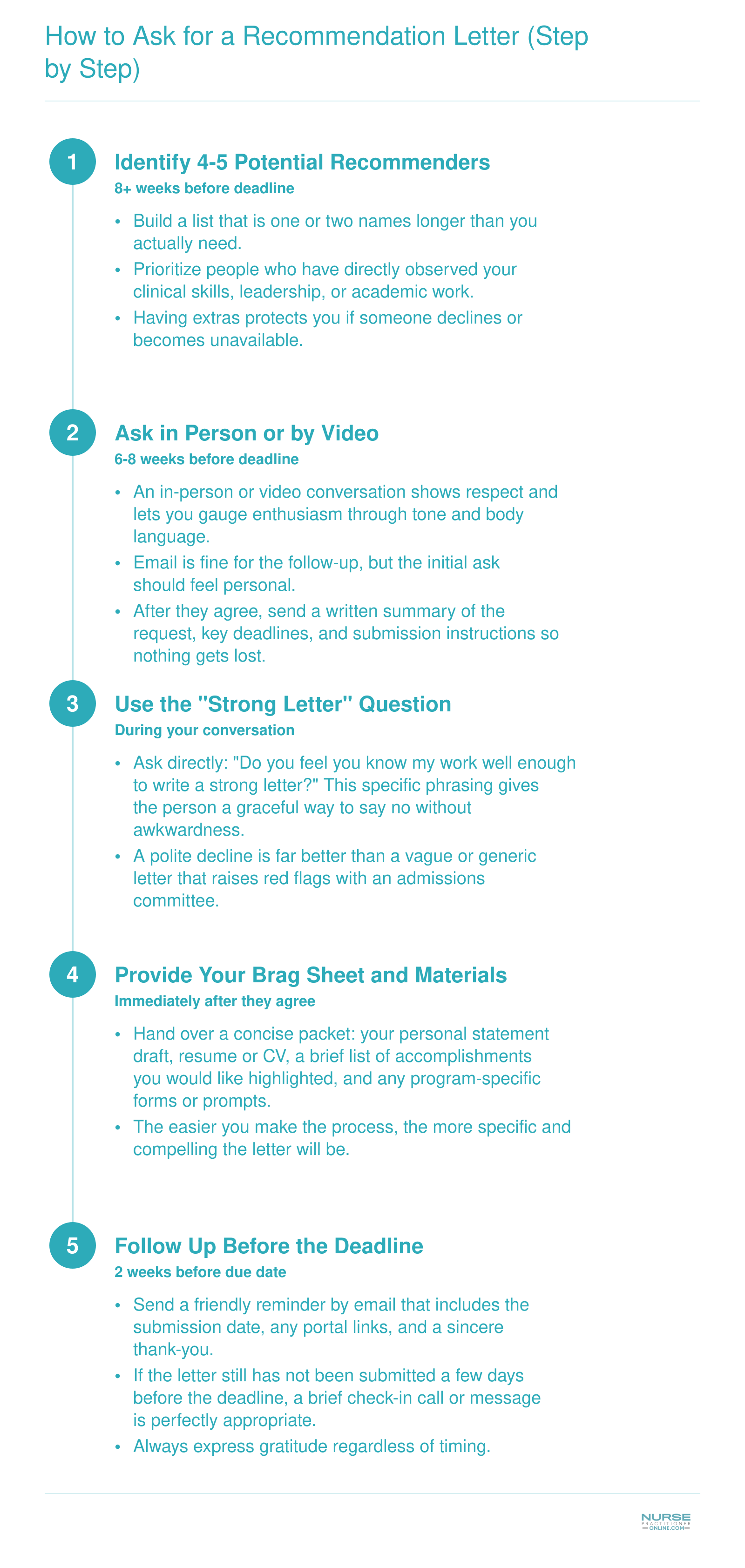
Timing and tact make all the difference when requesting a nurse practitioner letter of recommendation. Starting six to eight weeks before the submission deadline gives busy clinicians, managers, and faculty the breathing room they need to write something thoughtful rather than rushed. The way you frame the initial ask also matters: posing the "strong letter" question lets a potential recommender gracefully decline if they don't feel positioned to advocate for you, saving you both from a lukewarm letter that could quietly hurt your application.
What a Strong NP Recommendation Letter Includes
Admissions committees reviewing your application are searching for evidence that you possess the competencies required for advanced practice nursing. While your recommenders may not explicitly name frameworks like the AACN Essentials or NONPF NP core competencies, committees will recognize these domains when they appear: clinical judgment, evidence-based practice, interprofessional collaboration, person-centered care, professionalism, and leadership.1 A strong letter demonstrates these qualities through concrete examples rather than vague praise.
The Core Competencies Committees Want to See
The 2021 AACN Essentials outline domains that translate directly to what evaluators look for in recommendation letters.2 These include Knowledge for Nursing Practice, Person-Centered Care, Interprofessional Partnerships, Quality and Safety, Professionalism, and Personal, Professional, and Leadership Development. Similarly, NONPF competencies emphasize scientific foundations for practice, quality improvement, technology and information literacy, and independent practice readiness.3
Your recommender does not need to cite these frameworks by name. Instead, committees recognize these competencies when a letter describes how you:
- Demonstrated clinical judgment in complex patient assessments and decision-making
- Applied evidence-based practice by asking good clinical questions and seeking current research
- Communicated effectively with patients, families, and the care team
- Collaborated across disciplines to improve patient outcomes
- Showed professionalism, accountability, and ethical conduct under pressure
- Took initiative and displayed leadership potential in your unit or practice setting
Specific Anecdotes Over Generic Praise
The difference between a forgettable letter and a compelling one often comes down to specificity. "She identified a subtle EKG change that prompted early intervention for a patient who would have otherwise deteriorated" tells evaluators far more than "She is a thorough clinician." The first example demonstrates clinical judgment, prioritization, and the ability to handle high-acuity situations. The second could describe almost anyone.
Encourage your recommenders to recall two or three specific moments that illustrate your capabilities. These anecdotes should connect naturally to the competencies committees value, even without naming those competencies directly. If you are still mapping out the steps to become a nurse practitioner, building these kinds of stories early gives your recommenders richer material to draw from.
Recommended Letter Structure
The strongest letters tend to follow a clear organizational pattern:
- Relationship context and duration: How long has the recommender supervised or worked alongside you, and in what capacity?
- Two to three competency-mapped anecdotes: Specific examples that demonstrate your clinical reasoning, communication, collaboration, or leadership
- Comparison to peers: Statements like "She ranks in the top five percent of nurses I have supervised in my twenty-year career" carry significant weight
- Explicit endorsement for graduate study: A direct statement that the recommender believes you are prepared for the rigor of an NP program
Growth Potential Matters
Committees are not only evaluating your current performance. They want evidence that you can handle graduate-level academic work and eventually practice with greater autonomy. The strongest letters address your capacity for growth, intellectual curiosity, and willingness to seek feedback. A recommender who can speak to how you have developed over time, embraced challenges, or sought out learning opportunities provides exactly what evaluators need to see. Whether you are applying to online MSN NP programs or a DNP track, this forward-looking perspective helps committees picture you thriving in their program.
Questions to Ask Yourself
Strong Vs. Weak Letter: Annotated Side-By-Side Comparison
A single vague sentence can undo an otherwise strong application. Admissions committees read hundreds of letters each cycle, and the difference between a candidate who moves forward and one who stalls often comes down to whether the recommender offered concrete, clinical evidence or simply echoed polite generalities.
The comparison below maps six core letter elements against strong and weak versions of each. The analysis after the table explains why the gap matters.
The Side-by-Side Table
| Element | Strong Version | Weak Version |
|---|---|---|
| Opening / relationship context | "I supervised him directly in the ICU for three years on night shift." | "She is a good nurse and team player." |
| Clinical anecdote | "She consistently identified early signs of sepsis in at least three patients during my supervision, prompting rapid intervention and preventing ICU transfer in two cases." | "He always goes above and beyond for patients." |
| Behavioral / competency example | "When a patient with limited English proficiency became confused about anticoagulation instructions, she recognized the risk, secured an interpreter, and used teach-back to confirm understanding, preventing a potential medication error." | "She is a very good nurse and will do well in your program." |
| Comparative language | "She is among the top 5% of nurses I have supervised in my 18 years as a clinical nurse manager, particularly in her ability to synthesize complex cardiac data into clear plans." | "She is one of the best nurses I have worked with." |
| Alignment with NP role | "She formulates differential diagnoses, proposes evidence-based plans, and adjusts them in response to new data with minimal prompting, behaviors consistent with entry-level NP practice." | "She is always on time, completes assigned tasks, and follows orders well." |
| Closing endorsement | "I recommend her without reservation for admission to your Family Nurse Practitioner program."2 | "I think she will do well in your program." |
Why the Strong Versions Work
Each strong example earns its credibility through specificity, measurability, and relevance to graduate-level practice. Naming a number of patients, a clinical outcome, or a time frame converts vague praise into verifiable evidence. The sepsis example does not just say the nurse is observant; it traces a clinical sequence from recognition to intervention to outcome. The anticoagulation anecdote links a behavioral choice directly to an NP competency: patient safety through autonomous reasoning.
The comparative language example goes further by anchoring the praise in a benchmark. "Top 5% across 18 years" is far harder to dismiss than "one of the best I have worked with," which every candidate hears. Quantified comparisons signal an exceptional candidate rather than a merely adequate one.
The NP-role alignment entry matters because it answers the central question on every admissions committee's mind: is this person ready to function at the provider level, or are they simply a skilled bedside nurse? Describing someone who formulates differentials and adjusts evidence-based plans "with minimal prompting" tells the committee she is already practicing at the edge of her current scope.
Why the Weak Versions Fail
The weak examples share a common flaw: they could apply to any nurse in any setting at any point in their career. Generic praise carries no information that distinguishes your application from the pile. Worse, an overly brief letter with no time frame, no clinical context, and no NP-specific language is often read as a reluctant or obligatory endorsement, even when the recommender meant it kindly.
A closing line like "I think she will do well" hedges in a way that undercuts everything before it. A clean, unambiguous endorsement that names the specific program and includes the writer's contact information signals genuine confidence and gives the committee someone to call if they want more.2
When you prepare your recommenders, share these distinctions. A brief conversation about what strong letters look like, paired with a summary of your clinical accomplishments, gives even a busy supervisor the raw material to write something that actually moves the needle. If you are still mapping out next steps for your application, our guide on how to enroll in NP school online walks you through the full process.
Related Articles
NP School Vs. NP Employment Vs. DNP Letters: Key Differences
The purpose, tone, and content of a recommendation letter shift dramatically depending on whether you are applying to an NP program, an NP position, or a DNP program. Understanding these differences helps you guide your recommenders toward what matters most.
Purpose and audience
Each letter serves a distinct decision-maker. NP school letters target admissions committees looking for future clinical potential.1 NP job letters go to hiring managers or clinical directors who need proof of immediate competence.2 DNP letters are read by faculty who want to see a track record of leadership and scholarly thinking.3
Tone and focus
- NP school admission: Emphasizes academic strengths, clinical reasoning during rotations, and professional traits such as empathy and teamwork. The tone is future-oriented, projecting how the candidate will thrive in a graduate program.
- NP employment: Centers on autonomous clinical performance, reliability under pressure, and concrete examples of diagnostic accuracy or patient management. The tone is confident and evidence-heavy, demonstrating you can handle the role from day one.
- DNP program: Highlights systems-level thinking, quality improvement projects, and the ability to complete a scholarly capstone. The tone conveys intellectual curiosity and a commitment to advancing the profession.
Key competencies to emphasize
The right competencies vary by application type:
- NP school: Academic readiness, clinical judgment, professionalism, and specialty fit. Recommenders should mention how you handle complex patients, ask insightful questions, or show dedication to a particular population.
- NP job: Diagnostic reasoning, autonomous practice, team collaboration, and reliability. Specific examples of times you caught a critical finding or led a code response carry more weight than general praise.
- DNP program: Leadership, quality improvement initiatives, scholarly writing, and project completion skills. Admissions readers look for evidence you can design and execute a practice-change project.
Ideal recommenders
Who writes the letter matters as much as what it says:
- NP school: Nursing faculty, clinical preceptors, or advanced practice nurses who observed your clinical growth. A professor who saw your academic rigor or a preceptor who supervised your care planning is ideal.
- NP job: Current or recent NP supervisors, collaborating physicians, or experienced NP colleagues. They should speak to your day-to-day clinical work, patient volume, and teamwork.
- DNP program: Supervisors with leadership roles, academic mentors familiar with your scholarship, or project collaborators. They should comment on your ability to lead change and write at a doctoral level. If you are still weighing the pros and cons of doctoral education, reviewing the case for DNP entry-to-practice can clarify why these letters carry so much weight.
Special considerations for LPN-to-NP bridge applicants
If you are an LPN applying to a bridge-to-NP program, your letters must go beyond descriptions of your current scope. Admissions committees need to see your readiness to transition into advanced practice, not just a summary of your LPN competence. Ask recommenders to highlight moments when you showed critical thinking beyond your licensed duties, took initiative in care planning, or demonstrated the learning agility required for advanced pharmacology, pathophysiology, and independent decision-making. This differs from a standard RN-to-NP letter, where the recommender already sees you functioning at the registered nurse level. For LPN bridge candidates, choose a supervisor or educator who can speak to your potential rather than someone who can only list your daily tasks.
In 2025, AACN data showed that 93,176 qualified applications to baccalaureate and higher-degree nursing programs were not accepted. In a field this competitive, a compelling letter of recommendation can be the deciding factor that moves your application into the accepted pile.
Providing Materials and Managing the Submission Process
Once your recommenders have agreed to write for you, your next job is to give them everything they need to craft a strong, timely letter, and then to track the process through to completion. A well-organized recommender packet and clear communication can mean the difference between a generic letter and one that vividly showcases your readiness for graduate nursing practice.
Assembling Your Recommender Packet
Create a comprehensive recommender packet for each person writing on your behalf. Include your updated resume or curriculum vitae, a draft of your personal statement (so they understand your professional goals and why you're pursuing the NP specialty), a one-page summary of key clinical experiences or accomplishments you hope they'll highlight, and the program's stated competency domains or mission statement. Add crystal-clear submission instructions: the program name, deadline date, and step-by-step directions for the electronic portal. If you're applying through NursingCAS, explain that they'll receive an email invitation from [email protected] and will need to respond through the Liaison Letters recommender portal.1 Note that for the 2025-2026 application cycle the overall deadline is January 29, 2027 at 11:59 PM Eastern, but individual program deadlines often fall earlier, so flag your earliest due date prominently.2
How NursingCAS Electronic Submission Works
When you add a recommender in the Program Materials section under References, you'll decide at that moment whether to waive your right to view the letter.3 Most applicants waive confidentiality; admissions committees view non-waived letters with some skepticism. Once you save the request, your recommender receives an email with a secure link to the Liaison Letters recommender portal, where they can upload a PDF or type directly into a text box. You can track the status (Requested, Accepted, or Complete) under Check Status in your References tab.3 If a recommender misses the email or the link expires, you can resend the invitation by editing the reference entry and clicking resend. Keep in mind that once a letter is marked Complete, you generally cannot remove or replace it, and letters do not carry over from one application cycle to the next, so plan accordingly.1
Follow-Up Etiquette and Formatting Standards
Two weeks before your earliest program deadline, send a polite reminder email checking whether your recommender has everything they need. If the portal still shows Requested or Accepted (not Complete) three to five days before the deadline, send one more gentle nudge with the due date highlighted. After the letter is submitted, and again after you receive your admission decision, send a thank-you note, even if the outcome wasn't what you hoped. Express genuine gratitude for their time and support.
While NursingCAS does not enforce a universal format requirement, most graduate nursing programs expect letters on institutional or professional letterhead, one to two pages in length, and signed.1 Your recommender will typically upload a PDF that meets these conventions. Because you've waived access, you won't see the final letter, so trust the process and focus your energy on keeping the timeline on track.
Frequently Asked Questions About NP Letters of Recommendation
Navigating the recommendation letter process can feel overwhelming, especially when you are juggling clinical shifts and coursework. Below are answers to the questions working nurses ask most often when preparing their NP program applications.
- How many letters of recommendation do you need for NP programs?
- Most NP programs require two to three letters, though some DNP programs ask for as many as four. Always check each school's specific instructions before you begin reaching out. Starting early gives your recommenders plenty of lead time, and having one extra person on standby protects you if someone's schedule falls through at the last minute.
- Can an LPN use the same type of recommendation letter as an RN applying to NP school?
- Not exactly. LPNs applying to bridge or direct-entry NP tracks should seek letters that highlight clinical competency within their scope of practice, leadership in team settings, and academic readiness. While the format is similar, the content should address how the LPN's experience translates to advanced practice potential rather than simply mirroring an RN's letter.
- Should I waive my right to see the recommendation letter?
- Yes, waiving your right signals confidence and tells the admissions committee that the letter is candid. Schools tend to give more weight to letters submitted under a waiver because reviewers trust that the recommender wrote freely. If you have chosen your recommenders wisely and communicated your goals, you can feel comfortable waiving access.
- What if my recommender asks me to draft the letter myself?
- This happens more often than you might expect. Provide a detailed outline rather than a polished letter, and include specific clinical examples, competencies, and achievements you would like highlighted. Your recommender can then personalize the draft in their own voice. Be transparent, and never submit a letter you wrote entirely on your own without the recommender's genuine review and signature.
- Can I use the same letters for multiple NP programs through NursingCAS?
- Yes. NursingCAS allows recommenders to submit one letter that can be sent to every program you designate within the system. This is a major time saver for both you and your letter writers. However, if a program requires a supplemental or program-specific letter outside NursingCAS, you will need to coordinate that submission separately.
- Is it appropriate to ask a physician I have never worked with directly but who knows my reputation?
- Generally, no. Admissions committees look for specific, firsthand examples of your clinical judgment and professionalism. A physician who knows you only by reputation will struggle to provide those concrete details, and the resulting letter may read as generic. A better choice is a provider, supervisor, or faculty member who has directly observed your patient care and can speak with authority about your skills.