
Most important takeaways…
- AANP membership includes 12 free CE credits annually, offsetting most of the roughly $225 yearly dues on their own.
- NP median salary exceeds $120,000, making annual organization dues less than a single day of pre-tax earnings.
- Twenty-nine states now grant NPs full practice authority, a policy achievement fueled by organized professional advocacy.
- Stacking a national membership with a state or specialty organization lets you match benefits to your career stage and practice setting.
Most nurse practitioners join the American Association of Nurse Practitioners or a state organization knowing it looks good on a CV, but fewer than half ever claim the embedded financial perks that typically exceed the cost of membership within the first quarter of the year. Annual dues run between $153 and $225 for full AANP membership in 2026, yet the organization bundles free continuing education credits, certification-exam discounts, liability-insurance rate reductions, and prescription-database access that retail separately for well over $1,000.
The hesitation is understandable. Between student loans, malpractice premiums, and recertification fees, another annual invoice feels like overhead rather than investment. But when you map membership benefits against what you already spend on CE, exam prep, and professional tools, the break-even point arrives faster than most working NPs expect.
The real challenge is not whether to join, but which tier of membership delivers the highest return at your current career stage and how to activate benefits that many members never touch.
What Is a Professional Nurse Practitioner Organization?
Joining a single organization versus stacking memberships across multiple tiers represents two distinct approaches to professional development, and understanding what these organizations actually do helps you decide which path fits your career goals.
The Three Tiers of NP Organizations
Professional nurse practitioner organizations operate at three distinct levels, each serving complementary purposes in your career.
- National organizations: Groups like the American Association of Nurse Practitioners (AANP) and the American Nurses Credentialing Center (ANCC) represent NPs at the federal level, driving policy changes and offering widely recognized certification and continuing education programs.
- State-level associations: Every state has its own NP organization, such as the California Association for Nurse Practitioners (CANP) or the New York State Nurse Practitioner Association (NYSNAPNY). These groups focus on state-specific scope-of-practice legislation, local networking events, and regional job opportunities.
- Specialty organizations: Groups like the National Association of Pediatric Nurse Practitioners (NAPNAP), Nurse Practitioners in Women's Health (NPWH), and the American Academy of Ambulatory Care Nursing (AAACN) serve NPs working in specific patient populations or practice settings.
A Shared Mission Across All Tiers
Despite their different scopes, all professional NP organizations share four core functions. They advocate for NPs through legislative efforts and public awareness campaigns. They provide continuing education to help members maintain nurse practitioner licensing and stay current with evidence-based practice. They support professional development through leadership opportunities, mentorship programs, and career resources. They also build community by connecting NPs with peers who share similar challenges and goals.
Stacking Memberships for Maximum Benefit
Many NPs hold memberships in more than one organization simultaneously. A family nurse practitioner in Texas might belong to AANP for national advocacy, the Texas Nurse Practitioners (TNP) for state legislative updates, and a specialty group aligned with their clinical focus. Benefits often stack: you might access AANP's extensive continuing education library while also taking advantage of your state association's local conference discounts and a specialty organization's clinical practice guidelines.
Voluntary but Valuable
Membership in these organizations remains completely voluntary. No licensing board requires it. However, the perspective among working NPs has shifted considerably. Rather than viewing dues as an optional expense, more nurse practitioners now treat membership as a career-accelerating investment that pays dividends through networking opportunities, advocacy wins that expand practice authority, and continuing education that keeps skills sharp and certification current.
AANP Vs. State Vs. Specialty NP Organizations: How Benefits Compare
Not all nurse practitioner organizations deliver the same value, and choosing between them is less about prestige than about matching the benefits to where you practice and what you specialize in. Most working NPs end up joining at least two: a national body for credentialing weight and a state or specialty group for local relevance.
The National Heavyweight: AANP
The American Association of Nurse Practitioners is the largest national NP organization, and its benefit package reflects that scale. Annual full membership runs $153 for the 2025-2026 cycle, with a reduced Career Starter rate of $97 for NPs in their first year of practice and a $55 student tier.1 Members receive 12 free CE contact hours included with dues, which alone can offset a meaningful portion of the cost when you compare it to paying per-credit on a commercial CE platform.2
AANP's advocacy work centers on the issues that shape NP practice nationally: full practice authority, Medicare and Medicaid reimbursement parity, and federal regulatory comment.3 Member perks extend beyond CE to include discounts on clinical reference tools, a reduction on AANPCB APRN certification fees, peer-reviewed journal access, the CE Tracker tool for license renewal documentation, and discounted registration for the national conference.3
State NP Associations
State organizations (California's CANP, Texas's TANP, Florida's FNA-NP, New York's NPA of NY, and their counterparts in every other state) are where licensure and scope-of-practice fights actually get won or lost. Their dues are typically lower than AANP's, and their lobbying budgets target state legislatures and boards of nursing. If your state is still working toward full practice authority, your state association is doing that work, and getting involved in politics and nursing at the state level amplifies your voice. State groups also tend to host smaller regional conferences, local job boards, and networking events you can actually attend in person.
Specialty Organizations
Specialty bodies like NPWH (women's health) and NAPNAP (pediatrics) trade breadth for depth. Their CE offerings, practice guidelines, and journals are tailored to one population, which matters most for certification maintenance in a focused specialty. Membership often includes specialty-specific clinical resources you simply will not find through a general NP organization.
For most NPs, the smartest move is layering: AANP for national clout and CE volume, a state association for advocacy where you actually practice, and a specialty group if your patient panel is narrow enough to justify it.
Questions to Ask Yourself
5 Unexpected Perks That Make NP Membership Worth It
AANP members receive 12 free continuing education credits per year through the Course of the Month program, a benefit that quickly offsets membership costs when you compare it to retail CE pricing.1 That's just the start. Professional nurse practitioner organizations deliver a surprising range of benefits that go far beyond the expected networking events and email newsletters. Here are five perks that often surprise new members and make the investment pay for itself.
Perk 1: CE Savings That Add Up Fast
AANP membership bundles 12 free CE credits annually through the Course of the Month program, plus access to 10 free CE articles from the Journal of the American Association of Nurse Practitioners (JAANP).2 Members also receive 50% off additional JAANP CE offerings.3 When you price individual CE credits at typical retail rates of $15 to $30 per contact hour, those 12 free credits represent $180 to $360 in value before you count the discounted JAANP catalog. Many state organizations offer similar CE bundles through their annual conferences or online libraries, and specialty organizations often include certification-specific CE as part of dues. Over a two-year certification cycle, the CE savings alone can cover your membership cost multiple times over.
Perk 2: Student Loan Refinancing and Financial Perks
Several NP organizations partner with financial service providers to offer members reduced student loan refinancing rates, group discounts on malpractice insurance, and access to retail savings programs. While specific partnerships and rate reductions change year to year, these benefits can translate to meaningful savings on your biggest monthly expenses. Malpractice insurance group rates through professional organizations frequently undercut individual policies by 10% to 20%, and even small reductions in student loan interest rates compound significantly over a 10- or 15-year repayment term.
Perk 3: Clinical Tool and Resource Access
AANP members gain access to Point of Care Tools and Clinical Practice Briefs, resources that support real-time clinical decision-making and evidence-based prescribing.4 Many organizations also offer enhanced CE tracking tools that store and organize your certificates for easy reporting at recertification time. If you're looking for even more ways to streamline your workflow, consider exploring best apps for nurse practitioners. Clinical decision-support subscriptions and prescribing references typically run several hundred dollars per year when purchased individually, making bundled access a substantial hidden benefit.
Perk 4: Advocacy Wins That Directly Impact NP Earnings and Autonomy
Organized advocacy delivers tangible results. Between 2024 and 2026, coordinated lobbying efforts by national and state NP organizations contributed to full practice authority expansions, scope-of-practice clarifications, and reimbursement parity victories in multiple states. These legislative wins directly affect your earning potential and clinical autonomy, opening doors to independent practice, broader patient panels, and competitive compensation. Membership dues fund the legal research, coalition-building, and statehouse presence that make these victories possible.
Perk 5: Fellowship and Leadership Pathways
The Fellow of the American Association of Nurse Practitioners (FAANP) credential recognizes sustained professional achievement and opens doors to academic appointments, editorial boards, and national committee service. State organizations offer similar leadership tracks through board service, taskforce participation, and mentorship programs. These credentials and experiences differentiate your CV in competitive markets, strengthen tenure and promotion portfolios, and build the professional networks that lead to career-defining opportunities. For NPs weighing advanced degrees alongside organizational involvement, it's worth considering whether a DNP is worth it as part of your long-term career strategy.
Exclusive Member Discounts You May Be Overlooking
Beyond visible perks like CE and advocacy, your membership portal hides everyday savings that can quietly offset your dues. These discounts sit behind a login, but spending ten minutes browsing can put money back in your budget.
Travel Savings on Rental Cars and Hotels
Many NP organizations negotiate corporate rates with rental car agencies and hotels. A membership code unlocks unadvertised savings. Before your next trip, check the travel partnerships page for discounted rates on mid-week and weekend rentals and preferred hotel pricing, even for personal travel.
Insurance Discounts Worth Investigating
Malpractice and disability insurance premiums can feel steep. Associations often partner with carriers to offer group rates. Even a small reduction could cover much of your annual dues.
Professional Retail and Software Deals
Scrubs, stethoscopes, and reference apps are recurring costs. Many NP organizations maintain discounts with uniform brands, equipment retailers, and software companies. Browse the 'Member Offers' or 'Partners' page to save on items you already buy.
Affinity Programs for Everyday Expenses
Some associations extend buying power to consumer services. Discounts through programs with carriers like Verizon or Sprint may be available after verifying membership. Check the affinity section to reduce your cell phone bill; these set-and-forget savings compound over time.
The Real ROI of NP Organization Membership
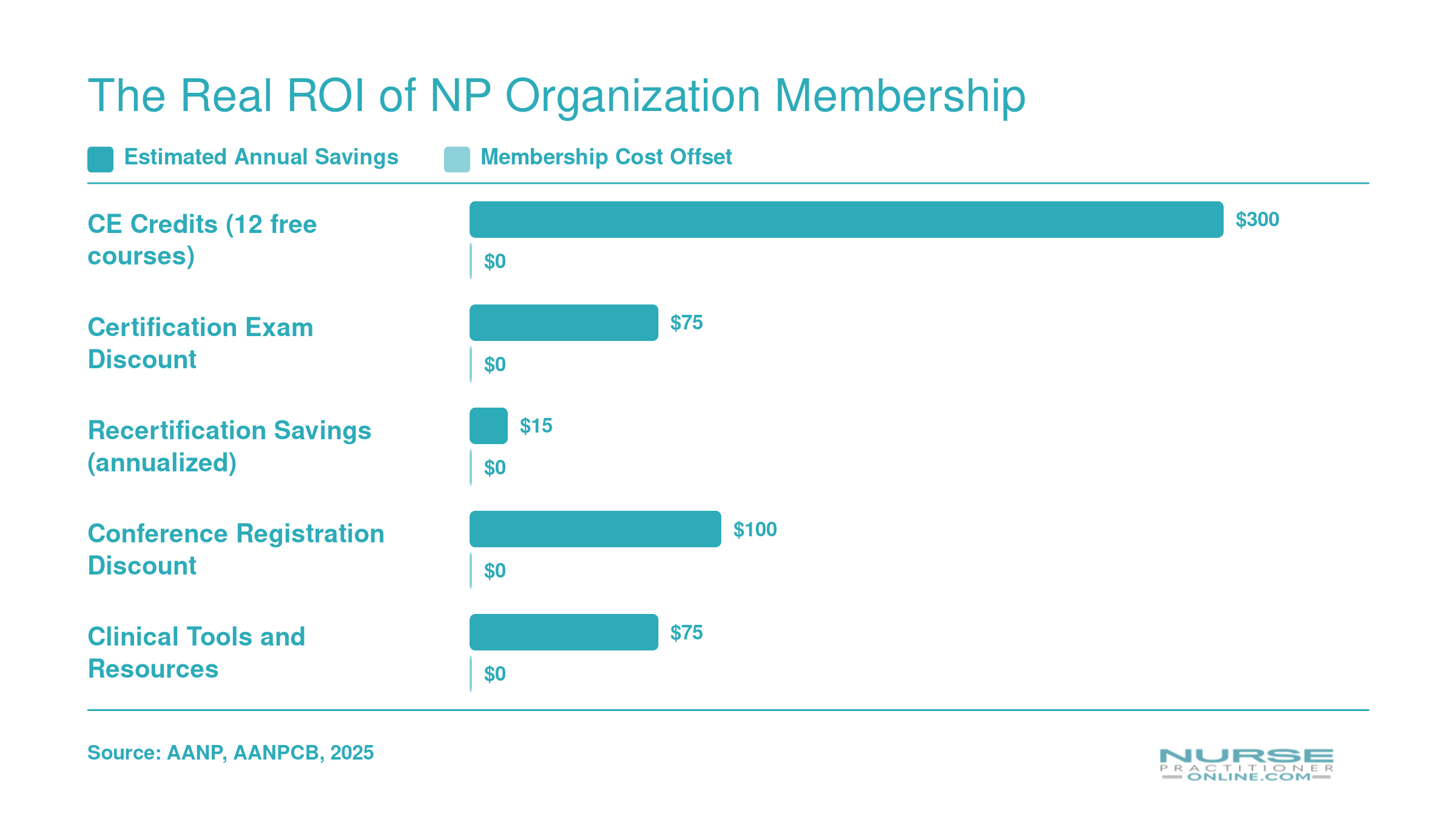
When you stack up your annual AANP membership fee against the savings it unlocks, the math speaks for itself. Here is a look at how estimated annual savings across five common benefit categories compare to the $153 full membership cost.
How Much Does NP Organization Membership Cost, and What's the ROI?
One of the most common questions working nurses ask before committing to a professional organization is whether the annual dues actually pay for themselves. The short answer: for most nurse practitioners, membership costs less than a single day's pay, and the combined savings can easily double or triple that investment over a year.
AANP Membership Dues by Tier
The American Association of Nurse Practitioners structures its dues so that members at every career stage can participate. As of 2025, annual rates are:1
- Full NP member: $153 per year
- Career starter (first year after licensure): $97 per year
- Licensed NP student (enrolled in a post-graduate program): $97 per year
- Student (pre-licensure): $55 per year
- Retired NP: $56 per year
AANP does not currently offer multi-year discount bundles or auto-renewal savings, so the price you see is the price you pay each cycle.1 The organization did implement a modest 2 percent dues increase in 2025, which is worth noting if you are budgeting for future years.
How State Association Dues Compare
State NP organizations set their own fee schedules, and the range can surprise you. Representative annual dues in four high-NP-employment states illustrate the spread:
- California (CANP): Dues typically fall in the mid-to-upper range among state associations, reflecting the state's larger advocacy infrastructure.
- Texas (TANP): Texas charges moderate dues that fund active legislative efforts around full practice authority.
- Florida: Florida's NP association dues tend to be on the lower end, though members gain access to state-specific CE and regulatory updates.
- New York: New York's association sits in a similar mid-range bracket, with dues supporting ongoing scope-of-practice campaigns.
Many NPs join both a national organization like AANP and their state association, so plan for a combined outlay that usually lands between $200 and $400 per year.
A Sample ROI Calculation
Let us walk through a realistic annual scenario for a full NP member paying $153 in AANP dues:
- CE savings: AANP provides free and discounted continuing education credits. Purchasing equivalent CE independently often costs $200 to $400 per year.
- Certification discounts: Members frequently receive reduced fees on recertification exams, saving $25 to $75 depending on the certifying body's partnership.
- Malpractice and insurance discounts: Group rates negotiated through membership can shave $50 to $150 off annual malpractice premiums.
- Clinical tools and resources: Access to members-only clinical decision support tools and practice guidelines can replace subscriptions that run $100 or more annually.
Add those up conservatively and you are looking at $375 to $725 in tangible savings against a $153 investment. That is a net positive of at least $220 in the most conservative estimate.
Framing the Cost Against Your Earnings
If the AANP membership cost still gives you pause, consider this: the median NP earns well over $200 in a single workday. You can explore nurse practitioner salary by specialty for a closer look at where your specialty falls. Your full-year AANP dues amount to less than one day's take-home pay. When you factor in the professional development, advocacy support, and networking access layered on top of the dollar savings outlined above, the return is not just positive. It is one of the most efficient investments you can make in your career each year.
Which Membership Delivers the Most Value at Your Career Stage?
Your professional needs shift dramatically from the first day of your NP program to the day you step back from clinical practice, and the smartest approach to membership recognizes those changes. Rather than asking whether to join a professional organization, consider which benefits align with where you are right now and where you want to be in five years.
Student NPs: Building Your Foundation
If you are currently enrolled in an NP program, national membership through AANP offers the strongest return on a modest investment. Student dues run about $55 per year, and members receive a $75 discount on certification exams, meaning the membership essentially pays for itself before you graduate.1 Beyond the financial perks, students gain access to the AANP SET learning platform, which provides study resources tailored to board preparation. Scholarship and grant opportunities through the organization can also offset program costs.2 At this stage, networking benefits matter less than tangible savings and exam readiness tools.
New Graduate NPs: Launching Your Career
The transition from student to practicing clinician brings new priorities. That same $75 certification exam discount remains valuable if you have not yet sat for boards, but the AANP JobCenter becomes increasingly relevant as you search for your first position.3 Transition-to-practice support helps new graduates navigate the steep learning curve of independent or semi-independent practice. Financial products offered through membership can assist with student loan management or first-time home purchases. National membership continues to deliver the broadest utility during these early career years.
Mid-Career NPs: Expanding Your Influence
Once you have established clinical competence and professional stability, membership value shifts toward leadership and advocacy. Committee positions, state representative roles, and involvement with the AANP Advocacy Center allow mid-career NPs to shape policy and advance the profession.3 Advanced continuing education offerings and the AANP Network for Research support those pursuing scholarly work or specialty certifications. At this stage, many NPs also join specialty organizations like NPWH to complement their national membership, creating a layered network of professional resources.
Late-Career and Retiring NPs: Staying Connected
Retired membership options provide reduced dues while maintaining access to journals, continuing education, and professional community.3 Many late-career NPs find value in advisory roles and mentorship opportunities that allow them to guide the next generation. Continued advocacy involvement ensures your voice remains part of the policy conversation even after stepping back from direct patient care.
How NP Salary and Job Outlook Make Membership a Smart Investment
When you stack the cost of a professional nurse practitioner organization membership against what NPs actually earn, the math speaks for itself. Even at the 25th percentile, nurse practitioners bring home nearly $110,000 per year, which means a typical annual membership fee of $150 to $250 represents roughly 0.1% to 0.2% of your income. With more than 307,000 NPs employed nationally and projected job growth of 35% from 2024 to 2034 (according to the Bureau of Labor Statistics Occupational Outlook Handbook), the profession's collective scale gives organized membership real influence on policy, practice standards, and reimbursement advocacy.
| Salary Benchmark | Annual Earnings | Membership Fee as a Percentage of Earnings |
|---|---|---|
| 25th Percentile | $109,940 | Approximately 0.14% to 0.23% |
| Median (50th Percentile) | $129,210 | Approximately 0.12% to 0.19% |
| Mean (Average) | $132,000 | Approximately 0.11% to 0.19% |
| 75th Percentile | $149,570 | Approximately 0.10% to 0.17% |
As of September 2025, 29 U.S. states and territories have granted full practice authority to nurse practitioners, a major policy win driven largely by advocacy efforts from the American Association of Nurse Practitioners and state-level professional organizations working together to expand access to care.
Tips to Maximize Your NP Organization Membership
Most NP certifications require 1,000 clinical hours and 75 continuing education credits per renewal cycle, which means your membership CE library is not a passive perk but an active financial tool. The nurses who get the most out of their dues treat membership as a system, not a subscription.
Stack Memberships Without Doubling Up
Joining one national organization alongside one state or specialty association gives you access to complementary CE libraries, distinct advocacy networks, and different discount ecosystems. A national membership tends to carry broader clinical resources and conference access, while a state association connects you directly to legislators shaping scope-of-practice rules in your backyard. Together they cover more ground than either does alone, without much overlap in what they offer day to day.
Time Your CE Strategically
Front-load your continuing education early in the membership year. If you wait until month ten to start clicking through modules, you risk a renewal deadline cutting your access short or a busy stretch pushing CE into crunch mode. Completing credits in the first quarter also leaves room to use the remaining months for elective topics, specialty deep-dives, or conference-based credits that add breadth to your portfolio.
Make the Conference Math Work
Attending at least one conference per year, whether virtual or in-person, often pays for itself. Member registration rates on a single national conference can run several hundred dollars below the non-member price, which frequently exceeds the cost of annual dues on its own. Add a workshop or pre-conference session and the savings compound quickly.
Volunteer Your Way Into Leadership
Committee roles and advocacy positions are among the least-used and highest-value benefits available. Volunteering opens doors to mentorship, builds a visible professional record, and in some organizations creates a pathway toward fellowship recognition. If FAANP fellowship is on your radar, active organizational service is one of the criteria reviewers look at closely.
Put Lesser-Known Perks on Your Calendar
Prescribing reference tools, malpractice insurance discounts, and job board features are the benefits members most often forget they have. Exploring nurse practitioner tools you already pay for can make a real difference. A simple calendar reminder at the start of each quarter prompts you to log in, check what is available, and actually use what you are paying for. A benefit you never open is not a benefit at all.
Frequently Asked Questions About NP Organization Membership
Choosing the right professional organization (or organizations) is a practical decision that affects your continuing education, your career trajectory, and your bottom line. Below are answers to the most common questions working nurses and new NP graduates ask about membership.
- What are the perks of being a nurse practitioner who joins a professional organization?
- Beyond networking, members typically gain access to discounted or free continuing education credits, group rates on malpractice insurance, legislative advocacy on scope of practice issues, career resources like job boards and salary data, and exclusive conference pricing. Many organizations also offer mentorship programs and leadership development tracks that are difficult to access independently.
- How much does AANP membership cost and is it worth it?
- Full AANP membership runs roughly $175 per year for practicing NPs, with discounted rates for students and new graduates. When you factor in the value of included CE credits, certification exam discounts, malpractice insurance savings, and access to clinical resources, most members recoup the fee several times over. Many NPs find it pays for itself with just one or two free CE courses.
- What CE benefits come with NP organization membership?
- Most NP organizations bundle continuing education into membership. AANP, for example, offers a library of free and low cost CE modules covering pharmacology, clinical topics, and practice management. State associations often provide CE specific to local prescriptive authority rules and scope of practice updates. These included credits can save members hundreds of dollars annually compared to purchasing CE courses individually.
- How do AANP and state NP association benefits compare?
- AANP focuses on national advocacy, broad CE libraries, certification support, and large scale networking events. State NP associations concentrate on local legislative issues, state specific CE requirements, and regional networking. AANP offers wider clinical resources, while your state association gives you a direct voice in the regulatory environment that governs your daily practice. The two complement each other well.
- Which NP organization membership is best for new graduates?
- New graduates often benefit most from AANP's discounted first year membership, which includes certification exam prep resources, mentorship matching, and a robust job board. Adding your state NP association is also wise because it connects you with local preceptors and keeps you informed about state level practice regulations. Specialty organizations can wait until you have settled into a clinical focus.
- Can joining an NP organization help you earn more money?
- Yes, indirectly. Members gain access to salary benchmarking data, contract negotiation workshops, and job boards that list competitive positions. Organizations also advocate for full practice authority legislation, which research associates with higher NP compensation in states where it passes. Over a career, these tools and advocacy efforts can translate into meaningfully higher lifetime earnings.
- Can you belong to more than one NP organization at the same time?
- Absolutely. There is no limit, and many experienced NPs hold simultaneous memberships in a national organization like AANP, their state NP association, and a specialty group aligned with their clinical focus. The key is evaluating each membership's cost against the specific benefits it provides at your current career stage, then adjusting as your priorities evolve.
Is NP organization membership actually worth the annual cost? For most nurse practitioners, the answer is clear: benefits like free CE credits, malpractice discounts, and career resources routinely return three to five times the membership fee in real savings, and that math holds even at the 25th percentile of NP earnings.
The smartest move is straightforward: pick one national organization and one state or specialty organization, activate your benefits the same week you join, and treat those dues as a line item in your professional budget, not an optional expense. Whether you are just starting to become a nurse practitioner or you are a seasoned clinician weighing a DNP degree, organized membership may be the single highest-leverage action you can take for both your profession and your paycheck as scope-of-practice advocacy continues to expand full practice authority state by state.