Most important takeaways…
- NP employment is projected to grow by 40 percent, making a strong professional network essential for accessing top opportunities early.
- Ready to use message templates and scripts help you start genuine conversations on LinkedIn and at conferences without overthinking.
- A 48 hour follow-up email after meeting a new contact is the single networking habit that compounds results over time.
- Median NP salaries vary by nearly $38,000 across states, so networking beyond your local market can significantly boost earning potential.
Roughly 70 to 85 percent of jobs are filled through referrals and personal connections rather than public postings, and the nurse practitioner market is no exception. Hiring managers in primary care, acute care, and specialty clinics routinely fill openings through word-of-mouth before a requisition ever reaches a job board or hospital careers page.
That creates a quiet problem for NPs. Graduate programs train clinicians in pharmacology, differential diagnosis, and patient management, but rarely teach the relationship-building skills that determine which job offers, preceptor slots, and committee invitations actually reach you. Even NPs completing nurse practitioner clinical rotations may not realize those placements are prime networking opportunities. The result is a workforce of capable providers competing for visible openings while the better roles move through private channels.
Why Networking Is Essential for Nurse Practitioners
If you have ever landed a clinical rotation through a colleague's recommendation or learned about a job opening before it was posted, you have already experienced the power of professional networking. For nurse practitioners, building relationships is not just a nice career extra. It is often the difference between struggling to find opportunities and having them come to you.
The 4 C's of Networking Applied to NP Practice
Dr. Ivan Misner, founder of Business Network International, developed a framework called the 4 C's of Networking that translates remarkably well to advanced practice nursing.1 The four components are Competence, Credibility, Clarity, and Connectivity.
- Competence: Your clinical knowledge and skills form the foundation. When colleagues see you handle a complex diabetic patient or navigate a tricky differential diagnosis, they remember. That competence becomes your reputation.
- Credibility: Trust takes time to build but compounds over years. The preceptor who watches you work hard during clinicals becomes the supervisor who recommends you for a position three years later.
- Clarity: Can you articulate what you are looking for in your career? NPs who clearly communicate their specialty interests or practice goals make it easy for others to connect them with relevant opportunities.
- Connectivity: This measures both the quantity and quality of your professional relationships. A diverse network spanning different specialties, practice settings, and career stages opens more doors than a narrow one.
Why Cold Applications Fall Short
Healthcare hiring often happens through channels that never touch public job boards. While precise statistics on hidden job market rates in nursing vary by region and specialty, industry surveys consistently show that referral hiring dominates across professional fields. One survey of nearly 4,000 businesses found that 73 percent obtained business through networking referrals.2 Healthcare organizations follow similar patterns, frequently filling positions through internal recommendations before advertising externally.
For NPs specifically, this matters because many desirable positions, particularly those in small practices, specialty clinics, or emerging telehealth companies, rely heavily on word-of-mouth recruitment. Your application carries more weight when someone on the inside has already vouched for your clinical judgment.
NP Networking Is Different
General professional networking advice often misses what makes NP relationships unique. Your network is not just about job hunting. It serves multiple critical functions:
- Scope-of-practice advocacy: State-level legislative efforts to expand NP autonomy depend on organized voices. Relationships with professional association members and policy-focused NPs amplify your influence.
- Collaborative practice agreements: In states requiring physician oversight, finding a collaborating physician often comes down to who you know and who will vouch for your competence.
- Preceptorship pipelines: Clinical placement shortages are real. Students and new grads who build relationships with practicing NPs gain access to preceptors that their programs cannot always provide.
- Specialty pivots: Transitioning from family practice to dermatology or acute care requires mentors and advocates in your target specialty.
Beyond Job Leads
Networking drives more than employment. Your professional connections become sources of mentorship when you face difficult clinical decisions or career crossroads. They alert you to continuing education opportunities, conference scholarships, and certification updates. Understanding the evolving scope of practice for nurse practitioners across different states helps you focus your advocacy efforts and target the right contacts. Meanwhile, learning how nurse practitioners get involved in politics can further expand your influence beyond the clinic.
The relationships you build now will pay dividends for decades, not just in jobs secured but in the quality of your practice and your voice in the profession.
NP Networking by Career Stage: Students, New Grads, and Experienced Clinicians
What does nurse practitioner networking actually look like at my stage of training or experience?
That question deserves a direct answer, because the honest truth is that the right networking moves at year one of NP school look nothing like the right moves at year ten of practice. Matching your strategy to your stage is what separates purposeful relationship-building from spinning your wheels.
NP Students: You Are Already Networking
Every clinical rotation is a built-in networking event. Your preceptors, the attending physicians you collaborate with, the staff NPs you shadow on busy mornings: these people are future references, colleagues, and possibly employers. Treat those relationships accordingly from the very first shift.
Join the student chapter of the American Association of Nurse Practitioners (AANP) or a specialty organization that aligns with your interests. Student membership fees are typically low, and the access to conferences, listservs, and mentors is real.
Your one concrete weekly action: send one genuine thank-you email per clinical week. Keep it brief and specific, mention something you learned or a case that stuck with you. It takes three minutes and people remember it months later.
New Graduates (0-3 Years): Build Visibility While You Find Your Footing
The first few years after graduation are primarily about two things: finding a mentor who practices in your specialty, and building a professional presence that reflects where you are headed clinically. A LinkedIn profile that clearly signals your specialty interest and the patient populations you serve does quiet work on your behalf between active job searches.
Attend local NP meetups or regional conferences when you can. State NP associations often host events that are affordable and draw a mix of new and established practitioners. These rooms are low-stakes and genuinely friendly.
Your one concrete weekly action: comment thoughtfully on two NP-related LinkedIn posts. A substantive comment, one that adds a clinical perspective or asks a real question, is more visible than you might expect and opens doors to direct conversations.
Experienced NPs (5+ Years): Shift From Receiving to Giving
At this stage, the most powerful networking you can do is generous networking. Mentor a student preceptee. Volunteer for a professional committee. Submit a proposal to speak at a regional or national conference. These activities expand your lateral network in ways that job boards never will, and they position you naturally for leadership roles, nurse practitioner advancement opportunities, or practice ownership conversations.
Networking with peers at your level, other experienced NPs across specialties, opens doors to collaborative practice models, partnership opportunities, and leadership pipelines that are rarely posted publicly.
Your one concrete weekly action: reach out to one former colleague or professional contact each week, not to ask for anything, but simply to check in or share something useful. Relationships you tend before you need them are the ones that actually deliver when it counts.
The Bureau of Labor Statistics projects that nurse practitioner employment will grow by 40 percent, making it one of the fastest growing occupations in the country. With demand this strong, building a solid professional network now positions you to access the best opportunities before they ever hit a public job board.
Where to Network: Top Platforms and Organizations for NPs
Networking platforms for nurse practitioners fall into three practical buckets: large general-membership organizations that connect you with NPs across every specialty, specialty-focused associations that put you in a room with people who do exactly what you do, and digital platforms built specifically for healthcare professionals. Knowing which mix to invest your time in depends on your specialty, your career stage, and how much travel or screen time you can realistically spare.
General Membership Organizations
The American Association of Nurse Practitioners (AANP) is the default starting point for most NPs regardless of specialty.1 Membership includes access to a member community, a dedicated student forum, the AANP Job Center, continuing education, and advocacy tools. AANP offers multiple membership tiers, including student and post-master's rates, and runs two major in-person events in 2026: the National Conference in the summer and the Fall Conference.2 Both are strong venues for meeting NPs outside your immediate workplace.
Specialty Organizations Worth Joining
If you practice in a defined specialty, a specialty organization usually delivers tighter, more useful connections than a general one:3
- NAPNAP (Pediatric NPs): 50 local chapters plus an online chapter, with the Annual National Conference on Pediatric Health Care anchoring the year.
- NPWH (Women's Health NPs): A community of roughly 13,500 members focused on women's health practice and specialty advocacy.
- NAFNP (Family NPs): Built around committee-based involvement and monthly member engagement meetings in 2026, which makes it easier to plug in between annual conferences.
- AAENP (Emergency NPs): A specialty community for emergency NPs with regular meetings, active committees, and specialty-specific education.
Joining one specialty organization plus AANP is a reasonable baseline. Two specialty organizations gets expensive fast, so pick the one whose committees, chapters, or meeting cadence you will actually use. If you are still completing your program, networking with NP clinical preceptors can open doors to specialty communities before you even graduate.
Digital Platforms
ENP Network is a professional networking platform designed for healthcare professionals seeking peer connections. It supports profile building, peer connections, groups, job listings, and practice visibility, so it functions as a healthcare-specific complement to LinkedIn rather than a replacement.3 Most NPs benefit from maintaining both: LinkedIn for recruiters and broader professional reach, ENP Network for tighter clinical peer conversations. And if networking sparks interest in paths beyond the bedside, there are a growing number of non-clinical nurse practitioner jobs worth exploring as well.
Related Articles
Networking Message Templates and Scripts for Nurse Practitioners
Knowing you should network is one thing; knowing exactly what to say is another. The gap between intention and action usually comes down to staring at a blank message box and wondering how to sound genuine without overstepping. These ready-to-use templates give you a starting framework, but the real magic happens when you customize them to reflect your voice and your specific situation.
LinkedIn Connection Request (Under 300 Characters)
LinkedIn limits connection notes to 300 characters, so every word matters. Lead with a genuine compliment, name the specialty you are interested in, and close with a clear, low-pressure ask.
"Hi [Name], I loved your post on managing complex psych-med panels in primary care. I'm an RN transitioning into psych-mental health NP practice and would value connecting with someone whose clinical perspective I admire. Would you be open to a brief chat?"
That clocks in just under the limit. Notice it references a specific post and names the specialty, so the recipient knows this is not a mass blast.
Post-Conference Follow-Up Email
Subject line: Great meeting you at [Conference Name]
"Hi [Name],
It was wonderful speaking with you at [Conference Name] during the session on [topic]. Your insight about [specific point they made] really shifted how I'm thinking about [related clinical or career issue].
I came across [article, resource, or guideline] that connects to what we discussed and thought you might find it useful: [brief description, no attachment unless invited].
I'd love to continue the conversation. Would you be open to a 15-minute call or coffee chat in the next few weeks? I'm flexible on timing.
Warm regards, [Your name, credentials, and contact info]"
The key here is offering something of value before making an ask. A relevant resource or article shows you were genuinely listening, not just collecting contacts.
Mentor Request Template
Reaching out cold for mentorship can feel intimidating, but framing a small, time-limited ask dramatically increases your chances of a yes.
"Hi [Name],
I've followed your work in [specialty or setting] for some time, and your [publication, presentation, leadership role] particularly resonated with me as I navigate [your current career stage or transition].
I'm hoping to learn more about [one or two focused topics], and I would be grateful for a single 20-minute phone call at your convenience. I've prepared a few specific questions so I can respect your time.
I completely understand if your schedule doesn't allow it. Either way, thank you for the work you do in advancing NP practice.
Best, [Your name and credentials]"
Proposing a single short call removes the pressure of an open-ended mentoring commitment. If the conversation goes well, you can naturally discuss continuing the relationship. This approach is especially valuable if you are navigating the path from RN to NP and looking for experienced practitioners to guide you.
Informational Interview Ask
When you are exploring a new clinical setting or specialty, frame the outreach as learning rather than a veiled job inquiry. People are far more willing to share their experience when they do not feel like they are being pitched.
"Hi [Name],
I'm a [current role] exploring the transition into [target specialty or setting]. I've been researching the day-to-day realities of [specific aspect: patient population, workflow, collaborative model] and would love to hear a firsthand perspective.
Would you have 20 minutes in the coming weeks for an informational conversation? I'm genuinely interested in understanding the rewards and challenges of the role, not making any asks beyond your insight.
Thank you for considering it. [Your name and credentials]"
Naming the specific aspect you want to learn about signals preparation and keeps the conversation focused. If you are considering roles outside the exam room, informational interviews are one of the best ways to explore non-clinical jobs for nurse practitioners before committing to a pivot.
A Note on Personalization
Templates are starting points, not finished products. Before you hit send on any of these, change at least two details to reflect the actual person and situation. Swap in a reference to something they recently published, a mutual connection, a shared clinical interest, or a specific event where your paths crossed. Generic messages get ignored; personalized ones get replies. Even a small detail, like mentioning the title of a talk they gave or a comment they left in an online forum, signals that you did your homework and are reaching out with genuine intent rather than copying and pasting your way through a contact list.
Used consistently and authentically, these scripts can open doors to specialty pivots, mentorship relationships, and job leads that never hit a public posting.
Questions to Ask Yourself
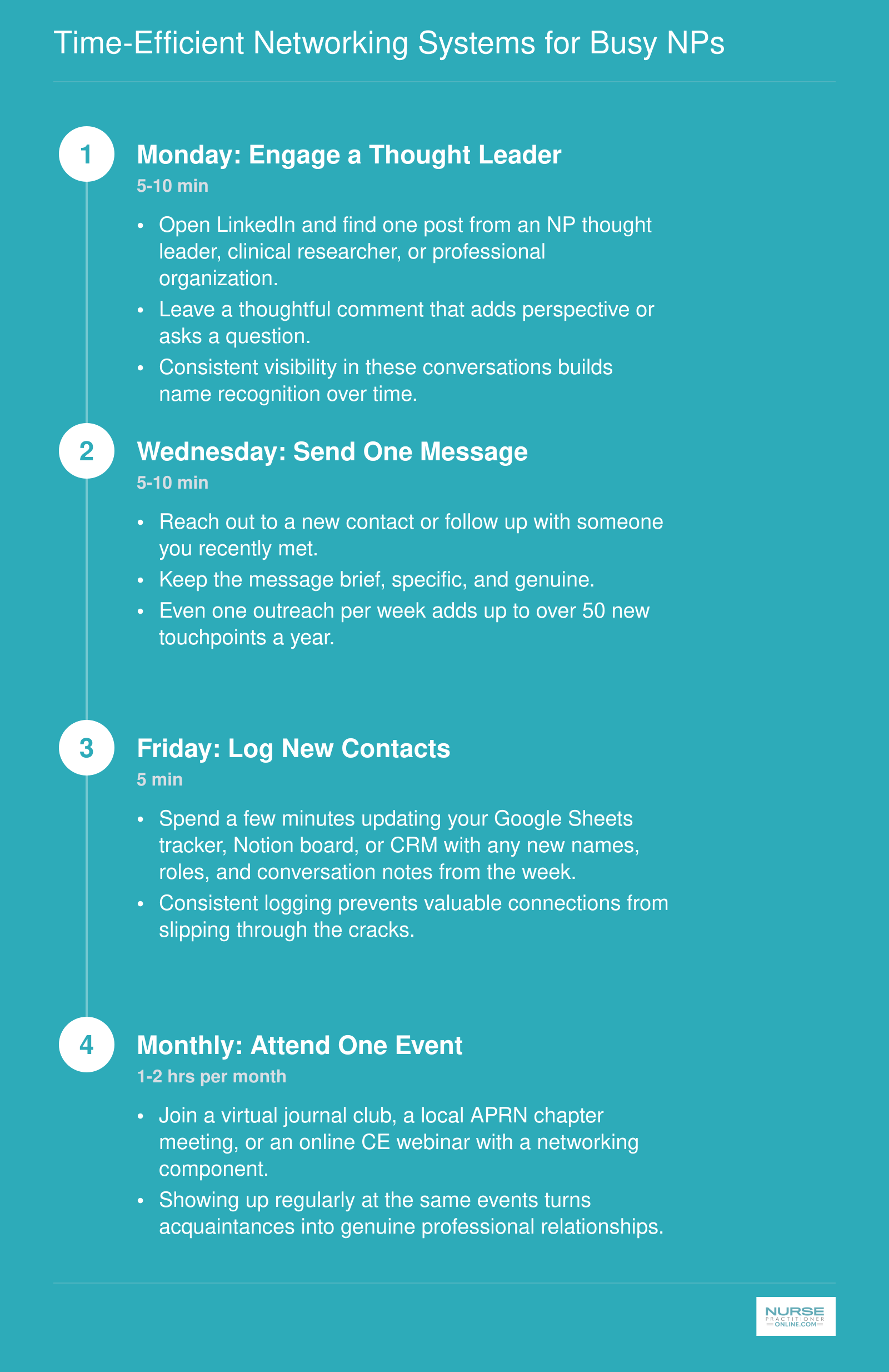
Time-Efficient Networking Systems for Busy NPs
You don't need hours each week to build a strong professional network. A simple, repeatable cadence keeps you visible and connected without cutting into patient care or personal time. Track your contacts in a free tool like Google Sheets, a Notion template, or even a recurring phone reminder, and set a measurable quarterly goal: aim for three new meaningful connections per quarter and one informational interview per month.
How to Use Networking to Land an NP Job
How can you turn a casual coffee chat into a job offer without coming across as pushy? The answer lies in a subtle, relationship-first approach that lets the opportunity come to you.
The "Planted Seed" Approach: Informational Interviews That Lead to Opportunities
Informational interviews are your most natural entry point. Instead of asking "Are you hiring?" you plant a single seed and let it grow. Begin by expressing genuine curiosity about their practice setting or patient population. Near the end of the conversation, when the rapport is strong, you can say: "I'm starting to explore opportunities where I can build on these skills. If you hear of any openings that might fit, I'd love a heads-up." Then let it go. This low-pressure mention puts you on their radar without demanding immediate action. When a position does open, they are far more likely to think of you because you have already established a connection.
Using LinkedIn to Surface NP Job Leads Every Day
LinkedIn is the modern front door for NP recruitment, and small tweaks can dramatically increase your visibility. Start with your headline: instead of "Nurse Practitioner" alone, try something like "Family Nurse Practitioner | Specializing in Diabetes Care & Telehealth" so recruiters searching for those keywords find you first. Next, shift from passive scrolling to active engagement. Comment thoughtfully on posts from hiring managers or clinical directors in your desired specialty. A simple observation or question shows your name in their notifications, building familiarity. Finally, join NP job-posting groups such as "Nurse Practitioner Jobs Network" or local state NP association groups. Many positions get shared there before ever hitting a major job board.
How to Ask for a Referral Without Feeling Awkward
If you have a contact at a practice you're targeting, the referral request is one of the most high-impact moves you can make. The key is to give them an easy out and a simple way to say yes. You might say: "I saw the posting in your urgent care department and it aligns perfectly with what I'm looking for. If you're comfortable putting in a good word, I'd be grateful. No pressure at all." This phrasing respects their professional boundaries while making the ask clear. Even if they don't refer you, they may share insider info about the team culture or hiring timeline. If you're also weighing roles outside traditional clinical settings, exploring alternative jobs for nurse practitioners can expand the types of referrals you request.
Why Staying Connected with NP Recruiters Pays Off
Many NPs treat recruiters like a one-time transaction, but building ongoing relationships with NP-focused staffing agencies and healthcare recruiters creates a long-term asset. Connect with a few on LinkedIn, keep your profile updated, and check in every few months, even when you're happy in your role. Send a brief message: "No active search right now, but I always like to know what's out there for future planning." This keeps you top-of-mind for recruiters who often fill roles before they're publicly listed.
Healthcare-wide trends in 2026 show referred employees have an 85% retention rate, compared to 65% for those hired through job boards, a sign that referrals lead to better matches and longer tenure.1 With projected NP job growth of 40 to 45% through 2033, a network that's already in place positions you to move when the right door opens.2
Handling Networking Anxiety and Building Confidence as an NP
Introverted RNs who thrive in one-on-one patient care sometimes struggle when networking demands a room full of strangers, while extroverted nurses often find the transition to NP networking easier but still wrestle with impostor syndrome about their new provider identity.
Why Networking Feels Harder for New NPs
Impostor syndrome is nearly universal among newly certified nurse practitioners, particularly those transitioning from experienced RN to novice provider. You spent years building clinical confidence as a nurse, and now you're relearning everything through a diagnostic lens. When you walk into a room of seasoned NPs, the gap between your RN expertise and your provider inexperience can make small talk feel like exposure. This identity shift makes networking uniquely challenging: you're not quite a student anymore, but you don't yet feel like a peer to the NPs you're trying to connect with. Recognizing this as normal rather than a personal failing is the first step toward building networking confidence.
Three Tactics for Introverted NPs
If live networking drains you, start with asynchronous channels that let you control the pace. Comment thoughtfully on LinkedIn posts from NPs in your specialty, reply to email listserv threads, or contribute to online forums before forcing yourself into conference ballrooms. These lower-stakes interactions build relationships without the energy cost of real-time conversation.
When you do attend live events, set a manageable goal: two meaningful conversations, then permission to leave. Quality beats quantity. Approach one speaker after their session with a specific question, introduce yourself to one person in the lunch line, then go home. You'll feel accomplished rather than depleted.
Prepare a 15-second introduction that focuses on clinical interest rather than credentials. Instead of "I just graduated from X program and I'm looking for a job," try "I'm really interested in adolescent mental health in school-based settings. What's your practice focus?" This shifts attention away from your perceived gaps and toward shared curiosity.
Reframe Networking as Clinical Curiosity
You already know how to ask questions, listen actively, and learn from colleagues. That's not self-promotion; it's how good clinicians operate. When you ask a peer how they approach a complex diagnosis or what made them choose their practice model, you're networking. Stop labeling it as something foreign and start recognizing it as an extension of the collaborative inquiry you've practiced your entire nursing career. If the emotional toll of constant professional growth starts to wear on you, strategies for preventing nurse practitioner burnout can help you protect your energy while staying engaged.
Find an Accountability Partner
Networking feels less daunting with a buddy. Identify one NP friend or classmate and commit to attending one event together each quarter, or share one networking win via text every Sunday evening. Knowing someone else is tracking progress with you transforms networking from an overwhelming solo project into a shared professional development habit.
Networking Pays Off: How NP Salaries Vary by State and Setting
Where you practice matters, and who you know can determine where you end up. The difference between the highest and lowest median salaries on this list is nearly $38,000 per year, which underscores why networking across state lines and into high-demand markets is one of the smartest moves you can make. These figures reflect approximate 2024 Bureau of Labor Statistics data for all nurse practitioners regardless of specialty. Networking your way into a high-demand specialty or underserved region can push your earnings well above these medians.
| State | Total NPs Employed | Median Annual Salary | 25th Percentile | 75th Percentile |
|---|---|---|---|---|
| California | 20,980 | $166,610 | $140,260 | $205,400 |
| New Jersey | 9,590 | $149,620 | $126,030 | $162,250 |
| Alaska | 570 | $145,450 | $104,000 | $165,510 |
| New York | 20,430 | $145,390 | $128,190 | $164,670 |
| Oregon | 2,430 | $144,600 | $129,840 | $163,240 |
| Washington | 4,790 | $140,220 | $125,890 | $161,730 |
| Connecticut | 3,680 | $138,960 | $125,910 | $159,680 |
| Massachusetts | 8,920 | $138,890 | $125,590 | $160,310 |
| New Mexico | 1,870 | $138,440 | $113,240 | $156,000 |
| Arizona | 7,540 | $133,790 | $115,290 | $151,650 |
| Montana | 1,050 | $133,640 | $112,180 | $141,050 |
| New Hampshire | 1,790 | $132,440 | $120,270 | $143,010 |
| District of Columbia | 790 | $131,380 | $119,240 | $143,960 |
| Hawaii | 470 | $130,940 | $121,410 | $158,100 |
| Rhode Island | 1,200 | $130,710 | $126,200 | $160,030 |
| Texas | 21,690 | $129,880 | $110,570 | $143,860 |
| Colorado | 4,130 | $129,750 | $110,300 | $139,440 |
| Vermont | 680 | $129,740 | $115,650 | $139,930 |
| Iowa | 2,810 | $129,420 | $115,950 | $137,900 |
| Florida | 24,690 | $129,010 | $109,670 | $143,670 |
| Idaho | 1,570 | $128,940 | $119,290 | $140,920 |
| Illinois | 9,560 | $128,620 | $111,450 | $138,420 |
| Wisconsin | 4,950 | $128,580 | $117,630 | $137,150 |
| Minnesota | 8,690 | $128,570 | $103,250 | $139,590 |
| Indiana | 7,470 | $128,280 | $111,210 | $134,840 |
Frequently Asked Questions About NP Networking
These are some of the most common questions nurse practitioners and NP students ask about building professional connections. Each answer points you toward a deeper discussion earlier in this article.
- What are the 4 C's of networking?
- The 4 C's are Connection, Communication, Collaboration, and Consistency. Connection means identifying people who align with your professional goals. Communication is sharing your expertise and interests clearly. Collaboration involves finding ways to create mutual value, such as co-presenting or sharing referrals. Consistency means staying in touch over time so relationships grow rather than fade. The networking systems section of this article offers practical ways to build all four into your routine.
- How do nurse practitioners network effectively?
- Effective NP networking combines online presence, professional organization involvement, and genuine relationship building. Start by optimizing your LinkedIn profile, then attend conferences or local chapter meetings where you can have real conversations. Follow up with new contacts within 48 hours and look for ways to offer value before asking for anything. The career stage section above breaks down specific strategies depending on whether you are a student, new grad, or experienced clinician.
- What should I say when networking as a nurse practitioner?
- Lead with a brief introduction that includes your specialty focus, what setting you work in (or hope to), and a specific reason you wanted to connect. For example: 'I'm a family NP transitioning into urgent care and noticed your post about building walk-in clinic workflows.' Asking a thoughtful question shows genuine interest. The message templates section earlier in this article provides word-for-word scripts you can adapt.
- How can networking help me find an NP job?
- Many NP positions are filled through referrals and word of mouth before they are ever posted publicly. A strong network gives you early access to openings, insider knowledge about workplace culture, and personal introductions to hiring managers. Informational interviews can also lead directly to job offers. The section on using networking for your job search covers specific tactics, including how to let your contacts know you are looking without being pushy.
- Which professional organizations should nurse practitioners join for networking?
- Top choices include the American Association of Nurse Practitioners (AANP), your state NP association, and specialty organizations such as the National Association of Pediatric Nurse Practitioners (NAPNAP) or the American Academy of Emergency Nurse Practitioners (AAENP). Many of these groups host annual conferences, local chapter events, and online forums. The platforms and organizations section of this article lists additional options and explains what each one offers for networking.
- How do introverted nurse practitioners network successfully?
- Introverted NPs often thrive with one-on-one conversations rather than large mixers. Start by connecting online through LinkedIn or specialty forums, where you can craft thoughtful messages at your own pace. At in-person events, set a small goal, such as having two meaningful conversations, instead of trying to meet everyone. Volunteering for a committee or presenting a poster also creates natural conversation starters. The section on networking anxiety offers more confidence-building strategies tailored to introverts.