
Most important takeaways…
- Most NP preceptors still serve unpaid in 2026, though paid arrangements now range from roughly $5 to $15 per student hour.
- At least five states offer active tax credits or stipends to nurse practitioners who precept NP students.
- Third-party preceptor placement services can charge students $3,000 to $8,000 or more per clinical rotation.
- Precepting one NP student adds an estimated 30 to 60 plus hours of uncompensated work over a typical 16-week rotation.
NP programs have expanded sharply over the past decade, with more than 400 accredited programs now enrolling students across the country. Clinical training requirements have not scaled alongside that growth. Most programs require between 500 and 1,000 supervised hours before a student can sit for board certification, and the pool of willing preceptors has not kept pace with demand.
Historically, precepting was an unpaid professional obligation, something experienced NPs did to give back to the profession. That norm is eroding. A growing market now involves payments moving in multiple directions: schools contracting with clinical sites, third-party platforms charging students placement fees, and a handful of states offering preceptors direct cash stipends or tax credits.
The financial stakes are real on both sides. Students may spend thousands of dollars securing a single clinical rotation. Preceptors, meanwhile, absorb 30 to 60 hours of uncompensated work per rotation cycle. That asymmetry is reshaping how clinical education gets funded and who bears the cost.
Do Nurse Practitioner Preceptors Get Paid? The Short Answer
Most nurse practitioner preceptors in the United States still serve on a volunteer basis, receiving no direct cash payment for their time.1 That has been the historical norm across the profession, and it remains the dominant model in 2026. However, the share of preceptors receiving some form of compensation is growing, driven by a widening shortage of clinical training sites, the rise of third-party placement services, and a handful of state-level incentive programs.2
If you are wondering whether you could get paid to precept NP students, the honest answer is: it depends on how you define "paid," where you practice, and who arranges the placement.
Three Main Compensation Channels
Preceptor compensation generally flows through one of three routes:
- School-arranged stipends: Some universities, particularly private programs with larger tuition revenue, budget a per-rotation stipend or honorarium for clinical preceptors. Amounts vary widely and are not standardized.
- Platform-brokered payments: Third-party preceptor matching services connect NP students with willing clinicians for a fee. These platforms typically charge students somewhere in the range of $1,000 to $2,000 per clinical rotation, and a portion of that fee goes to the preceptor, often at a rate of roughly $10 to $12 per hour.32
- Employer-provided incentives: Some health systems and clinics offer indirect compensation to staff who precept. This can include continuing education credits, adjunct faculty appointments, library access at a partnering university, scheduling accommodations, or workload adjustments.4
What "Paid" Really Means
The word "paid" covers a surprisingly broad spectrum. Depending on the arrangement, an NP preceptor might receive:
- Direct cash stipends or hourly fees
- Tuition waivers or discounts (often through a university affiliation agreement)
- Free continuing education credits
- State tax credits (available in a small but growing number of states)
- A formal adjunct faculty title, which can enhance a resume and open doors to academic roles
Research consistently shows that most preceptors are motivated by intrinsic factors, such as a desire to shape the next generation of clinicians, rather than financial reward.4 Many describe cash compensation as appreciated but not the primary reason they volunteer their time.
Factors That Influence Whether a Preceptor Is Paid
Whether compensation is available often comes down to a few variables:
- Specialty: High-demand specialties like psychiatric-mental health or acute care may see more paid opportunities simply because student demand outpaces preceptor supply.
- Geography: Preceptors in rural or underserved areas may benefit from state incentive programs designed to attract clinical training sites. Urban preceptors, by contrast, may have more placement options but fewer formal compensation structures.
- School type: Private NP programs tend to have more flexibility in their budgets to offer stipends. Public university programs may rely more heavily on longstanding clinical affiliation agreements that do not include payment.
No single national database tracks exactly what percentage of NP preceptors receive compensation in any given year, so precise prevalence figures are not available.5 What is clear from the research is that the conversation around paying preceptors has shifted from "should we?" to "how do we make it sustainable?" If you are considering precepting, it is worth asking the partnering school or placement service directly about their compensation model before committing your time. Students navigating this process on the other side can learn more about how online NP students arrange local clinical placements and what to expect during nurse practitioner clinical rotations.
How Much Do NP Preceptors Get Paid? Current Rates and Ranges
If you search "do NP preceptors get paid," you'll likely encounter a landscape that feels more like a patchwork than a clear pay scale. The reality is a tension between the growing demand for clinical training and the modest compensation most preceptors receive. Here's what the numbers look like right now.
Typical Per-Rotation Flat Fees
Preceptor matching platforms and some academic institutions commonly structure payment as a flat fee for each student for a full clinical rotation. In 2024, reported per-rotation fees on these services typically fell between $1,200 and $1,440, though some listings can dip to $1,000 or stretch to $1,500 depending on locale and urgency.1 Most rotations require around 120 hours of direct student oversight, a figure that varies by program.2
- Standard range: $1,200, $1,440 per student per rotation, based on published platform data.
- Expanded market range: $1,000, $1,500 observed informally across multiple matching services.
- Rotation duration: Approximately 120 hours is the common benchmark, but some programs require as few as 100 or as many as 250 hours.
Hourly Equivalent: The Modest Reality
When you convert a flat fee into an effective hourly rate, the numbers quickly reframe the arrangement. Using the 120-hour baseline:2
- At $1,200 per rotation: $10 per hour.
- At $1,440 per rotation: $12 per hour.
These rates land well below what an experienced NP commands in clinical practice. For perspective, the highest paid nurse practitioner specialties can earn over $150,000 annually. Even if a student requires fewer oversight hours, the per-hour return rarely exceeds $15. This helps explain why many preceptors view the payment not as income but as a small acknowledgment of effort.
Variation by Specialty and Setting
Formal data on specialty-based pricing is thin; however, market observations and anecdotal reports consistently point to higher fees for certain in-demand areas.1 Psychiatric-mental health and acute care nurse practitioner preceptors are often in shorter supply than family nurse practitioner preceptors, which can push their per-rotation rates upward by 20, 30% or more on matching platforms. This scarcity premium isn't reflected in standardized datasets, but it's a frequent finding in online preceptor marketplaces.
- PMHNP and AGACNP: Expect to see fees at the upper end of, or even above, the $1,500 range.
- FNP: More supply keeps rates closer to the median, around $1,200, $1,400.
Institutional Stipends and Faculty Appointments
Some academic medical centers and VA healthcare systems take a different approach. Rather than paying per student, they offer dedicated faculty appointments that include a salary supplement for precepting. These arrangements can range from $500 to $5,000 per year, depending on the institution and the number of students supervised. In a few states, tax incentive programs provide additional support. Virginia, for example, offers credits worth up to $5,000 annually for eligible preceptors who complete 25 to 250 hours of mentoring.3
- Faculty appointment supplements: Often a flat annual amount, which can vary widely.
- State tax credits: Virginia's effective hourly rate can reach $20 per hour; Tennessee's program pays $1,500 for a minimum of 70 hours, equating to about $21.43 per hour.4
These institutional pathways tend to offer more stability than platform-based per-student fees, but they also come with additional administrative requirements and may be limited to specific geographic regions or program affiliations.
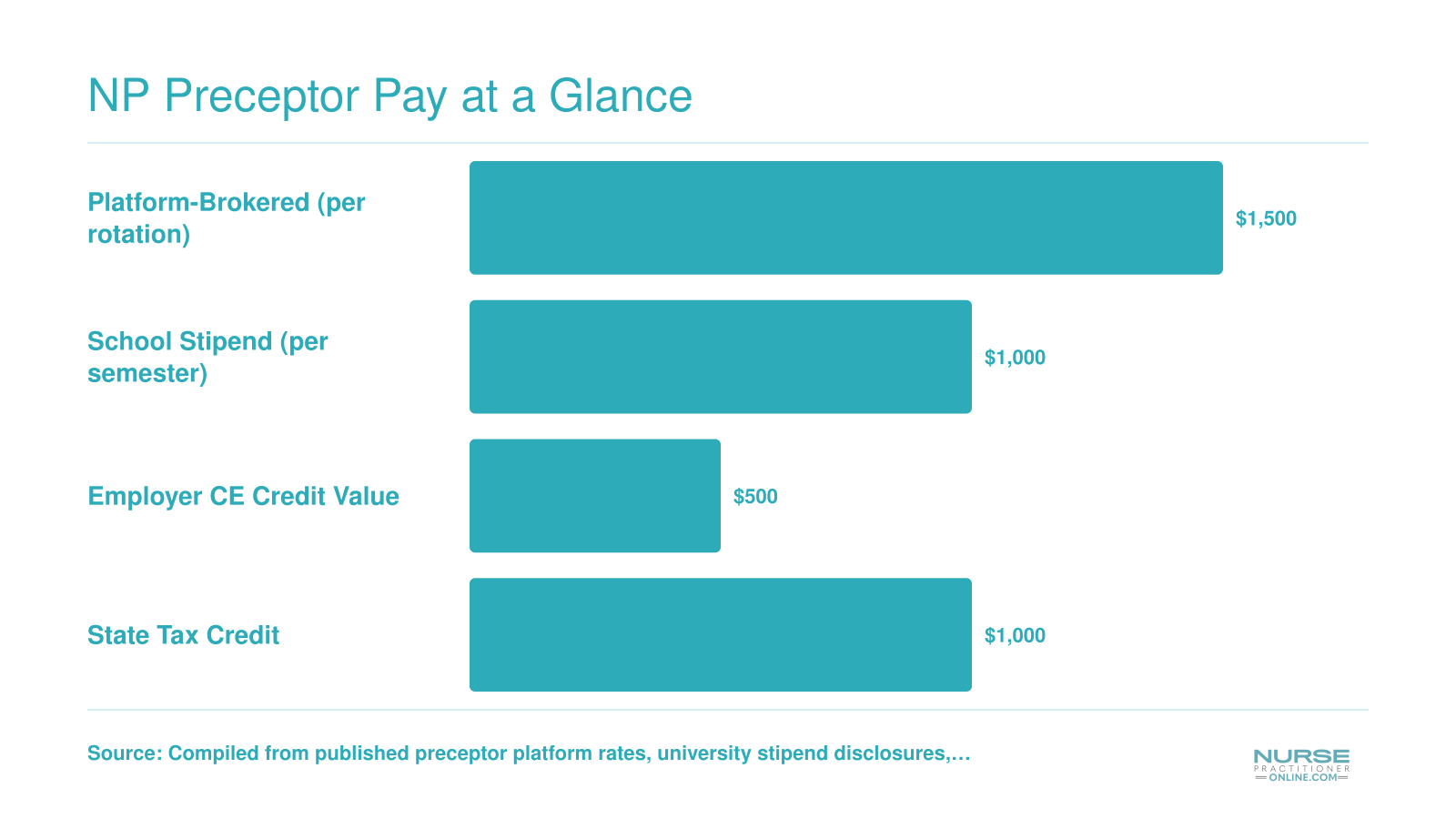
NP Preceptor Pay at a Glance
NP preceptor compensation varies widely depending on how the arrangement is structured. The figures below reflect typical ranges reported across platforms, schools, employers, and state programs. When you factor in the 8 to 15 hours per week most preceptors invest in mentoring, the effective hourly rate often works out to roughly $10 to $25 per hour.
Paid Vs. Unpaid NP Preceptorships: Pros, Cons, and Ethical Considerations
The debate over whether NP preceptors should be paid touches on real workforce shortages, student debt burdens, and the nature of clinical mentorship itself. As of 2026, no major nursing organization, including NONPF, AACN, or AANP, has issued an explicit position statement for or against student-paid preceptorships, though the 2022 National Task Force standards do require equitable clinical placement practices. That silence leaves students, preceptors, and programs navigating a gray area with significant financial and ethical stakes.
Pros
- Compensating preceptors expands the clinical site pool, helping students secure placements during a well-documented shortage.
- Payment recognizes the real labor preceptors invest in teaching, evaluating, and mentoring NP students alongside a full patient load.
- Institutional compensation models can increase preceptor engagement and accountability by formalizing the teaching relationship.
- A funded preceptor pipeline may reduce the bottleneck that delays graduation timelines for NP students nationwide.
Cons
- When students pay directly for placement, it creates inequitable access that favors wealthier students and deepens existing debt burdens.
- Direct payment from a student to a preceptor introduces a conflict of interest in clinical evaluation and grading.
- Commercializing the mentorship relationship risks turning clinical education into a transactional, pay to play arrangement.
- Shifting responsibility for securing and funding preceptors from institutions to individual students can feel like a hidden program cost that was never disclosed at enrollment.
Questions to Ask Yourself
State Incentives and Tax Credits for NP Preceptors
Which states actually pay NP preceptors, and how much can you earn?
Several states now offer financial rewards to nurse practitioners who precept students, but the programs cover a wide map. In 2026, at least five states have active cash grants or tax credits, and the amounts vary from a few hundred dollars to over $6,000 a year. While not every NP will qualify, these incentives can turn an otherwise unpaid teaching role into a modest income stream, or at least cover some of the hidden costs.
Where the money comes from: a state-by-state snapshot
State incentive programs generally fall into two buckets: direct cash grants and state income tax credits. The distinction matters because a grant puts money in your pocket right away, while a tax credit reduces your state tax bill, potentially to zero. Here is what is currently offered:
- Virginia: The Nursing Preceptor Incentive Program (NPIP) provides cash grants from $500 to $5,000 per fiscal year. Eligible providers include APRNs, physicians, physician assistants, and registered nurses. The program is active as of February 2026, with funds distributed through the Virginia Department of Health.1
- Georgia: A state income tax credit of up to $6,375 per year is available for advanced practice nurses, physicians, and physician assistants. The credit has no sunset date and applies to individuals who precept in underserved areas or for schools with approved clinical programs.2
- Hawaii: APRNs can claim an unspecified state income tax credit for serving as a preceptor. The incentive has been active since 2019, though the exact dollar value depends on individual tax circumstances and is not capped in statute.3
- Washington: A grant program launched in April 2023 pays up to $1,000 to advanced registered nurse practitioners (ARNPs), registered nurses, and licensed practical nurses who precept. The funds are subject to annual appropriation.3
- Arizona: Preceptors who are APRNs can receive a $1,000 grant per fiscal year. The incentive began in 2022 and is administered through state nursing workforce initiatives.2
These five states are among the most transparent, but a handful of others are piloting similar efforts. If you live elsewhere, check with your board of nursing or state health department; new programs appear regularly as legislatures recognize the preceptor shortage. The shortage is part of a broader pattern of workforce strain that is also contributing to nurse practitioners leaving primary care for specialty roles.
How to turn a state incentive into real income
Earning your first preceptor incentive check requires more than just taking a student. Most programs have application windows, minimum precepting hours, and documentation requirements. Typically, you must precept for a set number of weeks or total clinical hours, often ranging from 80 to 160 hours per student. In Virginia, for example, you submit a completed preceptor verification form along with proof of the student's enrollment and your license.1 Georgia's tax credit requires filing a specific form with your state tax return.2
The upside is that these incentives can be layered. You might collect a grant from one source while still receiving a modest honorarium from the student's school (though some ethics guidelines caution against double-dipping, so consult your employer and state regulations). The money is typically paid directly to you, not routed through the school, which means it lands in your bank account, or reduces your April tax bill, with little friction.
How Preceptor Matching Platforms Work (And What They Pay)
Cost versus convenience defines the preceptor matching platform decision. These services promise to solve your clinical site hunt in exchange for fees that can rival a semester's tuition, but understanding exactly how the money flows helps you decide whether the investment makes sense for your situation.
The Basic Model: Student-Funded Matching
Most preceptor matching platforms operate on a student-pay model. You pay the platform, the platform connects you with a vetted preceptor, and the clinical hours get done. Schools are rarely involved in these transactions directly, which means this expense typically falls outside financial aid coverage and comes straight from your pocket.
The major platforms serving NP students in 2026 include Clinical Match Me, NPHub, and PreceptorPoint.123 All three require students to cover the matching fee, though pricing structures and specialty coverage vary.
What Students Pay
Fees range considerably depending on the platform and the complexity of your placement needs:
- Clinical Match Me: Charges around $1,995 per rotation and covers FNP, AGNP, PMHNP, and PNP specialties.1
- NPHub: Fees range from $1,800 to $3,000 and cover a broader specialty list including FNP, AGNP, PMHNP, Pediatrics, Acute Care, and Urgent Care or Primary Care settings.4
- PreceptorPoint: Pricing falls between $1,500 and $2,500 per rotation, with coverage for FNP, AGNP, PMHNP, Pediatric NP, Primary Care, Urgent Care, Psych and Mental Health, and Adult or Geriatric specialties.3
If your program requires three or four clinical rotations, these costs can add $5,000 to $12,000 to your total educational expenses.
What Preceptors Actually Receive
Here is where transparency gets murky. None of the major platforms publicly disclose how much compensation flows to the preceptors themselves.13 Some portion of your fee presumably reaches the clinician supervising you, but the exact split between platform overhead and preceptor payment remains unclear. This lack of transparency frustrates both students who want to know where their money goes and preceptors trying to understand their market value.
Vetting and Quality Considerations
Platforms typically screen preceptors for proper licensure, appropriate clinical experience, and willingness to meet program requirements. However, the depth of vetting varies. Before committing funds, ask specific questions about how the platform verifies preceptor credentials, handles placement failures, and manages conflicts if a clinical experience does not meet your program's standards. If you are weighing whether to use a platform or find a site on your own, consider exploring nurse practitioner advancement opportunities to broaden your professional network first.
The bottom line: matching platforms offer a real solution when traditional networking fails, but the significant cost and limited fee transparency mean you should exhaust lower-cost options first.
The Cost to NP Students: What Schools and Students Pay for Preceptors
Finding a preceptor is not just a logistical hurdle for NP students; it is increasingly a financial one too.
What Third-Party Placement Services Charge
When a student cannot secure a clinical placement through their school or personal network, they often turn to third-party matching platforms, and the fees add up quickly. NPHub starts at $1,000 per rotation.1 Clinical Match Me charges a flat $1,995 per rotation for placements up to 250 hours.2 PreceptorTree prices by specialty, with family medicine rotations running $1,500 to $1,600, pediatrics and OB-GYN between $1,600 and $1,800, and psychiatry reaching $1,800 to $2,000.3
Across a full NP program requiring multiple nurse practitioner student clinical rotations, a student relying entirely on these platforms could spend $5,000 or more before earning a single credential. Even health systems that arrange placements on their own terms are not always free: Aurora Health Care, for example, charges an administrative fee of $500 per rotation.4
On an hourly basis, supervised clinical time through paid placement channels runs roughly $12.50 to $17.50 per hour, when you divide total fees by the standard 125 to 160 hours most rotations require.3
How Programs Handle (or Don't Handle) Placement
Not every student faces identical exposure to these costs, and program structure explains most of the difference. Some NP programs bundle preceptor coordination into tuition or charge a separate clinical fee that covers placement support. Others, particularly fully online programs and some for-profit institutions, leave students responsible for finding their own preceptors entirely.1 That student-driven model is common enough that it is now considered standard practice at many programs nationwide, even as the national preceptor shortage makes self-placement increasingly difficult.
The result is an uneven landscape. A student at a program with robust placement infrastructure may pay nothing beyond tuition, while a peer in a self-placement program might quietly absorb thousands in fees that never appear on any official cost-of-attendance disclosure.
Putting Preceptor Costs in Perspective
Total NP program tuition typically ranges from around $20,000 on the lower end to $60,000 or more at private universities. Preceptor placement fees, if a student pays them out of pocket across an entire program, can represent anywhere from 5 to 20 percent of that total investment. That is a meaningful add-on, especially for nurses already managing loan debt or reduced hours during school. Before enrolling, it is worth asking any program directly: do you guarantee clinical placement, or is that my responsibility to arrange?
What Nurse Practitioners Earn Nationally
Before evaluating whether preceptor compensation is fair, it helps to understand what nurse practitioners earn in their primary clinical roles. The Bureau of Labor Statistics reports that more than 307,000 NPs are employed nationally, with a median annual salary of $129,210. When you consider that many preceptor stipends translate to roughly $5 to $10 per hour of mentoring time, the gap between an NP's clinical earning power and preceptor pay becomes striking.
| Wage Percentile | Annual Salary |
|---|---|
| 25th Percentile | $109,940 |
| Median (50th Percentile) | $129,210 |
| Mean (Average) | $132,000 |
| 75th Percentile | $149,570 |
Challenges of Finding and Keeping Quality NP Preceptors
Enrollments in nurse practitioner programs have increased steadily for over a decade, yet the supply of clinical preceptors has barely moved, creating a critical bottleneck. The American Association of Colleges of Nursing (AACN) reports that master's and doctoral NP programs continue to see year-over-year growth, while surveys from the National Organization of Nurse Practitioner Faculties (NONPF) indicate that fewer than half of practicing NPs are willing to precept students. This imbalance is felt most acutely in online programs, which often lack local clinical networks and compete for a shrinking pool of available preceptors.
The Supply-Demand Imbalance
The surge in NP enrollments, fueled by expanding scope-of-practice laws and high demand for primary and specialty care providers, has not been matched by a corresponding increase in clinical training sites. Many NPs cite productivity pressures and administrative burdens as reasons for declining to take students. Without enough preceptors, students face delays in program completion, sometimes waiting months for a placement. The problem is not just about numbers: finding a preceptor who matches the student's population focus and practice setting adds another layer of difficulty.
Real Barriers Preceptors Face
Precepting is often added on top of a full patient caseload with no reduction in clinical expectations. The result is lost productivity: visits take longer, documentation piles up, and RVU-based compensation can drop. Liability concerns also weigh heavily. While students are supervised, preceptors remain legally responsible for patient outcomes, and not all malpractice carriers extend clear coverage for trainee involvement. Institutional support varies widely; some employers celebrate teaching, while others see it as a drain on resources. This lack of consistent recognition and administrative backup fuels burnout.
High-Acuity and Specialty Precepting Add Complexity
Precepting in emergency departments, intensive care units, or psychiatric settings carries additional stress. These high-acuity environments demand rapid decision-making, and the margin for error is razor-thin. Psych-mental health NP students, in particular, require preceptors who can navigate complex therapeutic relationships and manage safety risks. Finding NPs willing to take on that level of responsibility, often without extra pay, becomes a needle-in-a-haystack challenge. Students pursuing online FNP programs face similar hurdles when competing for limited community-based placements.
Why Preceptors Don't Return
Even when an NP agrees to precept once, many do not come back for a second rotation. The top reasons: the sheer time commitment, lack of meaningful compensation or recognition, and the emotional toll of balancing teaching with patient care. Without structured incentives, financial or otherwise, the one-and-done pattern drains the preceptor pipeline, leaving schools and students scrambling semester after semester.
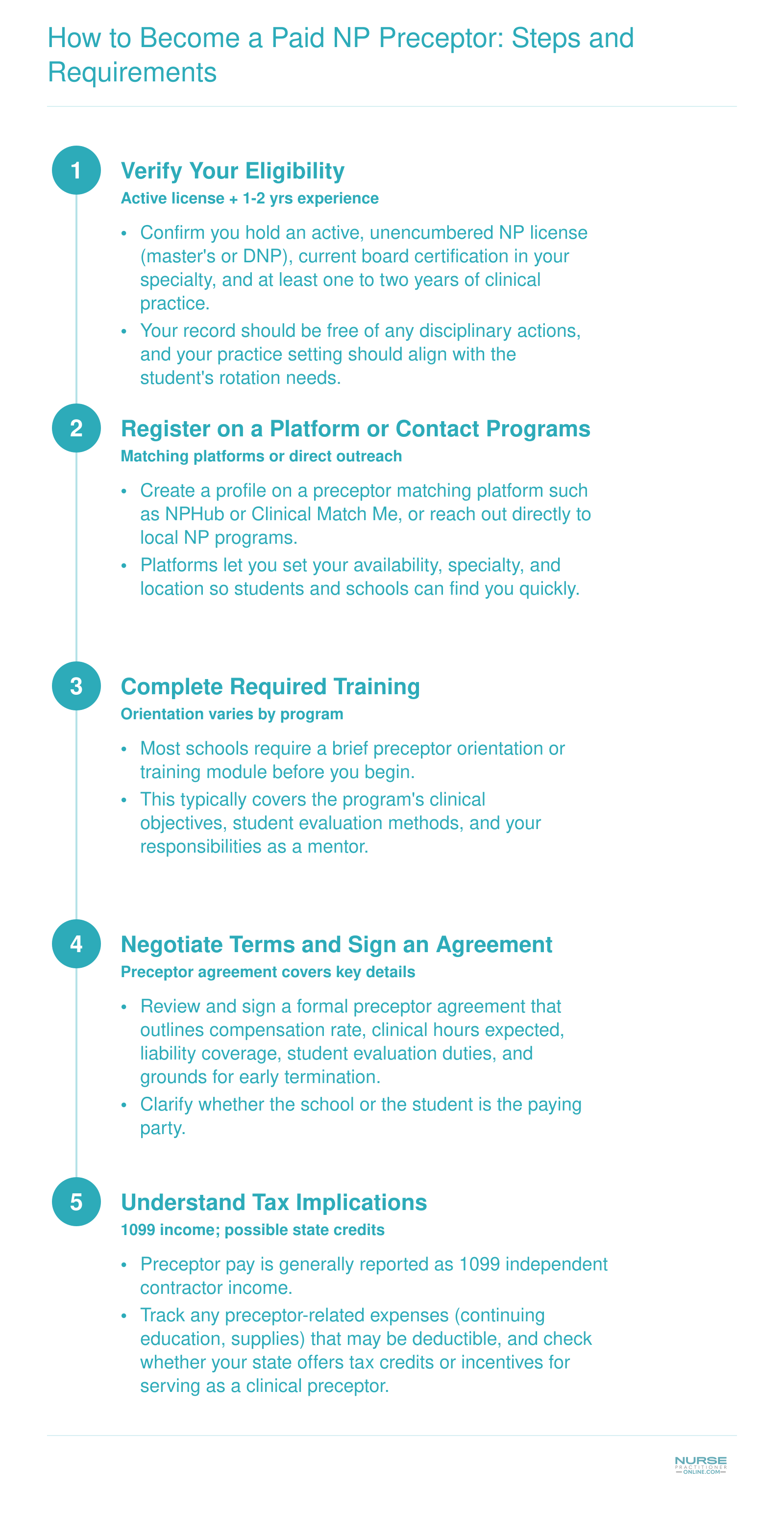
How to Become a Paid NP Preceptor: Steps and Requirements
If you are an experienced nurse practitioner interested in mentoring the next generation (and earning extra income while you do it), the path to becoming a paid preceptor is straightforward. Most programs require at least one to two years of NP clinical experience and active board certification in a specialty that matches the student's rotation focus.
Frequently Asked Questions About NP Preceptor Pay
These are some of the most common questions working nurses and experienced NPs ask about preceptor compensation. Each answer draws on the details covered throughout this guide, so you can use this section as a quick reference.
- Do most nurse practitioner preceptors get paid or volunteer?
- The majority of NP preceptors serve on a volunteer basis. Most schools rely on goodwill, continuing education credits, and small non-monetary perks such as library access or adjunct faculty titles rather than direct payment. However, the trend is shifting. A growing number of programs and third-party platforms now offer stipends or hourly pay, especially in regions where preceptor shortages are most acute.
- How much do NP preceptors get paid per rotation or per hour?
- Rates vary widely. When compensation is offered, preceptors typically receive between $5 and $15 per student clinical hour, or a flat stipend ranging from roughly $500 to $2,000 per rotation. Some matching platforms list rates in the $1,000 to $1,500 range for a standard semester-length rotation. Exact figures depend on the school, geographic area, specialty, and whether the arrangement is direct or brokered through a placement service.
- Which states offer financial incentives or tax credits for NP preceptors?
- Several states have enacted or proposed legislation to encourage preceptor participation. Colorado, Georgia, Hawaii, Maryland, and Virginia are among those that have offered tax credits, often in the range of $1,000 per student rotation. South Carolina and Connecticut have also explored incentive programs. Eligibility criteria and credit amounts change frequently, so check your state's current legislative session or department of revenue website for the latest details.
- Can NP preceptors negotiate compensation directly with schools?
- Yes, though success depends on the institution. Some schools have formal stipend programs with set rates, while others are open to negotiation, particularly for hard-to-fill specialties like psychiatric mental health or acute care. If a school does not advertise payment, it is still worth asking about CE credits, tuition discounts, or other benefits. Putting expectations in writing before the rotation begins protects both parties.
- What are the challenges with being a preceptor?
- The biggest challenge is time. Precepting adds hours of teaching, charting review, and feedback on top of a full clinical workload, often without reduced patient volume. Administrative paperwork from the school, liability concerns, and the emotional labor of mentoring students at varying skill levels also contribute to burnout. When compensation is absent or minimal, many experienced NPs eventually step back from the role.
- Which role is typically the most challenging for preceptors?
- Most preceptors report that the evaluator role is the most difficult. Providing honest, constructive feedback to a student who is struggling, while maintaining a supportive learning environment, creates real tension. Failing or remediating a student can strain professional relationships and generate additional documentation. Balancing the responsibility to protect patients with the desire to help a learner succeed requires skill that goes well beyond clinical expertise.
- Is NP preceptor income reported as 1099 independent contractor income?
- In most cases, yes. When a school, student, or placement platform pays you directly and the amount exceeds the IRS reporting threshold (currently $600 per payer per year), you should expect to receive a 1099-NEC form. That income is subject to self-employment tax unless you are already on the school's payroll as adjunct faculty. Keeping records of related expenses, such as malpractice rider costs, may help offset the tax burden. Consulting a tax professional is always a good idea.
Nurse Preceptor Differential Vs. NP Student Preceptor Pay: Understanding the Difference
A preceptor differential and NP student preceptor pay are two entirely different forms of compensation, and confusing them is one of the most common mix-ups when nurses start researching what preceptors actually earn. One shows up on a staff nurse's paycheck as an hourly bump. The other is a stipend tied to graduate clinical education. They belong to different worlds.
The Staff RN Preceptor Differential
In most hospital settings, staff RNs who onboard new hires or orient nursing students receive a small hourly differential, often $1, $3 extra per hour worked while precepting. This is an employment perk built into the hospital's pay structure, negotiated through HR policy or union contracts, and it has nothing to do with nurse practitioner education. To learn your facility's exact rate, consult your HR department or collective bargaining agreement. The Bureau of Labor Statistics tracks base RN wages, but it does not capture these unit-level differentials, and it does not track NP preceptor pay at all.
NP Student Preceptor Compensation
NP preceptor pay is a separate arrangement tied to graduate clinical education. When it exists, it typically comes through the NP program itself or through a preceptor matching platform, and it is usually structured as a flat fee or stipend per rotation rather than an hourly wage. Amounts vary widely by school, specialty, and region. To find real numbers, contact clinical placement coordinators at specific NP programs, review platform fee schedules directly, or check surveys from professional bodies like the American Association of Nurse Practitioners or the National Organization of Nurse Practitioner Faculties.
Why "Nurse Preceptor Salary" Listings Are Misleading
If you have searched job boards like ZipRecruiter for "nurse preceptor salary," the six-figure numbers you see are almost always full-time preceptor or clinical educator positions, salaried roles inside hospitals or academic health systems. They are not the per-rotation payments an FNP or other NP in clinical practice receives for taking on a student. Keeping these three categories straight, hospital differential, per-rotation NP student stipend, and full-time preceptor job, will help you avoid common np preceptor problems and decide whether precepting is worth your time.