Most important takeaways…
- Six post-master's AGACNP certificate programs serve the Cincinnati area, most offering fully online or hybrid formats.
- Clinical hour requirements typically range from 500 to 750, and preceptor placement support varies widely by program.
- AGACNPs in the Cincinnati metro earn a median salary near $120,000 according to 2024 Bureau of Labor Statistics data.
- Ohio licensure requires passing the ANCC AGACNP-BC or AACN ACNPC-AG exam before applying for prescriptive authority.
Hospital systems across Cincinnati are expanding ICU capacity and adding acute care NP roles faster than local programs produce certified graduates. For nurses who already hold an MSN, a post-master's Adult-Gerontology Acute Care Nurse Practitioner certificate offers the most direct route into these positions, typically requiring 18 to 24 months and 500 to 600 clinical hours rather than a full doctoral program.
Six certificate programs serve the Greater Cincinnati area, each with distinct tuition structures, clinical placement support, and format options. Some run fully online with self-arranged preceptors; others bundle hybrid intensives and dedicated clinical coordinators. Understanding those differences matters because preceptor access in acute care settings remains a documented bottleneck, and programs vary widely in how much help they provide.
Best Post-Master's AGACNP Certificate Programs Near Cincinnati
Ohio is home to several strong post-master's AGACNP certificate programs, and nurses in the Cincinnati metro area can reach most of them online or through short hybrid intensives. Below, we highlight six programs that accept Ohio-licensed RNs with an MSN, noting tuition, format, and institutional outcomes so you can compare options side by side. Program-level earnings and debt data are not yet published for these certificates, so we include institution-wide figures where they can offer a helpful baseline.
- Graduate tuition and net price
- Program delivery format flexibility
- Clinical hour structure
- Institutional graduation and retention rates
- Regional accessibility for Cincinnati nurses
- College Scorecard graduate earnings — collegescorecard.ed.gov
- NCES-IPEDS federal institutional data — nces.ed.gov
- Internal program database
- Independent program research

University of Cincinnati
Located right in Cincinnati, UC is the only program on this list that lets you attend weekly hands-on labs without a long drive. The post-MSN AGACNP certificate is a hybrid offering with an unusually procedure-heavy skills lab component covering ultrasound-guided line placement, airway management, lumbar puncture, and more. Applicants must reside in Ohio, Kentucky, or Indiana, a restriction designed to strengthen the tri-state acute care workforce. The institution-wide graduation rate is 75%, and median graduate debt across all programs sits at about $21,250, though these figures reflect the full university rather than the certificate specifically.
- Hybrid format with weekly on-campus skills labs in Cincinnati
- In-state tuition starts at $836 per credit hour
- Residency limited to Ohio, Kentucky, or Indiana
- Fall-only admission; July 1, 2026 deadline (may close early)
- Prepares for ANCC or AACN national certification
- Requires MSN, active RN license, and minimum 3.25 BSN GPA
- Procedural skills include suturing, chest tubes, IO access
- Faculty are practicing acute care nurse practitioners
Adult-Gerontology Acute Care Nurse Practitioner Post-MSN Certificate — Hybrid

Mount Carmel College of Nursing
Mount Carmel's hybrid AGACNP certificate blends online coursework with face-to-face sessions at its Columbus campus, roughly 100 miles from Cincinnati. The college's intimate 8-to-1 student-faculty ratio means you will get individualized attention, and net price after aid averages about $10,420 institution-wide. The institution-wide graduation rate is approximately 54%, which reflects the full college rather than certificate completers. Tuition runs $22,602 regardless of residency, and a Graduate Clinical Coordinator assists with preceptor placement, though students are ultimately responsible for securing their own sites.
- Hybrid delivery with online and face-to-face coursework
- Flat tuition of $22,602 for all students regardless of state
- 8-to-1 student-faculty ratio for personalized support
- Summer and fall cohort start options available
- Students secure preceptors with coordinator assistance
- Pharmacology courses must be completed within five years
- Focuses on acute, critical, and chronic care for adults
Post-Graduate Certificate: Adult-Gerontology Acute Care Nurse Practitioner — Hybrid

Ohio University
Ohio University delivers its AGACNP post-graduate certificate almost entirely online, making it a practical choice for Cincinnati-area nurses who cannot commute to a distant campus regularly. The 20-credit program spans three semesters and includes 750 clinical hours. Ohio residents pay $785 per credit, and no GRE is required. The institution-wide graduation rate is about 65%, with median graduate debt around $21,056 across all programs. Brief on-campus intensives take place in Athens for clinical skills workshops, so plan for a few trips during the program.
- Primarily online with brief on-campus intensives in Athens
- 20 credit hours across three semesters
- Ohio resident tuition of $785 per credit hour
- 750 clinical hours in acute care settings
- No GRE required for admission
- Requires MSN, 3.0 GPA, and active RN licensure
- Prepares for the AGACNP-BC certification exam
- Curriculum includes advanced pharmacology and diagnostic reasoning
Post-Graduate Adult Gerontology-Acute Care Nurse Practitioner Certificate — Online

Ursuline College
Ursuline College in Pepper Pike offers one of the most streamlined AGACNP post-graduate certificates in Ohio, structured as a focused two-course program with a clinical component. Recognized by the NLN as a Center of Excellence in Nursing Education, the college maintains an 8-to-1 student-faculty ratio. The institution-wide graduation rate is about 67%, and median graduate debt is roughly $26,250 across all programs. Sticker tuition is $31,864, but the average net price after aid drops to around $16,164 institution-wide.
- Hybrid format combining online learning with clinical hours
- Compact two-course certificate structure
- 8-to-1 student-faculty ratio for close faculty interaction
- Accredited by CCNE and NLN Center of Excellence
- Requires MSN degree and active nursing license
- Focuses on complex patient monitoring in high-acuity settings
- Prepares graduates for AGACNP national certification
Adult Gerontology Acute Care Nurse Practitioner Post-Graduate Certificate — Hybrid
Youngstown State University
YSU offers a fully online, 36-credit AGACNP post-master's certificate that can be completed in as few as 18 months, making it one of the more comprehensive options on this list. Total in-state tuition is quoted at roughly $19,548 ($543 per credit), the lowest published total among these six programs. The university accepts students from Ohio, Pennsylvania, West Virginia, and Michigan. The institution-wide graduation rate is about 51%, and median graduate debt is approximately $24,000 across all programs. Courses run in seven-week sessions, which can help working nurses manage their schedules.
- Fully online delivery with no campus visits required
- 36 credit hours completable in roughly 18 months
- In-state tuition approximately $543 per credit ($19,548 total)
- 540 clinical practicum hours in acute care settings
- Seven-week course sessions designed for working nurses
- Open to residents of Ohio, Pennsylvania, West Virginia, Michigan
- Requires MSN, 3.0 GPA, and one year critical care experience
- Prepares for ANCC or AANP certification exams
Adult Gerontology Acute Care Nurse Practitioner Post-Master's Certificate — Online

Malone University
Malone University in Canton delivers its AGACNP post-master's certificate fully online with a sequential cohort model, meaning your group progresses through the curriculum together. A distinctive feature is fixed cohort tuition, which locks in your per-credit rate and shields you from mid-program increases. Applicants must hold an unrestricted Ohio RN license, making this effectively an Ohio-only pathway. The institution-wide graduation rate is about 45%, and median graduate debt is roughly $26,289 across all programs. Completion typically takes 24 to 36 months.
- Fully online with no campus visits needed
- Fixed cohort tuition protects against mid-program increases
- Sequential cohort model for peer support and pacing
- Requires unrestricted Ohio RN license and MSN degree
- Accredited by CCNE
- Prepares for AANP or ANCC certification exams
- Completion timeline of 24 to 36 months
- Integrates holistic care philosophy into curriculum
Adult Gerontology Acute Care Nurse Practitioner Post-Master's Certificate — Online
Program Comparison: Cost, Clinical Hours, and Format at a Glance
A side-by-side spreadsheet beats a polished marketing page every time when you are choosing an AGACNP certificate. Brochures emphasize what programs want you to see; a comparison grid forces you to confront the numbers that actually shape your next two to three years: total credits, required clinical hours, tuition per credit, and whether the schedule bends around full-time nursing work.
Build Your Own Comparison Grid
Before you commit, pull up the official nursing department page for each program on your shortlist and record the same four data points for each. Catalogs and program handbooks (not admissions landing pages) are where you will find the binding numbers. If you are still building that shortlist, our directory of online post-master's ACNP certificate programs is a good starting point.
- Total credits: Post-master's AGACNP certificates typically range from roughly 20 to 35 credits, depending on how much of your prior MSN coursework transfers in via a gap analysis.
- Clinical hours: National accreditors require a minimum of 500 supervised clinical hours for NP preparation, and most AGACNP tracks build in 500 to 750 hours specifically in acute care settings.
- Time to completion: Part-time tracks commonly run four to six semesters. Look for a sample plan of study on the program site to see how courses sequence around clinical rotations.
- Format: Confirm whether didactic coursework is fully online, whether synchronous class sessions are required, and how many on-campus intensives (if any) you must attend.
Verify Tuition Before You Apply
Published per-credit rates can be misleading for online learners. Some Ohio and neighboring-state programs charge all online students a single flat rate; others still differentiate by residency. Call the admissions office directly and ask, in plain terms, what an out-of-state online student in the AGACNP certificate will pay per credit, and whether any online-program discount or in-state equivalency applies. Get the answer in writing through the admissions portal or email.
Cross-Check Against Neutral Sources
For occupational context (wages, projected growth, typical work settings), the U.S. Bureau of Labor Statistics at BLS.gov is the standard reference. For accreditation status and program standards, check the American Association of Colleges of Nursing (AACN) and confirm CCNE or ACEN accreditation directly through the accreditor's database. You can also browse AGNP post master's certificate online listings to compare accreditation details across programs. If a program is not listed with its accreditor, treat that as a serious red flag and move on.
Questions to Ask Yourself
Admission Requirements Across Ohio AGACNP Certificate Programs
While every Ohio program sets its own criteria, most share a common foundation of requirements. Here is what you can expect as you prepare your application.
- MSN from an Accredited ProgramAll Ohio AGACNP post-master's certificate programs require a master's degree in nursing from a nationally accredited institution. Several programs, including those at the University of Cincinnati, Ohio University, Youngstown State, and Kent State, also welcome applicants who hold a non-NP MSN or a Clinical Nurse Specialist credential, so you do not necessarily need an existing NP certification to apply.
- Minimum GPAExpect a cumulative graduate GPA requirement between 3.0 and 3.25. The University of Cincinnati sets the bar highest at 3.25 overall (with a separate 3.0 science GPA requirement), while Ohio State, Youngstown State, and Kent State require a 3.0. Ohio University falls in between at 3.20.
- Active, Unencumbered RN LicenseAn active RN license is standard across programs. Some schools also impose geographic restrictions, for example, the University of Cincinnati currently accepts applicants licensed in Ohio, Kentucky, or Indiana, while Youngstown State serves Ohio, Pennsylvania, West Virginia, and Michigan.
- National NP or APRN CertificationRequirements here vary significantly. Ohio State and Mount Carmel College of Nursing require current APRN certification in another population focus before you apply. In contrast, the University of Cincinnati, Ohio University, Youngstown State, and Kent State do not require national NP certification, making them accessible if you earned a non-NP MSN.
- Graduate-Level Prerequisite CoursesOhio University, Youngstown State, and Kent State explicitly require completed coursework in advanced pathophysiology, advanced pharmacology, and advanced health assessment, with Ohio University requiring a grade of B or better. Kent State adds a freshness clause: those courses must be fewer than five years old if you have not practiced as an APRN within the past two years. Other programs, such as the University of Cincinnati, fold these prerequisites into their evaluation of your prior MSN transcript.
- Clinical RN ExperienceMost programs ask for at least one year of RN experience, but the type of experience matters. Youngstown State specifically requires one year in an acute care setting such as the ICU, emergency department, or intermediate care unit. The University of Cincinnati and Mount Carmel also require one year of RN experience but do not restrict it to critical care. If you currently work in primary care or an outpatient setting, pay close attention to which programs accept general RN experience versus those that mandate acute care bedside hours.
Online vs. Hybrid: Which AGACNP Certificate Formats Are Available?
If you live in northern Kentucky or southeast Indiana and commute into a Cincinnati hospital, the practical question is: which AGACNP certificate programs let you keep that schedule, and which expect you on a campus several times a year?
Truly online didactic programs
Ohio University (Athens) and Youngstown State University deliver the AGACNP post-master's certificate in an online format.12 Coursework is asynchronous or scheduled around working nurses' shifts, and you complete it from home. Note that Ohio University's program description does flag on-campus intensives and clinical skills workshops, so even an "online" label can carry one or two short residencies for hands-on skills like suturing and advanced airway management.1 Read the fine print before assuming zero travel.
Youngstown State publishes its state authorization list: it currently enrolls students residing in Ohio, Pennsylvania, West Virginia, and Michigan.2 Indiana and Kentucky residents would need to confirm eligibility directly, since state authorization for nursing programs changes year to year.
Hybrid programs near Cincinnati
The University of Cincinnati and Mount Carmel College of Nursing (Columbus) run hybrid AGACNP certificates.34 In this context, hybrid typically means online coursework paired with required on-campus simulation labs, orientation sessions, or skills check-offs, usually one to three visits per year. UC explicitly combines online coursework with in-person labs covering procedures like suturing, and it limits enrollment to residents of Ohio, Kentucky, and Indiana, making it well suited to the tri-state Cincinnati commuter.3
What "online" does not mean
No AGACNP certificate is fully remote. Every program requires in-person clinical rotations in an approved acute care setting, generally 500 to 750 hours depending on the school. The online label refers to didactic coursework, not clinicals. If you plan to complete rotations in your home state (say, a Lexington or Louisville ICU), confirm in writing that the program will approve out-of-state clinical sites and that its faculty can verify preceptors across state lines. UC and Mount Carmel both require you to secure your own preceptor and site before clinicals begin.34
Clinical Experience and Preceptor Support in Greater Cincinnati
Clinical hours are the supervised, hands-on patient care rotations you complete with a practicing nurse practitioner or physician preceptor in an acute care setting. They are the bridge between coursework and certification eligibility, and they are typically the hardest logistical piece of any post-master's AGACNP certificate to coordinate.
How Many Hours You Will Actually Need
The ANCC and AACN certification exams both require a minimum of 500 direct patient care hours in the AGACNP population focus.1 Most programs build in more than that to give you a stronger clinical foundation. Among programs reviewed here, requirements range from 540 hours at Youngstown State University2 up to 750 hours at Ohio University, Chamberlain, and the University of New Hampshire.34 Mount Carmel College of Nursing sits in the middle at 650 hours.6
Acceptable settings reflect what acute care practice actually looks like: ICUs, emergency departments, step-down and progressive care units, trauma services, and inpatient acute care floors. Youngstown State, for example, explicitly accepts hospitals, ICUs, trauma units, emergency departments, emergent care centers, and long-term care facilities.2
Who Finds Your Preceptor
This is the question that should drive your program choice as much as tuition does.
- Student-initiated with support: Mount Carmel uses this model, with a clinical coordinator helping vet sites, but you do the outreach. Clinical placement begins within the first three weeks of your first semester, so you need contacts lined up before you matriculate.6
- Broader placement network: The University of Southern Indiana works with preceptors across numerous states, which can help if local acute care slots are scarce.7
- Self-placement is common: Most online programs expect you to identify your own preceptors, though the level of administrative help varies.
If you are new to navigating this process, our guide on how online NP students arrange clinicals in their local area walks through strategies step by step.
Where Cincinnati Students Typically Rotate
Greater Cincinnati has a deep bench of acute care employers that regularly host NP students: UC Health, TriHealth, Cincinnati Children's, Mercy Health, and St. Elizabeth Healthcare across the river in Northern Kentucky. Kettering Health serves students willing to commute toward Dayton.
Start outreach six to nine months before your clinical start date. Acute care preceptor slots are competitive; intensivists and ED providers are often capped on how many students they can mentor per year, and many systems require contracts with your university before a preceptor can say yes. Talk to your current charge nurses and unit managers first, leverage relationships you already have, and ask early whether your employer has a formal student placement office. The nurses who land strong rotations are almost always the ones who started the conversation while they were still applying.
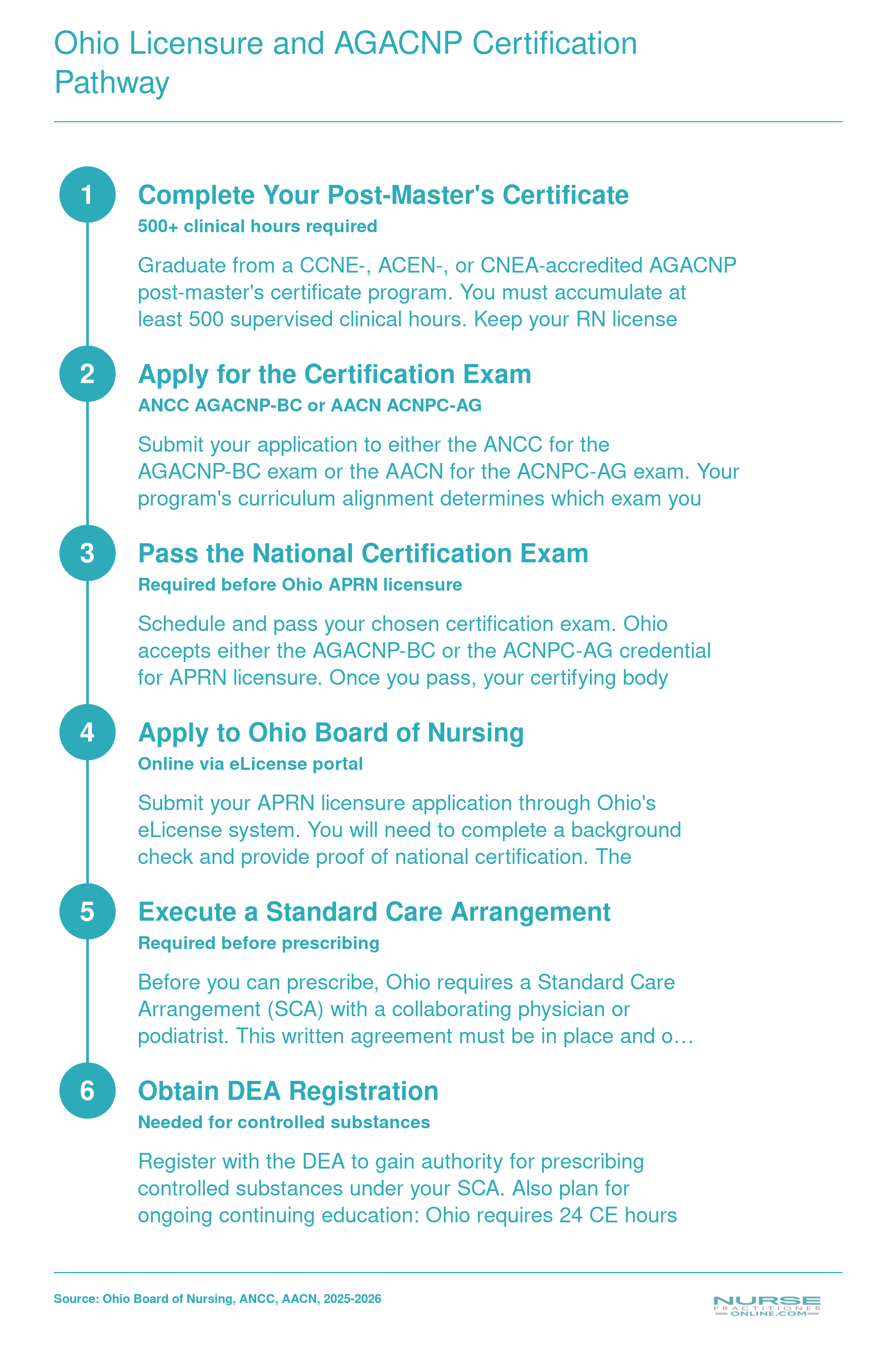
Ohio Licensure and AGACNP Certification Pathway
Moving from a post-master's AGACNP certificate to full prescriptive authority in Ohio involves a clear sequence of steps. Two national certification exams are available: the ANCC AGACNP-BC and the AACN ACNPC-AG. Your program determines which exam you are eligible to sit for, so confirm this before enrolling. Here is the step-by-step path from program completion to practice.
AGACNP vs. AGPCNP: Understanding the Difference
The decision between an AGACNP and an AGPCNP certificate is not about prestige or pay. It is about where you want to practice and which patients you want to care for. The two credentials sound nearly identical, and search engines often blur them, but they are distinct population foci with separate certification exams and non-overlapping scopes.1 This article covers the AGACNP (acute care) pathway. If you see yourself in a clinic managing chronic conditions rather than at a bedside managing instability, the AGPCNP route may be the better fit.
Patient Population and Setting
The acute care nurse practitioner cares for adolescents through older adults experiencing acute, critical, or complex chronic conditions that are unstable. Typical settings include ICUs, step-down units, emergency departments, hospitalist services, and specialty inpatient teams (cardiology, pulmonary, trauma).2 The AGPCNP cares for the same age range but in primary care, ambulatory clinics, and long-term care, with a focus on prevention, wellness, and stable chronic disease management like hypertension and diabetes.3
Procedures, Exams, and Employers
AGACNPs are trained for procedures such as central line placement, arterial lines, intubation assistance, and ventilator management. AGPCNPs focus on physical assessment, screening, immunizations, and longitudinal care planning. Certification runs through separate exams: the AGACNP-BC or ACNPC-AG for acute care, and the AGPCNP-BC for primary care.1
Why the Distinction Matters
These credentials are not interchangeable. An AGPCNP cannot be hired into an ICU role, and an AGACNP is not credentialed for a primary care panel. Ohio employers credential to the certification, so choose based on the work you actually want, not on whichever program has an earlier start date. If you want to explore the full landscape of nurse practitioner specialties, reviewing the differences carefully before committing will save you time and money.
AGACNP Salary and Job Outlook in the Cincinnati Metro Area
An Adult-Gerontology Acute Care Nurse Practitioner (AGACNP) specializes in managing complex, acutely ill adult and elderly patients in hospital settings. Salaries in the Cincinnati area reflect that high-acuity focus.
What AGACNPs Earn in Cincinnati
According to 2024 Bureau of Labor Statistics data, nurse practitioners in the Cincinnati-Middletown metropolitan area earn a median annual wage of $130,100.1 The lowest 10 percent earn around $76,280, while experienced practitioners in the 90th percentile earn $157,090. This places Cincinnati slightly above the Ohio statewide median for NPs, where the mean annual wage is $126,740, with a 10th percentile of $98,380 and a 90th percentile of $154,280.1 Factors such as years of experience, specialty certification, and the specific health system all influence where you fall on that scale.
Earnings After Graduation: Program Value Comparison
While program-specific earnings data for post-master's certificates is not yet available, institutional outcomes from the ranked schools offer a useful lens. Ten years after entry, graduates of Mount Carmel College of Nursing reported a median wage of $75,103, and Ursuline College alumni reported $56,878. University of Cincinnati graduates saw $54,810, while Ohio University, Malone University, and Youngstown State University reported $52,581, $48,909, and $41,544 respectively. These figures represent all graduates, not just nursing, but they underscore strong earning potential relative to program cost. For instance, Mount Carmel's in-state tuition of about $22,600 yields a return-on-investment ratio of over 3-to-1, even at the institutional median.
Where AGACNPs Work in Greater Cincinnati
Several major health systems actively recruit acute care NPs across the metro. UC Health, the region's only academic medical center, consistently needs AGACNPs for its intensive care and specialty units. TriHealth and Mercy Health operate multiple hospitals and outpatient centers. Cincinnati Children's Hospital, a nationally ranked pediatric facility, employs acute care NPs in pediatric ICU and specialty roles. Kettering Health, just north of the city, and St. Elizabeth Healthcare in Northern Kentucky also expand the job market. The concentration of large hospitals and teaching facilities supports steady demand for AGACNPs, particularly those with experience in critical care, cardiology, or hospitalist services. If you are considering related online DNP acute care nurse practitioner programs, the salary outlook in this region makes a compelling case for the investment.
National Growth, Local Demand
Nationally, the BLS projects a 46% increase in nurse practitioner employment from 2023 to 2033, far outpacing average job growth. Cincinnati mirrors that trend thanks to an aging population and a robust healthcare sector. The presence of multiple academic medical centers and the region's role as a referral hub for parts of Kentucky and Indiana further cement strong long-term prospects for AGACNP-certified nurses.
Frequently Asked Questions
Below are the questions nurses ask most often when considering a post-master's Adult-Gerontology Acute Care Nurse Practitioner certificate near Cincinnati. For deeper detail on any topic, refer to the corresponding sections earlier in this article.
- What are the requirements for a post-master's ACNP certificate in Ohio?
- Most Ohio programs require a current MSN or doctoral nursing degree from a CCNE- or ACEN-accredited institution, an active RN license, and national certification as a nurse practitioner in another population focus. You will also typically need a minimum GPA (often 3.0), professional references, a current resume, and a goal statement. Some schools ask for recent acute care clinical experience as well.
- How many clinical hours are required for an AGACNP post-master's certificate?
- Clinical hour requirements vary by program but generally fall between 500 and 750 direct patient care hours in acute care settings. The exact number depends on your prior coursework and any transfer credits the program accepts. Earlier in this article, the program comparison table breaks down clinical hour expectations for each school near Cincinnati.
- Which Ohio AGACNP post-master's certificate program is the cheapest?
- Tuition varies considerably across Ohio institutions, and the most affordable option depends on whether you qualify for in-state rates, employer tuition benefits, or military discounts. Review the cost comparison section above for a side-by-side look at per-credit tuition. Contact each program's financial aid office directly for the most current figures, since rates can change each academic year.
- Can I complete an AGACNP post-master's certificate fully online?
- Didactic coursework is available fully online through several programs accessible to Cincinnati-area nurses. However, every AGACNP certificate requires hands-on clinical rotations at approved acute care sites, so a fully online experience is not possible. The online vs. hybrid section of this article explains which formats each program offers and how clinical placements are arranged.
- How long does it take to finish an AGACNP post-master's certificate part-time?
- Part-time students typically complete an AGACNP post-master's certificate in three to five semesters, or roughly 12 to 24 months. Your timeline depends on how many courses you take per term and how quickly you secure clinical placement sites. Programs designed for working nurses often build in scheduling flexibility so you can maintain your current position while progressing through the curriculum.
- What is the difference between AGACNP and AGPCNP certificates?
- The AGACNP (Acute Care) certificate prepares you to manage complex, rapidly changing conditions in hospitals, ICUs, and emergency departments. The AGPCNP (Primary Care) certificate focuses on chronic disease management and preventive care in outpatient or community settings. The two tracks lead to different certification exams and distinct scopes of practice. See the AGACNP vs. AGPCNP section earlier in this article for a fuller comparison.
- Do AGACNP post-master's certificate programs accept out-of-state students?
- Many Ohio programs welcome applicants from other states, especially those offering online didactic coursework. You will, however, need to confirm that the program holds authorization to operate in your home state under the State Authorization Reciprocity Agreement (SARA) or through individual state approvals. Clinical placement logistics may also differ for out-of-state students, so reach out to admissions early to plan accordingly.