Most important takeaways…
- Ohio AGACNP tuition ranges from under $7,000 per year in state to nearly $54,000 at top research universities.
- Every online acute care NP program in Ohio still requires hands-on clinical rotations in high-acuity settings.
- Most Ohio AGACNP programs require prior ICU or critical care nursing experience before admission.
- Expect roughly 2 to 4 years from program start to practicing as a licensed APRN in Ohio.
Ohio hospitals are expanding acute care nurse practitioner roles to manage increasingly complex inpatient caseloads, driving AGACNP demand well above traditional primary care NP growth. Unlike family or adult-gerontology primary care NPs, acute care nurse practitioners train specifically for hospitalist, ICU, and emergency department settings, a distinction that shapes everything from coursework to clinical placements. Ohio offers a small but competitive cluster of fully or partially online AGACNP programs, each requiring at least 600 direct-care clinical hours. That clinical intensity, paired with mandatory intensive care experience for admission, narrows the field quickly: the number of programs may be modest, but the bar for entry and the stakes for choosing the right one are anything but.
Top Online ACNP Programs in Ohio: 2026 Rankings
The following ranking highlights online and hybrid Adult-Gerontology Acute Care Nurse Practitioner programs offered by Ohio institutions in 2026. Schools are ordered using a mixed quality composite that weighs online accessibility alongside institutional outcomes such as graduation rates, retention, affordability, and student support. Whether you are pursuing a master's, doctorate, or post-master's certificate, each entry below breaks down what makes the program a strong fit for working nurses ready to move into advanced acute care roles.
- Online delivery accessibility
- Institutional graduation and retention
- Tuition and net price affordability
- Student-to-faculty ratio
- Program-level clinical requirements
- Internal program database
- College Scorecard graduate earnings — collegescorecard.ed.gov
- Independent program research
- NCES-IPEDS federal institutional data — nces.ed.gov

Mount Carmel College of Nursing
Based in Columbus and embedded within the Mount Carmel Health System, Mount Carmel College of Nursing pairs an intimate 8:1 student-to-faculty ratio with direct access to Central Ohio acute care facilities. Its AGACNP offerings blend online coursework with scheduled campus immersions, and the Graduate Clinical Coordinator assists students in establishing clinical site affiliations across the region. With a reported 100% first-time certification pass rate for its MSN track, the college emphasizes hands-on readiness for high-acuity settings such as ICUs and emergency departments.
- Hybrid format with scheduled on-campus immersions
- 48 credit hours completed over five semesters (18 months)
- 650 clinical hours in high-acuity settings
- In-state tuition of $22,602; net price around $10,420
- Average class size of approximately 30 students
- 100% first-time certification pass rate reported
- Prepares graduates for ICU, ED, and specialty roles
- Designed for master's-prepared registered nurses
- Hybrid coursework with clinical experience component
- Summer and fall cohort starts (deadlines March 30 and July 15)
- Students secure preceptors with coordinator guidance
- Pharmacology courses must be completed within five years
- Focus on evidence-based practice and ethical decision-making
Adult-Gerontology Acute Care Nurse Practitioner (MSN) — Hybrid
Adult-Gerontology Acute Care Nurse Practitioner (Post-Graduate Certificate) — Hybrid

Cedarville University
Cedarville University offers one of the most affordable AGACNP pathways in Ohio, with graduate tuition listed at $11,015. The school delivers both an online MSN and a hybrid DNP in this specialty, each requiring 800 clinical hours and four on-campus simulation experiences using high-fidelity labs. A CCNE-accredited program with a 98% job placement rate and six annual start dates, Cedarville integrates a Biblical worldview throughout its curriculum while preparing graduates for ANCC or AACN certification.
- Online format with four required on-campus simulation visits
- 800 clinical experience hours across acute care settings
- Graduate tuition of $11,015; institution-wide graduation rate 72.5%
- National certification preparation for ANCC or AACN
- Part-time and full-time scheduling options available
- High-fidelity simulation training included
- CCNE-accredited hybrid doctorate with 800 clinical hours
- Six start dates per year with full- or part-time pacing
- 98% job placement rate reported by the program
- Scholarships up to $5,000 available
- Clinical placement coordinator support provided
- Trains in invasive procedures for ICU, ED, and cardiology roles
- Prepares for both ANCC and AACN board certification
Adult-Gerontology Acute Care Nurse Practitioner (MSN) — Online
Adult-Gerontology Acute Care Nurse Practitioner (DNP) — Online

University of Cincinnati
The University of Cincinnati delivers its AGACNP offerings through a hybrid model that pairs online didactics with hands-on skills labs at UC's campus, where students practice procedures like suturing, ultrasound-guided line placement, and airway management. Enrollment is limited to residents of Ohio, Kentucky, and Indiana, and UC guarantees local preceptor placement within that tri-state corridor. Faculty are practicing clinicians, and the program prepares graduates for AGACNP-BC certification. In-state tuition is $14,902, and the institution reports a 75% graduation rate.
- Hybrid delivery with online coursework and in-person labs
- Tuition starts at $836 per credit for Ohio residents
- Fall-only admission; application deadline July 1, 2026
- Requires MSN, active RN license, and minimum 3.25 BSN GPA
- Residency limited to Ohio, Kentucky, or Indiana
- Covers skills such as suturing and airway management
- Prepares for ANCC or AACN national certification
- Hybrid format with on-campus labs in two semesters
- $836 per credit with full-time and part-time options
- Guaranteed local preceptors within the tri-state area
- Minimum 3.0 GPA and work experience required
- Dual certification preparation (AGACNP-BC)
- Faculty are practicing acute care nurses
- Financial aid and scholarships available
Adult-Gerontology Acute Care Nurse Practitioner (Post-MSN Certificate) — Hybrid
Adult-Gerontology Acute Care Nurse Practitioner (DNP) — Hybrid
Youngstown State University
Youngstown State University stands out for its fully online, accelerated post-master's certificate structured in seven-week course blocks, making it especially practical for nurses juggling shifts in northeast Ohio and the surrounding corridor. Total in-state tuition is approximately $19,548 for 36 credit hours, and the program includes 540 clinical practicum hours in acute care settings. Eligibility extends to RNs licensed in Ohio, Pennsylvania, West Virginia, or Michigan, and the curriculum is approved by the Ohio Board of Nursing in addition to its CCNE accreditation.
- Fully online with accelerated seven-week course blocks
- 36 credit hours; completable in as few as 18 months
- Total in-state tuition around $19,548 ($543 per credit)
- 540 clinical practicum hours in acute care settings
- Open to RNs in Ohio, Pennsylvania, West Virginia, or Michigan
- Ohio Board of Nursing approved and CCNE accredited
- Requires MSN, 3.0 GPA, and one year critical care experience
- BLS and ACLS certifications must be maintained
Adult Gerontology Acute Care Nurse Practitioner (Post-Master's Certificate) — Online

Ohio University
Ohio University in Athens offers two online AGACNP pathways: a 20-credit post-graduate certificate completable in three semesters and a 70-credit BSN-to-DNP track. Both are delivered primarily online with periodic on-campus clinical skills intensives. Ohio residents pay $785 per credit for the certificate and $608 per credit for the DNP, and no GRE is required for either option. The certificate includes 750 clinical hours while the DNP requires 1,000 hours, and both prepare graduates for the AGACNP-BC exam. Fall-only starts keep cohorts cohesive and well-supported.
- Online format with on-campus clinical skills intensives
- 20 credit hours across three semesters
- $785 per credit for Ohio residents
- 750 clinical hours included
- No GRE required; MSN and 3.0 GPA needed
- CCNE accredited with fall-only admission
- Prepares for the AGACNP-BC certification exam
- 70 total credit hours delivered primarily online
- $608 per credit for Ohio residents
- 1,000 clinical and practicum hours required
- Part-time curriculum with flexible scheduling
- Minimum 3.2 GPA and two years RN experience needed
- Up to 9 transfer credits accepted
- No GRE or GMAT required for admission
Post-Graduate Adult Gerontology Acute Care Nurse Practitioner Certificate — Online
BSN-to-DNP Adult Gerontology Acute Care Nurse Practitioner — Online

Ursuline College
Located in Pepper Pike near Cleveland, Ursuline College's Breen School of Nursing holds a National League for Nursing Center of Excellence designation, underscoring its commitment to advanced-practice education. The college offers both an MSN and a post-graduate certificate in AGACNP through a hybrid model geared toward working professionals. With an 8:1 student-to-faculty ratio and CCNE accreditation, Ursuline emphasizes complex patient monitoring, nursing vigilance, and research utilization. Listed tuition is $31,864, though the average net price drops to approximately $16,164 after institutional aid.
- Hybrid program with online and in-person components
- Ranked graduate nursing program with CCNE accreditation
- Minimum one year of nursing experience required
- Unencumbered RN license needed for admission
- 8:1 student-to-faculty ratio
- NLN Center of Excellence designation
- Two-course hybrid certificate for MSN-prepared nurses
- Includes clinical experience in high-acuity settings
- Focuses on complex patient monitoring and interventions
- Prepares graduates for AGACNP certification
- Financial aid options available
- Designed for working advanced-practice professionals
Adult-Gerontology Acute Care Nurse Practitioner (MSN) — Hybrid
Adult-Gerontology Acute Care Nurse Practitioner (Post-Graduate Certificate) — Hybrid

Case Western Reserve University
Case Western Reserve University brings the academic firepower of a top-tier research institution to its AGACNP program, housed in one of Ohio's largest academic medical ecosystems with close ties to University Hospitals and the greater Cleveland clinical network. The hybrid MSN requires 40 credit hours and 600 clinical hours, typically finished in 18 to 24 months. A distinguishing feature is the flight nursing specialty option, which appeals to nurses interested in critical care transport and regional trauma systems. The institution's 87.2% graduation rate and 9:1 student-to-faculty ratio reflect strong student support, though tuition of $53,980 positions the program at the premium end.
- Hybrid format blending online learning and campus intensives
- 40 credit hours with a minimum of 600 clinical hours
- Completable in 18 to 24 months
- Flight nursing specialty option available
- Blended majors and joint degree pathways offered
- 9:1 student-to-faculty ratio
- Institution-wide graduation rate of 87.2%
- Financial aid available; tuition is $53,980
Adult-Gerontology Acute Care Nurse Practitioner (MSN) — Hybrid

Malone University
Malone University in Canton delivers a fully online AGACNP post-master's certificate with no campus visits required, a practical advantage for Ohio nurses outside major metro areas. The program follows a sequential cohort model with fixed tuition per cohort, giving students cost predictability from enrollment through completion. Coursework spans 24 to 36 months with an annual fall start, and the curriculum integrates holistic care principles alongside CCNE-accredited preparation for AANP or ANCC certification exams. Admission requires an Ohio RN license, an MSN, and critical care experience.
- Fully online with no campus visits required
- Sequential cohort model with fixed tuition per cohort
- 24 to 36 months to completion
- CCNE accredited; prepares for AANP or ANCC exams
- Ohio RN license and MSN degree required
- Critical care experience needed for admission
- Annual fall start date only
- Holistic nursing philosophy with Christian values integrated
Adult Gerontology Acute Care Nurse Practitioner (Post-Master's Certificate) — Online
How These Ohio AGACNP Rankings Were Built
Ranking programs by sticker price alone versus evaluating them across multiple institutional outcomes tells two very different stories, and we wanted to tell the more complete one. We started with every accredited AGACNP program in Ohio that accepts online students, then scored each on a composite that rewards strong institutional outcomes and genuine online accessibility.
What the Rankings Measure
Our composite draws on several institution-wide signals rather than a single headline number. The factors we weighed include:
- Graduation rate: The overall rate at which enrolled students complete their degrees, reflecting the school's support systems, retention efforts, and academic culture.
- Net price: A sector-conditional institutional average that captures the typical out-of-pocket cost after grants and scholarships. This gives a more grounded sense of affordability than published tuition alone, though your individual cost will vary based on residency, financial aid, and enrollment status.
- Tuition affordability: Graduate-level tuition and required fees specific to degree type. These figures are degree-aware, meaning they reflect what a graduate nursing student can expect rather than an undergraduate rate. If you are comparing costs across specialties, our guide to the most affordable nurse practitioner programs offers a broader national benchmark.
- Online delivery eligibility: Programs had to offer coursework in a format that allows working nurses to study remotely, whether fully online or in a hybrid arrangement with limited on-campus requirements.
It is worth noting that every metric above is institution-wide. These are not program-specific pass rates or faculty ratios.
What the Rankings Do Not Cover
No single ranking can capture everything that matters. Ours intentionally leaves out several factors that are addressed in dedicated sections elsewhere in this article:
- Board certification exam pass rates
- Clinical placement quality or preceptor networks
- Faculty-to-student ratios and mentorship access
Those elements are critical to your decision, which is exactly why they get their own detailed treatment rather than being compressed into a single score.
A Note on Cost Figures
The tuition numbers you will see throughout the article reflect graduate tuition and fees at the degree level, not a generic university figure. The net price is an institutional average conditioned on sector (public or private), so treat it as a helpful benchmark rather than an exact quote for your personal situation. Your financial aid office can provide a tailored estimate once you apply.
Online, Hybrid, or Both? Ohio ACNP Program Formats Explained
When Ohio AGACNP programs say "online," they almost never mean you can earn your credential without leaving your house. Every acute care NP program requires hands-on clinical rotations in high-acuity settings, and many add periodic on-campus intensives for simulation labs and procedural skills. The real question is how much of your didactic coursework happens virtually, how often you travel to campus, and who helps you secure clinical sites. Understanding these differences will help you pick the format that fits your schedule, your location, and your comfort level with independent preceptor networking.
| Feature | Fully Online Format | Hybrid Format |
|---|---|---|
| Didactic Delivery | Lectures, discussions, and exams completed entirely through a learning management system on your own schedule. Programs like Cedarville University, Youngstown State University, and Malone University follow this model. | Most coursework is online, but select didactic sessions (case conferences, advanced assessment workshops) are delivered during scheduled on-campus days. The University of Cincinnati, Case Western Reserve, Ursuline College, and Mount Carmel College of Nursing use this approach. |
| On-Campus or Immersion Days | Typically limited to a handful of required visits per year. Cedarville, for example, lists four on-campus experiences that include high-fidelity simulation. Ohio University's post-graduate certificate includes on-campus intensives alongside its online coursework. | More frequent campus attendance, often tied to simulation labs where you practice procedures such as suturing, chest tube management, and central line insertion. Case Western Reserve and the University of Cincinnati build in-person skills labs into their hybrid schedules. |
| Clinical Rotation Coordination | Students are generally responsible for identifying and securing their own preceptors in acute care settings near home. This model can work well for RNs in rural Ohio who already have strong hospital relationships, though it requires proactive outreach. | Programs with a hybrid structure often provide more hands-on placement assistance, leveraging established health-system partnerships in cities like Columbus, Cleveland, and Cincinnati. Mount Carmel's Columbus location and Case Western Reserve's Cleveland network are notable examples. |
| Scheduling Flexibility for Working RNs | Maximum flexibility for nurses juggling 12-hour shifts. Youngstown State offers seven-week course blocks with multiple start dates, and Malone uses a sequential cohort model. Ideal if you cannot commit to regular campus travel. | Requires blocking off specific weekends or multi-day intensives throughout the program. The University of Cincinnati starts only in the fall semester. If you live within driving distance of campus, the trade-off is more structured skills training and faculty face time. |
| Best Fit | Working RNs in smaller or rural communities across Ohio who can arrange local clinical preceptors and prefer to minimize travel. Strong self-directed learners who are comfortable coordinating their own clinical sites. | Nurses based near major metro areas (Cincinnati, Cleveland, Columbus) who value built-in simulation experiences, direct faculty mentorship during skills labs, and institutional support in placing clinical rotations at partnered hospital systems. |
Questions to Ask Yourself
Ohio AGACNP Tuition and Cost Comparison
Tuition across Ohio's online ACNP programs ranges dramatically, from under $7,000 per year in state to nearly $54,000 at a top research university. Mount Carmel College of Nursing stands out for the lowest institution-wide average net price at $10,420, while Youngstown State University offers the most affordable published tuition for Ohio residents. Keep in mind that the net price figures shown below are institution-wide averages reported to the federal government and reflect the typical cost after grants and scholarships for all undergrad students at each school; your actual graduate-level costs will vary based on program fees, credit loads, and any employer tuition assistance or graduate-specific aid you receive.
| School | In-State Tuition | Out-of-State Tuition | Avg. Net Price (Institution-Wide) | Median Graduate Debt |
|---|---|---|---|---|
| Mount Carmel College of Nursing | $22,602 | $22,602 | $10,420 | $22,082 |
| Youngstown State University | $6,848 | $7,028 | $12,767 | $24,000 |
| Ursuline College | $31,864 | $31,864 | $16,164 | $26,250 |
| Malone University | $13,830 | $13,830 | $20,948 | $26,289 |
| Ohio University | $9,720 | $17,712 | $21,637 | $21,056 |
| Cedarville University | $11,015 | $11,015 | $24,468 | $20,937 |
| University of Cincinnati | $14,902 | $26,674 | $25,648 | $21,250 |
| Case Western Reserve University | $53,980 | $53,980 | $41,190 | $24,000 |
Clinical Hours, Placement Support, and What to Expect
Your clinical training is where the classroom dissolves and real acute care practice begins. For Ohio AGACNP programs, that training is substantial, and understanding what is expected before you enroll will save you a lot of surprises down the road.
How Many Hours Are You Looking At?
Ohio programs require between 600 and 800 supervised clinical hours, depending on the school.1 Ohio State University sets its minimum at 600 hours, Mount Carmel College of Nursing requires 6502, Case Western Reserve University requires 700 or more, Ohio University requires 750, and Cedarville University sets the bar highest at 800 hours.1 All of these exceed the national certification minimum of 500 supervised hours, which is intentional: programs build in extra time because acute care competency demands it.
Every one of those hours must take place in an acute or critical care environment. Hospitals, trauma centers, intensive care units, and specialty inpatient units all qualify. A primary care clinic or outpatient office does not. If you are currently working in a community health or ambulatory setting, plan ahead: you will need to connect with inpatient facilities for your rotations. For a broader look at what clinical placements involve, our guide to nurse practitioner clinical rotations covers the student role, typical schedules, and what to expect at the bedside.
Who Finds Your Clinical Site?
This is one of the most practical questions to ask any program before you apply. Ohio schools take different approaches.
Case Western Reserve, Ohio State, and the University of Cincinnati all coordinate placements on behalf of their students.1 Each of those programs also maintains formal partnerships with major Ohio health systems. Case Western works with Cleveland Clinic, University Hospitals, and MetroHealth. Ohio State places students through Wexner Medical Center and affiliated Central Ohio partners. The University of Cincinnati draws on UC Health and Cincinnati Children's.
Mount Carmel College of Nursing and Cedarville University use a hybrid model, meaning the program provides some support and connections but students may also need to identify and secure their own preceptors.1 Mount Carmel does have an established relationship with the Mount Carmel Health System, which gives its students a meaningful starting point.
Out-of-State and Distance Students
If you live outside Ohio but are enrolled in an Ohio-based online program, you will generally complete your clinical hours in your home state, not in Ohio. Most programs accommodate this, but you should confirm with the program's clinical coordinator before enrolling. Nursing licensure and clinical agreements are state-specific, so the logistics vary. If you are already an Ohio-licensed RN working in the state, you are well positioned to access Ohio's large network of hospital systems for your placements.
If you are comparing options beyond Ohio, our national directory of acute care nurse practitioner programs online can help you evaluate placement models side by side.
The bottom line: ask every program you consider exactly who manages placement, what happens if a site falls through, and how they handle students in rural or underserved areas where acute care sites can be harder to find.
Admission Prerequisites: ICU Experience and Beyond
Family nurse practitioner programs typically welcome applicants from nearly any clinical nursing background, but acute care nurse practitioner programs set a higher bar: hands-on experience caring for acutely ill patients is non-negotiable. Understanding the difference between FNP and AGNP tracks can help you decide which path fits your clinical background. If you are weighing whether your experience qualifies you, here is what Ohio AGACNP programs expect in 2026.
Acute Care and ICU Experience Requirements
Most Ohio AGACNP programs require one to two years of direct acute care or ICU nursing experience before you can apply. Ohio University and Wright State University both ask for at least two years2, while Ohio State University and Case Western Reserve University set the minimum at one year.34 Case Western Reserve specifically requires at least one year of critical care experience, and Youngstown State University's post-master's certificate track does the same.5
Some programs do accept experience beyond the traditional ICU setting. Work in step-down units, emergency departments, progressive care, and telemetry floors may satisfy the acute care requirement at certain schools, though you should verify directly with each admissions office. Programs generally want to see that you have managed complex, rapidly changing patient conditions, so the closer your experience aligns with high-acuity care, the stronger your application will be.
Standard Admission Criteria
Beyond clinical experience, Ohio programs share several baseline requirements:
- BSN from an accredited program: All programs expect a bachelor's degree in nursing from a CCNE or ACEN-accredited institution.
- Minimum GPA: A 3.0 cumulative GPA is a common threshold at Ohio University, Wright State, and Youngstown State.25
- Active RN license: An unencumbered registered nurse license is universally required.
- Certifications: BLS is required across the board. Youngstown State also requires current ACLS certification.5
- Background check: Wright State and Youngstown State mandate a background check as part of the admissions process.25
- Supporting materials: Expect to submit professional references and a personal goal statement explaining your interest in acute care practice.
Post-Master's Certificate Options
If you already hold an MSN or DNP in another specialty, you do not have to start over. Ohio University offers an AGACNP post-master's certificate, and Youngstown State University provides a dedicated online post-master's AGACNP certificate track that requires one year of critical care experience, a 3.0 GPA, and both BLS and ACLS certifications.5 These certificate pathways let experienced nurse practitioners add acute care credentials without repeating foundational graduate coursework, a route many competitors overlook when listing Ohio program options. If you are considering a longer path from your RN license to advanced practice, our guide on how long it takes to become a nurse practitioner maps out realistic timelines. Not every Ohio school offers this pathway, so if a post-master's certificate matters to you, confirm availability before applying.
Common Questions About Ohio ACNP Programs
Choosing an acute care nurse practitioner program raises a lot of practical questions, especially when you are balancing clinical work and family life. Below are straightforward answers to the questions Ohio nurses ask most often about online AGACNP education.
- What is the difference between AGACNP and AGNP (or FNP) programs?
- An Adult Gerontology Acute Care NP (AGACNP) program prepares you to manage complex, rapidly changing conditions in hospital and critical care settings. By contrast, an Adult Gerontology Primary Care NP (AGNP) or Family NP (FNP) program focuses on outpatient, preventive, and chronic disease management across the lifespan. In Ohio, the distinction matters at the certification and licensure level because each credential defines a different scope of practice.
- How long does it take to complete an online AGACNP program in Ohio?
- Most online AGACNP programs in Ohio require roughly six to eight semesters of full-time study, which translates to about two to three years for BSN-to-MSN tracks. Part-time options can extend the timeline to three or four years. Post-master's certificate tracks for nurses who already hold an MSN are generally shorter, often around three to four semesters depending on the university.
- Do you need ICU experience to get into an ACNP program in Ohio?
- Requirements vary by school, but many Ohio AGACNP programs strongly prefer or require at least one to two years of acute or critical care nursing experience. Some programs accept broad inpatient experience, such as emergency department, progressive care, or step-down unit work. Check each school's prerequisites carefully, because programs that require ICU hours may not count med-surg or outpatient time toward the requirement.
- How many clinical hours are required for an ACNP program in Ohio?
- Ohio AGACNP programs typically require a minimum of 500 direct patient care clinical hours, though some programs set the bar higher depending on total credit hours and curriculum design. These hours must be completed in acute or critical care settings under a qualified preceptor. Several Ohio universities offer clinical placement assistance, but students should plan early because securing sites in competitive metro areas can take time.
- What is the total cost of an online AGACNP program in Ohio?
- Tuition for an online AGACNP program in Ohio varies widely by institution and residency status. Total program costs can range from roughly $30,000 to over $70,000 for tuition alone, before fees, books, and clinical travel expenses. In-state students at public universities often benefit from lower per-credit rates. Be sure to factor in technology fees, background check costs, and any required on-campus immersion visits when comparing programs.
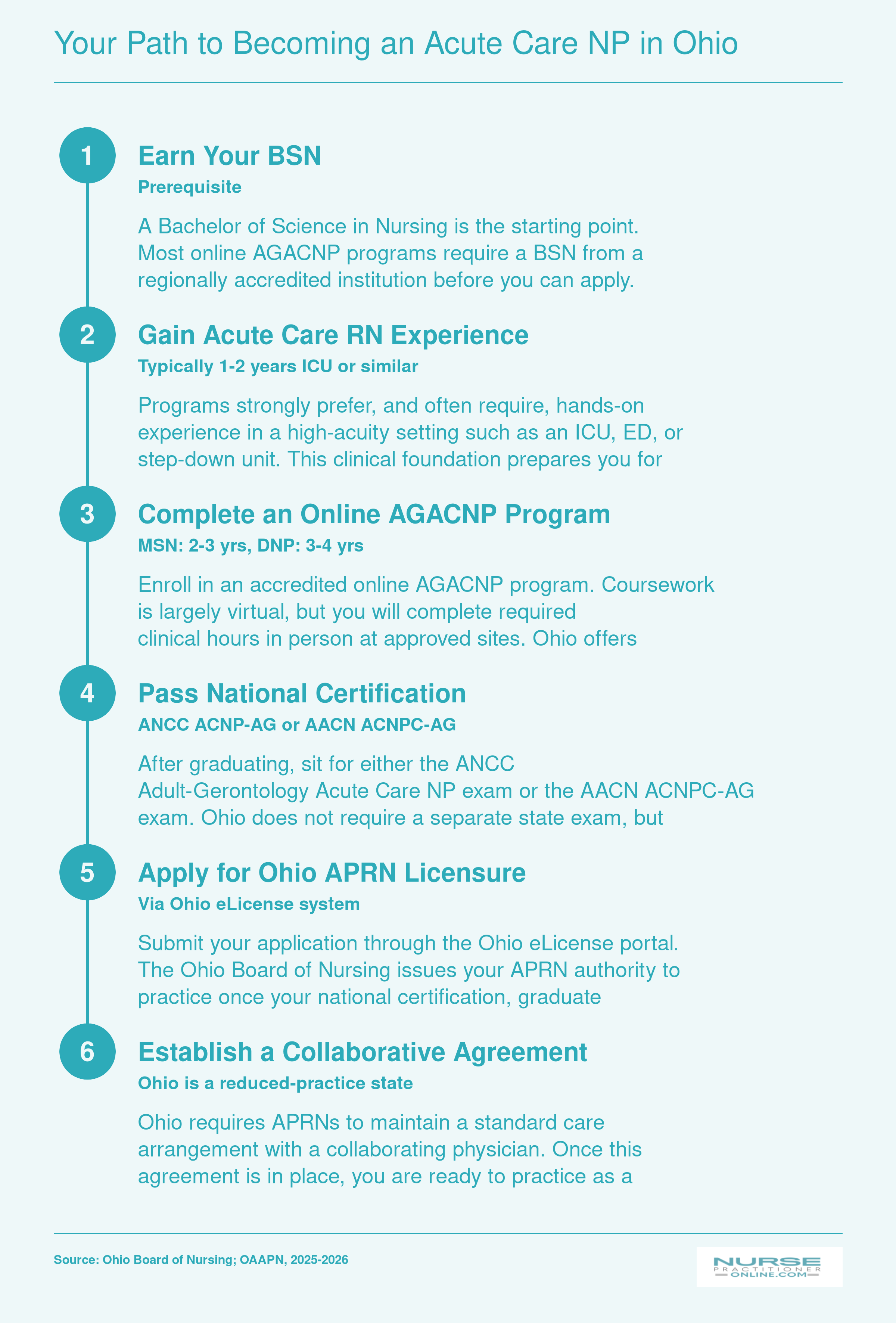
Your Path to Becoming an Acute Care NP in Ohio
The road from bedside RN to practicing AGACNP in Ohio follows a clear credentialing ladder. Whether you choose an MSN or DNP track, expect roughly 2-4 years from program start to your first day as a licensed APRN. Here is how each milestone fits together.
AGACNP Salary and Career Outlook in Ohio
Acute care nurse practitioners in Ohio earn strong salaries that reflect the complexity and intensity of their work, typically positioning themselves at the upper end of the NP specialties by salary spectrum. Earnings in this specialty are driven by hospital-based settings, shift differentials for nights and weekends, and advanced procedural skills that distinguish AGACNPs from primary-care NPs.
National and Ohio Wage Benchmarks
Nationwide, nurse practitioners earned a median annual wage of $121,610 as of 2022, with the top 10 percent exceeding $165,240 and entry-level practitioners (10th percentile) earning around $87,340. Ohio's largest metro areas offer competitive compensation: Columbus reports a median NP wage of $124,580, with top earners reaching $150,250, while Cleveland and Cincinnati metro markets follow similar patterns.2 Acute care NPs in high-acuity settings, including intensive care units, surgical teams, and trauma centers, often command salaries at or above the 75th percentile due to the technical demands and round-the-clock nature of hospital practice.
What Ohio AGACNP Graduates Can Expect
Program-level earnings data for Ohio's AGACNP graduates remain limited at the credential-specific level, so most salary discussions rely on broader nurse practitioner datasets. However, several factors consistently push acute care NP salaries higher: hospital employers typically offer shift differentials, critical-care bonuses, and procedure-based pay that outpace ambulatory clinic roles. Many AGACNPs also work in teaching hospitals or Level I trauma centers, which invest in advanced-practice providers to manage complex patient populations. If you are weighing degree options, our comparison of MSN vs DNP vs PhD in nursing can help you understand how each credential may influence your earning potential.
Job Growth and Demand Drivers
The Bureau of Labor Statistics projects employment of nurse practitioners will grow more than 40 percent through the next decade, far outpacing most occupations. In Ohio, this demand is amplified by an aging population, expansion of hospital-based specialty services, and physician shortages in acute care. Cleveland Clinic, OhioHealth, University of Cincinnati Medical Center, and other major health systems actively recruit AGACNPs to manage critical-care patients, perform procedures, and support surgical teams, roles that translate into robust job security and upward mobility.
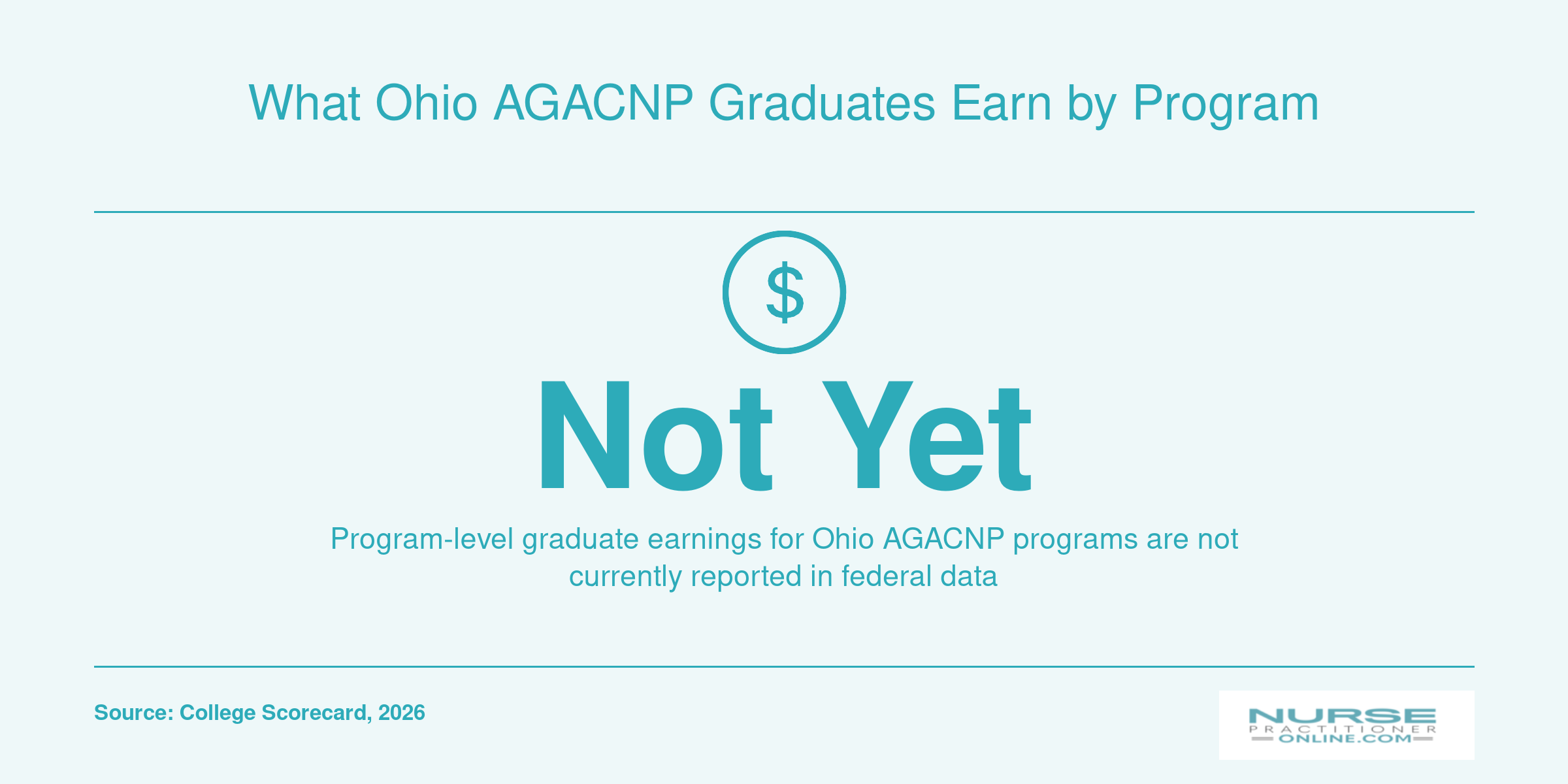
While specific post-graduation earnings by Ohio AGACNP program are not yet published, the combination of strong statewide wages, hospital employment patterns, and projected job growth paints an optimistic picture for graduates entering this specialty in 2026 and beyond.
What Ohio AGACNP Graduates Earn by Program
Program-level earnings data for Ohio AGACNP graduates are not yet available through the College Scorecard. Because these programs are relatively specialized and have smaller cohorts, federal reporting thresholds often prevent individual program earnings from being published. As more graduates complete these programs and earnings data matures, we expect program-by-program comparisons to become available in future updates.