Most important takeaways…
- Most Ohio post-master's FNP certificates require 12 to 24 months depending on enrollment pace and prior coursework.
- Cleveland State University mandates 780 clinical hours, exceeding the typical 500 to 720 hour range at peer programs.
- Nurse practitioners in the Cleveland metro area earn a median salary above the statewide Ohio average.
- Programs near Cleveland offer online, hybrid, and on-campus formats so working nurses can match classes to shift schedules.
A post-master's FNP certificate is not a second master's degree. It is a graduate-level credential designed for nurses who already hold an MSN or DNP in a different specialty and want to retrain as family nurse practitioners without repeating foundational coursework. The distinction matters: these programs typically run 12 to 18 months and cost $10,000 to $25,000, far less than a full MSN-FNP.
Several accredited programs operate within commuting distance of Cleveland, and a growing number offer fully online formats with local clinical placements. The tension most nurses face is whether to prioritize proximity and preceptor support or flexibility and cost. A campus-based program may ease clinical coordination, but an online certificate often fits around shift work more cleanly.
Clinical hour requirements, certification exam pass rates, and Ohio Board of Nursing licensure steps all factor into which program will get you credentialed fastest. Cleveland's primary care shortage means demand for FNPs remains strong, but entering practice hinges on passing the AANP or ANCC exam after you finish coursework.
Why a Post-Master's FNP Certificate Makes Sense in Cleveland
What is the fastest path to Family Nurse Practitioner certification if you already hold an MSN or doctoral degree? For nurses in Northeast Ohio who completed their graduate education in another specialty, a post-master's FNP certificate offers a direct route to primary care practice without repeating the full master's degree experience.
The Post-Master's Advantage Over a Second MSN
A post-master's FNP certificate is purpose-built for nurses who have already earned an MSN or DNP in a different area, whether that is nursing education, nurse leadership, adult-gerontology, or another APRN specialty. Rather than spending two to three years completing another full master's program, certificate students focus exclusively on FNP-specific coursework and clinical hours. Most programs run 12 to 24 months depending on pace and prior clinical background. If you are comparing options nationally, our directory of online post masters FNP programs can help you benchmark what Cleveland-area schools offer.
The cost difference matters too. Certificate programs typically require 20 to 35 credit hours compared to 45 or more for a complete MSN-FNP track. That translates to lower tuition bills and a faster return on your educational investment.
Cleveland's Growing Need for Primary Care Providers
Northeast Ohio faces persistent primary care shortages, particularly in underserved urban neighborhoods and surrounding rural counties. Health systems across the Cleveland metro area actively recruit board-certified FNPs to staff outpatient clinics, urgent care centers, and patient-centered medical homes. Employers consistently favor candidates who hold national certification from AANP or ANCC, both of which the Ohio Board of Nursing accepts for APRN licensure.
Understanding Ohio's Practice Environment
Ohio does not grant full practice authority to nurse practitioners as of 2026. FNPs here work under a standard care arrangement with a collaborating physician, which outlines prescriptive authority and clinical oversight expectations. While this requires an additional layer of coordination, it does not prevent FNPs from building robust primary care practices. Prescriptive authority is tied to this arrangement, so securing a collaborative relationship is part of the transition into practice.
Licensure Path for Post-Master's Certificate Graduates
The Ohio Board of Nursing accepts post-master's certificates for APRN licensure applications. You will need to pass a national certification exam from either AANP or ANCC, maintain an active Ohio RN license, complete a background check, and submit your application through the state's eLicense system. For a broader overview of what the credentialing process involves across all states, see our nurse practitioner licensing guide. Once licensed, expect to complete 24 hours of continuing education every two years, including 12 hours in pharmacology, and renew your national certification every five years.
Top Post-Master's FNP Certificate Programs Near Cleveland, Ohio
The programs below were selected with Cleveland-area working nurses in mind. Rather than a generic directory, this list weighs affordability, graduate outcomes, institutional graduation rates, and format flexibility so you can find a program that fits your schedule, budget, and career goals. Keep in mind that the graduation rates listed are institution-wide figures and do not reflect the specific FNP certificate track.
- Affordability and tuition value
- Graduate outcomes and earnings
- Institutional graduation rates
- Format flexibility for working nurses
- Clinical placement accessibility
- Internal program database
- College Scorecard graduate earnings — collegescorecard.ed.gov
- NCES-IPEDS federal institutional data — nces.ed.gov
- Independent program research

Ohio University
Ohio University delivers a fully online post-graduate FNP certificate built around 20 credit hours and 750 clinical hours spread across three semesters. Ohio residents benefit from a competitive per-credit rate that brings total tuition to roughly $13,680, and the university extends a 15% scholarship to veterans, active military, alumni, and corporate partners. With a 65.4% institution-wide graduation rate and an 18:1 student-to-faculty ratio, OU provides a solid academic infrastructure without requiring you to leave the Cleveland area for coursework.
- Fully online format with no required campus visits
- 20 credit hours completed across three semesters
- 750 clinical hours in your local community
- $684 per credit for Ohio residents
- No GRE required for admission
- CCNE-accredited with advanced pharmacology coursework
- 15% scholarship for veterans, military, and alumni
- Fall admission with application deadline in spring
Post-Graduate Family Nurse Practitioner Certificate — Online

Cleveland State University
Cleveland State University puts you closest to the action with its campus right in downtown Cleveland and a post-graduate FNP certificate that is nearly identical in per-credit cost for in-state and out-of-state students. The 35-credit program pairs 100% online coursework with a single on-campus residency and 780 clinical hours, and the university offers clinical placement support so you can secure preceptors near home. CSU's three annual intakes give working nurses multiple entry points, and full-time students can finish in as little as 15 months.
- 100% online coursework with one on-campus residency
- 35 credit hours with 780 clinical hours
- Approximately $636.70 per credit (in-state)
- Clinical placement support provided by the university
- Full-time completion in about 15 months
- Three admission intakes per year
- Transfer credits and course waivers accepted
Post-Graduate Certificate, Family Nurse Practitioner — Online

University of Akron
Just 40 miles south of Cleveland, the University of Akron offers a campus-based post-MSN FNP certificate specifically designed for certified Adult Gerontology Primary Care NPs who want to broaden their scope into pediatric and adolescent health. At only 10 to 13 credit hours, this is one of the most streamlined pathways in Ohio, and in-state tuition starts at roughly $10,125 per year at the graduate level. The program includes a clinical residency component and requires a faculty interview, two years of clinical experience, and an active Ohio RN license.
- Designed for certified Adult Gerontology Primary Care NPs
- 10 to 13 credit hours, among the shortest in Ohio
- Campus-based format in Akron (about 40 miles from Cleveland)
- Includes clinical residency with pediatric and adolescent focus
- Advanced pharmacology and child health nursing courses
- Two years of clinical experience required for admission
- Faculty interview as part of the admissions process
Post-MSN Family Nurse Practitioner Certificate — On-Campus

Otterbein University
Otterbein University, a private institution in Westerville (about 140 miles southwest of Cleveland), pairs online core courses with on-campus lab sessions for hands-on skills training. The 31-credit hybrid program includes 600 clinical hours completed with community-based preceptors, and estimated total tuition comes in around $22,407. Otterbein boasts a 67.9% institution-wide graduation rate, the highest on this list, along with a 12:1 student-to-faculty ratio and consistently high FNP certification exam pass rates.
- Hybrid format: online courses plus on-campus lab sessions
- 31 credit hours with 600 community-based clinical hours
- Estimated total tuition of approximately $22,407
- 12:1 student-to-faculty ratio for personalized support
- High FNP national certification exam pass rates reported
- Graduate nursing degree and one year of clinical experience required
- Courses cover health promotion, acute, and chronic illness management
Family Nurse Practitioner, Post-Graduate Certificate — Hybrid
Questions to Ask Yourself
How Long Does a Post-Master's FNP Certificate Take to Complete?
Time to certification varies widely depending on your work schedule, prior coursework, and whether you can attend full-time or need to balance classes with shifts on the floor. Most post-master's Family Nurse Practitioner certificates in Ohio range from 12 to 24 months, but understanding what drives that timeline will help you plan realistically.
Full-Time vs. Part-Time Enrollment
Full-time students typically complete a post-master's FNP certificate in 12 to 18 months, or roughly two to three semesters. Cleveland State University's program, for example, is structured around 35 credits and 780 clinical hours, with a full-time pathway spanning 15 to 24 months.1 If you can step back from full-time bedside work or have family support, this accelerated track gets you certified faster and may help you maintain momentum through the intensive clinical rotations.
Part-time options stretch that timeline to 18 to 24 months or longer. Many working nurses choose this route, taking one or two clinical courses per semester while maintaining their RN role. Some Ohio programs cap completion at three years to ensure students stay current with evolving practice standards and clinical competencies.
Credit Requirements and Transfer Pathways
Credit loads for post-master's FNP certificates typically range from 18 to 35 credits. The number depends heavily on what you bring from your first master's. If you already hold an MSN with advanced pathophysiology, advanced pharmacology, and advanced health assessment, you may skip those foundational courses and focus only on the FNP-specific clinical practicum and population-health content, shortening your program to as few as 18 credits.
Nurses transitioning from another NP specialty, such as Psychiatric-Mental Health or Adult-Gerontology primary care nurse practitioner programs, usually need fewer bridge credits than those coming from a Clinical Nurse Specialist or Nurse Educator MSN. The latter groups often lack the three foundational graduate-level courses, adding an extra semester.
Start Dates and Scheduling Flexibility
Start dates matter when you're planning around a nursing schedule. Some Ohio programs admit only in the fall, while others offer rolling or multi-semester entry points. Check whether the program you're considering locks you into a rigid cohort sequence or allows you to pause and resume if life intervenes.
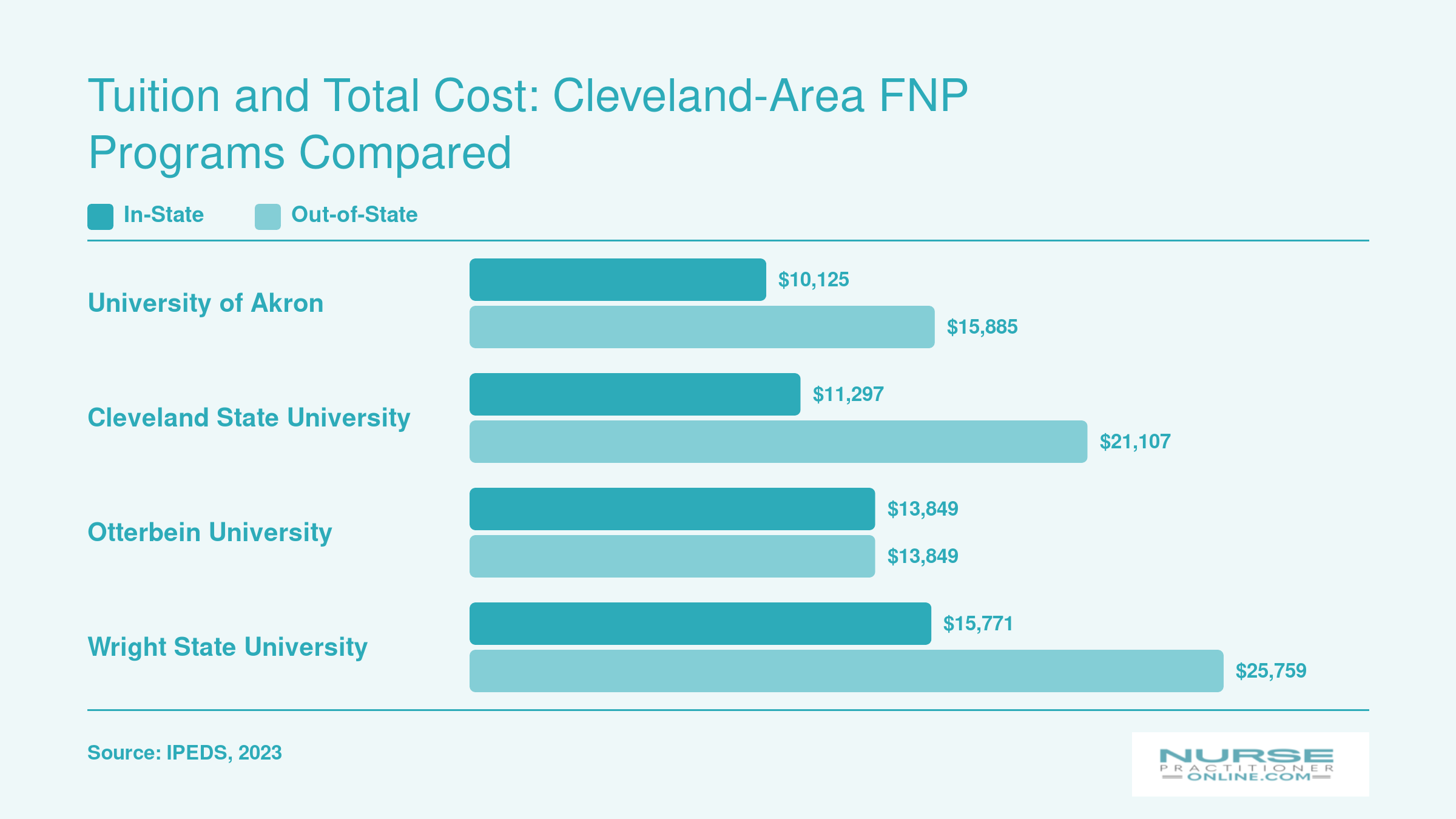
Tuition and Total Cost: Cleveland-Area FNP Programs Compared
Tuition rates vary significantly across Ohio's post-master's FNP certificate programs. The figures below reflect annual graduate-level tuition reported by each institution. Keep in mind that these are institution-wide averages, so your actual certificate cost will depend on your specific credit load and any transfer credits or course waivers you receive. Also worth noting: online students at Ohio public universities may qualify for in-state tuition rates regardless of where they live, but you should verify this directly with each program.
Clinical Hours and Preceptor Placement in Ohio FNP Programs
Cleveland State University's Post-Master's FNP Certificate requires 780 direct patient care clinical hours, placing it above the typical 500 to 720 hour range that CCNE and ACEN accredited programs build into their FNP curricula. The Ohio Board of Nursing does not set its own clinical hour minimum for advanced practice certificate programs; it defers to the standards of the national accrediting body, which means the program's accreditor effectively defines the floor.
How Preceptor Sourcing Differs Between Programs
For a working nurse weighing programs, the most consequential variable is often not the hour count but how preceptors get assigned. Cleveland State provides clinical placement assistance, meaning faculty and clinical coordinators help identify approved sites and preceptors rather than handing the search entirely to the student. Other Ohio-based and out-of-state online FNP programs operate on a self-sourcing model, where the student is responsible for recruiting a qualified nurse practitioner or physician preceptor, securing a signed agreement, and submitting it for faculty approval.
Self-sourcing is workable for nurses with strong existing relationships at their employer, but it can add months to a timeline if those relationships do not pan out. Ask any program directly: who finds the preceptor, who vets them, and what happens if a placement falls through mid-semester?
Cleveland-Area Clinical Sites and What to Verify
The Cleveland metro offers a deep bench of potential clinical environments, including Cleveland Clinic affiliates, University Hospitals, MetroHealth, and federally qualified community health centers across Cuyahoga County. Availability shifts year to year based on preceptor capacity and existing affiliation agreements, so no program can promise placement at a specific health system.
If you are considering an online FNP program based outside Ohio, confirm before you enroll that the school has active clinical affiliation agreements with Ohio health systems. Without them, you may face extra paperwork, delays in credentialing through Ohio facilities, or in some cases an inability to complete hours in your home state. Cleveland State also requires on-site residency components, which is worth factoring into your scheduling if you live further out from the main campus.
Certification Exam Pass Rates at Ohio FNP Programs
When you complete a post-master's FNP certificate, you still have one more gate to clear before you can practice: the national certification exam. Ohio's Board of Nursing requires APRN licensure, and that licensure depends on passing either the AANP FNP-C or the ANCC FNP-BC exam. That is why a program's certification pass rate is one of the most honest signals of quality you can find. A school can point to impressive faculty credentials and cutting-edge simulation labs, but if graduates are struggling on exam day, something in the curriculum is not translating.
What the National Numbers Look Like
As a baseline, the AANP FNP-C exam carried a national first-time pass rate of 81 percent in 2025, while the ANCC FNP-BC exam sat at 83 percent in 2024.1 Those figures give you a fair comparison point. A program performing consistently above those benchmarks is demonstrating that its curriculum prepares students to meet national standards. A program landing well below them warrants a closer look at how coursework and clinical hours are structured.
Why Ohio Program Data Is Hard to Find
Here is the honest reality: not all Ohio FNP programs publish their certification pass rates openly. Some institutions report aggregate NP data rather than FNP-specific figures. Others update publicly available information on a lag, so the most recent year you can verify may be a cycle or two behind. That inconsistency makes direct comparison difficult, and it means you should not assume that silence equals poor performance. It may simply reflect inconsistent reporting norms across institutions.
What to Ask During Admissions
The most reliable move is to request program-specific, first-time pass rate data directly from the schools you are considering. When you reach out, ask for the following:
- Exam specificity: Rates for the FNP credential specifically, not a combined NP figure
- Recency: Data from the last two to three graduating cohorts, not a single banner year
- Cohort size: A 100 percent pass rate from a cohort of five students carries less weight than a 90 percent rate from 40 graduates
- Exam choice: Whether the program prepares students primarily for AANP, ANCC, or both
Programs that are confident in their outcomes will answer these questions readily. If a school is evasive or can only offer anecdotal information, factor that into your decision. Your Ohio APRN license depends on passing that exam, and choosing a program with a demonstrated track record of helping students get there is one of the best investments you can make in your advanced practice career.
Online, Hybrid, or On-Campus: Choosing the Right FNP Format
The programs near Cleveland span all three delivery formats, so the right fit depends on your schedule, learning style, and comfort with independent study. Here is a practical look at the tradeoffs, along with which ranked programs fall into each category.
Pros
- Online programs like Ohio University and Cleveland State let you keep working full time without relocating, since coursework is fully remote.
- Hybrid formats such as Otterbein University combine online lectures with periodic on-campus lab sessions, giving you hands-on simulation time without a daily commute.
- Online and hybrid programs typically use the same curriculum, faculty, and accreditation standards as their on-campus counterparts.
- Cleveland State offers clinical placement support, reducing the burden of finding your own preceptor sites.
- Campus-based programs like the University of Akron provide direct access to simulation labs, on-site faculty mentorship, and built-in clinical partnerships.
- In-person cohort learning at campus programs can strengthen peer connections and professional networking throughout your certificate.
Cons
- Some online programs expect you to self-source clinical placements, which can be time-consuming, especially in competitive metro areas like Cleveland.
- Fully online learners need strong self-discipline; without a structured classroom schedule, coursework can slip when 12-hour shifts pile up.
- Remote formats may offer fewer organic opportunities for peer cohort bonding compared to students who meet face to face each week.
- Campus-based programs like the University of Akron require rigid scheduling that can be difficult to balance with night shifts or rotating schedules.
- Commuting to a physical campus adds travel time and cost for nurses already logging long clinical hours during the workweek.
Admission Requirements for Post-Master's FNP Certificates in Ohio
Ohio programs share a common set of prerequisites, though specific thresholds vary by school. Gather these essentials before you apply so nothing slows your timeline.
- Graduate degree from an accredited programYou will need an MSN (or doctoral degree) earned at a school accredited by the CCNE or ACEN. Most programs also expect you to have completed the "three Ps" at the graduate level, advanced pathophysiology, advanced pharmacology, and advanced health assessment.
- Current, unencumbered RN licenseAn active U.S. RN license with no restrictions is required. You must hold licensure in the state where you plan to complete clinical rotations, whether that is Ohio or a Nurse Licensure Compact state.
- Minimum GPA of 3.0A cumulative graduate GPA of 3.0 is the standard floor across most Cleveland-area and Ohio programs, though a few set the bar at 3.2. If you fall slightly below, strong clinical experience or a goal statement may support your candidacy.
- Clinical nursing experienceExpect to document at least one year of direct patient care as a registered nurse. Some programs prefer two years, and applicants already certified as nurse practitioners in another specialty may have additional pathways.
- National NP certification or advanced-practice courseworkIf you already hold national certification in a different NP specialty, programs typically want proof of that credential. Applicants without prior NP certification should be prepared to show equivalent advanced-practice graduate coursework.
- Supporting application materialsPlan to submit a current CV or résumé, a professional goal statement explaining why you are pursuing the FNP certificate, two to three letters of recommendation from clinical or academic references, and official transcripts from every graduate institution attended.
What FNPs Earn in Cleveland and Across Ohio
Salary is a practical starting point when you're weighing the return on a post-master's FNP certificate. Nationally, nurse practitioners earn strong wages, but earnings shift depending on where you practice, your experience, and the setting. Understanding what FNPs make in Cleveland and across Ohio helps you set realistic expectations and plan your career move.
National NP earnings give a baseline
According to the Bureau of Labor Statistics, the median annual wage for nurse practitioners across the country was $121,610 in 2022. The bottom 10% earned about $87,340, while the top 10% brought in more than $165,240. The middle half of NPs fell between $103,250 and $135,470. These national figures offer a useful benchmark, but they don't tell the whole story for Ohio.
How Cleveland and Ohio compare
For the most accurate local picture, head directly to the BLS Occupational Employment and Wage Statistics page and search for nurse practitioners (SOC 29-1171) in the Cleveland-Elyria-Mentor metropolitan area. The data is refreshed annually, so you can see the latest median, percentile breakdowns, and employment counts for the region. Ohio's statewide wage data often sits close to the national average, but factors like urban versus rural practice, hospital versus clinic setting, and years of experience create meaningful variation.
The Ohio Department of Job and Family Services also publishes state-specific projections and wage analyses that sometimes offer more granular industry detail than the national BLS reports. For a boots-on-the-ground view, organizations like the Ohio Association of Advanced Practice Nurses (OAAPN) frequently share salary surveys and regional trend insights directly from practicing FNPs.
Real-time ranges from job boards
Job boards like Indeed and Glassdoor can give you a feel for current FNP salary ranges in Cleveland and across Ohio. However, these sites often reflect asking salaries or self-reported data, so cross-check what you find against official BLS figures. A posted range of $105,000 to $130,000 for a Cleveland-area FNP position, for example, sits squarely within the national middle band but may lean a bit lower than the national median, a pattern you'll want to confirm with hard data.
Growth that backs up the investment
The long-term outlook strengthens the case. The BLS projects 35% job growth for nurse anesthetists, nurse midwives, and nurse practitioners combined between 2024 and 2034, far outpacing most occupations.2 Demand for primary care nurse practitioners keeps FNP salaries competitive and career options plentiful, particularly in communities across Ohio. By pairing official data with local intelligence from nursing schools and professional networks, you can build a confident picture of what your post-graduate certificate can deliver in Cleveland and beyond.
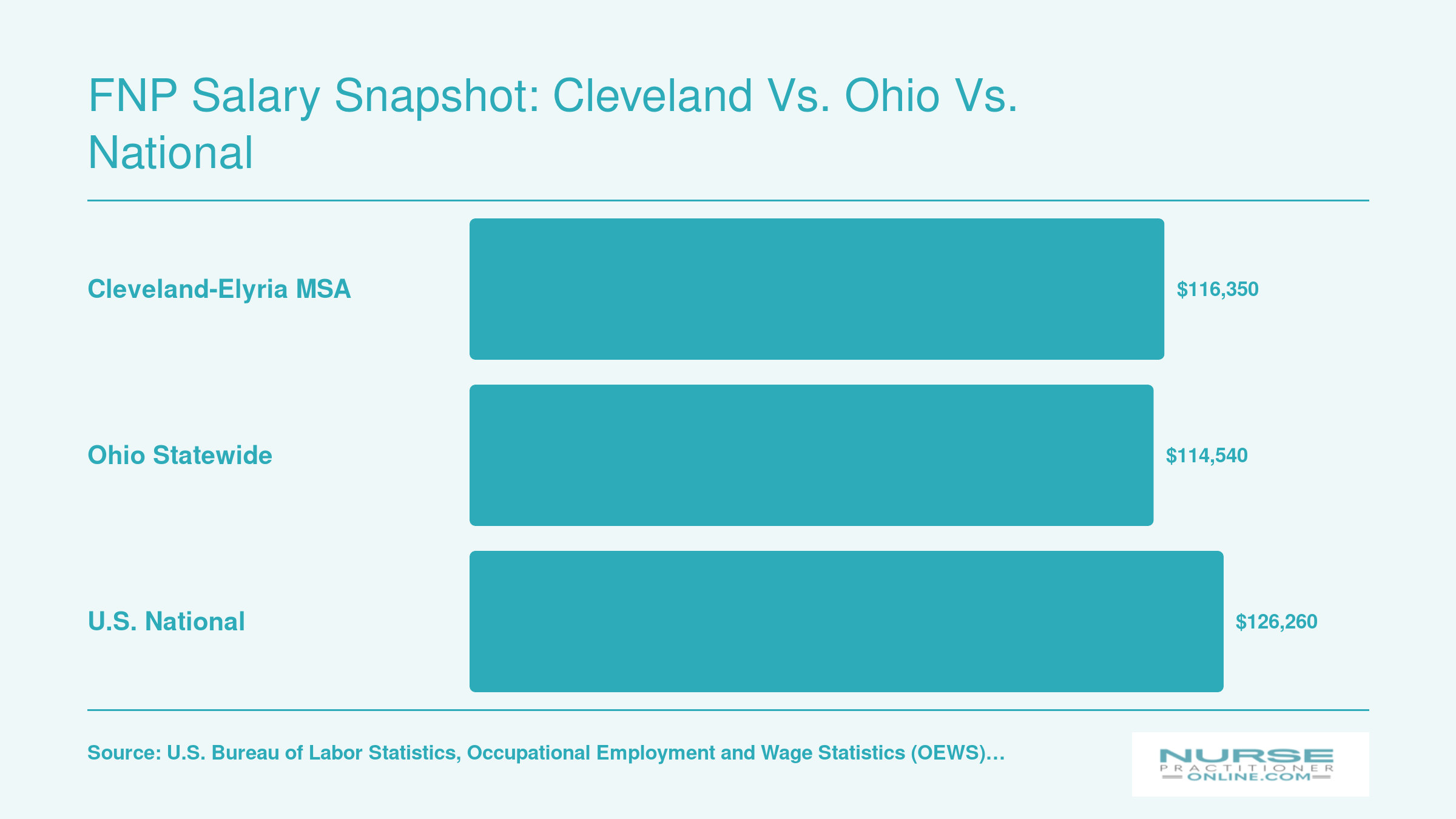
FNP Salary Snapshot: Cleveland vs. Ohio vs. National
Where does Cleveland stack up for nurse practitioner pay? The grouped bar chart below compares median annual salaries for nurse practitioners at three geographic levels, giving you a quick sense of local earning potential as you weigh post-master's FNP certificate programs in the area.
Frequently Asked Questions About Post-Master's FNP Certificates in Ohio
Below are answers to some of the most common questions nurses ask when exploring post-master's FNP certificate programs in and around Cleveland. If you need program-specific details, reach out to each school's admissions office for the latest information.
- How much does a post-master's FNP certificate cost in Ohio?
- Tuition varies by school, credit load, and residency status. Most Ohio programs require roughly 20 to 30 credit hours of coursework plus clinical practicum hours. Total costs can range from around $15,000 to more than $30,000. Contact each program's financial aid office for current per-credit rates, fees, and any available scholarships or employer tuition reimbursement options.
- Can I earn a post-master's FNP certificate entirely online?
- Yes, several Ohio schools offer fully online didactic coursework. Ohio University and Youngstown State University both list online delivery with no stated on-campus requirement, though clinical practicum hours must still be completed in person at an approved site. Other programs, such as the University of Mount Union, use a hybrid format that includes two on-campus intensives alongside online classes.
- What are the Ohio Board of Nursing requirements for FNP licensure after completing a post-master's certificate?
- After finishing your certificate, you must pass a national certification exam from either AANP or ANCC. Ohio recognizes both. You then apply for APRN licensure online through the state's eLicense portal. Required documents include official transcripts, proof of national certification, and program or education verification. There is no separate licensure pathway specific to post-master's certificate holders; the standard APRN requirements apply.
- How long does it take to get a post-master's FNP certificate if I study part-time?
- Part-time students typically finish in three to five semesters, which translates to roughly 18 to 30 months depending on the program's schedule and your clinical placement timeline. Full-time students may complete coursework in as few as two to three semesters. Check with each school about how flexibly you can pace your clinical hours, since that component often determines overall program length.