Most important takeaways…
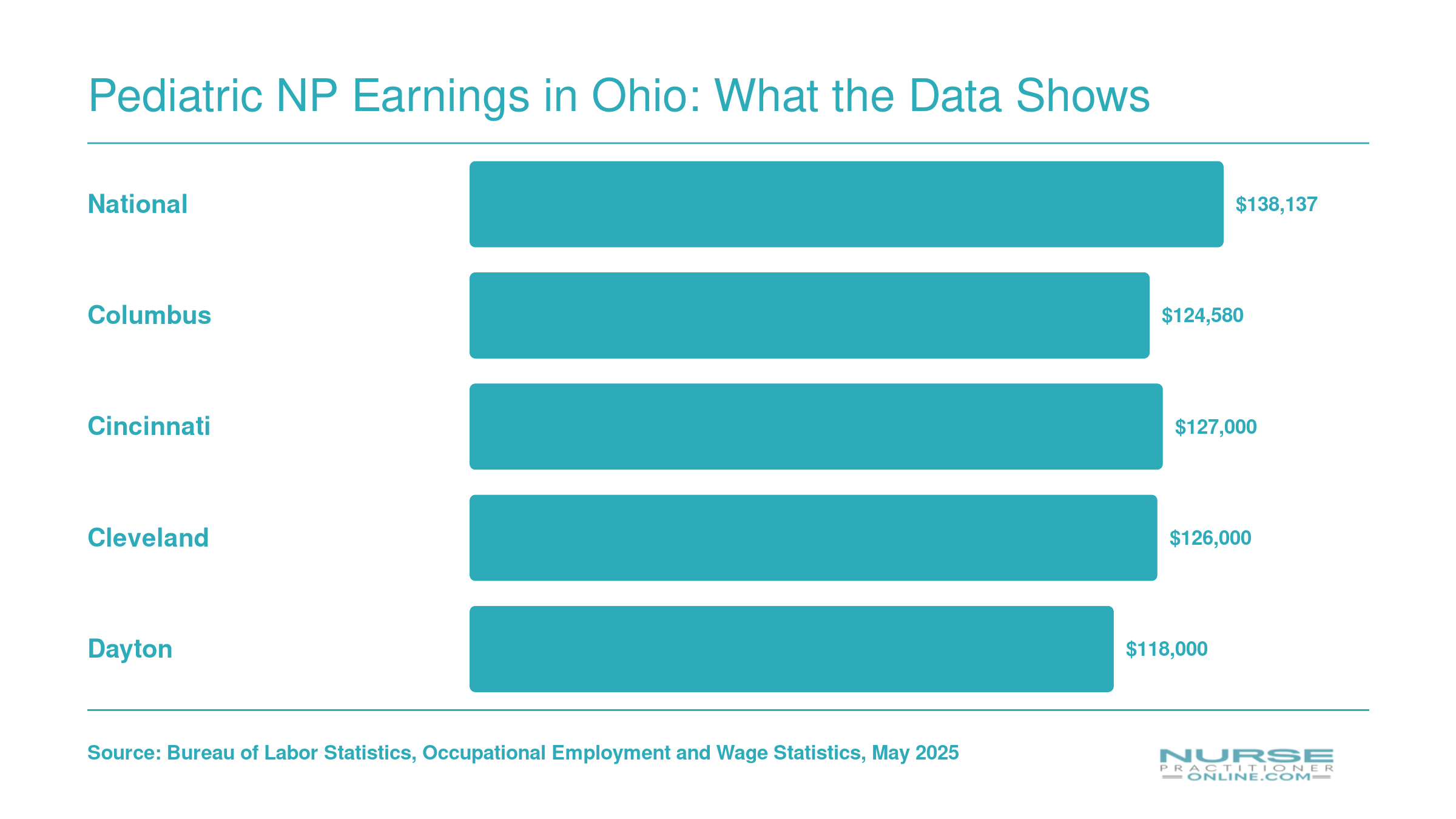
- Columbus area NPs earn roughly $124,600 annually, about $13,500 below the national median of $138,137.
- Ohio State, Wright State, and Cincinnati all offer PNP tracks within driving distance of Columbus.
- Nationwide Children's Hospital partnerships give Columbus area students access to high acuity pediatric clinical rotations.
- Primary care and acute care PNP are separate PNCB credentials, so choosing your track early is essential.
Nationwide Children's Hospital, one of the country's largest pediatric tertiary care centers, anchors a regional job market where pediatric nurse practitioners are in steady demand. For nurses in the Columbus area, that demand translates into a distinct advantage: multiple accredited PNP programs sit within driving distance, offering both primary and acute care tracks.
Selecting a program still forces hard trade-offs between online flexibility, on-campus skill labs, and the placement of clinical rotations. The choice hinges less on prestige and more on which patient population and practice setting you plan to serve after graduation.
Top Pediatric Nurse Practitioner Programs Near Columbus, Ohio for 2026
Ohio is home to a strong cluster of pediatric nurse practitioner programs, and nurses in the Columbus area are especially well positioned to take advantage of them. We scored each program on a value index that weighs what graduates earn against what they owe, factoring in graduate tuition, median debt, and institution-wide graduation rates as a contextual quality signal. Program-level earnings data is not yet available for these PNP tracks, so the rankings lean on institutional outcomes and program-specific strengths identified through independent research.
- Graduate tuition and net price
- Median graduate debt levels
- Institutional graduation rate
- Scorecard earnings outcomes
- Program concentration and clinical depth
- NCES-IPEDS federal institutional data — nces.ed.gov
- College Scorecard graduate earnings — collegescorecard.ed.gov
- Independent program research
- Internal program database

Ohio State University
Ohio State sits at the epicenter of Columbus's pediatric healthcare ecosystem, with deep clinical ties to Nationwide Children's Hospital, one of the largest pediatric hospitals in the country. The College of Nursing offers both primary care and acute care PNP tracks at the master's level, and the acute care pathway has maintained a 100% national certification exam pass rate since 2007. As a comprehensive health sciences center, OSU gives nursing students daily exposure to interprofessional collaboration with medicine, pharmacy, and allied health disciplines.
- Ranked #5 nationally by U.S. News, #1 among public universities
- On-campus format with 16 to 20 weekly clinical hours
- Clinical rotations at Wexner Medical Center and community sites
- Covers pediatric pharmacology, mental health, and clinical reasoning
- Eligible for PNCB board certification upon completion
- Multiple pathways: Traditional MSN or BSN-to-DNP
- AACN Essentials aligned curriculum
- 600 clinical hours required across acute care settings
- Placements at Nationwide Children's Hospital and Cleveland Clinic
- Online didactic option with local clinical experiences
- Prepares for CPNP-AC certification
- Full-time or part-time study available
- Post-Master's pathway offered for current NPs
- Requires pediatric nursing experience before graduation
Pediatric Primary Care Nurse Practitioner (MSN) — On-Campus
Pediatric Acute Care Nurse Practitioner (MSN) — On-Campus

Case Western Reserve University
Case Western Reserve University in Cleveland pairs a highly selective academic environment with powerhouse pediatric partners, including University Hospitals Rainbow Babies & Children's Hospital and Cleveland Clinic Children's. The MSN PNP Acute Care track is a hybrid program requiring 45 credit hours and more than 600 clinical hours, giving students deep exposure to tertiary and quaternary pediatric services. With a 9:1 student-to-faculty ratio, mentorship is a genuine hallmark of the experience.
- Hybrid format: online coursework with on-campus intensives
- 45 credit hours and over 600 clinical hours
- Affiliated with Rainbow Babies & Children's Hospital
- Prepares for PNCB certification exam
- Part-time study plans available
- Includes advanced pathophysiology and pharmacology courses
- Dual major and post-graduate certificate options offered
Pediatric Nurse Practitioner in Acute Care (MSN) — Hybrid

University of Cincinnati
The University of Cincinnati offers both a DNP and a post-master's certificate in Pediatric Acute Care NP, making it a versatile choice for nurses at different career stages. The programs serve a tri-state region spanning Ohio, Kentucky, and Indiana, with online coursework supplemented by periodic on-campus immersions in Cincinnati. Faculty members are practicing nurses, and each student receives a dedicated advisor, success coordinator, and clinical coordinator.
- Online coursework with on-campus immersions
- $836 per credit hour for Ohio residents
- Full-time and part-time options available
- Prepares for CPNP-BC national certification
- Financial aid and scholarships available
- Fall semester start, application deadline June 2026
- Faculty who are active clinical practitioners
- Hybrid delivery for post-MSN nurses
- Requires BSN and MSN from accredited institutions
- Minimum 3.25 BSN GPA and one year RN experience
- Individualized study plans available
- Clinicals arranged in the U.S., typically in-region
- Applicants must reside in Ohio, Kentucky, or Indiana
Pediatric Acute Care Nurse Practitioner (DNP) — Hybrid
Pediatric Acute Care Nurse Practitioner (Post-Graduate Certificate) — Hybrid

Cedarville University
Cedarville University, located roughly midway between Columbus and Dayton, offers the only explicitly faith-integrated DNP PNP program among major Ohio options. The curriculum covers primary care for children from birth through age 21 and requires 800 clinical hours. CCNE accredited and reporting a 98% graduate placement rate, Cedarville combines rigorous clinical training with a biblical worldview and four on-campus enrichment intensives woven into an otherwise online format.
- CCNE accredited with 800 required clinical hours
- Online delivery with four on-campus intensive experiences
- Prepares for PNCB or ANCC certification
- Six start dates per year across fall, spring, and summer
- Scholarships ranging from $3,000 to $5,000
- 98% placement rate for graduates
- Low student-to-faculty ratio with expert clinical faculty
- Biblical worldview integrated throughout coursework
DNP Pediatric Nurse Practitioner, Primary Care — Hybrid

University of Akron
The University of Akron serves northeast Ohio with a robust set of pediatric NP pathways, including MSN tracks in both acute care and primary health care, plus a compact 10-credit post-MSN certificate for licensed APRNs who want to add pediatric acute care skills. Campus-based clinical placements draw from the Akron-Cleveland corridor's pediatric hospitals and emergency departments, giving students hands-on experience with complex acute and chronic conditions in children.
- 28-credit-hour specialty track focused on acute and critical care
- Clinical placements in pediatric EDs and ICUs
- 12 months of RN experience required
- Evidence-based practice core curriculum
- Admission interview required
- 3.0 GPA minimum for admission
- Prepares for advanced NP practice roles
- 28-credit-hour primary care specialty track
- Meets PNCB certification requirements
- Multiple clinical practicum courses included
- Advanced pediatric assessment and pharmacology courses
- Requires current Ohio RN license
- Requires BSN from accredited program
- Compact 10-credit-hour program for current NPs
- Requires Ohio APRN license and national pediatric certification
- 150-hour supervised clinical practicums
- Designed for working professionals seeking upskilling
- Individual gap analysis for other specialty NPs
- Prepares for pediatric primary care certification
Child and Adolescent Health Nurse Practitioner, Acute Care (MSN) — On-Campus
Child and Adolescent Health Nurse Practitioner, Primary Health Care (MSN) — On-Campus
Child and Adolescent Health Nurse Practitioner (Post-MSN Certificate) — On-Campus

Kent State University
Kent State University's MSN Pediatric Primary Care NP concentration prepares nurses to deliver comprehensive care to infants, children, and adolescents across outpatient and specialty settings. The program leverages Kent State's multi-campus system and offers many courses online, making it a practical option for nurses across central and eastern Ohio who cannot relocate. CCNE accredited, with fall and spring start dates, the program pairs faculty mentorship from nationally certified APRNs with flexible scheduling.
- CCNE accredited with fall and spring start dates
- Hybrid format with many courses available online
- Full-time and part-time study options
- Faculty mentors who are nationally certified APRNs
- Practicum in outpatient primary care and specialty settings
- Family-centered care framework throughout curriculum
- Accessible via Kent State's multi-campus system
Pediatric Primary Care Nurse Practitioner (MSN) — Hybrid

Wright State University
Wright State University in Dayton offers a fully online post-master's certificate in Pediatric NP Primary Care, designed specifically for master's-prepared NPs who want to add a pediatric credential without pursuing another full degree. The 18-credit-hour program includes 560 clinical hours, with placements typically arranged in the student's home region across Ohio. It is a strategic choice for family NPs or other APRNs looking to meet growing pediatric primary care demand.
- Fully online didactic coursework with synchronous sessions
- 18 credit hours and 560 clinical hours
- Designed for master's-prepared NPs adding PNP-PC scope
- Clinicals precepted by pediatricians or PNPs in Ohio
- Prepares for PNCB national certification
- Requires MSN from a CCNE-accredited program
- Gap analysis to tailor course requirements
- Covers birth through 21 years of age
Pediatric Nurse Practitioner, Primary Care (Post-Master's Certificate) — Online
Primary Care vs. Acute Care PNP: Choosing Your Specialization
Before you pick a program, you need to pick a track. The Pediatric Nursing Certification Board (PNCB) offers two distinct credentials, and each one shapes where you practice, which patients you see, and what your day looks like. Here is a side-by-side look at the two paths, along with which Ohio programs near Columbus offer each concentration.
| Dimension | CPNP-PC (Primary Care) | CPNP-AC (Acute Care) |
|---|---|---|
| Certification Credential | CPNP-PC, awarded by the PNCB | CPNP-AC, awarded by the PNCB |
| Clinical Focus | Health promotion, disease prevention, outpatient management of common illnesses | Acute, critical, and complex conditions in unstable or high-acuity pediatric patients |
| Patient Population | Birth through young adulthood (approximately age 21), longitudinal and continuity-based care | Infants through young adults, episodic or longitudinal care in high-acuity settings |
| Typical Work Settings | Private pediatric practices, ambulatory clinics, federally qualified health centers, school-based clinics | Children's hospitals, PICUs, NICUs, emergency departments, subspecialty inpatient units |
| Care Orientation | Community-focused: well-child visits, immunizations, chronic illness management, anticipatory guidance | Hospital-focused: stabilization, procedural management, coordination across subspecialties |
| Ohio Programs Offering This Track | Ohio State University (MSN, campus), Cedarville University (DNP, hybrid), Kent State University (MSN, hybrid), Wright State University (post-master's certificate, online) | Case Western Reserve University (MSN, hybrid, 45 credits, 600+ clinical hours), University of Cincinnati (post-MSN certificate, hybrid), University of Akron (post-MSN certificate, campus) |
| Best Fit If You Love... | Building long-term relationships with families, guiding child development, and working in outpatient or community settings | Fast-paced hospital environments, managing critically ill children, and collaborating with surgical or subspecialty teams |
Questions to Ask Yourself
What Do These PNP Programs Actually Cost?
Tuition can vary dramatically depending on whether a school is public or private and whether you qualify for in-state rates. The table below compares annual tuition, average net price, and median graduate debt across all seven programs. Keep in mind that the net price figures shown are institution-level averages that reflect financial aid across all students at each university, not a guaranteed quote for your specific graduate nursing program. Your actual costs will depend on your enrollment status, financial aid package, and how many credits your PNP track requires. Among these schools, Ohio State University and Cedarville University stand out for the lowest median graduate debt at completion ($19,976 and $20,937, respectively), which is worth noting if minimizing borrowing is a top priority.
| School | In-State Tuition | Out-of-State Tuition | Avg. Net Price | Median Graduate Debt |
|---|---|---|---|---|
| University of Akron | $10,125 | $15,885 | $13,946 | $23,250 |
| Wright State University | $15,771 | $25,759 | $15,415 | $22,750 |
| Ohio State University | $13,901 | $42,740 | $17,339 | $19,976 |
| Kent State University | $12,483 | $23,352 | $20,787 | $24,500 |
| Cedarville University | $11,015 | $11,015 | $24,468 | $20,937 |
| University of Cincinnati | $14,902 | $26,674 | $25,648 | $21,250 |
| Case Western Reserve University | $53,980 | $53,980 | $41,190 | $24,000 |
Related Articles
Online, On-Campus, or Hybrid: PNP Format Options in Ohio
Working nurses often face a direct tradeoff between flexibility and on-campus community: online programs let you study asynchronously on night shifts and weekends, but hybrid formats preserve hands-on skill labs and faculty face time. In Ohio, pediatric nurse practitioner programs span all three delivery models, and no other resource breaks down which schools offer which format for PNP tracks specifically.
Format Breakdown for Ohio PNP Programs
Among the ranked programs near Columbus, Ohio State University and the University of Akron offer campus-based PNP programs, meaning you attend lectures and skill labs in person. These formats suit nurses living within commuting distance of Columbus or Akron and who value structured, on-site learning.
Case Western Reserve University, the University of Cincinnati, Cedarville University, and Kent State University all deliver hybrid PNP programs. In a hybrid model, most didactic coursework happens online, with periodic on-campus intensives for physical assessment labs, simulation, or clinical seminars. Hybrid students typically visit campus two to four times per semester for multiday sessions.
Wright State University offers a fully online PNP certificate with synchronous coursework, meaning you log in at scheduled times for live class sessions. This format gives you geographic flexibility while preserving real-time interaction with faculty and peers.
What "Online" Actually Means for Clinical Training
Regardless of the program's format label, clinical hours are always in person. Ohio PNP programs require 560 to 800 supervised clinical hours in pediatric settings. Even if your lectures are asynchronous, you still need to secure preceptors at children's hospitals, pediatric primary care offices, or specialty clinics within driving distance of your home.
Proximity to Columbus matters for everyone. Nationwide Children's Hospital, one of the country's largest pediatric academic medical centers, hosts clinical rotations for students across multiple programs. Hybrid and online students who live near Columbus gain easier access to these high-volume, high-acuity training sites than those living hours away.
Practical Considerations for Working RNs
Asynchronous coursework allows you to watch lectures and complete assignments between shifts, but hybrid intensives require taking vacation days or shift swaps. If your employer offers weekend or evening clinical shifts, you may find it easier to block out entire weekdays for campus visits.
Clinical scheduling flexibility varies by program. Some schools assign you to preceptors; others expect you to identify and secure your own. Hybrid programs typically offer more support in placement, especially if they maintain partnerships with local children's hospitals. Online-only formats may require you to do more legwork in finding pediatric preceptors willing to supervise graduate students.
Children's Hospital Partnerships and Clinical Training Sites
Which pediatric NP programs in Ohio have official clinical training partnerships with Nationwide Children's Hospital and other major children's hospitals?
Formal affiliations between a university and a pediatric hospital can dramatically shape your clinical training experience. At present, the landscape near Columbus is uneven, and only a few programs maintain documented partnerships with Nationwide Children's Hospital and its regional counterparts.
Mapping the Current Ohio PNP-Hospital Affiliations
According to the most recent graduate nursing affiliation listings from Nationwide Children's Hospital (2024), only two ranked programs appear as explicitly designated affiliates: Kent State University and Case Western Reserve University.1 Both schools have structured pathways that make their PNP students eligible for clinical placements within Nationwide Children's vast network of inpatient, outpatient, and specialty clinics across Columbus.
The remaining programs, including Ohio State, University of Cincinnati, Wright State, University of Akron, and Otterbein, are not listed as formal graduate nursing affiliates of Nationwide Children's.1 This does not necessarily mean those students cannot rotate there, but it indicates that no institutional agreement currently guarantees access or priority. For Cincinnati Children's Hospital Medical Center, Akron Children's Hospital, and Dayton Children's Hospital, publicly available affiliate directories are less centralized, and many programs rely on individual instructor relationships to secure slots rather than published partnerships.
Why a Children's Hospital Affiliation Matters
- Specialized Preceptors: Affiliated sites often assign dedicated pediatric nurse practitioner and physician preceptors who are experienced in guiding APRN students through advanced assessment, diagnosis, and management of complex pediatric conditions.
- Case Volume and Diversity: Large children's hospitals manage high-acuity patients, rare congenital disorders, and a broad socioeconomic mix that a smaller general clinic cannot replicate. Rotations in NICUs, PICUs, and specialty clinics become more feasible.
- Post-Graduation Hiring Pipelines: Many affiliated hospitals prioritize hiring graduates they have trained, essentially creating a direct line from clinical rotation to job offer. For working nurses seeking career advancement, this can shorten the transition to a new role.
Clinical Placement Availability Is Never Guaranteed
Even at affiliated sites, spot availability fluctuates by semester. Your cohort's size, the number of preceptors on leave, and hospital capacity can all affect whether you secure your preferred rotation. Programs with formal agreements typically get early or priority scheduling, but no one should assume a placement is automatic. If a specific hospital experience is crucial to your career goal (say, pediatric cardiology at Nationwide Children's), you should ask the program coordinator directly how many PNP students from their school rotated in that department during the past academic year and what the typical success rate looks like.
As you weigh these factors, it helps to see how programs compare nationally. Our ranked list of online PNP programs can give you a broader perspective on clinical training structures across the country. In the Columbus area, being physically close to a world-class facility is no substitute for a formal partnership. As you compare programs, factor in not just the name of nearby hospitals but the concrete clinical pathways each school can actually deliver.
Pediatric NP Earnings in Ohio: What the Data Shows
Ohio nurse practitioners earn competitive wages, though the Columbus metro area falls roughly $13,500 below the national median of $138,137. Factors like cost of living, employer mix, and the concentration of major health systems help explain why wages vary across the state's metro areas. Program-level early-career earnings for the pediatric NP programs featured in this article are not yet published, so the figures below reflect all nurse practitioner specialties combined in each region.
Your Roadmap to Becoming a Pediatric NP in Ohio
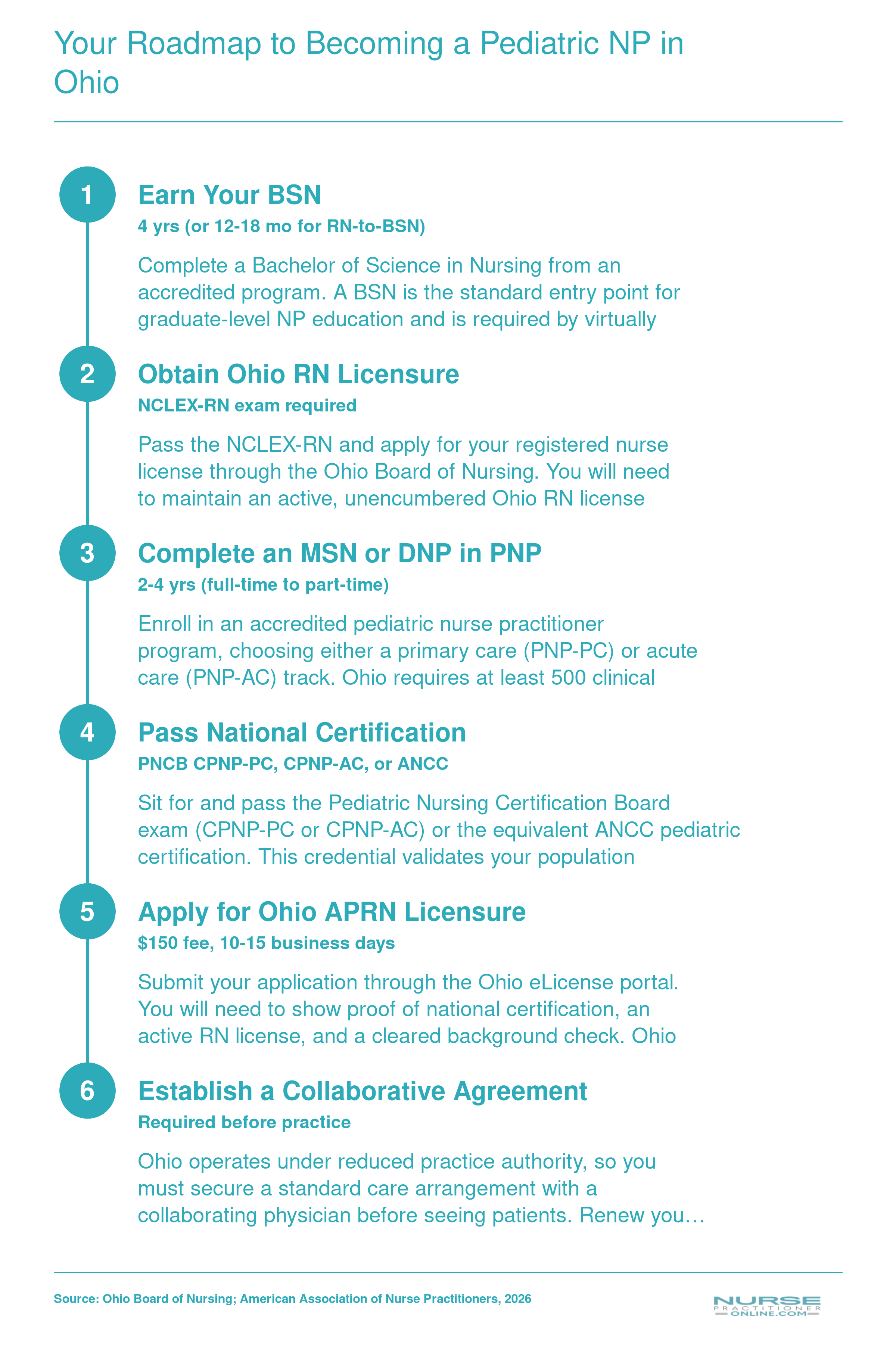
The path from bedside RN to pediatric nurse practitioner follows a clear sequence of education, certification, and licensure steps. Depending on whether you study full-time or part-time, expect the graduate portion alone to take roughly two to four years. Here is the step-by-step roadmap Ohio nurses follow.
Ohio Pediatric NP Admissions: What Programs Expect
Getting into a pediatric nurse practitioner program in Ohio takes more than a strong GPA. Admissions committees look at the full picture, and understanding what each component signals can give you a real edge before you hit submit.
The Baseline Requirements
Almost every Ohio PNP program anchors its admissions criteria around a few non-negotiables. You will need an active, unencumbered RN license, a BSN from a program accredited by ACEN, CCNE, or CNEA, and a minimum cumulative GPA, typically 3.0. Ohio State University, for example, sets that 3.0 floor and also requires a statistics course completed within the past five years with a grade of B or higher.1 Kent State's post-master's certificate goes further, requiring completion of advanced pathophysiology, advanced pharmacology, and advanced health assessment, all at a B or above within the same five-year window.2 If you are weighing similar DNP prerequisites at the doctoral level, many of these foundational courses overlap.
Clinical experience matters just as much as coursework. Most programs want to see at least one to two years of hands-on nursing experience, with pediatric or acute care backgrounds viewed most favorably. Ohio State's acute care PNP track specifically notes a one-year minimum.1 If your current experience is in a different specialty, it is worth reaching out to admissions advisors directly rather than assuming you are disqualified.
Beyond the Transcript
Supplemental materials carry real weight in competitive cohorts. Expect to submit a personal statement, two or three letters of recommendation from professional or academic sources, and current CPR/BLS certification. Some programs, including Ohio State, conduct holistic reviews, meaning a compelling personal narrative or a distinctive clinical background can offset a GPA that sits right at the minimum. Ohio State has also waived the GRE requirement, which removes a significant hurdle for working nurses who have been out of the classroom for a while.1 University of Cincinnati asks for a goal statement in the 500-to-700-word range, and some programs schedule interviews with faculty or program directors as a final step.
No Ohio PNP program currently publishes its acceptance rate or cohort size publicly, so it is difficult to put a precise number on how competitive any one track is. What is clear is that programs with strong research affiliations and clinical partnerships tend to receive robust applicant pools.
Full-Time vs. Part-Time Enrollment
Most Ohio programs accommodate both full-time and part-time students, a practical necessity given that the majority of applicants are working nurses. Full-time completion typically runs two to three years for an MSN-level PNP track, while part-time paths can extend that timeline to three or four years. Post-master's certificate programs, like those at Kent State and Wright State, are generally shorter regardless of pace. If you are also considering acute care nurse practitioner programs, you will find similar flexibility in scheduling. Mapping your enrollment plan to your current clinical schedule early in the process will help you choose the format that keeps you on track without burning out.
Common Questions About Pediatric NP Programs in Ohio
Choosing a pediatric nurse practitioner program is a big decision, and you probably have plenty of questions. Below are answers to the ones Ohio nurses ask most often, drawn from current program details, salary data, and admissions requirements.
- How long does it take to complete a pediatric nurse practitioner program in Ohio?
- It depends on the pathway. A full MSN with a PNP concentration typically takes two to three years of full-time study, often requiring 40 to 50 or more graduate credits plus several hundred clinical hours. If you already hold an MSN, a post-master's certificate can be much shorter. Wright State University's PNP primary care certificate, for example, is just 18 credits across three semesters with 560 clinical hours.
- What is the difference between primary care and acute care PNP programs?
- Primary care PNP programs prepare you to manage wellness visits, chronic conditions, and developmental screenings in outpatient settings such as pediatric clinics and schools. Acute care PNP programs focus on managing critically or acutely ill children in hospitals, emergency departments, and specialty units. Your choice should align with the clinical environment where you want to practice, and some employers, especially children's hospitals, require the acute care credential for inpatient roles.
- How much does a pediatric nurse practitioner make in Ohio?
- Nurse practitioner salaries in Ohio vary by setting, experience, and specialty. According to Bureau of Labor Statistics data, NPs in the state generally earn a median salary that is competitive with national figures, and pediatric specialists in hospital systems often earn at the higher end of that range. Compensation can increase further with acute care certification or leadership responsibilities. Exact figures shift year to year, so checking the latest BLS release is always a good idea.
- Are there fully online pediatric nurse practitioner programs available in Ohio?
- Most Ohio PNP programs use a hybrid format: didactic coursework is delivered online while clinical rotations are completed in person at approved sites. Fully online options for the classroom portion give working nurses significant flexibility, but you will still need to arrange hands-on clinical hours locally. Part-time tracks are available at several Ohio schools, making it easier to balance coursework with your current RN position.
- What college has the best pediatric nursing program near Columbus?
- Several strong options are accessible from Columbus. Wright State University offers an accredited PNP primary care certificate that can be completed in three semesters. Ohio State University and the University of Cincinnati also have well-regarded graduate nursing programs with pediatric tracks. Proximity to Nationwide Children's Hospital gives Columbus-area students a major clinical advantage, so consider which program best connects you to that training environment.
- Is financial aid available for PNP graduate students in Ohio?
- Yes. Graduate nursing students in Ohio can access Federal Direct Unsubsidized Loans as a baseline funding source. Beyond federal loans, programs like the NURSE Corps Loan Repayment Program and HRSA scholarships target nurses who commit to serving in underserved communities. Many universities also offer graduate assistantships, merit scholarships, or employer tuition reimbursement partnerships. Contact your program's financial aid office early to explore every option.
- Can I work as an RN while completing a PNP program part-time?
- Absolutely. Part-time tracks are available at Ohio PNP programs specifically to accommodate working nurses. Many students continue in their RN roles while taking one or two courses per semester. Keep in mind that clinical rotation hours can be intensive, so you may need to adjust your work schedule during those semesters. Talking with your employer about flexible shifts or a reduced schedule during clinicals can make the process much more manageable.