Most important takeaways…
- Most Ohio MSN WHNP programs require 500 to 700 clinical hours, and not all schools arrange local Dayton preceptors for you.
- Annual graduate tuition across top accessible programs ranges roughly from $12,000 to over $25,000 for Ohio residents.
- Ohio requires WHNP certification exclusively through the National Certification Corporation before you can obtain APRN licensure.
- WHNPs must maintain a collaborating physician agreement in Ohio, as the state does not grant full practice authority to NPs.
Southwest Ohio has a measurable shortage of women's health specialists, yet Dayton itself hosts no dedicated MSN Women's Health Nurse Practitioner program on the ground. That gap makes program selection unusually consequential: the wrong fit on cost, format, or clinical logistics can stall a career transition that most working nurses can afford to attempt only once.
The programs most accessible to Dayton-area nurses in 2026 are largely online, pairing asynchronous or synchronous coursework with clinical hours completed close to home. That structure suits nurses who cannot relocate or leave full-time positions, but it also shifts real logistical responsibility onto the student, particularly around securing qualified preceptors in the local market.
Ohio's collaborative practice requirement adds another layer: even after earning the MSN and clearing national certification through the National Certification Corporation, WHNPs must maintain a formal arrangement with a collaborating physician to prescribe. That regulatory reality shapes hiring, compensation, and long-term practice options across the Dayton metro.
Top MSN WHNP Programs Accessible from Dayton, Ohio, 2026 Rankings
For Dayton-area nurses ready to specialize in women's health, a handful of Ohio-based MSN WHNP programs stand out for their mix of affordability, clinical flexibility, and strong academic reputations. Some are fully online with no campus visits required, while others use hybrid or on-campus formats that still work for nurses willing to make periodic trips within the state. Below, we spotlight four programs that Ohio residents can realistically pursue while continuing to work and live in the Dayton metro.
- Affordability and net price
- Graduate outcomes and earnings
- Program accessibility from Dayton
- Clinical placement flexibility
- Institutional graduation rate
- College Scorecard graduate earnings — collegescorecard.ed.gov
- NCES-IPEDS federal institutional data — nces.ed.gov
- Independent program research
- Internal program database

University of Cincinnati
The University of Cincinnati delivers a fully online MSN WHNP program built for working nurses across Ohio. Faculty hold active WHNP or Nurse-Midwifery certifications, bringing real-world clinical insight into every course. With three start dates per year, a temporarily waived graduate application fee through Spring 2027, and the ability to complete clinical hours in your own community, this program is especially practical for Dayton-area RNs who want minimal disruption to their careers and families.
- 100% online coursework with in-person precepted clinicals
- Three annual start dates for flexible enrollment
- Clinical hours arranged in your home community
- Faculty certified in WHNP or Nurse-Midwifery
- Covers wellness, prenatal care, and gynecologic management
- Graduate application fee waived through Spring 2027
- Prepares for outpatient and inpatient care roles
Women's Health Nurse Practitioner MSN — Online

Ohio State University
Ohio State University is one of only two CCNE-accredited WHNP programs physically based in Ohio, lending it particular weight for in-state applicants. The on-campus program prepares graduates for National Certification Corporation (NCC) credentialing through holistic, client-centered coursework and precepted clinical experiences arranged across the state. OSU also offers a distinctive dual Nurse-Midwifery and WHNP track with over 1,000 clinical hours for nurses who want both credentials.
- On-campus format at OSU's Columbus campus
- Prepares graduates for NCC WHNP certification
- Precepted clinical sites arranged across Ohio
- Part-time and full-time scheduling available
- Emphasis on gynecologic and reproductive health
- Evidence-based practice and leadership development
- Campus-based program with dual certification eligibility
- Over 1,000 required clinical hours
- ACME-accredited midwifery track
- Covers pregnancy, childbirth, and newborn care
- Includes reproductive and gynecologic health training
- Graduate entry and post-master's pathways available
Women's Health Nurse Practitioner MSN — On-Campus
Dual Nurse-Midwifery and Women's Health NP MSN — On-Campus

Kent State University
Kent State University offers a 100% online WHNP concentration within its MSN program, and students are never required to visit the Kent campus. Clinical practicum hours are completed in the student's own state of residence, making this an especially accessible option for Dayton-area nurses who want to arrange placements at local health systems. A CCNE-accredited post-master's certificate pathway is also available for MSN-prepared nurses who simply want to add the WHNP specialty.
- 100% online coursework, no campus visits required
- Clinical practicum completed in student's home state
- CCNE-accredited program
- Post-master's WHNP certificate option available
- Small class sizes with individualized faculty mentorship
- 24/7 technical support via Canvas platform
- Ambulatory and primary care clinical settings
Women's Health Nurse Practitioner MSN — Online

Case Western Reserve University
Case Western Reserve University's hybrid MSN WHNP program pairs online coursework with intensive on-campus sessions in Cleveland, requiring 38 credit hours and roughly 600 clinical hours. Full-time students can finish in as few as 12 months across four semesters. With a 9-to-1 student-to-faculty ratio and a strong research orientation, Case Western is a compelling choice for Dayton nurses who value a prestigious, clinically rigorous environment and are willing to travel for periodic immersion days.
- Hybrid format blending online and on-campus intensives
- 38 credit hours with approximately 600 clinical hours
- Full-time completion possible in 12 months
- 9-to-1 student-to-faculty ratio
- Covers gynecologic, reproductive, and lifespan care
- Part-time study plans available
- Prepares for national WHNP certification
- Financial aid options available for qualified students
Women's Health Nurse Practitioner MSN — Hybrid
What Dayton-Area Nurses Should Know: Online vs. On-Campus WHNP Formats
Choosing between online and on-campus WHNP program formats is one of the most practical decisions you will face as a working nurse near Dayton. Most of the top-ranked programs accessible from this region offer fully online or hybrid delivery, while a handful maintain traditional campus-based tracks in Columbus or Cincinnati. Understanding the trade-offs helps you pick the format that fits your schedule, budget, and learning style.
Pros
- Online programs let you keep working full-time shifts while completing coursework on your own schedule, a major benefit for busy RNs.
- Studying online opens access to well-regarded WHNP programs across Ohio and beyond, not just those within driving distance of Dayton.
- Online tuition is often lower overall because you eliminate commuting costs and some campus fees from your total investment.
- Hybrid and on-campus formats typically coordinate clinical placements for you, reducing the stress of finding your own preceptor sites.
- On-campus cohorts build stronger peer networks and direct faculty relationships that many graduates credit with boosting their clinical confidence.
- Structured in-person sessions in hybrid programs offer hands-on skills practice that can be difficult to replicate in a purely virtual setting.
Cons
- Fully online students usually must arrange their own clinical placements near Dayton, which can be competitive and time-consuming.
- Without regular face-to-face faculty interaction, online learners may miss spontaneous mentorship and real-time feedback on developing clinical reasoning.
- Online coursework demands consistent self-discipline; balancing asynchronous deadlines with 12-hour nursing shifts requires strong time management.
- On-campus programs in Columbus or Cincinnati mean roughly 70 to 100 miles of round-trip commuting from Dayton, adding hours to an already packed week.
- Rigid on-campus class schedules can conflict with rotating hospital shifts, making it harder for working nurses to attend every session.
- Campus-based programs may carry higher total costs once you factor in parking, gas, and potential lost shift income from commute days.
WHNP Tuition and Net Price Side-by-Side for Ohio Students
Understanding the true cost of your MSN WHNP program is one of the most important steps in planning your career advancement. The table below compares annual graduate tuition rates and institution-wide average net prices for four Ohio programs accessible from Dayton. Ohio residents enrolling at one of the three public universities can expect significantly lower tuition than the private option. Keep in mind that the net price figures shown are institution-wide averages; your individual aid package, including employer tuition assistance and graduate assistantships, will vary.
| School | In-State Tuition | Out-of-State Tuition | Avg. Net Price | Type |
|---|---|---|---|---|
| Kent State University | $12,483 | $23,352 | $20,787 | Public |
| Ohio State University | $13,901 | $42,740 | $17,339 | Public |
| University of Cincinnati | $14,902 | $26,674 | $25,648 | Public |
| Case Western Reserve University | $53,980 | $53,980 | $41,190 | Private |
How Dayton-Area WHNP Students Secure Clinical Placements Locally
Securing high-quality clinical placements is one of the most challenging steps in your WHNP journey, and Dayton-area students face both advantages and real constraints. Understanding how to navigate the local health system landscape and starting your outreach early can make the difference between a smooth clinical experience and months of frustrating dead ends.
Major Health Systems and Their Placement Policies
The Dayton metro is anchored by two large health systems that historically host advanced practice nursing students: Premier Health and Kettering Health Network. Both operate women's health units, but availability fluctuates year to year based on capacity and preceptor availability. Premier Health, for example, is currently not accepting new WHNP placement requests due to high demand and limited preceptor resources.1 However, if you already have a relationship with a Premier Health preceptor, the system will accept student-identified placements through its onboarding process.1 You must submit an affiliation agreement and placement application at least eight weeks before your rotation begins.1
Kettering Health Network and Dayton Children's Hospital also host NP students in select settings, though WHNP-specific opportunities are often clinic-based rather than inpatient. Wright-Patterson Air Force Base medical facilities can be excellent sites if you have connections or prior military affiliation, offering a unique population mix and comprehensive women's health services.
How Online WHNP Programs Handle Placement
Not all programs approach clinical coordination the same way. University of Cincinnati College of Nursing, for instance, maintains relationships with major health systems across Ohio and helps match students with sites when possible.4 Its network includes Cleveland Clinic and Atrium Health, but Dayton-area students often still need to identify local preceptors independently. Frontier Nursing University, on the other hand, uses a student-initiated model from the start: you are responsible for finding and vetting your own preceptors, with program support limited to affiliation paperwork and approval.3 If you are comparing placement models across multiple schools, our guide to the best online WHNP programs includes details on how top-ranked programs structure clinical coordination.
Some students turn to paid matching services such as Clinical Match Me or NPHub. Both offer national WHNP preceptor networks and attempt to match based on procedure access and clinical goals, not just availability.23 Fees vary, but the investment can save months of cold-calling practices.
Practical Steps for Finding Preceptors
Start your outreach six to twelve months before your clinical courses begin.3 Contact OB/GYN private practices, women's health clinics, community health centers, and family practices with robust prenatal or gynecology panels. Explain your program requirements clearly, emphasizing the total clinical hours you need (typically 500 to 630 across the WHNP curriculum) and your willingness to work around the preceptor's schedule. For a detailed walkthrough of the outreach process, see our guide on how to find NP clinical preceptors.
Regional Advantages and Competition
Dayton's proximity to Cincinnati (about 55 miles south) and Columbus (about 70 miles north) substantially expands your clinical site pool. Many students successfully complete rotations in both cities, especially when local Dayton options are saturated. Be prepared for competition: programs with dedicated clinical coordinators and established affiliation agreements often secure placements faster than students navigating the process alone. If you are choosing between programs, ask directly how much placement support you will receive and whether the school holds active agreements with Dayton-area health systems.
Related Articles
Admissions Requirements and Completion Timelines Compared
Every MSN Women's Health Nurse Practitioner program accessible from Dayton shares a core set of admission standards, but timelines and prerequisites vary enough to influence your decision. Understanding these differences up front helps you choose a program that aligns with both your academic record and your availability over the next two to three years.
Baseline Admission Criteria Across Ohio WHNP Programs
All programs expect a Bachelor of Science in Nursing from an accredited institution and an active, unencumbered RN license. Minimum undergraduate GPA requirements cluster around 3.0 overall and 3.0 in nursing science coursework. University of Cincinnati, for example, enforces both thresholds and strongly prefers applicants with at least one year of clinical nursing experience, though this is not an absolute bar for entry. Ohio State and Kent State use similar benchmarks, and most programs evaluate your nursing undergraduate coursework separately to ensure a solid foundation in pathophysiology and health assessment.23 Regarding standardized tests, the trend in 2026 leans away from GRE requirements: University of Cincinnati and Kent State do not ask for GRE scores, simplifying the application process for working nurses.
Program Length and Credit-Hour Ranges
Most MSN WHNP programs run between 24 and 36 months when completed part-time, making them manageable alongside a nursing job. University of Cincinnati's WHNP track spans 24 months and comprises 49 credits, including 672 clinical hours. Kent State and Ohio State offer similar timeframes but extend flexibility to 36 months for students who need to reduce their course load.23 Full-time enrollment compresses the timeline, though few working nurses find full-time feasible. Credit requirements generally fall between 42 and 50 semester hours, depending on whether the program integrates comprehensive exams, capstone projects, or additional electives. If you are also comparing WHNP programs from other institutions nationwide, these credit ranges are fairly standard.
Wright State's Current WHNP Offerings
Wright State University does not currently offer a Women's Health Nurse Practitioner track as of the 2025-2026 academic year.4 The university's graduate nursing programs focus on Family Nurse Practitioner and other specializations, so Dayton-area nurses seeking WHNP preparation must look to University of Cincinnati, Ohio State, Kent State, or online programs like Frontier Nursing University.
Prerequisite Courses and Application Timing
Several programs require or strongly recommend completing coursework in statistics and advanced health assessment before you begin core WHNP classes. University of Cincinnati uses the NursingCAS centralized application system and sets a July 1 deadline for fall cohorts, with an $85 application fee. Planning to submit prerequisite transcripts and reference letters several months ahead of that cutoff keeps you competitive in a selective applicant pool.
Questions to Ask Yourself
WHNP Salary and Career Demand in the Dayton Metro
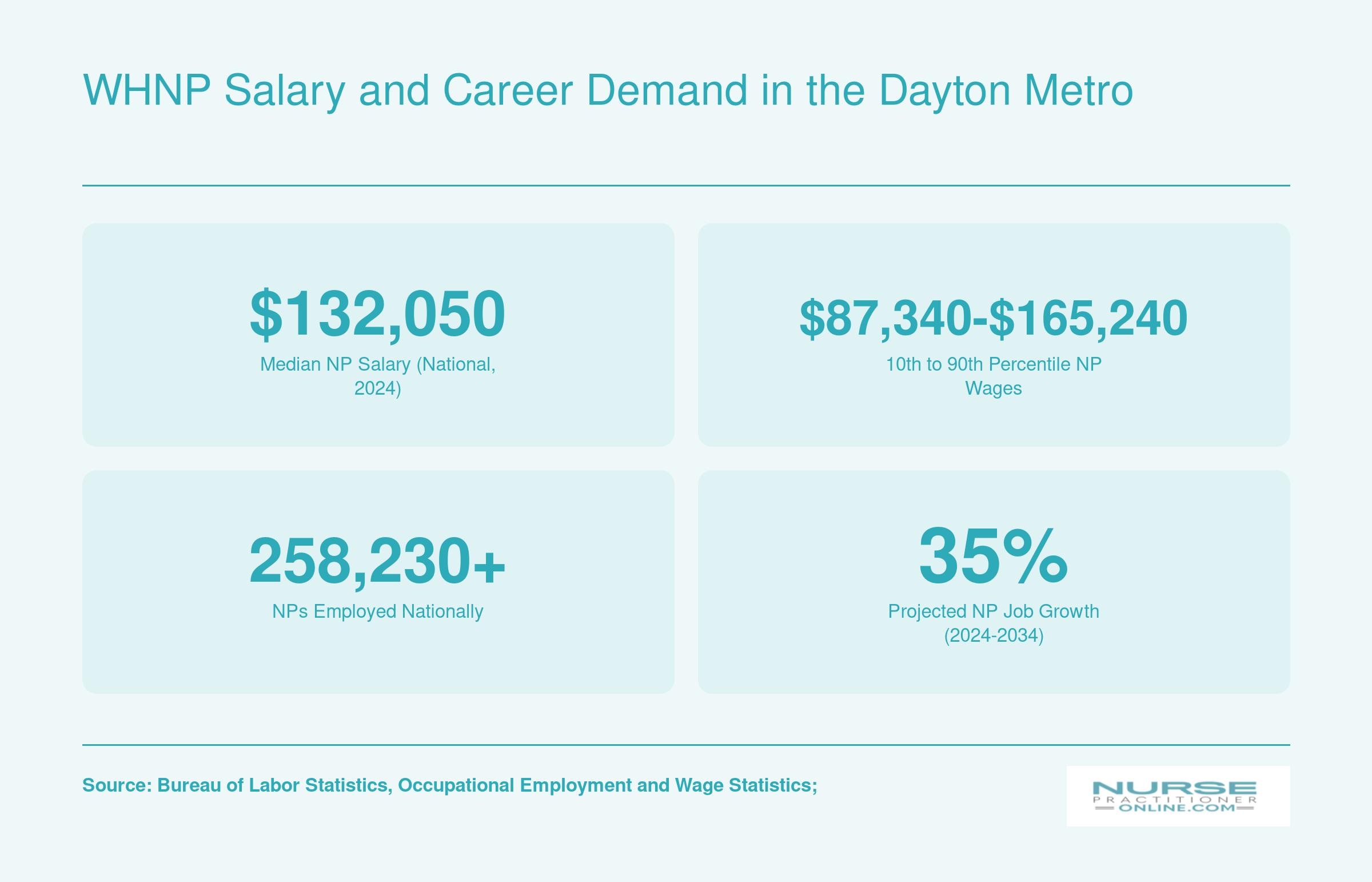
The Bureau of Labor Statistics tracks nurse practitioner wages broadly rather than by specialty, so WHNP-specific salary figures for the Dayton metro are not published separately. That said, women's health NPs in the area can expect compensation closely aligned with general NP wages. Program-level earnings data for Ohio WHNP graduates are not yet available, but the national NP outlook paints a strong picture for career changers near Dayton.
Ohio APRN Licensure and WHNP Certification: Step-by-Step
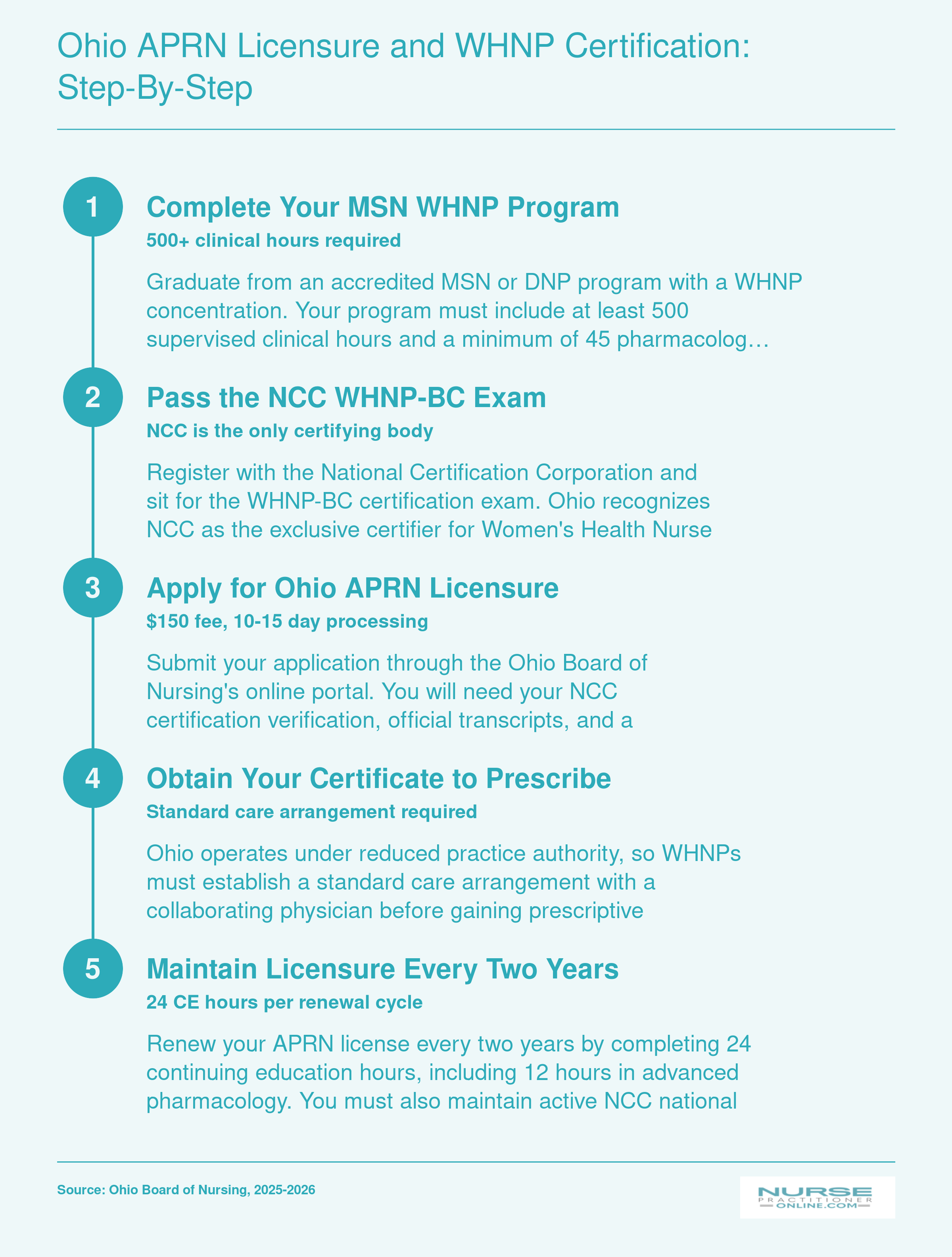
After earning your MSN in Women's Health Nurse Practitioner studies, a clear credentialing sequence stands between you and practice. Ohio designates the National Certification Corporation (NCC) as the sole certifying body for this specialty, so every step below is built around the WHNP-BC credential. Here is the path from graduation to prescriptive authority.
Common Questions About WHNP Programs Near Dayton
Below are answers to some of the most common questions Dayton-area nurses ask when exploring MSN Women's Health Nurse Practitioner programs. Each response draws on details covered earlier in this guide, so you can use this section as a quick reference.
- Which WHNP programs can I attend if I live in Dayton, Ohio?
- Dayton-area nurses have several options. University of Cincinnati offers an on-campus and hybrid WHNP track within driving distance, while nationally accredited online programs from schools such as Frontier Nursing University, Georgetown University, and Stony Brook University allow you to study from home. Many of these online programs hold CCNE or ACEN accreditation and accept Ohio residents, giving you flexibility without relocating.
- Can I complete WHNP clinical hours near Dayton if I enroll in an online program?
- Yes. Most online WHNP programs require you to arrange precepted clinical rotations in your own community. The Dayton metro has OB/GYN practices, Planned Parenthood clinics, federally qualified health centers, and hospital-based women's health departments that regularly host APRN students. Your program's clinical placement office can help identify approved sites, though starting the search early, ideally two to three semesters ahead, is strongly recommended.
- What certification exam do WHNP graduates need to pass in Ohio?
- WHNP graduates in Ohio must pass the National Certification Corporation (NCC) Women's Health Care Nurse Practitioner certification exam. This is the recognized credential for WHNPs nationwide. After passing, you apply to the Ohio Board of Nursing for your Certificate of Authority to practice as an APRN. The NCC exam covers prenatal, gynecologic, primary care, and reproductive health content.
- How long does it take to complete an MSN WHNP program in Ohio?
- Full-time students typically finish an MSN WHNP program in about two to three years. Part-time tracks, designed for working nurses, often take three to four years. Accelerated options may compress coursework into roughly 20 to 24 months. Clinical hour requirements, usually between 500 and 700, are a key factor in the timeline, so plan your schedule around practicum availability in the Dayton area.
- Does Wright State University offer a Women's Health Nurse Practitioner track?
- As of 2026, Wright State University's College of Nursing and Health does not offer a dedicated WHNP specialty track. Wright State does offer other APRN concentrations, including Family Nurse Practitioner. Dayton nurses seeking a WHNP focus will need to look at University of Cincinnati's program or enroll in an accredited online program that supports Ohio clinical placements.
- What is the salary for a Women's Health Nurse Practitioner in Dayton, Ohio?
- Salaries for nurse practitioners in the Dayton metro area generally range from roughly $95,000 to $115,000 per year, depending on experience, practice setting, and employer. WHNPs working in specialty OB/GYN practices or hospital systems may earn toward the higher end. Bureau of Labor Statistics data for the broader NP occupation in southwestern Ohio provides the best publicly available benchmark, though individual offers will vary.