Most important takeaways…
- Ohio grants full practice authority to pediatric NPs, requiring no collaborative agreement after licensure.
- Net prices for the seven ranked programs range from roughly $13,900 to over $41,000.
- Even moderate borrowing stays manageable because Ohio pediatric NP salaries often exceed $100,000 annually.
- Most MSN-PNP programs require 600 to 800 supervised clinical hours regardless of online or hybrid format.
Seven Ohio universities currently offer pediatric nurse practitioner pathways, with in-state graduate tuition starting near $10,100 at the University of Akron and climbing past $53,000 at Case Western Reserve. For nurses in the Toledo area, that range creates a real tension: the most affordable MSN-PNP and post-master's options sit two to four hours away by car, but online and hybrid formats close much of that distance.
Program format matters as much as price. Wright State delivers its post-master's PNP certificate entirely online, while Kent State and Cedarville run hybrid models that require only periodic campus visits. Ohio's full practice authority for APRNs means the credential you earn translates directly into independent clinical practice, no collaborative agreement needed.
Top Affordable Pediatric Nurse Practitioner Programs Near Toledo
Toledo-area nurses exploring pediatric NP education have several strong options across Ohio. While no single school on this list sits in Toledo itself, a mix of online, hybrid, and campus formats means you can advance your career without uprooting your life. Below, each program is presented with institution-wide net price, tuition, graduation rate, and format so you can compare at a glance.
- Affordability and net price
- Graduation and retention rates
- Program format flexibility
- Clinical hour requirements
- Certification eligibility
- Internal program database
- College Scorecard graduate earnings — collegescorecard.ed.gov
- NCES-IPEDS federal institutional data — nces.ed.gov
- Independent program research

Ohio State University
Ohio State University is home to one of the nation's highest-ranked nursing colleges, and its pediatric NP offerings reflect that reputation. With both a Primary Care and an Acute Care MSN track, students train at sites including the Wexner Medical Center and Nationwide Children's Hospital. The school offering these PNP programs has a graduation rate of 87.7%, one of the strongest among Ohio public universities.
- Ranked #5 nationally and #1 among public universities by U.S. News
- Clinical experiences at Wexner Medical Center
- Eligible for PNCB board certification
- AACN Essentials aligned curriculum
- Multiple degree pathways including BSN to DNP
- 16 to 20 hours of weekly clinical practice
- Campus-based format in Columbus
- 600 clinical hours required across Ohio sites
- Prepares for CPNP-AC certification
- Placements at Nationwide Children's Hospital and Cleveland Clinic
- Full-time or part-time study available
- Covers advanced pediatric assessment and pharmacology
- Addresses mental health issues in pediatric populations
- Post-Master's study option available
Pediatric Primary Care Nurse Practitioner MSN — On-Campus
Pediatric Acute Care Nurse Practitioner MSN — On-Campus

University of Akron
The University of Akron offers one of the lowest net prices in the state for aspiring pediatric NPs, with three distinct pathways: a Primary Health Care MSN, an Acute Care MSN, and a Post-MSN Certificate. Clinical placements in emergency departments and ICUs give acute care students hands-on experience with complex pediatric cases. The school offering these PNP programs has a graduation rate of 51.9%.
- 28-credit hour specialty track
- Clinical placements in EDs and ICUs
- 12 months RN experience required
- 3 concentration options within the MSN
- Admission interview required
- Evidence-based practice core curriculum
- Meets PNCB certification requirements
- 28-credit hour specialty track
- Pharmacology for child health nursing included
- Multiple clinical practicum courses
- B- minimum grade requirement per course
- Campus-based delivery in Akron
- 10 credit hours total
- Designed for certified pediatric NPs adding primary care skills
- 150-hour supervised clinical practicums
- Requires current Ohio APRN license
- One year of pediatric clinical experience needed
- Flexible for working professionals
Child and Adolescent Health Nurse Practitioner MSN, Acute Care — On-Campus
Child and Adolescent Health Nurse Practitioner MSN, Primary Health Care — On-Campus
Child and Adolescent Health Nurse Practitioner Post-MSN Certificate — On-Campus

Wright State University
Wright State University stands out for Toledo-area nurses who need a fully online pathway. Its Pediatric NP Primary Care Graduate Certificate is delivered online with some synchronous sessions, covering care for children from birth to age 21 across 18 credit hours and 560 clinical hours. The school offering this PNP program has a graduation rate of 41.7%.
- Fully online with synchronous coursework
- 18 total credit hours
- 560 clinical hours required
- Covers birth to 21 years of age
- Eligible for PNCB national certification
- Requires master's degree from CCNE-accredited program
- Precepted by pediatricians or PNPs
- Includes health promotion and chronic illness management
Pediatric Nurse Practitioner, Primary Care Graduate Certificate — Online

Kent State University
Kent State University's CCNE-accredited MSN in Pediatric Primary Care Nurse Practitioner blends many online courses with hands-on clinical experiences, making it a practical hybrid option. Faculty mentorship from nationally certified advanced practice nurses supports rigorous clinical training, and fall or spring start dates give you scheduling flexibility. The school offering this PNP program has a graduation rate of 63.7%.
- CCNE accredited program
- Full-time and part-time plans available
- Two start dates per year, fall and spring
- Many courses delivered online
- Faculty mentorship from nationally certified APRNs
- Practicum in outpatient primary care and specialty settings
- Prepares graduates for roles in clinics, hospitals, and schools
Pediatric Primary Care Nurse Practitioner MSN — Hybrid

University of Cincinnati
The University of Cincinnati gives you two pediatric acute care pathways: a Post-MSN Certificate and a DNP. Both use a hybrid model that pairs online coursework with on-campus immersions and in-person clinical practice. Graduates are prepared for the CPNP-BC certification exam. The school offering these PNP programs has a graduation rate of 75%.
- Hybrid format with online coursework and on-campus immersions
- Prepares for CPNP-BC national certification exam
- Minimum 3.25 BSN GPA required
- Ohio, Kentucky, or Indiana residency required
- Part-time Ohio tuition at $836 per credit hour
- Fall semester admission only
- In-person clinical practice included
- Online coursework with on-campus immersions
- Prepares for CPNP-BC certification
- Full-time and part-time options
- Dedicated advisor, success coordinator, and clinical coordinator
- Financial aid and scholarships available
- Faculty who are practicing nurses
- Goal statement of 500 to 700 words required
Pediatric Acute Care Nurse Practitioner Post-MSN Certificate — Hybrid
Pediatric Acute Care Nurse Practitioner DNP — Online

Cedarville University
Cedarville University pairs a strong 72.5% graduation rate with a faith-integrated DNP in Pediatric Nurse Practitioner. The program is delivered primarily online with four on-campus clinical enrichment experiences, and it includes 800 clinical hours in primary care settings. Scholarships ranging from $3,000 to $5,000 help offset the private-university price tag.
- CCNE accredited with 800 clinical hours
- Primarily online with four on-campus immersions
- Six start dates per year across fall, spring, and summer
- Prepares for PNCB certification
- Scholarships from $3,000 to $5,000 available
- 98% placement rate for graduates
- Low student-to-faculty ratio
- Biblical worldview integrated in coursework
DNP, Pediatric Nurse Practitioner, Primary Care — Hybrid

Case Western Reserve University
Case Western Reserve University is the most selective and research-intensive option on this list, with a 9:1 student-to-faculty ratio and an institutional graduation rate of 87.2%. Its hybrid MSN in Pediatric Acute Care Nurse Practitioner requires 45 credit hours and more than 600 clinical hours, preparing graduates to manage critical and chronic illnesses in children. The higher sticker price comes with strong earning potential after graduation.
- Hybrid format at the Health Education Campus in Cleveland
- 45 credit hours with over 600 clinical hours
- Requires one year of recent acute care pediatric RN experience
- Eligible for PNCB certification
- Advanced pathophysiology and pharmacology coursework
- Part-time study plans available
- Dual major option available
- Post-graduate certificate pathway also offered
Pediatric Nurse Practitioner in Acute Care MSN — Hybrid
Common Questions About Pediatric NP Programs in Ohio
If you are a working nurse near Toledo exploring pediatric nurse practitioner programs, you probably have practical questions about cost, format, and timeline. Below are straightforward answers drawn from current program data and national wage statistics.
- How much does NP school cost in Ohio?
- Tuition varies widely depending on the school and degree level. Among Ohio public universities offering pediatric NP tracks, published graduate tuition ranges from roughly $10,000 to $15,000 per year for in-state students. For example, the University of Akron lists in-state graduate tuition near $10,125, while Ohio State University is around $13,900. Private institutions such as Case Western Reserve University can exceed $53,000 per year, so comparing net price after aid is essential.
- Can you get a pediatric nurse practitioner degree entirely online?
- Some Ohio schools offer coursework fully online, but every accredited PNP program requires supervised clinical hours completed in person. Wright State University, for instance, delivers its post-master's PNP certificate with synchronous online coursework, yet students must complete 560 direct-care clinical hours at approved sites. So while you can minimize time on campus, plan to arrange local clinical placements near Toledo or wherever you live.
- How long does it take to become a pediatric nurse practitioner?
- Starting from a BSN, most MSN-level PNP programs take two to three years of full-time study, typically requiring 40 to 50 credit hours plus 600 or more clinical hours. Part-time tracks, which many working nurses prefer, may extend the timeline to three or four years. Post-master's certificate programs for nurses who already hold an MSN are shorter, often one to two years and 10 to 18 credit hours.
- What are the requirements for pediatric nurse practitioner programs in Ohio?
- Admission requirements are fairly consistent across Ohio schools. Expect to need an unencumbered RN license, a BSN from a CCNE- or ACEN-accredited program, and a minimum GPA of 3.0 to 3.25. Many programs also require at least one year of clinical nursing experience, preferably in pediatrics. Additional items typically include official transcripts, a goal statement, professional references, a background check, and an interview with program faculty.
- How much does a pediatric NP make in Ohio?
- The Bureau of Labor Statistics reports a national median annual wage of approximately $129,210 for nurse practitioners. Ohio-specific figures tend to fall somewhat below the national median, though salaries vary by employer, setting, and specialty. Program-level earnings data for Ohio PNP graduates are not yet available for most schools, so checking employer postings in the Toledo metro area will give you the most current local picture.
- What is the difference between PNP-PC and PNP-AC certification?
- PNP-PC (Primary Care) prepares you to manage well-child visits, immunizations, chronic conditions, and minor illnesses for patients from birth through young adulthood. PNP-AC (Acute Care) focuses on managing complex, rapidly changing, or critical conditions, often in hospital or emergency settings. Some Ohio programs, such as Case Western Reserve and the University of Cincinnati, offer the acute care track, while others, like Ohio State and Kent State, concentrate on primary care. Choosing between them depends on where you want to practice.
How These PNP Programs Were Evaluated
Choosing a pediatric nurse practitioner program often comes down to a tradeoff between upfront cost and long-term fit, and this ranking is built to surface the cost side clearly so you can weigh the rest yourself.
Affordability Drives the Order
Affordability carries the most weight here. The ordering reflects net price after grants and scholarships, published tuition rates, and access indicators like the share of undergraduates receiving Pell grants, which signals how willing a school is to enroll students who need aid. Programs that combine a moderate sticker price with strong aid tend to rise; those that lean on high tuition with thin aid tend to fall. For a broader look at how MSN pediatric nurse practitioner programs compare nationally, those benchmarks can add useful context.
Secondary Factors
Beyond cost, the evaluation considers institution-wide graduation rates as a rough proxy for student support, whether the PNP track is offered online, hybrid, or on-campus, and federal outcome data on earnings and loan repayment for graduates of the institution. These factors break ties between schools that look similar on price alone.
What the Data Cannot Tell You
A few important limits are worth naming. Federal datasets do not publish graduation rates at the individual PNP program level, so the figures used reflect the whole institution. Clinical placement quality, preceptor strength, and student satisfaction are not captured in any public dataset. Average net price is an institution-wide figure, so your actual cost will vary with your income, residency status, and aid package.
The goal is transparency: unlike generic "best programs" lists that never explain their criteria, you can see exactly which levers move a school up or down here.
Related Articles
Ohio MSN-PNP Tuition and Net Price Side by Side
Across these seven Ohio pediatric nurse practitioner programs, the average net price ranges from roughly $13,900 to over $41,000, a spread driven largely by whether the school is public or private and how generous its financial aid packages are. Public universities such as the University of Akron and Wright State sit at the lower end, while private institutions like Case Western Reserve University carry a higher sticker price but also distribute substantial aid. Keep in mind that net price figures represent an institution-wide average for undergraduate students receiving aid, not a guaranteed cost specific to PNP or graduate programs. Your actual out-of-pocket expense will depend on the aid you qualify for at the graduate level.
| School | Type | In-State Tuition | Out-of-State Tuition | Avg. Net Price |
|---|---|---|---|---|
| University of Akron | Public | $10,125 | $15,885 | $13,946 |
| Wright State University | Public | $15,771 | $25,759 | $15,415 |
| Ohio State University | Public | $13,901 | $42,740 | $17,339 |
| Kent State University | Public | $12,483 | $23,352 | $20,787 |
| Cedarville University | Private | $11,015 | $11,015 | $24,468 |
| University of Cincinnati | Public | $14,902 | $26,674 | $25,648 |
| Case Western Reserve University | Private | $53,980 | $53,980 | $41,190 |
Questions to Ask Yourself
Online, Hybrid, or On-Campus: Choosing a PNP Program Format
Every pediatric nurse practitioner program requires hands-on clinical hours, typically ranging from 600 to 800 depending on the degree level. That means even a fully online program will ask you to show up in person for supervised patient care. The real question is how each format handles the rest of your coursework, and how that affects your schedule, your budget, and your professional connections. Among the Ohio programs profiled on nursepractitioneronline.com, most use a hybrid model, one is fully online, and one is campus-based. Here is how the three formats stack up across the factors that matter most to working nurses.
| Flexibility for Working Nurses | Clinical Hour Logistics | Networking and Faculty Access | Cost Considerations | Ohio Programs in This Format |
|---|---|---|---|---|
| Highest. Lectures and assignments are completed on your own schedule or via live video sessions. Ideal if you work rotating shifts or live far from campus. | You arrange placements near your home or workplace. The school may help identify preceptors, but much of the legwork falls to you. Expect roughly 560 or more direct care hours for a certificate, or 600 to 800 for MSN and DNP tracks. | Peer interaction happens through discussion boards, group projects, and virtual office hours. Building relationships takes more intentional effort than in face-to-face settings. | Often the most affordable option because you avoid commuting, parking, and relocation costs. Out-of-state tuition may still apply at some public universities. | Wright State University (post-master's certificate, fully online with synchronous coursework) |
| Moderate. Most coursework is online, but you travel to campus for scheduled immersion days, skills labs, or simulation sessions, often a few times per semester. | Schools with on-campus immersions frequently pair those visits with clinical orientation or skills validation. Cedarville University, for example, includes four on-campus clinical enrichment experiences within its DNP track. Clinical placements still occur locally. | Immersion weekends and lab days give you regular face time with faculty and classmates. This can be especially valuable for building preceptor referrals and study groups. | Travel and lodging for immersion days add cost beyond tuition. However, in-state tuition at programs like Kent State University or University of Cincinnati can keep overall expenses competitive. | Kent State University (MSN), University of Cincinnati (post-MSN certificate), Cedarville University (DNP), Case Western Reserve University (MSN) |
| Lowest. You attend classes on a fixed weekly schedule. Best suited for nurses who live near campus or can reduce their work hours. | Clinical sites are often affiliated with the university's own health system or partner hospitals. Ohio State University students, for instance, gain clinical experiences through the Wexner Medical Center, which can simplify placement logistics. | Strongest in-person connections. Daily interaction with faculty, guest lecturers, and cohort members creates a built-in professional network. | Tuition may be similar to hybrid programs, but add commuting, parking, and potential lost wages from a less flexible schedule. Ohio State's in-state graduate tuition is approximately $13,900 per year. | Ohio State University (MSN), University of Akron (post-MSN certificate) |
What Ohio PNP Programs Require for Admission
Getting into a pediatric nurse practitioner program in Ohio is competitive, but the requirements are predictable once you know what schools are looking for. Most MSN-PNP tracks share a common baseline, with a few program-specific twists worth flagging before you submit applications. If you're still exploring how to enroll in NP school online, start with the admission checklist below.
The Baseline Every Applicant Needs
Nearly every Ohio PNP program expects the same foundation:
- BSN from an accredited program: Required for direct entry into the MSN-PNP track. RN-to-MSN bridge options exist at some schools, but the traditional path assumes you already hold a bachelor's in nursing.
- Unencumbered RN license: You need an active, unrestricted Ohio license (or a compact-state equivalent) before clinicals begin.
- Minimum GPA of 3.0: Ohio University, the University of Akron, and Wright State University all set the floor at a 3.0 undergraduate GPA.23 Competitive applicants typically present higher.
- Clinical experience: Ohio University and Wright State look for around two years of RN experience.3 Akron expects one to two years and specifically wants current hospital-based pediatric experience for its acute care PNP track.2 Wright State notes a preference for critical care, OR, or primary care backgrounds.3
Prerequisite Coursework
Expect to show undergraduate work in statistics, health assessment, and pathophysiology. Akron, for example, requires graduate-level statistics (STAT 661 Statistics for Life Sciences or an equivalent) as part of the program itself.2 If your statistics course is more than five years old, ask the admissions office whether you'll need to retake it.
GRE, Timelines, and Program Status
The GRE has largely faded from MSN admissions. None of the three Ohio programs above currently advertise a GRE requirement, but policies shift year to year, so verify directly before assuming you can skip it.
Most PNP programs admit a single cohort each fall, with deadlines stretching from winter through late spring. Ohio University, for instance, lists a June 29, 2026 deadline for its fall 2026 MSN cohort. Plan letters of recommendation and transcript requests months in advance.
One important caveat: Kent State's PNP track has been suspended in recent cycles. Before you invest time in any application, contact the program office and confirm the track is actively enrolling new students for your intended start term.
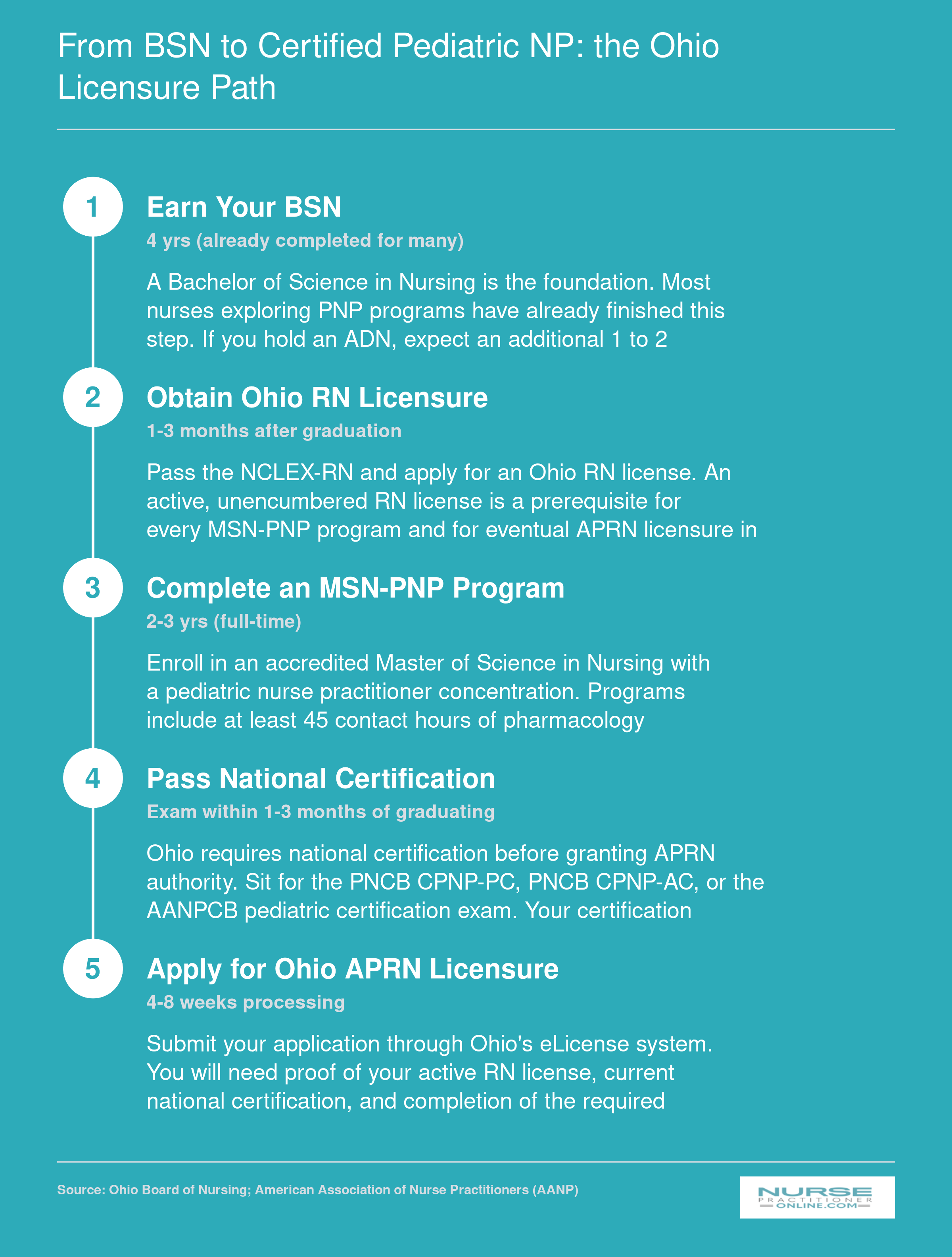
From BSN to Certified Pediatric NP: The Ohio Licensure Path
If you already hold a BSN, you are closer to practicing as a pediatric nurse practitioner than you might think. Ohio grants APRNs full practice authority with no collaborative agreement requirement, so once you complete the steps below you can evaluate, diagnose, and prescribe independently. Here is the typical path and approximate timeline for each stage.
PNP Certification Pass Rates and What Ohio Graduates Earn
National certification pass rates offer a concrete measure of how well a pediatric nurse practitioner program prepares its students, but the real payoff comes in the form of a steady income and career growth after graduation.
How PNCB Pass Rates Look Nationwide
In 2024, first-time pass rates on the Pediatric Nursing Certification Board (PNCB) exams were 80.69% for the Pediatric Nurse Practitioner, Primary Care (CPNP-PC) exam and 69.57% for the Acute Care (CPNP-AC) version.1 The passing standard for both exams is a scaled score of 400.2 While many Ohio schools do not publicly release their own program-specific pass rates, these national figures serve as the baseline. During program research, it is worth asking admissions counselors for recent cohort outcomes, because strong pass rates often reflect clinical preparation that aligns with certification requirements.
Ohio NP Salaries: The Big Picture
According to Bureau of Labor Statistics data (May 2024), nurse practitioners in Ohio earn well above the state's overall median wage. While these numbers cover all NP specialties, they offer a reliable earnings benchmark for PNP graduates who typically start in similar salary bands:
- Ohio statewide: Median $120,860; 10th percentile $93,840; 90th percentile $151,680
- Toledo metro area: Median $119,790; 10th percentile $92,410; 90th percentile $149,790
The spread between the 10th and 90th percentiles underscores how experience, practice setting, and specialty credentials can significantly lift income over time.
What Institutional Earnings Data Tell Us
Program-level earnings for PNP graduates are not yet reported through College Scorecard, but institutional median earnings offer a directional view. The following figures show median earnings ten years after entry for all graduates at featured schools (not nursing-specific, so actual NP earnings are likely higher):
- Case Western Reserve University: $87,989
- Ohio State University: $60,409
- University of Cincinnati: $54,810
- Cedarville University: $55,443
- Wright State University: $49,500
- University of Akron: $46,600
- Kent State University: $45,388
Remember these numbers reflect the full institution, not just nursing. When you focus on the relatively low net-price programs, like Ohio State ($17,339 effective net price) or Wright State ($15,415), the earnings picture becomes especially compelling.
Pediatric Specialization and Earning Potential
It is true that pediatric NP salaries can differ from adult acute care figures, with some surveys showing pediatric primary care NPs earning slightly less than their adult counterparts. If you are curious how those adult-focused tracks compare, you can explore best online MSN adult gerontology nurse practitioner programs for additional salary context. However, demand for pediatric providers remains high in both primary care and specialty settings across Ohio. Earning a PNP certification through a respected, affordable program sets you up for competitive pay and long-term stability.
Calculating Your Return on Investment
When you pair affordable tuition with strong salary potential, the math works in your favor. Even at the high end (Case Western's $41,190 effective net price), the institutional earnings of nearly $88,000 ten years out suggest a strong return. For many nurses in Toledo, the equation is simple: a lower net-price MSN PNP program plus Ohio's solid NP wages equals a career move that pays for itself quickly.
Financial Aid, Loan Repayment, and ROI for PNP Students
Paying full sticker price versus strategically layering financial aid can mean the difference between graduating with manageable debt and spending a decade digging out of it. Understanding every available dollar, from federal programs to employer benefits, is essential before you commit to a pediatric nurse practitioner program.
Schools That Serve Financially Constrained Students
Not every Ohio PNP program draws the same student population, and the share of undergraduates receiving Pell Grants offers a useful window into how well a school supports students with limited financial resources. Among the Ohio programs featured on nursepractitioneronline.com, the University of Akron (about 60 percent Pell recipients), Wright State University (roughly 59 percent), and Kent State University (approximately 55 percent) all enroll higher proportions of students who qualified for need-based aid at the undergraduate level. The University of Cincinnati and Ohio State University also serve substantial Pell populations, at about 50 percent and 48 percent respectively. While Pell Grants apply to undergraduate study, a school with a strong culture of financial support tends to extend that ethos into its graduate programs through assistantships, scholarships, and flexible payment plans.
Putting Graduate Debt in Real-World Terms
Median graduate debt at these Ohio institutions generally falls between roughly $20,000 and $24,500. Program-level debt and monthly payment figures are not yet published for these specific PNP tracks, but those institutional medians still provide a useful benchmark. On a standard ten-year repayment plan at current federal interest rates, a $22,000 loan translates to monthly payments in the neighborhood of $230 to $260, a meaningful but manageable figure once you are earning a pediatric NP salary.
Federal Loan Repayment Programs Worth Knowing
Pediatric nurse practitioners qualify for three major federal repayment programs that can erase a significant share of your educational debt.1
- NHSC Loan Repayment Program: Offers up to $100,000 in exchange for serving in a federally designated Health Professional Shortage Area. A pediatric specialty track exists, making PNPs a strong fit.3
- NURSE Corps Loan Repayment Program: Covers up to 60 percent of qualifying nursing education debt in return for a two-year service commitment at a critical shortage facility. RNs and APRNs, including PNPs, are eligible.1
- Public Service Loan Forgiveness (PSLF): After 120 qualifying monthly payments while working full-time for a government or 501(c)(3) nonprofit employer, the remaining balance on your federal Direct Loans is forgiven.2 Many pediatric settings, including children's hospitals and community health centers, qualify.
Return on Investment Across Ohio Programs
The ratio of what graduates earn to what they owe varies meaningfully across Ohio schools. Case Western Reserve University shows the strongest return, with institutional-level median earnings roughly 3.7 times median graduate debt. Ohio State University follows at about 3.0 times, and Cedarville University comes in near 2.6 times. Even programs at the lower end of this range, such as Kent State University at roughly 1.9 times, still reflect a positive return, especially if you take advantage of loan repayment programs that reduce your effective debt.
Toledo-Area Tuition Reimbursement
Before you borrow a single dollar, check with your current employer. Major Toledo-area healthcare systems, including ProMedica and Mercy Health, have historically offered tuition reimbursement benefits for employed RNs pursuing advanced practice degrees. The specifics (annual caps, service commitments, and eligibility windows) vary by employer and contract year, so speak with your HR department early in the planning process. Stacking employer reimbursement with federal aid and a well-chosen repayment program can dramatically shrink your out-of-pocket cost and accelerate your path to a positive return on your PNP investment.