Most important takeaways…
- Eight Akron-area AGNP programs were compared, with annual net prices ranging from roughly $14,000 to over $30,000.
- Three of the eight programs deliver coursework fully online, giving working nurses the most scheduling flexibility.
- Most BSN-to-MSN AGNP tracks take two to three years, while post-master's certificates can finish in about one year.
- Programs offering dedicated clinical placement support can prevent costly graduation delays caused by self-sourced preceptor searches.
Nearly one in four Ohioans will be 65 or older by 2030, creating urgent demand for nurse practitioners trained in adult-gerontology primary care. For working nurses near Akron, earning an AGNP credential opens high-paying clinical roles in outpatient clinics, skilled nursing facilities, and primary care practices serving aging populations.
Tuition for Ohio AGNP programs ranges from roughly $12,000 to more than $40,000 for the full degree, and proximity to Akron affects more than gas money. Schools within commuting distance simplify clinical placement logistics, especially if your program requires on-campus skills labs or expects you to secure local preceptors in geriatric settings. If you are still exploring the specialty itself, our overview of the adult gerontology primary care nurse practitioner role is a good place to start.
Not every affordable program delivers strong clinical placement support or flexible scheduling for full-time nurses. Some schools leave preceptor coordination entirely to students, adding months of unpaid hunting time between you and graduation.
Budget-Friendly Adult Gerontology NP Programs Near Akron, OH, Ranked by Affordability
This ranking is organized primarily by affordability, weighting institution-wide average net price after financial aid alongside financial-aid access for each school. Because net price figures reflect an institution-wide average after aid, your actual cost will depend on your enrollment status, residency, and aid package. Still, these numbers give you a practical starting point for comparing what Akron-area nurses can expect to invest in an AGNP degree across Ohio's strongest programs.
- Institution-wide net price after aid
- Financial aid access and availability
- In-state tuition affordability
- Delivery format flexibility
- Regional relevance to Akron
- NCES-IPEDS federal institutional data — nces.ed.gov
- College Scorecard graduate earnings — collegescorecard.ed.gov
- Internal program database
- Independent program research

University of Akron
Sitting right in the heart of Akron, the University of Akron is the most budget-conscious choice on this list for local RNs pursuing an AGNP degree. Its campus-based MSN program combines a 14-credit nursing core with a 30-credit adult gerontology specialty track, and strong clinical partnerships across Summit County mean you can train close to home without relocating. With an institution-wide graduation rate of about 52%, it is worth connecting with an advisor early to build a realistic timeline and support plan.
- In-state tuition around $10,125 per year
- 30 specialty-track credit hours
- Meets ANCC and AANP certification eligibility
- Requires BSN, Ohio RN license, and 12 months RN experience
- Campus-based format with close faculty collaboration
- Clinical placements concentrated in NE Ohio health systems
- Interview and 300-word essay required for admission
Adult Gerontology Primary Care Nurse Practitioner (MSN) — On-Campus

Ursuline College
Ursuline College in Pepper Pike, about an hour north of Akron, pairs a private-college experience with a surprisingly competitive net price thanks to generous institutional aid. Ranked No. 41 nationally and No. 3 in Ohio by U.S. News, the AGNP track emphasizes health maintenance, disease prevention, and patient education for adult and older populations. An intimate 8:1 student-to-faculty ratio means you will get hands-on mentoring throughout clinical practica. Both an MSN track and a BSN-to-DNP pathway are available, with fall and spring start dates.
- CCNE accredited program
- Nationally ranked MSN program (No. 41 U.S. News)
- Minimum one year of nursing experience required
- Fall and spring semester start dates
- Current RN license mandatory
- Comprehensive patient care focus across adult lifespan
- Hybrid learning format combines online and campus sessions
- 24-month full-time or four-year part-time option
- Includes clinical practicums in Cleveland-area health systems
- Covers advanced health assessment and pharmacology
- Leadership in healthcare integrated throughout
- Terminal DNP degree with evidence-based practice emphasis
Adult Gerontology Primary Care Nurse Practitioner (MSN) — On-Campus
Adult Gerontology Primary Care Nurse Practitioner (BSN to DNP) — On-Campus

Ohio State University
Ohio State University offers one of the most comprehensive AGNP program portfolios in the state, spanning an MSN, a BSN-to-DNP, and a campus-based doctoral pathway. Ranked No. 5 nationally by U.S. News, the program combines synchronous online classes with 16 to 20 hours of weekly clinical practice under expert preceptors at sites connected to the Wexner Medical Center. An 87.7% institution-wide graduation rate and strong statewide clinical network make it a popular destination for Akron-area nurses willing to invest a bit more for a nationally recognized credential.
- Ranked No. 5 nationally by U.S. News
- Available online or on campus
- Prepares for ANCC and AANP board certification
- 16 to 20 hours of weekly clinical practice
- Comprehensive care training for ages 13 and up
- Evidence-based curriculum with expert faculty
- Three-year program with full-time and part-time options
- Synchronous online classes with fall start
- Clinical placements at Wexner Medical Center
- Earn MSN en route to DNP
- Clinical site placement assistance provided
- Financial aid and scholarships available
- Two application rounds per year
Adult Gerontology Primary Care Nurse Practitioner (MSN) — Online
Adult Gerontology Primary Care Nurse Practitioner (BSN to DNP) — Online

Kent State University
Kent State University sits just a short drive from Akron, making its hybrid AGPCNP program one of the most convenient options for nurses who want local campus access without leaving their Akron-area jobs. The CCNE-accredited MSN concentration blends online coursework with on-campus clinical experiences in diverse NE Ohio settings, including internal medicine clinics, emergency departments, and long-term care facilities. Kent State's College of Nursing is a three-time NLN Center of Excellence, and faculty mentors are nationally certified APRNs.
- CCNE accredited, three-time NLN Center of Excellence
- Full-time and part-time scheduling options
- Fall and spring start dates available
- Hybrid format with many online courses
- Faculty mentorship from nationally certified APRNs
- Clinical experiences in Portage, Summit, and Cuyahoga counties
Adult Gerontology Primary Care Nurse Practitioner (MSN) — Hybrid

Franklin University
Franklin University in Columbus delivers both an online MSN and an online DNP in adult gerontology primary care, making it a strong pick for Akron nurses who want transparent, budget-friendly pricing without relocating. The DNP pathway lists a total program tuition of roughly $47,124 with an automatic $2,000 scholarship, military discounts, and employer-reimbursement support. CCNE-accredited coursework emphasizes evidence-based geriatric care, and clinical hours can often be arranged near the student's home region.
- CCNE accredited and 100% online
- Capstone project required for completion
- Prepares for national AGNP certification
- Designed for working nurses with flexible scheduling
- Focus on geriatric population and chronic comorbidities
- Advanced clinical skills in pathophysiology and pharmacology
- Total program tuition approximately $47,124
- $748 per credit with automatic $2,000 scholarship
- 63 credit hours over a three-year timeline
- 1,100 clinical hours with built-in practicum
- Three start dates per year (fall, spring, summer)
- Military benefits and employer reimbursement supported
- 100% online coursework, no dissertation required
M.S. in Nursing, Adult Gerontology Primary Care Nurse Practitioner — Online
Doctor of Nursing Practice, Adult Gerontology Primary Care Nurse Practitioner — Online

University of Cincinnati
The University of Cincinnati's fully online AGPCNP master's program lets Akron-area nurses earn their degree from a major public research university without leaving NE Ohio. The curriculum covers preventative, acute, and chronic care for patients ages 13 and older, and clinical placements can often be coordinated near a student's home. UC's institution-wide graduation rate of 75% and accreditation by the Higher Learning Commission add reassurance, though the net price runs higher than some other public Ohio options on this list.
- 100% online program format for working nurses
- Care for patients ages 13 and older
- Emphasis on education, diagnosis, and treatment
- Focus on preventative and chronic care management
- Accredited by the Higher Learning Commission
- Careers in community-based primary care settings
Adult Gerontology Primary Care Nurse Practitioner (MSN) — Online

The University of Findlay
The University of Findlay offers a campus-based BSN-to-DNP pathway that blends theory with hands-on clinical experience focused on aging adults. While it is a private institution and its net price sits higher than most public alternatives on this list, its 12:1 student-to-faculty ratio supports close mentorship. Students should note Findlay is located in northwest Ohio, so Akron-area nurses would need to factor in travel or relocation costs when budgeting.
- Campus-based program in Findlay, OH
- Focuses on adult gerontology primary care
- Pathway to terminal DNP degree
- Comprehensive care curriculum for aging adults
- Blends theoretical coursework with clinical practicums
- 12:1 student-to-faculty ratio for close mentorship
Adult Gerontology Primary Care BSN to DNP — On-Campus

Case Western Reserve University
Case Western Reserve University in Cleveland is the premium option on this list, with a net price well above other Ohio AGNP programs. What you get in return is a research-intensive, nationally recognized nursing school with an 87.2% institution-wide graduation rate and unique dual-degree options in bioethics, anthropology, or public health. The hybrid MSN requires only eight campus visits and can be completed in about 18 months, which appeals to working Akron-area nurses willing to invest more for a prestigious credential.
- 41 credit hours, completable in approximately 18 months
- 600 clinical hours across diverse practice settings
- Hybrid format with only eight campus visits required
- Dual degree options in Bioethics, Anthropology, or Public Health
- Post-graduate APRN certificates available
- Full-time and part-time scheduling paths
- 9:1 student-to-faculty ratio for individualized support
Adult Gerontology Primary Care Nurse Practitioner (MSN) — Hybrid
AGNP Tuition Side-by-Side: What You'll Actually Pay at Akron-Area Schools
The table below compares published tuition rates and average net prices for eight Ohio schools offering adult gerontology nurse practitioner programs. Keep two things in mind as you read it. First, the net price shown is an institution-level average after financial aid and may not reflect your exact graduate-program cost. Second, the widest sticker-price gaps appear at Ohio State University (nearly $29,000 between in-state and out-of-state tuition) and Kent State University (roughly $11,000), so confirming your residency status is one of the fastest ways to protect your budget. Employer tuition reimbursement can shave thousands more off your bill: Cleveland Clinic reimburses up to $7,500 per year for full-time employees pursuing a graduate degree at a CCNE-accredited school (with a 15% tuition discount at partner Chamberlain College of Nursing), University Hospitals offers $7,500 to $10,000 annually, and Summa Health also provides graduate tuition reimbursement, though its cap is not publicly specified.
| School | In-State Tuition | Out-of-State Tuition | Avg. Net Price (Institution Level) | Degree Level |
|---|---|---|---|---|
| University of Akron | $10,125 | $15,885 | $13,946 | Master's |
| Franklin University | $12,090 | $12,090 | $25,243 | Master's |
| Kent State University | $12,483 | $23,352 | $20,787 | Master's |
| Ohio State University | $13,901 | $42,740 | $17,339 | Master's |
| University of Cincinnati | $14,902 | $26,674 | $25,648 | Master's |
| The University of Findlay | $18,706 | $18,706 | $27,221 | Doctorate (BSN to DNP) |
| Ursuline College | $31,864 | $31,864 | $16,164 | Master's |
| Case Western Reserve University | $53,980 | $53,980 | $41,190 | Master's |
Questions to Ask Yourself
Online, Hybrid, and On-Campus AGNP Programs Available in Ohio
Of the eight adult gerontology NP programs reviewed for the Akron area, three deliver coursework fully online, two use a hybrid format, and three are primarily campus-based. Knowing the difference matters a lot when you are working a full-time nursing schedule and trying to keep your household running at the same time.
What Each Format Actually Means for Working Nurses
A fully online program means your lectures, discussions, and coursework happen through a learning management system on your schedule. Ohio State University, the University of Cincinnati, and Franklin University all fall into this category. For a working RN in Akron, that means you are not commuting to Columbus or Cincinnati for class nights. You log in when your shift ends or on weekends.
A hybrid program blends online coursework with required in-person components. Kent State University, located about 12 miles southeast of Akron, and Case Western Reserve University in Cleveland both operate this way. Kent State lists many online courses available alongside its hybrid structure. Case Western Reserve is particularly transparent: its program includes roughly eight campus visits over the course of the degree. That is manageable for most nurses but requires planning around your work schedule in advance.
Campus-based programs, like the one at the University of Akron and Ursuline College in Pepper Pike, generally expect you to attend in person more regularly. For nurses who live close to campus and prefer face-to-face instruction, that is a real advantage. For nurses working nights or rotating shifts, it adds friction.
The Part Every 'Online' Program Has in Common
Here is the detail that surprises some prospective students: even a fully online AGNP program requires you to complete supervised clinical hours in person. No program can waive hands-on patient care. Ohio State specifies 16 to 20 hours of weekly clinical practice. Case Western Reserve logs 600 clinical hours total. You will be physically present with patients, preceptors, and healthcare teams regardless of whether your coursework streams through a laptop.
Some programs assist with placing you at clinical sites; others expect you to arrange your own. This distinction is worth asking about directly before you apply. If you are still weighing whether an online format is right for you, our guide on how to enroll in NP school online walks through the practical steps.
The Northeast Ohio Geographic Advantage
Nurses based in Akron sit inside one of Ohio's densest healthcare corridors. Cleveland Clinic, Summa Health, Akron Children's Hospital, and University Hospitals facilities are all within a reasonable radius. That density matters when you are sourcing clinical hours, because more options usually means more flexibility around your existing work commitments. Programs at Kent State and the University of Akron, both physically close to Akron, are naturally positioned to support clinical placements in this region. Even the fully online programs from OSU or Franklin University do not require you to travel for clinical hours, since placements typically happen near where you already live and work.
How Long Does It Take to Complete an AGNP Program?
Timeline flexibility is one of the biggest advantages of pursuing an Adult Gerontology Nurse Practitioner credential, especially for nurses balancing shifts, family, and continuing education. The path you choose depends on where you are in your career and how quickly you want to transition into advanced practice.
MSN Track: The Most Common Starting Point
For RNs holding a BSN, the MSN pathway typically takes two to three years of full-time study or three to four years part-time. At the University of Akron, the Adult Gerontology Primary Care Nurse Practitioner MSN requires 41 to 44 credits, which most students complete over two to three years depending on their enrollment pace.1 Part-time study is the most popular choice among working nurses, since it allows you to maintain income and benefits while progressing toward your degree. Keep in mind that stretching your program over more semesters can affect total tuition costs and may impact financial aid eligibility, so plan your budget accordingly.
Post-Master's Certificate: A Faster Route for MSN Holders
If you already hold an MSN in another specialty, a post-master's certificate lets you add AGNP credentials in significantly less time. The University of Akron's Post-MSN Certificate in Adult Gerontology Primary Care requires just 17 credits and a minimum of 450 clinical hours, which most nurses complete in one to two years.2 This pathway is ideal if you want to pivot into gerontology care without repeating foundational graduate coursework. You can also explore AGNP post-master's certificate online options from other accredited schools to compare credit requirements and costs.
DNP Track: Planning for Doctoral-Level Practice
Nurses interested in the highest practice credential can pursue a Post-Master's Doctor of Nursing Practice at institutions like the University of Akron.3 DNP programs vary widely in length, but expect an additional two to three years beyond the MSN, depending on your dissertation or scholarly project requirements.
Primary Care vs. Acute Care: How Track Choice Affects Your Timeline
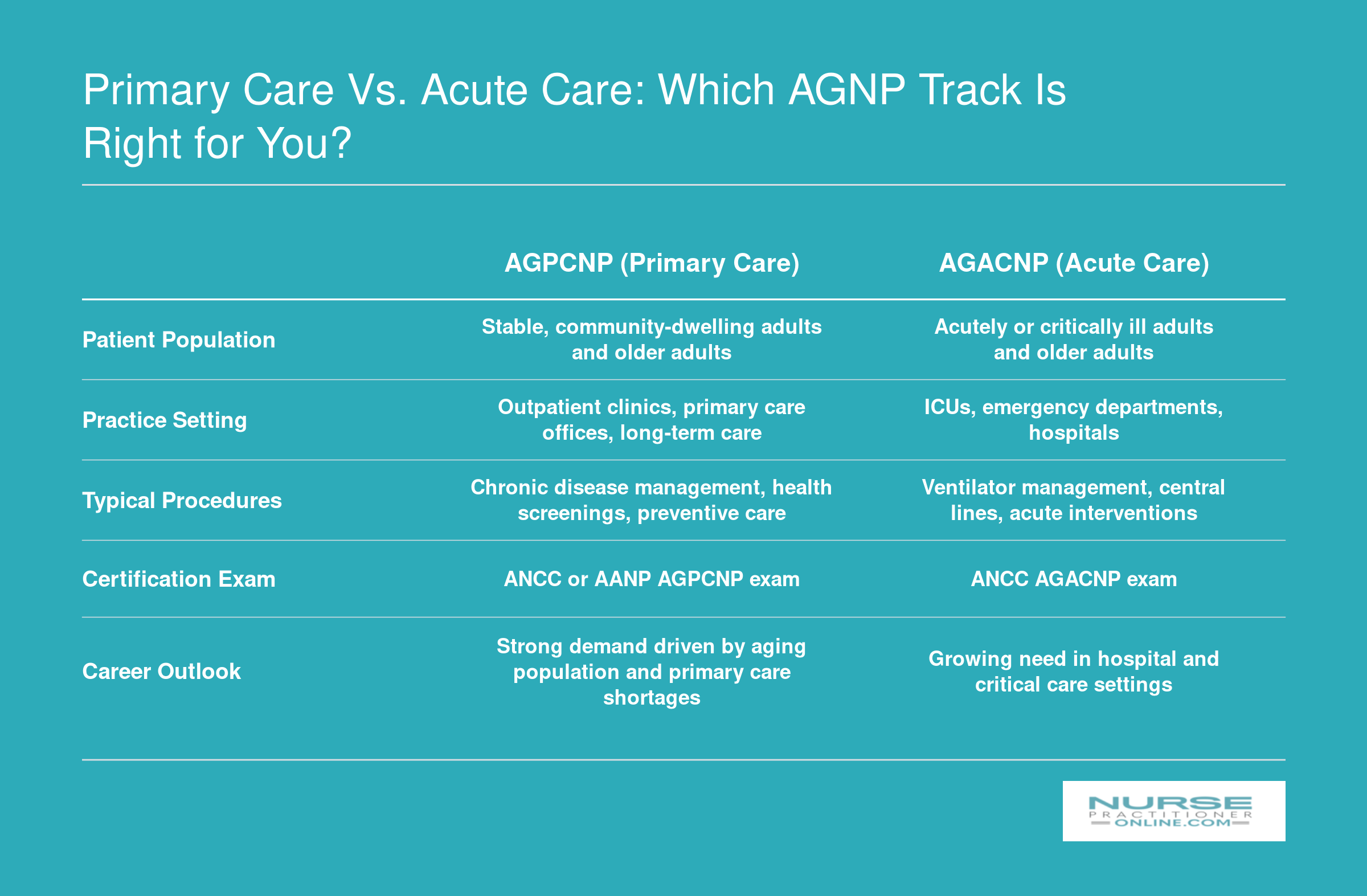
The Adult Gerontology Primary Care (AGPCNP) track prepares you for outpatient, community, and long-term care settings, while the Acute Care (AGACNP) track focuses on hospital-based, critical, and emergency care. Acute care tracks often require more clinical hours and may include additional specialized coursework, potentially adding a semester or two to your timeline. For a broader look at both track types, review our guide to adult gerontology nurse practitioner programs. When reviewing programs near Akron, confirm which track each school offers and factor that into your completion estimate.
Primary Care vs. Acute Care: Which AGNP Track Is Right for You?
Before you commit to a program, it is worth understanding the two distinct adult gerontology NP tracks. The programs featured in this article follow the primary care (AGPCNP) pathway, which prepares you for outpatient, wellness focused roles with older adults. The acute care (AGACNP) track is a separate certification with a different scope of practice, so choosing the wrong one could limit where you can work. Knowing the difference now will save you time, money, and frustration down the road.
Clinical Placement Hours and Practicum Logistics Near Akron
Clinical placement logistics will shape your AGNP experience more than tuition ever will. The hours are non-negotiable for certification, and how your program handles preceptor coordination determines whether you spend your nights studying or cold-emailing strangers asking them to supervise you.
How Many Clinical Hours You Actually Need
The national floor for AGNP certification eligibility is 500 supervised clinical hours, and most programs build in a cushion above that. The University of Akron's Post-MSN AGPCNP Certificate, for example, lists 450 hours of practicum work in the certificate itself, paired with the assumption that students already hold an MSN with prior clinical experience.1 The full MSN track at Akron spreads its clinical work across four practicum courses inside a 30-credit program, layering hours progressively as students move from health assessment into specialty management.2
DNP-level AGNP tracks ask for more. Akron's DNP program assumes 500 hours of prior NP-level clinical work coming in and adds DNP project and residency hours on top, often pushing total post-BSN clinical exposure past 1,000 hours.3 If you are entering at the BSN-to-DNP level, plan for a longer practicum runway than your MSN peers.
Who Finds Your Preceptor
This is the question that separates a smooth program from a stressful one. Policies in northeast Ohio vary: some schools maintain affiliation agreements and place students directly, others provide a partial list and expect you to secure your own preceptor, and a few leave sourcing almost entirely to the student with faculty approval at the end. Before you commit, ask the program coordinator directly: do you place me, or do I place myself? Get the answer in writing.
The Akron Geographic Advantage
Akron sits inside a dense clinical corridor. Cleveland Clinic, Summa Health, Akron Children's Hospital, and University Hospitals all operate primary care and gerontology practices within commuting distance, and several have standing relationships with regional nursing schools. Even if your program requires self-sourced preceptors, the density of qualified AGNPs and physicians in this market makes the search materially easier than it would be in a rural part of the state.
AGNP Graduate Earnings and Return on Investment in Ohio
Spending less on tuition versus investing in a higher-ranked program: both paths can lead to a rewarding AGNP career, but the real question is how quickly your degree pays for itself once you start practicing. Understanding typical nurse practitioner earnings in Ohio, and especially in the Akron metro area, helps you weigh program costs against long-term financial gains.
National Wage Benchmarks for Nurse Practitioners
According to Bureau of Labor Statistics data, the national median annual wage for nurse practitioners was approximately $121,610 as of May 2022. Wages ranged from about $87,340 at the 10th percentile to $165,240 at the 90th percentile. These numbers give you a useful baseline, but your actual earning potential depends heavily on geography, specialty track, and years of experience. Ohio's mean annual wage for nurse practitioners sits around $122,910, which tracks closely with the national median and suggests competitive compensation for NPs practicing in the state.
How to Find Akron-Specific Salary Data
For the most precise local figures, head to the Bureau of Labor Statistics Occupational Employment and Wage Statistics database. Search under SOC code 29-1171 for nurse practitioners, then filter by the Akron, OH metropolitan statistical area or by Ohio statewide. The most recent release typically reflects May data from the prior year. This will give you median wages along with percentile breakdowns so you can see the full earning spectrum.
For additional Ohio-focused insight, check the Ohio Department of Job and Family Services labor market information portal. Professional organizations like the Ohio Association of Advanced Practice Nurses also publish periodic salary surveys and workforce reports that capture trends specific to NPs practicing in the state.
Cross-Referencing With Real Job Postings
Salary databases reflect historical averages, so it is smart to supplement that data with a scan of current job listings. Search for adult gerontology nurse practitioner roles in the Akron area on platforms like Indeed, Glassdoor, and LinkedIn. Focus on postings from the last 60 to 90 days for the most accurate snapshot of what employers are actually offering. Pay attention to whether listings include sign-on bonuses, loan repayment assistance, or tuition reimbursement, because all of these factor into your total return on investment.
Tap Into Alumni Earnings Data
University career services offices are an underused resource. Programs at schools like the University of Akron and Kent State University often track graduate outcomes, including starting salaries and employment rates for recent alumni. Reaching out to these offices, or attending virtual information sessions, can give you region-specific ROI estimates that published databases may not capture. Ask specifically about AGNP graduates rather than all nursing master's completers, because specialty and certification track can influence starting pay.
Putting It All Together
When you compare a program's total tuition cost against anticipated first-year earnings, you get a clearer picture of how long it will take to recoup your educational investment. A program that costs a few thousand dollars more but offers stronger clinical placement support or higher certification pass rates may deliver a faster return if it helps you land a well-paying role sooner. Use the salary research tools above to build a realistic budget model before you commit, and remember that the lowest sticker price is not always the best deal when long-term earnings are part of the equation.
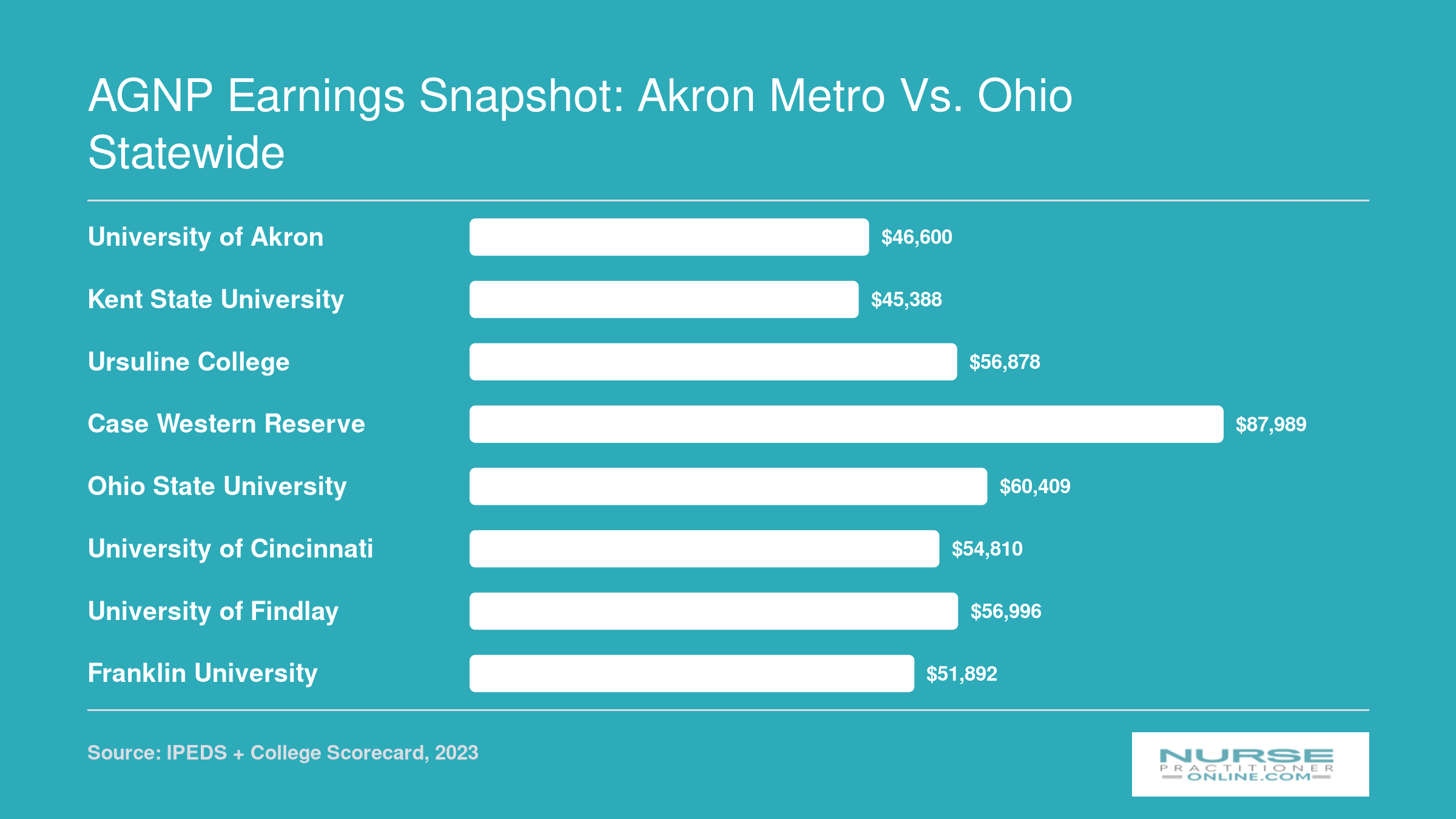
AGNP Earnings Snapshot: Akron Metro vs. Ohio Statewide
How do long-term earnings compare for graduates of schools closest to Akron versus those across Ohio? The figures below show median earnings ten years after enrollment at institution level. Program-level first-year post-graduation earnings are not yet available for these AGNP programs, so we are using the broader institutional medians as a reference point. Keep in mind that NP-specific salaries typically exceed these university-wide figures once you are credentialed and practicing.
AGPCNP Certification Pass Rates at Ohio Nursing Schools
An affordable tuition sticker means little if the program doesn't prepare you to pass the certification exam on the first attempt. Examining pass rates helps you weigh upfront savings against long-term career readiness.
Why Certification Pass Rates Matter
First-time pass rates on the ANCC or AANP Adult-Gerontology Primary Care NP exam are a direct indicator of how well a program equips you for clinical practice. National benchmarks typically hover around 85%2, and a program consistently falling below that threshold may signal gaps in curriculum, faculty support, or clinical placement quality. Factors like nursing program accreditation also play a role in ensuring consistent educational standards. A strong pass rate reassures you that graduates are not just earning degrees but are truly prepared to deliver safe, effective care to older adults.
What the Data Shows for Ohio Schools
Published pass rate data for AGPCNP programs in Ohio remains limited. Among the few programs reporting, Kent State University stands out with a 96.3% certification pass rate from its 2021 cohort, well above the national average of 85% for the AGPCNP exam.1 This suggests a pipeline of graduates who transition confidently into practice. For other budget-friendly schools near Akron, such as Cleveland State or Ursuline College, official AGPCNP-specific pass rates are not publicly available as of June 2026, creating an information gap for prospective students.
How to Evaluate Programs Without Published Rates
When a school does not disclose its certification scores, don't assume the worst, but do dig deeper. Contact the program coordinator directly and ask for the most recent ANCC or AANP pass rate data. Inquire about remediation resources for students who struggle with board-style exams, and request examples of how the curriculum mirrors the test blueprint. A program's willingness to share this information often reflects its commitment to student success. If a low-cost option dodges the question, treat it as a red flag: the true cost of a failing exam includes retake fees, lost income, and delayed employment.
Choosing the Right AGNP Program: A Decision Framework for Akron-Area Nurses
CCNE or ACEN accreditation is a non-negotiable baseline for any AGNP program, but affordability, flexibility, and clinical support ultimately determine which Akron-area school delivers the best value for your career.
Stack the Essentials: Accreditation, Cost, and Format
Before comparing credit-hour rates, confirm that every program on your list holds national nursing accreditation. Then arrange the remaining factors in order of personal priority. For most working nurses near Akron, that order looks like this:
- Cost: Look beyond sticker price. Factor in employer tuition reimbursement, part-time pacing for manageable payments, and hidden fees.
- Format: Online, hybrid, or on-campus impacts your income while studying. A fully online AGNP program lets you keep working full-time.
- Program length: Part-time tracks can extend to 3-4 years but lower annual cost; full-time saves time but demands more upfront.
- Clinical placement support: Schools that guarantee local preceptors save you months of searching and lost wages.
- Certification pass rates: High first-time pass rates on the Adult-Gerontology Primary Care or Acute Care NP exam signal strong curriculum alignment and test prep.
Clinical Placement Support: The Hidden Cost Factor
A program advertising low tuition can quickly become expensive if you spend six months hunting for your own preceptor in Akron-area hospitals or clinics. Delays in clinical rotations push back your graduation date and postpone a higher AGNP salary. When comparing programs, ask directly: Will the school place you with a preceptor within a reasonable commute of Akron? What is the average time from enrollment to first clinical rotation? The answers reveal whether the low sticker price is genuine or a trade-off you may later regret.
Certification Success: A Predictor of Future Earnings
AGNP certification pass rates are more than a quality indicator; they correlate with graduate earnings. Ohio nursing schools with consistently high pass rates often embed test preparation into the curriculum, reducing the extra cost and study time you would otherwise pour into a third-party review course. If a school has not published its pass rates, or if the rates trail state averages, probe further. Ask about curriculum updates, faculty-to-student ratios, and recent graduate employment outcomes before committing.
Your Next Step: Turn Comparison into Action
Now that you have a decision framework, apply it. Pick two or three AGNP programs near Akron that meet the accreditation baseline and align with your cost and format preferences. Request detailed program information, ask pointed questions about clinical placement logistics, and verify current tuition rates directly with the school. That conversation alone often surfaces practical details no website can convey, and it moves you from passive comparison to an active career move.
Related Articles
Frequently Asked Questions About AGNP Programs Near Akron, Ohio
Choosing an adult gerontology nurse practitioner program is a big decision, especially when you are balancing work, family, and finances. Here are answers to the questions Akron-area nurses ask most often when exploring AGNP programs.
- How much does an adult-gerontology nurse practitioner make in Ohio?
- Salaries vary by employer, setting, and experience level, but adult gerontology nurse practitioners in Ohio generally earn competitive wages that reflect advanced practice credentials. Urban centers like Cleveland and Columbus tend to offer higher pay, while the Akron metro area falls in a similar mid-range. Check the Bureau of Labor Statistics for the most current Ohio figures.
- How long does it take to complete an AGNP program near Akron?
- Most MSN-level AGNP programs take about two to three years of full-time study to complete. Part-time tracks designed for working nurses can extend that to three or four years. Post-master's certificate options are shorter, typically around one to two years, depending on how many credits transfer from your previous graduate coursework.
- What is the difference between adult-gerontology primary care and acute care NP?
- The primary care track (AGPCNP) prepares you to manage chronic conditions, wellness visits, and preventive care in outpatient settings such as clinics and private practices. The acute care track (AGACNP) focuses on hospitalized or critically ill adults in emergency departments, ICUs, and specialty inpatient units. Your choice should align with the patient population and setting where you want to practice.
- What are the clinical hour requirements for AGNP programs in Ohio?
- Most AGNP programs require a minimum of 500 to 750 direct patient care clinical hours, though some schools set the bar higher. These hours must be completed under an approved preceptor in settings appropriate to your chosen track, whether primary care or acute care. Confirm exact requirements with each program before enrolling.
- Are there fully online adult-gerontology NP programs available near Akron?
- Yes, several Ohio universities and nationally accredited schools offer AGNP programs with fully online didactic coursework. However, clinical practicum hours must still be completed in person. Some programs help students arrange placements in the Akron area, while others expect you to secure your own clinical sites, so ask about placement support early.
- Does Ohio grant full practice authority to nurse practitioners?
- No. As of 2024, Ohio operates under a collaborative framework that requires nurse practitioners to maintain a standard care arrangement with a physician or other collaborating provider. Advocacy efforts continue at the state level to expand practice authority. The Ohio Board of Nursing and the American Association of Nurse Practitioners provide current details on regulatory requirements.
- What GPA do I need to get into an AGNP program in Ohio?
- Minimum GPA requirements vary, but most Ohio AGNP programs expect a cumulative undergraduate GPA of at least 3.0 on a 4.0 scale. Some competitive programs prefer a 3.2 or higher, particularly in science coursework. If your GPA falls slightly below the threshold, strong clinical experience, professional references, and a well-written personal statement can strengthen your application.
- Can I work full-time while completing an AGNP program?
- Many AGNP programs near Akron offer part-time and evening or weekend schedules specifically designed for working nurses. Online didactic courses add additional flexibility. That said, clinical rotations require daytime availability and can be difficult to juggle alongside a full-time schedule. Most students find it helpful to reduce their work hours during practicum semesters.