Most important takeaways…
- Ohio public universities can cut DNP AGNP total tuition by thousands compared to private programs, making in-state rates critical.
- Dayton-area nurse practitioners earn a median salary that generally justifies the cost of a DNP investment over time.
- Securing a qualified AGNP preceptor near Dayton often takes three to six months of proactive networking.
- Stacking federal aid, Ohio scholarships, and employer tuition benefits can significantly reduce out-of-pocket DNP expenses.
Ohio's 65-and-older population is projected to grow faster than the national average through the end of this decade, and the state already faces a primary care provider gap in several rural and suburban counties surrounding Dayton. That demand makes the Adult-Gerontology Nurse Practitioner one of the most strategically sound DNP specializations for working nurses in the region. The financial barrier, however, is real. Net prices across online AGNP programs in Ohio range from roughly $16,000 to over $27,000, a spread wide enough that your choice of school can change your debt picture by tens of thousands of dollars.
For Dayton-area nurses juggling 12-hour shifts and family obligations, knowing the true cost, delivery format, clinical placement logistics, and salary return before committing is not optional. It is the difference between a sound investment and a financial strain that follows you for years.
Best Affordable DNP AGNP Programs for Dayton-Area Nurses
When you compare DNP programs, sticker tuition can be misleading. Net price, the amount students actually pay after grants and institutional aid, is a far more useful yardstick. A school with high published tuition may end up costing thousands less once aid kicks in. The five Ohio programs below are ranked primarily by net price so you can see where your dollar stretches furthest. Because program-level earnings and debt data are not yet published for these AGNP tracks, we include institution-wide graduate debt figures to give you a ballpark sense of cost versus outcome.
- Net price after financial aid
- In-state tuition affordability
- Program delivery flexibility
- Institutional graduation rate
- Graduate debt at completion
- Internal program database
- NCES-IPEDS federal institutional data — nces.ed.gov
- College Scorecard graduate earnings — collegescorecard.ed.gov
- Independent program research

Ursuline College
Ursuline College is a small, private Catholic institution in Pepper Pike with an 8:1 student-to-faculty ratio, offering highly personalized attention that larger universities rarely match. Its hybrid DNP program blends online coursework with on-campus sessions, and the school reports a 66.7% institution-wide graduation rate. With over half of undergraduates receiving Pell Grants, Ursuline has a strong track record of supporting students who need financial assistance, and its net price reflects that commitment.
- Hybrid format combines online classes with campus sessions
- 24-month full-time or four-year part-time completion paths
- Curriculum includes advanced pharmacology and health assessment
- Clinical practicums integrated throughout the program
- Evidence-based practice and leadership development focus
- Terminal DNP degree with no separate dissertation required
Adult-Gerontology Primary Care Nurse Practitioner DNP — Hybrid

Ohio State University
Ohio State University is a public research powerhouse in Columbus whose College of Nursing consistently ranks among the strongest in the Midwest. The university posts an 87.7% institution-wide graduation rate and offers in-state tuition of roughly $13,900, making it one of the most cost-effective options for Ohio residents. Its BSN-to-DNP pathway lets you earn an MSN along the way, and clinical placement support extends across Ohio through the Wexner Medical Center network.
- Synchronous online classes with hybrid delivery options
- Full-time (3-year) or part-time (4-year) completion tracks
- Earn an MSN en route to the DNP degree
- Clinical placements supported at Wexner Medical Center sites
- 10 concentration options within the DNP program
- Two application rounds per year with fall start
- Financial aid and scholarships available
- Holistic admissions process; 3.0 GPA minimum
Adult-Gerontology Primary Care Nurse Practitioner BSN-to-DNP — Hybrid

Franklin University
Franklin University, a private nonprofit in Columbus, markets its DNP as a transparent, budget-conscious option with a published total tuition of about $47,124 and an automatic $2,000 scholarship for incoming students. Its 100% online coursework and three annual start dates make it especially practical for working RNs in the Dayton metro who cannot commute regularly. Clinical hours are coordinated with local practice sites, so many students complete practicums near home rather than traveling to Columbus.
- 100% online coursework; no campus residency required
- Total program tuition approximately $47,124 (63 credits at $748 each)
- Three start dates per year: fall, spring, and summer
- 1,100 clinical hours built into coursework
- Automatic $2,000 institutional scholarship for new students
- CCNE-accredited program with capstone (no dissertation)
- Military tuition discount and employer reimbursement supported
- Completion in approximately three years
Doctor of Nursing Practice, Adult-Gerontology Primary Care Nurse Practitioner — Online

University of Cincinnati
The University of Cincinnati is a large public research institution about an hour south of Dayton, giving Miami Valley nurses relatively easy access to campus immersions. UC's online DNP in Adult-Gerontology Primary Care prepares graduates for the AGPCNP-BC certification exam, and a dedicated Clinical Site Coordinator helps students secure placements across Ohio. In-state graduate tuition is approximately $14,900, and the school's 75% institution-wide graduation rate signals strong student support.
- Primarily online with required in-person immersion days
- Full-time and part-time scheduling available
- Dedicated Clinical Site Coordinator assists with placements
- Prepares graduates for AGPCNP-BC national certification
- Faculty are active practicing nurse practitioners
- Fall-semester start; application deadline in early summer
- Minimum 1 year of RN experience required for admission
- Financial aid and scholarship opportunities available
Adult-Gerontology Primary Care Nurse Practitioner DNP — Online

The University of Findlay
The University of Findlay is a private institution in northwest Ohio offering a campus-based BSN-to-DNP pathway focused on adult and geriatric primary care. With a 12:1 student-to-faculty ratio and a curriculum that blends theory with hands-on clinical experiences, Findlay emphasizes close faculty mentorship. Its higher net price puts it at the bottom of this affordability ranking, but the structured on-campus experience may appeal to students who prefer face-to-face instruction.
- Campus-based program in Findlay, Ohio
- Focus on comprehensive care for aging adult populations
- Blends didactic theory with clinical practice experiences
- Pathway from BSN directly to doctoral-level practice
- 12:1 student-to-faculty ratio for individualized support
- Covers advanced pathophysiology, assessment, and pharmacology
Adult-Gero Primary Care BSN to DNP — On-Campus
How Much Does a DNP AGNP Cost in Ohio?
Tuition for DNP Adult-Gerontology Nurse Practitioner programs in Ohio varies widely depending on whether you attend a public or private university, choose online or on-campus delivery, and qualify for in-state rates. The figures below reflect published tuition estimates and institutional data available as of the most recent reporting year. Keep in mind that fees, textbooks, and clinical-related expenses can add thousands more to your total cost, so treat these numbers as starting points rather than final price tags.
| School | Location | Program Type | Delivery Format | Estimated Per-Credit Cost | Estimated Total Tuition | Notes |
|---|---|---|---|---|---|---|
| Ursuline College | Pepper Pike, OH (about 4 hours from Dayton) | DNP AGPCNP (BSN to DNP) | Hybrid | N/A | Approximately $31,864 per year (institutional rate) | 24-month full-time or 4-year part-time option available |
| Ohio State University | Columbus, OH (about 70 miles from Dayton) | DNP AGPCNP (BSN to DNP) | Hybrid (synchronous online with on-campus components) | N/A | Approximately $13,901/year in-state; $42,740/year out-of-state | 3-year program; clinical placement assistance through Wexner Medical Center; financial aid and scholarships available |
| Franklin University | Columbus, OH (about 70 miles from Dayton) | DNP AGPCNP | Online | $748 | Approximately $47,124 total (63 credits) | CCNE accredited; 3 start dates per year; automatic $2,000 scholarship; military tuition discount |
| University of Cincinnati | Cincinnati, OH (about 55 miles from Dayton) | DNP AGPCNP | Online with in-person immersions | N/A | Approximately $14,902/year in-state; $26,674/year out-of-state | Fall start only; minimum 1 year RN experience required; clinical site coordinator provided |
| The University of Findlay | Findlay, OH (about 130 miles from Dayton) | DNP AGPCNP (BSN to DNP) | Campus | N/A | Approximately $18,706 per year (institutional rate) | Smaller class sizes with a 12:1 student-to-faculty ratio |
| Ohio University | Athens, OH (about 190 miles from Dayton) | AGACNP MSN (not DNP) | Online | $678 | Approximately $27,120 total (40 credits) | MSN-level program, not a DNP; listed tuition is an estimate and subject to change |
| Mount Carmel College of Nursing | Columbus, OH (about 70 miles from Dayton) | DNP | N/A | $744 (2021-2022 rate) | Approximately $28,898 (2021-2022 rate) | Older tuition data; confirm current rates directly with the school |
Questions to Ask Yourself
Online vs. Hybrid DNP AGNP Options Near Dayton
If you are balancing full-time nursing shifts with family life, the delivery format of your DNP AGNP program matters just as much as cost. Ohio programs fall into three broad categories: fully online with limited on-campus visits, hybrid with scheduled immersions, and traditional campus-based. Here is how the major options compare for Dayton-area nurses.
| Feature | Fully Online (e.g., Ohio University AG-ACNP, Franklin University AGPCNP, University of Cincinnati AGPCNP) | Hybrid (e.g., Ohio State University AGPCNP, Ursuline College AGPCNP) | Campus-Based (e.g., University of Findlay AGPCNP) |
|---|---|---|---|
| Coursework delivery | Synchronous or asynchronous online lectures and discussions; University of Cincinnati adds required in-person immersion days | Online coursework paired with periodic on-campus intensive weekends or multi-day sessions | Regularly scheduled on-campus classes throughout the semester |
| On-campus time commitment | Ohio University: limited intensives only. Franklin University: 100% online coursework. University of Cincinnati: periodic on-campus immersions required | Typically 2 to 4 immersion visits per year, each lasting 2 to 4 days | Weekly or biweekly attendance at the Findlay campus |
| Clinical hours required | Ohio University: 750 hours. Franklin University: 1,100 hours. University of Cincinnati: check program for current requirements | Varies by program; Ohio State offers clinical placements at Wexner Medical Center | Clinical hours completed at approved sites, often in the northwest Ohio region |
| Clinical placement support | Local preceptorship model: students arrange placements near home, meaning Dayton-area sites are an option. University of Cincinnati provides a Clinical Site Coordinator | Ohio State assists with placement at affiliated sites; Ursuline includes clinical practicums with program support | Clinical sites typically coordinated through university partnerships in the Findlay area |
| Approximate in-state tuition per year | Franklin University: approximately $12,090. University of Cincinnati: approximately $14,902 | Ohio State: approximately $13,901. Ursuline College: approximately $31,864 (private) | University of Findlay: approximately $18,706 (private) |
| Best fit for Dayton nurses | Ideal if you cannot take time off for regular campus visits; you complete clinicals at Dayton-area hospitals and practices | Good middle ground if you want some face-to-face interaction but need flexibility; Columbus is roughly an hour from Dayton | Best suited for nurses who can relocate or commute to Findlay (about two hours north of Dayton) |
Primary Care vs. Acute Care AGNP: Cost and Career Differences
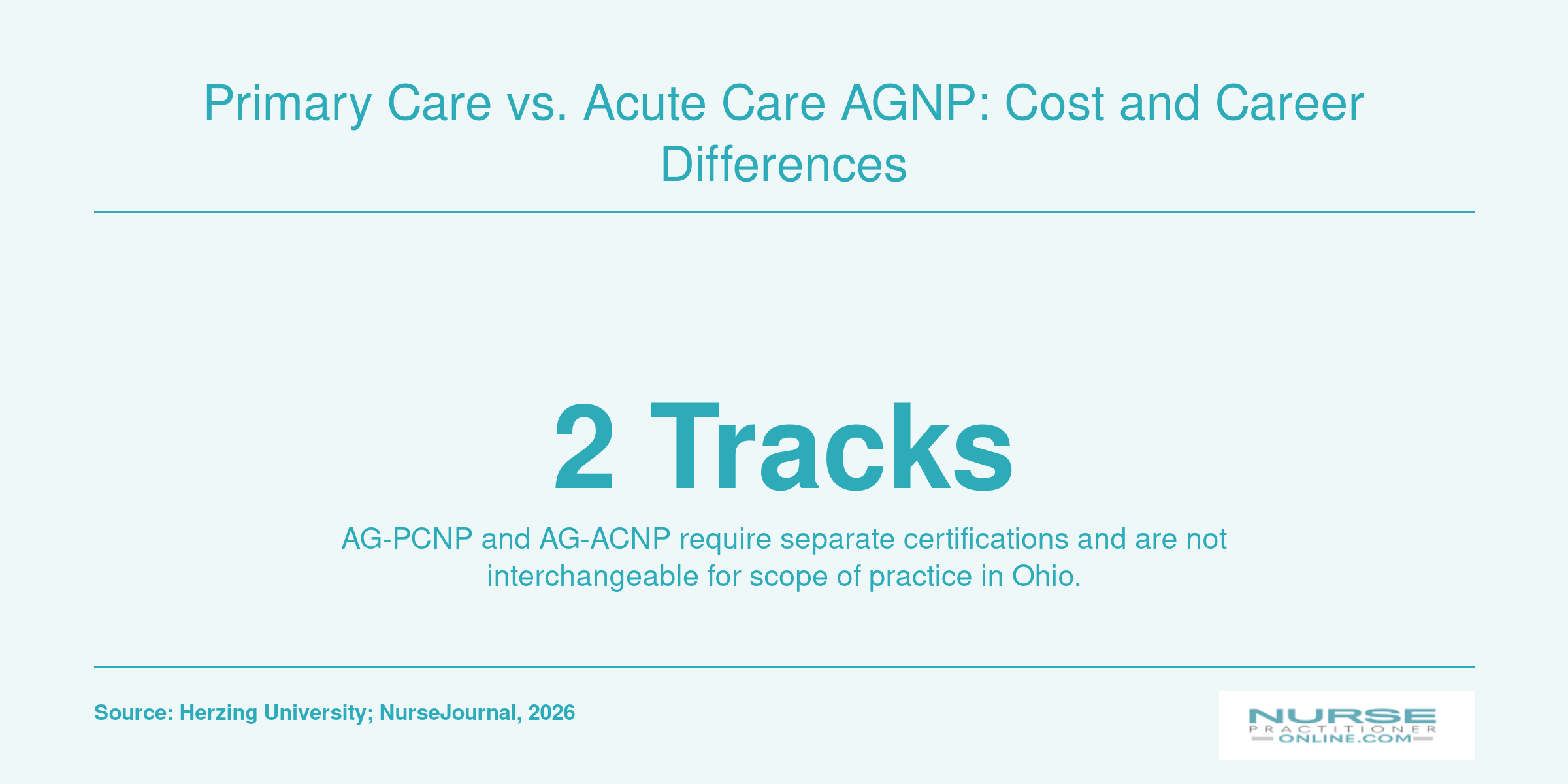
If you are weighing a primary care track against an acute care track, understand that these two AGNP specializations are not interchangeable. Each carries its own scope of practice, certification requirements, and typical work settings. The AG-PCNP prepares you for outpatient clinics and primary care offices, certifying through the ANCC (AGPCNP-BC) or AANP (A-GNP). The AG-ACNP prepares you for hospitals, emergency departments, and ICUs, certifying through the ANCC (AGACNP-BC) or AACN (ACNPC-AG). Both tracks serve adults ages 13 and older, but Ohio law does not allow you to practice across the other track's scope without the corresponding credential. Among Ohio DNP programs in our dataset, only the primary care track appears consistently, with published in-state tuition ranging from roughly $12,000 to $32,000 per year depending on the school. Program-level earnings data for these AGNP tracks are not yet available, so direct salary comparisons at the program level are not possible at this time. National sources such as Herzing University and NurseJournal note that acute care NPs may command slightly higher median pay due to hospital-based settings, though actual figures vary by employer and region.
Clinical Placements and Preceptor Resources in the Dayton Region
A clinical placement is a real-world site where you perform supervised NP rotations under the guidance of a licensed provider. For DNP Adult-Gerontology Nurse Practitioner students, finding these placements in the Dayton area is typically your responsibility, and success hinges on early planning and strong networking.
Major Health Systems in the Miami Valley
The Dayton metro is served by several large health systems that accept DNP and NP students for clinical rotations. Premier Health operates hospitals across the region and maintains a formal Graduate Nursing Student Clinical Placement Program.1 Premier prioritizes its own employees for placements, does not guarantee spots, and excludes Women's Health and Mental Health rotations from its DNP student opportunities.1 Students should request placements through the system at least one year in advance and expect internal deadlines and affiliation-agreement requirements.1
Kettering Health Network is another major player, offering both inpatient and outpatient settings across multiple specialties. The Dayton VA Medical Center provides robust opportunities for students interested in working with veterans, particularly in primary care and chronic disease management settings that align well with AGNP training. Wright-Patterson Air Force Base medical facilities also host student rotations, though access may be limited to programs with existing affiliation agreements or students who hold military credentials.
Covenant HealthCare partners with local schools including the University of Cincinnati and the University of Dayton and uses the ACEMAPP platform to coordinate student placements and documentation.2
Self-Placement Is the Norm at the DNP Level
Most DNP programs in Ohio require students to self-arrange their preceptors rather than assign placements. This means you will personally reach out to potential preceptors, secure agreements, and coordinate schedules. If you are new to this process, our guide on how online NP students arrange clinicals in their local area walks through the key steps. Start this process at least six months before your clinical term begins. Contact prospective sites directly, introduce your program and goals, and ask whether they accept DNP students and have available preceptors.
FQHCs and Underserved-Population Sites
Federally qualified health centers in the Dayton area offer excellent clinical exposure to underserved populations, including uninsured and Medicaid patients. These sites often welcome NP students and provide hands-on experience managing chronic conditions, preventive care, and social determinants of health. Practicing in an FQHC during your DNP training may also open eligibility for loan-repayment programs after graduation.
Networking and Professional Connections
Join the Ohio Association of Advanced Practice Nurses early in your program. The organization hosts regional events, maintains preceptor directories, and connects students with practicing NPs who may agree to supervise rotations. Leverage your current workplace relationships, alumni networks, and clinical instructors for introductions. Starting your outreach early and casting a wide net dramatically increases your odds of securing quality placements close to home.
Financial Aid and Scholarships for Ohio DNP AGNP Students
How can you realistically pay for a DNP Adult-Gerontology Nurse Practitioner program without drowning in student loan debt? The good news is that several federal, state, and employer-based funding streams exist for Ohio nurses, and stacking more than one can make a significant dent in your total cost.
Federal Programs Worth Applying For First
Two federal programs stand out for DNP AGNP students willing to serve in high-need communities after graduation.
- NURSE Corps Loan Repayment Program: This HRSA-administered program covers up to 85 percent of qualifying nursing education debt in exchange for service at a Critical Shortage Facility or in an underserved area. If you plan to practice primary care in rural southwest Ohio, this is one of the most generous repayment deals available.1
- NHSC Loan Repayment Program: Designed for primary care providers who commit to working in a Health Professional Shortage Area (HPSA), this program offers substantial loan repayment awards. Several communities in the greater Dayton region hold HPSA designations, so eligibility may be closer than you think.
- Nurse Corps Scholarship Program: For students still in school, this federal scholarship covers tuition, fees, and provides a monthly living stipend. The 2026 application cycle is open, and competition is stiff, so apply early and have your documents ready.1
- NHSC Scholarship Program: Similar in structure, this scholarship covers tuition, fees, and a stipend in return for a post-graduation service commitment in an underserved area.1
Both scholarship programs require a service obligation, typically two to four years. If you already see yourself practicing in community health or a federally qualified health center, these commitments align naturally with your career path.
Ohio-Specific Funding Options
Ohio's dedicated funding for advanced practice nursing students is limited but worth pursuing. The Ohio Nurse Education Assistance Loan Program (NEALP), administered by the Ohio Department of Higher Education, offers up to $1,800 per year for eligible nursing students, including those in advanced registered nurse (ARN) categories.2 It functions as forgivable loan assistance, meaning a portion is forgiven for each year you practice in Ohio after graduation.
Beyond NEALP, Ohio does not currently operate a large-scale state scholarship exclusively for DNP or NP students. Keep an eye on Ohio Action Coalition initiatives and any emerging state workforce pipeline grants targeting advanced practice nurses, as these programs can appear with new legislative sessions.
Professional association scholarships can also supplement your funding. The National Black Nurses Association scholarships, for example, are available at all educational levels for members on an annual cycle.3
Employer Tuition Reimbursement
For working RNs, employer tuition reimbursement is often the single largest and most accessible funding source. Major Dayton-area health systems, including Premier Health and Kettering Health, have historically offered tuition assistance benefits to employees pursuing advanced degrees. Benefit amounts and eligibility requirements vary, so check with your HR department early in your program search. Some employers cap annual reimbursement at a few thousand dollars, while others cover a more substantial portion, especially if you commit to staying with the organization after graduation.
If you are also exploring AGNP options in other parts of the state, our guide to adult gerontology nurse practitioner programs near Akron Ohio covers additional affordable choices worth considering.
Federal Loans and Long-Term Repayment Strategies
When grants and scholarships do not cover everything, federal Grad PLUS loans can fill the gap. These loans carry higher interest rates than subsidized undergraduate options, so borrow only what you need.
Two repayment strategies make the remaining debt more manageable:
- Income-driven repayment plans: These cap your monthly payment at a percentage of your discretionary income, which is helpful during the transition from RN to NP salary levels.
- Public Service Loan Forgiveness (PSLF): If you work full-time at a nonprofit health system (and many Dayton-area hospitals qualify), your remaining federal loan balance may be forgiven after 120 qualifying payments. Enroll in an income-driven plan from day one to maximize PSLF benefits.
The bottom line: start with service-based scholarships and loan repayment programs, layer in employer reimbursement, tap Ohio's NEALP, and use federal loans only as a last resort. That layered approach keeps your out-of-pocket costs as low as possible while you earn your DNP AGNP.
AGNP Salary and Career Outcomes in the Dayton Metro Area
The core question for any DNP investment is straightforward: will the salary increase justify the tuition and time you put in? For nurses in the Dayton area, the math generally works in your favor, though understanding the full picture requires looking at both regional wages and what graduates actually earn after finishing their programs.
What Nurse Practitioners Earn in the Dayton Region
Nurse practitioners in Ohio earn a mean annual wage between $121,250 and $122,910 according to recent data.1 While metro-specific figures for the Dayton-Springfield-Sidney area fluctuate with local demand, Ohio NPs broadly align with national patterns. Nationally, nurse practitioners at the 10th percentile earn around $87,340, the median sits at $121,610, and those at the 90th percentile reach $165,240.2 For a deeper breakdown, see our guide to nurse practitioner salary by state and specialty.
For context, a BSN-prepared registered nurse in the Dayton metro typically earns between $60,000 and $75,000 depending on specialty and experience. That means completing your DNP AGNP could represent a salary jump of $45,000 to $60,000 annually once you transition into practice.
Calculating Your Return on Investment
When you compare graduate debt from Ohio DNP programs against potential earnings, the numbers favor completing your doctorate:
- Ohio State University: Median graduate debt around $20,000 with in-state tuition at roughly $13,900 per year
- University of Cincinnati: Graduate debt near $21,250 with in-state tuition around $14,900 annually
- Franklin University: Total program tuition advertised at $47,124 with debt around $20,800
- University of Findlay: Tuition at approximately $18,700 per year with debt near $25,400
- Ursuline College: Higher tuition at about $31,800 annually with debt around $26,250
Using a conservative estimate, if your program costs $50,000 total and you increase your salary by $50,000 annually as an NP, you recoup your investment within one year of practice. Even accounting for lost wages during clinical hours and opportunity costs, most graduates see positive returns within two to three years.
Program-level earnings data for DNP AGNP graduates specifically is not yet available from federal reporting for these programs, so these projections rely on broader occupational wage data.
Practice Authority and What It Means for Your Career
Ohio currently operates under reduced practice authority for nurse practitioners.3 This means you will need a collaborative agreement with a physician during your early years of practice, typically for the first several years. While this adds an administrative layer, it does not significantly impact your earning potential in most practice settings. You can compare Ohio's requirements with other states on our nurse practitioner practice authority by state overview. Many health systems in the Dayton area already have collaborative structures in place, so finding an agreeable physician partner tends to be manageable rather than prohibitive.
The practical effect is that your autonomy grows over time as you build your practice hours. Once you meet Ohio's requirements, you gain greater independence in your clinical decision-making. For AGNP graduates focused on primary care in the Dayton metro, this pathway still offers strong career stability and competitive compensation relative to the investment required.
Dayton NP Salary Snapshot
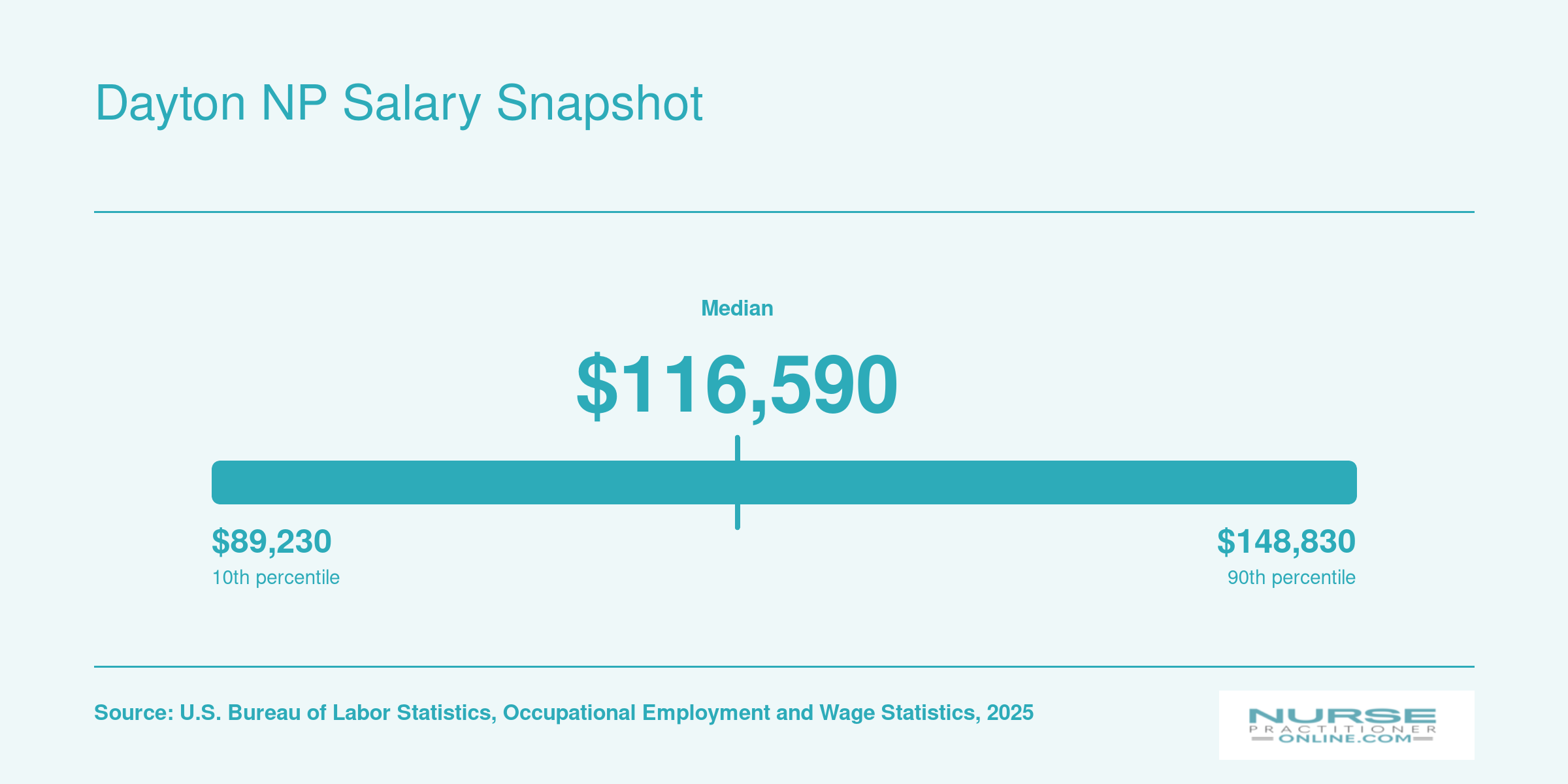
Understanding how nurse practitioner salaries stack up in the Dayton metro area can help you weigh the return on your DNP investment. The figures below show the spread from entry-level to top earners, based on BLS data. For context, the national median NP salary sits at roughly $126,260, while the Ohio statewide median is approximately $118,680.
How to Choose the Right DNP AGNP Program Near Dayton
A fully online program with self-arranged preceptors appeals to one working nurse, while another prefers a hybrid format with campus intensives and clinical placement support. Neither is universally better. Your decision depends on how you work, where you live, and what resources you can realistically access over three to four years of graduate study.
Start With Accreditation
Before comparing tuition or format, confirm the program holds accreditation from either the Commission on Collegiate Nursing Education (CCNE) or the Accreditation Commission for Education in Nursing (ACEN). Both are recognized by the Ohio Board of Nursing for APRN licensure.1 Some programs, like Franklin University's online DNP, prominently note their CCNE accreditation. Others may be in candidacy status, which can affect federal financial aid eligibility. If you plan to sit for national certification through AANP or ANCC, an accredited degree is non-negotiable.
Match Format to Your Schedule
Online coursework sounds flexible until you discover the program requires three on-campus intensives per year in a city five hours from Dayton. Add up hotel stays, time off work, and travel costs before committing. Programs at Ohio State University and University of Cincinnati use hybrid models with periodic immersions, while Franklin University offers fully online didactics. Consider how synchronous class times fit your shift schedule. A program with evening live sessions may work perfectly for day-shift nurses but conflict badly with night rotations.
Weigh Clinical Placement Support
Clinical site coordination varies dramatically. University of Cincinnati provides a clinical site coordinator to help students identify preceptors. Ohio State students can access placements at Wexner Medical Center. Other programs expect you to cold-call practices and negotiate your own arrangements. If you lack professional connections in the Dayton metro area, a program with dedicated placement assistance can save months of frustration.
Calculate True Cost, Including Pacing
Most working RNs choose part-time enrollment, stretching the degree over three to four years instead of two. Part-time pacing reduces semester-to-semester stress, but it also means paying fees across more terms. Some programs charge per-credit, others use flat-rate semesters. A program advertising lower tuition may cost more overall if part-time students still pay full-time technology and administrative fees each term.
Consider Admission Selectivity
Admission rates influence your application strategy. Ohio State's undergraduate admission rate sits around 61 percent, suggesting a moderately selective institutional culture. University of Cincinnati admits roughly 85 percent of applicants at the undergraduate level. Graduate nursing programs often have different thresholds, but these figures hint at relative accessibility. If your GPA hovers near the minimum, targeting a program with broader admission may improve your odds.
Verify Certification Alignment
Ohio requires Adult-Gerontology Nurse Practitioners to hold national certification as either AGPCNP or AGACNP through AANP, ANCC, or AACN.2 Before enrolling, confirm the program's AGNP track explicitly prepares you for your intended exam. A primary care track leads to the AGPCNP-BC credential, while an acute care nurse practitioner programs track prepares you for AGACNP-BC. Enrolling in the wrong track means additional coursework later or a certification mismatch that limits your practice options.
Frequently Asked Questions About DNP AGNP Programs in Ohio
We hear many of the same questions from Dayton-area nurses weighing a Doctor of Nursing Practice in adult-gerontology. Below are straightforward answers drawn from current Ohio program data and common admissions requirements.
- What is the cheapest DNP program in Ohio for nurse practitioners?
- Among Ohio DNP AGNP programs we track, Ursuline College in Pepper Pike has the lowest effective net price at about $16,164 per year. Ohio State University follows at roughly $17,339 for in-state students. Both offer hybrid formats that let you complete most coursework remotely, which is helpful if you are commuting from the Dayton area.
- How long does it take to complete a DNP AGNP program part-time?
- Most Ohio programs offer a part-time track that runs three to four years. Ursuline College, for example, lists a four-year part-time option alongside a 24-month full-time path. Ohio State and Franklin University each structure their DNP around three years. Your actual timeline depends on how many clinical hours you can schedule each semester while working.
- Are there fully online DNP adult-gerontology nurse practitioner programs near Dayton?
- Yes. Franklin University and the University of Cincinnati both offer DNP AGNP programs with 100% online coursework, though Cincinnati requires brief in-person immersion sessions. Ohio State's program uses synchronous online classes with optional on-campus components. Clinical hours must still be completed in person, but you can often arrange placements in the Dayton metro area.
- What is the difference between adult-gerontology primary care and acute care NP?
- Primary care AGNPs manage chronic conditions, wellness visits, and preventive care for patients ages 13 and older in outpatient settings. Acute care AGNPs treat complex, rapidly changing conditions in hospitals, ICUs, and emergency departments. The certifying exams are different (AGPCNP-BC vs. AGACNP-BC), and your scope of practice varies by setting. Most Ohio programs listed here focus on the primary care track.
- What scholarships are available for DNP students in Ohio?
- Franklin University offers an automatic $2,000 scholarship for DNP students plus military tuition discounts. Ohio State provides institutional scholarships and financial aid through its College of Nursing. The University of Cincinnati also lists scholarship opportunities. Beyond school-specific awards, Ohio nurses should explore HRSA Nurse Corps scholarships, OAPN foundation grants, and employer tuition reimbursement programs.
- Do DNP AGNP programs require a master's degree for admission, or can BSN-prepared nurses apply?
- Several Ohio programs accept BSN-prepared nurses directly through a BSN-to-DNP pathway. Ohio State, Franklin University, and the University of Findlay all advertise this option, which lets you earn your MSN en route to the DNP. Most programs require a minimum GPA of 3.0 to 3.3, at least one year of RN experience, and letters of recommendation. Check each school's specific prerequisites before applying.