Most important takeaways…
- Four Florida area programs offer post-master's AGNP certificates, with per credit costs ranging roughly from $500 to over $1,100.
- FNP to AGACNP transitions typically require only 15 to 20 credits, while non-NP MSN holders may need 30 or more.
- Florida nurse practitioners earned a median annual wage of $110,310, making the certificate investment recoverable within a few years.
- Verify both state authorization and Board of Nursing clinical approval before enrolling in any out-of-state online program.
A post-master's Adult-Gerontology Nurse Practitioner (AGNP) certificate is a streamlined academic program designed for MSN-prepared nurses who already hold one NP specialty and wish to add a second population focus. These certificates come in two tracks: Adult-Gerontology Acute Care (AGACNP) and Adult-Gerontology Primary Care (AGPCNP). Both prepare you to sit for national certification and apply for Florida APRN licensure in the new specialty, typically in 12 to 18 months of part-time enrollment.
Cost is often the first filter. The four programs profiled below range from roughly $9,600 to $23,000 in total tuition, all accessible to Miami-area nurses through hybrid or fully online formats. You can also explore a broader list of adult gerontology nurse practitioner programs to compare options beyond the local market. Each school is evaluated on per-credit cost, clinical-hour load, and authorization to enroll Florida residents.
The practical challenge is not just affordability but also state authorization, clinical placement logistics, and matching the right track to your career goals. Florida employs separate APRN practice acts for acute and primary care, so choosing the wrong certificate means additional coursework later if your practice setting shifts.
Best Post-Master's AGNP Certificate Programs Near Miami
These four Florida institutions offer post-master's adult-gerontology nurse practitioner certificates within reach of the Miami metro area. Each program is profiled with institution-level cost data, format details, and return-on-investment context to help you weigh affordability against convenience. Note that net price figures reflect the institution-wide average after financial aid for all students and are not a guaranteed quote for certificate-level enrollees.
- Tuition and net price affordability
- Program format and flexibility
- Graduation and retention rates
- Graduate earnings and debt levels
- Regional clinical placement access
- College Scorecard graduate earnings — collegescorecard.ed.gov
- NCES-IPEDS federal institutional data — nces.ed.gov
- Internal program database
- Independent program research

Florida International University
Located in the heart of Miami, Florida International University delivers a fully online post-graduate AGPCNP certificate that requires 32 credit hours. FIU stands out for its clinical placement flexibility: students may complete clinical rotations outside the traditional South Florida counties of Monroe, Dade, Broward, and Palm Beach, giving working nurses broader preceptor options. The institution posts a 74.4% graduation rate, and its median graduate debt of $16,500 paired with median earnings of $60,249 ten years after enrollment suggest a solid return on investment.
- Fully online format with no required campus visits
- 32 credit hours build on an existing MSN degree
- Clinicals permitted outside traditional South Florida counties
- Prepares graduates for national NP certification
- Fall application deadline is March 1
- In-state tuition approximately $11,334 per year
- Institution-level net price averages $9,288 after aid
- Designed for working professionals seeking career advancement
Post-Graduate Certificate in Adult-Gerontology Primary Care Nurse Practitioner — Online

Florida Atlantic University
Florida Atlantic University's Christine E. Lynn College of Nursing offers a campus-based post-graduate AGPCNP certificate in Boca Raton, roughly an hour north of downtown Miami. The program requires an MSN, a 3.0 GPA, active Florida RN licensure, and a nursing philosophy essay. FAU reports the lowest institution-level net price on this list at $8,752, with in-state tuition near $6,693 per year, making it an attractive budget option. Median graduate debt sits at $17,236, while ten-year median earnings reach $56,746.
- Campus-based program at the Boca Raton location
- Requires MSN degree and minimum 3.0 GPA
- Active Florida RN licensure is an admission prerequisite
- Includes a nursing philosophy essay and recommendation letter
- In-state tuition around $6,693 per year
- Lowest institution-level net price in this list at $8,752
- Curriculum includes Advanced Nursing Practice Grounded in Caring
- Limited-access program; interview or writing sample may apply
Post-Graduate Certificate in Adult-Gerontology Primary Care Nurse Practitioner — On-Campus

University of Central Florida
The University of Central Florida's College of Nursing in Orlando provides a hybrid AGPCNP graduate certificate that blends online coursework with hands-on clinical practice. At 19 credit hours and up to 660 required clinical hours, it is one of the more streamlined options in the state. UCF's 78% graduation rate and 92% retention rate reflect strong student support, though its Orlando base means Miami-area students should plan for some travel. Median graduate debt is $18,190, with ten-year median earnings of $58,308.
- Hybrid format combining online classes and clinical practice
- 19 credit hours with up to 660 clinical hours required
- Requires both a BSN and MSN from accredited institutions
- Undergraduate statistics course is a prerequisite
- Coursework covers health promotion, gerontologic, and women's health
- In-state tuition approximately $8,872 per year
- Institution-level net price averages $10,411 after aid
- Prepares graduates for Florida APRN licensure and certification
Adult-Gerontology Primary Care Nurse Practitioner Graduate Certificate — Hybrid

University of Miami
The University of Miami offers a campus-based post-graduate AGPCNP certificate with 16 to 19 credit hours delivered through a lock-step curriculum. All clinical experiences must be completed within Florida, which keeps placements relevant for South Florida practice. Tuition runs approximately $1,500 per credit, and a $1,500 non-refundable deposit is required upon admission. While the sticker price is notably higher than public university peers, UM's 83.7% graduation rate and ten-year median earnings of $75,328 are the strongest on this list. The application deadline for the current cycle is June 1, 2026.
- Campus-based lock-step curriculum in Coral Gables
- 16 to 19 credit hours determined by individual gap analysis
- All clinical rotations must be completed within Florida
- Approximately $1,500 per credit hour
- Accepts MSN or DNP graduates for admission
- Courses include Adult Gerontology I, II, and III
- 11:1 student-to-faculty ratio, lowest among listed schools
- Application deadline for the current cycle is June 1, 2026
Post-Graduate Certificate in Adult-Gerontology Primary Care Nurse Practitioner — On-Campus
Post-Master's AGACNP vs AGPCNP: Which Certificate Fits Your Goals?
Choosing between an Adult-Gerontology Acute Care Nurse Practitioner (AGACNP) certificate and an Adult-Gerontology Primary Care Nurse Practitioner (AGPCNP) certificate is one of the most important decisions you'll make as you plan your post-master's education. Both credentials prepare you to care for adults and older adults, but the practice environments, patient relationships, and day-to-day responsibilities differ significantly.1
Scope of Practice: Acuity Matters
Both the AGACNP and AGPCNP scopes are defined by patient acuity rather than setting alone.2 AGACNPs specialize in acute care, managing patients experiencing complex, rapidly changing conditions. Your role centers on episodic care: stabilizing a patient through a critical illness, post-surgical recovery, or exacerbation of a chronic disease. AGPCNPs focus on primary care, providing longitudinal health management. You build ongoing relationships with patients, coordinating preventive care, managing chronic conditions, and addressing health maintenance across the lifespan.
Typical Practice Settings in South Florida
In the Miami area, AGACNPs typically work in hospital systems, including intensive care units, emergency departments, surgical services, and specialty inpatient teams. South Florida's large academic medical centers and regional hospitals show strong demand for acute care practitioners.1 AGPCNPs, by contrast, are most commonly employed in outpatient clinics, community health centers, private practices, and long-term care facilities. If you envision continuity of care and a patient panel you follow over months and years, the primary care pathway aligns better with that goal. You can compare both tracks side by side across accredited AGNP post master's certificate online programs to see how curricula differ.
Board Certification Pathways
After completing your certificate, you'll need to pass a national board exam. AGACNPs can certify through the American Association of Critical-Care Nurses (AACN) or the American Nurses Credentialing Center (ANCC). AGPCNPs certify through ANCC or the American Association of Nurse Practitioners (AANP).1 Both certificates prepare you for full Florida APRN licensure, but the exam you take will reflect your chosen specialty. If you're leaning toward the acute care track specifically, reviewing online post-master's ACNP certificate programs can help you narrow your options.
Matching Your Goals to the Right Certificate
Reflect on your current NP experience and your future practice vision. If you thrive in fast-paced, high-acuity environments and enjoy procedural skills and critical decision-making under pressure, AGACNP may be the best fit. If you value preventive medicine, health education, and long-term therapeutic relationships, AGPCNP offers that pathway. Either certificate expands your career options in South Florida's robust healthcare market.
Questions to Ask Yourself
Tuition and Cost Comparison for Florida-Area AGNP Certificates
Choosing an economical post-master's AGNP or AGACNP certificate means weighing per-credit costs, total credits, and clinical hour requirements side by side. The table below compares programs that are either based in Florida or authorized to enroll Florida nurses online. Keep in mind that fees, textbooks, and clinical placement expenses are not reflected in tuition estimates, so your actual out-of-pocket cost may be higher.
| School | Delivery | Credits Required | Clinical Hours | Per-Credit Cost | Estimated Total Cost |
|---|---|---|---|---|---|
| West Coast University | Online | 29 | Not published | $667 to $785 | $19,343 to $22,765 |
| St. Thomas University (FL) | Online | 35 | 500 | $605 | $22,650 |
| Herzing University | Online | 33 | 540 | $755 to $770 | $24,915 to $25,410 |
| Florida International University (Miami) | Online | 32 | Not published | Contact school | Contact school |
| Florida Atlantic University (Boca Raton) | Campus | Not published | Not published | Contact school | Contact school |
| University of Central Florida (Orlando) | Hybrid | 19 | Up to 660 | Contact school | Contact school |
| University of Miami (Coral Gables) | Campus | 16 to 19 | Not published | Contact school | Contact school |
State Authorization and Florida APRN Licensure for Online Programs
Enrolling in an out-of-state online AGNP certificate as a Florida resident requires two separate green lights: state authorization for the academic program and Board of Nursing approval for your clinical rotations. Schools sometimes have one without the other, and that gap can stall your certificate plans for a semester or longer.
How SARA Works (and Where It Stops)
The State Authorization Reciprocity Agreement (SARA) is an interstate compact that lets approved institutions enroll students from member states without seeking individual state-by-state authorization for distance coursework. Florida participates in SARA, so a SARA-approved university in Missouri or New Hampshire can generally accept your tuition and deliver online lectures without additional paperwork.
The critical limit: NC-SARA does not cover clinical placements.1 Hands-on practicum hours in a Florida hospital or clinic fall under Florida Board of Nursing jurisdiction, not SARA. A program can be SARA-authorized for coursework yet still decline Florida applicants because it has not built the clinical pipeline here. Rockhurst University, for example, participates in SARA but does not currently accept Florida students into its online AGACNP track.1 Always confirm both pieces in writing before you apply.
Programs With Confirmed Florida Pathways
A handful of options are clearly viable for Miami-area nurses:
- University of Central Florida: Its AGACNP graduate certificate is structured to meet Florida APRN licensure requirements directly.2
- Miami Regional University: A local post-master's AGACNP certificate requiring roughly 30 credits and 810 clinical hours, with placements coordinated in South Florida.3
- University of New Hampshire: Delivers the standard advanced core (advanced physical assessment, pathophysiology, pharmacology) online, though Florida applicants should verify current clinical placement support before committing.4
Florida APRN Licensure Checklist
Once you finish the certificate, the Florida Board of Nursing requires:
- An active Florida RN license in good standing.2
- Graduation from a CCNE or ACEN accredited program.
- National certification through ANCC or AACN in your population focus (AGACNP or AGPCNP).2
- A completed criminal background check and fingerprinting.3
- A separate DEA registration if you plan to prescribe controlled substances.
Florida operates under a collaborative or supervisory practice model rather than full independent practice, so you will also need to formalize a protocol with a supervising physician before billing in most settings.2
Related Articles
Clinical Placement Logistics in South Florida
Clinical placement is often the make-or-break logistical hurdle for working nurses pursuing a post-master's AGACNP certificate. Before you enroll, understand how a program handles placements and what hour commitment you are signing up for.
School-Arranged vs Self-Arranged Placements
Programs generally fall into one of two camps. South University's AGACNP post-master's certificate uses a school-assigned model, meaning the program's clinical coordinators work to secure preceptors and sites for you.1 Many competing programs, including several large online options that recruit Florida students, expect you to identify your own preceptor and proposed site, then submit them for program approval. USF's AGACNP post-graduate certificate falls closer to a hybrid: students typically have input into site selection while the university handles credentialing.2
Neither model is universally better. School-assigned placements reduce your administrative load but may send you to a site farther from home. Self-arranged placements give you control and let you leverage existing workplace relationships, but the search can take months.
Where Miami-Area Students Typically Train
South Florida has a deep bench of acute care sites that have historically precepted NP students. Common rotations include:
- Jackson Health System: The Miami-Dade public hospital network, including Jackson Memorial, offers high-acuity ICU, trauma, and specialty exposure.
- Baptist Health South Florida: A large nonprofit system spanning Miami-Dade, Broward, and Monroe counties with strong cardiology and oncology services.
- Memorial Healthcare System: Broward County's public system, including Memorial Regional Hospital in Hollywood.
- HCA Florida hospitals: Multiple facilities across both counties, often more receptive to outside NP students.
- Cleveland Clinic Florida (Weston): Subspecialty acute care opportunities for students who can commute west.
Hour Requirements and Scheduling Around Work
National AGACNP certification requires a minimum of 500 supervised direct patient care hours.3 Most post-master's certificates land between 600 and 750 hours: USF requires 5402, South University requires 6601, and programs like the University of New Hampshire's certificate sit at 750.4 Spread across two or three semesters, that translates to roughly 16 to 24 clinical hours per week, usually in 8- or 12-hour blocks aligned with preceptor shifts. If you are still weighing different specialty tracks, reviewing acute care nurse practitioner programs online can help you compare hour requirements side by side.
Practical Tips
Start preceptor outreach six to nine months before your first clinical course. Ask physicians and AGACNPs you already work with, since an existing professional relationship dramatically shortens onboarding. Confirm your program's site approval timeline early, because hospital credentialing committees in South Florida often run 60 to 120 days, and a late submission can push back your start date by a full term.
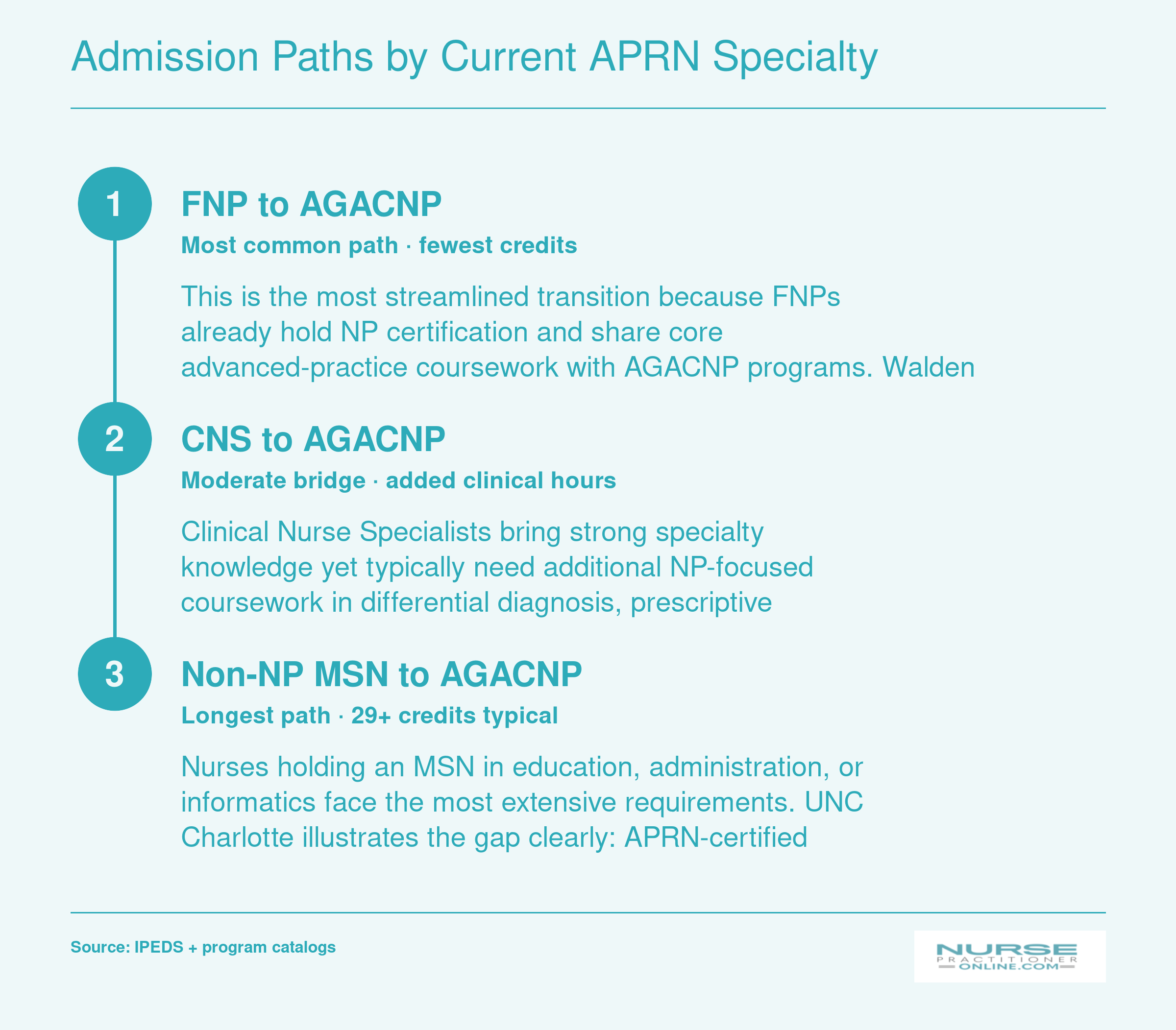
Admission Paths by Current APRN Specialty
Your existing credential determines how many credits and clinical hours stand between you and AGACNP certification. The three most common entry points are outlined below, with real program data showing how requirements shift depending on where you start.
Career Outlook and Salary Impact in Florida
Nurse practitioners across Florida earned a median annual wage of $110,310 as of 2022, with the top 10 percent reaching $149,520.1 In the Miami, Fort Lauderdale, Pompano Beach metro area, the median stood at $105,250, and practitioners at the 75th percentile commanded $123,770.1 These figures reflect the entire nurse practitioner category, but acute care NPs working in hospital settings, particularly those holding AGACNP credentials, often see a meaningful premium over their primary-care counterparts.
How an AGACNP Certificate Boosts Earning Potential
Adding an Adult-Gerontology Acute Care Nurse Practitioner credential positions you for roles in emergency departments, intensive care units, and specialty inpatient services, where staffing demands and acuity drive higher salaries. Industry surveys indicate that hospital-employed acute care NPs frequently earn 10 to 15 percent more than family or primary-care NPs in the same region, placing many Florida AGACNPs well into the upper quartiles of the pay distribution.
When you compare that salary lift to the typical investment for a post-master's certificate (between $10,000 and $25,000 for programs near Miami), the return on investment becomes clear. If earning the AGACNP credential raises your annual income by $8,000 to $12,000, you can recover tuition within two to three years. Beyond that point, the credential continues to open doors to leadership roles, specialty teams, and opportunities that primary-care-only licenses may not reach.
Job Growth and Demand Drivers in South Florida
Nurse practitioner employment nationwide is projected to grow 38 to 40 percent through 2032, far outpacing most other occupations.2 Florida's aging population, South Florida in particular, amplifies that trend. As hospital systems across Miami-Dade, Broward, and Palm Beach counties expand cardiology nurse practitioner units, oncology programs, and emergency services, they compete for AGACNPs who can manage complex inpatient cases autonomously.
Local health systems regularly post openings for acute care NPs, and many recruiters note that candidates with dual certifications (for instance, FNP plus AGACNP) enjoy even broader employability. Dual-certified NPs can transition between outpatient clinics and inpatient units, fill gaps during peak census periods, and negotiate stronger compensation packages. If you already hold an FNP or other population-focused credential, adding an AGACNP certificate through a post-master's program can make you one of the most flexible candidates in Florida's competitive market.
Long-Term Compensation Trajectory
Early-career NPs in South Florida start near the 25th percentile, around $91,020 in Miami, Fort Lauderdale, but those who specialize in acute care and accumulate a few years of inpatient experience often move into the 75th percentile or beyond.1 By mid-career, an AGACNP with hospitalist or intensivist experience can approach or exceed the $145,950 mark seen at the 90th percentile for the metro area.1 When you factor in sign-on bonuses, shift differentials for nights or weekends, and employer contributions to retirement plans, the total compensation picture becomes even more favorable.
In 2024, the national pass rate for the AACN Adult-Gerontology Acute Care Nurse Practitioner certification exam was 75 percent. While aggregate data does not yet separate post-master's certificate candidates from traditional MSN graduates, most certificate programs report comparable or slightly higher first-time pass rates, likely reflecting the clinical experience post-master's students bring to their studies.
Frequently Asked Questions About Post-Master's AGNP Certificates
Choosing a post-master's certificate is a big decision, especially when you are balancing clinical shifts and personal commitments. Below are straightforward answers to the questions nurses in the Miami area ask most often about adult-gerontology NP certificates.
- What is a post-master's AGACNP certificate and who is it for?
- A post-master's AGACNP certificate is a focused credential designed for nurses who already hold a master's degree in nursing, typically with an existing NP or CNS specialization. It prepares you to diagnose and manage complex, acute, and critical conditions in adult and older adult patients. The certificate is ideal for family NPs, adult-gerontology primary care NPs, or other APRNs who want to expand their scope into acute care settings such as hospitals and ICUs.
- How many credits and clinical hours does a post-master's AGNP certificate typically require?
- Most post-master's AGNP certificate programs range from roughly 15 to 25 credit hours, depending on your prior coursework and the specific track (acute care vs. primary care). Clinical hour requirements generally fall between 500 and 750 supervised hours. Programs often evaluate your existing transcripts and award credit for overlapping content, which can shorten the timeline. Many nurses complete the certificate in two to four semesters of part-time study.
- Can I complete an online AGACNP post-master's certificate while living in Florida?
- Yes, but the university offering the program must hold Florida state authorization or participate in the State Authorization Reciprocity Agreement (SARA). Many accredited programs deliver didactic coursework fully online and allow you to arrange clinical placements locally in South Florida. Before enrolling, confirm that the school is approved to operate in Florida and that its curriculum meets the requirements for APRN licensure through the Florida Board of Nursing.
- How much does a post-master's adult-gerontology NP certificate cost?
- Total tuition varies widely depending on the institution and credit load. Programs typically range from around $8,000 at the lower end for in-state public university options to $25,000 or more at private institutions. Additional costs include clinical fees, background checks, malpractice insurance, and certification exam fees. Comparing per-credit rates across several schools is the most reliable way to estimate your total out-of-pocket investment.
- What is the difference between AGACNP and AGPCNP post-master's certificates?
- The AGACNP (Adult-Gerontology Acute Care Nurse Practitioner) certificate focuses on managing acutely and critically ill adults in settings like emergency departments, ICUs, and surgical units. The AGPCNP (Adult-Gerontology Primary Care Nurse Practitioner) certificate centers on wellness promotion, chronic disease management, and preventive care in outpatient or community settings. Your choice should align with the patient population and clinical environment where you plan to practice.
- How does adding an AGACNP certificate affect salary and job opportunities in Florida?
- Holding dual NP certifications can make you significantly more competitive in South Florida's healthcare market. Acute care NPs are in strong demand across the region's hospital systems, and adding the AGACNP credential can open doors to higher-acuity, higher-paying roles. While individual salaries depend on employer, experience, and setting, dual-certified NPs often command a broader range of job offers and may have greater leverage when negotiating compensation.
- Do I need to hold an active NP license to enroll in a post-master's AGACNP program?
- Requirements vary by school, but most programs require applicants to hold an active, unencumbered APRN or NP license and a master's degree in nursing from an accredited institution. Some programs accept clinical nurse specialists or other advanced practice nurses as well. It is important to verify each program's prerequisites, because some may also require national board certification in your current specialty before admission.
Florida by City
- ACNP Programs in Florida
- AGNP Programs in Florida
- DNP NP Programs in Florida
- FNP Programs in Florida
- Fort Lauderdale, Florida (FNP)
- Fort Myers, Florida (FNP)
- Lakeland, Florida (PNP)
- Miami, Florida (PNP)
- Orlando, Florida (FNP)
- PMHNP Programs in Florida
- PNP Programs in Florida
- Sarasota, Florida (FNP)
- Tampa, Florida (PNP)