Most important takeaways…
- Orlando-area nurses can complete an in-state FNP degree for roughly half the cost of comparable private programs.
- Total FNP expenses in Florida, including clinical travel, exams, and licensing, often add thousands beyond published tuition.
- Nurse practitioners in the Orlando metro earn competitive salaries that typically allow graduates to recoup their investment within a few years.
- Federal loan repayment programs, employer tuition benefits, and state scholarships can significantly reduce out-of-pocket FNP costs.
Nursing programs with identical outcomes can carry wildly different price tags. Among schools accessible to registered nurses in the Orlando metro, tuition for the same FNP credential spans from roughly $10,000 to more than $30,000 for the entire program, yet every graduate sits for the same AANP or ANCC certification exam and earns the same ARNP title in Florida.
You will find the most affordable options concentrated within Florida's public university system, where in-state graduate tuition remains competitive and financial aid packages can lower net costs even further. Several schools on the list deliver coursework online or in hybrid formats, so you can stay in Central Florida while earning your degree. If you are still exploring what the family nurse practitioner role involves day to day, that context can help you decide whether this specialty fits your goals.
Every program ranked here meets national accreditation standards, prepares you to sit for nurse practitioner licensing and certification, and satisfies Florida Board of Nursing requirements for Advanced Registered Nurse Practitioner licensure. The credential and the scope of practice are identical, but your out-of-pocket cost and loan burden can differ by tens of thousands of dollars depending on which school you choose.
Most Affordable FNP Programs Near Orlando, Florida for 2026
Florida's public university system gives Orlando-area nurses a genuine cost advantage when pursuing an FNP credential. Every school on this list accepts Florida residents at in-state rates, and several deliver coursework entirely or mostly online, so you can study from Central Florida without relocating. We ranked these programs by net price after typical grant aid, then layered in graduation strength, program flexibility, and clinical fit for nurses based in the Orlando metro.
- Net price after financial aid
- Institutional graduation rate
- Program delivery flexibility
- Clinical placement accessibility
- In-state tuition advantage
- Independent program research
- Internal program database
- NCES-IPEDS federal institutional data — nces.ed.gov
- College Scorecard graduate earnings — collegescorecard.ed.gov

University of Florida
The University of Florida pairs one of the strongest graduation rates in the state (91.1% overall) with the lowest net price on this list, making it a standout value for Florida residents. Its College of Nursing offers a hybrid BSN-to-DNP pathway focused on family-centered primary care across the lifespan, with supervised clinical placements arranged throughout Florida. The significant gap between in-state tuition (roughly $12,700) and out-of-state tuition (about $30,100) underscores how much Florida residency matters here.
- Hybrid format with clinical placements across Florida
- Full-time and part-time scheduling available
- Prepares for both ANCC and AANP certification exams
- Emphasizes community-based care and health promotion
- Covers chronic disease management across the lifespan
- Supervised precepted clinical experience required
- Collaborative, interprofessional care approach
BSN to DNP Family Nurse Practitioner — Hybrid

Florida International University
Florida International University, a public research institution in Miami, keeps net costs competitive for in-state students while offering both a post-graduate FNP certificate and a BSN-to-DNP track. The school's overall graduation rate is 74.4%, and its nursing programs emphasize primary care in ambulatory settings with fall and spring start dates. Out-of-state tuition jumps to roughly $24,400, so establishing Florida residency before enrollment is essential for affordability.
- Hybrid program requiring 36 credits
- Designed for nurses who already hold an MSN
- Blends online coursework with campus sessions
- Prepares graduates for national FNP certification
- Ideal for working professionals adding a specialty
- Financial aid available to qualifying students
- Hybrid FNP track with four concentration options
- Clinical placements in ambulatory care settings
- Family-centered, lifespan approach to primary care
- Fall and spring admission windows
- Prepares for national certification upon completion
- Located in Miami with access to diverse patient populations
Post-Graduate Nurse Practitioner Certificate, Family Nurse Practitioner — Hybrid
Post-BSN to DNP Family Nurse Practitioner — Hybrid

Florida Atlantic University
Florida Atlantic University routinely appears on statewide lists of the most affordable public FNP programs, with in-state per-credit costs around $372. The school's overall graduation rate is 62.6%, and its MSN and BSN-to-DNP pathways both use a hybrid format across three campus locations in South Florida. FAU arranges clinical preceptors for its DNP students, removing one of the biggest logistical hurdles for busy nurses.
- 52 credits with 780 required clinical hours
- Part-time hybrid format, about 2.5 years to complete
- In-state tuition approximately $372 per credit hour
- No GRE or MAT entrance exam required
- Eligible for ANCC or AANP certification
- Fall-semester admission only
- Clinical sites located in South Florida
- 77 total credit hours across 11 semesters
- Total program tuition listed at roughly $28,629
- Includes a Master's Along the Way option
- 1,000 clinical hours with preceptors arranged by program
- DNP classes meet one weekend per month
- Synchronous and asynchronous online components
- Capstone project required for graduation
MSN Family Nurse Practitioner — Hybrid
BSN to DNP Family Nurse Practitioner — Hybrid

University of South Florida
The University of South Florida in Tampa offers both an MSN and a BS-to-DNP pathway with a family health concentration, keeping Orlando nurses within a short drive on I-4 for any required campus sessions. The school's overall graduation rate is 76.8%, and net price lands just under $10,000 for aided students. Both tracks prepare graduates for the ANCC or AANPCB certification exam and emphasize clinical judgment, research, and health policy leadership.
- 60 credit hours in a hybrid delivery format
- Comprehensive examination required at completion
- Covers research, health policy, and clinical leadership
- Prepares for ANCC or AANPCB certification
- Lifespan focus from pediatrics through geriatrics
- Clinical judgment development is a core emphasis
- Prepares for ANCC or AANPCB certification
- Designed for work in ambulatory care settings
- Comprehensive care training across the lifespan
- Hybrid format blending online and on-campus learning
- Builds leadership and evidence-based practice skills
- Open to BSN-prepared registered nurses
MSN Family Nurse Practitioner — Hybrid
BS-DNP Family Health Concentration — Hybrid

University of West Florida
The University of West Florida stands out as one of the most affordable online FNP programs nationally, with total MSN-FNP costs cited around $22,500 for in-state students. Because the program is fully online, Orlando-area nurses can earn their degree without relocating to Pensacola. The school's overall graduation rate is 58.8%, and the 45-credit cohort model keeps students on a structured timeline with clear milestones.
- Fully online delivery, no relocation needed
- 45 total credit hours in a cohort progression
- Nationally recognized for low total program cost
- Accredited by NLNAC, ACEN, or CCNE
- No thesis or capstone project required
- Prepares students for doctoral-level studies
- Competitive admission with a 3.0 GPA minimum
- Physical exam and background check required
MSN Family Nurse Practitioner — Online

Florida State University
Florida State University's College of Nursing offers multiple FNP pathways: a post-MSN certificate delivered entirely online and hybrid BSN-to-DNP and MSN-to-DNP doctorate tracks. The school's overall graduation rate is an impressive 85.6%, and its curriculum uses a multi-theoretical model for lifespan family care. Campus visits are limited to two or three skills workshops, making the program manageable for nurses who live hours away in Orlando.
- Fully online format for nurses who hold an MSN
- 585 supervised clinical hours in family practice
- Preceptors coordinated by program staff
- Requires three prerequisite graduate courses
- Prepares for expert-level patient care
- Clinical clearance fee of $174 applies
- BSN-to-DNP and MSN-to-DNP pathways available
- Full-time and part-time scheduling options
- Only 2 to 3 campus visits for skills workshops
- Prepares for ANCC or AANPCP certification
- Capstone and comprehensive exit exam (HESI) required
- Clinical placements with expert preceptors nationwide
- Leadership and health systems training integrated
Family Nurse Practitioner Certificate — Online
DNP Family Nurse Practitioner — Hybrid

University of North Florida
The University of North Florida in Jacksonville delivers a campus-based DNP with a Family Nurse Practitioner track, built on the latest AACN Essentials and NONPF standards. The school's overall graduation rate is 69.2%, and the program welcomes both BSN and MSN graduates seeking FNP certification and Florida APRN licensure. Tuition waivers and financial aid are available, helping to offset the roughly $10,150 net price.
- Campus-based program at the Jacksonville campus
- Open to both BSN and MSN graduates
- Full-time and part-time study options
- CCNE accredited with AACN-aligned curriculum
- Prepares for FNP certification and APRN licensure
- Tuition waivers available for qualifying students
- Emphasizes health promotion and disease prevention
- Clinical experience in diverse healthcare settings
DNP Family Nurse Practitioner — On-Campus

Florida Gulf Coast University
Florida Gulf Coast University offers a direct BSN-to-DNP pathway with an FNP concentration, a cost-efficient route that eliminates the need to complete a separate MSN first. The CCNE-accredited, 81-credit program can be finished in three years full-time or four years part-time, with clinical placement assistance and a dedicated faculty advisor. The school's overall graduation rate is 57.4%, and distinctive funding support includes a $2.7 million federal grant and access to the Nurse Faculty Loan Program.
- 81 total credit hours in a hybrid format
- Three-year full-time or four-year part-time completion
- Over 1,000 clinical hours with placement assistance
- CCNE accredited with faculty advisor assigned
- $2.7M federal grant supports the FNP program
- Nurse Faculty Loan Program available to students
- No entrance exam required for admission
- Prepares for national FNP certification
BSN to DNP Family Nurse Practitioner — Hybrid

Ana G. Mendez University
Ana G. Mendez University is the only school on this list with a physical campus in the Orlando metro, offering an on-site MSN-FNP program that covers pathophysiology, pharmacology, health assessment, and biomedical ethics. As a private institution, its net price ($19,775) is notably higher than the public options above, but the convenience of a local campus and the program's emphasis on cultural diversity and interprofessional collaboration may appeal to nurses who prefer face-to-face instruction close to home.
- On-site classes at the Metro Orlando campus
- Prepares for national FNP certification exam
- Curriculum spans pathophysiology and pharmacology
- Focus on primary care leadership across all ages
- No thesis or capstone project required
- Multiple Florida campus locations available
- Emphasizes cultural diversity and patient-centered care
MSN Family Nurse Practitioner — On-Campus

Miami Regional University
Miami Regional University, a private institution in Miami Springs, offers an ACEN-accredited MSN-FNP with both full-time (20 months) and part-time (32 months) tracks. The school's overall graduation rate is 84.5%, one of the highest on this list, but its net price of roughly $22,100 places it among the more expensive options. Students must hold Florida or SARA-state residency and complete a clinical preceptorship arranged or approved by the program.
- ACEN accredited with campus and online delivery
- 20-month full-time or 32-month part-time options
- 50 semester credits with clinical preceptorship
- Requires active RN license and bachelor's degree
- Serves all age groups in primary care settings
- Three letters of recommendation needed for admission
- Florida or SARA-state residency required
MSN Family Nurse Practitioner — On-Campus

South University-Tampa
South University's Tampa campus delivers a 62-credit MSN with a Family Nurse Practitioner specialization, available on campus, online, or in a hybrid mix. The school's overall graduation rate is 23.3%, which is significantly lower than other options on this list, and its net price of about $20,400 is well above the public university alternatives. Its flat tuition of roughly $16,600 applies regardless of residency, which could benefit out-of-state applicants but offers no savings for Floridians compared with public institutions.
- 62 total credits with on-campus, online, or hybrid options
- Flat tuition rate regardless of state residency
- CCNE accredited program at the Tampa campus
- Includes clinical practicums in advanced pharmacology
- Requires BSN with a minimum 2.5 GPA
- Active RN license needed for admission
- Prepares graduates for national certification exam
MSN Family Nurse Practitioner — On-Campus
How We Identified Orlando's Most Affordable FNP Options
Sorting by published tuition alone versus evaluating actual affordability after financial aid leads to very different conclusions about which programs represent the best value for working nurses.
Net Price After Aid Drives Our Rankings
We weighted average net price after aid most heavily, then layered in graduation rates and post-program earnings to ensure low cost doesn't come at the expense of outcomes. The net price metric reflects what the typical full-time undergraduate student at an institution pays after grants and scholarships, not the sticker price published in catalogs. Individual costs vary by aid package, financial need, enrollment intensity, and whether you qualify for employer tuition assistance or state-specific grants. The figure gives you a meaningful starting point, but expect your personal financial aid offer to differ.
Geographic Scope and Program Eligibility
We included programs headquartered in or within commuting distance of Orlando plus accredited online programs that accept Florida students and support clinical placements in Central Florida. Proximity matters if you prefer hybrid formats with occasional campus intensives, on-site simulation labs, or face-to-face advising. Fully online programs expand your options without requiring relocation, but verify each school's willingness to assist with preceptor arrangements in the Orlando metro before you apply. If you're comparing options beyond this region, our broader ranking of best online FNP programs can help you benchmark costs and outcomes nationally.
Data Sources and Transparency
Our analysis draws from College Scorecard institution-level and program-level data, which aggregates federal reporting on costs, completion, and earnings. We cross-referenced published tuition schedules and fee structures to confirm current rates. When program-specific earnings or employment outcomes are not yet available, we note that plainly rather than extrapolate. Our goal is to surface the schools that balance affordability with strong track records, giving you confidence that a lower price tag won't compromise your preparation or career prospects.
FNP Program Cost Comparison: Orlando-Area Schools Side by Side
Tuition is only one piece of the puzzle. The table below compares in-state graduate tuition, credit requirements, degree level, and program format for FNP programs accessible to Orlando-area nurses. Because ancillary fees (technology fees, malpractice insurance, background checks, and clinical placement costs) vary by semester and are not always published, the figures here reflect base tuition rates reported to federal databases. Always confirm the latest fee schedule directly with each school before applying.
| School | City | Degree Level | Credits Required | In-State Grad Tuition (Annual) | Format |
|---|---|---|---|---|---|
| University of Central Florida | Orlando | DNP | 73 | $23,894 (est. total at $327/cr.) | Online/Hybrid |
| University of Florida | Gainesville | DNP | N/A | $12,737 | Hybrid |
| Florida Atlantic University | Boca Raton | MSN | 52 | $6,693 | Hybrid |
| Florida Gulf Coast University | Fort Myers | DNP | 81 | $8,961 | Hybrid |
| University of West Florida | Pensacola | MSN | 45 | $9,062 | Online |
| University of South Florida | Tampa | MSN | 60 | $10,428 | Hybrid |
| University of North Florida | Jacksonville | DNP | N/A | $10,364 | Campus |
| Ana G. Mendez University | Orlando | MSN | N/A | $10,455 | Campus |
| Florida State University | Tallahassee | Post-Master's Certificate | N/A | $10,553 | Online |
| Florida International University | Miami | Post-Master's Certificate | 36 | $11,334 | Hybrid |
| South University, Tampa | Tampa | MSN | 62 | $16,611 | Campus |
| Miami Regional University | Miami Springs | MSN | 50 | N/A | Campus |
Questions to Ask Yourself
The Real Cost of Becoming an FNP in Florida
How much does FNP school cost in Florida, and what expenses beyond tuition should you budget for?
The sticker price on a program's website rarely tells the full story. When you factor in clinical travel, licensing fees, and exam costs, your total investment can climb several thousand dollars beyond published tuition figures.
Tuition Ranges Across Florida FNP Programs
Among the Florida-based programs accessible to Orlando nurses, tuition varies considerably. The lowest net price in the ranked dataset sits around $6,500 at the University of Florida, while private options such as Miami Regional University reflect net prices exceeding $22,000. Most public university MSN and DNP programs in Florida fall somewhere between $9,000 and $13,000 for in-state residents when looking at net price figures, though total program costs depend on credit requirements, which range from 45 to 81 credits depending on the degree pathway.
For context, national estimates for FNP programs frequently cite total tuition between $25,000 and $60,000 for a full master's degree, so Florida's public options often land on the lower end of that spectrum. If you're still weighing the overall timeline and investment, our guide on how to become a nurse practitioner breaks down the full process step by step.
Hidden Costs You Should Expect
Orlando's sprawling metro area means clinical rotations can require significant travel. If your preceptor site is in Kissimmee one semester and Sanford the next, gas and parking add up over 500 to 1,000 clinical hours.
Other expenses to budget for include:
- Malpractice insurance: Typically $150 to $300 per year for student coverage
- Background checks and drug screenings: Often required annually, costing $50 to $150 each time
- AANP or ANCC certification exam: Fees currently run approximately $315 to $395 depending on which board you choose
- Florida ARNP license application: State fees add another $100 to $200 to your final costs
When you total these ancillary expenses across a two-to-three-year program, expect to add $1,500 to $3,000 beyond tuition.
A Shorter Path for Nurses Who Already Hold an MSN
If you completed a master's degree in nursing education, leadership, or another specialty, a post-master's certificate FNP program can be a faster and less expensive route to becoming a family nurse practitioner. These certificates typically require 28 to 36 credits rather than the 45 to 60 credits of a full MSN program.
Several schools offer this pathway to Orlando-area nurses. University of Central Florida provides a hybrid-online FNP certificate for nurses who already hold APRN credentials.1 Florida International University offers a 36-credit hybrid certificate, and Florida State University runs an online certificate requiring 585 clinical hours. National online options include United States University, which offers a 34-credit online hybrid certificate completable in 16 months with 540 clinical hours.2 American International College advertises 28 credits at $850 per credit, totaling around $23,800.3 Herzing University (33 credits, fully online) and South College (fully online) offer similar post-graduate certificate programs.45
For nurses who already carry an MSN, these certificates can shave $10,000 to $20,000 off the total cost compared to starting a new master's program from scratch.
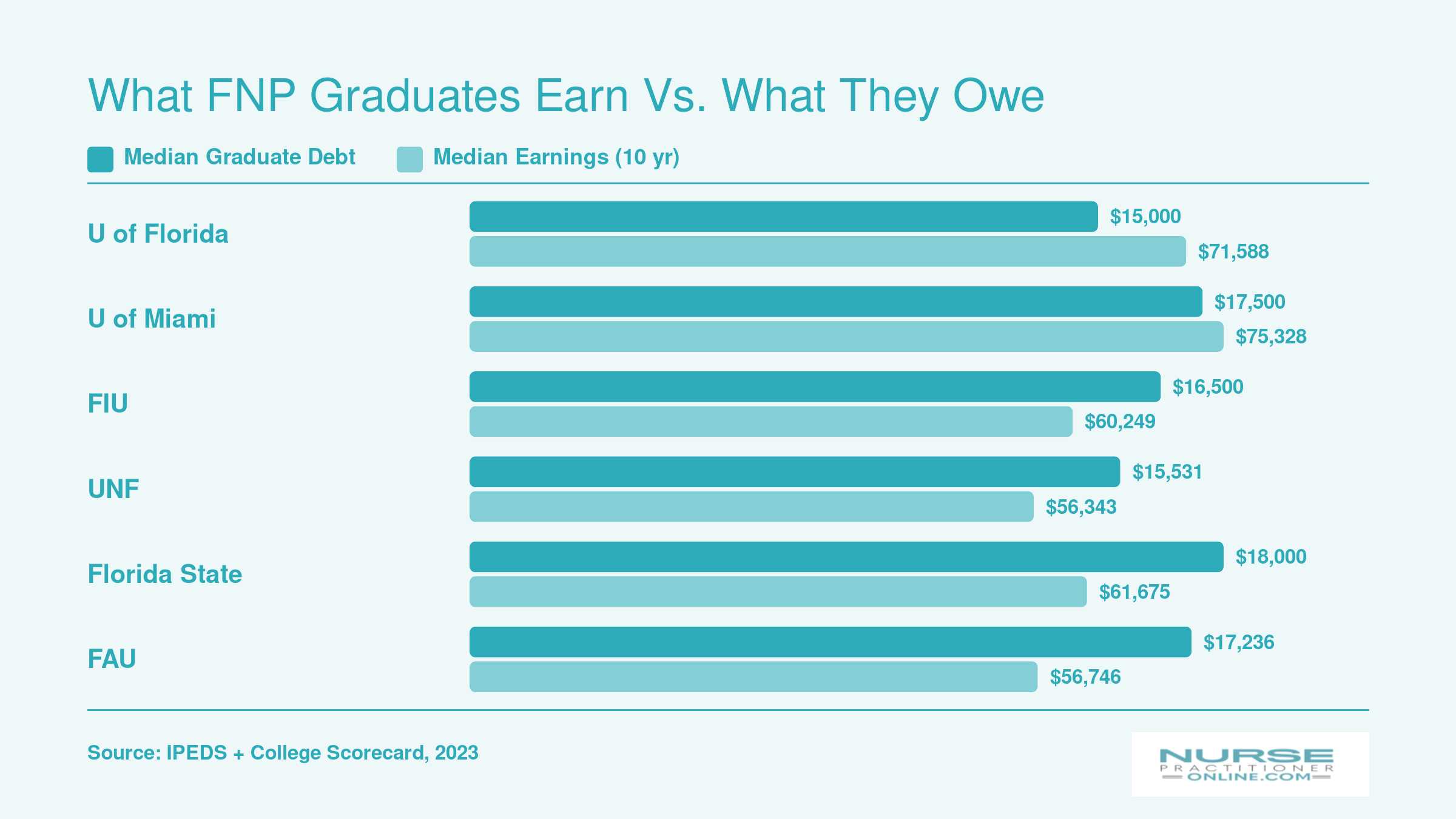
What FNP Graduates Earn vs. What They Owe
When comparing FNP programs, sticker price only tells part of the story. The debt-to-earnings ratio reveals how quickly you can recoup your investment. A program with slightly higher tuition but stronger earning potential may actually deliver better long-term value. Here are the top programs ranked by their return on investment, comparing median graduate debt against median earnings ten years after enrollment.
Related Articles
FNP Salary in the Orlando Metro: What the Numbers Say
Choosing an FNP program involves balancing upfront costs against long-term earning power. For nurses in Central Florida, the math often works out strongly in your favor, as Orlando-area salaries are competitive with, and in some cases exceed, statewide norms.
Orlando-Area FNP Salaries at a Glance
According to May 2023 data from the Bureau of Labor Statistics, the Orlando-Kissimmee-Sanford metropolitan area employed 2,160 nurse practitioners.1 The median annual wage for NPs in the region was $119,140. The middle half of earners made between $99,440 (25th percentile) and $135,010 (75th percentile). Even at the 10th percentile, often reflecting newer or part-time practitioners, the annual wage was $84,730. At the upper end, the 90th percentile reached $156,940. These numbers demonstrate a strong income floor and substantial upside for experienced FNPs in the Orlando market.
How Orlando Compares to State and National Averages
Orlando's median NP wage of $119,140 runs slightly above the Florida statewide median of $116,110.2 This local premium holds across the distribution: the 10th percentile in Orlando ($84,730) beats Florida's 10th percentile ($81,610), and the 90th percentile ($156,940) edges out the state's $152,660. Compared to the national median of $124,680, Orlando sits just below the U.S. average, but the gap is modest. In fact, the local 10th percentile is notably close to the national 10th percentile ($90,790), signaling that even entry-level NP roles in Orlando pay competitively. While the top 10% of earners nationally pull ahead at $168,030, many of those positions cluster in higher-cost-of-living metro areas, making Orlando's salary-to-cost ratio particularly attractive.
Breaking Down the Return on Your Education Investment
These salary figures translate directly into a fast payback on even the most affordable FNP programs near Orlando. If you choose one of the lowest-cost programs profiled in this article, total tuition often falls between $15,000 and $20,000. At the median Orlando wage of $119,140, that entire education expense equals about two months of gross salary. After adjusting for taxes, you can realistically recoup your outlay within your first year of practice. More importantly, moving from an RN to NP role typically brings a $20,000 to $30,000 annual earnings increase, so the net financial gain starts almost immediately. When you consider that many working nurses maintain their RN position while completing an online or hybrid FNP program, the calculus becomes even more favorable: you invest in your degree without forgoing your current income, then step into a higher-paying role with no delay.
Financial Aid, Scholarships, and Cost-Saving Strategies for Florida FNP Students
Where can Orlando-area nurses find financial support to offset FNP program costs, and which strategies deliver the greatest return?
Funding an FNP degree takes planning, but federal loan repayment programs, state aid, employer tuition benefits, and professional scholarships can significantly reduce your net expense. Below are the most accessible pathways for Florida nurses.
NURSE Corps Loan Repayment Program
The federal NURSE Corps Loan Repayment Program repays 60 percent of eligible nursing education debt in exchange for two years of full-time service (at least 32 hours per week) at a Critical Shortage Facility.1 Eligible professionals include registered nurses, advanced practice registered nurses, and nurse faculty. Both federal and private loans meeting program rules qualify for repayment.2 If you complete the initial two years, you may apply for an optional third year of service, during which the program repays an additional 25 percent of the original balance.
Florida applicants can apply alongside candidates nationwide, but service site availability varies by region. Visit the official HRSA website to check the current list of approved Critical Shortage Facilities in Central Florida, verify your eligibility, and review application cycles. The 2026 cycle is closed, so plan ahead for the next open period.4 For a broader look at repayment and forgiveness options available to NPs, see our guide to student loan forgiveness for nurse practitioners.
Florida State Grants and Scholarships
The Florida Department of Education's Office of Student Financial Assistance administers state aid programs, but broad graduate-nursing-specific grants remain limited.2 The Florida Student Assistance Grant (FSAG) primarily serves undergraduates, though some graduate students may qualify under certain conditions. Contact your FNP program's financial aid office to confirm whether you meet eligibility criteria for FSAG or any institutional awards funded through state partnerships.
Because statewide graduate nursing aid is scarce, many Florida FNP students rely on employer-based tuition reimbursement or school-specific scholarships instead.
Employer Tuition Reimbursement at Orlando Health Systems
AdventHealth, Orlando Health, and HCA Florida each offer tuition reimbursement for employees pursuing advanced nursing degrees, but annual caps, eligibility windows, and service commitments vary by system. Contact your employer's human resources or employee benefits department directly. Ask specifically whether FNP students qualify, what the annual reimbursement limit is, how many years you must remain employed after graduation, and whether part-time enrollment affects eligibility. These details are not standardized across systems, so confirmation from HR is essential.
Professional Association Scholarships
The Florida Nurses Association and the American Association of Nurse Practitioners maintain updated lists of scholarships and loan repayment opportunities. Cross-reference these resources with your FNP program's financial aid page, which often highlights school-specific awards, alumni scholarships, or regional grants available only to enrolled students. Applying to multiple smaller awards can yield meaningful support when stacked together.
Online, Hybrid, or Campus-Based: Which FNP Format Works for Orlando Nurses?
Choosing the right program format is just as important as choosing the right school. Each delivery model comes with trade-offs that hit your wallet, your schedule, and your long-term career differently. Here is a practical breakdown to help you weigh what matters most as a working nurse in the Orlando area.
Pros
- Fully online programs often cost less overall because you eliminate commuting, parking, and campus fees in a sprawling metro like Orlando.
- Online coursework lets you study around 12-hour hospital shifts, making it easier to keep earning while you learn.
- Going online opens the door to accredited out-of-state programs that may charge lower tuition than local brick-and-mortar schools.
- Hybrid and campus-based programs typically offer structured clinical placement support, including regional partnerships with Central Florida health systems.
- In-person skills labs give you hands-on practice with faculty feedback, which many students find invaluable for building clinical confidence.
- Cohort-based hybrid programs foster peer networking and study groups that can sustain you through a rigorous curriculum.
Cons
- Fully online students usually must find and secure their own clinical preceptors in Central Florida, which can be competitive and time-consuming.
- Some online programs offer less built-in peer interaction, and a small number of employers still view fully online degrees with slightly less prestige.
- Hybrid or campus-based programs often require fixed class days that are harder to fit around rotating hospital schedules.
- Commuting to a physical campus in the greater Orlando metro adds fuel costs, tolls, and time, especially if you live in outlying areas like Kissimmee or Sanford.
- Brick-and-mortar tuition tends to run higher once you factor in mandatory campus fees, lab fees, and parking permits.
Securing Clinical Placements in Central Florida
Clinical placements are hands-on rotations where you practice patient care under an experienced provider's supervision, and they represent one of the most demanding logistical hurdles of any FNP program. National certification requires at least 500 direct patient care hours1, though many Florida programs require considerably more. UCF's BSN-DNP FNP track, for example, mandates 1,140 practicum hours across the program.2
Understanding Geographic Requirements
UCF assigns clinical placements through a dedicated Graduate Program Clinical Placement Coordinator, which removes the burden of finding your own preceptors.3 However, students cannot complete rotations outside a defined service area that includes Orange, Seminole, Volusia, Lake, Brevard, Osceola, Flagler, northern Indian River, and Marion counties.4 For nurses already living and working in Central Florida, this restriction often works in their favor: placements stay reasonably close to home.
If you enroll in an online FNP program headquartered outside Florida, expect a different experience. Many distance programs require students to locate and secure their own preceptor relationships, a process that can consume dozens of unpaid hours before clinicals even begin.
Resources for Self-Placement Students
Florida's Area Health Education Centers and the Florida Nurses Association both maintain preceptor networks designed to connect graduate nursing students with willing clinical sites. These organizations can help you identify family practice clinics, federally qualified health centers, and specialty offices across Orange, Seminole, Osceola, and surrounding counties. Starting outreach early, ideally six months before your first clinical rotation, increases your odds of landing a conveniently located site.
Questions to Ask Before You Commit
During the admissions process, ask each program directly:
- Does the school secure placements, or is that my responsibility?
- Are there geographic restrictions on where I can complete rotations?
- What support exists if a preceptor relationship falls through mid-semester?
The answers can save you hundreds of hours of phone calls, emails, and long drives across Central Florida. Programs that handle placement coordination may justify slightly higher tuition simply by reducing the hidden time cost of finding your own sites.
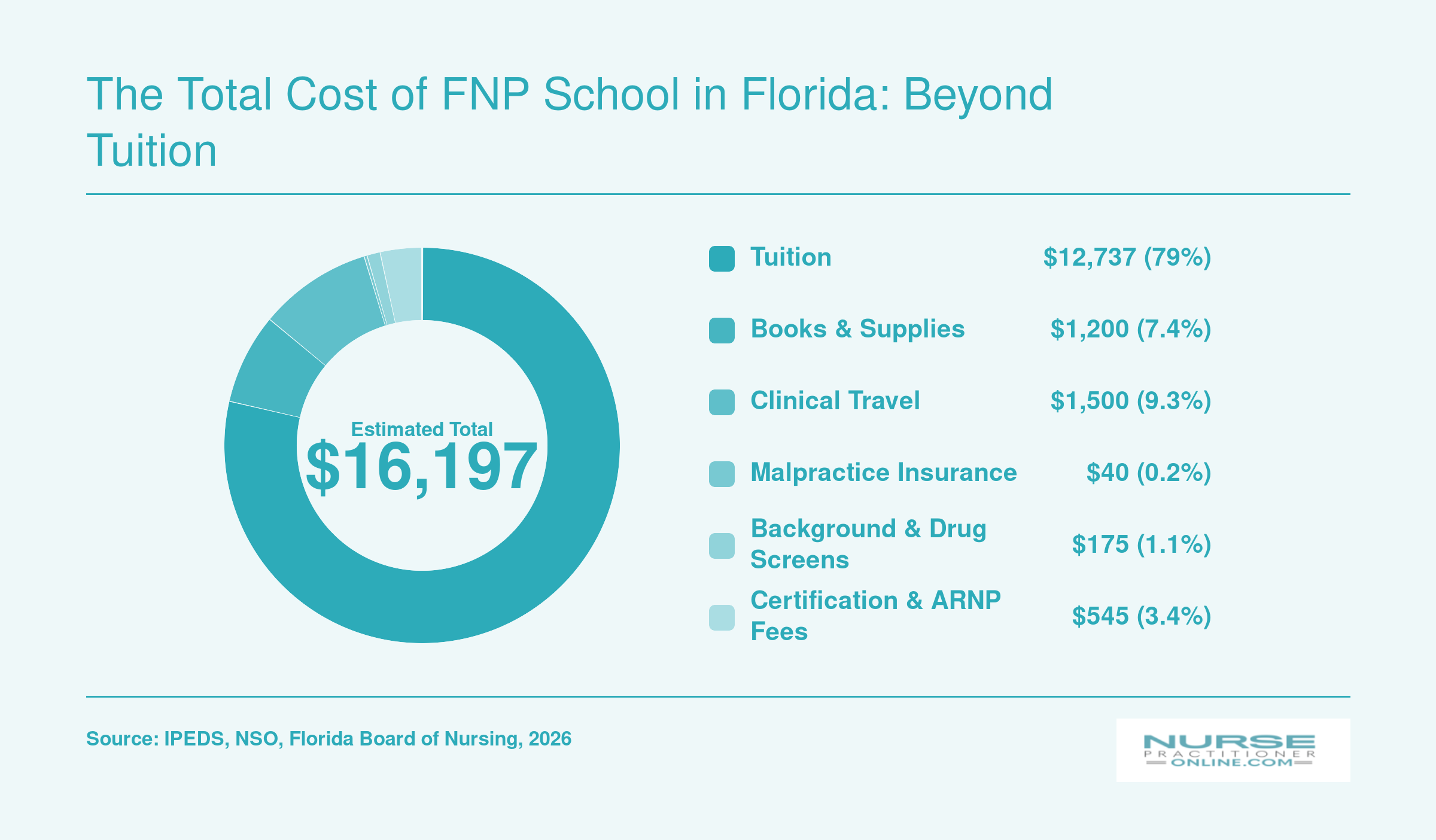
The Total Cost of FNP School in Florida: Beyond Tuition
Tuition is the biggest line item, but it is far from the only expense you will pay on the road to your ARNP license. Using the University of Florida's in-state FNP tuition as a mid-range anchor, here is what a full cost-of-attendance picture looks like when you add every required fee, supply, and credential cost.
More FNP Programs Available to Orlando-Area Nurses
If you're looking for even more options, the following Florida schools also offer FNP programs. While they didn't make our top 10 most affordable list, they provide excellent pathways to becoming a family nurse practitioner, with a range of formats from online to hybrid to campus-based.
Orlando Area
AdventHealth University Orlando, FL · Online
- Master of Science in Nursing (Family Nurse Practitioner)
- Doctor of Nursing Practice (Family Nurse Practitioner)
South Florida
Keiser University-Ft Lauderdale Fort Lauderdale, FL · Online
- Master of Science in Nursing, Family Nurse Practitioner
St. Thomas University Miami Gardens, FL · Online
- Master of Science – Family Nurse Practitioner
Barry University Miami, FL · Hybrid
- Nurse Practitioner (MSN) Family Practice
- Nursing Practice, Post-Baccalaureate DNP (Family Nurse Practitioner)
Nova Southeastern University Fort Lauderdale, FL · Hybrid
- B.S.N. to D.N.P. (Family Nurse Practitioner)
- Postgraduate Certificate (Family Nurse Practitioner (FNP))
- Family Nurse Practitioner M.S.N.-A.P.R.N.
University of Miami Coral Gables, FL · On-Campus
- BSN to DNP Family Nurse Practitioner
- Family Nurse Practitioner
- Family Nurse Practitioner (FNP) Program
- Post Masters Certificate in Family Nurse Practitioner
Larkin University Miami, FL · Hybrid
- Master of Science in Nursing (MSN) (Family Nurse Practitioner)
Palm Beach Area
Palm Beach Atlantic University West Palm Beach, FL · Hybrid
- Doctor of Nursing Practice, D.N.P. (Family Nurse Practitioner)
- Doctor of Nursing Practice, D.N.P. (Family Nurse Practitioner Track)
Tampa Bay Area
The University of Tampa Tampa, FL · On-Campus
- Post-Master’s Certificate Program in FNP
Jacksonville Area
Jacksonville University Jacksonville, FL · Hybrid
- BSN to DNP Family Nurse Practitioner
- Family Nurse Practitioner Post-Graduate Certificate
- BSN-DNP Family Nurse Practitioner Cognate
Florida by City
- ACNP Programs in Florida
- AGNP Programs in Florida
- DNP NP Programs in Florida
- FNP Programs in Florida
- Fort Lauderdale, Florida (FNP)
- Fort Myers, Florida (FNP)
- Lakeland, Florida (PNP)
- Miami, Florida (AGNP)
- Miami, Florida (PNP)
- PMHNP Programs in Florida
- PNP Programs in Florida
- Sarasota, Florida (FNP)
- Tampa, Florida (PNP)