Most important takeaways…
- The University of Florida and Florida International University are the two ranked PNP programs closest to Miami in 2026.
- Florida offers primary care, acute care, and dual PNP tracks leading to different national certification exams.
- Miami metro nurse practitioners earned a mean annual wage of roughly $101,870 according to BLS data.
- Securing pediatric clinical preceptors in South Florida is harder than in most NP specialties, so school placement support matters.
South Florida has a large and fast-growing pediatric patient population, yet the number of accredited programs awarding a pediatric nurse practitioner credential in or near Miami remains small. That gap creates real pressure for RNs who want to specialize in child and adolescent care: the demand is clear, but the local program options are not.
The practical tension most applicants face is not motivation but logistics. Clinical hour requirements, admission GPA floors, and tuition that can exceed $30,000 put meaningful constraints on which programs are actually reachable for a working nurse with Miami-area family or job obligations. Both online-heavy and hybrid formats exist, which matters when you cannot relocate or stop working.
In Florida, pediatric NP preparation also splits across distinct certification tracks, primary care versus acute care, each pointing toward different clinical settings and licensing exams. Picking the wrong track is a harder mistake to reverse than most applicants expect. If you are also weighing pediatric nurse practitioner programs elsewhere in the state, the comparison can sharpen your sense of what each Miami-area option does and does not offer.
2026 Best Pediatric Nurse Practitioner Programs Near Miami, FL
These Florida PNP programs were evaluated using a composite of tuition affordability, graduate earnings outcomes, institutional graduation rates, and format flexibility rather than alphabetical order or prestige alone. Both schools below offer distinct paths to pediatric NP certification, and each carries specific advantages depending on whether you prioritize location, delivery format, or degree level.
- Tuition affordability for residents
- Graduate earnings after completion
- Institutional graduation rates
- Program format flexibility
- Clinical placement accessibility
- Internal program database
- Independent program research
- College Scorecard graduate earnings — collegescorecard.ed.gov
- NCES-IPEDS federal institutional data — nces.ed.gov

Florida International University
Florida International University is the only Miami-based public university offering a pediatric primary care NP concentration, making it the most geographically convenient option for South Florida nurses. Its Post-BSN to DNP pathway is delivered predominantly online, and students can arrange clinical rotations at local pediatric sites, including partners affiliated with Nicklaus Children's Hospital. FIU's institution-wide graduation rate sits at roughly 74%, and its median alumni earnings ten years out reach about $60,249, reflecting solid long-term value for in-state students.
- Doctorate-level pathway directly from BSN to DNP
- Delivered online with flexible local clinical placements
- Prepares graduates for national PNCB certification
- Four specialty concentration options within the DNP
- Application submitted through NursingCAS
- In-state tuition among the lowest for Florida PNP programs
- Exposure to diverse, underserved Miami pediatric populations
Post-BSN to DNP, Pediatric Primary Care Nurse Practitioner — Online

University of South Florida
The University of South Florida in Tampa offers both a master's-level Pediatric Primary Care NP and a BSN-to-DNP pediatric health concentration, giving nurses a choice between two degree endpoints at one CCNE-accredited institution. USF's on-campus programs use a lock-step plan structure that keeps cohorts on a predictable timeline, which appeals to nurses who prefer a defined schedule. The university posts a strong 76.8% graduation rate and a 91% first-year retention rate, both signals of institutional support. Program-level earnings data is not yet available, though institution-wide median earnings ten years after enrollment are approximately $57,743.
- Master's degree requiring 57 total credit hours
- On-campus delivery with lock-step cohort plan
- Prepares for PNCB Pediatric Primary Care NP Certification Exam
- Comprehensive examination required for completion
- Curriculum covers health promotion and disease prevention
- Family-centered care framework from infancy through adolescence
- New graduate program plan also available
- Doctoral pathway with pediatric health concentration
- On-campus format with part-time and full-time options
- Focus on ambulatory pediatric primary care practice
- Prepares graduates for PNCB national certification
- Comprehensive pediatric health training across age groups
- Builds on the same family-centered curriculum as the MSN track
MSN, Pediatric Primary Care Nurse Practitioner — On-Campus
BSN to DNP, Pediatric Primary Care Nurse Practitioner — On-Campus
Primary Care, Acute Care & Dual PNP Tracks Offered in Florida
Choosing the right PNP track defines not just where you'll practice, whether that's outpatient clinics or hospital floors, but also which national certification exam you'll sit for. Florida nursing schools offer distinct paths, each shaped by clinical focus and patient acuity, so aligning your goals early avoids costly detours.
Understanding PNP Track Options
The Pediatric Nurse Practitioner, Primary Care (PNP-PC) track equips you for ongoing, relationship-based care across childhood and adolescence. You'll manage well-child visits, immunizations, developmental screenings, and common acute illnesses in settings like private pediatric offices, school-based health centers, or community clinics. The emphasis stays on health promotion, chronic condition management, and family education.
In contrast, the Pediatric Nurse Practitioner, Acute Care (PNP-AC) track prepares you for high-stakes, episodic care of children with complex acute, critical, or unstable chronic conditions. You'll interpret advanced diagnostics, perform invasive procedures, and coordinate care across intensive care units, emergency departments, and specialty inpatient services. The clinical reasoning required differs fundamentally from the preventive, whole-child orientation of primary care. If you're weighing this path, our overview of acute care nurse practitioner programs can help you compare options nationally.
A dual track blends both competencies, allowing you to float seamlessly between outpatient and inpatient pediatric roles. This breadth can be especially valuable in smaller communities, rural areas, or health systems that rotate advanced practice providers across settings. Dual-track graduates sit for both certification exams and emerge as some of the most versatile advanced practice nurses.
Florida Programs by Track Availability
Florida institutions vary sharply in what they offer. The University of Florida runs a hybrid BSN-to-DNP program with both primary care and acute care PNP tracks; no dual option is currently available.1 The University of South Florida offers only the primary care PNP route through an in-person BSN-to-DNP. Florida International University provides a primary care PNP track at the MSN and DNP levels, plus a distinctive dual track pairing PNP-PC with a Nurse Educator focus; the program is predominantly online or hybrid.2 Herzing University's online RN-to-MSN and BSN-to-MSN pathways include a primary care PNP track, while Rasmussen University's fully online post-master's certificate concentrates solely on primary care for nurses who already hold a master's degree. For a broader look at online pnp programs, our national rankings can help you benchmark these Florida options.
Clinical Settings and Certification
Your track dictates not only the patient population but the certification exam you take. The Pediatric Nursing Certification Board (PNCB) administers the CPNP-PC exam for primary care graduates and the CPNP-AC exam for acute care graduates. Primary care PNPs typically step into outpatient clinics or community health roles; acute care PNPs staff children's hospitals and specialty units. Dual-track nurses pursue both credentials, unlocking flexibility to move across the care continuum. If you want to learn more about what the role entails day to day, our guide on how to become a pediatric nurse practitioner breaks down each step. When comparing Florida programs, verify each school's NCLEX pass rates, clinical placement support for your chosen track, and alignment with your preferred certification pathway. No single track is universally superior; what matters is how well it fits the patients you want to serve every day.
Flexible Formats: Online, Hybrid & On-Campus PNP Programs for Working Nurses
Most Florida pediatric nurse practitioner programs now offer online didactic coursework, but the details matter more than the label. Programs classified as "online" typically deliver lectures, case discussions, and exams asynchronously so you can complete them around your shifts. However, many require periodic intensive on-campus sessions for labs, simulation, or skills validation, and every program mandates in-person clinical rotations. You cannot earn PNP certification without face-to-face patient care hours.
What "Online" Really Means for PNP Students
When a program advertises an online format, you can expect to watch recorded lectures and participate in discussion boards on your own schedule. Yet even fully online programs reserve clinical placements for pediatric offices, hospitals, and specialty clinics where you work directly with a preceptor. At Florida International University, the MSN Pediatric Primary Care NP track runs predominantly online over six semesters (45 credits), while the Post-BSN to DNP version follows an online format across ten semesters (77 credits).12 Both require clinical practice hours in real pediatric settings, though students may complete clinicals outside Monroe, Miami-Dade, Broward, and Palm Beach counties if they secure approved sites.2 This flexibility helps working nurses who live in rural counties or prefer to complete hours near home. If you are weighing whether online learning is right for you, our guide on how to enroll in NP school online walks through the process step by step.
Hybrid and Campus Options in the Region
Not every program uses a purely online model. The University of Florida offers a hybrid Pediatric NP DNP (78 credits) that pairs online modules with periodic campus visits, a structure that fosters faculty mentorship while preserving schedule flexibility.3 The University of South Florida delivers its Pediatric Primary Care NP program entirely in person on the Tampa campus, a choice that works well for nurses who value daily interaction and live within commuting distance. Nurses who already hold an MSN and want to add a pediatric specialty may also consider post-master's pediatric nurse practitioner certificate options.
Part-Time vs Full-Time Pacing
Most MSN-level PNP programs can be completed in two years full-time, but many working RNs stretch coursework to three years part-time. FIU's Post-BSN to DNP track offers part-time enrollment upon request and approval, allowing you to balance night shifts or weekend rotations with fewer courses per semester.2 Part-time pacing reduces tuition strain and prevents clinical-hour overload during peak work periods, though it does delay your entry into advanced practice by twelve to eighteen months.
What You Need to Get In: Admission Requirements Across Florida PNP Programs
A 3.0 GPA is the floor at the University of Florida, and that benchmark is a useful starting reference for any Florida PNP applicant sizing up the landscape.1 Admission requirements across the state follow a recognizable pattern, but the details diverge enough to shape which programs are realistic options for you right now.
Core Requirements Most Programs Share
Virtually every accredited PNP program in Florida requires the same foundational credentials:
- Degree: A BSN from an accredited nursing program. Florida PNP programs are designed for working registered nurses, not direct-entry applicants from other fields.
- Licensure: An active, unencumbered RN license. Programs typically accept a Florida license or a multistate compact license.1
- GPA: A minimum undergraduate GPA of 3.0 on a 4.0 scale is the standard across programs including the University of Florida. Some programs evaluate graduate coursework separately if you have a master's degree.
- Work experience: At least one year of RN experience is a common requirement. The University of Florida specifies that experience should be in pediatric acute care, which is a meaningful distinction.1 If your background is adult med-surg or outpatient primary care, you may need to build relevant pediatric hours before applying.
GRE and Prerequisite Courses
The GRE has largely disappeared from Florida PNP admissions. The University of Florida does not require it for the 2026-2027 cycle, and the broader trend across graduate nursing programs has moved decisively toward test-optional policies.1 If you have been holding off on applying because of the GRE, that barrier is likely gone.
Prerequisite coursework beyond the BSN is also minimal at most programs. The University of Florida, for example, lists no additional prerequisites.1 That said, verify this directly with each program, since statistics or pathophysiology courses occasionally appear as conditions of admission at other institutions. If you are weighing a doctoral pathway instead, our guide to DNP prerequisites walks through what to expect at that level.
Application Deadlines
Deadlines vary by cohort and entry point. The University of Florida set a February 1, 2026 deadline for Fall 2026 enrollment.1 That cycle has passed, which means if you are planning for Fall 2027, applications will likely open in the fall of 2026. Other Florida programs, including those at FIU, USF, the University of Miami, and Barry University, publish deadlines on their own timelines, so check each program's graduate nursing admissions page directly.
The practical takeaway: start gathering your transcripts, letters of recommendation, and a personal statement well before any posted deadline. Most programs want three professional references, a resume documenting your clinical experience, and a goal statement that speaks specifically to why you are pursuing the PNP specialty. Generic applications rarely distinguish candidates in competitive cohorts.
Frequently Asked Questions About PNP Programs in Florida
Choosing a pediatric nurse practitioner program is a big decision, and you probably have questions about cost, timeline, and certification. Below are answers to the most common questions working nurses ask when exploring PNP programs in Florida.
- How much does a pediatric nurse practitioner make in Miami?
- Exact figures vary by employer, setting, and experience level. Pediatric NPs in the Miami metro area generally earn competitive salaries in line with broader NP compensation trends in South Florida, though published program-level earnings specific to pediatric specialties are limited. We cover current salary benchmarks in more detail in the earnings section of this guide.
- How long does it take to become a pediatric nurse practitioner in Florida?
- It depends on the degree path. An MSN-level PNP program typically requires 40 to 50 credits and takes about two to three years to complete. A DNP track runs longer, usually 70 to 90 credits over three to four years. Part-time schedules for working nurses can extend these timelines by a year or more.
- What is the difference between a primary care and acute care PNP?
- A primary care PNP (CPNP-PC) focuses on wellness visits, developmental screenings, chronic disease management, and routine pediatric care in outpatient settings. An acute care PNP (CPNP-AC) is trained to manage complex, rapidly changing, or critical conditions, typically in hospital or emergency settings. Some Florida programs offer dual-track options that prepare you for both certifications.
- Can you complete a pediatric nurse practitioner program online in Florida?
- Yes. Several Florida universities offer hybrid PNP programs where didactic coursework is delivered online and clinical hours are completed in person at approved pediatric sites, often in South Florida. Fully online options with no campus visits are less common because hands-on clinical rotations are a required component of every accredited program.
- What board certification do pediatric nurse practitioners need in Florida?
- Florida requires graduation from an approved graduate NP program and a passing score on a national board certification exam. For pediatric NPs, the accepted credentials are the CPNP-PC (primary care) or CPNP-AC (acute care), both administered by the Pediatric Nursing Certification Board (PNCB). These are the current pathways recognized by the Florida Board of Nursing.
- Is there a difference between PNCB and ANCC certification for pediatric NPs?
- The ANCC's pediatric primary care credential (PPCNP-BC) was retired at the end of 2018, so it is no longer available to new test-takers. Today, the PNCB is the sole certifying body for pediatric NPs seeking either the CPNP-PC or CPNP-AC. The CPNP-PC exam includes 175 questions with a three-hour time limit, and the national pass rate has historically been around 92 percent. If you already hold the retired ANCC credential, check with the Florida Board of Nursing about renewal and transition options.
- Do Florida PNP programs help arrange clinical placements or is it self-placement?
- Policies vary by school. Some Florida PNP programs maintain established partnerships with children's hospitals, pediatric clinics, and community health centers in South Florida and will coordinate placements for you. Others use a self-placement model where students are responsible for securing their own preceptors, with faculty guidance. Always ask prospective programs about their clinical placement support before you apply, because finding pediatric-specific preceptors on your own can be time-consuming.
Tuition, Debt & ROI: What Florida PNP Programs Actually Cost
Nurse practitioner education is increasingly evaluated through the lens of financial return, not just academic fit. For working nurses in South Florida, understanding the true cost of a pediatric NP program means looking past the advertised tuition rates and examining net price, debt loads, and long-term earning power.
Comparing Program Tuition at Florida's PNP Options
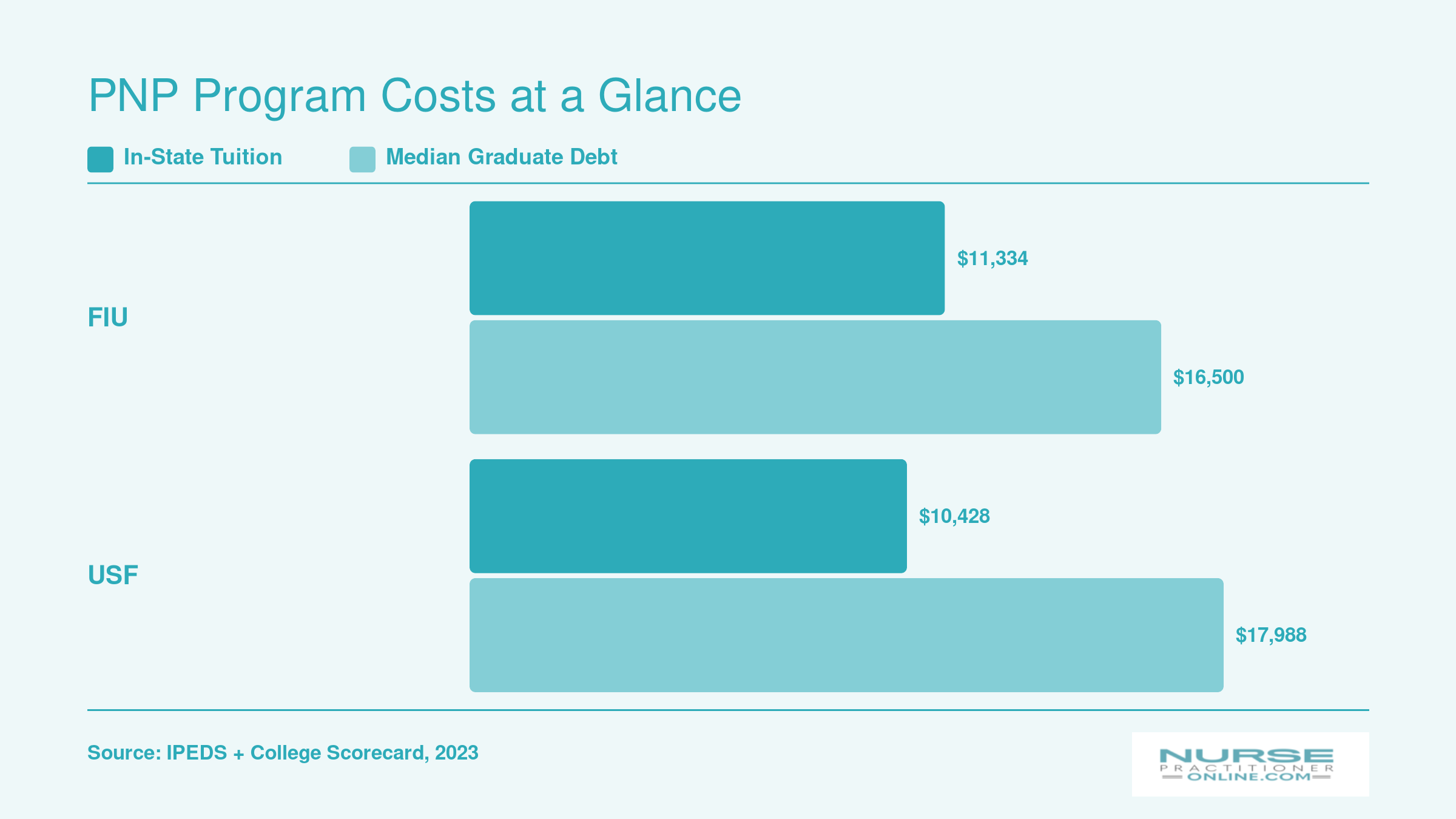
Tuition at the top Florida pediatric nurse practitioner programs varies widely, especially for out-of-state students. Florida International University (FIU) in Miami charges $11,334 for in-state learners and $24,439 for non-residents in its Post-BSN to DNP track. The University of South Florida (USF) in Tampa offers a master's-level PNP program at a lower base price: $10,428 in-state and $21,126 out-of-state. These figures represent program-specific tuition and do not include fees, books, or living expenses.
- Cheapest Miami option: FIU's in-state rate is the most affordable PNP program in the immediate Miami metro. Although USF's tuition is slightly lower overall, it is located in Tampa, not Miami.
- Sticker vs. net price: Keep in mind that many students pay less than published tuition. The net price (an institution-wide average after aid) was $9,288 at FIU and $9,812 at USF, indicating that typical graduate students at both schools receive significant financial support.
Beyond Sticker Price: Net Cost and Debt
The real burden is what you owe after graduation. Federal data shows median graduate debt at FIU is $16,500, while at USF it's $17,988. These figures are lower than many national NP programs. While the federal College Scorecard does not report program-level monthly loan payments, a standard 10-year repayment on those balances would keep monthly obligations manageable compared to expected NP salaries.
- Debt context: Both schools' median debt is well below the $40,000 to $60,000 range sometimes seen at private graduate nursing programs. For a broader look at budget-friendly options, see our guide to the most affordable nurse practitioner programs.
- Loan repayment programs: Federal Direct Unsubsidized Loans and Grad PLUS Loans are available, but nurses should also explore the HRSA Nurse Corps Scholarship Program, which covers tuition and fees in exchange for service in a shortage area. Florida also offers state-funded loan repayment for advanced practice nurses in underserved communities.
Earning Potential and Return on Investment
ROI measures whether the earnings bump justifies the educational cost. Institution-wide data for FIU shows median earnings of $60,249 ten years after entry, paired with a graduate debt median of $16,500, yielding an estimated ROI ratio of about 3.7. USF has median earnings of $57,743 and debt of $17,988, for an ROI ratio of roughly 3.2. Although these earnings are not specific to PNP graduates, they demonstrate that advanced nursing degrees at these schools generally produce a strong financial return.
- No program-level earnings yet: Federal earnings data for specific PNP programs is not yet published, but NP salary trends in Florida (often above $100,000 annually) suggest even stronger outcomes for pediatric nurse practitioners.
- Short-term outlook: Entry-level NP salaries in the region typically exceed the debt obligations from these programs within the first year of practice.
Ways to Lower Your Out-of-Pocket Cost
- Employer tuition reimbursement: Many Miami-area hospitals and health systems offer annual tuition benefits of $3,000 to $5,000 for nurses pursuing advanced degrees.
- Federal and state scholarships: Beyond the Nurse Corps, Florida's Nursing Student Loan Forgiveness Program and the Florida Department of Education's Office of Student Financial Assistance offer grants and loan repayment for graduate nursing students.
- Online flexibility: FIU's online PNP track allows you to continue working full-time, reducing opportunity cost and keeping income flowing while you study. If you're comparing MSN-level options nationally, our MSN pediatric nurse practitioner programs page can help.
- In-state residency: If you're relocating, establishing Florida residency before applying can slash tuition by more than 50% at both public universities.
Making an informed decision means weighing the full cost picture: net price after aid, manageable debt, and concrete salary increases, rather than fixating on the headline tuition number. Both programs presented here deliver solid value, but FIU emerges as the most affordable local choice for Miami-based nurses.
PNP Program Costs at a Glance
Comparing tuition and median graduate debt across the two ranked PNP programs helps you gauge total investment before factoring in financial aid. Program-level post-graduation earnings are not yet available for these programs, so institution-wide median graduate debt is shown as an ROI reference point.
Clinical Placements & Pediatric Clinical Sites in South Florida
School-arranged placements versus student self-placement: the difference can shape your entire clinical year, and in pediatric NP programs it matters more than in almost any other specialty.1
Why Pediatric Sites Are Harder to Secure
Finding a qualified pediatric preceptor is genuinely more challenging than it is for family or adult-gerontology programs. There are simply fewer pediatric-focused clinical sites in any given metro, and the ones that exist field a high volume of requests from multiple programs.1 That imbalance means students at programs with self-placement models can spend months cold-calling offices before landing a site, while students at schools with placement support can focus on coursework instead.
Major Pediatric Clinical Sites in the Miami Metro
South Florida is fortunate to have several high-caliber pediatric institutions that work with NP students. The sites most commonly associated with PNP training in the region include:
- Nicklaus Children's Hospital: A dedicated children's hospital in Miami and a clinical partner with Florida International University's PNP program, making it one of the more accessible sites for FIU students.
- Holtz Children's Hospital at Jackson Memorial: One of the largest pediatric centers in the Southeast, located in Miami's Health District.
- Joe DiMaggio Children's Hospital: Located in Hollywood, this facility draws students from across Broward and Miami-Dade counties.
- Baptist Health pediatric clinics: Outpatient pediatric settings that offer a strong primary care complement to inpatient hospital experiences.
Beyond the major children's hospitals, federally qualified health centers (FQHCs) and community health centers throughout Miami-Dade and Broward provide valuable placement opportunities, particularly for students interested in underserved pediatric populations. These sites often see a wide breadth of acute and chronic conditions and can be excellent learning environments.
Placement Support: What Different Programs Offer
FIU's hybrid PNP program connects students to Miami-area sites, including Nicklaus Children's, through its existing partnerships.1 Herzing University's online PNP program takes a similar approach, arranging regional clinical placements for students rather than leaving them to find sites independently. Not every Florida PNP program offers this level of support, though, so it is worth asking any program directly whether placement is facilitated or self-directed before you enroll.
Clinical Hour Requirements
Most MSN-level PNP programs require somewhere between 500 and 700 direct patient care hours to meet certification eligibility. DNP programs online typically require more, often exceeding 1,000 hours when you factor in clinical residency or project requirements. Confirm the exact hour totals with each program, since the Pediatric Nursing Certification Board sets minimum thresholds for both primary care and acute care PNP certifications, and your program's hours must align with the track you intend to sit for.
Pediatric NP Earnings & Job Demand in the Miami Metro
Understanding what you can expect to earn as a pediatric nurse practitioner (PNP) in the Miami area helps you plan your career and evaluate the return on your educational investment. Nurse practitioner salaries in South Florida are competitive, and the region's large pediatric population drives steady demand.
What Nurse Practitioners Earn in Miami
According to the most recent federal wage data, nurse practitioners in the Miami-Fort Lauderdale-Pompano Beach metro area earn a mean annual wage of $135,450. While the Bureau of Labor Statistics does not break out pediatric-specific NP earnings, this figure provides a reliable baseline for the region. To give you a range, Florida statewide data shows the 10th percentile of NP wages at $100,540 and the 90th percentile at $155,490. For context, the national median annual wage for all NPs was $121,610 in 2022, so Miami-area NPs typically outpace the national benchmark.2 Salaries can vary based on setting, experience, and specialty; PNPs in acute care or hospital-based roles often fall on the higher end.
How Miami Compares to Florida and the Nation
Florida's mean NP wage of $129,010 sits slightly above the national mean. Miami's mean of $135,450 reinforces the metro's position as one of the higher-paying areas in the state, aided by the cost of living and concentration of major health systems. When you compare these figures to pediatric nursing roles without an advanced degree, the wage premium for a PNP is substantial, making graduate education a clear financial lever over a career.
Key Employers for Pediatric NPs in South Florida
Several large health systems in the Miami area are primary employers of pediatric nurse practitioners: - Nicklaus Children's Health System: Home to the region's only freestanding pediatric hospital, Nicklaus Children's Hospital, this system is a major hub for pediatric specialty and primary care. - Baptist Health South Florida: Includes Baptist Children's Hospital and numerous pediatric outpatient centers. - Jackson Health System: Through Holtz Children's Hospital, Jackson offers a full spectrum of pediatric services and is a teaching affiliate of the University of Miami. - Memorial Healthcare System: Joe DiMaggio Children's Hospital in Hollywood provides another large pediatric footprint near Miami.
These institutions often recruit PNPs for roles in primary care, urgent care, and specialty clinics. Competitive compensation packages typically include shift differentials, sign-on bonuses, and tuition reimbursement.
Florida's Full Practice Authority and Earning Potential
Florida's move toward full practice authority for nurse practitioners has important implications for PNPs. Under current law, NPs in Florida can qualify for autonomous practice after completing 3,000 hours of supervised experience. This independence allows you to open your own pediatric practice, provide primary care in underserved areas, and bill directly for services, all factors that can increase your earning potential beyond what traditional employed roles offer.
Strong Job Growth Ahead
The outlook for nurse practitioners remains exceptionally strong. Nationally, the Bureau of Labor Statistics projects a 35% increase in NP jobs from 2024 to 2034.3 Florida's growth is even more pronounced: state projections anticipate a 58.5% rise in NP employment in the coming years, accompanied by an estimated 2,190 annual job openings.4 A growing population of children in Miami-Dade and Broward counties, along with expanding pediatric sub-specialties, ensures that pediatric acute care nurse practitioner programs will continue to attract interest and that pediatric NPs will remain in high demand.
Miami PNP Salary Snapshot
Nurse practitioners in the Miami metro area earned a mean annual wage of roughly $101,870, according to Bureau of Labor Statistics occupational data from May 2022. While this figure covers all NP specialties rather than pediatric NPs specifically, it offers a useful baseline. More recent compensation figures may be higher as demand continues to grow.
Choosing the Right PNP Program: Your Decision Checklist
Which factors should carry the most weight when choosing a pediatric nurse practitioner program in Florida? The answer depends entirely on your current situation. A working RN with family responsibilities in Miami has different priorities than a recent BSN graduate willing to relocate for the ideal clinical experience. Your decision checklist should reflect your personal constraints and professional goals.
Compare Programs Across Six Key Dimensions
Review each program using the framework this article has built:
- Track type: Does the program offer the primary-care, acute-care, or dual track that aligns with your career target?
- Format: Does the online, hybrid, or on-campus schedule fit your work and family life?
- Cost: What is the total tuition, and can you realistically manage the debt load based on expected PNP earnings?
- Clinical support: Does the school arrange placements, or will you need to secure your own preceptors in South Florida?
- Certification pass rates: Do graduates consistently pass PNCB or AANP exams on the first attempt?
- Location: Are clinical sites and campus visits manageable from your home base?
Weight Factors Based on Your Life
If you are juggling a full-time nursing job and childcare, format and clinical support may outweigh a few thousand dollars in tuition. If you are early in your career with geographic flexibility, maximizing clinical variety and certification outcomes may take priority. Some nurses also find that exploring best nurse practitioner programs in Florida broadens their perspective on what is available beyond a single specialty.
Take Action
Request information packets from two or three programs that match your top criteria. Compare financial aid packages line by line. If possible, visit clinical sites or attend a program open house. Choosing the right PNP program is not about finding the perfect school; it is about finding the program that fits your life today and positions you for the pediatric nursing career you want tomorrow.
Florida by City
- ACNP Programs in Florida
- AGNP Programs in Florida
- DNP NP Programs in Florida
- FNP Programs in Florida
- Fort Lauderdale, Florida (FNP)
- Fort Myers, Florida (FNP)
- Lakeland, Florida (PNP)
- Miami, Florida (AGNP)
- Orlando, Florida (FNP)
- PMHNP Programs in Florida
- PNP Programs in Florida
- Sarasota, Florida (FNP)
- Tampa, Florida (PNP)