
Most important takeaways…
- Fourteen scored FNP programs near Fort Myers range from roughly $12,000 to over $50,000 in total net price.
- Nurse practitioners in the Cape Coral to Fort Myers metro earn a median annual wage near $110,000.
- Most accredited FNP programs require 500 to 700 direct patient care clinical hours before graduation.
- Fort Myers RNs can typically recoup their FNP degree investment within two to four years of practice.
Southwest Florida added more than 150 nurse practitioner job postings in the Cape Coral and Fort Myers metro area over the past year alone, yet tuition for an FNP degree in the state can range from roughly $18,000 at a public university to well over $80,000 at a private institution. For working RNs in Lee and Collier counties, that spread makes program selection a financial decision as much as an academic one.
The 14 programs ranked below were chosen with affordability weighted heavily: net price, published tuition, and typical graduate debt all factored into the evaluation. Alongside those rankings you will see detailed cost breakdowns, clinical hour expectations, Fort Myers area salary benchmarks, and the specific steps to earn your Florida ARNP license after graduation.
14 Economical Family Nurse Practitioner Programs for Fort Myers Students
These 14 Florida FNP programs were evaluated using a weighted scorecard that prioritizes net price and financial accessibility alongside graduation rates and post-completion earnings. This is not a simple tuition sort: schools that combine strong institutional support with lower out-of-pocket costs rise higher, while programs with inflated sticker prices but weak outcomes are weighted accordingly. Graduation rates listed below are institution-wide figures, a useful proxy for how well a school supports students through completion, though they do not reflect FNP-track results specifically. Program-level earnings data is not yet available for these FNP tracks, so institution-wide median earnings are shown where reported.
- Net price and financial accessibility
- Institutional graduation and retention rates
- Post-completion median earnings
- Program format and regional access
- Graduate debt levels
- Internal program database
- College Scorecard graduate earnings — collegescorecard.ed.gov
- NCES-IPEDS federal institutional data — nces.ed.gov
- Independent program research

Florida Gulf Coast University
Florida Gulf Coast University is the only public university with an FNP program physically located in Fort Myers, which means local RNs can skip relocation costs and commute time entirely. A $2.7 million federal grant specifically expands FNP training and clinical infrastructure across Lee, Collier, and surrounding counties, translating into placement assistance and potential student support in Southwest Florida's underserved communities. FGCU also offers a post-graduate FNP certificate for APRNs who already hold a master's or doctoral degree, with the flexibility to attend classes face-to-face in Fort Myers or synchronously online.
- CCNE-accredited, 81 total credit hours
- Full-time (3 years) or part-time (4 years) completion
- Hybrid format combining online coursework and on-campus sessions
- Over 1,000 clinical hours with placement assistance provided
- Faculty advisor assigned to each student
- $2.7M federal grant supporting FNP expansion
- Nurse Faculty Loan Program available
- Prepares for ANCC or AANP national certification
BSN to DNP Family Nurse Practitioner — Hybrid

University of Florida
The University of Florida's BSN-to-DNP Family Nurse Practitioner track is one of the most economical doctoral-level options in the state, with a net price of $6,541 and a median graduate debt of $15,000. UF's 91% institution-wide graduation rate signals strong student support infrastructure, and all clinical placements are completed within Florida. The hybrid format blends online coursework with periodic campus visits, and both full-time and part-time schedules are available for working nurses.
- Hybrid format with clinical placements across Florida
- Full-time and part-time scheduling options
- Eligible for both ANCC and AANP certification
- Emphasis on community-based primary care across the lifespan
- Health promotion, chronic disease management curriculum
- Supervised precepted clinical experience required
- 91% institution-wide graduation rate
BSN to DNP Family Nurse Practitioner — Hybrid

Florida International University
Florida International University offers both a post-BSN to DNP pathway and a post-graduate NP certificate with an FNP concentration, giving nurses at different career stages a flexible entry point. No entrance exam is required for the DNP track, which can lower the time and cost of applying. FIU's in-state tuition and $9,288 net price make it one of the more accessible public options for Florida residents, with fall and spring start dates adding scheduling flexibility.
- Hybrid format with FNP track
- No entrance exam required
- Fall and spring start dates
- Primary care across the lifespan
- Clinical placements in ambulatory settings
- Prepares for ANCC or AANP national certification
- 36 credits required; builds on existing MSN
- Hybrid delivery blending online and campus learning
- Designed for working professionals
- Prepares for national FNP certification
- Financial aid available
- Students responsible for clinical site coordination
Post-BSN to DNP Family Nurse Practitioner — Hybrid
Post-Graduate Nurse Practitioner Certificate (FNP) — Hybrid

Florida Atlantic University
Florida Atlantic University's MSN and BSN-to-DNP FNP pathways are among the lowest-cost public options in South Florida, with the DNP track advertised at roughly $28,629 in total program tuition for residents. The MSN track requires 52 credits and 780 clinical hours over about 2.5 years, offered part-time in a hybrid format. FAU arranges clinical preceptors for DNP students, an important logistical benefit for nurses who may be juggling clinical coordination with a full work schedule.
- 52 credit hours, 780 clinical hours
- Part-time hybrid format, roughly 2.5 years
- No GRE or MAT entrance exam required
- $371.81 per credit hour for in-state students
- Fall-only admission; 3.0 GPA minimum
- Eligible for ANCC or AANP certification exams
- 77 total credit hours, 1,000 clinical hours
- $28,629 estimated total in-state tuition
- 11-semester program with summer start
- Clinical preceptors arranged by the program
- Master's Along the Way option available
- DNP classes meet one weekend per month
MSN Family Nurse Practitioner — Hybrid
BSN to DNP Family Nurse Practitioner — Hybrid

University of South Florida
The University of South Florida delivers both an MSN and a BS-to-DNP pathway in family health, making it a versatile public option for nurses at different educational starting points. The 60-credit MSN program emphasizes clinical judgment, health policy, and leadership alongside core FNP competencies. USF's Tampa location and hybrid delivery can work for Southwest Florida nurses willing to make periodic trips across the state, and the $9,812 net price keeps it competitive among Florida's public universities.
- 60 credit hours with comprehensive exam at completion
- Hybrid delivery format
- Prepares for ANCC or AANPCB certification
- Focus on clinical judgment and lifespan care
- Research, health policy, and leadership coursework
- Capstone project required
- Hybrid format with ambulatory care focus
- Comprehensive care across the lifespan
- Prepares for ANCC or AANPCB certification
- Leadership and health systems training included
- Open to BSN-prepared nurses
- Work in ambulatory and primary care settings
MSN Family Nurse Practitioner — Hybrid
BS-DNP Family Health Concentration — Hybrid

University of West Florida
The University of West Florida stands out as one of the few fully online MSN-FNP programs in the Florida public university system, making it especially practical for Fort Myers nurses who want to earn their degree without relocating to the Panhandle. The 45-credit cohort-based program follows a structured progression model that keeps students on track, and its competitive admission process reflects selective standards. UWF's $9,364 net price is among the lowest for any Florida public FNP option.
- Fully online delivery, accessible statewide
- 45 total credit hours in cohort progression
- 3.0 GPA minimum; competitive admission
- NLNAC, ACEN, or CCNE accredited
- No thesis or capstone required
- Prepares students for doctoral studies
- Physical exam and background check required
MSN Family Nurse Practitioner — Online

Florida State University
Florida State University offers three FNP pathways: a post-master's certificate, a BSN-to-DNP, and an MSN-to-DNP, giving nurses multiple on-ramps depending on their current credentials. The online certificate program is notable because preceptors are secured by program coordinators rather than students, a significant advantage for Fort Myers-based nurses who might otherwise struggle to arrange placements far from campus. FSU's 85.6% graduation rate and $11,297 net price reflect strong institutional support at a reasonable cost.
- Online delivery accessible statewide
- 585 clinical hours in family practice settings
- Preceptors secured by program coordinators
- Requires existing MSN plus three graduate prerequisites
- Synchronous Zoom classes included
- $174 clinical clearance fee applies
- BSN-to-DNP and MSN-to-DNP pathways available
- Full-time and part-time scheduling options
- Campus visits 2 to 3 times for skills workshops
- Comprehensive exit exam (HESI) prior to graduation
- Prepares for ANCC or AANPCP certification
- Fall start with May application deadline
Family Nurse Practitioner Certificate — Online
Doctor of Nursing Practice (FNP) — Hybrid

University of North Florida
The University of North Florida's CCNE-accredited DNP with an FNP track integrates AACN Essentials and NONPF standards into a curriculum centered on health promotion, disease prevention, and management of acute and chronic conditions. UNF welcomes both BSN and MSN graduates, with full-time and part-time scheduling. Its $10,154 net price and $15,531 median graduate debt keep it in the affordable tier among Florida public schools, and tuition waivers are available for qualifying students.
- CCNE accredited, aligned with AACN Essentials
- Open to both BSN and MSN graduates
- Full-time and part-time options available
- Prepares for FNP certification and Florida APRN licensure
- Tuition waivers and financial aid available
- Clinical experience in diverse healthcare settings
- Fall application deadline October 1
Family Nurse Practitioner DNP — On-Campus

Ana G. Mendez University
Ana G. Mendez University is a private institution with campuses in Orlando, Tampa Bay, and South Florida, offering an on-site MSN-FNP track focused on primary care leadership for families and individuals of all ages. Its $12,188 median graduate debt is the lowest among the private schools on this list, and the curriculum integrates pathophysiology, pharmacology, health assessment, and biomedical ethics. The campus-based format means Fort Myers students would need to travel, but multiple locations provide some geographic flexibility.
- On-site delivery at three Florida campuses
- Prepares for national FNP certification
- Curriculum covers pathophysiology, pharmacology, health assessment
- Focus on primary care leadership for all ages
- No thesis or capstone required
- Opportunities in family practice and urgent care settings
MSN Family Nurse Practitioner — On-Campus

Miami Regional University
Miami Regional University is a private, ACEN-accredited school offering an MSN-FNP that can be completed in as few as 20 months full-time or 32 months part-time. The program combines campus and online learning with clinical preceptorships and accepts applicants from Florida or SARA-member states. Its 84.5% institution-wide graduation rate is among the highest of the private schools on this list, though the $22,113 net price and $22,500 median graduate debt are higher than public alternatives.
- ACEN accredited, 50 semester credits
- 20-month full-time or 32-month part-time completion
- Campus and online delivery with clinical preceptorship
- Requires active RN license and bachelor's degree
- Florida or SARA state residency required
- Three recommendation letters and background check needed
MSN Family Nurse Practitioner — On-Campus

South University-Tampa
South University's Tampa campus delivers a 62-credit MSN with a Family Nurse Practitioner specialization, available on campus, online, or in a hybrid format. The program is CCNE accredited and includes courses in advanced pharmacology and clinical practicums across the lifespan. Be aware that the institution-wide graduation rate sits at 23.3%, the lowest on this list, and median graduate debt reaches $26,123, so prospective students should weigh completion support carefully against cost.
- CCNE accredited, 62 total credits
- On-campus, online, or hybrid delivery options
- Requires BSN with 2.5 GPA and active RN license
- Includes courses in pathophysiology and advanced pharmacology
- Clinical practicums across the lifespan
- National certification exam required for licensure
MSN Family Nurse Practitioner — On-Campus

Keiser University-Ft Lauderdale
Keiser University offers a CCNE-accredited, primarily online MSN-FNP that can be completed in 18 to 24 months with 8-week course terms and residency requirements. The 49-credit curriculum covers health promotion, disease prevention, and management of acute and chronic illness across the lifespan. As a private institution, Keiser's net price ($30,498) is the highest on this list, though up to 12 transfer credits are accepted and financial aid is available.
- CCNE accredited, 49 credit hours
- Online with residency, 18 to 24 months
- 8-week course terms with flexible scheduling
- Up to 12 transfer credits accepted
- Requires BSN from an accredited school
- Prepares for FNP Board Certification Examination
- Financial aid available
MSN Family Nurse Practitioner — On-Campus

St. Thomas University
St. Thomas University's fully online MSN-FNP program is designed for speed and affordability among private options, with a total tuition of $31,510 across 47 credits and the possibility of finishing in as few as 18 months. Courses run in 6- to 7-week blocks with multiple start dates per year, which fits nurses who want to start quickly. Applicants must reside in Florida or Georgia for clinical placements, and 500 clinical hours are completed across four courses.
- CCNE accredited, 47 credits at $605 per credit
- Fully online, completable in as few as 18 months
- 500 clinical hours across four clinical courses
- Multiple start dates throughout the year
- 3.0 GPA and active RN license required
- Florida or Georgia residency required for clinicals
- Free application with no application fee
MSN Family Nurse Practitioner — On-Campus

AdventHealth University
AdventHealth University's online MSN-FNP requires just 35 credit hours for nurses who already hold a BSN and have at least two years of recent direct patient care. Two on-campus intensives in Orlando provide hands-on assessment training, while the rest of the coursework is delivered in 7-week or 14-week online formats. AHU also offers a DNP pathway with both BSN and MSN entry points. The institution-wide graduation rate is 38.9%, so prospective students should look closely at cohort completion data before enrolling.
- 35 credit hours, completable in 2 years full-time
- Online with two required on-campus intensives
- 7-week or 14-week course format options
- No entrance exam required; 3.0 GPA minimum
- Requires 2 years recent direct patient care experience
- $50 application fee; financial aid available
- 42 total credit hours in cohort-based structure
- BSN and MSN entry pathways available
- Online with campus intensives
- Capstone project required
- Active unencumbered RN license required
- Live or virtual admissions interview required
MSN Family Nurse Practitioner — On-Campus
Doctor of Nursing Practice (FNP) — Hybrid
What Does an FNP Program Actually Cost in Florida?
The sticker price on an FNP program is almost never the full story, and the gap between tuition and your actual out-of-pocket total can be substantial.
Tuition: The Public vs. Private Divide
Across the 14 programs reviewed here, in-state tuition at Florida public universities runs from roughly $6,700 per year at Florida Atlantic University to about $12,700 at the University of Florida for its doctoral-track program. Private schools occupy a much wider range. St. Thomas University and Ana G. Mendez University sit at the more accessible end of the private spectrum, with program-level tuition in the $10,000 to $12,500 range annually. The University of Miami and Jacksonville University represent the high end, with tuition figures that can push well past $46,000 per year.
Out-of-state tuition changes the math quickly for public programs. University of Florida jumps from about $12,700 in-state to more than $30,000 out-of-state, and Florida Gulf Coast University moves from under $9,000 to over $31,000. If you are a Florida resident, locking in in-state rates is one of the most effective ways to control costs.
What Tuition Does Not Cover
The expenses that appear in no tuition table can add up to several thousand dollars across your program. Budget for:
- Clinical compliance fees: Background checks, drug screenings, and health screenings are required at nearly every program. Florida State University, for example, lists a clinical clearance cost around $174, and that is before physical exams or required immunization updates.
- Malpractice insurance: Students typically carry their own professional liability coverage during clinical rotations, which can run $100 to $300 per year.
- Preceptor-related costs: Some programs expect you to find your own clinical sites. If a school does not arrange placements, you may pay a third-party service to assist with placement, sometimes several hundred dollars per semester.
- Technology, uniforms, and supplies: These are modest per item but accumulate over two to four years.
Debt: Making the Numbers Tangible
Program-level graduate debt data is not yet published for most of the programs listed here, so the figures below reflect institutional medians. Among the schools in this group, median graduate debt ranges from about $12,200 at the lower end to $22,500 at the higher end.
On a standard 10-year federal repayment plan, every $10,000 in debt translates to roughly $100 to $115 per month, depending on your interest rate. A graduate carrying $15,000 in debt faces a monthly payment close to $150 to $170, while someone finishing with $22,500 might pay $230 to $260 per month. Neither figure is unmanageable against a nurse practitioner salary, but the difference across programs is real money over a decade.
A Realistic All-In Estimate
For a working Florida nurse pursuing an FNP at a public university and maintaining in-state residency, a total program cost (including tuition, fees, and clinical expenses) typically lands between $25,000 and $50,000 for an MSN pathway, or $40,000 to $70,000 for a BSN-to-DNP. Private programs without strong scholarship support can push that range to $60,000 or higher. If you are also weighing best online FNP programs outside your immediate area, comparing these all-in figures side by side gives you the clearest picture. Building those numbers into a simple budget before you apply is a smarter move than discovering them at orientation.
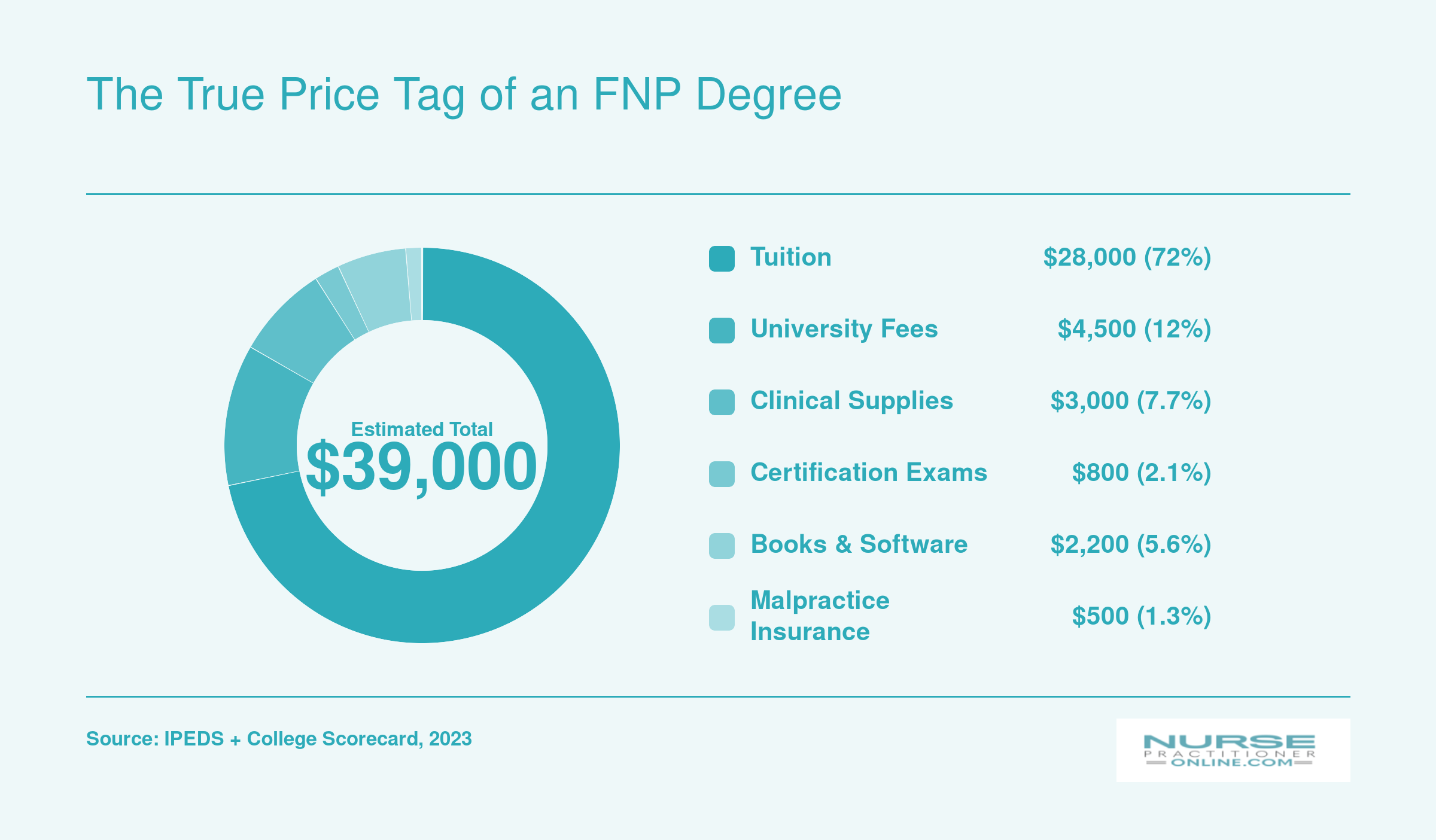
The True Price Tag of an FNP Degree
Tuition is only part of the picture. When you add fees, clinical supplies, and other expenses, the total investment in an FNP degree can look quite different from the sticker price. Here is a realistic cost composition based on reported tuition at affordable Florida programs and typical ancillary expenses FNP students encounter.
Choosing Between Online, Hybrid, and On-Campus FNP Formats
According to the Bureau of Labor Statistics, nurse practitioners in Florida earned a median annual wage of $110,000 in 2025, a figure that reflects a wide range of practice settings and clinical experiences. Your choice of FNP program format can influence where and how you land that role, so it pays to understand how online, hybrid, and on-campus paths really compare.
What the Research Tells Us About Learning Formats
Accreditation is the great equalizer. The National Organization of Nurse Practitioner Faculties and the American Association of Nurse Practitioners both confirm that employers evaluate FNP graduates based on clinical competence and board certification, not the delivery method of their coursework. Large-scale studies available through the American Association of Colleges of Nursing show that certification pass rates and post-graduation employment rates are comparable across formats when programs meet the same rigorous standards. The key difference lies in who you are as a learner and what your life outside school demands.
- Employer surveys: AANP research indicates that hiring managers prioritize accredited program completion and strong clinical recommendations over whether a program was online or in-person.
- Enrollment trends: AACN data document a steady shift toward online and hybrid NP programs, driven by demand from working nurses who need geographic flexibility.
Practical Considerations for Southwest Florida Nurses
Living in Fort Myers, you already know that the nearest large academic medical centers are two hours north in Tampa or two hours east in Miami. An on-campus program can mean weekly commutes that eat into study time and clinical hours. Online and hybrid options let you stay local, often allowing you to complete clinical rotations at nearby hospitals like Lee Health or NCH Healthcare System. When you compare costs, factor in travel and lost work hours, not just tuition.
- Online programs: Maximum flexibility; you'll still need in-person clinical preceptors, but didactic work can happen from your home office.
- Hybrid programs: A middle ground that combines the convenience of online learning with occasional on-campus intensives for skills labs or simulations.
- On-campus programs: The most structured option, ideal if you thrive on face-to-face interaction and can relocate or commute reliably.
How to Vet a Program's Format Track Record
Don't guess. Look at the data schools publish. Many program websites include annual reports with format-specific completion rates, job placement stats, and student satisfaction surveys. Dig into the AACN's nursing education database for aggregate outcomes by delivery model, and cross-check BLS occupational profiles to see which practice settings align with your long-term goals. Some specialties may favor the network you build in a campus-based cohort.
If you're still early in the process, our guide on how to enroll in NP school online walks you through the practical steps of getting started. Call admissions offices and ask pointed questions: What percentage of your online students finish on time? How many find local preceptors? What do your alumni say about the transition to practice? The right format is the one that fits your life, your learning style, and the professional network you want to build.
Questions to Ask Yourself
Clinical Hours, Preceptor Placement, and What Florida FNP Students Should Expect
Accreditation standards set the floor for clinical preparation, but many programs build substantially higher expectations into their curriculum.
Minimum Clinical Hours for FNP Programs
Nationally accredited FNP programs typically require between 500 and 700 direct patient care hours to graduate.1 The minimum threshold across most programs aligns at 500 hours, reflecting the baseline established by nursing accreditors to ensure every graduate has sufficient hands-on experience before entering independent practice.2 Many programs in Florida exceed this floor, assigning 600, 650, or even 720 clinical hours to better prepare students for the breadth of primary care they will encounter in the field. Programs that push beyond 500 hours often do so to align with state board expectations, employer preferences, or their own institutional standards for clinical competency. When evaluating FNP program clinical hours in Florida, ask not only about the total count but also how those hours are distributed across lifespan populations, whether elective rotations are available, and if any hours double-count toward specialty certifications.
Preceptor Placement: Who Finds Your Clinical Sites?
One of the most consequential differences among FNP programs is whether the school arranges your clinical placements or leaves placement entirely to you. Programs with dedicated clinical coordinators typically match students to preceptors within an established network of partner sites. This model offers predictability and reduces the logistical burden on working nurses. In contrast, self-placement programs require you to identify, contact, and secure your own preceptors, a process that can take weeks or months and may delay your progress if sites fall through. For Fort Myers students enrolled in online programs based elsewhere in Florida or out of state, self-placement can be especially challenging if the program has no existing partnerships in Southwest Florida.
Practical Tips for Fort Myers-Area Students
If your program requires self-placement, start your preceptor outreach at least one semester ahead of your first clinical course. Lee Health, the dominant health system in the region, operates a formal preceptor application process; confirm eligibility and lead times early. Smaller primary care offices, urgent care centers, and federally qualified health centers in Cape Coral, Bonita Springs, and Estero may also welcome FNP students. Before committing to any site, verify that it meets your program's requirements for patient volume, supervision ratio, preceptor credentials, and documentation. Many programs mandate that preceptors hold national certification, maintain an active Florida ARNP license, and work in settings that serve diverse age groups. Clarify these details with your program coordinator and the prospective site before signing any affiliation agreements.
Frequently Asked Questions About FNP Programs in Florida
Navigating FNP program requirements, licensure rules, and financing options can feel overwhelming when you are already juggling shifts and family life. Below are the questions Fort Myers nurses ask most often, answered with the latest Florida regulatory details so you can plan your next step with confidence.
- How many clinical hours do FNP programs require in Florida?
- Florida requires a minimum of 500 supervised clinical hours for FNP licensure, and many programs build in 600 to 750 hours to strengthen your preparation for certification exams. Your program must be accredited by CCNE, ACEN, or NLN CNEA for those hours to count. If you are comparing schools, pay attention to whether the program helps you secure preceptor sites in the Fort Myers area or leaves that responsibility to you.
- Can I complete an FNP program entirely online while living in Fort Myers?
- Most coursework can be completed online, but every accredited FNP program includes hands-on clinical hours that must be done in person. Several Florida universities and nationally available online programs allow Fort Myers students to arrange clinical rotations at local hospitals and primary care offices. The didactic portion is fully online, which makes it manageable alongside a nursing schedule, but plan ahead for the in-person clinical component.
- What is the ARNP licensure process in Florida?
- After graduating, you must pass a national certification exam (ANCC or AANP), then apply through the Florida Department of Health's MQA online portal. You will need an active Florida RN license, official graduate transcripts, national certification verification, proof of malpractice insurance, and a Level 2 background check. Once your ARNP license is granted and you want prescriptive authority, you register separately with the DEA.
- What is the difference between ANCC and AANP certification exams?
- Both are accepted in Florida. The ANCC FNP-BC exam had a pass rate of about 82% in 2025 and tends to emphasize research, theory, and policy alongside clinical knowledge. The AANP exam is often described as more clinically focused. Choose whichever aligns with your study strengths. Your program's curriculum may lean toward one exam's content, so ask faculty which exam their graduates typically sit for.
- Do any Florida FNP programs accept students without a BSN?
- A few Florida programs offer RN-to-MSN bridge tracks designed for registered nurses who hold an associate degree. These tracks add prerequisite coursework before you enter the FNP concentration, so the total timeline is longer. However, most FNP programs require a BSN for direct admission. If you do not yet have your BSN, an RN-to-BSN program completed first often opens more options and may qualify for employer tuition assistance.
- How long does it typically take to finish an FNP program part-time?
- Part-time students usually complete an MSN-level FNP program in three to four years, compared with roughly two years full-time. DNP tracks run longer, often four to five years at a part-time pace. Scheduling clinical rotations around work shifts is the biggest variable. Many Fort Myers nurses spread clinicals across weekends and days off to avoid cutting into their income.
- What financial aid options are available for FNP students in Florida?
- Start with the FAFSA to access federal loans and, in some cases, graduate assistantships. Florida Bright Futures does not cover graduate study, but several hospitals in Southwest Florida offer tuition reimbursement for nurses pursuing advanced degrees. Federal loan repayment programs such as the NURSE Corps Scholarship and NHSC loan repayment can significantly reduce your debt if you commit to practicing in an underserved area after graduation.
- Does Florida grant full practice authority to ARNPs?
- Florida currently operates under a reduced practice model for most ARNPs. However, experienced primary care ARNPs who meet specific criteria can practice autonomously without a supervising physician agreement. Legislative efforts continue to expand practice authority further. For new graduates, expect to work under a collaborative arrangement initially. Once you gain experience, the pathway to greater independence becomes more accessible under current Florida law.
FNP Earnings in the Fort Myers–Cape Coral Metro Area
Nurse practitioners in the Cape Coral–Fort Myers metro area earn notably competitive wages, often outpacing several larger Florida markets. According to the most recent Bureau of Labor Statistics data, approximately 820 NPs are employed locally, a figure that reflects steady demand across Southwest Florida's growing healthcare landscape. The table below compares local NP pay at key percentiles with RN wages in the same metro, giving you a clear picture of the financial leap an FNP degree can deliver.
| Role or Geography | Total Employment | 25th Percentile | Median | 75th Percentile | Mean |
|---|---|---|---|---|---|
| NPs, Cape Coral–Fort Myers | 820 | $120,160 | $143,670 | $143,670 | $136,210 |
| NPs, Miami–Fort Lauderdale–West Palm Beach | 9,200 | $109,990 | $135,450 | $150,840 | $132,730 |
| NPs, Tampa–St. Petersburg–Clearwater | 3,810 | $105,410 | $128,430 | $134,190 | $125,970 |
| NPs, Jacksonville | 2,290 | $107,680 | $129,530 | $132,590 | $127,910 |
| NPs, Orlando–Kissimmee–Sanford | 1,970 | $107,860 | $128,210 | $132,790 | $126,670 |
| NPs, North Port–Bradenton–Sarasota | 720 | $109,230 | $130,780 | $135,920 | $131,490 |
| RNs, Cape Coral–Fort Myers | 6,560 | $81,680 | $86,090 | $90,310 | $87,020 |
Is an FNP Degree Worth It? ROI for Southwest Florida Nurses
Return on investment for an FNP degree comes down to a straightforward question: how long will it take for your higher nurse practitioner salary to recoup the cost of school?
The Salary Premium for Fort Myers NPs
Registered nurses in the Cape Coral/Fort Myers metro area earn a median annual wage of $75,510, according to 2024 Bureau of Labor Statistics data.1 Family nurse practitioners in Florida typically earn considerably more; nationally, nurse practitioners command median salaries well above $100,000. That salary difference is the foundation of your return.
For a working RN in Fort Myers earning the local median, moving into an FNP role can lift annual income by $30,000 to $40,000 or more, depending on practice setting and experience. That premium is what pays down your program debt and ultimately builds wealth over the course of your career.
Simple Payback: Median Debt Divided by Annual Gain
A rough payback calculation divides median graduate debt by the annual salary increase you'll see as an FNP. If you borrow $15,000 and gain $35,000 per year in salary, your break-even point is less than six months. If you borrow $40,000 and gain the same amount, payback stretches to just over a year.
The programs in our ranking show wide variation in cost and therefore in how quickly they pay for themselves. University of Florida's DNP, for instance, carries median debt of $15,000 and posts an ROI ratio of 4.77, meaning the salary gain relative to debt is nearly five times over. Florida International University's graduate certificate shows median debt of $16,500 and an ROI ratio of 3.65. University of Miami's master's program, with median debt of $17,500, delivers an ROI ratio of 4.30. Florida State University's online certificate comes in at $18,000 median debt and a 3.43 ROI ratio, while University of North Florida's DNP sits at $15,531 with a 3.63 ratio. If you are weighing a DNP pathway specifically, comparing best online DNP nurse practitioner programs can help you benchmark costs beyond the Florida options listed here.
Cheapest Programs Pay for Themselves Fastest
The most affordable programs in the ranking can recoup their cost in a matter of months rather than years. Public-university programs with low in-state tuition and modest debt loads routinely break even within the first year of FNP practice. More expensive programs still offer strong long-term returns (nurse practitioners enjoy decades of elevated earning potential), but the upfront investment takes longer to recover.
For Fort Myers nurses balancing family budgets and work schedules, choosing a program with lower total cost can accelerate the transition from debt repayment to wealth building, making the FNP investment both worthwhile and financially sustainable.
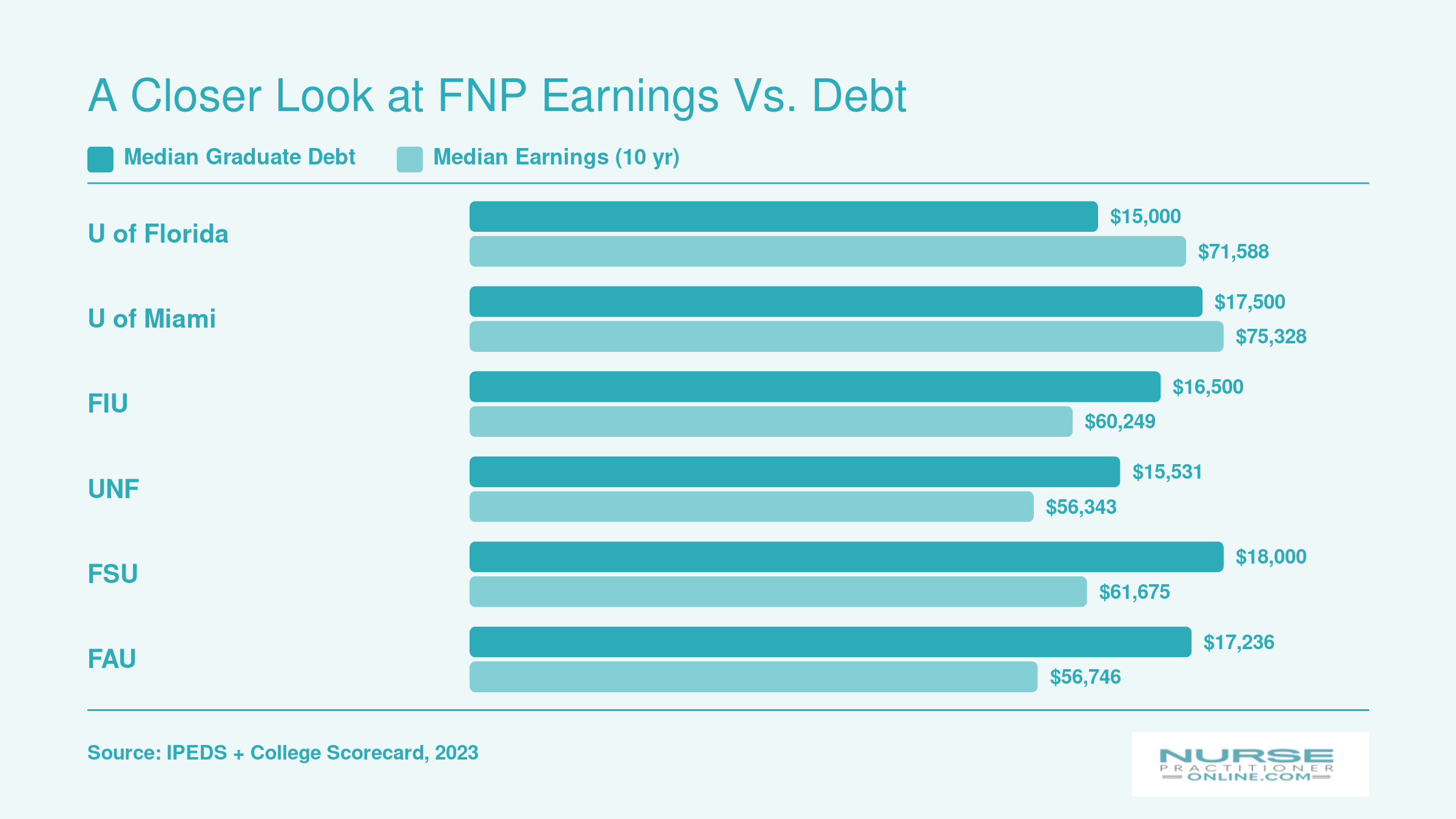
A Closer Look at FNP Earnings vs. Debt
How far does each tuition dollar stretch? The chart below compares institution-wide median graduate debt against median earnings ten years after enrollment for the top programs by earnings-to-debt ratio. While program-specific post-completion earnings are not yet available for these FNP tracks, the institution-level figures give you a useful baseline for comparing value across schools.
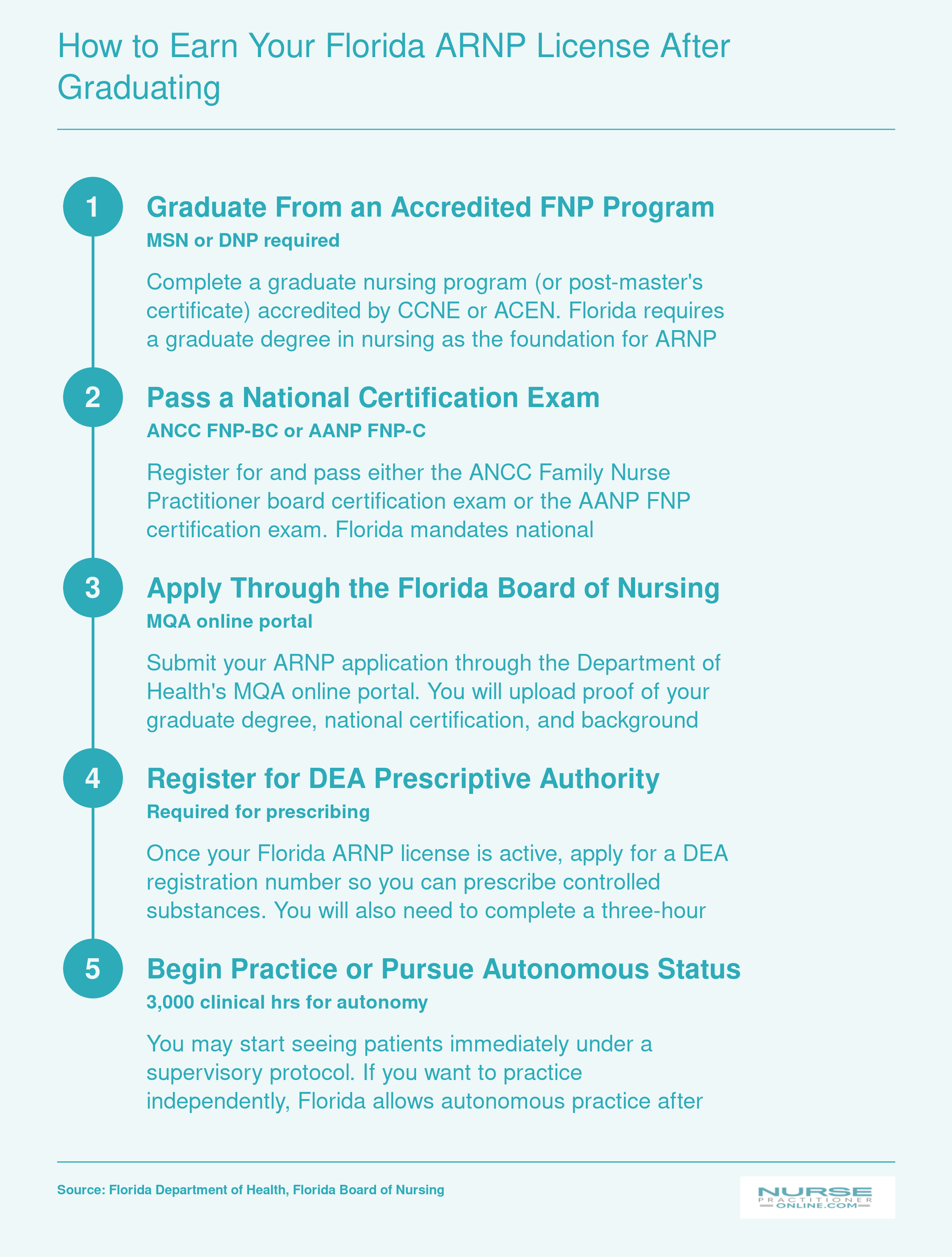
How to Earn Your Florida ARNP License After Graduating
Once you finish your FNP program, a clear sequence of steps stands between you and practicing as an Advanced Registered Nurse Practitioner in Florida. The process moves quickly if you prepare your documents in advance and schedule your certification exam before graduation. Here is what to expect.
A Decision Framework for Picking the Right FNP Program
By now you have seen the moving parts: sticker price versus net price, online versus hybrid delivery, whether the school finds your preceptors or you do, graduation and certification outcomes, and the Florida ARNP licensure steps that follow your diploma. Pulling those threads together into a single decision is easier when you weight each factor against your own situation rather than chasing a single "best" program.
Build Your Personal Checklist
Start with a short list of non-negotiables, then rank the rest. A working bedside nurse with two kids will value flexibility differently than a recent BSN graduate who can move for clinicals.
- Format fit: If you are staying in your hospital job, prioritize fully online or low-residency programs with asynchronous coursework. If you learn better in person, a hybrid option near Fort Myers may be worth a longer commute.
- Net price, not tuition: Ask each program for an itemized cost estimate that includes fees, technology charges, clinical course surcharges, background checks, malpractice coverage, and required intensives. Two programs with identical per-credit tuition can differ by thousands once everything is added up.
- Clinical support: If you do not already have nurse practitioners in your network willing to precept you, weight preceptor placement heavily. Self-placement programs work, but only if you are confident you can secure 600 to 700 hours of qualified supervision in family practice.
- Outcomes you can verify: Look at certification pass rates and graduation rates the school publishes, and ask about average time to complete.
Use the Moment to Your Advantage
Florida's practice authority for nurse practitioners has been expanding, with autonomous practice pathways now available to qualifying ARNPs in primary care settings. That makes 2026 a strong moment to invest in an FNP credential: the scope of what you can do after licensure is broader than it was even a few years ago. Nurses who already hold an FNP and want to add a specialty might also explore a post-master's FNP certificate or other advanced credentials. Pick the program that fits your life, confirm the full cost in writing before you sign, and step into a role Southwest Florida genuinely needs.
More FNP Programs Available to Fort Myers Students
Beyond the top-ranked programs, several other Florida schools offer FNP pathways that may align with your specific location, format, or institutional preferences. Explore these additional options below.
South Florida
Barry University Miami, FL · Hybrid
- Nurse Practitioner (MSN) Family Practice
- Nursing Practice, Post-Baccalaureate DNP (Family Nurse Practitioner)
University of Miami Coral Gables, FL · On-Campus
- BSN to DNP Family Nurse Practitioner
- Family Nurse Practitioner
- Family Nurse Practitioner (FNP) Program
- Post Masters Certificate in Family Nurse Practitioner
Larkin University Miami, FL · Hybrid
- Master of Science in Nursing (MSN) (Family Nurse Practitioner)
Nova Southeastern University Fort Lauderdale, FL · Hybrid
- B.S.N. to D.N.P. (Family Nurse Practitioner)
- Postgraduate Certificate (Family Nurse Practitioner (FNP))
- Family Nurse Practitioner M.S.N.-A.P.R.N.
Palm Beach Atlantic University West Palm Beach, FL · Hybrid
- Doctor of Nursing Practice, D.N.P. (Family Nurse Practitioner)
- Doctor of Nursing Practice, D.N.P. (Family Nurse Practitioner Track)
Tampa Bay Area
The University of Tampa Tampa, FL · On-Campus
- Post-Master’s Certificate Program in FNP
Jacksonville Area
Jacksonville University Jacksonville, FL · Hybrid
- BSN to DNP Family Nurse Practitioner
- Family Nurse Practitioner Post-Graduate Certificate
- BSN-DNP Family Nurse Practitioner Cognate
Florida by City
- ACNP Programs in Florida
- AGNP Programs in Florida
- DNP NP Programs in Florida
- FNP Programs in Florida
- Fort Lauderdale, Florida (FNP)
- Lakeland, Florida (PNP)
- Miami, Florida (AGNP)
- Miami, Florida (PNP)
- Orlando, Florida (FNP)
- PMHNP Programs in Florida
- PNP Programs in Florida
- Sarasota, Florida (FNP)
- Tampa, Florida (PNP)