Most important takeaways…
- Most post-master's FNP certificates near Aurora require 18 to 27 credits and can be completed in 12 to 24 months.
- Securing a clinical preceptor early is the single biggest factor in avoiding costly timeline delays.
- NP employment is projected to grow 46 percent from 2023 to 2033, adding roughly 135,500 openings nationwide.
- Every program, whether fully online or hybrid, requires 500 to 720 supervised clinical hours with an approved preceptor.
For MSN-prepared nurses in the Aurora area, the math is straightforward: a post-master's FNP certificate adds family practice scope without repeating a full graduate degree, and some accredited programs can be completed in as few as 12 months. That efficiency matters when you are already credentialed, employed, and unwilling to walk away from your income for two or three years.
The real tension is not whether to pursue the certificate. It is which program fits your pace, your budget, and your clinical placement options in the Denver metro. Tuition ranges widely, completion timelines vary by 12 months or more across comparable programs, and preceptor sourcing in Colorado's suburban corridors can quietly add a semester to an otherwise aggressive schedule.
Colorado's primary care workforce shortages have accelerated demand for family NPs specifically, and with full practice authority already in place, certificate holders can move directly into independent practice once licensed. For nurses who want to compress that timeline even further, our roundup of fastest nurse practitioner programs outlines the most accelerated paths available. The credential gap between an MSN generalist and a board-certified FNP has never carried more practical weight in this market.
Top Post-Master's FNP Certificate Programs Near Aurora, Colorado
Colorado offers a small but meaningful set of post-master's FNP certificate options for nurses in the Aurora area. We evaluated available programs on a composite of affordability, institutional graduation rates, and graduate outcomes to surface certificates that balance speed with value. Because only two Colorado programs met our criteria, the article also previews notable out-of-state online alternatives in later sections.
- Tuition and net price affordability
- Institutional graduation rate
- Graduate earnings outcomes
- Program format and accessibility
- Clinical preparation and credit load
- College Scorecard graduate earnings — collegescorecard.ed.gov
- NCES-IPEDS federal institutional data — nces.ed.gov
- Independent program research
- Internal program database

Regis University
Regis University is a private, Jesuit institution in Denver that delivers its post-graduate FNP certificate entirely online, making it a practical choice for Aurora-area nurses who want to study without a long commute. The program emphasizes advanced clinical assessment, diagnosis, and treatment planning across the lifespan, with a curriculum that weaves in leadership, ethics, and health policy. Military-friendly policies and a strong student-to-faculty ratio of 11:1 add to its appeal for working professionals seeking personalized support.
- Fully online delivery, ideal for working nurses near Aurora
- 36 credit hours with required clinical experiences
- Prepares graduates for both AANP and ANCC certification exams
- Requires a master's degree in nursing from an accredited program
- Minimum two years of nursing experience for admission
- CCNE-accredited curriculum with health promotion focus
- Includes urban and rural clinical placement options
Post-Graduate Certificate: Family Nurse Practitioner — Online

Colorado State University Pueblo
Colorado State University Pueblo offers a distinctive dual-track post-master's certificate that prepares nurses for both FNP and Adult/Gerontology Acute Care NP certification. Frequently cited as one of the most affordable FNP pathways in Colorado for state residents, CSU Pueblo's in-state tuition is notably lower than private alternatives. The campus-based format does require travel from Aurora (roughly two hours south), but the dual certification and competitive pricing make it worth considering for nurses who want broad practice versatility.
- 47 credit hours covering both FNP and AGACNP tracks
- 585 clinical hours focused on evidence-based, patient-centered care
- Campus-based delivery in Pueblo, approximately two hours from Aurora
- Dual certification prepares graduates for primary and acute care roles
- Can be completed in as few as 2.5 years at a full-time pace
- Requires master's in nursing with a minimum 3.0 GPA
- Active RN license, CPR, ACLS, and PALS certifications required
- Prerequisites include statistics, chemistry, and microbiology
Adult/Gerontology Acute Care and Family Nurse Practitioner Post-Master's Certificate — On-Campus
How Long Does a Post-Master's FNP Certificate Take?
The honest tradeoff for working nurses is this: you can finish a post-master's FNP certificate in roughly 12 months if you push hard, or stretch it across 24+ months to keep your job, family, and sanity intact. Most accredited programs land somewhere in that one-to-two-year window, and the deciding factors are credits, clinical hours, and how many courses you can realistically carry per term.
The Typical Range
Nationally, post-master's FNP certificates run between 15 and 45 credit hours, with most programs clustering in the 21 to 30 credit range. That credit load translates to roughly three to six academic terms depending on whether you study full-time or part-time. Full-time students taking two to three courses per term often finish in 12 to 18 months. Part-time nurses taking one course per term should plan on 24 to 36 months. You can compare options across online post masters FNP programs to see how credit requirements differ from school to school.
Clinical Hours Drive the Calendar
The National Organization of Nurse Practitioner Faculties (NONPF) sets the standard most schools follow: a minimum of 500 supervised direct patient care clinical hours for the FNP population focus. Many programs require 600 to 750 hours to meet certification eligibility and accreditation expectations. Because you can typically only log clinical hours during specific practicum terms, those hours often set the floor on how fast you can finish, no matter how aggressively you stack coursework.
How to Confirm a Program's Real Timeline
Published completion times can be optimistic. Before you commit, do three things:
- Pull the program's curriculum or plan of study page and count the required credits and practicum terms yourself.
- Email the admissions office and ask for the average time-to-completion for part-time students, not just the catalog ideal.
- Cross-check the program's accreditation through CCNE or ACEN, and review the AACN's directory to confirm it is in good standing.
If you are still weighing whether a post-master's certificate is the right next step, the broader guide on how to become a nurse practitioner walks through the full credential pathway. Program length, however, always comes down to the school's own curriculum map.
Credits, Clinical Hours, and Completion Time: Program-by-Program Comparison
How many credits, clinical hours, and months separate you from practicing as a family nurse practitioner in Colorado?
That single question drives most of the decision-making for working nurses weighing post-master's FNP certificate options, yet finding a clear comparison across in-state and nationally available online programs can be surprisingly difficult. The table below puts Colorado-based programs and top online programs that accept Colorado residents side by side so you can evaluate them in one place.
What the Comparison Covers
Each program differs in how it counts credits (semester vs. quarter hours), how many clinical hours it requires, how quickly a motivated student can finish, how often new cohorts start, and what the tuition picture looks like. Keep in mind that quarter-credit programs may appear to have higher credit totals, but quarter credits are roughly two-thirds the weight of semester credits, so a 60-quarter-credit program is closer to 40 semester credits in actual coursework volume.
Program-by-Program Snapshot
- Walden University (online, NC-SARA authorized): 60 quarter credits; clinical hours embedded in practicum courses; multiple start dates throughout the year; tuition structured per quarter credit.1 Walden specifically markets an accelerated pathway for post-master's FNP students, making it one of the more flexible national options for Colorado nurses juggling shift schedules.
- Maryville University (online, NC-SARA authorized): Offers a streamlined post-master's FNP certificate with semester-based credits; year-round start options allow students to begin when ready rather than waiting for a fall cohort.
- Chamberlain University (online, NC-SARA authorized): Known for structured clinical placement support; multiple session starts per year; tuition quoted per credit hour.
- Purdue Global (online, NC-SARA authorized): Designed for working nurses with prior graduate education; flexible pacing and several enrollment windows annually.
Colorado-based programs, including options at the University of Colorado and Regis University, tend to follow traditional semester calendars with one or two entry points per year, which can extend your timeline if you miss an enrollment window.
Why This Comparison Matters
When you line these programs up, a few patterns emerge. National online programs generally offer more frequent start dates, sometimes as many as six or more per year, which means less waiting and a faster path to completion. Colorado-based programs may offer the convenience of local clinical site relationships, potentially simplifying preceptor placement. Cost varies widely: per-credit tuition at national programs can range from roughly $500 to over $800, while in-state options may carry different rate structures for Colorado residents.
Before choosing based on speed alone, confirm that any program you are considering holds NC-SARA authorization or direct state authorization to operate in Colorado. All four national programs listed above currently hold that authorization, but policies can change, so verify directly with both the school and the Colorado State Board of Nursing before enrolling. For a broader look at how these schools compare to the full national landscape, explore our guide to post-master's certificate FNP programs.
If specific tuition figures or clinical hour totals are not listed here, it is because published data for some programs was not available at the time of writing. Contact each program's admissions office for the most current numbers, and ask specifically about any fees beyond tuition, such as clinical placement fees, technology fees, or background check costs. Those extras can add hundreds or even thousands of dollars to your total investment.
Fully Online vs. Hybrid: Which Format Works for Colorado Nurses?
Before you commit to a program format, keep one thing in mind: every post-master's FNP certificate requires hands-on clinical hours, no matter how the coursework is delivered. Fully online programs still mean face-to-face patient care with an approved preceptor. The real question is how the didactic portion fits your life as a working nurse in the Aurora or Denver metro area.
Pros
- Fully online programs eliminate campus visits, letting you study around night shifts, weekends, or rotating schedules.
- Online formats open the door to faster out-of-state programs you might not otherwise access from Colorado.
- Hybrid programs often include built-in clinical site networks across the Denver and Aurora metro, saving you the headache of finding your own preceptor.
- Structured immersion weekends in hybrid formats create a cohort community and consistent peer support throughout the program.
- Hybrid models typically pair you with faculty mentors during on-site intensives, offering richer clinical guidance than virtual office hours alone.
Cons
- Fully online students usually must arrange their own clinical preceptors in Colorado, which can be competitive in the Denver metro market.
- Some out-of-state online programs face state-authorization complications that may delay enrollment or limit financial aid eligibility in Colorado.
- Online learners may receive less direct faculty mentoring compared to peers who attend in-person sessions regularly.
- Hybrid programs tie you to a specific geographic area, which can be a drawback if you relocate or travel frequently for work.
- Cohort-locked hybrid schedules offer less flexibility and may extend your completion timeline if you need to pause or reduce your course load.
Related Articles
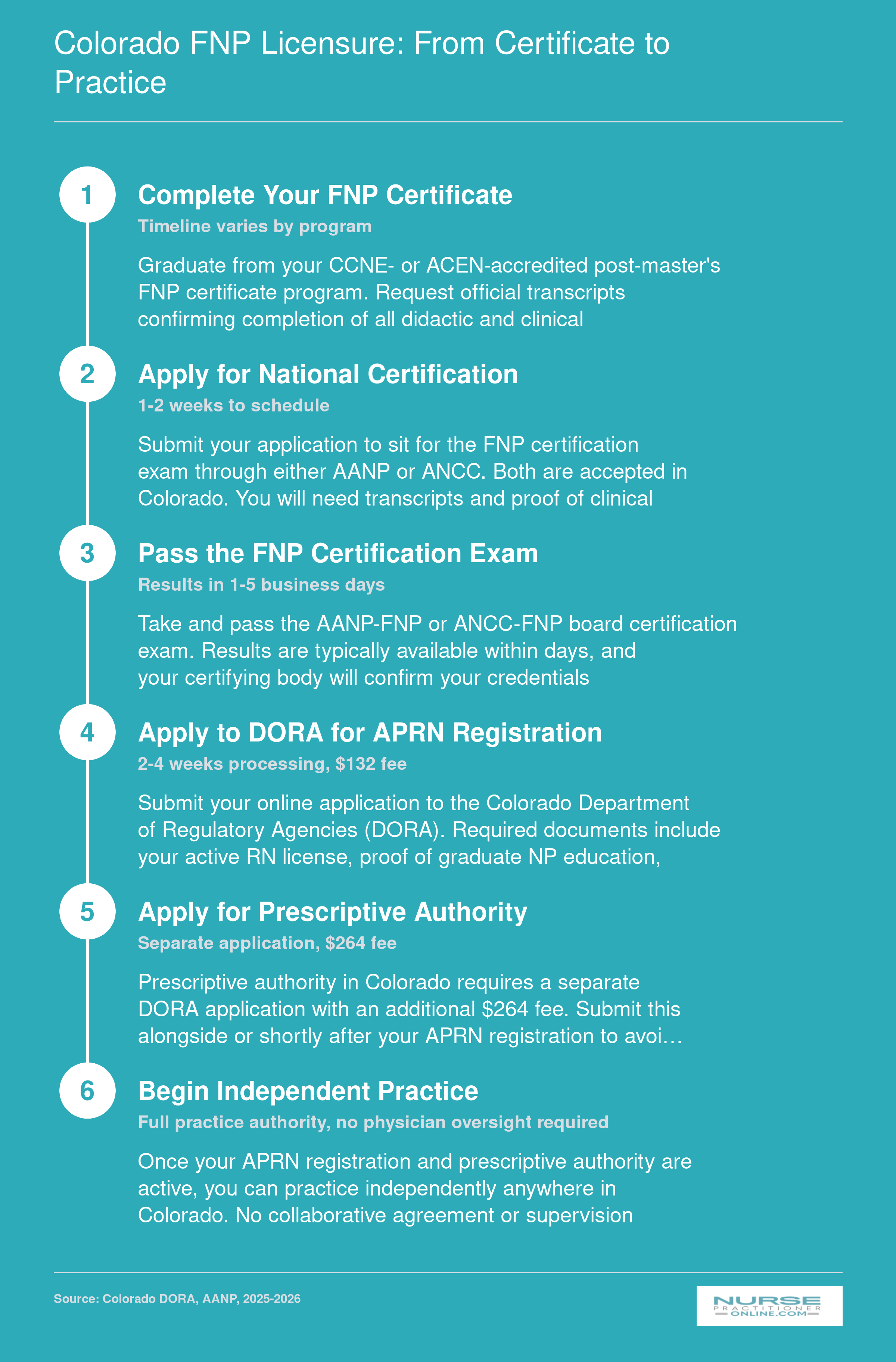
Colorado FNP Licensure: From Certificate to Practice
Once you complete your post-master's FNP certificate, you are just a few steps away from practicing independently in Colorado. Because Colorado grants full practice authority to nurse practitioners, you will not need a collaborative agreement with a physician. Here is the typical path and timeline from graduation to your first day seeing patients on your own.
Questions to Ask Yourself
What a Post-Master's FNP Certificate Costs, and What You'll Earn
Post-master's FNP tuition in Colorado has quietly become one of the better returns in graduate nursing, largely because state NP wages have climbed faster than certificate prices. The math has shifted: a credential that adds 12 to 18 months of part-time study now sits against a Colorado NP mean wage of $132,540 (BLS, May 2024), which works out to roughly $63.72 an hour.1 That gap between what the certificate costs and what it unlocks is the number worth running before you enroll.
Total Program Cost at the Fastest Completion Track
Using tuition figures published by each school, here is what the two Colorado programs profiled in this article look like at their fastest realistic completion track:
- Regis University (Denver), Post-Graduate Certificate FNP, online, 36 credits: Recent graduate tuition runs about $24,300 for the program. At a 12-month accelerated pace, that is roughly $2,025 per month of enrollment; stretched to 18 months, closer to $1,350 per month.
- Colorado State University Pueblo, Post-Master's AGACNP/FNP, campus-based, 47 credits, 585 clinical hours: Graduate tuition lands near $10,064 for in-state students. Over a typical 18- to 24-month completion, that is roughly $420 to $560 per month, though the dual-certification track and clinical load make a 12-month finish unrealistic.
The per-month figure matters more than sticker price when you are comparing a leaner 36-credit online certificate against a heavier 47-credit dual-track program. You are buying time-to-license, not just credits. If you are also weighing a dual AGACNP track, exploring AGNP post master's certificate online options can help you benchmark costs nationally.
Framing ROI Against Denver-Aurora-Lakewood NP Wages
Program-level earnings data is not yet published for these specific post-master's certificates, so we anchor ROI in the Colorado BLS wage instead. At a $132,540 mean, every month you shave off completion is worth roughly $11,000 in gross NP earnings you would otherwise defer. Even at the 10th percentile of the national NP wage ($87,340), one month of NP work covers most of a month of Regis tuition, and several months of CSU Pueblo tuition.3
The Speed vs. Cost Tradeoff
The fastest program is rarely the cheapest per credit. Regis costs more per credit than CSU Pueblo, but if its online format lets you finish six months sooner, that head start on NP wages (conservatively $40,000 to $60,000 gross) more than absorbs the tuition premium. The break-even tilts toward speed whenever the wage delta between your current RN role and a Colorado NP role exceeds roughly $40,000 a year, which is typical in the Denver-Aurora metro.
How to Finish Your FNP Certificate Faster
In the Denver-Aurora metro area, finding a clinical preceptor often takes 6 to 12 months.1 Planning ahead is the single most effective way to avoid delays. With strategic decisions about credits, placements, start dates, and workload, you can compress your timeline without compromising quality.
Maximize Credit Transfer and Advanced Standing
If you completed pharmacology, pathophysiology, and health assessment in your MSN, you may be able to waive those courses in a post master's certificate FNP program. Many programs, including online options that serve Colorado nurses, offer credit for prior graduate work, but policies vary. Some schools require syllabi review or a challenge exam; others automatically apply transfer credits if the courses are recent and from an accredited program. Ask program advisors directly about advanced standing before you enroll, as it can shave a full semester off your timeline.
Secure Clinical Placements in Denver-Aurora Faster
The Denver-Aurora area is a major healthcare hub with UCHealth, SCL Health, and Denver Health, but NP student slots are limited and require formal affiliation agreements.1 Clinical placement delays are the top reason for program extension, so start early. Key strategies: - Leverage school-arranged placements: The University of Colorado Anschutz College of Nursing arranges clinical placements for its students, removing the guesswork. If you choose a program without this support, you'll need to self-secure preceptors. - Tap into paid matching services: NP Hub and Clinical Match Me offer fee-based preceptor-matching nationwide, including Colorado.13 They can cut the lead time significantly, but expect to budget for the service. - Target community health centers: Federally Qualified Health Centers (FQHCs) in Colorado often prioritize NP students from in-state programs.1 Reach out early and have your program's clinical director initiate the conversation. - Avoid common pitfalls: The Little Clinic (Kroger) only works through school clinical directors, not directly with students.4 Don't waste time cold-calling without a formal affiliation in place.
Choose Enrollment Start Dates Strategically
Programs with multiple start dates (some offer six per year) let you begin as soon as you're ready instead of waiting for an annual fall cohort. If you miss a deadline for a once-a-year program, you lose a full calendar year. Even a three-month head start can mean finishing clinicals before the next winter surge in preceptor demand. When comparing programs, ask about upcoming start dates and whether they admit on a rolling basis.
Balance Workload Without Burning Out
Most working RNs pursuing a family nurse practitioner certificate find full-time enrollment unrealistic while maintaining a nursing schedule. Part-time study extends the timeline but protects your income and sanity. Students who attempt full-time often report burnout and, ironically, slower progress due to clinical placement conflicts. Map out your work shifts and study blocks before committing. If your RN position offers flexible scheduling or tuition reimbursement, negotiate upfront: these perks can free up time and money for faster completion.
The Bureau of Labor Statistics projects nurse practitioner employment will grow 46 percent from 2023 to 2033, adding approximately 135,500 job openings nationwide over that decade. That makes NP one of the fastest-growing healthcare professions, driven by demand for primary care and rural access.
Choosing the Right Post-Master's FNP Certificate: Speed, Cost, and Fit
Which post-master's FNP certificate program is actually the best fit for a working nurse in Aurora, not just the fastest or the cheapest?
That question is worth sitting with, because the answer is different for everyone. Speed, cost, and program quality rarely line up perfectly, and chasing one factor at the expense of the others can backfire.
Speed Is Only One Piece of the Puzzle
A 12-month completion timeline sounds great until you discover the program offers little to no help securing a clinical preceptor. Finding your own preceptor in a competitive metro area like Aurora can add months to your timeline, effectively erasing any speed advantage. Before you prioritize a fast track, ask each program directly how they support clinical placement and what percentage of students find preceptors through the program's own network.
Similarly, a low per-credit tuition rate can be deceiving. If a program's structure stretches your timeline from 12 months to 18 months, you are paying for additional semesters and potentially foregoing a higher NP salary for longer. Total program cost matters more than the sticker price per credit.
A Practical Framework for Comparing Programs
Rather than ranking programs by a single factor, compare them across three questions:
- Timeline: How many credits are required, and can you complete them part-time while working?
- Clinical support: Does the program help match you with a preceptor, or does that responsibility fall entirely on you?
- Total cost: What is the full tuition from start to finish, including fees, given your realistic pace?
Your Concrete Next Step
Contact two or three programs that interest you and ask for a transcript evaluation before you commit. Many FNP post-master's certificates require 15 to 25 credits, and any graduate coursework you have already completed in areas like pharmacology or pathophysiology may transfer. Knowing your credit gap upfront gives you a realistic picture of both your timeline and your total expense. If you are still weighing whether a post-master's certificate or a different pathway is best, reviewing best online post master's NP certificate programs can help you compare options across specialties.
Also verify that any online program you are considering is authorized to operate in Colorado. Out-of-state programs are not automatically approved to enroll Colorado residents. You can confirm authorization through Colorado's Department of Regulatory Agencies or check whether the program participates in the National Council for State Authorization Reciprocity Agreements.
The Bottom Line for Aurora-Area Nurses
Colorado is a full practice authority state, meaning FNPs can practice and prescribe independently without a physician collaboration agreement. For nurses already holding a master's degree, the post-master's FNP certificate is a focused, efficient path (typically 9 to 18 months) to reach that independent practice milestone. Combined with strong regional demand for primary care providers and competitive NP salaries along the Front Range, this credential offers a genuinely high return on a relatively short investment. Choose a program that matches your pace, protects your schedule, and actually gets you to the finish line.