Most important takeaways…
- The shortest AGACNP post-master's certificates require 15 to 24 credits and can be completed in as few as 12 months.
- Colorado's only in-state option is the University of Colorado Anschutz hybrid online program, so most nurses enroll out of state.
- Denver metro NP employment sits near 2,190, with acute care specialists commanding premium pay over primary care roles.
- BLS projects 35 percent NP employment growth from 2024 to 2034, translating to roughly 32,700 annual openings nationwide.
What is the shortest AGACNP post-master's certificate program available to nurses in Colorado?
Colorado has virtually no in-state post-master's certificate options for acute care nurse practitioners, which means Denver-area nurses almost universally enroll in nationally available ACNP programs online. The ranked programs below accept Colorado residents, deliver coursework primarily online or in a hybrid format, and range from 13 to 30 credits, with completion timelines spanning 12 to 24 months depending on prior coursework and clinical hour requirements.
The practical tension is real: faster programs demand more concentrated clinical rotations, and out-of-state tuition rates vary widely, from roughly $7,000 to over $47,000 total. Choosing well means weighing timeline against cost, clinical placement realities near Denver, and how each program's curriculum aligns with the ANCC or AACN certification exams you will sit for after graduation.
Best Short Online ACNP Post-Master's Certificate Programs for Colorado Students
Because Colorado has very few in-state AGACNP post-master's certificate options, most Denver-area nurses look to nationally available online programs. Every school below accepts Colorado residents and delivers coursework primarily online or in a hybrid format, so you can keep working while you earn your certificate. We prioritized programs with the fewest required credits and the shortest timelines, then layered in institutional quality indicators and clinical-placement flexibility. Note that the institution-wide graduation rates cited here reflect overall academic quality rather than certificate-specific completion rates, since program-level data is not yet reported for most of these certificates.
- Total credits and program length
- Clinical hour requirements
- Online or hybrid delivery format
- Institutional graduation and retention rates
- Colorado enrollment eligibility
- Internal program database
- NCES-IPEDS federal institutional data — nces.ed.gov
- College Scorecard graduate earnings — collegescorecard.ed.gov
- Independent program research

Florida State University
Florida State University's College of Nursing delivers a 22-credit AGACNP post-master's certificate entirely online with synchronous components, making it one of the leanest credit loads you'll find. The university holds an institution-wide graduation rate of about 86% and is CCNE accredited. Colorado nurses can complete didactic work from home, though clinical placements are typically self-arranged in your local community with FSU oversight.
- Only 22 credit hours, among the lowest nationally
- Delivered fully online with synchronous sessions
- CCNE-accredited College of Nursing
- Clinical rotations coordinated by student locally
- Includes simulation exercises and online labs
- Prepares for ANCC or AACN board certification
- Synchronous format supports real-time faculty interaction
Adult Gerontology Acute Care Nurse Practitioner Post-Master's Graduate Certificate — Online

University of Central Florida
The University of Central Florida offers a 23-credit hybrid AGACNP post-master's certificate designed for APRNs holding an MSN or DNP. UCF is a large public research university with a 78% institution-wide graduation rate and strong emphasis on evidence-based practice. The curriculum covers disease prevention through critical care, and clinical hours can be arranged in your home state.
- Requires 23 credit hours beyond a master's or DNP
- Hybrid format blends online coursework with clinicals
- Requires current APRN national certification for admission
- Emphasizes evidence-based practice and leadership
- Develops advanced diagnostic reasoning skills
- Prepares graduates for state licensure in acute care
- Open to out-of-state students, including Colorado
Adult-Gerontology Acute Care Nurse Practitioner Post-Master's Certificate — Hybrid

University of North Carolina at Chapel Hill
UNC Chapel Hill pairs an elite 91% institution-wide graduation rate with a hybrid AGACNP post-graduate certificate built on its nationally recognized College of Nursing. The program emphasizes advanced assessment, diagnostic, and treatment skills for managing complex acute and geriatric patients. Colorado residents should plan for out-of-state graduate tuition, though the university's strong reputation can enhance long-term career prospects.
- Hybrid format with online and on-campus elements
- Backed by a 91% institutional graduation rate
- Focuses on complex acute and geriatric patient care
- Develops advanced assessment and diagnostic skills
- CCNE-accredited nursing program
- Prepares for national NP board certification
- Strong research university with a 15:1 student-faculty ratio
Adult-Gerontology Acute Care Nurse Practitioner Post-Graduate Certificate — Hybrid

University of Minnesota-Twin Cities
The University of Minnesota's AGACNP post-graduate certificate stands out with a flexible 13 to 16 credit range determined by an individualized gap analysis, meaning experienced APRNs could finish with fewer courses. The three-semester hybrid program features asynchronous content and biweekly Zoom sessions. Clinical hours range from 240 to 600 depending on your prior experience, which can significantly shorten your timeline. Note that this program currently requires a DNP for admission.
- Only 13 to 16 credits based on individual gap analysis
- Clinical hours range from 240 to 600 per experience level
- Three-semester schedule with asynchronous coursework
- Biweekly Zoom sessions for interactive learning
- On-campus skills intensive held during summer semester
- Requires DNP degree for admission
- Prepares for certification through AACN or ANCC
Adult Gerontological Acute Care Nurse Practitioner Post-Graduate Certificate — Hybrid

University of Pennsylvania
Penn's streamlined 12-month online certificate is purpose-built for APRNs already certified in another population focus who want to add acute care. The program runs year-round with rolling start dates, and students arrange clinical preceptors in their own communities, so Denver-area nurses can complete practicum hours locally. Tuition runs approximately $7,178 per credit unit, placing it at the premium end, but a 96.5% institution-wide graduation rate and an 8:1 student-faculty ratio reflect exceptional academic support.
- Designed for currently certified APRNs adding AGACNP
- Fully online with a 12-month part-time timeline
- Year-round start dates for scheduling flexibility
- Students secure local preceptors (Denver area eligible)
- Colorado is not listed among restricted states
- Approximately $7,178 per credit unit, no federal aid
- Backed by a 96.5% institution-wide graduation rate
Streamlined Post-Graduate APRN Adult Gerontology Acute Care NP Certificate — Online

University of Utah
The University of Utah's hybrid AGACNP post-graduate certificate uses an individualized gap analysis to tailor credit and clinical requirements to each student's background, potentially making it one of the faster pathways for experienced acute care nurses. As a fellow Mountain West institution, Utah's geographic proximity to Denver is a practical plus for any required on-campus visits. Keep in mind that this is a non-degree certificate, so federal financial aid is not available.
- Individualized study plan based on gap analysis
- Hybrid format with tailored coursework and practicums
- Closest Mountain West option to Denver
- Requires active APRN licensure and 3.0 GPA
- CCNE-accredited program
- No federal financial aid (non-degree-seeking certificate)
- Certificate posted to official university transcript
Adult/Gerontology Acute Care Nurse Practitioner Post-Graduate APRN Certificate — Hybrid

University of Washington-Tacoma Campus
UW Tacoma's 12 to 15 month AGACNP certificate pairs a faculty-guided gap analysis with weekly in-person classes in Tacoma and clinical rotations in both urban and rural settings. The program is best suited for nurses who can manage regular travel to the Pacific Northwest, which limits its convenience for Denver-based students. Graduates become eligible for national certification through ANCC or AACNCC.
- Completion in 12 to 15 months
- Faculty-guided gap analysis shapes individual plan
- Weekly in-person classes required in Tacoma
- Clinical placements in urban and rural sites
- Prepares for ANCC or AACNCC certification
- CCNE-accredited program with a 15:1 faculty ratio
- Tuition follows state-based or fee-based model
Adult-Gerontology Acute Care Nurse Practitioner Certificate — Hybrid

The University of Texas at El Paso
UTEP delivers its AGACNP post-master's certificate fully online, and students arrange clinical practicum hours in their home communities, a practical advantage for Denver-area nurses. The program requires 28 to 40 credit hours and 630 to 775 clinical hours, placing it on the higher end for total workload. As a Hispanic-Serving Institution, UTEP brings a strong commitment to diverse learner populations and affordable public university tuition.
- Fully online delivery, open to Colorado residents
- 28 to 40 credit hours depending on background
- 630 to 775 clinical practicum hours required
- Clinical sites arranged in student's home community
- Requires a Master's in Nursing and active RN license
- Affordable public university tuition structure
- Submission through UTEP Graduate School
Post-Master's Nurse Practitioner Certificate, AGACNP Concentration — On-Campus

University of Arizona
The University of Arizona's AGACNP graduate certificate requires 30 credits and 810 clinical hours across four part-time semesters, making it a thorough but longer pathway. A required Clinical Skills Intensive brings students to Tucson for hands-on training. At roughly $1,053 per credit, total tuition is competitive among Western schools. Colorado nurses should confirm current offering dates, as UA does not run this certificate every year.
- 30 credits over four part-time semesters
- 810 clinical hours with residency practicum
- Hybrid format with required Tucson campus visits
- Approximately $1,053 per credit
- Requires MSN and RN experience in acute care
- Prepares for national board certification
- Not offered every year; confirm availability in advance
Adult-Gerontology Acute Care Nurse Practitioner Graduate Certificate — Hybrid

Rutgers University
Rutgers School of Nursing offers a hybrid AGACNP post-master's certificate combining online coursework with clinical experiences primarily in New Jersey. The university's 84% institution-wide graduation rate and 16:1 student-faculty ratio speak to solid academic support. Colorado-based nurses should note that clinical placements are oriented toward the New Jersey health system, so local practicum arrangements may require extra coordination.
- Hybrid format with online and in-person components
- Designed for MSN- or doctoral-prepared nurses
- Focuses on evidence-based acute care management
- Clinical affiliations centered in New Jersey
- 84% institution-wide graduation rate
- 16:1 student-faculty ratio for personalized support
- Leads to specialty NP certification eligibility
Adult-Gerontology Acute Care Nurse Practitioner Post-Master's Certificate — Hybrid
Why No In-State ACNP Post-Master's Certificates Exist in Colorado, and Why That's OK
The University of Colorado Anschutz Medical Campus does offer a Post-Graduate Certificate in Adult-Gerontology Acute Care Nurse Practitioner, a 12-month hybrid online program that accepts nurses who already hold a Master of Science in Nursing.1 This is the only in-state AGACNP post-master's credential currently available to Colorado nurses in 2026, and it meets the same accreditation standards and board-certification requirements as every program on our national list.
Because the supply of in-state post-master's certificates is limited to a single program, many Colorado nurses benefit from casting a wider net. That is not a compromise. It is often an upgrade.
SARA Makes Online Programs Simple for Colorado Students
Colorado is a full member of the State Authorization Reciprocity Agreement (SARA), which means accredited online nursing programs in other SARA states can enroll Colorado students without navigating a separate state approval process. For you, this translates to fewer administrative hurdles, faster enrollment, and access to dozens of CCNE- and ACEN-accredited AGACNP post master's certificate online programs nationwide. Clinical placements in Colorado are coordinated through the same processes any out-of-state program uses, and most schools on our list explicitly support Colorado students in finding preceptors within the state.
Accreditation and Certification Are National, Not Geographic
Whether you complete your AGACNP certificate at CU Anschutz or at Hofstra University2, you will sit for the same ANCC or AACN board certification exam and apply for the same Colorado APRN license. The credential you earn does not carry a state label. The clinical hours (typically 500 to 600), the pharmacology coursework, the advanced pathophysiology curriculum, and the competency assessments follow the same national standards regardless of where the program is headquartered. Employers in Denver and Colorado Springs evaluate your board certification and your clinical experience, not the zip code of your nursing school.
AGACNP vs. AGPCNP: Confirm You Need Acute Care
Before you enroll, double-check that you are pursuing the right specialty. An Adult-Gerontology Acute Care Nurse Practitioner (AGACNP) certificate prepares you to care for acutely ill adults in hospitals, intensive care units, emergency departments, and specialty inpatient settings. An Adult-Gerontology Primary Care Nurse Practitioner (AGPCNP) certificate, by contrast, trains you for outpatient clinics, wellness visits, and chronic disease management. The two credentials are not interchangeable. If your career goal involves intensivist roles, rapid response teams, or inpatient cardiology, you need the AGACNP track; if you plan to work in a family practice or community health center, you need the primary care variant. Most best online post master's NP certificate programs offer both tracks, so confirm the credential name on your acceptance letter matches your intended practice environment.
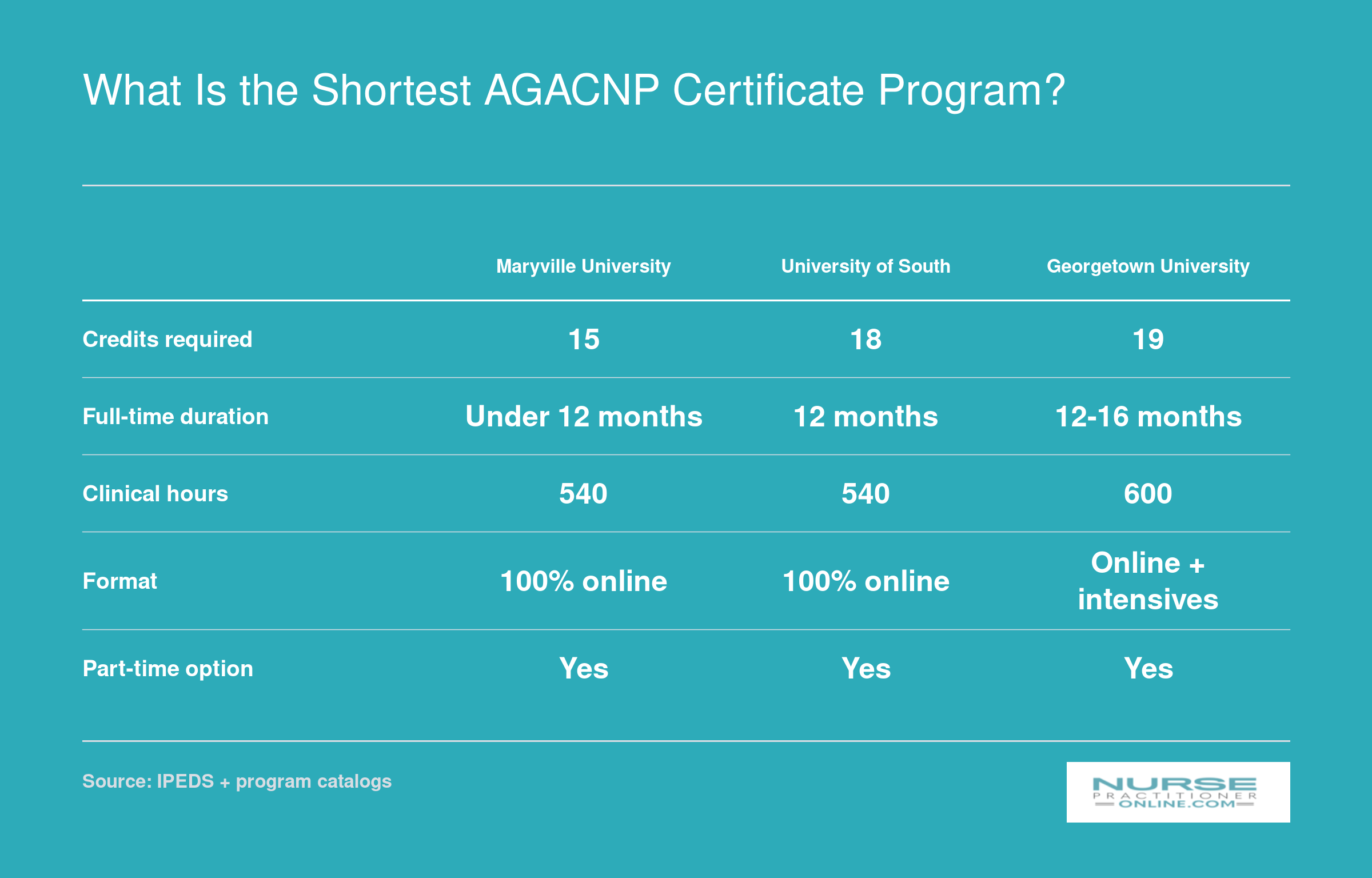
What Is the Shortest AGACNP Certificate Program?
Most AGACNP post-master's certificate programs require 15 to 24 credits and take 12 to 24 months to complete. A handful of programs can be finished in under 12 months by full-time students, especially those who transfer in applicable coursework. Keep in mind that "shortest" depends heavily on pacing: a program listed at 12 months full-time may stretch to 18 or 24 months at part-time pace, which is common among working nurses balancing clinical shifts.
How We Ranked the Fastest AGACNP Post-Master's Certificates
Speed was the primary lens, but it was never the only one. A program that finishes in nine months means little if it cannot place you in a Denver ICU rotation or if its credential will not sit well with the Colorado Board of Nursing. The rankings balance time-to-completion against the practical realities of becoming a board-eligible acute care NP in Colorado.
What Carried the Most Weight
We applied a weighted model that prioritized the factors working nurses ask about first:
- Estimated completion time: Programs advertising 12 to 18 months of full-time or accelerated part-time study ranked highest.
- Total credit hours: Lower credit loads (typically 15 to 30 credits for a post-master's certificate) move you to the finish line faster.
- Clinical hour requirements: AGACNP certificates generally require 500 to 750 supervised hours. Programs with clear, structured placement support scored better.
- Programmatic accreditation: Only programs holding CCNE or ACEN accreditation were considered eligible.
- Colorado authorization: Every ranked program must be authorized to enroll Colorado residents and support clinical placements in the state.
- Tuition: Per-credit cost was factored in, with preference for transparent pricing.
Quality Signals and Their Limits
We include institution-wide graduation rate as a general quality proxy, not as program-specific completion data. Post-master's certificate students are a small, highly motivated subgroup, and their finish rates typically exceed the broader undergraduate figure the institution reports. If you are weighing a certificate against a terminal degree, our guide to online DNP acute care nurse practitioner programs can help you compare timelines and career outcomes.
Similarly, average net price reflects the institution as a whole, mostly undergraduate aid patterns. Your actual certificate cost will depend on per-credit tuition, residency status, and any employer tuition benefits. You can also explore online post-master's ACNP certificate programs nationally to benchmark pricing. Always confirm current figures with the program directly before you commit.
Colorado Authorization & Clinical Placement Support for Out-of-State ACNP Programs
Because most AGACNP post-master's certificate programs that accept Colorado students are based out of state, you will want to verify a few practical details before you commit your time and tuition dollars. The steps below will help you confirm that your chosen program is authorized to operate in Colorado, that you can complete clinical hours near home, and that you will not be blindsided by travel requirements.
Verify State Authorization Through the Colorado Board of Nursing
Colorado requires out-of-state nursing programs to hold proper authorization before enrolling students who live in the state. Start by visiting the Colorado Board of Nursing website (bn.state.co.us) and reviewing its list of approved programs. Authorization status can change from year to year, so confirm the current status even if a program was approved in a prior cycle. The University of Colorado Anschutz Medical Campus, for example, is authorized in 2026 and arranges clinical placements for students in the Denver metro area, making it a strong local benchmark for what support should look like.1
Ask About Clinical Placement Assistance
Clinical hours are often the most stressful piece of any post-master's certificate. Some programs provide dedicated placement coordinators who secure preceptors on your behalf, while others expect you to self-arrange every rotation. Before applying, contact each program's admissions or clinical placement office and ask these questions directly:
- Preceptor sourcing: Does the program locate and vet preceptors in Colorado, or is that your responsibility?
- Existing site agreements: Does the school already hold affiliation agreements with Colorado hospitals or health systems?
- Timeline: How far in advance of your first clinical course should you begin the placement process?
Knowing these answers early prevents last-minute scrambles that can delay your graduation.
Check for Mandatory On-Campus Intensives
Even programs marketed as fully online sometimes require short on-campus visits. These are often listed under headings like "residencies" or "immersion experiences" in a program's catalog or website. A weekend intensive in Washington, D.C. or Chicago may be manageable, but several week-long visits each semester could strain your work schedule and budget. Factor travel, lodging, and time-off costs into your overall program comparison. Checking nursing program accreditation details can also reveal whether a school's on-site requirements align with regional accreditor expectations.
Consult Professional Associations for Regulatory Guidance
The American Association of Nurse Practitioners (AANP) publishes state-by-state resources covering scope of practice, clinical placement regulations, and certification pathways. Reviewing AANP guidance specific to Colorado can help you understand how your post-master's certificate will translate into licensure and practice authority once you finish. If you are still weighing program formats, comparing adult gerontology nurse practitioner programs nationally can give you a broader view of what is available. State regulations around acute care NP certification and collaborative practice agreements evolve, so staying current through a trusted professional organization is well worth the effort.
Taking these steps before you enroll protects both your investment and your timeline, so you can focus on learning rather than logistics.
Related Articles
Curriculum, Credits & Clinical Hour Breakdown
Most AGACNP post-master's certificate programs require between 18 and 30 credits, with clinical hour mandates ranging from 650 to 810 hours depending on the institution.12 Understanding these requirements helps you plan your academic timeline and clinical placement logistics as a working nurse.
Core Curriculum Components
A typical AGACNP post-master's certificate curriculum includes advanced pathophysiology, advanced pharmacology, and advanced health assessment (commonly called the 3 Ps) if you did not complete these courses in your original MSN program. Many programs waive these prerequisites for MSN-prepared nurses who already completed equivalent graduate-level coursework, which can reduce your credit load by 6 to 9 credits.3 Saint Louis University's program, for example, allows 3 to 6 transfer credits for these foundational courses, while Arkansas State University may add up to 9 credits if you need to complete missing prerequisites.5
Beyond the 3 Ps, you will take acute care-specific courses covering diagnostic reasoning, management of acute and critically ill patients across the lifespan, and advanced practice roles in hospital settings. These courses prepare you for clinical rotations in intensive care units, emergency departments, and progressive care environments.
Clinical Hour Requirements and Transfer Policies
Clinical practicum requirements for AGACNP certificates typically range from 650 to 810 direct patient care hours in acute care settings.2 Mount Carmel College of Nursing requires 650 clinical hours, while the University of Arizona mandates 810 hours and Northern Kentucky University sets the bar at 750 hours.78 These hours must be completed in acute care environments such as ICUs, emergency departments, step-down units, and surgical services.
Prior MSN clinical hours rarely transfer toward your AGACNP certificate because certification bodies require role-specific training, with a minimum of 500 supervised clinical hours in the acute care role.5 However, Mount Carmel allows up to 150 hours of transfer credit for relevant acute care clinical experience, a rare but valuable policy for nurses already working in hospital settings.
Accelerated Pacing and Calendar Time
Even when total credit requirements remain fixed, year-round enrollment and compressed term structures can reduce your time to completion. Programs offering multiple start dates per year or 8-week terms instead of traditional semesters let you maintain momentum without breaks, shortening the calendar time from enrollment to certification eligibility. This flexibility is especially valuable for working nurses managing shift schedules alongside coursework.
Questions to Ask Yourself
Cost Comparison: Tuition, Fees & Financial Aid for ACNP Post-Master's Certificates
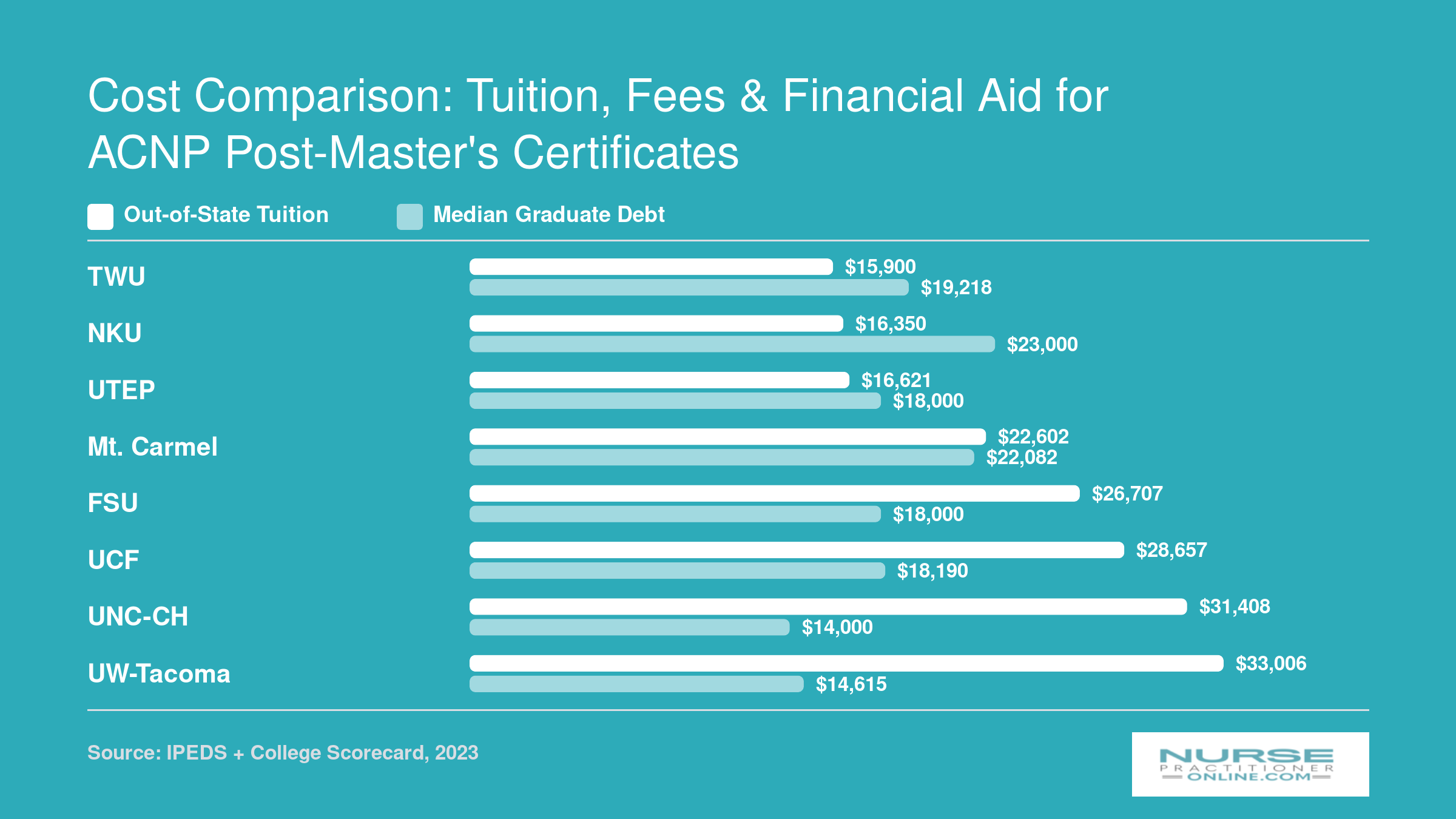
Because no Colorado institution currently offers an AGACNP post-master's certificate, every program on this list charges Colorado students out-of-state or flat-rate tuition. Keep in mind that total cost of ownership goes beyond tuition: budget for clinical-site travel, background checks, and any on-campus immersion days. Financial aid at the post-master's level is typically limited to federal unsubsidized loans and employer tuition reimbursement, so comparing per-credit pricing and median graduate debt is especially important before you commit.
Career Paths & Salary Outlook for Acute Care NPs in Colorado
Earning your ACNP post-master's certificate positions you for higher-acuity roles that typically command premium pay compared to primary care NP positions. The Denver metro area employs roughly 2,190 nurse practitioners, and demand for acute care specialists remains strong across several sub-specialties. Major Denver-area hospital systems including UCHealth, Denver Health, Intermountain Health (formerly SCL Health), HCA HealthONE, and the VA Eastern Colorado Healthcare System actively recruit ACNPs for intensivist, cardiac, trauma, emergency, and surgical roles. Intensivist and critical care ACNP positions carry especially high demand in the Denver metro, followed closely by cardiac and trauma acute care roles. Neurocritical care is a smaller but growing niche. According to BLS data, nurse practitioners in the Denver area earn a median salary of $130,630 per year, which outpaces both the Colorado statewide and national medians. For context, the median RN salary in the same metro is $98,500, meaning the NP credential alone represents a significant earnings jump before you factor in the acute care premium that high-acuity hospital settings often add.
| Role or Location | Median Annual Salary | 25th Percentile | 75th Percentile | Estimated Employment |
|---|---|---|---|---|
| Nurse Practitioners, Denver Metro | $130,630 | $118,030 | $139,620 | 2,190 |
| Nurse Practitioners, Boulder | $134,670 | $114,290 | $145,570 | 260 |
| Nurse Practitioners, Colorado Springs | $125,770 | $108,190 | $138,210 | 470 |
| Nurse Practitioners, Fort Collins | $129,830 | $112,270 | $138,980 | 270 |
| Nurse Practitioners, Greeley | $115,820 | $76,590 | $135,330 | 130 |
| Registered Nurses, Denver Metro | $98,500 | $81,790 | $105,920 | 29,570 |
| Medical and Health Services Managers, Denver Metro | $134,940 | $105,280 | $174,240 | 4,260 |
How to Choose the Right ACNP Post-Master's Certificate as a Working Nurse
Choosing an ACNP post-master's certificate as a working nurse means picking a program that fits around 12-hour shifts, family obligations, and the realities of finding preceptors in your hospital system. The right program is not always the cheapest or the shortest. It is the one you can actually finish while keeping your job and licensure intact.
A Four-Factor Decision Framework
When you compare programs, weigh these four factors in roughly this order:
- Clinical placement support: Ask whether the program places you or expects you to find your own preceptors. If you live in Colorado and the school is in another state, confirm they have placement coordinators familiar with Front Range hospitals.
- Schedule flexibility: Look for asynchronous coursework, evening live sessions, and willingness to accommodate shift workers. Synchronous classes at 10 a.m. on a Tuesday do not work if you are post-call.
- Total cost: Add tuition, fees, technology charges, travel for intensives, and lost wages during clinical rotations. A $25,000 program with three weekend immersions in another state can cost more than a $35,000 fully online option.
- Accreditation and exam alignment: Confirm the program holds CCNE or ACEN accreditation and that its curriculum maps to the certification exam you plan to take.
Full-Time vs. Part-Time Pacing
Full-time completion in 12 to 16 months is intense. You will be juggling 500-plus clinical hours alongside coursework, which usually means cutting back to part-time RN work. Part-time pacing over 24-plus months lets you keep full-time employment but stretches your clinical hour scheduling across more semesters, which can complicate preceptor continuity. Map out which clinical courses run which terms before you commit, and talk to your nurse manager about flexible scheduling early.
Hybrid vs. Fully Online
Many programs marketed as online still require one to three on-campus immersion weekends for skills check-offs. Factor airfare, hotel, and PTO into your budget. If travel is a hardship, prioritize programs that conduct skills validation virtually or at regional sites. For a broader comparison of acute care nurse practitioner programs, reviewing national rankings can help you identify which schools offer the most travel-friendly formats.
Confirm Your Certification Pathway
Before you enroll, verify exam eligibility directly with both the ANCC and AACN. The ANCC AGACNP-BC exam requires a minimum of 500 clinical hours, completion of APRN core courses (advanced pathophysiology, health assessment, and pharmacology), and graduation from a CCNE, ACEN, or NLN CNEA accredited post-graduate certificate program.1 The AACN ACNPC-AG exam requires graduation from a graduate-level adult-gerontology ACNP program at a nationally accredited school of nursing, with specific clinical hour details outlined in the ACNPC-AG Exam Handbook.2 CCNE accreditation does not automatically guarantee eligibility for the AACN exam; alignment with AACN competencies matters. Email the program director and ask point-blank: "Will your graduates sit for both the ANCC AGACNP-BC and the AACN ACNPC-AG?" Get the answer in writing.
The Bureau of Labor Statistics projects that nurse practitioner employment will grow 35 percent from 2024 to 2034, much faster than the average for all occupations, with approximately 32,700 annual job openings. This growth reflects increasing demand for primary and acute care services as healthcare delivery continues to shift toward advanced practice nurses.
Frequently Asked Questions About ACNP Post-Master's Certificates for Colorado Nurses
Colorado nurses researching acute care NP certificates often share the same core questions about program length, format, costs, and clinical requirements. Below are straightforward answers to the questions we hear most often, grounded in current program data for 2026.
- What is the shortest AGACNP post-master's certificate program?
- The shortest programs can be completed in roughly three semesters, or about 12 months of full-time study. Credit requirements typically range from 15 to 24 semester hours depending on how many prior graduate courses transfer in. Programs at the lower end of the credit range, combined with year-round scheduling, offer the fastest path to sitting for the AGACNP certification exam.
- How long is a post-master's ACNP certificate for Colorado students?
- Most Colorado students finish in two to four semesters, which translates to about 12 to 24 months. The exact timeline depends on whether you enroll full time or part time and how many clinical hours you still need. Part-time tracks are popular with working nurses, though they do extend completion by one or two semesters compared to the accelerated options.
- Can I complete an ACNP post-master's certificate fully online from Colorado?
- Yes. Because no Colorado university currently offers an in-state AGACNP post-master's certificate, most Colorado students enroll in online programs at out-of-state schools that hold State Authorization Reciprocity Agreement (SARA) membership or individual Colorado authorization. Didactic coursework is fully online, though you will complete clinical rotations in person at a Colorado site.
- What are the clinical hour requirements for an AGACNP post-master's certificate?
- Clinical requirements generally fall between 500 and 750 direct patient care hours, depending on the program and your prior NP specialty. Some schools grant gap-analysis credit for overlapping competencies, which can reduce hours. All clinical rotations must take place in acute care settings such as ICUs, emergency departments, or inpatient specialty units under a qualified preceptor.
- How much does an ACNP post-master's certificate cost?
- Total tuition typically ranges from about $12,000 to $30,000, depending on the institution, credit load, and whether the school charges in-state or flat-rate online tuition. Additional costs include certification exam fees, background checks, and clinical compliance items. Many programs accept federal financial aid, and some employers offer tuition reimbursement for advanced practice credentials.
- What is the difference between an AGACNP and AGPCNP post-master's certificate?
- The Adult-Gerontology Acute Care NP (AGACNP) certificate prepares you to manage patients with complex, unstable, or critical conditions in hospital and acute settings. The Adult-Gerontology Primary Care NP (AGPCNP) certificate focuses on outpatient, preventive, and chronic disease management. Each leads to a different national certification exam, so your choice should align with the clinical environment where you plan to practice.
More Online ACNP Post-Master's Certificate Programs for Colorado Students
Beyond our top-ranked programs, these additional accredited options offer flexible online or hybrid formats that welcome Colorado students. Each school provides a path to AGACNP certification with features like distance learning, local clinical placements, and competitive tuition.
Other
The University of Texas at Tyler Tyler, TX · Hybrid
- Adult Gerontology Acute Care Nurse Practitioner (AGACNP) Certificate
University of Connecticut Storrs, CT · Online
- Adult Gerontology Acute Care Nurse Practitioner
Duke University Durham, NC · Hybrid
- Adult-Gerontology Acute Care Nurse Practitioner Post-Graduate Certificate
University of South Carolina Columbia, SC · Online
- Adult Gerontology-Acute Care Nurse Practitioner, Certificate
Texas Tech University Health Sciences Center Lubbock, TX · Hybrid
- Post-Graduate Adult-Gerontology Acute Care Nurse Practitioner Certificate
University of Kentucky Lexington, KY · Hybrid
- Adult Gerontology Acute Care Nurse Practitioner
East Carolina University Greenville, NC · Online
- Post-Master's Certificate in Adult-Gerontology Acute Care Nurse Practitioner
Texas Woman's University Denton, TX · Online
- Post-master's Certificate in Adult-Gerontology Acute Care Nurse Practitioner
Mount Carmel College of Nursing Columbus, OH · Hybrid
- Post-Graduate Certificate: Adult-Gerontology Acute Care Nurse Practitioner
Northern Kentucky University Highland Heights, KY · Online
- Post-Master's Adult-Gero Acute Care Nurse Practitioner Certificate
University of Alabama at Birmingham Birmingham, AL · Hybrid
- Post-Graduate APRN Certificate (Adult-Gerontology Acute Care Nurse Practitioner)
University of Louisville Louisville, KY · Hybrid
- Adult Gerontology Acute Care Nurse Practitioner
North Dakota State University Fargo, ND · Hybrid
- Adult-Gerontology Acute Care Nurse Practitioner
The University of Texas Medical Branch at Galveston Galveston, TX · Hybrid
- Adult-Gerontology Acute Care Nurse Practitioner Post-MSN Certificate
Miami Regional University Miami Springs, FL · Hybrid
- Adult Gerontology Acute Care Post-Master Certification