Most important takeaways…
- Tampa-area nurse practitioners earn a median of $128,430 per year, roughly $44,000 more than the median RN salary locally.
- Accredited MSN-PNP options near Tampa are limited, so expect to compare in-state public programs statewide for the best tuition value.
- Florida's full practice authority law lets experienced PNPs practice independently after meeting supervised clinical hour requirements.
- Most Florida PNP programs use a hybrid format, pairing online coursework with required on-campus or clinical intensive days.
Pediatric nurse practitioner programs in Florida are notably scarce compared to the dozens of family nurse practitioner tracks available statewide. In the Tampa area, only one accredited MSN-PNP program currently operates, a reality that narrows your choices but sharpens the value of understanding what you will actually pay.
Cost is the decision factor that separates a manageable degree from years of loan repayment. The University of South Florida's program runs 57 credit hours with in-state tuition near $10,400, though total expenses climb once you factor in fees, clinical supplies, and certification exam costs. If you are comparing Tampa's option against nearby markets, pediatric nurse practitioner programs near Lakeland offer another Florida benchmark worth reviewing.
Florida's 2025 expansion of full practice authority has made the PNP credential more valuable than ever, but limited program availability means planning ahead is essential.
Most Affordable MSN PNP Programs Near Tampa, Florida
Programs below were selected from accredited MSN Pediatric Nurse Practitioner offerings within reach of Tampa-area nurses and ranked by affordability using net price after financial aid. Because only one accredited MSN-PNP program currently operates in the immediate Tampa region, the list reflects that reality rather than padding with unrelated schools. If additional programs become available, nursepractitioneronline.com will update this ranking.
- Net price after financial aid
- In-state and out-of-state tuition
- Institutional graduation rate
- Program credit requirements
- Clinical integration and outcomes
- NCES-IPEDS federal institutional data — nces.ed.gov
- College Scorecard graduate earnings — collegescorecard.ed.gov
- Internal program database
- Independent program research

University of South Florida
The University of South Florida is a major public research institution in Tampa that consistently ranks among the most affordable graduate nursing options in the state. With a strong in-state tuition advantage and deep integration with Tampa Bay's pediatric clinical network, USF positions graduates for immediate local employment. The university also carries military-friendly designation, opening additional funding pathways for service-connected students.
- 57 credit hours covering pediatric assessment, diagnosis, and management
- Prepares graduates for the PNCB Pediatric Primary Care NP Certification Exam
- Lock-step and new-graduate program plans offer structured pacing
- Family-centered curriculum spans infancy through adolescence
- Comprehensive examination required before graduation
- Clinical placements coordinated across Tampa Bay pediatric sites
- In-state graduate tuition significantly below private alternatives
Pediatric Primary Care Nurse Practitioner (MSN) — On-Campus
What Actually Drives the Cost of an MSN-PNP Program?
Tuition per credit hour is only the starting line when you tally the real cost of earning your MSN as a pediatric nurse practitioner, and overlooking the smaller line items can leave you thousands of dollars short at the worst possible time.
Credit-Hour Rates Vary More Than You Might Expect
Florida's public universities publish graduate nursing tuition on their college of nursing or graduate studies web pages, and the differences can be significant. For the 2025-2026 catalog year, in-state graduate credit-hour rates at schools like USF, FIU, and UF each carry their own base tuition plus university, technology, and health fees that shift the effective per-credit cost upward. Because MSN-PNP programs typically require 40 to 50 credit hours, even a $30 difference per credit compounds into well over $1,000 across the degree. Pull up the tuition and fee schedule directly from each university's website rather than relying on third-party estimates, since published rates are updated annually and sometimes mid-cycle. If you are still comparing programs nationally, our guide to MSN pediatric nurse practitioner programs can help you benchmark Florida options against the broader market.
Fees That Hide in Plain Sight
Beyond tuition, anticipate costs that rarely appear in headline figures:
- Simulation and lab fees: Many PNP programs charge per-semester lab or simulation fees ranging from a few hundred to over a thousand dollars.
- Clinical liability insurance: Required before you set foot in a clinical site, typically $50 to $150 per year.
- Background checks and drug screens: Usually $75 to $150, sometimes repeated before each new clinical rotation.
- Technology and proctoring fees: Online and hybrid students often pay platform or exam-proctoring charges each term.
The most reliable way to get a complete breakdown is to contact the program's administrative office or financial aid department directly by phone or email. Staff can walk you through program-specific costs that may not be itemized on a public web page.
Certification Exam Costs After Graduation
Your degree alone does not make you a certified PNP. You will sit for a national certification exam through either the Pediatric Nursing Certification Board (PNCB) or the American Nurses Credentialing Center (ANCC). Exam fees for both organizations are typically in the $300 to $400 range, though they may be adjusted annually. Always confirm the current fee on the PNCB or ANCC official website before budgeting, because outdated figures circulate widely online.
Contextualizing Cost Against Earning Potential
Before you finalize a program choice based on sticker price alone, visit the Bureau of Labor Statistics at BLS.gov to review broad employment and wage data for nurse practitioners. Comparing total program cost against projected earnings in your target region, whether Tampa, Orlando, or elsewhere in Florida, helps you evaluate return on investment rather than simply chasing the lowest tuition number. A program that costs a few thousand more but offers stronger clinical placement support or higher certification pass rates may pay for itself within the first year of practice.
Online, Hybrid, or On-Campus: Delivery Formats for Florida PNP Programs
Most Florida MSN-PNP programs have settled into a hybrid model, blending asynchronous online coursework with required on-campus or clinical days rather than going fully one direction or the other.1
What 'Online' Actually Means in a PNP Program
Here is the point that trips up a lot of applicants: no MSN-PNP program is truly online in the way you might stream a course on your own schedule with zero travel. Every program, regardless of how the didactic coursework is delivered, requires in-person clinical hours. Florida's Board of Nursing and national certification bodies set those requirements, and no school can waive them. When a program calls itself online, it means the classroom lectures and assignments happen remotely. Your clinical rotations in pediatric settings still happen in person, and you arrange those locally, usually with the help of your program's placement support. If you are still weighing how the enrollment process works for remote-friendly programs, our guide on how to enroll in NP school online walks through the steps.
Format Comparison at a Glance
- Schedule flexibility: Online programs (Herzing, Rasmussen) offer the most flexibility for working nurses since coursework is largely self-paced. Hybrid programs (USF, FIU, UF) require you to be available for scheduled campus days throughout the year.1
- Campus visits: USF requires multiple campus days each academic year.2 FIU expects in-person attendance each semester. UF schedules periodic campus visits. Herzing students may see anywhere from zero to three brief visits depending on their cohort.2 Rasmussen keeps campus requirements limited.
- Clinical requirements: All five programs require supervised in-person clinical hours in pediatric settings, regardless of how online the rest of the curriculum is.
- Technology needs: Online and hybrid formats both assume a reliable broadband connection, a capable laptop, and comfort with learning management systems. Online-heavy programs lean harder on video conferencing and digital simulation tools.
- Typical student profile: Fully online formats tend to attract nurses who are already working full time and live far from a main campus. Hybrid formats appeal to nurses who prefer some face-to-face instruction and live within reasonable driving distance of a Florida campus.
Matching Format to Your Situation
If you are based in or near Tampa, USF and FIU are close enough that hybrid requirements are manageable. If you are farther out or your schedule makes regular campus trips genuinely difficult, Herzing or Rasmussen may be the more realistic fit. For a broader look at accredited online pediatric nurse practitioner programs nationwide, our rankings page compares costs and format details side by side. The honest question to ask any program is not just how many campus days are required, but when those days are scheduled and how much notice you receive, since those logistics matter just as much as the raw number.
Related Articles
Admission Checklist for Florida MSN PNP Programs
Before you start filling out applications, gather everything you'll need in one place. Most Florida pediatric nurse practitioner programs share a core set of requirements, though a few details vary by school.
- BSN from an accredited institutionAll Florida PNP programs require a Bachelor of Science in Nursing from a program accredited by CCNE or ACEN. Make sure your official transcripts are ready to submit through the centralized application system (many programs, including USF, use NursingCAS).
- Minimum GPA of 3.0A cumulative GPA of 3.0 on a 4.0 scale is the standard threshold across most Florida programs. Some schools set the bar slightly higher for competitive admission, so aim above the minimum when possible.
- Active, unencumbered RN licenseYou'll need a current U.S. RN license in good standing. At USF, for example, applicants must also hold a Florida RN license by October 30 of the enrollment year, so plan your endorsement timeline accordingly.
- Clinical nursing experienceMost programs expect at least one to two years of RN experience. Pediatric or acute care background is preferred but not always mandatory, USF requires a minimum of one year. Highlight any relevant population-specific experience in your application.
- Prerequisite courseworkCommon prerequisites include undergraduate statistics and health assessment. Review each program's specific course requirements early, because completing missing prerequisites can add a semester to your timeline.
- Goal statement and résumé or CVPrepare a professional goal statement explaining why you want to specialize in pediatric care and how the program fits your career plan. Pair it with an up-to-date CV that details your clinical roles, certifications, and any leadership experience.
- Letters of recommendationExpect to provide two to three professional references. USF requires three letters. Choose recommenders who can speak to your clinical competence and readiness for advanced practice, nurse managers, supervising physicians, or faculty mentors work well.
- GRE scores (check waiver policies)GRE requirements are increasingly flexible. USF recommends the GRE but offers a waiver for applicants with a GPA of 3.2 or higher or at least five years of nursing experience. Other Florida programs have dropped the requirement entirely, so verify each school's current policy before paying for the exam.
- Application deadlinesDeadlines vary by program and cohort. USF's priority deadline for fall admission is February 15, with a final deadline of July 1. Applying by the priority date gives you the best shot at admission and any available funding, so mark your calendar early.
Questions to Ask Yourself
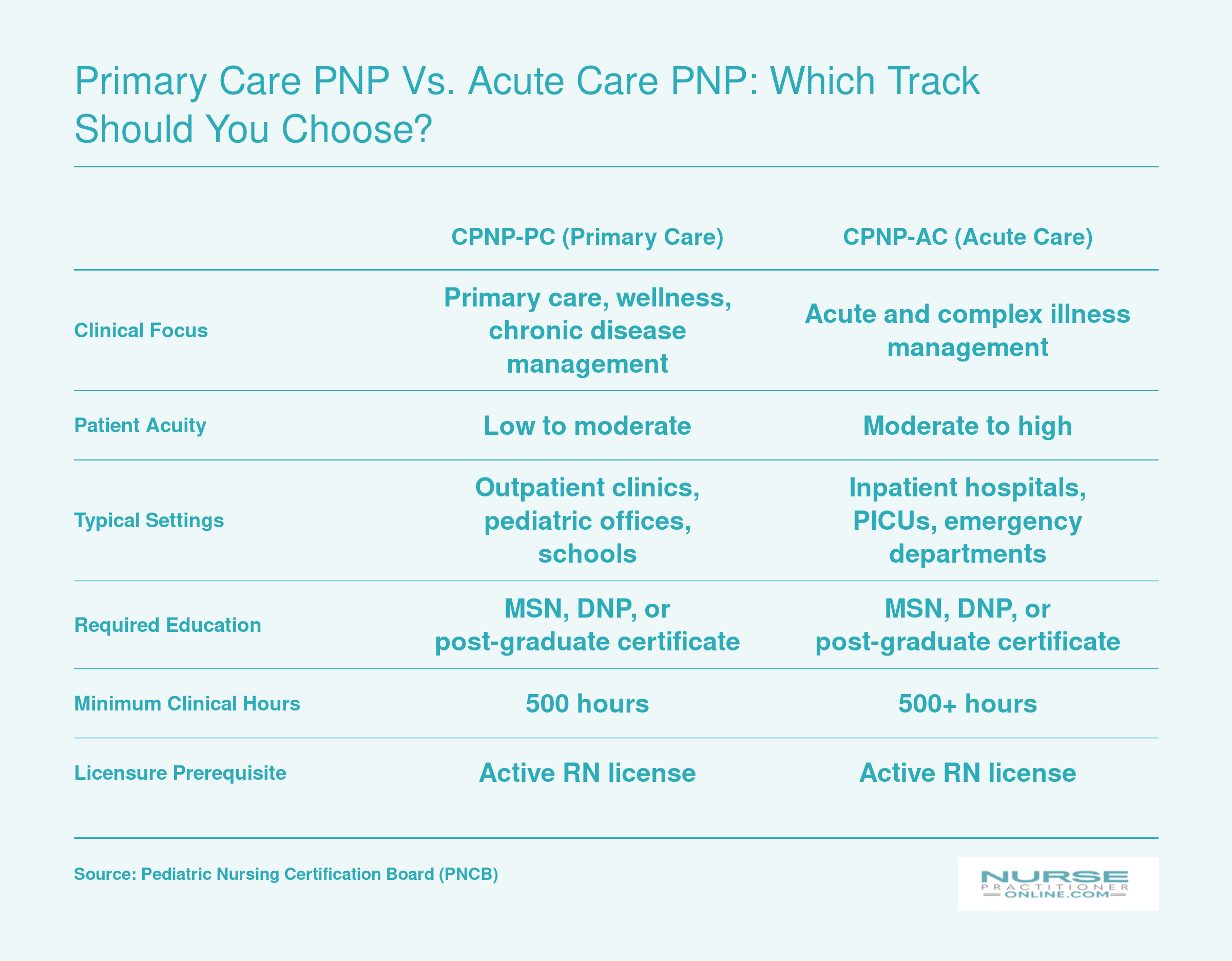
Primary Care PNP vs. Acute Care PNP: Which Track Should You Choose?
Your track choice locks in the certification exam you sit for and the scope of practice you carry for your entire career, so this decision needs to happen before you apply. Both the CPNP-PC and CPNP-AC are certified through the Pediatric Nursing Certification Board (PNCB) and accredited by the NCCA, but they prepare you for very different clinical roles. Keep in mind that not every Florida program offers both tracks; several only offer the primary care pathway, so confirm availability early.
PNP Earnings in Tampa and Across Florida
Salary data from the U.S. Bureau of Labor Statistics shows that nurse practitioners in the Tampa metro area earn a median annual wage of $128,430, which represents a significant jump over the median RN salary of $84,290 in the same region. That roughly $44,000 annual increase means that even if you invest $25,000 to $45,000 in one of the more affordable MSN PNP programs featured in this article, you could recoup your tuition costs within the first year of practice. The table below breaks down NP wages across percentiles for Tampa and several nearby Florida metros so you can see the full earning range.
| Metro Area | 10th Percentile | 25th Percentile | Median (50th) | 75th Percentile | 90th Percentile |
|---|---|---|---|---|---|
| Tampa, St. Petersburg, Clearwater | Not reported | $105,410 | $128,430 | $134,190 | Not reported |
| Miami, Fort Lauderdale, West Palm Beach | Not reported | $109,990 | $135,450 | $150,840 | Not reported |
| Jacksonville | Not reported | $107,680 | $129,530 | $132,590 | Not reported |
| Orlando, Kissimmee, Sanford | Not reported | $107,860 | $128,210 | $132,790 | Not reported |
| North Port, Bradenton, Sarasota | Not reported | $109,230 | $130,780 | $135,920 | Not reported |
| Cape Coral, Fort Myers | Not reported | $120,160 | $143,670 | $143,670 | Not reported |
| Lakeland, Winter Haven | Not reported | $103,880 | $123,140 | $129,310 | Not reported |
| Port St. Lucie | Not reported | $117,990 | $132,230 | $137,300 | Not reported |
| Palm Bay, Melbourne, Titusville | Not reported | $102,970 | $115,140 | $128,870 | Not reported |
| Deltona, Daytona Beach, Ormond Beach | Not reported | $102,820 | $124,440 | $131,200 | Not reported |
Scholarships, Loan Forgiveness, and Tuition Help for Florida Nursing Students
Graduate nursing students in Florida have access to a layered system of financial support that can significantly reduce out-of-pocket costs for an MSN-PNP degree. The challenge lies in knowing where to look and understanding that most funding sources require proactive research and direct outreach rather than automatic awards.
State-Level Loan Forgiveness for Florida Nurses
Florida operates a Nursing Student Loan Forgiveness Program designed to encourage nurses to practice in underserved areas or high-need facilities. Eligibility requirements, application deadlines, and current funding status change periodically. For accurate details, visit the Florida Department of Education's Office of Student Financial Assistance website and search specifically for "Nursing Student Loan Forgiveness Program." Do not rely on secondhand summaries, as the terms may shift year to year. For a broader look at repayment relief options, our guide to student loan forgiveness options for nurse practitioners covers four major federal and state pathways.
Federal Support Through NURSE Corps
The NURSE Corps Scholarship Program covers tuition, fees, and provides a monthly living stipend for students enrolled at least half-time in graduate nursing programs leading to advanced practice licensure.2 In exchange, recipients commit to a two-year service obligation at a Critical Shortage Facility or in a high-need area.2 PNP students may qualify, but funding availability fluctuates with federal appropriations. The NURSE Corps Loan Repayment Program offers a separate track, repaying 60 percent of qualifying nursing education debt for those who commit to working in underserved communities.2 Confirm current eligibility requirements and application windows directly on the official NURSE Corps website at bhw.hrsa.gov.
Employer Tuition Reimbursement in the Tampa Area
Major Tampa-area health systems frequently offer tuition assistance for employees pursuing advanced nursing degrees. BayCare, AdventHealth, and Tampa General Hospital each maintain distinct policies covering graduate nursing education, often with service commitments attached. These programs are not always advertised publicly. Contact each hospital's human resources department or tuition reimbursement coordinator directly to ask about graduate nursing tuition assistance, maximum annual benefits, and any required employment tenure before or after your degree.
Professional Association Resources
The AACN maintains a scholarship and financial aid resource page that compiles opportunities relevant to nurses pursuing advanced practice credentials.3 The American Association of Nurse Practitioners at aanp.org also lists scholarship opportunities specific to NP students. Both organizations can point you toward regional awards that receive fewer applicants than national competitions.
Federal Student Loans as a Baseline
When scholarships and employer support fall short, federal loans remain available. Graduate students can borrow up to $20,500 annually through the Federal Direct Unsubsidized Loan program, with an aggregate limit of $138,500 including undergraduate debt.4 The 2024 to 2025 interest rate sits at 8.08 percent with a 1.057 percent origination fee.4 Graduate PLUS loans cover remaining costs at 9.08 percent interest and a 4.228 percent origination fee.4 Complete the FAFSA early; the 2025 to 2026 application opened in December 2024.5
USF's College of Nursing awarded over 380 scholarships totaling $730,000 in private scholarship funds during the 2024 to 2025 academic year, demonstrating that institutional aid at Florida schools can be substantial for those who apply.6
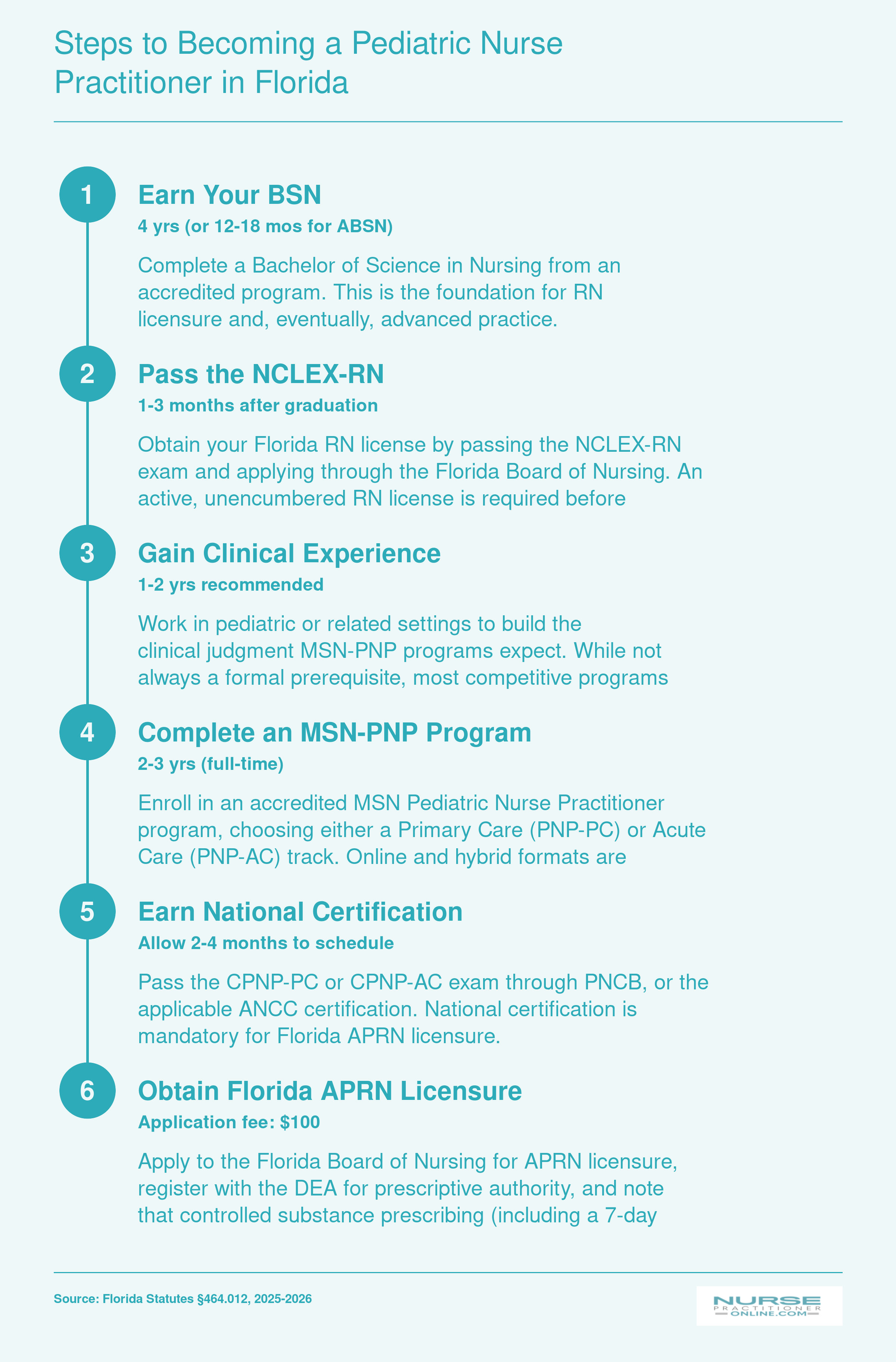
Steps to Becoming a Pediatric Nurse Practitioner in Florida
The path from BSN to practicing PNP in Florida typically takes 6-8 years, with the MSN portion accounting for 2-3 of those years. Here is a step-by-step look at each milestone, including Florida-specific requirements under §464.012.
Frequently Asked Questions About PNP Programs in Florida
Choosing a pediatric nurse practitioner program is a big decision, especially when you are balancing shifts, family, and finances. Below are answers to the questions Tampa-area nurses ask most often about MSN PNP programs in Florida.
- How much does a pediatric nurse practitioner make in Tampa, Florida?
- The Bureau of Labor Statistics does not break out pediatric NP pay separately, but nurse practitioners in the Tampa-St. Petersburg-Clearwater metro area earn a median salary of roughly $128,430 per year. The middle 50 percent fall between about $105,410 and $134,190. PNP salaries can vary depending on whether you work in primary care, hospital-based acute care, or specialty clinics.
- Can you complete a pediatric nurse practitioner program entirely online in Florida?
- Several Florida schools offer fully online didactic (classroom) coursework for NP programs, and that model extends to many PNP tracks. However, every accredited program still requires hands-on clinical hours completed in person at approved pediatric sites. So while you can do most of your studying from home, plan on spending several hundred hours in face-to-face clinical rotations near your community.
- How long does it take to finish an MSN PNP program?
- Most MSN PNP programs require roughly 40 to 50 semester credits and take full-time students about two to three years to complete. Part-time options, which many working RNs prefer, may stretch the timeline to three or four years. Clinical hour requirements typically range from 500 to over 600 hours, and scheduling those rotations can influence your overall pace.
- What is the difference between PNCB and ANCC certification for pediatric nurse practitioners?
- The Pediatric Nursing Certification Board (PNCB) offers the Certified Pediatric Nurse Practitioner exam in both primary care (CPNP-PC) and acute care (CPNP-AC) tracks. The American Nurses Credentialing Center (ANCC) also offers a pediatric primary care NP certification. Both credentials satisfy Florida Board of Nursing requirements for APRN licensure. Your choice often depends on which exam your program prepares you for and which credential your employer recognizes.
- Do Florida PNP programs help with clinical preceptor placement?
- Policies vary widely. Some institutions arrange clinical placements and coordinate preceptor agreements on your behalf, while others use a student-driven model where you are responsible for finding your own sites. In all cases, preceptors and clinical locations must meet the school's approval requirements and hold active contracts with the program. If your school does not place you directly, third-party preceptor matching services can help you locate qualified pediatric preceptors in the Tampa area.
Florida by City
- ACNP Programs in Florida
- AGNP Programs in Florida
- DNP NP Programs in Florida
- FNP Programs in Florida
- Fort Lauderdale, Florida (FNP)
- Fort Myers, Florida (FNP)
- Lakeland, Florida (PNP)
- Miami, Florida (AGNP)
- Miami, Florida (PNP)
- Orlando, Florida (FNP)
- PMHNP Programs in Florida
- PNP Programs in Florida
- Sarasota, Florida (FNP)