Most important takeaways…
- Florida offers BSN-to-MSN, BSN-to-DNP, and post-master's certificate routes into AGACNP practice.
- Most programs labeled "online" still require on-campus intensive weekends or simulation lab days in Florida.
- ACNP clinical rotations take place in high-acuity settings like ICUs and emergency departments across the state.
- The ANCC AGACNP-BC certification exam and a separate Florida APRN license are both required before treating patients.
Florida's hospitals and ICUs depend on adult-gerontology acute care nurse practitioners (AGACNPs) to manage patients on ventilators, titrate vasoactive drips, and lead rapid responses, a scope that separates them sharply from adult-gerontology primary care NPs (AGPCNPs). Nurses who confuse the two tracks often find themselves credentialed for a role they never intended. If you are weighing the differences, our breakdown of ACNP vs AGNP can help clarify which path matches your clinical goals.
The ranked programs that follow align with Florida's practice environment, but tuition figures, clinical placement logistics, and state licensure requirements still create real friction. A program that looks affordable on paper can stall your entry to the workforce if its hospital partnerships are weak.
Florida's Top Online AGACNP Programs for 2026
The programs below represent Florida's strongest online-delivery Adult-Gerontology Acute Care Nurse Practitioner options for 2026. Rather than relying on a single metric, this ranking weighs a composite of graduation rate, effective net price, post-completion earnings, and online or hybrid format availability. Whether you are pursuing a BSN-to-DNP, an MSN, or a post-master's certificate, each school offers a distinct path to AGACNP certification while letting you keep working at the bedside.
- Institution-wide graduation rate
- Effective net price after aid
- Post-completion median earnings
- Online or hybrid delivery format
- Program breadth and flexibility
- NCES-IPEDS federal institutional data — nces.ed.gov
- College Scorecard graduate earnings — collegescorecard.ed.gov
- Internal program database
- Independent program research

University of Florida
The University of Florida pairs one of the state's highest institution-wide graduation rates (91%) with the lowest effective net price among ranked programs, creating strong long-term value for Florida residents. Its AGACNP track sits within a hybrid DNP pathway that blends online coursework with clinical placements at high-acuity inpatient sites across the state. Students choose full-time or part-time pacing and graduate eligible for both ANCC and AACN certification, a dual-exam readiness feature not every program emphasizes.
- Hybrid DNP with online didactics and Florida-based clinicals
- Full-time and part-time pacing available
- Minimum one year of critical care RN experience required
- Prepares graduates for both ANCC and AACN certification exams
- Individualized clinical learning experiences with specialty directors
- In-state tuition approximately $12,737 per year
- Travel may be needed for clinical site rotations
BSN to DNP Adult-Gerontology Acute Care Nurse Practitioner — Hybrid

Florida State University
Florida State University stands out for offering both a fully online post-master's certificate and a hybrid DNP under one College of Nursing roof. The 22-credit online certificate is a focused entry point for MSN-prepared nurses who want acute care credentials without a doctoral commitment, while the DNP track accommodates BSN holders. FSU's CCNE-accredited curriculum is intentionally aligned with Florida Board of Nursing APRN licensure requirements, and clinical partnerships in the Tallahassee and North Florida corridor give students access to large teaching hospitals.
- Fully online delivery with synchronous components
- 22 credit hours beyond an existing MSN or DNP
- CCNE-accredited through Florida State's College of Nursing
- Curriculum covers complex illness management and ICU-level skills
- Simulation exercises complement online lectures and labs
- Prepares graduates for AGACNP national certification
- Hybrid format at $444 per credit hour
- Full-time and part-time study options available
- Four on-campus day sessions required during the program
- Synchronous and asynchronous coursework blend
- Capstone project required for degree completion
- 1 to 2 years of acute care RN experience recommended
- Eligible for both ANCC and AACN certification upon completion
Adult Gerontology Acute Care Nurse Practitioner Post-Master's Certificate — Online
BSN to DNP Adult-Gerontology Acute Care Nurse Practitioner — Hybrid

University of South Florida
Located in Tampa, the University of South Florida channels its deep ties to Tampa General Hospital and West-Central Florida health systems into a BS-DNP with an Adult-Gerontology Acute Care concentration. The hybrid program pairs online coursework with hands-on clinical experiences in one of the state's busiest trauma and critical care corridors. Both part-time and full-time course sequences are tailored at admission, helping working nurses balance shifts with doctoral study. Financial aid and nursing-specific scholarships may further offset its already competitive in-state tuition.
- Hybrid DNP blending online lectures with clinical rotations
- Part-time and full-time sequences customized upon admission
- Focuses on acute, critical, and chronic illness across adults
- Clinical sites leverage Tampa Bay regional hospital partnerships
- Graduates eligible for ANCC or AACN certification exams
- Financial aid and scholarships may be available
- In-state tuition approximately $10,428 per year
BS-DNP Adult-Gerontology Acute Care Concentration — Hybrid

University of Central Florida
UCF's AGACNP portfolio is built around Central Florida's demand for acute care nurse practitioners, with clinical ties to Orlando-area trauma centers and specialty ICUs. The 23-credit post-master's graduate certificate is the highlight for nurses who already hold an MSN or DNP and want a focused path to acute care certification. Hybrid delivery keeps didactic work online while requiring select on-campus activities at the Orlando campus, reinforcing interprofessional learning with regional health systems.
- Hybrid format: 23 credit hours beyond MSN or DNP
- Requires current national certification as an APRN
- Emphasizes evidence-based practice and diagnostic reasoning
- Covers disease prevention through critical care management
- Clinical hours integrated with Orlando-area health systems
- Prepares graduates for Florida state APRN licensure
- Flexible curriculum designed for working professionals
Adult-Gerontology Acute Care Nurse Practitioner Post-Master's Certificate — Hybrid

Miami Regional University
Miami Regional University offers a concentrated 12-month post-master's certificate built for South Florida nurses who want an accelerated route into acute care. The 30-credit, 810-clinical-hour hybrid program pairs primarily online coursework with required on-campus skills sessions during the first semester. Clinical preceptorships run throughout, with the university able to appoint South Florida preceptors if students cannot secure their own. Eligibility is limited to residents of Florida or SARA member states.
- Accelerated 12-month hybrid program
- 30 semester credits with 810 total clinical hours
- Primarily online coursework with on-campus skills sessions
- Three-day simulation weekend included in first semester
- MSN degree and current RN license required for admission
- ACLS and BLS certifications required before enrollment
- University can appoint preceptors in South Florida if needed
- Residency in Florida or SARA member state required
Adult Gerontology Acute Care Post-Master's Certificate — Hybrid

Nova Southeastern University
Nova Southeastern University provides one of the broadest AGACNP program menus among Florida private schools, spanning an MSN, a BSN-to-DNP, and a postgraduate certificate. All three routes use a hybrid model centered on the Palm Beach campus, with clinical networks stretching across Broward, Miami-Dade, and Palm Beach counties. The 45-credit MSN can be completed in six semesters, while the BSN-to-DNP requires 75 credits and over 1,000 clinical hours. A 225-mile residency requirement ensures students can reach affiliated clinical sites and campus intensives.
- CCNE-accredited, 45-credit MSN completed in six semesters
- Full-time and part-time options with fall or winter starts
- Hybrid delivery with optional live Zoom sessions
- Capstone project required for degree completion
- Dedicated faculty adviser throughout the program
- Financial aid and scholarships available
- 75-credit doctoral program with hybrid delivery
- Over 1,000 total clinical hours in South Florida sites
- Advanced acute care specialization with leadership focus
- Designed for BSN-prepared nurses entering doctoral study
- Clinical partnerships across Broward and Palm Beach counties
- Prepares graduates for Florida APRN licensure
- 24-credit hybrid certificate over four semesters
- On-site sessions held at Palm Beach campus
- Requires MSN degree and Florida RN licensure
- Minimum 12 months of clinical experience for admission
- Includes 170 practicum and 225 clinical hours
- Prepares for national AGACNP certification
MSN Nurse Practitioner in Adult-Gerontology Acute Care — Hybrid
BSN to DNP Adult-Gerontology Acute Care Nurse Practitioner — Hybrid
Adult-Gerontology Acute Care Nurse Practitioner Postgraduate Certificate — Hybrid

Barry University
Barry University brings a distinctly small-cohort, high-touch approach to AGACNP education in the Miami area. Its CCNE-accredited post-master's certificate and BSN-to-DNP both feature personalized curriculum plans and a 7:1 student-to-faculty ratio, the lowest among ranked Florida programs. A 30% tuition scholarship for qualifying students helps offset private-school pricing. Clinical placements lean on South Florida hospitals and ICU settings, making it a strong fit for Miami and Broward-based nurses who value individualized advising and local clinical access.
- Hybrid post-master's certificate with personalized curriculum
- Requires MSN degree, 3.3 GPA, and national certification
- Small class sizes with individualized faculty advising
- Focuses on acute, chronic, and critical condition management
- Competitive tuition with scholarship and financial aid options
- Strong certification pass rates reported by the program
- CCNE-accredited hybrid doctoral program
- 12-semester timeline with part-time pacing available
- 1,000 clinical hours in South Florida acute care settings
- 30% tuition scholarship available for qualifying students
- Prepares for ANCC certification and Florida ARNP licensure
- Graduate assistantships available to offset costs
- Technology-enhanced format designed for working nurses
Adult-Gerontology Acute Care Nurse Practitioner Post-Master's Certificate — Hybrid
BSN to DNP Adult-Gerontology Acute Care Nurse Practitioner — Hybrid
How These ACNP Rankings Were Built
Each program on this list passed through a weighted composite that rewards online accessibility alongside institutional outcomes, rather than relying on subjective reputation or promotional materials. The goal is straightforward: surface Florida AGACNP programs that combine flexible delivery with measurable performance indicators, giving working nurses a clearer picture of what each option actually offers.
The Four Ranking Pillars
Four data points anchor this methodology:
- Institution-wide graduation rate: This figure reflects how effectively a university supports students through to completion. While it covers all degree levels rather than ACNP cohorts specifically, schools with strong graduation rates tend to have robust student services, advising, and retention support.
- Average net price after aid: Sticker prices rarely tell the full story. This metric captures what students actually pay once grants, scholarships, and institutional aid are factored in, offering a more realistic view of total investment. If cost is a top concern, you may also want to explore affordable nurse practitioner programs across the country.
- Post-completion earnings: Where available, program-level salary data from federal sources shows what graduates earn after finishing. This provides a concrete measure of return on investment, though not all programs have published figures yet.
- Confirmed online or hybrid delivery: Only programs with verified distance-learning options appear here. Clinical hours require in-person time, but didactic coursework must be accessible remotely for nurses balancing shifts and family responsibilities.
What This Ranking Does Not Measure
Curriculum depth, faculty-to-student ratios, and clinical placement quality fall outside this composite. Those factors matter enormously, and later sections address them in detail. Similarly, the graduation rate reflects university-wide performance, not ACNP-specific retention. And net price represents an average across all aided students, so your actual cost may differ based on residency, employer tuition benefits, or merit awards. Nurses considering a doctoral pathway in the state can review our guide to online DNP nurse practitioner programs Florida for additional comparisons.
Think of this ranking as a starting filter. It identifies programs worth investigating further, not a definitive verdict on which school fits your particular situation.
Fully Online or Hybrid? What Florida ACNP Programs Actually Require
Most Florida AGACNP programs market themselves as "online," but the on-the-ground expectations vary widely. Before you commit, you need to know exactly how many days you will spend on campus, whether simulation labs are bundled into intensive weekends or spread across the semester, and whether your home address could disqualify you from clinical placement. Here is a side-by-side look at four key dimensions across the state's major programs.
| Program | Campus Intensive or Simulation Requirement | Asynchronous vs. Synchronous Lecture Split | Clinical Placement Geographic Restrictions |
|---|---|---|---|
| University of Florida (BSN to DNP) | Hybrid: on-site simulation and skills days required; students should plan for travel to Gainesville for scheduled intensives | Primarily asynchronous coursework with select synchronous sessions | Clinical sites limited to Florida only; students must arrange experiences within the state |
| Florida State University (Post-Master's Certificate) | Listed as online delivery; simulation exercises are incorporated but synchronous course components suggest scheduled virtual or on-site sessions | Online lectures with required synchronous components each term | Clinical rotations required; contact the College of Nursing for current county or region restrictions |
| University of South Florida (BS to DNP) | Hybrid format: expect on-campus skills labs and simulation weekends at the Tampa campus | Mix of asynchronous modules and scheduled synchronous class meetings | No published statewide residency restriction, but clinical experiences are coordinated through USF's Tampa Bay area network |
| University of Central Florida (Post-Master's Certificate) | Hybrid: on-campus sessions at the Orlando campus for hands-on skill validation and simulation | Flexible online coursework with periodic synchronous meetings | No published county restriction; clinical hours included in the 23-credit curriculum |
| Nova Southeastern University (Post-Master's Certificate) | Hybrid: on-site days at the Palm Beach campus required for practicum and simulation components | Online didactic content paired with required on-site lab days | Applicants must reside within 225 miles of the Palm Beach campus |
| Miami Regional University (Post-Master's Certificate) | Hybrid: primarily online coursework plus a required three-day simulation weekend on campus in Miami Springs | Primarily asynchronous lectures; simulation and skills sessions held during intensive weekends | Florida residency required (or residency in a SARA-participating state); students may need to secure their own preceptors, with an additional fee if the university arranges one |
| Barry University (Post-Master's Certificate) | Hybrid: on-campus sessions at the Miami campus for clinical skills and assessment labs | Online coursework designed for working professionals with scheduled on-campus lab dates | No published mileage cap, but proximity to South Florida clinical partners is strongly encouraged |
Questions to Ask Yourself
ACNP Tuition, Debt, and Earnings: A Florida-Specific ROI Look
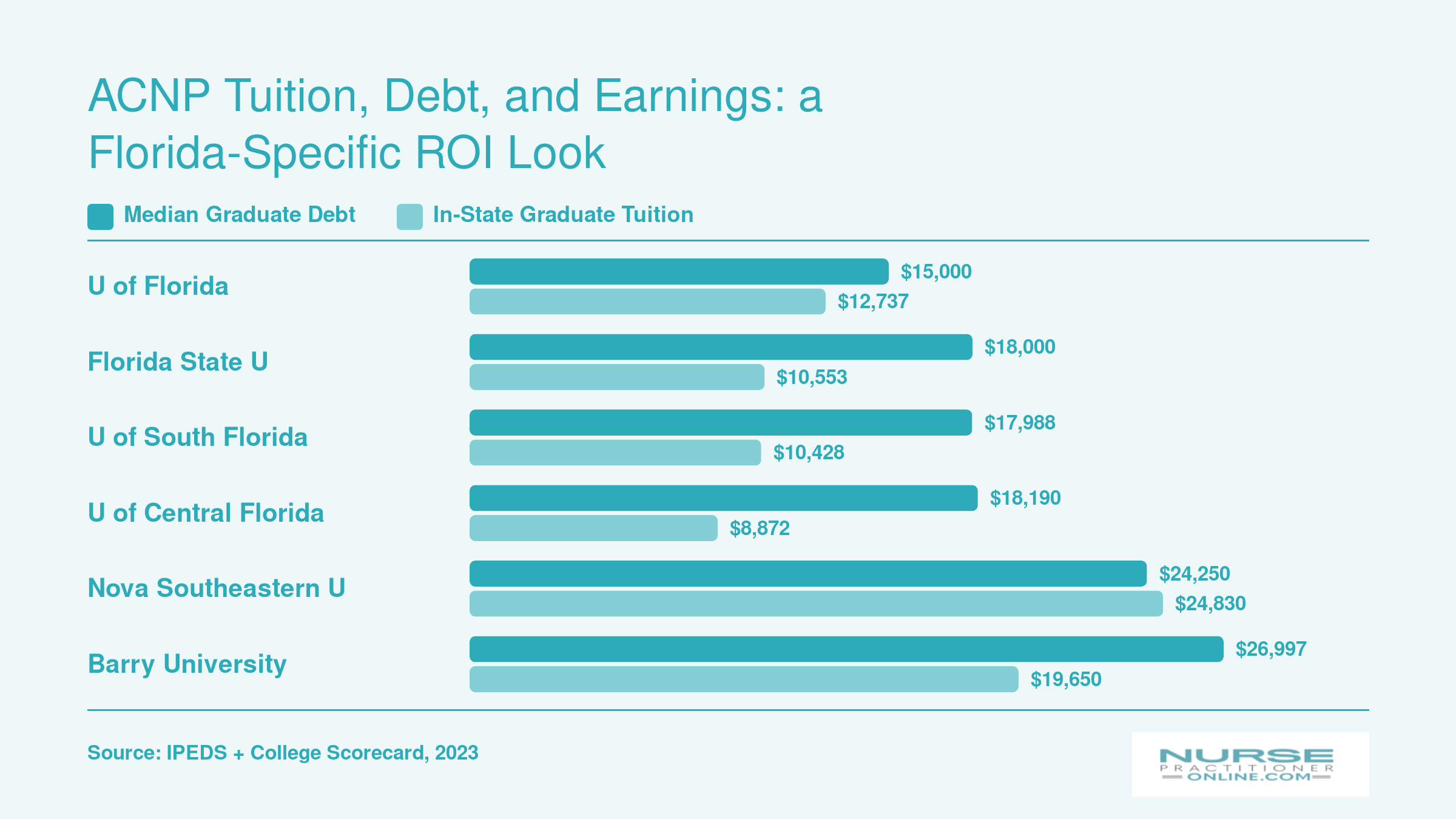
Program-level earnings and debt figures are not yet published for most Florida ACNP programs, so the chart below uses institution-wide median graduate debt as the best available proxy. Graduate tuition figures shown are degree-aware rates reported to IPEDS. Keep in mind that institution-wide net price is an approximate, undergraduate-weighted average and may not reflect your actual graduate costs. For a longer-horizon benchmark, the BLS reports a statewide median salary of $129,010 for nurse practitioners in Florida (2024), which far exceeds these debt figures and signals strong ROI over a full career.
Explore other Florida related topics
Related Articles
How Florida ACNP Programs Handle Clinical Placements
Clinical placements in an acute care nurse practitioner program are hands-on rotations in high-acuity settings like ICUs, emergency departments, and step-down units, where you learn to manage critically ill patients under an experienced preceptor's guidance. For working nurses in Florida exploring online AGACNP programs, understanding how each school handles these placements is one of the most important pieces of the decision.
Who Finds Your Clinical Sites?
Across Florida's online ACNP programs, the most common model puts the responsibility on you, the student, to identify and secure your own preceptors and clinical sites.1 The school then reviews and approves your proposed placement to confirm it meets program and accreditation standards.
- University of Central Florida: Students are responsible for identifying preceptors, with the school providing an approval process.
- University of South Florida: Students arrange their own clinical sites, subject to faculty approval.
- University of Miami: The program does not promise full placement guarantees, meaning students should expect to play an active role in securing rotations.
- Nova Southeastern University: The program is delivered online with three on-campus intensives, and students should plan for a similar self-placement expectation.
- Smaller private AGACNP programs in Florida: Some may offer more hands-on assistance through clinical placement coordinators or regional hospital partnerships, but even these schools generally do not guarantee placement outright.
The pattern is clear: regardless of whether a school provides a coordinator or a database of affiliated preceptor contacts, you should plan to do significant legwork yourself.
Geographic and Setting Requirements
Because the AGACNP focus is acute care, your rotations must take place in qualifying inpatient or critical care environments. Programs typically specify settings such as medical or surgical ICUs, cardiac care units, trauma centers, and emergency departments. Some schools limit placements to facilities within Florida or within specific health system affiliations, so confirm any geographic restrictions before you commit. If you live in a rural part of the state, access to a Level I or Level II trauma center for certain rotations may require travel. For a broader look at what these experiences involve, our guide to NP clinical rotations covers the typical structure and hour requirements across specialties.
How Many Clinical Hours to Expect
MSN-level ACNP programs in Florida generally require between 500 and 750 direct clinical hours, though the exact number varies by school and track.1 DNP programs layer additional practice hours on top of that. All hours must occur in acute care settings under an approved preceptor, so each rotation slot needs careful planning.
A Practical Timeline for Self-Placement
If your program requires you to find your own preceptors, begin your outreach six to nine months before your first clinical semester. Acute care preceptors, especially in busy ICUs and EDs, fill their student slots quickly, and hospital credentialing paperwork can take weeks or even months to process. Our step-by-step guide on how to find NP preceptors walks through the full process, but here are a few steps that help:
- Tap your existing professional network first. Colleagues, charge nurses, and unit managers in acute care settings often know providers willing to precept.
- Contact your program's clinical coordinator early, even if they do not place you directly. Many maintain lists of facilities and preceptors who have worked with students before.
- Reach out to multiple sites simultaneously. Having backup options protects you from delays if one facility's credentialing stalls.
- Keep meticulous records of every agreement, background check, and compliance document each site requires.
Clinical placement logistics can feel daunting, but nurses who start early and stay organized consistently report smoother rotations. If clinical support is a top priority for you, ask each program exactly what resources, databases, or coordinator assistance they offer before you apply.
BSN-to-MSN, BSN-to-DNP, and Post-Master's Certificate: ACNP Entry Routes in Florida
Not every nurse enters an AGACNP program from the same starting point, and Florida schools have structured their offerings around three distinct entry routes, each suited to a different stage of your career. Understanding which pathway fits your credentials and goals can save you semesters of coursework and thousands of dollars.
BSN-to-DNP: The Doctoral Route
If you hold a BSN and want to earn the highest practice degree in a single stretch, the BSN-to-DNP pathway is the most comprehensive option. Before applying, review the typical DNP prerequisites to make sure your transcripts and clinical experience are in order. Programs at the University of Florida and the University of South Florida offer this route with an AGACNP concentration, combining advanced clinical training with a doctoral scholarly project. Expect roughly three to four years of study (depending on full-time or part-time enrollment) and a hybrid format that pairs online coursework with on-site clinical and simulation days. Both programs prepare graduates for ANCC and AACN certification exams. UCF also offers a BSN-to-DNP AGACNP track alongside its certificate option.
Post-Master's AGACNP Certificate: Adding Acute Care to an Existing NP License
This is the fastest on-ramp for nurses who already hold an MSN or DNP and an active APRN credential, such as an FNP or AGPCNP, and want to add acute care privileges without repeating an entire graduate program. You can compare online post-master's ACNP certificate programs nationally, but Florida has a notably strong selection of its own:
- University of Central Florida: 23 credits and 660 clinical hours, delivered in a hybrid format. Applicants must already hold an APRN graduate degree.1
- Florida State University: 22 credits, offered primarily online with synchronous components. Accredited by the CCNE.3
- University of Miami: Accepts candidates with a graduate nursing degree and offers a post-master's AGACNP certificate.2
- Nova Southeastern University: 24 credits across four semesters at the Palm Beach campus, hybrid delivery.
- Miami Regional University: 30 credits with 810 clinical hours, completed in roughly 12 months.
- Barry University: Hybrid post-master's certificate with personalized curriculum plans and CCNE accreditation.
Credit requirements across these programs generally range from 22 to 30 semester hours, and completion timelines typically fall between one and two years. Because the core graduate courses (advanced pharmacology, pathophysiology, and health assessment) are usually prerequisites rather than part of the certificate itself, the workload is significantly lighter than a full degree program.
BSN-to-MSN: Less Common for AGACNP in Florida
While BSN-to-MSN is the most common pathway for many NP specializations nationally, Florida's AGACNP landscape leans heavily toward doctoral and certificate options. Among the programs in our ranked data, none are listed at the MSN degree level for this acute care specialty. Some Florida schools do offer MSN-level NP tracks in other concentrations, and RN-to-MSN bridge pathways exist at select institutions, but these bridge programs are uncommon for the AGACNP specialization specifically. If earning an MSN rather than a DNP is important to you, it is worth contacting individual programs directly, as offerings can shift from year to year. Weighing MSN vs DNP vs PhD in nursing can also help clarify which credential best aligns with your long-term goals.
Choosing the Right Route
The decision often comes down to where you are now and where you want to practice. If you are a bedside RN with a BSN and want to commit to the terminal practice degree, a BSN-to-DNP program at UF, USF, or UCF puts you on that trajectory. If you are already a certified NP and simply want to expand your scope into acute and critical care, a post-master's certificate at one of the six Florida schools listed above is the most efficient path, keeping you in practice while you add a new population focus.
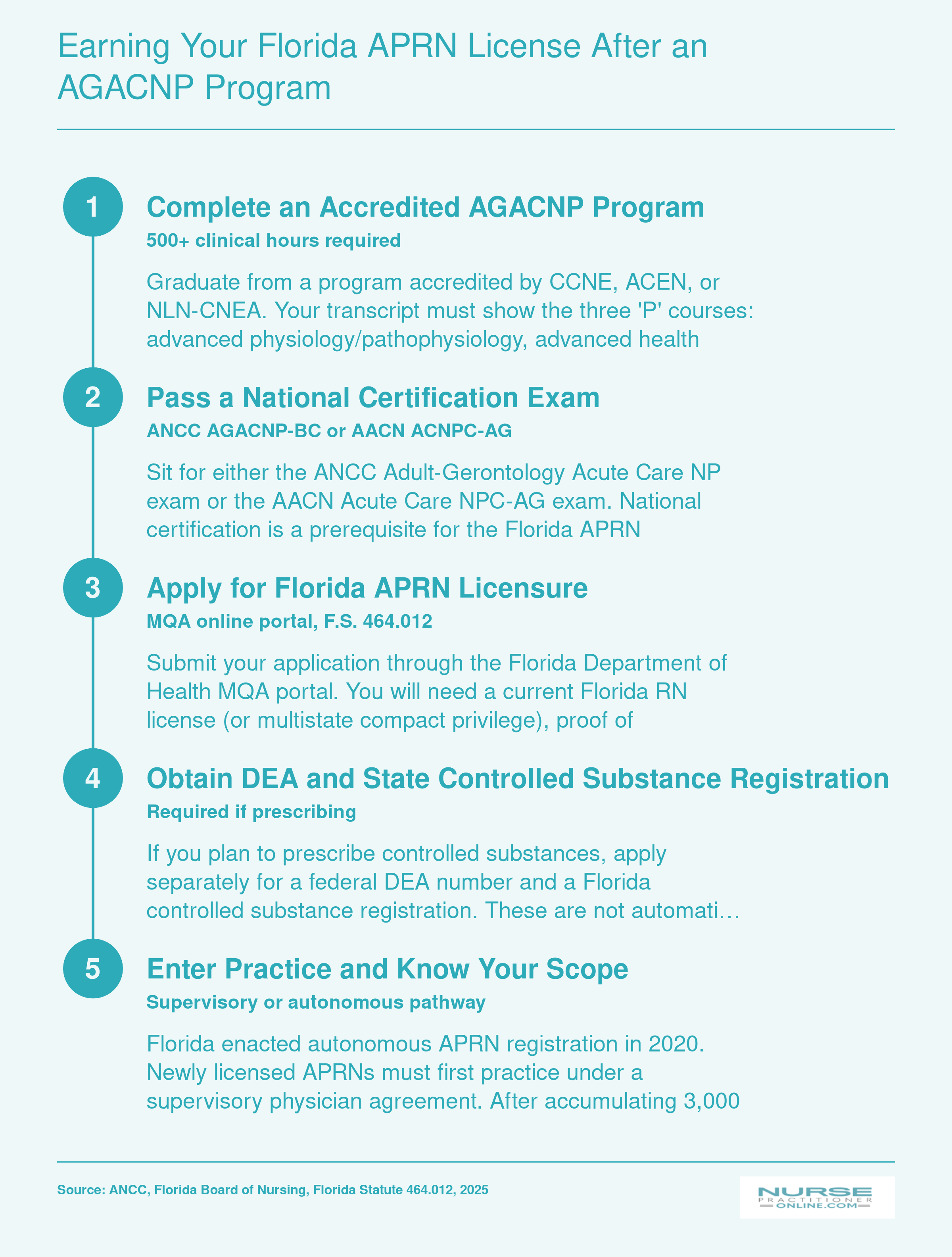
Earning Your Florida APRN License After an AGACNP Program
Finishing your AGACNP coursework is a major milestone, but it is not the finish line. Florida requires both national certification and a separate state APRN license before you can treat patients. The national ANCC AGACNP-BC certification exam carried an overall pass rate of roughly 80% in 2025, so solid exam prep matters. Here is the step-by-step sequence from program completion to practice.
Florida by Specialty
- AGNP Programs in Florida
- DNP NP Programs in Florida
- FNP Programs in Florida
- Fort Lauderdale, Florida (FNP)
- Fort Myers, Florida (FNP)
- Lakeland, Florida (PNP)
- Miami, Florida (AGNP)
- Miami, Florida (PNP)
- Orlando, Florida (FNP)
- PMHNP Programs in Florida
- PNP Programs in Florida
- Sarasota, Florida (FNP)
- Tampa, Florida (PNP)