
Most important takeaways…
- Fort Lauderdale metro NPs earn a median salary around $117,000, supported by a regional workforce of roughly 9,200 practitioners.
- Programs were scored on tuition, completion rates, and graduate earnings rather than reputation or subjective rankings.
- Most accredited FNP options near Fort Lauderdale use a hybrid format, combining online coursework with required in-person clinical hours.
- Admission requirements across Florida programs overlap heavily, so preparing one strong application package can serve multiple schools.
South Florida is short on primary care clinicians, and the gap is widening as the region's population ages and Florida's 2020 independent practice law continues to reshape what FNPs can do. For working RNs in Broward County, that translates into real leverage: stronger job postings, broader scope, and starting salaries in the Miami-Fort Lauderdale metro that now run well into six figures for experienced nurse practitioners.
Eleven accredited MSN FNP programs sit within commuting or online reach of Fort Lauderdale, spanning fully online tracks, hybrid models with on-campus intensives, and traditional campus cohorts. Tuition spans roughly $12,000 to over $46,000, completion runs 18 months to 2.5 years, and admissions selectivity varies sharply. Those are the factors that should drive the comparison more than brand recognition. If you are also weighing programs beyond the local area, the best online nurse practitioner programs can help you benchmark your options nationally.
Top MSN FNP Programs Near Fort Lauderdale for 2026
We evaluated every accredited MSN FNP pathway within reach of Fort Lauderdale and scored them on affordability, completion rates, and graduate earnings. The result is a mix of local powerhouses, statewide online options, and hybrid programs that let you keep working while you earn your degree. Net prices shown are institution-level averages after financial aid, so your actual cost may differ. Graduation rates reflect the overall institution, not the FNP program specifically.
- Institutional net price after aid
- Institution-wide graduation rates
- Graduate earnings outcomes
- Program format and flexibility
- Accreditation and certification preparation
- Independent program research
- College Scorecard graduate earnings — collegescorecard.ed.gov
- Internal program database
- NCES-IPEDS federal institutional data — nces.ed.gov

Ana G. Mendez University
Ana G. Mendez University operates campuses across Florida, including a South Florida location, giving Fort Lauderdale nurses a nearby on-site option. With a median graduate debt of just $12,188, it is one of the most affordable paths to an MSN FNP in the region. The curriculum blends didactic coursework with clinical experiences in family practice and urgent care settings.
- On-site delivery across multiple Florida campuses
- Prepares graduates for national FNP certification
- Curriculum covers pathophysiology, pharmacology, health assessment
- Includes biomedical ethics and health policy coursework
- Clinical experiences in family practice and urgent care
- Focus on primary care leadership across the lifespan
Master of Science in Nursing in Family Nurse Practitioner — On-Campus

Florida Atlantic University
Florida Atlantic University sits just 30 minutes north of Fort Lauderdale in Boca Raton, with additional sites in Davie and Jupiter that place clinical rotations squarely in South Florida. Its 52-credit hybrid program requires 780 clinical hours and can be completed in roughly 2.5 years on a part-time schedule. With an average net price of $8,752 for in-state students and no GRE requirement, FAU delivers strong value for working nurses who want to stay close to home.
- 52 credit hours with 780 required clinical hours
- Part-time hybrid format, about 2.5 years to complete
- In-state tuition around $372 per credit hour
- No GRE or MAT required for admission
- Clinical sites across Broward and Palm Beach counties
- Fall-only admission with a 3.0 GPA minimum
- Prepares for ANCC or AANP certification exams
- Three campus locations: Boca Raton, Davie, Jupiter
Family Nurse Practitioner MSN — Hybrid

University of South Florida
The University of South Florida pairs a respected College of Nursing with a 76.8% institution-wide graduation rate and an average net price under $10,000 for in-state students. Its 60-credit hybrid FNP program emphasizes clinical judgment, research, and health policy, preparing graduates for both ANCC and AANPCB certification. While the Tampa campus is a few hours from Fort Lauderdale, the hybrid format keeps required travel manageable.
- 60 credit hours in a hybrid delivery format
- Prepares for both ANCC and AANPCB certification exams
- Comprehensive examination required at completion
- Covers clinical judgment, research, and health policy
- Leadership and education training embedded in curriculum
- Average net price of $9,812 for in-state students
Family Nurse Practitioner MSN — Hybrid

University of Miami
The University of Miami's School of Nursing and Health Studies is one of South Florida's most selective institutions, with an 18.9% overall admission rate and an 83.7% graduation rate. Its compact 38-credit FNP program can be finished in as little as one year full-time through a lock-step cohort model. Students complete a minimum of 616 clinical hours at sites throughout Miami and Broward counties, giving Fort Lauderdale residents convenient placement options.
- 38 credit hours, completable in 1 or 2 years
- Lock-step cohort model with fall or spring starts
- Minimum 616 clinical hours in Miami and Broward counties
- CCNE accredited with full-time and part-time tracks
- Prepares for AANP or ANCC FNP certification
- Financial assistance opportunities available
- 11:1 student-to-faculty ratio across the institution
Family Nurse Practitioner MSN — On-Campus

Miami Regional University
Miami Regional University boasts an impressive 84.5% institution-wide graduation rate and a 97% retention rate, suggesting strong student support. The ACEN-accredited FNP program offers both full-time (20 months) and part-time (32 months) tracks, blending campus and online learning with clinical preceptorships. Applicants must hold an active Florida RN license or reside in a SARA-participating state.
- 50 semester credits with campus and online delivery
- Full-time track completable in 20 months
- Part-time track completable in 32 months
- ACEN accredited with clinical preceptorship included
- Requires active RN license and bachelor's degree
- Three recommendation letters required for admission
- 84.5% institution-wide graduation rate
Master of Science in Nursing Family Nurse Practitioner — On-Campus

Nova Southeastern University
Nova Southeastern University is headquartered right in Fort Lauderdale, making it the most geographically convenient choice on this list. The 45-credit hybrid FNP program combines online coursework with just three on-campus intensives, and students can choose between a full-time or flex track to finish in seven semesters. NSU also offers a postgraduate FNP certificate with clinical components at its Palm Beach and Tampa Bay campuses for nurses who already hold an MSN.
- 45 credits with online coursework plus 3 on-campus intensives
- Full-time or flex track, 7 semesters to completion
- CCNE accredited with fall and winter start options
- NursingCAS application deadlines: Aug 1 (fall), Dec 19 (winter)
- Financial aid and scholarships available
- Postgraduate FNP certificate also offered
- 95 practicum hours per credit of clinical coursework
Family Nurse Practitioner M.S.N.-A.P.R.N. — Hybrid

University of West Florida
The University of West Florida offers a fully online MSN FNP program, making it accessible to Fort Lauderdale nurses without relocation. The 45-credit curriculum follows a cohort progression model and requires a 3.0 GPA for admission. While the institution is based in Pensacola, the online format and a net price of $9,364 for in-state students make it a budget-friendly distance option.
- 100% online delivery with cohort progression
- 45 total credit hours required
- 3.0 GPA minimum with B grade required in all courses
- Competitive admission with prerequisite statistics course
- Prepares graduates for advanced practice and doctoral study
- Physical exam and background check required
- Average net price of $9,364 for in-state students
Family Nurse Practitioner M.S.N. — Online

St. Thomas University
St. Thomas University in Miami Gardens offers a fully online MSN FNP program with accelerated 6- to 7-week course terms and multiple start dates each year. The 47-credit program can be completed in as few as 18 months, and total tuition is listed at approximately $31,510. Applicants must hold an active RN license and reside in Florida or Georgia for clinical placements.
- 47 credit hours, completable in as few as 18 months
- Fully online with 6- to 7-week course terms
- Total program tuition approximately $31,510
- 500 clinical hours across four clinical courses
- CCNE accredited with multiple yearly start dates
- Free application with 3.0 GPA minimum
- Florida or Georgia residency required for clinicals
Master of Science, Family Nurse Practitioner — Online

Keiser University-Ft Lauderdale
Keiser University's Fort Lauderdale campus puts an FNP program right in the city, with additional Florida campus options and an online division for maximum scheduling flexibility. The 49-credit CCNE-accredited program uses 8-week course terms and can be completed in 18 to 24 months. A one-class-at-a-time format helps working nurses manage their course load alongside clinical shifts.
- 49 credit hours across 19 courses
- 18 to 24 months to completion
- Online with residency format and 8-week terms
- CCNE accredited, prepares for FNP board certification
- Up to 12 transfer credits accepted
- Fort Lauderdale campus plus multiple Florida locations
- One-class-at-a-time option for working nurses
- Financial aid available
Master of Science in Nursing, Family Nurse Practitioner — Online

AdventHealth University
AdventHealth University in Orlando offers a compact 35-credit online MSN FNP that can be finished in two years. Students attend just two on-campus intensives for hands-on health assessment training, keeping travel minimal. The institution stands out with a 6:1 student-to-faculty ratio and flexible 7- or 14-week course formats. Admission requires two years of recent direct patient care experience and a 3.0 GPA.
- 35 credit hours, completable in 2 years
- Online format with only two on-campus intensives
- 7-week or 14-week course format options
- 6:1 student-to-faculty ratio institution-wide
- No entrance exam required for admission
- 3.0 GPA and 2 years direct patient care required
- Practicums in women's, children's, and adult primary care
Master of Science in Nursing, Family Nurse Practitioner — Online

Barry University
Barry University in Miami offers a hybrid MSN FNP program with notably small class sizes, reflected in its 7:1 student-to-faculty ratio. The CCNE-accredited program currently provides a 25% tuition scholarship for MSN students, bringing the average net price to $22,613. Graduates report FNP certification pass rates between 72% and 100% in recent years, and preparation covers both ANCC and AANP exams.
- CCNE accredited with hybrid delivery format
- 25% tuition scholarship for MSN students
- Prepares for both ANCC and AANP certification exams
- Requires 3.0 GPA and one year of RN clinical experience
- 7:1 student-to-faculty ratio institution-wide
- Historical certification pass rates of 72% to 100%
- Financial aid and additional scholarships available
Nurse Practitioner MSN, Family Practice — Hybrid
Frequently Asked Questions About FNP Programs in Fort Lauderdale
Choosing an MSN Family Nurse Practitioner program is a big decision, and the details can vary widely from one school to the next. Below are answers to the questions South Florida nurses ask most often. Where specifics depend on a particular institution, we point you to the best source so you can verify the facts before you apply.
- How long does it take to complete an MSN FNP program?
- It depends on the school and whether you enroll full time or part time. Full-time tracks can run as short as 16 months, while part-time options commonly stretch to 27 or 30 months. Some DNP-level FNP pathways take around 60 months. Part-time students at certain universities may have up to 72 months to finish. Because timelines differ so much, check each program's website for its specific full-time and part-time options before you plan your schedule around work and family commitments.
- What GPA do I need to get into an FNP program in Florida?
- Most MSN FNP programs set a minimum cumulative GPA between 3.0 and 3.25 on a 4.0 scale. Some also weigh your science or nursing coursework GPA separately. A few programs require at least one year of clinical nursing experience in addition to meeting the GPA threshold. Requirements can shift from year to year, so confirm the latest admissions criteria directly on each school's website or by contacting the admissions office.
- What is the difference between an FNP and other nurse practitioner specialties?
- A Family Nurse Practitioner is trained to provide primary care across the lifespan, from pediatric patients through older adults. By contrast, a Psychiatric Mental Health Nurse Practitioner (PMHNP) focuses on mental health assessment and treatment, an Adult-Gerontology Nurse Practitioner (AGNP) specializes in adolescent through geriatric care, and a Pediatric Nurse Practitioner (PNP) concentrates on children. The scope of practice for each specialty is defined differently at the state level. For a thorough comparison, consult professional associations such as the American Association of Nurse Practitioners (AANP) or the National Organization of Nurse Practitioner Faculties (NONPF), and review the Florida Board of Nursing's guidelines for licensure in each specialty.
- Do FNP programs arrange clinical placements, or do I have to find my own preceptors?
- This varies significantly. Some programs take full responsibility for arranging clinical sites and preceptors, while others use a collaborative model where the school assists but students also participate in the search. Still other programs require students to identify their own preceptors, with the program reviewing and approving each placement. Clinical hour requirements range from roughly 600 to 1,000 hours depending on the degree level and institution. Do not rely on vague language on a program's website. Contact the admissions or clinical placement office directly and ask specifically whether placements are arranged, supported, or entirely self-sourced, especially if you plan to complete clinical hours in the Fort Lauderdale metro area.
- Can I complete an MSN FNP program online?
- Many accredited MSN FNP programs now offer coursework entirely online, making them accessible to working nurses in South Florida. However, every FNP program includes a clinical practicum component that must be completed in person at approved healthcare sites. The clinical hours you need typically fall between 600 and 750 for MSN-level programs, and they may be higher for DNP pathways. Hybrid formats that combine online didactic courses with local clinical rotations are the most common structure. Verify each school's delivery format, residency or immersion requirements, and clinical placement policies before enrolling.
- Where should I look for reliable information on FNP licensure in Florida?
- For general information about the nurse practitioner role, including national salary data and employment projections, BLS.gov is a solid starting point. For anything specific to Florida licensure, prescriptive authority, or scope of practice, go directly to the Florida Board of Nursing. Program-level details such as curriculum, tuition, accreditation status, and clinical requirements should always be confirmed on the individual school's official website. Professional organizations like AANP can also help you understand certification exam options and continuing education requirements after you graduate.
How We Scored These Fort Lauderdale FNP Programs
We evaluated each MSN FNP program using concrete, publicly reported measures that matter most to working nurses: what you pay, what you earn afterward, and whether the investment actually pays off. Instead of relying on reputation or subjective ratings, we grounded our ranking in data that reflects the financial and academic realities students face.
The Data Behind the Rankings
Each program was compared on five specific dimensions. The net price we use is what students actually pay after all grant and scholarship aid is applied, averaged for first-time, full-time undergraduates within the institution's sector (public or private). That means the figure reflects a typical after-aid cost, not the sticker price. We also looked at the institution's overall graduation rate to gauge how well the school moves all students through to completion, acknowledging that this is an institution-wide metric, not limited to nursing. For recent graduates, we examined median earnings two years into practice and median debt at graduation, both drawn from program-level reporting where available. From those, we calculated a return-on-investment ratio: how many dollars a graduate earns in two years for every dollar borrowed. The higher that ratio, the faster the degree pays for itself.
What We Don't Score
You will see program format (online, on-campus, or hybrid) noted alongside each entry. This is provided as a practical filter for your search, not as a judgment of quality. Online delivery can be just as rigorous as in-person instruction, and the right format depends on your personal circumstances. If you are exploring online options beyond Fort Lauderdale, our broader list of best online FNP programs covers accredited choices nationwide. Additionally, every program in our list holds accreditation from either the Commission on Collegiate Nursing Education (CCNE) or the Accreditation Commission for Education in Nursing (ACEN). Accreditation functions as a gate: only accredited programs are considered. It is a baseline qualifier, not a ranking factor, because all meet the required standards.
Why Earnings-to-Debt Matters More Than Brand
You will not find a directory that simply lists programs by name recognition. Instead, our scoring logic elevates the connection between what you borrow and what you earn. A program with a modest price tag and strong salary outcomes can be a smarter choice than a prestigious option that leaves you with heavy debt. For a family nurse practitioner in South Florida, median earnings after graduation directly impact your ability to pay down loans, build savings, and gain financial flexibility. Brand prestige may open a door once, but a healthy earnings-to-debt ratio opens opportunities every month. By centering on this ratio, we aim to highlight programs where the concrete returns justify the commitment, and where nurses can advance their careers without anchoring their future to unnecessary debt.
Related Articles
Choosing the Right MSN FNP Program: A Decision Framework for South Florida Nurses
What should you actually check before committing to an FNP program in South Florida?
With dozens of programs competing for your attention, the decision can feel overwhelming. This framework breaks the process into concrete steps that help you evaluate fit, cost, clinical logistics, and long-term career value. If you're also considering programs beyond your local area, comparing the best online MSN FNP programs can broaden your options significantly.
Accreditation: Your Non-Negotiable First Filter
Before you compare tuition rates or clinical hours, verify that any program you consider holds accreditation from either the Commission on Collegiate Nursing Education (CCNE) or the Accreditation Commission for Education in Nursing (ACEN). Both satisfy Florida Board of Nursing requirements for APRN licensure, but the distinction matters less than simply confirming active accreditation status before you enroll. Unaccredited programs can leave you ineligible for certification exams, wasting years of effort and thousands of dollars.
Clinical Placement Logistics in South Florida
South Florida hosts major health systems including Baptist Health South Florida, Broward Health, Memorial Healthcare System, and Holy Cross Health. Competition for preceptor spots is real, and policies vary significantly. Baptist Health South Florida, for example, accepts clinical rotation students only from partner or affiliate schools and requires a school coordinator to submit placement requests; students cannot self-source rotations there directly.1
When evaluating programs, ask explicitly whether the school arranges clinical placements or expects you to identify your own preceptors. Programs that coordinate placements typically require affiliation agreements, coordinator submissions, and pre-identified preceptors, but they handle much of the administrative burden.2 Self-sourcing can add months of networking and paperwork to your timeline.
Cost-to-Earnings: Calculating Your ROI
Tuition across South Florida programs ranges dramatically. Florida Atlantic University lists graduate nursing tuition around $6,700 for in-state students, while University of Miami's FNP program runs approximately $46,900. University of South Florida falls between at roughly $10,400 for residents.
Program-level earnings data for recent graduates is not yet published for most MSN FNP programs, so calculating precise ROI remains difficult. However, the principle holds: lower net price reduces your breakeven timeline. If two programs offer similar accreditation, clinical support, and pass rates, the more affordable option typically delivers better long-term financial returns.
Format Flexibility for Working RNs
The dominant model for South Florida FNP programs combines online coursework with local clinical rotations. Florida Atlantic University and University of South Florida both offer hybrid formats that allow you to complete didactic courses remotely while fulfilling clinical hours at sites near your home. University of Miami's program operates primarily on-campus with a lock-step cohort model. If your schedule requires evening or weekend flexibility, confirm whether a program mandates campus intensives, simulation labs, or fixed daytime schedules. Nurses who ultimately want to pursue doctoral-level practice may also want to explore DNP FNP programs online as a longer-term pathway.
Florida's Evolving APRN Scope of Practice
Florida has moved toward expanded autonomy for nurse practitioners, though requirements continue to evolve. Autonomous practice eligibility affects your long-term earning potential and practice options. An MSN FNP from an accredited program positions you for both current collaborative practice arrangements and any future full-practice-authority legislation. When choosing a program, consider whether curriculum content addresses independent practice skills, business fundamentals, and evolving regulatory landscapes.
Questions to Ask Yourself
MSN FNP Admission Requirements in Florida
Florida MSN FNP programs share a common set of admission requirements, though the details can vary from school to school. Gathering everything ahead of time will keep your application on track and reduce last-minute stress.
- Active, Unencumbered RN LicenseYou'll need a current, unrestricted registered nurse license in Florida or a nurse licensure compact state. Programs also typically require a background check as part of the admissions process.
- BSN from an Accredited InstitutionA Bachelor of Science in Nursing from a program accredited by CCNE, ACEN, or NLNAC is the standard prerequisite. If your BSN came from a program with a different accrediting body, contact your target school's admissions office to confirm eligibility.
- Minimum GPA of 3.0 (with Some Flexibility)Most Florida programs, including the University of Miami, Florida Southern College, and the University of West Florida, set a 3.0 GPA floor. However, a few schools accept applicants with a GPA as low as 2.5, South University, for example, so options exist if your undergraduate grades were lower. Some programs offer conditional admission in the 2.75–2.99 range.
- Clinical Nursing ExperienceExpect most programs to require one to two years of direct patient care experience as a registered nurse. This hands-on background strengthens your clinical reasoning before you step into the advanced practice role.
- Application MaterialsPlan to submit a professional statement or personal essay, two to three letters of recommendation (the University of Miami requires three), a current resume highlighting your clinical experience, and official transcripts from every college or university you've attended.
- Prerequisite CourseworkSome programs require specific courses completed before or during your first semester. Statistics is the most common prerequisite, the University of West Florida requires a C or better. Florida Southern College also asks for health assessment and nursing research. Review your BSN transcript early so you can fill any gaps before your application deadline.
Online, Hybrid, and Campus FNP Programs Compared
Every MSN FNP program near Fort Lauderdale requires hands-on clinical hours regardless of how lectures are delivered. When you see a program labeled 'online,' that means the didactic coursework is virtual, but you will still complete hundreds of supervised clinical hours in person at approved sites. Here is how the three delivery formats stack up across the dimensions that matter most to working RNs.
| Dimension | Primarily Online Didactics | Hybrid (Online + Scheduled On-Site Sessions) | Traditional Campus Based |
|---|---|---|---|
| Schedule flexibility for working RNs | Highest: complete lectures, discussions, and assignments on your own schedule. Ideal for nurses juggling 12-hour shifts. | Moderate: most coursework is online, but you must attend periodic on-campus intensives or lab days on fixed dates. | Lowest: classes meet on a set weekly schedule, which can be difficult to coordinate around rotating hospital shifts. |
| Programs in this guide | University of West Florida, St. Thomas University, Keiser University (Ft Lauderdale), AdventHealth University | University of South Florida, Florida Atlantic University, Nova Southeastern University, Barry University | Ana G. Mendez University, Miami Regional University, University of Miami |
| Typical in-state or published tuition per year | Ranges from roughly $9,000 (UWF) to about $36,000 (Keiser) | Ranges from roughly $6,700 (FAU) to about $25,000 (Nova Southeastern) | Ranges from roughly $10,500 (Ana G. Mendez) to about $47,000 (University of Miami) |
| Clinical rotation logistics | You arrange preceptors locally. South Florida has a large healthcare market, but securing sites independently takes planning. | The school often helps coordinate clinical placements near its campus or partner facilities, though some self-placement may be required. | Clinical sites are typically pre-arranged through the university's local health system partnerships, reducing the burden on students. |
| Networking and cohort experience | Peer connections happen through virtual discussion boards and online group projects. Some programs add brief on-campus residencies for face-to-face interaction. | Blends online community with periodic in-person cohort meetings, giving you both convenience and relationship-building opportunities. | Strongest in-person cohort bond. Daily interaction with classmates and faculty builds professional networks you can tap throughout your career. |
| Student-to-faculty ratio (range among listed programs) | 6:1 (AdventHealth) to 22:1 (UWF) | 7:1 (Barry) to 24:1 (FAU) | 11:1 (University of Miami) to 28:1 (Ana G. Mendez) |
| Best fit for | Self-directed learners comfortable with technology who need maximum scheduling freedom | Nurses who want online convenience but value regular face-to-face faculty contact | Nurses who prefer structured classroom learning and live close to campus |
FNP Salary and Job Outlook in the Fort Lauderdale Metro
The Miami-Fort Lauderdale-West Palm Beach metro is one of the largest employers of nurse practitioners in Florida, with roughly 9,200 NPs working in the region as of the most recent Bureau of Labor Statistics data. The local median salary of approximately $135,450 outpaces most other major Florida metros and exceeds the national median of about $121,610. For RNs considering the leap to an FNP role, the earning potential is significant: the local NP median is nearly $50,000 higher than the median for registered nurses in the same metro area.
| Area | Total NP Employment | 25th Percentile Salary | Median Salary | 75th Percentile Salary | Mean Salary |
|---|---|---|---|---|---|
| Miami-Fort Lauderdale-West Palm Beach, FL | 9,200 | $109,990 | $135,450 | $150,840 | $132,730 |
| Tampa-St. Petersburg-Clearwater, FL | 3,810 | $105,410 | $128,430 | $134,190 | $125,970 |
| Jacksonville, FL | 2,290 | $107,680 | $129,530 | $132,590 | $127,910 |
| Orlando-Kissimmee-Sanford, FL | 1,970 | $107,860 | $128,210 | $132,790 | $126,670 |
| Cape Coral-Fort Myers, FL | 820 | $120,160 | $143,670 | $143,670 | $136,210 |
| North Port-Bradenton-Sarasota, FL | 720 | $109,230 | $130,780 | $135,920 | $131,490 |
| National (all U.S.) | N/A | $103,250 | $121,610 | $135,470 | N/A |
What Fort Lauderdale FNP Graduates Actually Earn
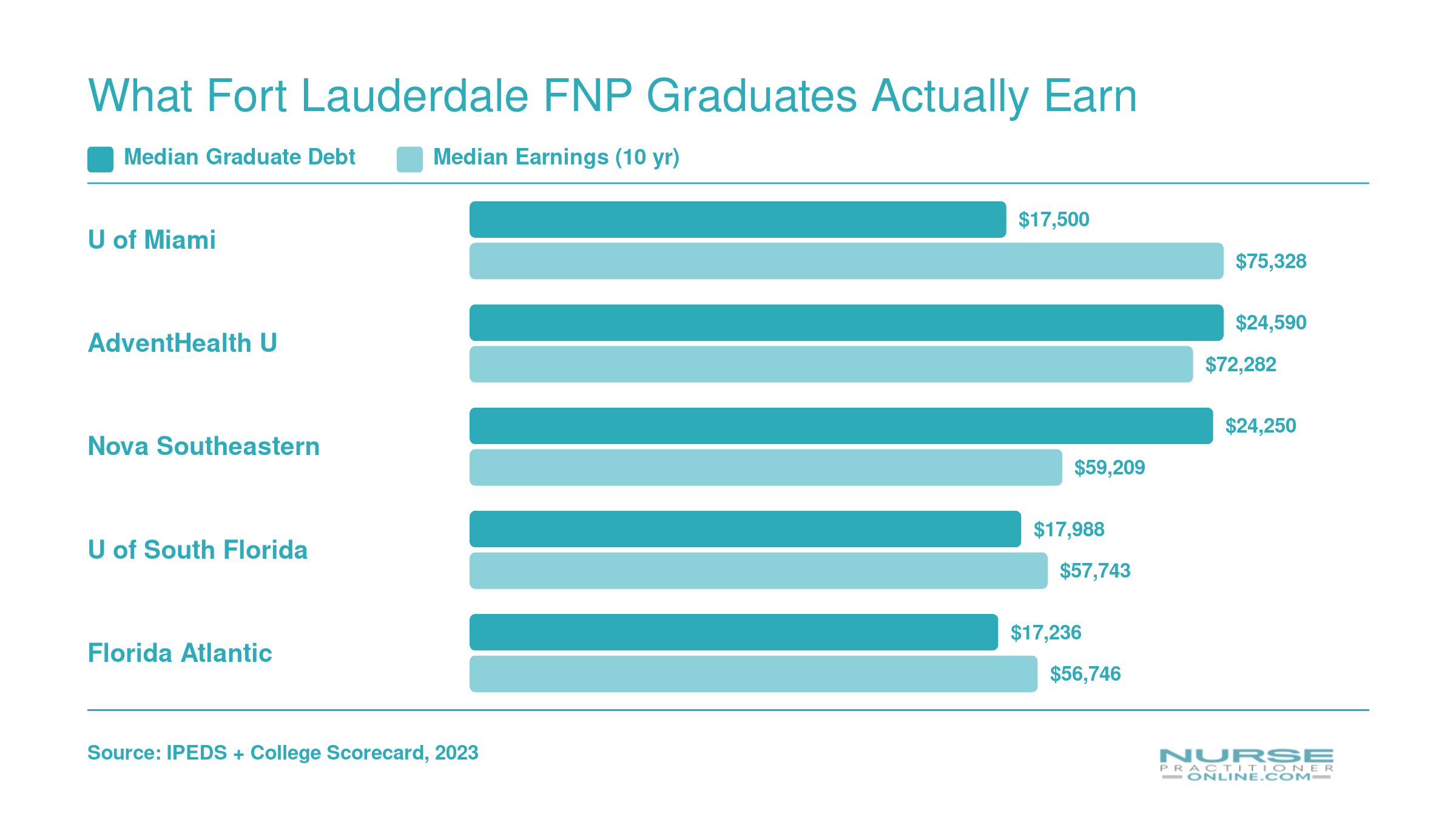
Program-level earnings data for FNP graduates at one year and four years after completion are not yet available for these schools. However, we can compare institution-wide median graduate debt against median earnings ten years after enrollment, giving you a clear picture of each school's long-term financial return. The spread is significant: the difference between the highest and lowest earners tops $18,500, showing that program choice truly matters.
Is an MSN FNP Degree Worth the Investment?
An MSN Family Nurse Practitioner degree is a graduate credential that takes a working RN, adds roughly 35 to 60 credits of advanced pathophysiology, pharmacology, and clinical training, and qualifies the graduate to diagnose, prescribe, and manage patients across the lifespan. The question of whether it's worth the cost comes down to two numbers: what you borrow to earn it, and what you make after. If you're still weighing the steps involved, our guide on how to become a nurse practitioner walks through the full timeline.
The Debt-to-Earnings Math
Across the Florida programs covered in this guide, typical graduate debt clusters in a tight range. Public options like Florida Atlantic University ($17,236), the University of South Florida ($17,988), and the University of West Florida ($16,624) sit near the low end. The University of Miami runs about $17,500 despite its private sticker price, thanks to institutional aid. AdventHealth University is the outlier at roughly $24,590. Against those numbers, the Bureau of Labor Statistics puts the median Florida RN wage near $80,000, while nurse practitioners in the state earn a median closer to $120,000. A $20,000 to $25,000 jump in annual income against $17,000 to $25,000 in total debt is a payback period most working RNs can absorb inside two years.
Florida's Scope of Practice Tailwind
Florida moved from restricted to reduced practice under current AANP classifications.1 Autonomous practice took effect for primary care, and as of 2026 the state allows FNPs to practice independently after completing 3,000 supervised hours, finishing coursework in differential diagnosis and pharmacology, and carrying $100,000/$300,000 malpractice coverage.2 Autonomous FNPs can admit, manage, and discharge patients and sign documents that previously required a physician.2 That authority directly increases earning potential through ownership stakes, locum work, and rural clinic contracts that aren't available in stricter states.
Paying Less Out of Pocket
South Florida nurses have several ways to shrink the debt side of the equation:
- Employer tuition assistance: Baptist Health South Florida, Memorial Healthcare System, and Broward Health each offer tuition reimbursement for clinical employees pursuing advanced degrees, with annual caps typically between $5,000 and $10,000.
- NURSE Corps Loan Repayment: Pays up to 85% of unpaid nursing loans in exchange for service at a Critical Shortage Facility, several of which sit inside Broward and Miami-Dade counties.
- Florida-specific scholarships: Awards through the Florida Nurses Foundation and FANP help, though state-level funding remains fragmented and competitive.3
The Verdict
For a working South Florida RN, the math favors finishing the MSN FNP. Debt loads at the ranked programs are modest, the post-graduation salary lift is substantial, and Florida's expanding autonomous practice rights compound the credential's long-term value.