Most important takeaways…
- Five Pittsburgh-area schools offer post-master's AG-PCNP certificates completable in roughly 12 to 18 months.
- NP employment in the Pittsburgh metro is projected to grow 40% from 2024 to 2034.
- Most programs require students to secure their own clinical preceptors across western Pennsylvania.
- Graduate tuition varies significantly, so comparing net price and estimated monthly loan payments is essential before applying.
Certified nurse practitioners in Pennsylvania are licensed by population focus, which means an FNP who wants to see older adults or chronically ill patients in a subspecialty clinic must either work outside their scope or return to school for a post-master's AGNP certificate. The certificate route takes 12 to 18 months and skips the duplicative MSN core, saving both time and tuition.
Pittsburgh's concentration of nursing programs at Pitt, Duquesne, Chatham, and Carlow gives Western Pennsylvania NPs four or five distinct certificate options within 30 miles. Format, clinical placement support, and per-credit cost vary enough that the right match depends on your work schedule, preceptor availability, and whether you plan to remain in primary care or eventually pivot to acute care. Pennsylvania's Board of Nursing requires national certification before you can add a new population focus to your CRNP license, so the certificate curriculum must prepare you for the AANP or ANCC exam.
Best Post-Master's AGNP Certificate Programs Near Pittsburgh
These five Pennsylvania programs were selected after weighing graduate tuition rates, institution-wide graduation and retention data, program format flexibility, and available graduate outcomes. Each offers a post-master's certificate in Adult-Gerontology Primary Care Nurse Practitioner, so the real differentiators for Pittsburgh-area nurses come down to credit requirements, clinical logistics, and cost. Program-level earnings data is not yet available for these certificates, but we include institution-wide graduate earnings where reported to give you a broader financial picture.
- Graduate tuition and net price
- Institutional graduation and retention rates
- Program format and flexibility
- Clinical hour requirements
- Graduate outcomes data
- Internal program database
- College Scorecard graduate earnings — collegescorecard.ed.gov
- NCES-IPEDS federal institutional data — nces.ed.gov
- Independent program research

Villanova University
Villanova University pairs a strong academic reputation with a 91.9% institution-wide graduation rate, the highest on this list. Its AGNP certificate uses a hybrid model: support courses are delivered online while clinical training takes place on site, giving students structure without requiring full-time campus attendance. The 10:1 student-to-faculty ratio means more individualized advising during clinical rotations, and institution-wide median earnings for graduates sit at roughly $100,400 ten years after enrollment.
- Hybrid format with online support courses and on-site clinicals
- 25 to 35 credit hours depending on gap analysis results
- 730 clinical hours required across varied practice settings
- Completion timeline ranges from 1.5 to 5 years
- Transfer credits accepted to shorten time to finish
- Physician and nurse practitioner preceptor collaboration
- Graduate tuition listed at $22,335 per year
Adult Gerontology Primary Care Nurse Practitioner Certificate — Hybrid

Thomas Jefferson University
Thomas Jefferson University brings the advantage of being embedded in a major academic medical center in Philadelphia, making preceptor connections more accessible. Its 18-credit AGNP certificate is the leanest on this list, which can translate to lower total cost and a faster path to certification. The program prepares graduates for both ANCC and AANPCB exams and emphasizes culturally responsive, evidence-based primary care for adults and older adults. The institution reports a median graduate debt of about $14,744, the lowest among these five schools.
- 18 credit hours, fewest required among these five programs
- Hybrid format with online coursework and in-person clinicals
- Prepares for both ANCC and AANPCB certification exams
- Open to nurses holding an MSN or doctoral degree
- Gap analysis determines any additional coursework needed
- Outpatient-focused clinicals in clinics, private practices, and specialty centers
- Graduate tuition listed at $24,528 per year
Adult-Gerontology Primary Care Nurse Practitioner Post-Graduate Certificate — Hybrid

La Salle University
La Salle University offers a fully online AGNP certificate, making it one of the more flexible options for Pittsburgh-based nurses who cannot travel regularly to the Philadelphia area. The program requires 14 credits of track-specific coursework plus 512 clinical hours, and coursework is CCNE-accredited. La Salle's net price of roughly $19,409 is the lowest among the private institutions on this list, and a gap analysis at admission tailors the curriculum to what each student actually needs.
- Fully online program format, no campus visits required
- 14 credits of AGPCNP track coursework
- 512 clinical hours in primary care settings
- CCNE-accredited nursing program
- Gap analysis personalizes each student's course plan
- Requires MSN degree, active RN license, and 3.0 GPA
- Prepares for Pennsylvania licensure and national certification
Adult Gerontology Primary Care Nurse Practitioner Certificate — Online

York College of Pennsylvania
York College of Pennsylvania stands out for its affordability, with graduate tuition listed at $8,340 per year, the lowest figure among these five schools. The online 23-credit program includes 784 clinical hours and meets certification requirements for both AANP and ANCC. Applicants who are not currently practicing as an NP must complete 56 hours of clinical experience with a nurse practitioner before starting the first clinical course, a readiness step that helps students hit the ground running.
- Graduate tuition of $8,340 per year, lowest on this list
- 23 credits required with 784 clinical hours
- Fully online coursework with a three-semester course sequence
- Gap analysis customizes credit requirements for each applicant
- 56 pre-clinical hours required for non-practicing NPs
- Meets AANP and ANCC certification eligibility requirements
- Includes advanced pharmacology and prescriptive privileges content
Adult-Gerontology Primary Care Nurse Practitioner Post-Master's Certificate — Online

Neumann University
Neumann University delivers its AGNP certificate entirely online with 7-week asynchronous courses, a format built for working nurses juggling shift schedules. Clinical placements span Pennsylvania, New Jersey, and Delaware, offering tri-state flexibility. All faculty are practicing nurse practitioners, and the program reports a 100% certification pass rate. At 45 credits and 784 clinical hours, it is the most comprehensive certificate on this list, which may benefit nurses whose gap analysis reveals broader preparation needs.
- 100% online with 7-week asynchronous course blocks
- 45 credits required with 784 clinical hours
- Clinical experiences available across PA, NJ, and DE
- All faculty are practicing nurse practitioners
- ACEN-accredited nursing program
- Gap analysis determines individualized course requirements
- Reported 100% national certification pass rate
- Graduate tuition listed at $11,320 per year
Post-Master's Certificate, Adult-Gerontology Primary Care — Online
Primary Care vs. Acute Care AGNP Certificates: Which Pittsburgh Schools Offer What?
The choice between primary care and acute care AGNP credentials shapes where you'll work for the rest of your career, so matching your goal to the right Pittsburgh program matters more than picking the closest campus. Primary care AGNPs (AG-PCNP) typically practice in clinics, outpatient specialty offices, and long-term care. Acute care AGNPs (AG-ACNP) work in hospitals, ICUs, step-down units, and hospitalist teams. The certification exams and accredited curricula are distinct, and you cannot substitute one for the other. For a broader look at both tracks nationwide, explore adult gerontology nurse practitioner programs.
What Western PA Schools Generally Offer
Pittsburgh-area programs have historically clustered around primary care AGNP tracks, with acute care offerings being less common at the post-master's certificate level. Rather than rely on outdated catalog snapshots, verify current availability directly:
- University of Pittsburgh School of Nursing: Check the graduate nursing programs page for post-master's NP certificate options and confirm which AGNP focus is currently enrolling.
- Duquesne University School of Nursing: Review the online nursing certificate listings and ask admissions whether AG-ACNP, AG-PCNP, or both are open for the 2026 cycle.
- Chatham University: Look under graduate nursing and confirm post-master's certificate tracks separately from the entry-level MSN.
- Carlow University College of Health and Wellness: Contact the nursing department directly, since certificate availability can shift year to year.
How to Confirm Before You Apply
Program offerings change between catalog years. Before submitting applications:
- Email or call each school's graduate nursing admissions office and ask specifically about AG-ACNP vs. AG-PCNP post-master's certificates for the 2026-2027 academic year.
- Cross-reference the Pennsylvania State Board of Nursing list of approved NP programs to confirm the track is recognized for licensure.
- Review the American Association of Nurse Practitioners (AANP) and the U.S. Bureau of Labor Statistics Occupational Outlook Handbook for current certification pathways and population focus definitions.
If your target school does not offer the acute care focus you need, online post-master's ACNP certificate programs are worth comparing, since many can arrange clinicals in Western Pennsylvania. When evaluating any program, make sure it holds nursing accreditation from CCNE or ACEN to protect your eligibility for national certification.
Questions to Ask Yourself
Pittsburgh-Area AGNP Certificate Costs: Tuition, Debt, and Monthly Payments
Understanding the true cost of a post-master's AGNP certificate means looking beyond sticker price. The table below compares graduate-level tuition, institution-level average net price, median debt at completion, and an estimated 10-year monthly loan payment for five Pennsylvania schools offering adult-gerontology primary care NP certificates. Keep in mind that the net price shown is an institution-wide average across all students and aid types; your actual certificate costs will depend on the number of credits required after your gap analysis, any employer tuition benefits, and the financial aid package you receive. Program-level earnings and debt data are not yet available for these certificates, so the figures below reflect overall institutional outcomes.
| School | Graduate Tuition (Per Year) | In-State / Out-of-State | Avg. Net Price (Institution Level) | Median Debt at Completion | Est. 10-Year Monthly Payment |
|---|---|---|---|---|---|
| York College of Pennsylvania | $8,340 | Same rate for all students | $18,556 | $26,000 | Approx. $275 |
| La Salle University | $29,220 | Same rate for all students | $19,409 | $25,000 | Approx. $265 |
| Neumann University | $11,320 | Same rate for all students | $27,804 | $27,000 | Approx. $285 |
| Thomas Jefferson University | $24,528 | Same rate for all students | $28,928 | $14,744 | Approx. $155 |
| Villanova University | $22,335 | Same rate for all students | $43,756 | $25,874 | Approx. $275 |
Related Articles
Online, Hybrid, or On-Campus: Format Options for Working NPs Near Pittsburgh
Working nurse practitioners around Pittsburgh typically ask one practical question first: can I complete this certificate without leaving my job? The answer depends on program format, and the five ranked programs near Pittsburgh offer three distinct models: fully online, hybrid, and campus-based.
Fully Online AGNP Certificates
Three of the five ranked programs deliver didactic coursework entirely online. La Salle University, York College of Pennsylvania, and Neumann University each structure their post-master's AGNP certificates with asynchronous online classes, meaning you attend no campus sessions for lectures or coursework. All three programs explicitly note this format in their program descriptions, and none require you to travel to campus for anything other than clinical placements. For working NPs who already hold demanding schedules, this format eliminates commute time and allows you to complete readings, case studies, and discussion boards during evenings, weekends, or lunch breaks.
Hybrid Certificates: Online Theory, In-Person Clinical Intensives
Villanova University and Thomas Jefferson University both operate hybrid formats. In these programs, you complete pharmacology, pathophysiology, and health assessment courses online, but travel to campus for simulation labs, skills validation, or clinical intensives. Villanova's program highlights on-site clinical courses alongside online support courses, and Thomas Jefferson notes a hybrid online format anchored at its Center City Philadelphia campus. Hybrid programs typically compress on-campus sessions into two- or three-day weekends once or twice per semester, which means you can schedule around work shifts with advance notice.
Part-Time Pacing and Evening Schedules
All five programs accommodate part-time enrollment. Villanova specifies a 1.5-year minimum and five-year maximum completion window, giving you flexibility to slow down during busy work periods. York College structures its 23-credit certificate as a three-semester sequence, but does not mandate full-time attendance. None of the programs publish cohort-locked start dates that force you into a rigid pace. You will want to confirm evening or weekend availability directly with each program, since online and hybrid structures do not always mean you can access all materials on your own schedule; some courses may include live sessions scheduled in the evenings.
Clinical Hours Are Always In-Person
Regardless of whether you choose an online or hybrid program, every AGNP certificate requires in-person clinical hours at local sites. Villanova requires 730 clinical hours, Thomas Jefferson requires 18 credits of clinical work, La Salle requires 512 hours, York College requires 784 hours, and Neumann requires 784 hours. You will complete these rotations at hospitals, outpatient clinics, and primary care offices in western Pennsylvania or wherever you secure preceptors. If you are also considering acute care specializations, you may find similar format flexibility in AGNP programs near Akron Ohio. A fully online program does not eliminate the need for local clinical placements; it only removes campus visits for didactic coursework.
Clinical Placements and Preceptor Support in Western Pennsylvania
Securing quality clinical placements often ranks as the single biggest stressor for post-master's certificate students, yet program support varies dramatically across Pittsburgh-area schools.
Understanding Preceptor Placement Responsibilities
Most post-master's AGNP certificate programs in the Pittsburgh region place the responsibility of finding clinical preceptors squarely on students. The University of Pittsburgh's Post-Professional Adult-Gerontology Acute Care NP Certificate, for example, requires students to self-arrange their clinical sites.1 While the university maintains academic connections with UPMC, this relationship does not guarantee placement at any specific facility.1 Students must initiate contact with potential preceptors, secure commitments, and then work with the program to establish a formal affiliation agreement before clinical hours can begin.2
This self-arrangement model is common across certificate programs because students often enter with existing professional networks and employer relationships that can facilitate placements. However, it does require significant advance planning, particularly for those new to an area or transitioning between specialties.
Clinical Hour Requirements
Post-master's AGNP certificates typically require between 500 and 600 direct patient care hours, though your prior certification may affect this total. The University of Pittsburgh's AG-ACNP certificate requires 540 clinical hours, with the possibility of waiving up to 300 hours based on documented prior experience in a related advanced practice role.2 This waiver option can significantly reduce your time to completion if you already hold certification in another NP specialty.
Keep in mind that even with waivers, you will still need to demonstrate competency in adult-gerontology populations through direct clinical experiences, so plan for at least one to two semesters of active clinical rotations.
Health System Partnerships in Western Pennsylvania
Pittsburgh's concentration of major health systems creates abundant clinical opportunities, though formal affiliation agreements must typically be established through your program. UPMC, Allegheny Health Network, and VA Pittsburgh Healthcare System all accept NP students, but each has its own credentialing timeline and requirements. Some sites require background checks, immunization documentation, and orientation sessions that can take two to three months to complete.
Programs with existing master agreements at these systems can sometimes expedite the process, but students should never assume placement is automatic. If you are also exploring options in neighboring states, reviewing online AGNP programs in Ohio may help you compare how different schools handle clinical coordination.
Practical Tips for Clinical Success
- Start early: Begin contacting potential preceptors three to six months before your clinical semester starts. Popular sites fill quickly.
- Leverage your employer: If you currently work in a hospital or clinic with NPs on staff, ask whether colleagues would precept you. This often streamlines credentialing.
- Use program resources: Ask your program's clinical coordinator about any site databases, preceptor registries, or lists of facilities with active affiliation agreements.
- Network strategically: Professional organizations like the Pennsylvania Coalition of Nurse Practitioners often connect students with willing preceptors in your specialty area.
Clinical placements require effort, but approaching the process systematically will help you secure quality experiences in the Pittsburgh metro's robust healthcare community.
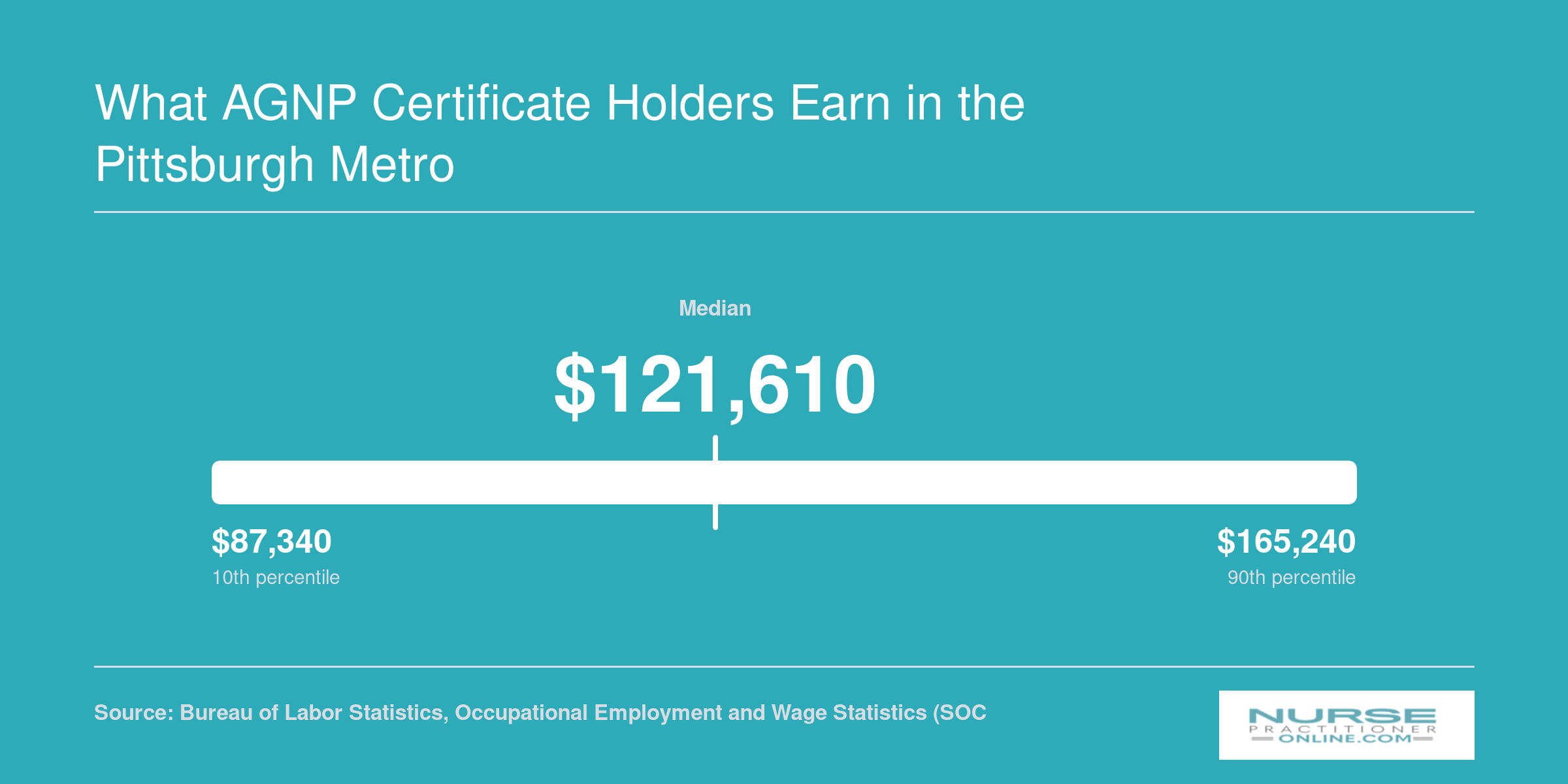
What AGNP Certificate Holders Earn in the Pittsburgh Metro
These figures reflect all nurse practitioner specialties in the Pittsburgh metropolitan area, not AGNP roles alone. The BLS does not break out earnings by NP subspecialty, so use these numbers as a general benchmark. Pennsylvania's statewide NP median of roughly $127,450 runs above the national median of about $121,610, and Pittsburgh-area wages follow a similar pattern. Exact Pittsburgh MSA percentiles shown below are based on the most recent available BLS data and may shift slightly with future releases.
Admission Requirements for Post-Master's AGNP Certificates
Admission criteria for post-master's AGNP certificate programs vary from school to school, so it pays to verify every detail before you apply. Here's a practical checklist to keep you on track.
- Confirm requirements on each school's official admissions pageStart with the dedicated admissions or certificate-program pages at the University of Pittsburgh School of Nursing, Duquesne University School of Nursing, Chatham University, and Carlow University. Look for sections titled "Admissions," "Requirements," or "Post-Master's Certificate Programs." Requirements, including minimum GPA, letters of recommendation, and whether a GRE score is needed, can change from one application cycle to the next, so always reference the current year's page.
- Verify your MSN meets accreditation standardsMost programs require that your master's degree come from a program accredited by the CCNE or ACEN. If you're unsure whether your MSN qualifies, review guidelines from the American Association of Nurse Practitioners (AANP) or the National Organization of Nurse Practitioner Faculties (NONPF), which outline accreditation expectations for post-master's applicants.
- Ask about prior NP certification requirementsSome schools expect applicants to already hold national certification in another NP population focus, while others accept any MSN-prepared nurse. Contact each admissions office directly, by phone or email, to clarify whether prior AGNP or other NP certification is required or preferred.
- Gather your supporting documents earlyCommon requirements include an unencumbered RN license, official transcripts, a current resume or CV, a professional goal statement, and two or three letters of recommendation from clinical or academic references. Starting this paperwork early keeps your timeline manageable alongside a full work schedule.
- Use official sources for career data, but rely on schools for admissions specificsThe Bureau of Labor Statistics (BLS.gov) is a solid resource for general nurse practitioner career outlook and wage information, but it does not track individual program admission criteria. For the most accurate and up-to-date admissions details, go straight to the source, each school's nursing admissions office.
PA Board of Nursing Licensure for AGNP Certificate Completers
How do you actually add an Adult-Gerontology population focus to your existing Pennsylvania CRNP license after finishing a post-master's certificate? The process runs through the Pennsylvania Board of Nursing, and it involves national certification, an application packet, and (still, in 2026) a written agreement with a collaborating physician.
Adding the AGNP Population Focus to Your CRNP License
If you already hold a Pennsylvania CRNP license in another population focus, you do not start over: you apply to add the Adult-Gerontology focus. The Board requires verification of your post-master's certificate (which includes the 500 clinical hours and gap analysis your program documents), an active PA RN license, current national certification in the new focus, and an opioid education attestation. The CRNP application fee is $95, with a $95 initial license fee for the new focus. Processing typically runs 14 to 30 business days once your file is complete.
If you also want to prescribe in the new population, you file a separate prescriptive authority application ($50), document at least 45 contact hours of pharmacology within the past five years, and submit a collaborative agreement covering drug categories and controlled substance compliance, signed by your collaborating physician.
Accepted Certification Exams
Pennsylvania accepts both major AGPCNP credentials. For a broader look at the certification process, see our nurse practitioner licensing guide.
- ANCC: Adult-Gerontology Primary Care Nurse Practitioner Board Certification (AGPCNP-BC)
- AANP: Adult-Gerontology Primary Care Nurse Practitioner Certification (A-GNP)
Either one satisfies the national certification requirement.2 Acute care candidates use the ANCC or AACN adult-gerontology acute care exams instead.
Collaborative Agreement and Practice Authority
Pennsylvania has not granted full practice authority to adult-gerontology nurse practitioners. You must maintain a written collaborative agreement with a physician that spells out scope, practice sites, how the physician is available, chart review, consultation, and coverage arrangements. Legislation expanding NP practice authority (versions of SB 25 and prior bills) has been reintroduced in recent sessions but has not passed as of 2026. Pennsylvania did join the Nurse Licensure Compact effective July 7, 2025, which simplifies multistate RN practice but does not change APRN scope rules.
AGNP Career Demand and Employment in the Pittsburgh Metro Area
Nurse practitioners are one of the fastest-growing occupations in the country, and the Pittsburgh metro reflects that momentum. The Bureau of Labor Statistics projects 40% growth for NPs nationwide from 2024 to 2034, making it the fastest-growing healthcare occupation.1 For working nurses considering an AGNP certificate, that translates into strong job security and expanding opportunities, especially in a region where major health systems like UPMC, Allegheny Health Network, and the VA Pittsburgh Healthcare System are among the largest employers.
Demand Drivers in Western Pennsylvania
The need for adult gerontology primary care nurse practitioner professionals is especially compelling across the Pittsburgh metro and surrounding counties. Pennsylvania has one of the oldest populations in the country, and that trend is accelerating. Many older adults live with multiple chronic conditions that require coordinated primary care, exactly the expertise an AGNP brings. Add in persistent primary care physician shortages in rural and underserved communities just outside the city, and the role of the AGNP becomes even more critical. From Fayette to Greene to Armstrong counties, NPs are often the most accessible, and sometimes only, primary care provider.
Earnings Snapshot for AGNP Certificate Holders
National wage data gives you a realistic anchor. The BLS reports a median annual salary of $129,210 for nurse practitioners in 2024, with the top 10% earning above $168,000.1 In the Pittsburgh region, salaries can vary by setting and experience, but AGNPs in primary care roles typically see earnings that align with or slightly exceed the local advanced practice nursing median. While program-specific earnings for post-master's certificate completers are not yet published for many Pennsylvania programs, institutional data from schools offering these certificates suggests that graduates enter a field where strong earning potential is the norm.
Where AGNPs Practice in the Pittsburgh Region
After certification, AGNPs in the Pittsburgh area work across a wide range of settings. Common practice sites include hospital-affiliated outpatient clinics, independent geriatric and internal medicine practices, long-term care and skilled nursing facilities, and federally qualified community health centers. Many AGNPs also find roles in specialty areas like palliative care or home-based primary care. The flexibility of the adult-gerontology primary care credential opens doors in both urban Pittsburgh and the smaller communities that ring the metro, giving you clinical options that fit your interests and lifestyle.
Common Questions About AGNP Certificates Near Pittsburgh
Choosing a post-master's AGNP certificate is a big step, and it is natural to have questions about timelines, costs, and logistics. Below are answers to the questions we hear most often from working nurses in the Pittsburgh area.
- How long does it take to complete a post-master's AGNP certificate program?
- Most programs range from about 15 to 24 credit hours and can be finished in two to four semesters, depending on whether you enroll full time or part time. Check each school's AGNP certificate page (for example, Pitt, Duquesne, or Carlow) for the specific course sequence, because some schools lock you into a cohort schedule while others let you pace yourself around your work commitments.
- Which certification exams can I sit for after completing an AGNP certificate?
- Both the AANP and the ANCC offer an Adult-Gerontology Primary Care NP certification exam. Visit aanp.org and ancc.org to review the current exam blueprints, eligibility requirements, and application deadlines. Your program should be accredited by CCNE or ACEN to qualify, so confirm accreditation status before you enroll.
- Are any Pittsburgh-area AGNP certificate programs fully online?
- Several programs deliver all didactic coursework online, with no on-campus requirements beyond clinical rotations. When researching schools, filter their websites for terms like 'fully online' or 'distance education,' and then confirm clinical placement policies through admissions staff or the program handbook. Clinical hours still need to be completed in person, typically at approved sites in western Pennsylvania or your home region.
- Which Pittsburgh-area schools offer adult-gerontology primary care NP certificates?
- Schools commonly mentioned include the University of Pittsburgh, Duquesne University, and Carlow University. Each publishes its required courses, credit hours, and semester structure on its AGNP certificate program page. Because program offerings can change from year to year, always verify directly with the school that the certificate is actively enrolling for the term you plan to start.
- Where can I find reliable salary and job outlook data for AGNPs in the Pittsburgh metro?
- The Bureau of Labor Statistics at bls.gov publishes metro-level wage and employment projections for nurse practitioners. Use that data as your baseline and be cautious about salary figures quoted on school marketing pages. For licensing rules specific to Pennsylvania, visit the state licensing board site at dos.pa.gov/health to make sure you understand every requirement before you apply for your NP license after finishing the certificate.
- What is the difference between an AGNP post-master's certificate and an MSN in adult-gerontology?
- A post-master's certificate is designed for nurses who already hold an MSN (or a DNP) and want to add a new population focus or specialty without repeating an entire graduate degree. You take only the courses and clinical hours specific to adult-gerontology primary care. An MSN, by contrast, includes foundational graduate core courses you have likely already completed. The certificate route is shorter, more affordable, and tailored for career changers who need a focused path to AGNP certification eligibility.
Pennsylvania by City
- ACNP Programs in Pennsylvania
- Allentown, Pennsylvania (FNP)
- DNP NP Programs in Pennsylvania
- FNP Programs in Pennsylvania
- Philadelphia, Pennsylvania (ACNP)
- Philadelphia, Pennsylvania (PNP)
- Philadelphia, Pennsylvania (WHNP)
- Pittsburgh, Pennsylvania (CCNP)
- Pittsburgh, Pennsylvania (PMHNP)
- PMHNP Programs in Pennsylvania
- PNP Programs in Pennsylvania
- Scranton, Pennsylvania (AGNP)