Most important takeaways…
- Pittsburgh-area AGACNP tuition spans a $35,000 range, making school selection a major cost lever.
- NPs in the Pittsburgh metro earned a median annual wage of $128,730 as of 2023.
- UPMC and AHN clinical partnerships can simplify ICU placement logistics for local AGACNP students.
- Post-master's AGACNP certificates let current MSN holders add acute care credentials in fewer semesters.
UPMC and Allegheny Health Network together employ thousands of advanced practice providers across Pittsburgh's hospital campuses, and both systems have publicly signaled ongoing demand for acute care nurse practitioners in critical, cardiac, and trauma units. That demand creates real opportunity, but it also raises a financially high-stakes question: which AGACNP program delivers solid preparation without saddling you with six-figure debt before you ever prescribe a vasopressor?
Graduate tuition across Pennsylvania AGACNP programs spans a wide range. Published program costs in this comparison run from roughly $11,000 to over $47,000, and the gap between sticker price and what students actually pay after institutional aid can shift a school's true cost by tens of thousands of dollars. For a working ICU nurse carrying a full-time schedule, that difference often determines whether a program is feasible at all. If you are also weighing programs outside of Pittsburgh, our overview of acute care nurse practitioner programs in Pennsylvania can help you compare options statewide.
Accreditation status, clinical hour requirements, delivery format, and admission prerequisites add further complexity. Pennsylvania requires AGACNP graduates to pass a national certification exam before obtaining CRNP licensure, so program quality and board preparation matter as much as price.
Most Affordable Critical Care NP Programs Near Pittsburgh, Ranked
Choosing an AGACNP program is a major investment, and for working ICU nurses in the Pittsburgh area, balancing tuition costs with schedule flexibility can feel like its own clinical challenge. The programs below are ranked by estimated net price, which reflects what students actually pay after grants and scholarships rather than sticker tuition alone. Keep in mind that net price figures are institution-wide averages and your individual cost will depend on your financial aid package, residency status, and enrollment intensity.
- Estimated net price after aid
- Program delivery format flexibility
- Institutional graduation and retention
- Graduate debt at completion
- Regional clinical placement access
- NCES-IPEDS federal institutional data — nces.ed.gov
- College Scorecard graduate earnings — collegescorecard.ed.gov
- Internal program database
- Independent program research

Cedar Crest College
Cedar Crest College delivers one of the lowest net prices on this list, making it an appealing pick for budget-minded RNs across Pennsylvania. Its hybrid DNP and online BSN-to-DNP pathways in adult-gerontology acute care blend asynchronous coursework with hands-on simulation in a multimillion-dollar lab, and dedicated clinical placement support helps Western PA students arrange rotations closer to home rather than in the Lehigh Valley. A 9-to-1 student-faculty ratio and flexible entry every semester mean you can start when your schedule allows.
- Hybrid format: online courses plus on-campus simulation days
- 728 clinical hours with dedicated placement support
- CCNE accredited with built-in board exam preparation
- Flexible entry each fall, spring, and summer term
- 3.0 minimum GPA; no prior clinical experience required
- DNP project with a scholarly, evidence-based focus
- Primarily asynchronous online coursework
- Includes a 2-day campus immersion component
- Clinical residency built into the curriculum
- Prepares graduates for national AGACNP certification
- Evidence-based practice emphasis throughout
- Designed for working professionals seeking flexibility
DNP Adult-Gerontology Acute Care Nurse Practitioner (Hybrid) — Hybrid
BSN to DNP Adult-Gerontology Acute Care Nurse Practitioner (Online) — Hybrid

Pennsylvania State University-Penn State Harrisburg
Penn State Harrisburg's online DNP in Adult-Gerontology Acute Care offers a uniform per-credit tuition rate regardless of where you live in Pennsylvania, effectively removing any regional cost penalty for Pittsburgh-area nurses. The 65 to 78 credit program includes 1,125 post-BSN practicum hours, and Penn State's network of more than 700 clinical partners extends into Western PA, so you can often arrange rotations near home. Three brief on-campus intensive sessions are the only required travel. Note that the institution-wide graduation rate listed here reflects the Harrisburg campus overall and not the DNP program specifically.
- Online DNP: 65 to 78 total credits at $1,027 per credit
- Flat tuition for in-state and out-of-state online students
- 1,125 hours of post-BSN clinical practicum
- Only three on-campus intensive sessions required
- CCNE accredited; prepares for national certification exam
- Rolling admissions with priority deadlines in March, June, Oct
DNP Adult-Gerontology Acute Care Nurse Practitioner (Online) — Online

Neumann University
Neumann University pairs a competitive online tuition rate with a fully asynchronous MSN format, which is ideal for ICU nurses juggling 12-hour shifts. The 45-credit ACEN-accredited AGACNP program reported a 100% certification pass rate in 2025 and includes 784 clinical hours with preceptors across Pennsylvania, New Jersey, and Delaware. Neumann actively supports Western PA clinical placements, so Pittsburgh-area students can complete rotations without relocating. All faculty are practicing nurse practitioners, keeping instruction grounded in real-world acute care.
- Fully asynchronous online format in 7-week terms
- 45 total credits with 784 clinical practice hours
- ACEN accredited; 100% faculty are practicing NPs
- 100% certification pass rate reported in 2025
- One year of acute care experience and ACLS required
- Clinical preceptors available across PA, NJ, and DE
MSN Adult-Gerontology Acute Care Nurse Practitioner (Online) — Online

Widener University
Widener University's hybrid MSN-AGACNP program sits at a moderate private-school price point while offering 750 clinical hours spread across three practicum courses. The curriculum covers advanced pathophysiology, pharmacology, and clinical decision-making for managing physiologically unstable patients from young adulthood through older age. Widener allows students to complete clinicals with approved preceptors statewide, giving Pittsburgh nurses access to local acute care sites. An 11-to-1 student-faculty ratio supports close mentorship throughout the program.
- Hybrid format: 45 total credits with 18 specialty credits
- 750 clinical hours across three practicum rotations
- Prepares for both ANCC and AANP certification exams
- Covers young adult through frail elderly patient populations
- Emphasizes diagnostic reasoning for unstable patients
- Includes leadership, informatics, and health policy courses
MSN Adult-Gerontology Acute Care Nurse Practitioner (Hybrid) — Hybrid

University of Pennsylvania
The University of Pennsylvania's MSN in Adult-Gerontology Acute Care carries a higher sticker price, but generous financial aid brings the net price closer to mid-range for many students, and median graduate debt is the lowest on this list at roughly $15,700. Penn's program stands out for clinical concentration options in cardiology, trauma, general surgery, transplant, nephrology, and internal medicine, plus elective minors in oncology, palliative care, and global health. Immersive simulation technology and mentored clinical placements round out a 12-course-unit curriculum. The institution-wide graduation rate of 96.5% reflects the university as a whole.
- 12 course units blending theory and mentored clinicals
- Clinical concentrations: cardiology, trauma, surgery, transplant
- Elective minors in oncology, palliative care, global health
- Immersive simulation technology and preceptor matching
- Lowest median graduate debt on this list (approx. $15,700)
- Hybrid format with full-time and part-time options
MSN Adult-Gerontology Acute Care Nurse Practitioner (Hybrid) — Hybrid

Saint Joseph's University
Saint Joseph's University offers a hybrid MSN with an Adult/Gerontology Acute Care concentration that balances online coursework with on-site clinicals at premier Pennsylvania locations. At 52 credits over three years and $1,002 per credit, total tuition is transparent and predictable. The program boasts a 100% pass rate on certification exams and accepts rolling admissions for fall, spring, and summer starts. CCNE accreditation and 720 clinical hours ensure graduates are well-prepared for the AACN or ANCC certification exam.
- Hybrid format: 52 credits at $1,002 per credit
- 720 clinical hours at premier PA clinical sites
- 100% certification exam pass rate
- CCNE accredited with rolling admissions
- Full-time and part-time options; fall, spring, summer starts
- Two years of clinical experience required for admission
MSN Adult/Gerontology Acute Care Nurse Practitioner (Hybrid) — On-Campus

University of Pittsburgh-Pittsburgh
As the only research university physically in Pittsburgh on this list, the University of Pittsburgh gives local RNs the shortest commute to campus residencies and direct access to UPMC's tertiary and quaternary ICUs for clinical rotations. The 79-credit BSN-to-DNP features a clinical emphasis directed study that lets you customize your focus in areas like internal medicine. In-state tuition for PA residents significantly improves affordability compared to private alternatives, and synchronous online course options help you keep working while earning the degree.
- 79 total credits with 1,020 clinical hours
- Hybrid delivery with synchronous online course options
- Clinical emphasis directed study for customized focus
- Full-time and part-time tracks available
- Prepares for ANCC or AACN national certification
- Eligible for Pennsylvania CRNP licensure upon completion
- DNP scholarly project required
- In-state tuition available for PA residents
BSN to DNP Adult-Gerontology Acute Care Nurse Practitioner (Hybrid) — Hybrid

Moravian University
Moravian University's campus-based MSN in Adult-Gerontology Acute Care emphasizes interdisciplinary collaboration, evidence-based practice, and ethical decision-making. Located in Bethlehem, it is the most traditionally on-campus option on this list, which may suit nurses who prefer in-person instruction and close faculty mentorship at a 10-to-1 ratio. That said, the campus format is less convenient for Pittsburgh-based nurses and adds commuting or relocation considerations to the overall cost equation.
- Campus-based program in Bethlehem, PA
- Focuses on evidence-based acute care across the lifespan
- Emphasizes quality improvement and leadership skills
- Interdisciplinary collaboration and health care technology
- 10-to-1 student-faculty ratio for close mentorship
- Covers cultural, spiritual, and social justice perspectives
MSN Adult-Gerontology Acute Care Nurse Practitioner (Campus) — On-Campus

DeSales University
DeSales University pairs a 100% online MSN-AGACNP with a standout hands-on gross anatomy lab experience, a rare feature for distance programs. The program reports a 99.5% certification pass rate and trains students for high-intensity settings like ICUs and trauma units. A BSN-to-DNP hybrid track is also available for nurses pursuing doctoral-level preparation. For Pittsburgh-area RNs, the online MSN format is logistically straightforward, though clinical placements must be coordinated and pre-approved individually.
- 100% online flexible format with gross anatomy lab
- 99.5% certification pass rate reported
- Advanced clinical practicum in acute care settings
- Specialized training for ICU and critical care roles
- Designed for experienced registered nurses
- Clinical placements coordinated on an individual basis
- Hybrid format: 76 total credits
- 1,200 clinical and residency hours
- Includes DNP scholarly project requirement
- Covers pathophysiology, pharmacology, advanced assessment
- Leadership, informatics, and translational research courses
- Scholarship and leadership residency components
MSN Adult-Gerontology Acute Care Nurse Practitioner (Online) — Online
BSN to DNP Adult-Gerontology Acute Care Nurse Practitioner (Hybrid) — Online

Pennsylvania State University
Penn State's University Park campus anchors the same online DNP-AGACNP ecosystem as the Harrisburg campus, sharing a flat per-credit tuition rate and access to 700-plus clinical partners. The three-year program blends online coursework with in-person clinicals and offers both full-time and part-time options. NLN Center of Excellence designation signals strong faculty mentorship, and rolling admissions with priority deadlines in March, June, and October give you multiple entry points. The higher net price here reflects the University Park undergraduate profile, not necessarily what graduate nursing students pay.
- Online delivery: same $1,027 per credit as Harrisburg campus
- Complete in eight semesters over three years
- 700-plus clinical partners including Western PA sites
- NLN Center of Excellence faculty mentorship
- Rolling admissions; no GRE or entrance exam required
- Two years of acute care hospital experience required
- Full-time and part-time enrollment options available
DNP Adult-Gerontology Acute Care Nurse Practitioner (Online) — On-Campus

Duquesne University
Duquesne University sits right in Pittsburgh, giving local nurses easy access to campus residencies and deep ties with area hospitals for clinical placements. The online MSN-AGACNP is designed as a three-year, 42-credit program for working professionals, and CCNE accreditation ensures national recognition. Duquesne also offers institutional and external scholarship pathways targeted at Pennsylvania and tri-state nurses, which can meaningfully reduce out-of-pocket costs. A 3.0 GPA and at least one year of acute care experience are required for admission.
- Online MSN: 42 credits over three years
- CCNE accredited with evidence-based curriculum
- Strong Pittsburgh hospital partnerships for clinicals
- Scholarship pathways for PA and tri-state nurses
- BSN, 3.0 GPA, and acute care experience required
- Campus residencies are limited and manageable for locals
MSN Adult-Gerontology Acute Care Nurse Practitioner (Online) — Online

Drexel University
Drexel University's online MSN-AGACNP requires 57 credits and 800 clinical hours, with synchronous lectures and periodic on-campus intensives in Philadelphia. CCNE accreditation and a clinically active faculty keep the program practice-focused, and graduates are eligible for both ANCC and AACN certification. While Drexel's net price is the highest on this list, its strong name recognition and inter-professional simulation experiences may appeal to nurses seeking a competitive credential. Pittsburgh-area students should factor in travel costs for mandatory intensive weekends.
- Online with synchronous lectures and on-campus intensives
- 57 credits and 800 clinical hours required
- CCNE accredited; approved by PA State Board of Nursing
- Eligible for both ANCC and AACN certification exams
- BSN, 3.0 GPA, and two years acute care experience needed
- Inter-professional simulation scenarios with active faculty
- State-of-the-art simulation lab access during intensives
MSN Adult-Gerontology Acute Care Nurse Practitioner (Online) — Online
How We Evaluated These AGACNP Programs for Value
Some rankings elevate a program's prestige, selectivity, or research output. Ours starts with a different question: What will this degree actually cost you after grants and scholarships?
What Matters in a Value Ranking
We weight net price after financial aid most heavily, because that figure captures the real out-of-pocket expense working nurses face. A low sticker price means little if the average student receives minimal aid; a high-cost program can become affordable when institutional grants are factored in. To round out the financial picture, we also look at typical debt levels for graduates and, where available, program-level earnings outcomes that hint at how quickly a degree pays for itself. Finally, we incorporate graduation rates as a gauge of whether students who start the program finish it, a hidden cost if you invest time and tuition without earning the credential.
Every program that made this list is accredited by either the Commission on Collegiate Nursing Education (CCNE) or the Accreditation Commission for Education in Nursing (ACEN). Accreditation is non-negotiable: without it, you cannot sit for national certification or obtain state licensure. No unaccredited program was considered, regardless of price.
Where the Numbers Come From
The data feeding our evaluation come from publicly reported sources, primarily the U.S. Department of Education's College Scorecard. That dataset provides institution-wide metrics such as average net price, graduation rates, and median debt. When a school reports earnings for specific graduate-level fields, we include that context, but many figures are at the school level, not the AGACNP program level. This means the net price you see is an average across all students at that institution, so your actual cost may vary based on your financial situation and enrollment status. Similarly, graduation rates reflect the entire school, not just nursing master's tracks. We note these limitations plainly so you can interpret the numbers with clear eyes.
Why Not Prestige?
A national brand name looks impressive on a resume, but it says nothing about whether a local Pittsburgh employer values the degree or how much debt you will carry. If you are comparing across degree levels, our guide to best online DNP nurse practitioner programs can help you weigh the cost-benefit tradeoff at the doctoral level. We intentionally de-emphasize selectivity, rankings, and research reputation. Instead, we focus on the financial metrics that matter most to a working nurse: how much you will pay, how quickly you can graduate, and whether alumni from that school see earnings that justify the investment. In Pittsburgh, many hospital systems hire from regional programs with strong clinical partnerships; a prestige degree is rarely a requirement for advancement.
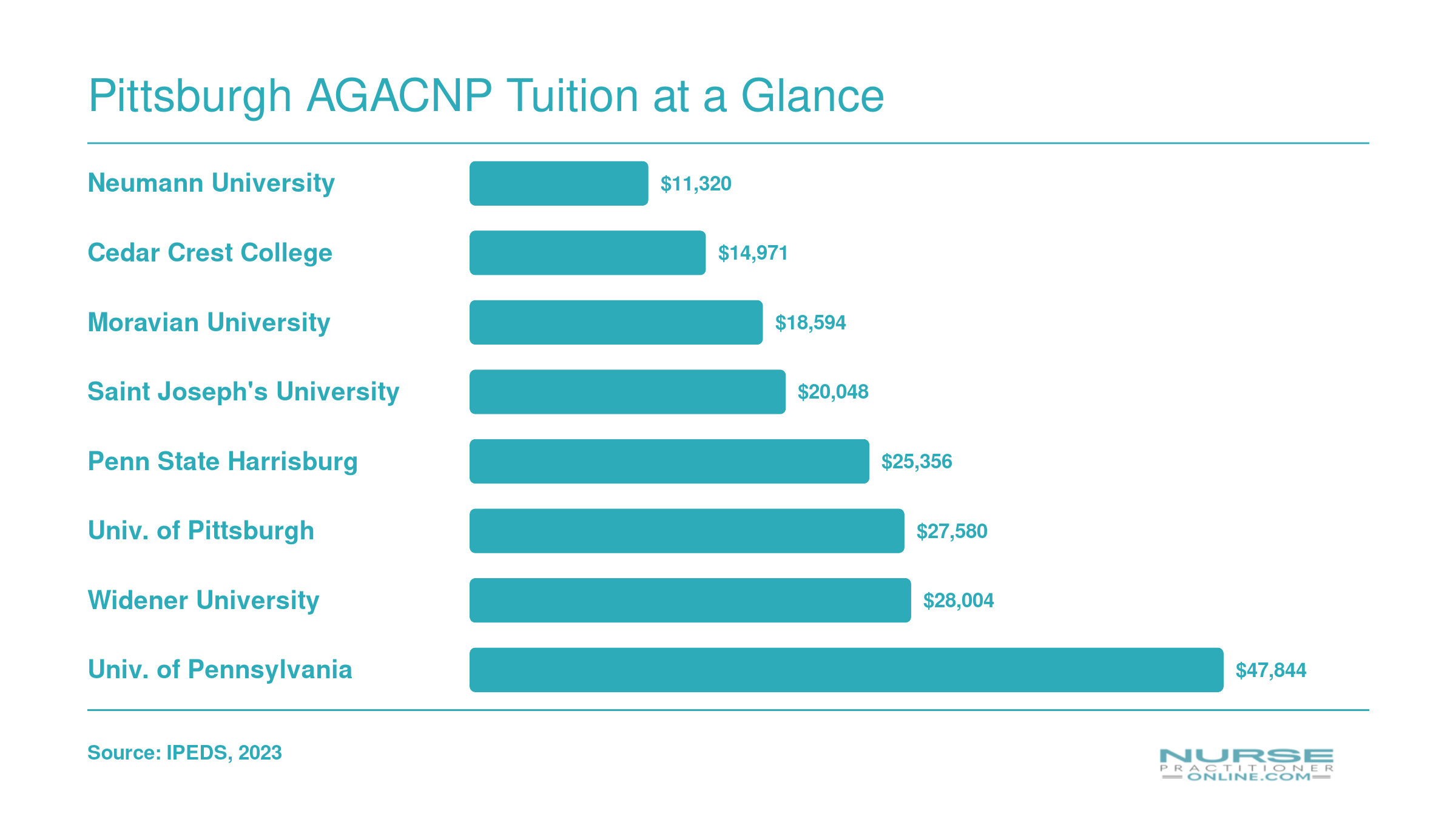
Pittsburgh AGACNP Tuition at a Glance
Annual graduate tuition for AGACNP programs across Pennsylvania varies by more than $35,000 depending on the school. The chart below ranks eight programs from lowest to highest published tuition so you can quickly spot where the biggest savings are. Keep in mind that the net price after financial aid, scholarships, and employer tuition benefits can be substantially lower. Scroll to the full cost table below for a detailed breakdown.
Side-by-Side Cost Breakdown: Tuition, Debt, and Monthly Payments
The table below compares graduate tuition rates, institution-wide net price estimates, median graduate debt, and approximate 10-year monthly loan payments for each AGACNP program on our list. Pay close attention to the median debt column: it reflects what graduates actually borrow, which matters more to your budget than sticker price alone. Keep in mind that the net price figures are institution-wide averages and may not reflect your specific graduate program costs. Always request a program-specific financial aid package before making your decision.
| School | In-State Grad Tuition | Out-of-State Grad Tuition | Approx. Net Price (Institution-Wide) | Median Graduate Debt | Est. 10-Year Monthly Payment |
|---|---|---|---|---|---|
| University of Pennsylvania | $47,844 | $47,844 | $28,699 | $15,715 | ~$181 |
| University of Pittsburgh | $27,580 | $46,786 | $30,434 | $24,250 | ~$279 |
| Penn State Harrisburg | $25,356 | $33,698 | $23,330 | $25,000 | ~$288 |
| Penn State University Park | $26,034 | $45,574 | $32,875 | $25,000 | ~$288 |
| Drexel University | $39,261 | $39,261 | $38,509 | $25,325 | ~$291 |
| Saint Joseph's University | $20,048 | $20,048 | $29,689 | $25,500 | ~$293 |
| DeSales University | $22,375 | $22,375 | $31,643 | $25,788 | ~$297 |
| Duquesne University | $27,612 | $27,612 | $37,730 | $26,244 | ~$302 |
| Moravian University | $18,594 | $18,594 | $30,670 | $26,793 | ~$308 |
| Cedar Crest College | $14,971 | $14,971 | $18,659 | $27,000 | ~$311 |
| Neumann University | $11,320 | $11,320 | $27,804 | $27,000 | ~$311 |
| Widener University | $28,004 | $28,004 | $25,759 | $27,000 | ~$311 |
Questions to Ask Yourself
Online, Hybrid, and On-Campus Options for Pittsburgh-Area RNs
Choosing the right delivery format can make or break your ability to finish an AGACNP program while working full time in the ICU. Below is a quick comparison of three Pennsylvania and nearby programs that welcome working nurses, each with a different balance of online coursework and required on-site sessions. Before you commit, visit each school's official nursing program page and look for sections labeled 'part-time study,' 'flexible scheduling,' or 'evening and weekend classes.' The University of Pittsburgh, Duquesne, Carlow, and Chatham all publish this information, and admissions offices are often willing to build a custom plan even when one is not explicitly advertised.
| Drexel University AGACNP | Widener University AGACNP | St. John Fisher University AGACNP | |
|---|---|---|---|
| Delivery Format | Mostly online with required on-site intensives | Hybrid (mix of in-person and online coursework) | Fully online with required on-site intensives |
| State | Pennsylvania | Pennsylvania | New York |
| Part-Time Track Available | Yes | Yes | Yes |
| On-Site Intensives or Residencies Required | Yes, contact the program coordinator for the number and timing of sessions each semester | Yes, expect scheduled campus visits; check the academic catalog for specifics | Yes, verify the number and location of sessions through the admissions office |
| Best Fit for Pittsburgh RNs | Strong option if you prefer mostly remote learning but can travel to the Philadelphia area for intensives | Good choice if you value regular face-to-face interaction and can commute to the Chester, PA campus | Worth considering if you want a fully online curriculum and can travel to Rochester, NY for limited on-campus days |
| How to Verify Scheduling Details | Review the curriculum in the Drexel academic catalog or contact the nursing program coordinator directly | Check the Widener nursing program page for evening and weekend class availability | Reach out to admissions or connect with current students through LinkedIn or program social media groups |
| Accreditation Verification | Confirm through the AANP or Pennsylvania State Board of Nursing | Confirm through the AANP or Pennsylvania State Board of Nursing | Confirm through the AANP or New York State Education Department |
Clinical Placements and UPMC/AHN Partnerships
Securing clinical placements through a formal university partnership or piecing them together independently represents the fork in the road for many Pittsburgh-area AGACNP students. Programs with established health system agreements often streamline your path to ICU hours, while others ask you to do more legwork. Understanding which schools hold active clinical affiliations with UPMC and Allegheny Health Network can save you months of phone calls and paperwork.
How to Verify Clinical Affiliations
Start by checking the official websites of AGACNP programs at Pitt, Duquesne, and Carlow. Clinical affiliate lists typically appear in program handbooks, FAQ sections, or dedicated clinical placement pages. UPMC maintains a clinical partnerships page describing service lines and clinical teams available to students from affiliated schools.1 AHN, with its 14 hospitals and more than 200 care sites across western Pennsylvania, also works with nursing programs, though partnership details may require a direct inquiry.23
Contact each school's clinical placement coordinator or AGACNP program director for the most current information. They can confirm whether formal agreements exist and explain the process for securing rotations at specific UPMC or AHN facilities. Some programs guarantee placements at partner hospitals, while others provide guidance but expect students to initiate the process.
Exploring Tuition Benefits and Hiring Pipelines
Both UPMC and AHN offer educational assistance to employees pursuing advanced degrees. If you currently work for either system, check the HR or talent acquisition section of the careers site. Search terms like "tuition reimbursement," "educational assistance," or "clinical partnership" combined with "AGACNP" can surface relevant programs. Some health systems also maintain informal hiring pipelines, giving preference to graduates from partner nursing schools. If you are weighing different specialty tracks, our overview of adult gerontology nurse practitioner programs covers the broader AGACNP and AGPCNP landscape.
Professional Association Resources
The Pennsylvania Coalition of Nurse Practitioners and the American Association of Critical-Care Nurses publish member resources and regional reports that occasionally address clinical training partnerships. These organizations can point you toward colleagues who completed AGACNP programs in the Pittsburgh area and may share firsthand insights about placement logistics, preceptor availability, and the quality of ICU rotations at local hospitals.
Admission Requirements and ICU Experience You'll Need
Admission standards vary across AGACNP programs in the Pittsburgh area, and requirements can shift from one application cycle to the next. Rather than relying on secondhand summaries, go straight to the source for the most accurate details.
- Verify requirements on each program's official admissions pageThe University of Pittsburgh School of Nursing and Duquesne University School of Nursing both maintain dedicated AGACNP admissions pages listing current GPA minimums, RN licensure requirements, required years of ICU or acute care bedside experience, GRE policies, prerequisite courses such as advanced pathophysiology or pharmacology, and certifications like BLS and ACLS. These pages are the most reliable starting point for the 2025–2026 application cycle.
- Confirm certification prerequisites through AANP and ANCCBefore you apply, review the eligibility criteria for the Adult-Gerontology Acute Care NP certification exam through the American Association of Nurse Practitioners (AANP) or the American Nurses Credentialing Center (ANCC). Understanding what the certifying bodies require, such as specific clinical hour totals, helps you choose a program that sets you up for a smooth path to credentialing after graduation.
- Check BLS.gov for broader scope-of-practice and workforce trendsThe Bureau of Labor Statistics publishes regularly updated information on nurse practitioner scope of practice, employment projections, and certification trends at the national and state level. Reviewing this data can help you gauge how the field is evolving in Pennsylvania and confirm that your planned specialty aligns with current workforce demand.
- Contact admissions offices directlyWebsites do not always reflect the latest changes. A quick phone call or email to a program's admissions team can clarify whether ICU experience requirements have been adjusted, whether prerequisite courses can be completed concurrently, or whether any new application components have been added for the current cycle. This step is especially important if you are applying during a transition period between academic years.
What Critical Care NPs Earn in the Pittsburgh Metro Area
According to the Bureau of Labor Statistics, nurse practitioners in the Pittsburgh metropolitan area earned a median annual wage of $128,730 as of 2023, with approximately 1,860 NPs employed across the region.1 The median hourly rate stood at $61.89. This regional figure outpaces the statewide Pennsylvania median and reflects the strong demand for advanced practice nurses in Pittsburgh's large health systems, including UPMC and Allegheny Health Network.
Salary Range: What New and Experienced Critical Care NPs Earn
The median tells only part of the story. Nurse practitioner earnings in Pittsburgh follow a wide distribution shaped by specialty, years of experience, and clinical setting. The 10th percentile for NPs in the area starts around the mid-$80,000 range, while the 25th percentile typically falls in the low $100,000s. At the upper end, the 75th percentile exceeds $145,000, and the 90th percentile can reach $160,000 or more.1 Critical care NPs often land above the median due to specialty differentials, shift premiums for nights and weekends, and the complexity of ICU and acute care roles. Many new AGACNP graduates begin in the 25th to 50th percentile range and move up as they gain autonomy and procedural competency.
How Pittsburgh Compares to Philadelphia and National Benchmarks
Pittsburgh's NP wages sit comfortably above the national median, which hovers in the low $120,000s.1 Philadelphia, with its larger market and higher cost of living, tends to pay slightly more on average, though the gap has narrowed in recent years as Pittsburgh's health systems compete for scarce critical care talent. For working nurses weighing relocation or remote program options, Pittsburgh offers a strong balance of competitive salary and lower housing costs compared to coastal metro areas.
Program-Specific Earnings Insights
Scorecard data on graduate earnings for specific AGACNP programs in Pennsylvania remain limited; many programs do not yet publish one-year or ten-year post-completion earnings. Where institutional data do exist, graduates of University of Pennsylvania's MSN program report median earnings above $111,000 within the first years post-graduation, reflecting both the prestige of the degree and the concentration of alumni in high-acuity roles. Duquesne and Pitt graduates similarly enter the market with strong earning potential, often securing positions in the region's flagship ICUs, transplant services, and cardiac units where pay scales reward specialization. Nurses considering an online acute care nurse practitioner programs pathway can compare tuition against these earning benchmarks to gauge return on investment.
For nurses already working in Pittsburgh ICUs, moving into an AGACNP role typically represents a meaningful salary increase, shift flexibility, and expanded career options across inpatient, procedural, and consultative settings.
How to Become a Critical Care Nurse Practitioner in Pennsylvania
The rapid expansion of intensivist-led care models across Pennsylvania hospitals has amplified demand for acute care nurse practitioners, yet the pathway from bedside ICU nurse to licensed AGACNP remains tangled in credentialing acronyms and state-specific regulations. Breaking the process into clear stages helps working nurses plot a realistic timeline while continuing to earn a paycheck.
Understanding the AGACNP Credential
First, a term clarification: "critical care NP" is a practice descriptor, not a formal certification. The recognized national credential is Adult-Gerontology Acute Care Nurse Practitioner (AGACNP). When Pittsburgh-area hospitals recruit for advanced practice providers in their ICUs, cardiac surgery step-downs, or rapid response teams, they are hiring AGACNPs who may also hold additional subspecialty training in critical care. Enrolling in an accredited AGACNP master's or DNP program is the foundational step after acquiring solid ICU experience. For a deeper look at the specialty itself, see our critical care nurse practitioner career guide.
Step 1: Build ICU Nursing Experience
Pennsylvania AGACNP programs require a compact but intense prerequisite: at least one to two years of full-time direct-care experience in a critical care setting. Most applicants to Pittsburgh-area programs such as those at the University of Pittsburgh, Duquesne University, and Robert Morris University arrive with 18 to 24 months in a medical, surgical, cardiothoracic, or neuro ICU. This experience ensures you have developed advanced assessment skills, ventilator management, hemodynamic monitoring, and the clinical judgment demanded by the acute care NP curriculum. If you are a newer nurse, plan to spend two years deepening your ICU competency before applying. This front-loaded investment pays dividends during clinical rotations and certification exams.
Step 2: Complete an Accredited AGACNP Graduate Program
Once you meet the clinical prerequisite, enroll in an accredited AGACNP master's or DNP program. Most working nurses choose part-time study to maintain full-time employment, stretching program length to roughly two to three years. Online and hybrid options from universities near Pittsburgh allow you to complete didactic coursework virtually while attending periodic on-campus intensives and clinical placements in your local region. If you are comparing national options, our roundup of AGACNP online programs is a helpful starting point. Program accreditation by the Commission on Collegiate Nursing Education (CCNE) or Accreditation Commission for Education in Nursing (ACEN) is essential, as it streamlines later certification and licensure.
Step 3: Pass a National AGACNP Certification Exam
After graduating, you must pass one of two nationally recognized board exams:1 - ANCC Adult-Gerontology Acute Care Nurse Practitioner (AGACNP-BC): This exam covers broader NP-role content (ethics, healthcare systems, professional issues) alongside acute care clinical management. - AACN Acute Care Nurse Practitioner, Adult-Gerontology (ACNPC-AG): The American Association of Critical-Care Nurses exam emphasizes heavy acute and critical care clinical management with a sharper focus on advanced physiology, pharmacology, and complex patient scenarios.
Both certifications are accepted by the Pennsylvania State Board of Nursing. Many nurses select the exam that aligns with their clinical background, though neither is intrinsically harder. Recertification occurs every five years through continuing education and clinical practice hours.1
Step 4: Obtain Pennsylvania CRNP Licensure
Pennsylvania remains a reduced-practice state as of 2026, meaning CRNPs must maintain a collaborative agreement with a physician to practice.3 The process begins on the Pennsylvania licensing portal, where you submit an application, official transcripts, and proof of national certification. The Board of Nursing issues your CRNP license after verifying eligibility. A separate application for prescriptive authority is required; this involves an additional fee and documentation of at least 45 hours of advanced pharmacology (part of your graduate program). Once licensed, you must renew your CRNP every two years, requiring 30 hours of continuing education, including 16 in pharmacotherapeutics, 2 in child abuse recognition, and (for prescribers) 2 in pain management.1
The Collaborative Agreement: A Practical Reality
You will need a signed collaborative agreement with a board-certified physician before you can practice. The document must define your scope of practice, practice settings, prescriptive parameters, and processes for consultation, referral, and coverage. Pittsburgh's large health systems, UPMC and AHN, have standardized templates and support structures to facilitate this, so the process is typically straightforward once you are hired. Although Pennsylvania has debated full practice authority legislation several times, no such law has passed as of June 2026, so expect to work under a collaborative framework.3
What's the Realistic Timeline?
For a nurse starting today, here is a typical pathway: - 1 to 2 years: Continue building ICU experience while researching AGACNP programs. - 2 to 3 years: Complete a part-time MSN-AGACNP or post-master's certificate. - 3 to 6 months: Study for and pass the ACNPC-AG or AGACNP-BC exam. - 1 to 3 months: Obtain Pennsylvania CRNP licensure and prescriptive authority, finalize collaborative agreement, and begin practicing.
This totals roughly four to five years from now, with the ability to keep working throughout. Some nurses compress the academic phase by choosing full-time study, but most find the part-time route more sustainable alongside ICU shifts.
Post-Master's AGACNP Certificate Programs Near Pittsburgh
Adding Acute Care to Your APRN Credentials
A post-master's AGACNP certificate is a short, focused program that lets you add adult-gerontology acute care nurse practitioner qualifications to your existing Master of Science in Nursing (MSN). It is designed for nurses who already hold APRN certification in another specialty, such as family, adult, or women's health, and want to pivot into critical care without earning a second full master's degree. Because the program credits count only the acute-care content you haven't yet covered, the pathway is substantially faster and less expensive than a complete MSN or DNP. For a broader look at what's available nationwide, see our roundup of online post-master's ACNP certificate programs.
Schools Near Pittsburgh That Offer the Certificate
Two major Pittsburgh-area universities run post-master's AGACNP tracks. The University of Pittsburgh offers an online certificate requiring 24 credits and 540 clinical hours, with a single 3-day on-site lab intensive.1 Duquesne University delivers a fully online program of 33 credits and 750 clinical hours, meaning no campus visits are needed.2 Both are designed for working RNs and build on the strong clinical partnerships these schools already have with UPMC and AHN.
If you're willing to look slightly farther afield, several other Pennsylvania schools provide fully online post-master's AGACNP certificates: Drexel University (29 credits), Saint Joseph's University, and Cedar Crest College among them.345 Out-of-state online options like Bradley University (32 credits, 600 clinical hours) and Herzing University (33 credits) also accept Pennsylvania nurses, though you will want to verify how they arrange clinical placements near your home.67
What to Expect: Credits, Hours, and Cost
Most AGACNP post-master's certificates fall in the 24 to 33 credit range, with clinical hour requirements from 540 to 750. That compares favorably to the 45 to 50 credits typical for a full MSN degree. Tuition varies by institution; as one benchmark, Saint Joseph's University lists a per-credit rate of $1,002 for 2025 to 2026, which puts a 24-credit program around $24,000, significantly less than most full-degree options.4 Because clinical hours are arranged through the school's placement network, you can often complete rotations in ICU settings across the Pittsburgh region while keeping your current job.
The post-master's certificate path remains under-discussed on many ranking sites, making it a powerful hidden option for experienced RNs who already have an MSN and want to move into Pittsburgh's critical care workforce quickly.
Common Questions About AGACNP Programs in the Pittsburgh Area
Below are some of the most common questions working nurses ask when exploring critical care nurse practitioner programs in and around Pittsburgh. Where possible, answers reference tuition, salary, and program details discussed earlier in this article.
- How much do critical care nurse practitioners make in PA?
- Critical care nurse practitioners in Pennsylvania earn competitive salaries that generally track above the national NP median. In the Pittsburgh metro area specifically, compensation can vary based on employer, specialty unit, and years of experience. Earlier in this article we outlined Pittsburgh-area salary benchmarks compared to statewide and national figures, so review that section for the most current numbers.
- What is the difference between a critical care NP and an acute care NP?
- The terms overlap significantly. An acute care nurse practitioner (AGACNP) is trained to manage patients with complex, acute, and critical conditions across adult and older adult populations. A "critical care NP" typically refers to an AGACNP who practices in an ICU or similar high-acuity setting. The graduate degree and certification pathway are the same; the distinction is really about where you choose to practice after graduation.
- Are there online critical care nurse practitioner programs available from Pittsburgh?
- Yes. Several Pittsburgh-area universities offer AGACNP programs with fully online or hybrid coursework, making them accessible to working RNs. Didactic classes are often delivered asynchronously, while clinical hours are completed at approved sites, frequently within the UPMC or AHN health systems. Check the online, hybrid, and on-campus comparison earlier in this article for program-specific details.
- What certification exams do AGACNP graduates need to pass?
- Graduates have two main options. The ANCC AGACNP-BC exam includes 175 questions (150 scored) over 3.5 hours, with a passing score of 350 and a reported pass rate of about 80 percent. The fee is $395 for non-members. The AACN ACNPC-AG exam costs $380 for non-members ($270 for AACN members). Both certifications are valid for five years and require at least 500 supervised clinical hours from an accredited program.
- How long does it take to become a critical care nurse practitioner in Pennsylvania?
- Most MSN-level AGACNP programs take two to three years of full-time study, or three to four years part-time. BSN-to-DNP tracks typically run three to four years. Add time for passing a national certification exam and obtaining Pennsylvania CRNP licensure through the State Board of Nursing. If you already hold a master's degree, a post-master's AGACNP certificate can be completed in roughly 12 to 18 months.
- Do Pittsburgh AGACNP programs require CCRN certification for admission?
- Pittsburgh-area AGACNP programs generally recommend, but do not require, CCRN certification at the time of admission. Most programs do expect applicants to have at least one to two years of acute or critical care RN experience. Holding a CCRN can strengthen your application and demonstrate readiness for advanced critical care coursework, so it is worth pursuing if your timeline allows.
Pennsylvania by City
- ACNP Programs in Pennsylvania
- Allentown, Pennsylvania (FNP)
- DNP NP Programs in Pennsylvania
- FNP Programs in Pennsylvania
- Philadelphia, Pennsylvania (ACNP)
- Philadelphia, Pennsylvania (PNP)
- Philadelphia, Pennsylvania (WHNP)
- Pittsburgh, Pennsylvania (AGNP)
- Pittsburgh, Pennsylvania (PMHNP)
- PMHNP Programs in Pennsylvania
- PNP Programs in Pennsylvania
- Scranton, Pennsylvania (AGNP)