
Most important takeaways…
- Post-master's WHNP certificates can cut total tuition roughly in half compared to a full MSN pathway.
- Philadelphia-area NPs earn about $60,000 more annually than staff RNs, enabling tuition payback within one year.
- Out-of-state online WHNP programs sometimes offer lower tuition, but clinical placement logistics add hidden costs for PA students.
- Employer tuition benefits and federal aid can reduce a program's net price well below its published sticker cost.
The cost spread between women's health nurse practitioner programs, even those accessible to Philadelphia-area nurses, can exceed $30,000 in total tuition, and the gap widens further when you account for fees, clinical supplies, and travel. A local hybrid program that supports your placement search may deliver better long-term value than a distant online program with a lower sticker price but no preceptor network in Pennsylvania.
This article ranks both Philadelphia-based and out-of-state online WHNP programs by all-in cost, not just tuition. It models real net price after financial aid and employer benefits, compares clinical placement logistics across formats, and breaks down the hidden expenses (liability insurance, health screenings, certification exam prep) that turn a $45,000 program into a $52,000 reality.
With Pennsylvania requiring national certification and APRN licensure before you can practice as a WHNP, choosing an accredited program that supports your clinical placements is not optional. Most Philadelphia hospitals and women's health clinics prefer preceptors they already know, which makes local connections a practical advantage worth weighing against tuition savings.
Most Affordable Online WHNP Programs for Philadelphia-Area Nurses, 2026 Rankings
Finding a Women's Health Nurse Practitioner program that balances quality with affordability can feel daunting, especially in a metro area with premium tuition price tags. The two Philadelphia-based WHNP programs below serve the local nursing workforce in very different ways: one offers a hybrid format designed for working RNs who want to keep commuting costs low, and the other delivers a research-rich, campus-centered experience backed by one of the nation's top-ranked nursing schools. Both prepare graduates for NCC board certification and Pennsylvania APRN licensure.
- Net price after financial aid
- Published tuition and fees
- Clinical placement accessibility
- Program format and flexibility
- Regional employer tuition benefits
- NCES-IPEDS federal institutional data — nces.ed.gov
- College Scorecard graduate earnings — collegescorecard.ed.gov
- Independent program research
- Internal program database

Thomas Jefferson University
Thomas Jefferson University pairs its College of Nursing with a major academic health system right on campus, giving WHNP students convenient access to clinical rotations without long commutes across the metro area. The university is recognized as military-friendly, opening additional funding pathways for veterans and service members. Jefferson's overall graduation rate of about 69% reflects the full undergraduate and graduate student body and should not be read as specific to the WHNP track.
- Hybrid format blends online coursework with on-campus sessions
- 45-credit curriculum completable in 2 to 5 years
- Approximately $1,234 per credit for WHNP coursework
- Part-time pacing helps maximize employer tuition reimbursement
- Prepares graduates for the NCC WHNP certification exam
- Clinical training at Center City and Dixon campuses
- Emphasis on evidence-based, culturally responsive care
Women's Health, Gender Related Nurse Practitioner (MSN) — Hybrid

University of Pennsylvania
The University of Pennsylvania's School of Nursing is consistently ranked among the nation's best, and its Women's Health/Gender-Related NP track reflects that prestige with strong research, policy, and dual-certification opportunities. Total program costs range from roughly $96,600 to $102,500, placing Penn at the higher end of Philadelphia options. However, nurses employed within the Penn Medicine system may offset a portion of that cost through employer tuition benefits of approximately $6,000 per year. The school arranges all clinical placements on the student's behalf, removing a significant logistical burden.
- Full-time track completable in about 14 months
- Part-time options span 2 to 3 years
- All clinical placements arranged by the school
- Dual certification pathway available for nurse-midwifery
- Curriculum includes public policy and technology research
- Total estimated cost between $96,600 and $102,500
- 8:1 student-to-faculty ratio across the university
- Penn Medicine employees eligible for tuition benefit support
Women's Health/Gender-Related Nurse Practitioner (MSN) — On-Campus
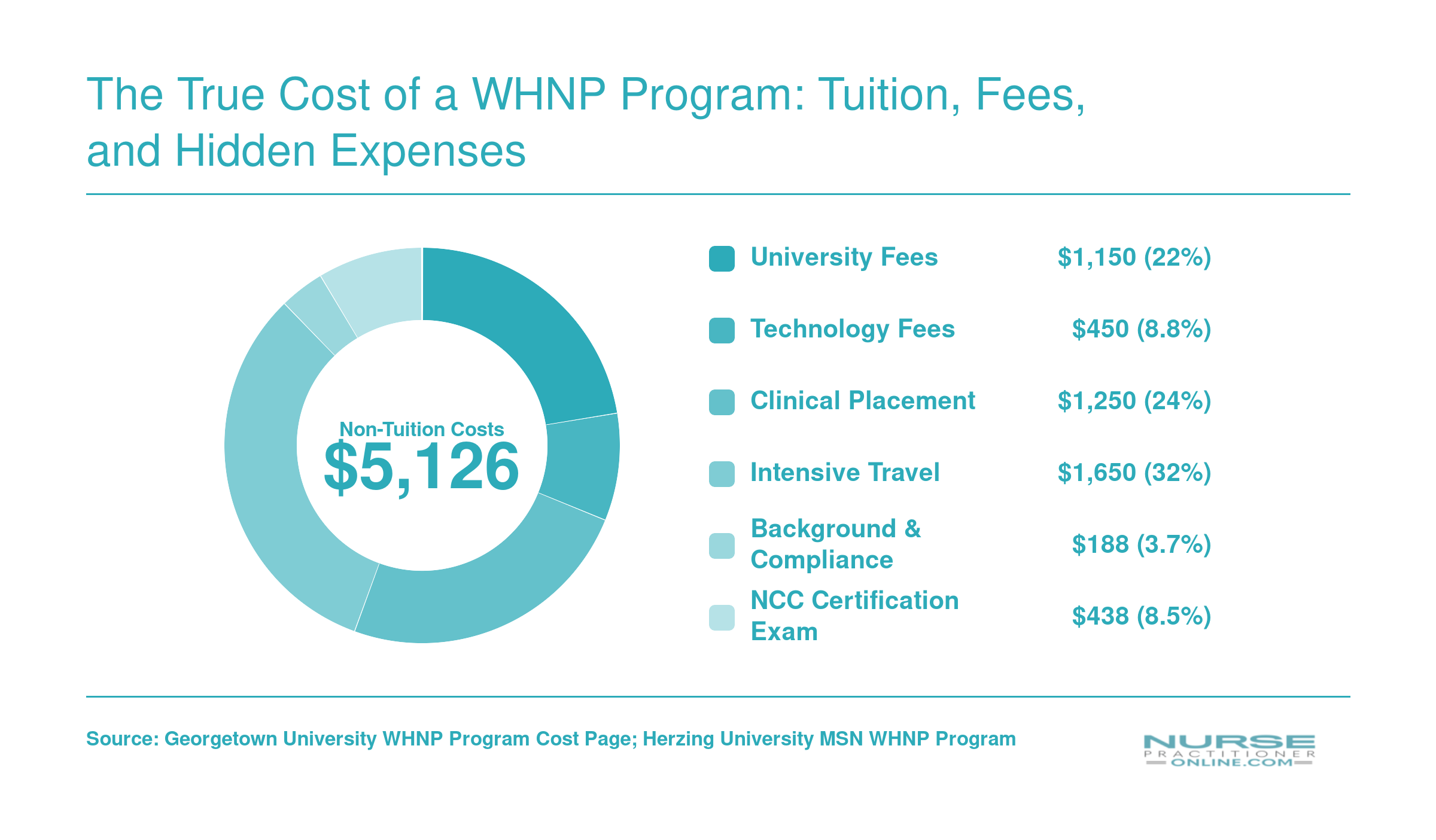
The True Cost of a WHNP Program: Tuition, Fees, and Hidden Expenses
Base tuition is only part of what you will actually spend on a WHNP program. The breakdown below shows realistic ranges for every cost category beyond tuition, so you can build a personalized budget before you apply. Clinical-related expenses (travel, housing for on-campus intensives, and preceptor placement fees) are the largest hidden variable and can add $2,000 to $5,000 or more to your total.
What You'll Actually Pay: Net Price After Financial Aid and Employer Benefits
Sticker price and real cost are two different numbers, and for most Philadelphia-area nurses, the gap between them is significant. Before you rule out a program on tuition alone, it is worth modeling what you would actually owe after stacking every available resource.
Start with Employer Reimbursement
Many of the region's largest health systems offer tuition reimbursement as a standard benefit, though the annual caps vary and tend to be tied to employment status and years of service. Jefferson Health and Penn Medicine both offer tuition reimbursement programs for eligible employees, with annual caps that have typically ranged from roughly $5,000 to $6,000 per year in recent benefit cycles. Main Line Health has offered similar support. Over a two-to-three-year MSN program, that reimbursement can chip away $10,000 to $18,000 from your total bill. Confirm current figures directly with your HR department, since caps are reviewed annually and depend on your employment category.
For context, Thomas Jefferson University's WHNP program carries tuition around $24,500 for the full program, and Penn's program runs considerably higher. After two years of employer reimbursement at even a modest cap, your out-of-pocket balance shifts meaningfully. If you are still comparing best online WHNP programs nationally, keep employer reimbursement in mind as a factor that can make a pricier local option competitive.
Layer In HRSA Nurse Corps Support
If you are open to serving at a qualifying health facility after graduation, the HRSA Nurse Corps Scholarship Program is one of the most powerful tools available. For the 2025-2026 cycle, applications are open and the program covers 100% of tuition and fees for eligible students enrolled full-time.12 WHNP students qualify. The commitment is two to three years of full-time service at a Critical Shortage Facility, and the award is taxable, so factor that into your planning.1 Priority goes to applicants with high financial need or disadvantaged backgrounds. Philadelphia and its surrounding counties have no shortage of qualifying sites.
The HRSA Nurse Corps Loan Repayment Program is a separate option for graduates already carrying debt. It repays a percentage of outstanding loans in exchange for service at an eligible site, and WHNP-prepared nurses practicing in underserved settings often qualify.
Pennsylvania's Primary Care Loan Repayment Program offers an additional layer for clinicians who commit to underserved communities in the state. Award amounts vary by cohort and funding availability, so check the current cycle before counting on a specific figure.
Understand What Loans Actually Do
Federal Grad PLUS loans and Stafford loans are available as a backstop, but they are not a benefit. They delay cost rather than reduce it. Pennsylvania State Grants for graduate students are limited and competitive. Grants and employer reimbursement are the mechanisms that genuinely lower what you pay. Loans simply change when you pay it.
One more note: institution-wide average net price figures published by the federal government reflect all graduate students at a school, not WHNP candidates specifically. Your actual net price depends entirely on the aid package you negotiate and the benefits you apply for. The number you see in aggregate data is a starting point for comparison, not a promise.
Questions to Ask Yourself
Philadelphia-Area Schools vs Out-of-State Online WHNP Programs: A Cost and Logistics Comparison
If you are a working nurse in the Philadelphia area, you have strong local options for WHNP education, but several well-regarded out-of-state online programs also enroll Pennsylvania students. The comparison below focuses on the factors that matter most to your bottom line and daily logistics: tuition structure, out-of-state surcharges, clinical placement support, and program format. Understanding these differences can save you thousands of dollars and months of frustration arranging preceptors.
| Factor | Thomas Jefferson University (Philadelphia) | Frontier Nursing University (Kentucky, Online) | Kent State University (Ohio, Online) | Stony Brook University (New York, Online) |
|---|---|---|---|---|
| Institution Type | Private | Private | Public | Public (SUNY) |
| Out-of-State Surcharge for PA Students | Not applicable (local) | No surcharge; flat rate for all students | Effectively none for online students | Yes; non-resident rate is higher |
| Annual Tuition (2025 to 2026) | Approximately $24,528 | Flat rate regardless of state (check current schedule) | Flat online per-credit rate (check current schedule) | Two-tier billing; PA residents pay non-resident rate |
| Program Format | Hybrid (online coursework plus on-campus sessions in Center City) | Primarily online with brief on-campus intensives in Kentucky | Primarily online | Primarily online |
| Clinical Placement Support in PA | Strong local clinical network in Greater Philadelphia | Shared responsibility; university provides backup support for preceptor placement | Student-led search with some university assistance | Limited; students are primarily responsible for securing PA preceptors |
| Travel Requirements | Minimal (campus is in Center City Philadelphia) | Periodic trips to Hyden, KY for intensive sessions | Minimal or none beyond clinical sites | Minimal or none beyond clinical sites |
| Key Advantage for Philly-Area Nurses | No relocation or travel; established preceptor relationships nearby | Predictable flat tuition with meaningful preceptor support | Competitive online tuition with no out-of-state penalty | SUNY reputation, though surcharge and limited PA preceptor help add cost and effort |
Clinical Placement Support and Costs for Pennsylvania WHNP Students
Securing clinical hours is often the piece of an online WHNP program that surprises nurses the most. The coursework feels manageable, but arranging hundreds of hours of supervised practice in a specialty setting is a different kind of challenge entirely.
How Many Hours Are We Talking About?
Most online WHNP programs require somewhere between 500 and 750 clinical hours, and that range matters more than it might seem. Frontier Nursing University, for instance, requires 750 hours, which is on the higher end of what you will encounter.1 More hours means more time coordinating with a preceptor, more scheduling to juggle around your current job, and potentially more travel if your preferred site is not nearby.
Placement Assistance vs. Self-Placement: Know Before You Enroll
This is one of the most consequential differences between programs, and it rarely appears in the tuition comparison charts. Many online programs expect students to locate and secure their own preceptors, which places the entire burden on you. Finding a willing OB/GYN or women's health clinician who meets your program's credentialing requirements, is accepting NP students, and has availability that fits your schedule can take months.
Frontier Nursing University takes a different approach. Their Clinical Outreach and Placement Services team actively helps students identify and vet preceptors and clinical sites.2 Students are not left to figure it out alone, which is a meaningful advantage, especially for nurses who do not already have strong contacts in women's health settings.
For Philadelphia-area nurses, the city's large hospital network and academic medical centers do create more opportunities than rural students face. But women's health and OB/GYN sites are genuinely harder to secure than primary care placements, regardless of geography. Demand for these sites from multiple programs competes for a limited number of willing preceptors.
The Real Dollar Cost of Self-Placement
When a program does not offer placement support, the hidden costs add up quickly:
- Time: Outreach, credentialing paperwork, and back-and-forth negotiation can consume dozens of hours before a single clinical hour is logged.
- Travel: If the only available site is not near your home or workplace, fuel, parking, and commute time become ongoing expenses throughout the program.
- Matching services: Third-party clinical placement agencies charge anywhere from $500 to over $2,000 to connect NP students with preceptors, a cost that never appears in a program's published tuition figure.
When you are comparing program costs, factor placement support into the equation. A program with a higher sticker price but dedicated clinical coordinators may actually cost less, and cause far less stress, than a cheaper program that leaves you to navigate placements on your own.
Related Articles
Post-Master's WHNP Certificate vs Full MSN: Which Path Costs Less?
The choice between a post-master's WHNP certificate and a full MSN comes down to one central question: how much of your nursing education do you really need to repeat? If you already hold an MSN, the answer is probably very little, and the certificate path can save you tens of thousands of dollars along with a year or more of your life.
Who the Post-Master's Certificate Is For
Post-master's WHNP certificates are designed specifically for NPs who already hold an MSN in another specialty, such as family nurse practitioner, and want to add women's health certification without returning to square one. You have already completed graduate-level pathophysiology, pharmacology, and health assessment. A certificate program credits that foundation and focuses your coursework on women's health clinical content and practicum hours. If you're weighing options across multiple specialties, you can also compare online post-master's NP certificate programs to see how WHNP stacks up against other tracks.
If you do not yet hold an MSN, a full MSN-WHNP is the appropriate route, and the longer timeline is simply the nature of building a graduate degree from the ground up.
Comparing Credit Loads and Total Cost
The credit difference between these two paths is substantial. A full MSN-WHNP typically requires 40 to 50 or more credits. A post-master's certificate can fall anywhere from 15 to 37 credits depending on the school, and that range translates directly into tuition savings.
Three programs accessible to Pennsylvania residents illustrate the spread:
- Frontier Nursing University: 24 to 30 credits at roughly $636 per credit, putting total tuition in the $15,000 to $19,000 range. The program runs on a hybrid model and is accredited by ACEN. Completion typically takes 18 to 30 months part-time.1
- Georgetown University: 22 credits, but at $2,652 per credit, the total cost runs from roughly $42,000 to $71,000 depending on the number of credits you ultimately complete. It is fully online and CCNE-accredited, with a 12 to 24 month timeline.2
- Drexel University: At 37 credits, Drexel's Women's Health/Gender-Related NP Certificate sits closer to a full MSN in scope, with estimated costs of $45,000 to $55,000. It is CCNE-accredited and can be completed in approximately 18 months through a hybrid format.3 Herzing University also offers a CCNE-accredited post-master's option with a 16 to 24 month timeline, though per-credit cost details are best confirmed directly with the program.4
Time-to-Completion and Opportunity Cost
Tuition is only part of the financial picture. A full MSN typically takes two to three years even on a part-time schedule, while most post-master's certificates can be completed in 12 to 18 months. Every additional semester in school is a semester you are not earning a WHNP salary, not billing at a higher rate, and possibly limiting your hours at your current position to manage coursework.
For an already-licensed NP, the certificate path usually offers the better return: lower tuition, faster completion, and an earlier transition into women's health practice. The full MSN makes sense when you are starting without an NP credential or when a specific employer or state requires the degree designation rather than a certificate alone.
Frequently Asked Questions About Online WHNP Programs
Choosing an online WHNP program involves juggling cost, format, timeline, and accreditation. Below are answers to the questions Philadelphia-area nurses ask most often when weighing their options.
- What is the cheapest online women's health nurse practitioner program?
- Tuition varies widely, but public universities with flat online rates tend to be the most affordable. Stony Brook University (SUNY) offers a fully online WHNP program with in-state SUNY tuition that is consistently among the lowest published rates. Programs at other state schools, such as the University of Missouri-Kansas City, also price competitively for out-of-state online learners. Always confirm current per-credit costs and fees directly with each school, because rates shift yearly.
- Can you complete a WHNP program entirely online?
- Coursework can be completed fully online at some schools. Stony Brook University, for example, delivers its WHNP program 100 percent online with no required campus visits. Other programs, such as Georgetown University's, are primarily online but require periodic on-campus intensives. Every WHNP program still mandates in-person clinical hours at approved local sites, so you will need to arrange hands-on placements near Philadelphia regardless of how classes are delivered.
- How long does an online WHNP program take to complete?
- Most online WHNP master's programs take 24 to 36 months depending on full-time or part-time enrollment. Georgetown's program is structured at roughly 23 months, while UMKC's runs about 24 months for full-time students. Part-time tracks, which many working nurses prefer, can extend the timeline closer to three years. Post-master's certificate options are typically shorter, often 12 to 18 months, for nurses who already hold an MSN.
- Are there CCNE-accredited online WHNP programs available in Pennsylvania?
- As of 2026, no Pennsylvania-based school offers an online WHNP concentration, but several CCNE-accredited programs outside the state enroll PA residents. Stony Brook University and Georgetown University both hold CCNE accreditation and accept students nationwide. Because Pennsylvania recognizes CCNE-accredited degrees for APRN licensure, completing one of these programs positions you to sit for the NCC Women's Health Nurse Practitioner certification exam and apply for PA state licensure.
Accreditation, Board Certification, and PA APRN Licensure for WHNPs
Choosing an accredited program and choosing a non-accredited one may look similar on paper, but the outcomes are worlds apart once you try to sit for certification and apply for licensure in Pennsylvania.
Why Accreditation Is the Foundation
Pennsylvania's State Board of Nursing accepts graduation from programs accredited by CCNE, ACEN, or other recognized accrediting bodies as a requirement for CRNP licensure.1 That requirement is not a formality. The National Certification Corporation (NCC), which administers the WHNP-BC exam, also requires candidates to have completed an accredited graduate-level WHNP program before they can even register for the test. Skip accreditation to save tuition dollars, and you may find yourself locked out of both certification and licensure entirely. The "savings" evaporate fast when you cannot practice.
The NCC WHNP-BC Exam
Once you finish your program, the NCC WHNP-BC certification exam is your next milestone. The exam covers women's health across the lifespan, including primary care, reproductive health, and perimenopause and menopause management. The exam fee runs approximately $400, though you should verify the current amount directly with NCC before you budget. The format is a computer-based multiple-choice exam, and NCC publishes candidate performance data periodically so you can benchmark what preparation looks like for most successful test-takers. For a broader look at the certification process across specialties, see our nurse practitioner licensing guide.
Pennsylvania CRNP Licensure: What the State Requires
Pennsylvania licenses nurse practitioners under the CRNP designation. To obtain that license, you need:
- Graduate degree: A master's or doctoral degree from an accredited program is required.1
- Active RN license: You must hold a current Pennsylvania RN license.3
- National certification: NCC WHNP-BC (or equivalent recognized certification) is required.3
- Collaborative agreement: Pennsylvania has not yet granted full practice authority to nurse practitioners. You will need a written collaborative agreement with a physician to practice, and additional restrictions apply if you plan to prescribe Schedule II controlled substances.1
- Application fees: The initial CRNP application fee is $100, with a $50 renewal fee and a separate $50 fee for prescriptive authority.
- Continuing education: Licensure renewal requires 30 hours of continuing education, including 16 hours in pharmacology and 3 hours in child abuse recognition.5
If you are coming from a neighboring state like Maryland or New Jersey, note that those states have moved closer to full practice authority for NPs. Pennsylvania's collaborative agreement requirement is a meaningful regulatory difference that affects how you structure your practice from day one.
The Cost of Getting This Wrong
A program that trims tuition by skipping accreditation is not a bargain. It is a dead end. As you research women's health nurse practitioner career paths, confirm CCNE or ACEN accreditation first, then compare costs. That single check protects every dollar you invest in the degree and keeps your path to the WHNP-BC and Pennsylvania CRNP licensure clear.
WHNP Salary and Return on Investment in Greater Philadelphia
The table below compares nurse practitioner earnings in the Philadelphia metro area with statewide Pennsylvania figures and the national median. Keep in mind that the Bureau of Labor Statistics does not separate WHNPs from other nurse practitioners, so these figures represent all NP specialties combined. That said, WHNP salaries generally fall within a similar range. When you compare the median NP salary in Greater Philadelphia ($131,590) against the total program costs highlighted in our rankings (roughly $20,000 to $65,000 for a full MSN or post-master's certificate), many graduates can recoup their tuition investment within the first year of the resulting pay increase alone, especially considering that the median RN salary in the same metro is $99,210.
| Geographic Area | Median Annual Salary | 25th Percentile | 75th Percentile | Mean Annual Salary | Total NP Employment |
|---|---|---|---|---|---|
| Philadelphia-Camden-Wilmington, PA-NJ-DE-MD (Metro) | $131,590 | $115,400 | $147,900 | $133,360 | 5,780 |
| Pittsburgh, PA (Metro) | $107,680 | $104,820 | $130,760 | $120,280 | 2,300 |
| Allentown-Bethlehem-Easton, PA-NJ (Metro) | $127,420 | $107,660 | $133,440 | $125,180 | 750 |
| Harrisburg-Carlisle, PA (Metro) | $131,390 | $117,630 | $142,170 | $133,000 | 500 |
| Reading, PA (Metro) | $135,030 | $116,590 | $141,550 | $135,270 | 280 |
| Lancaster, PA (Metro) | $130,240 | $110,250 | $135,790 | $128,890 | 390 |
| Scranton and Wilkes-Barre, PA (Metro) | $128,120 | $103,680 | $134,840 | $119,350 | 460 |
| Philadelphia Metro: Registered Nurses (for comparison) | $99,210 | $84,040 | $107,800 | $97,510 | 74,840 |
Pennsylvania by City
- ACNP Programs in Pennsylvania
- Allentown, Pennsylvania (FNP)
- DNP NP Programs in Pennsylvania
- FNP Programs in Pennsylvania
- Philadelphia, Pennsylvania (ACNP)
- Philadelphia, Pennsylvania (PNP)
- Pittsburgh, Pennsylvania (AGNP)
- Pittsburgh, Pennsylvania (CCNP)
- Pittsburgh, Pennsylvania (PMHNP)
- PMHNP Programs in Pennsylvania
- PNP Programs in Pennsylvania
- Scranton, Pennsylvania (AGNP)