Most important takeaways…
- DNP-PMHNP programs near Pittsburgh cluster between roughly $24,250 and $25,788 in median graduate debt, matching national doctoral nursing averages.
- Hybrid and online formats at Penn State and Duquesne can cut commuting and housing costs by thousands of dollars.
- NHSC loan repayment and employer tuition benefits offset a significant share of total program costs for PA students.
- Pittsburgh-area NPs earn a median near $112,000, positioning most graduates to recoup their investment within two to three years.
Western Pennsylvania faces a sustained shortage of mental health prescribers, and psychiatric-mental health nurse practitioners now help fill that gap in settings ranging from UPMC outpatient clinics to rural Medicaid health homes. Earning the DNP credential required to practice independently means committing to two to three years of graduate coursework and clinical training, but sticker prices among programs in and around Pittsburgh range from under $30,000 to well over $80,000 in total tuition.
That cost spread turns format, financial aid packaging, and clinical-placement logistics into critical variables. A program that appears inexpensive on a per-credit basis can become more expensive once you account for travel to on-campus intensives, clinical-site coordination fees, and lost shift income during mandatory daytime rotations.
Most Pennsylvania DNP-PMHNP graduates carry $24,000 to $26,000 in federal loans at completion, close to the national median for doctoral nursing degrees. Whether you land above or below that benchmark depends less on geography than on how aggressively you layer employer tuition benefits, federal traineeships, and Health Resources and Services Administration loan-repayment commitments into your financing strategy.
Most Affordable DNP-PMHNP Programs Near Pittsburgh, Ranked by Cost
These programs were evaluated by weighting net price, financial aid generosity, and graduate debt outcomes to surface options that deliver clinical training without excessive borrowing. All four schools are located in Pennsylvania and offer DNP pathways with a Psychiatric Mental Health Nurse Practitioner concentration, making them accessible to working nurses in the Pittsburgh metro. Keep in mind that program-level earnings and debt data are not yet available for these specific PMHNP tracks, so institution-wide figures are used as context where noted.
- Net price after financial aid
- Graduate debt at completion
- Financial aid generosity
- Clinical training quality and access
- Delivery format and flexibility
- NCES-IPEDS federal institutional data — nces.ed.gov
- College Scorecard graduate earnings — collegescorecard.ed.gov
- Independent program research
- Internal program database

Pennsylvania State University-Penn State Harrisburg
Penn State Harrisburg delivers the lowest net price among these four options, making it the standout choice for budget-conscious Pennsylvania nurses. Its primarily online DNP with only three required on-campus intensives in Harrisburg keeps travel costs minimal for Pittsburgh-area students. The program prepares graduates to assess and manage mental health and substance use disorders across all life stages through 31 specialized credits and 1,125 practicum hours, with access to Penn State's network of more than 700 clinical partners statewide.
- Online DNP with three on-campus intensives in Harrisburg
- 31 specialized credits in the PMHNP concentration
- 1,125 practicum hours required for clinical readiness
- CCNE accredited program with certification exam eligibility
- Per-credit cost of approximately $1,027
- Flexible scheduling designed for working registered nurses
- Access to 700+ clinical partner sites across Pennsylvania
Doctor of Nursing Practice, Psychiatric Mental Health Nurse Practitioner — Hybrid

Pennsylvania State University
Penn State's University Park campus offers a hybrid DNP with a PMHNP concentration through the Ross and Carol Nese College of Nursing. The three-year, part-time format blends online coursework with select in-person learning, letting Pittsburgh-area nurses keep earning while they study. Rolling admissions with no GRE requirement, military benefits acceptance, and institutional scholarships all help reduce the financial barrier. The school-wide graduation rate of roughly 86% reflects strong overall student support, though that figure covers all undergraduates rather than this specific doctoral track.
- Hybrid format: mostly online with select campus sessions
- Three-year part-time schedule for working nurses
- No GRE or GMAT required for admission
- Rolling admissions with priority dates in March, June, and October
- 700+ clinical partners for placement near your home region
- Military education benefits accepted
- Scholarships and need-based financial aid available
- Four NP concentration options within the same DNP framework
Doctor of Nursing Practice, Psychiatric Mental Health Nurse Practitioner — Hybrid

University of Pittsburgh-Pittsburgh
The University of Pittsburgh sits right in the heart of the city, and its PMHNP doctoral program has historically offered concentrated clinical placements across Pittsburgh's extensive behavioral health network, including major health systems and community agencies. The program provides both BSN-to-DNP (93 credits) and MSN-to-DNP (36 to 45 credits) pathways with 1,120 clinical residency hours. An important note for prospective applicants: as of early 2026 Pitt has paused new PMHNP applications while it redesigns the nurse practitioner program, so check directly with the School of Nursing for updated timelines before planning your enrollment.
- BSN-to-DNP pathway totaling 93 credits
- MSN-to-DNP pathway ranging from 36 to 45 credits
- 1,120 clinical residency hours in diverse settings
- CCNE accredited with national certification eligibility
- On-site and online learning components
- Emphasis on leadership development and multidisciplinary research
- Full-time and part-time enrollment options available
Psychiatric Mental Health Nurse Practitioner, Doctor of Nursing Practice — On-Campus

DeSales University
DeSales University is a private institution in eastern Pennsylvania offering a BSN-to-DNP with a PMHNP specialty. Because it is a private school, tuition is the same regardless of residency, listed at $22,375 per year. The curriculum covers 85 credit hours and 1,200 clinical hours spanning psychiatric assessment, psychopharmacology, and psychotherapy across the lifespan. Online synchronous and asynchronous delivery options make it workable from Pittsburgh, though students should budget for occasional travel to the Center Valley campus for simulation center access. Applicants need at least 24 months of psychiatric nursing experience, and the school-wide graduation rate of about 72% provides general institutional context.
- 85 total credit hours in the BSN-to-DNP track
- 1,200 clinical hours across hospitals, clinics, and outpatient centers
- Online synchronous or asynchronous delivery available
- CCNE accredited with fall start and rolling admissions
- 24 months of psychiatric experience required for admission
- Scholarships available for DNP students
- Healthcare Simulation Center access for hands-on training
- DNP scholarly project required for graduation
BSN-DNP, Psychiatric Mental Health Nurse Practitioner — On-Campus
Tuition and Total Cost-of-Attendance Comparison
The table below compares annual published tuition rates and institution-wide average net price for each DNP-PMHNP program near Pittsburgh. Keep in mind that published tuition is only part of the picture. Clinical placement fees ($1,500 to $4,000 over the program), malpractice insurance ($300 to $900), background checks and drug screens ($150 to $350), technology and proctoring fees ($1,000 to $3,000), and certification exam prep and testing costs ($600 to $900) can add $3,550 to $9,150 or more to your total bill. Also note that the average net price shown here is an institution-wide figure drawn from federal data. Your individual cost will vary based on your financial aid package, residency status, and the number of credits your specific track requires.
| School | In-State Tuition (Annual) | Out-of-State Tuition (Annual) | Avg. Net Price (Institution-Wide) | Format | Approx. Per-Credit Cost |
|---|---|---|---|---|---|
| Penn State Harrisburg (World Campus DNP) | $25,356 | $33,698 | $23,330 | Hybrid (online with on-campus intensives) | ~$1,027 |
| University of Pittsburgh | $27,580 | $46,786 | $30,434 | On-campus with online components | Not published |
| DeSales University | $22,375 | $22,375 (single rate) | $31,643 | On-campus | Not published |
| Penn State University Park (Nese College of Nursing) | $26,034 | $45,574 | $32,875 | Hybrid (online with on-campus intensives) | Not published |
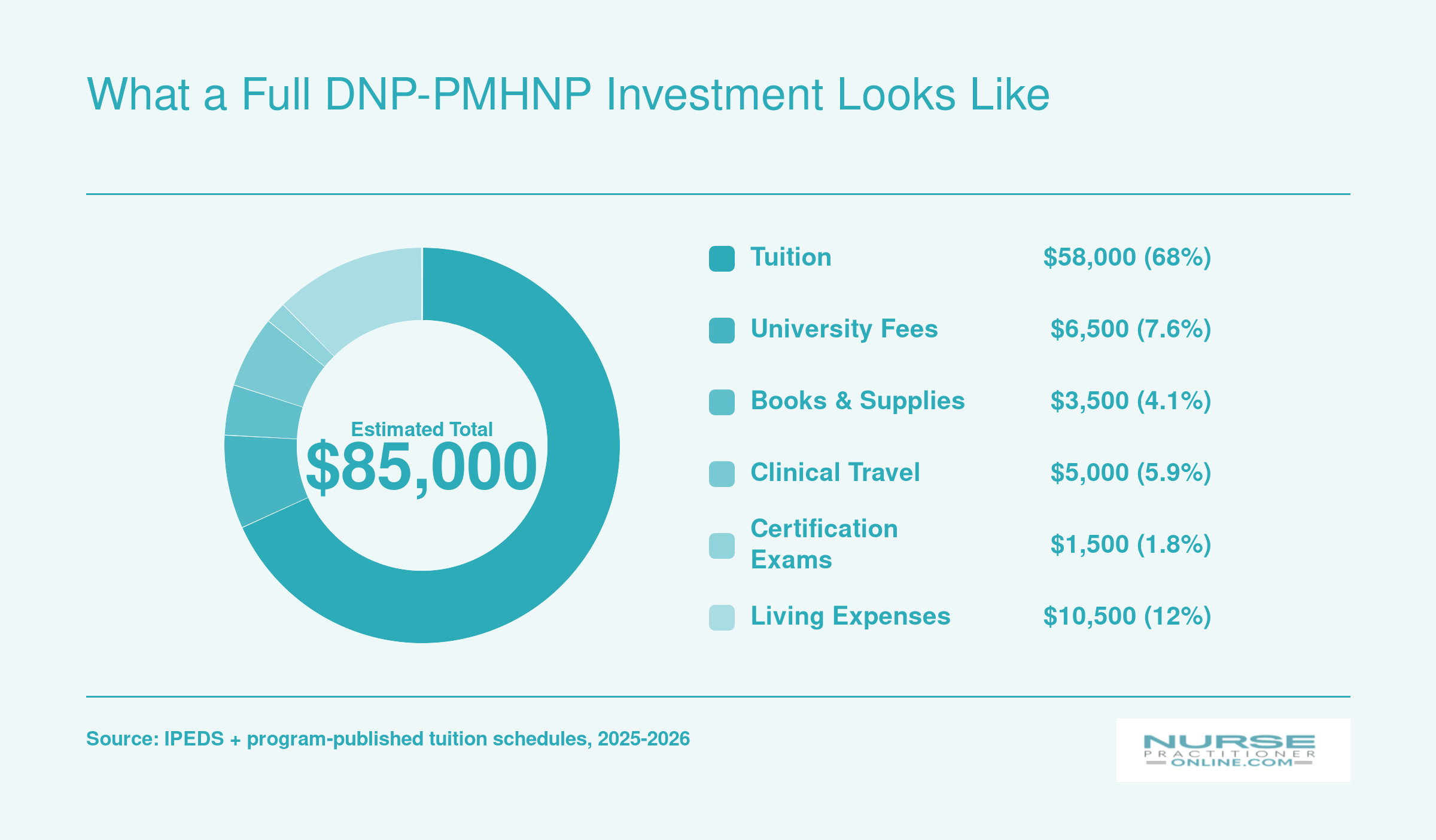
What a Full DNP-PMHNP Investment Looks Like
Tuition is the headline number, but it is far from the only expense. When you map out every dollar a DNP-PMHNP student near Pittsburgh can expect to spend, the total picture is considerably larger. The breakdown below uses a representative mid-range program estimate of roughly $85,000 to show where your money actually goes.
How Pittsburgh-Area DNP-PMHNP Costs Stack Up Nationally
Median graduate debt at the four Pennsylvania DNP-PMHNP programs in our comparison sits between roughly $24,250 and $25,788, a tight band that lands close to what national surveys report for doctoral nursing graduates. For context, published estimates put total DNP program costs nationally in the $40,000 to $80,000 range, with per-credit rates from about $500 to $1,500 and total credits running 30 to 90 depending on whether you enter post-BSN or post-MSN.12
Where Pennsylvania Programs Sit on the National Curve
Pennsylvania DNP-PMHNP options trend close to, and in some cases below, the national midpoint for graduate nursing debt. Penn State Harrisburg and Penn State University Park both report median graduate debt around $25,000, Pitt comes in just under at $24,250, and DeSales sits at $25,788. Net price (the figure that accounts for grants and institutional aid) lands between roughly $23,000 and $33,000 per year across the four. That is not bargain territory, but it does not blow past the national curve either, which is meaningful given that two of these are flagship research institutions.
Is the DNP Worth It Over an MSN?
The MSN-to-DNP cost gap is real: a DNP typically adds 30 or more credits and one to two years of tuition beyond an MSN-level PMHNP track. Whether that extra investment is justified depends on your goals. Employer preference is trending toward doctoral-prepared NPs in academic medical centers and some health systems, and AACN has long signaled the DNP as the preferred entry-level degree for advanced practice. That said, an MSN-prepared PMHNP can sit for the same ANCC certification exam and practice in the same clinical settings in Pennsylvania. If you are weighing the MSN path first, reviewing best online MSN nurse practitioner programs can help you compare costs before committing to a doctoral track.
Pennsylvania is not a full practice authority state. PMHNPs here must maintain a written collaborative agreement with a physician, which means the DNP credential does not unlock independent practice the way it might in, say, Oregon or Arizona. If autonomy is your driver, the degree alone will not change the regulatory picture.
Why Per-Credit Rate Matters More Than Sticker Price
Headline annual tuition can mislead. On a 60- to 75-credit DNP, a $100 per-credit difference translates to $6,000 to $7,500 over the full program.2 Penn State Harrisburg's published $1,027 per-credit rate, for example, produces a very different total than a program quoted at $1,150 or $1,250, even when the annual figures look similar. Always ask for the per-credit rate and multiply it out before signing on.
Online, Hybrid, or On-Campus: How Format Affects Your Bottom Line
The way you attend your DNP-PMHNP program can shape your total costs just as much as the tuition sticker price. Among the affordable programs near Pittsburgh, you will find a mix of formats: Penn State Harrisburg and Penn State University Park both offer hybrid programs with online coursework and a handful of required on-campus intensive sessions, while the University of Pittsburgh and DeSales University run primarily campus-based programs. Each format carries its own financial trade-offs worth weighing before you commit.
Pros
- Online and hybrid formats eliminate daily commuting costs, saving Pittsburgh-area nurses hundreds of dollars per month on gas, tolls, and parking.
- Hybrid programs let you keep working full-time between intensives, preserving your RN income throughout a three-year or longer program.
- Choosing an online or hybrid option opens your search well beyond the Pittsburgh metro, giving you access to lower-cost programs statewide.
- Hybrid programs like Penn State's include structured clinical partnerships with over 700 sites, which can reduce the time and expense of finding preceptors on your own.
- Campus-based programs such as Pitt's often provide strong built-in clinical placement support, removing a hidden cost that fully online students sometimes shoulder.
- On-campus cohorts at schools like DeSales offer face-to-face faculty mentorship and peer networking that can strengthen your DNP scholarly project.
Cons
- Even hybrid programs may require multiple on-campus intensive sessions, meaning you still need to budget for travel, lodging, and time off work.
- Fully online students often bear responsibility for securing their own clinical preceptors, a process that can cost time and money if local sites are limited.
- Campus-based programs in cities like Pittsburgh carry higher ancillary costs including parking, transit passes, and meals during long clinical days.
- Out-of-state online tuition rates can be significantly higher; for example, Penn State's out-of-state graduate tuition is roughly $12,000 more per year than in-state.
- On-campus formats make it harder to maintain full-time employment, potentially costing you a year or more of lost nursing wages over the life of the program.
Related Articles
Return on Investment: What DNP-PMHNP Graduates Earn vs. What They Owe
A DNP-PMHNP is one of the stronger investments a working nurse can make, but the return depends heavily on how much you borrow and how quickly you start earning at the NP rate.
What the Earnings Picture Looks Like Right Now
Program-level earnings data for the DNP-PMHNP programs ranked in this article are not yet available through federal reporting systems. That is not unusual for doctoral-level specialty tracks, where cohort sizes are small and reporting lags behind graduation. What we can say with confidence is that psychiatric mental health nurse practitioners in Pennsylvania consistently earn in the range that published national and state wage surveys show for the broader NP category, with PMHNP specialists often landing at the higher end due to persistent workforce shortages.
For context, institution-level graduate earnings data suggests that graduates of University of Pittsburgh, Penn State, and DeSales programs earn in the low-to-mid $60,000s within roughly ten years of enrollment entry. That figure blends all graduate programs and all fields, so your PMHNP-specific outcome will likely look different, and in most market data, more favorable.
Debt Load and What It Costs Monthly
Median graduate debt at the ranked institutions runs from roughly $24,250 at Pitt to $25,788 at DeSales. On a standard ten-year federal repayment plan, debt in that range translates to monthly payments somewhere in the neighborhood of $250 to $270, a figure that is manageable against a full-time PMHNP salary but worth planning around during the transition from RN to NP pay.
The ratio of estimated institutional earnings to program cost is a useful rough screen. Pitt carries the strongest ratio among the four programs, followed closely by both Penn State options, with DeSales slightly lower. None of these ratios signal a poor investment. They do signal that price differences between programs matter less than you might expect once you are fully employed as a PMHNP.
Three Questions Worth Asking Before You Borrow
Before you decide how much to finance, work through these:
- Part-time employment during the program: Hybrid programs from Penn State Harrisburg and Penn State University Park are designed around working nurses. If you can sustain even part-time NP-adjacent work, you reduce what you need to borrow each semester.
- Employer tuition reimbursement: Health systems in the Pittsburgh metro, particularly large academic medical centers, offer tuition benefits that can run $5,000 to $10,000 per year. That reimbursement changes the effective cost of every program on this list, sometimes dramatically enough to flip the affordability ranking.
- Relocation trade-offs: A program with lower sticker tuition outside Pittsburgh may cost more once you factor in housing, lost local wages, and the disruption of leaving an established clinical network. Run the full numbers, not just the per-credit rate.
The debt load for these programs is relatively contained by doctoral-degree standards. The real ROI lever is how fast you clear certification, get hired, and start billing at NP rates. Programs with clear, structured clinical placement support tend to accelerate that timeline more than small tuition differences do. If you are weighing PMHNP options beyond western Pennsylvania, comparing affordable PMHNP programs in other regions can help you benchmark costs and outcomes.
Earnings Trajectory After a DNP-PMHNP
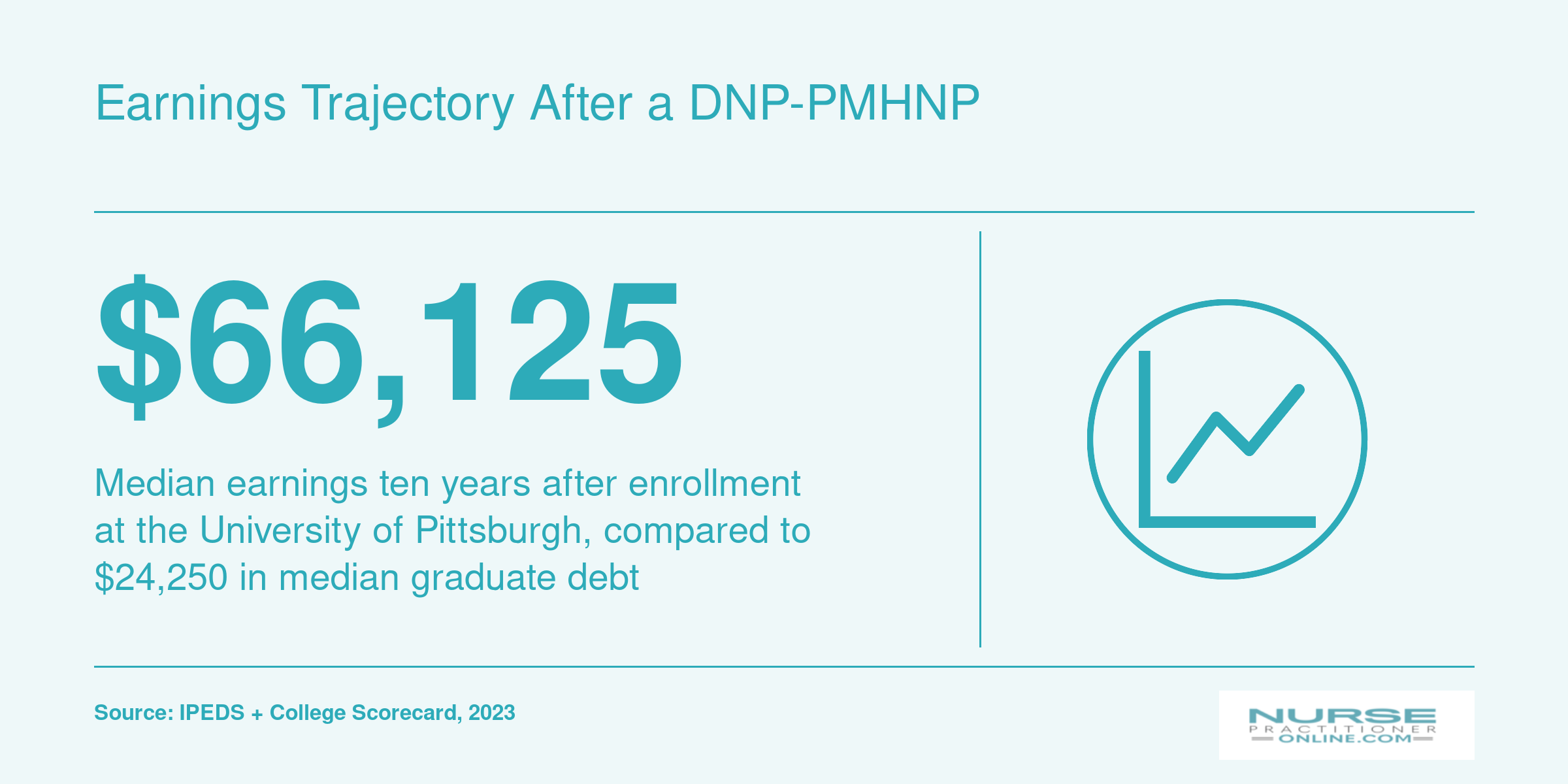
Program-level earnings data at one, two, four, and five years after completion are not yet available for the DNP-PMHNP programs near Pittsburgh. However, institution-wide data from the University of Pittsburgh offers a useful reference point. With a median graduate debt of $24,250 and median earnings of $66,125 at ten years post-enrollment, graduates see their investment pay for itself relatively quickly, reinforcing that the top-ROI program in this comparison delivers strong long-term value.
Financial Aid, Scholarships, and Cost-Cutting Strategies for PA PMHNP Students
Federal loan repayment programs and local health-system benefits have expanded significantly for psychiatric-mental health nurse practitioners in Pennsylvania, reflecting the state's acute shortage of mental health providers in rural and underserved communities. The combination of employer tuition assistance and service-based forgiveness can reduce your out-of-pocket investment by tens of thousands of dollars, provided you understand eligibility rules and plan your career moves accordingly.
Employer Tuition Assistance in Pittsburgh Health Systems
UPMC and Allegheny Health Network both operate education-benefit programs for employees pursuing advanced nursing degrees, but the details vary widely by position, bargaining unit, and facility. Full-time registered nurses at UPMC may be eligible for tuition reimbursement or direct tuition assistance through the UPMC Education Assistance Program, with annual caps that typically range from $3,000 to $5,250 per calendar year depending on your role and years of service. AHN offers similar benefits through its education assistance initiative, though eligibility and maximum reimbursement amounts are often outlined in union contracts and may differ for staff nurses versus specialty-unit employees.
Because these programs are not publicly cataloged in a single database, contact your HR department or employee benefits coordinator directly before enrolling in a DNP-PMHNP program. Ask about annual caps, whether the benefit covers only tuition or extends to fees and books, and what your service-commitment or repayment obligation will be if you leave the organization within a specified period after graduation. Many nurses structure their DNP enrollment to align with their employer's calendar-year reimbursement schedule, spreading courses across multiple benefit years to maximize assistance. If you are still deciding how to navigate the application process, our guide on how to enroll in NP school online walks you through each step.
Federal Loan Repayment and Scholarships
The Health Resources and Services Administration operates two major loan-repayment programs open to PMHNPs who practice in federally designated Health Professional Shortage Areas. The Nurse Corps Loan Repayment Program awards up to $50,000 in exchange for a two-year full-time service commitment at an eligible critical-shortage facility; awards are tax-free and can be renewed for a third year. The National Health Service Corps offers up to $100,000 for a five-year commitment, with partial awards available for shorter terms. Both programs define eligible sites on an annual basis, and several rural counties in Pennsylvania, as well as underserved urban census tracts in Pittsburgh, currently qualify. Visit hrsa.gov to confirm current award amounts, application deadlines, and site-eligibility maps.
Beyond federal programs, contact your DNP or PMHNP program's financial aid office for school-specific scholarships, assistantships, and employer-partnership tuition discounts. The American Association of Nurse Practitioners, the National Organization of Nurse Practitioner Faculties, and specialty societies such as the American Psychiatric Nurses Association maintain updated scholarship databases and sometimes negotiate group tuition rates with university partners.
Salary Data and ROI Planning
Use the Bureau of Labor Statistics Occupational Employment and Wage Statistics tool at bls.gov to review current median and percentile wages for nurse practitioners in the Pittsburgh metropolitan area, then cross-reference those figures with your expected total degree cost and any service-obligation timelines. Pennsylvania's Department of Labor and Industry also publishes state-level workforce projections and salary ranges that can help you model your return on investment under different practice settings: community mental health centers, hospital consult-liaison teams, and private outpatient practices each carry different earning curves and repayment scenarios.
Clinical Placement Logistics and Hidden Costs in the Pittsburgh Area
Five hundred direct clinical hours is the minimum required for PMHNP certification through the American Nurses Credentialing Center, yet most DNP-level programs build in well beyond that threshold.1 Programs commonly require 720 to 1,000 or more supervised hours once you add DNP project and residency components. Carlow University's post-master's DNP PMHNP track, for example, requires 720 nurse practitioner clinical hours plus an additional 250 project hours.2 Those hours translate into real dollars and real scheduling pressure, especially for working nurses juggling shifts.
Finding Preceptors in the Pittsburgh Metro
Pittsburgh offers a relatively strong clinical landscape for psychiatric-mental health rotations. UPMC's behavioral health network is one of the largest academic psychiatric systems in the region, operating inpatient units, outpatient clinics, and crisis services across multiple campuses. Community mental health centers in Allegheny County and surrounding areas add further options, and VA Pittsburgh Healthcare System can be an excellent placement site for students who navigate federal onboarding requirements early. That said, demand for PMHNP preceptors has grown sharply as more online programs enroll students nationwide, so competition for local slots can be stiff.
Some programs, like the University of Colorado Anschutz PMHNP track, arrange placements through faculty connections.3 Others, particularly fully online programs based outside Pennsylvania, expect students to locate and secure their own preceptors. This distinction matters more than many applicants realize.
Hidden Costs to Budget For
Clinical rotations carry expenses that rarely appear on a tuition bill. Consider these before committing:
- Preceptor-matching service fees: Some programs charge a separate fee, sometimes several hundred dollars per semester, for clinical placement coordination. Other programs outsource to third-party matching services that bill students directly.
- Travel and mileage: If local sites are full, you may need to drive to rural or suburban behavioral health facilities in western Pennsylvania. Weekly round trips of 60 to 100 miles add up quickly over two or three semesters of rotations.
- Lost wages: Clinical hours are unpaid. A nurse working three 12-hour shifts per week who drops to two shifts during a clinical semester could lose thousands of dollars in income over the course of the program.
- Compliance costs: Background checks, drug screenings, additional liability insurance, and site-specific onboarding requirements often come out of pocket.
Ask Before You Enroll
Before you submit a deposit, ask each program a direct question: are clinical placements guaranteed, or will I be responsible for finding my own preceptor? Programs that guarantee placement or provide dedicated clinical coordination staff can save you significant time, stress, and money. If you already hold an MSN and want to add the PMHNP specialty, exploring best online post-master's PMHNP certificate programs can help you compare placement support across schools. Programs that leave placement entirely to students may look cheaper on paper, but the hidden burden of self-sourcing a psychiatric preceptor in a competitive metro like Pittsburgh can add weeks of effort and real financial cost to your degree. Clarifying this upfront is one of the most practical steps you can take when comparing affordable DNP-PMHNP options.
PMHNP Earnings and Job Demand in the Pittsburgh Metro
What Pittsburgh PMHNPs Can Expect to Earn
The Bureau of Labor Statistics tracks nurse practitioners under SOC code 29-1171, and while it does not break out psychiatric-mental health NPs as a separate category, the broader NP wage data gives a reasonable floor for PMHNP earnings. Nationally, nurse practitioners earned a median annual wage of $121,610 in 2022, with the middle half of the workforce making between roughly $103,250 and $135,470.1 The top 10 percent cleared $165,240.
Pittsburgh-area wages for nurse practitioners tend to track close to the national median, though specialty psychiatric roles often command a premium above general primary care NP pay because of the demand pressure on behavioral health. Pennsylvania statewide NP wages have historically run within a few thousand dollars of the national figure. Treat any local PMHNP-specific number cautiously: the BLS does not publish a Pittsburgh metro figure isolated to psychiatric-mental health NPs, so the most honest framing is that you can reasonably expect Pittsburgh PMHNP compensation to sit in the broad national NP range, with experienced clinicians and those willing to take on inpatient or telepsychiatry caseloads pushing toward the upper percentiles.
Paying Down the Program at Pittsburgh Wages
If you graduate carrying $40,000 to $70,000 in DNP-PMHNP debt (a typical range for the more affordable in-state and online options covered earlier in this article) and step into a role paying near the national NP median, allocating 10 to 15 percent of gross income to loan repayment can clear that balance in roughly four to seven years. Higher-cost private programs leaving graduates with $90,000-plus in debt stretch that timeline closer to a decade unless you target Public Service Loan Forgiveness through a qualifying employer like UPMC or a federally qualified health center. If you are still weighing program formats, our ranking of the best online DNP PMHNP programs can help you compare costs side by side.
Demand Drivers in Western Pennsylvania
The hiring picture for PMHNPs in Pittsburgh is shaped by several converging pressures:
- Health system expansion: UPMC Western Behavioral Health Network and Allegheny Health Network have both been visibly building out psychiatric services, including outpatient clinics and telepsychiatry lines.
- Opioid response funding: Pennsylvania's continued investment of opioid settlement dollars into behavioral health capacity has created sustained demand for prescribers who can manage co-occurring substance use and psychiatric conditions.
- Telehealth normalization: Post-2020 telehealth rules have made it easier for PMHNPs to serve rural Western PA counties from a Pittsburgh base.
- Workforce shortage: HRSA has designated large portions of Pennsylvania as Mental Health Professional Shortage Areas, and federal workforce projections consistently identify PMHNPs as a key profession for closing the psychiatric provider gap over the next decade.
For a new graduate, that combination means you should expect multiple offers rather than a single take-it-or-leave-it position.
Pittsburgh PMHNP Salary Snapshot
Pittsburgh PMHNP Salary Snapshot
Choosing a DNP-PMHNP program means balancing the lowest tuition against the real total cost, which includes clinical placement fees, lost work hours, and format trade-offs that can shift your budget by thousands. Financial aid and service-based loan repayment can sharply reduce what you borrow, and the strong Pittsburgh salary trajectory makes even mid-range programs a solid investment.
Start by pulling the ranked list above. Shortlist two or three programs that fit your budget and scheduling needs, then contact each admissions and financial aid office directly. Request an itemized cost-of-attendance estimate that spells out clinical fees, travel expectations, and any hidden charges before you commit. If you are earlier in the pathway and still exploring how to become a nurse practitioner, mapping out the full timeline now will help you budget more accurately for a DNP.
Pennsylvania by City
- ACNP Programs in Pennsylvania
- Allentown, Pennsylvania (FNP)
- DNP NP Programs in Pennsylvania
- FNP Programs in Pennsylvania
- Philadelphia, Pennsylvania (ACNP)
- Philadelphia, Pennsylvania (PNP)
- Philadelphia, Pennsylvania (WHNP)
- Pittsburgh, Pennsylvania (AGNP)
- Pittsburgh, Pennsylvania (CCNP)
- PMHNP Programs in Pennsylvania
- PNP Programs in Pennsylvania
- Scranton, Pennsylvania (AGNP)