
Most important takeaways…
- Every county in Indiana is a federally designated mental health shortage area, boosting loan forgiveness eligibility for new PMHNPs.
- Fully online PMHNP programs near Indianapolis often cost less than hybrid formats due to lower campus and commuting fees.
- Indiana residents can save roughly $20,000 in total tuition over out-of-state students at public universities like Indiana University.
- Federal scholarships and loan repayment programs for psychiatric NPs expanded in 2026, reflecting the national mental health workforce crisis.
Psychiatric nurse practitioners command a median six-figure salary in Indiana, but the upfront cost of a PMHNP program remains the single biggest barrier keeping experienced RNs from advancing. Among the seven affordable PMHNP programs near Indianapolis featured here, tuition alone ranges from roughly $10,000 to $26,000, not counting clinical supplies, certification fees, and living expenses.
Indianapolis nurses face a clear choice: enroll in a low-cost post-master's certificate at a public university like Purdue Global or IU Indianapolis, or pay private-school tuition at institutions like Indiana Wesleyan or the University of Saint Francis. For many, the difference between in-state and out-of-state rates at public schools can swing the total program cost by $18,000 or more.
The return on that investment is solid. Indiana's psychiatric nurse practitioner shortage is severe, with every county in the state designated a federal mental health Health Professional Shortage Area, and demand for PMHNPs has pushed median salaries well above those of staff nurses. Still, picking the right program means balancing total cost against degree level, clinical placement support, and whether your current employer offers tuition reimbursement or loan forgiveness. If you are weighing a doctoral track, our rankings of best online DNP PMHNP programs can help you compare options alongside the certificate and master's pathways covered below.
Budget-Friendly PMHNP Programs Indianapolis-Area Nurses Should Know About
Indianapolis-area nurses looking to specialize in psychiatric-mental health care have several affordable pathways right here in Indiana. The programs below span multiple degree levels, from post-master's certificates to BSN-to-DNP tracks, and most can be completed online or with minimal campus visits. Whether you hold an ASN, BSN, or MSN, there is a budget-conscious option that fits your current credentials and career goals.
- Net price after financial aid
- Pell Grant participation rates
- Tuition and fee affordability
- Institutional graduation outcomes
- Program accessibility for Indiana residents
- NCES-IPEDS federal institutional data — nces.ed.gov
- College Scorecard graduate earnings — collegescorecard.ed.gov
- Internal program database
- Independent program research

Purdue University Global
Purdue University Global is a fully online public institution built for working professionals, and its PMHNP tracks consistently appear on national lists of the most affordable online psychiatric NP programs. With a net price of roughly $7,770 and transfer-friendly policies that award credit for prior graduate coursework and professional experience, it offers one of the lowest entry costs in this ranking. Indianapolis nurses can complete every credit from home, with no mandatory campus visits required.
- 48 quarter credit hours, 100% online format
- Designed for master's-prepared nurses
- Covers psychotherapy, medication management, and lifespan care
- Clinical practice with qualified preceptors included
- Eligible for ANCC or AANP certification upon completion
- Credit for prior learning review may reduce total hours
- No tuition charged for extension courses
- 60 to 90 quarter credit hours depending on specialty
- BSN required for admission with a minimum 2.5 GPA
- Immersive learning and clinical preceptorship experiences
- ExcelTrack accelerated option available
- Prepares for ANCC or AANP certification exams
- Courses in pathophysiology, pharmacology, and health policy
- Online format designed for registered nurses balancing work
Psychiatric Mental Health Nurse Practitioner Postgraduate Certificate — Online
Master of Science in Nursing, Psychiatric Mental Health Nurse Practitioner — Online

Indiana University-Indianapolis
Located in downtown Indianapolis, IU Indianapolis is the closest public university option for local nurses and ranks as one of the most budget-friendly PMHNP programs in the metro area. Its BSN-to-DNP track includes 66 credit hours and over 1,000 clinical hours, with placements arranged cooperatively across the city's major health systems, cutting travel and housing costs. The hybrid format blends online coursework with in-person sessions, and military-friendly benefits can further reduce net costs for eligible students.
- 66 credit hours with 1,005 total clinical hours
- 750 direct patient care hours with cooperatively arranged sites
- Completable in three years full-time or four years part-time
- Hybrid delivery combining online and on-campus sessions
- Graduates eligible for ANCC certification and Indiana prescriptive authority
- DNP project focused on a population health intervention
- Military-friendly institution with dedicated support services
- In-state tuition available to all Indiana residents
BSN-DNP Psychiatric-Mental Health Nurse Practitioner — Hybrid

Purdue University
Purdue University in West Lafayette offers hybrid PMHNP pathways at the master's, post-BSN DNP, and certificate levels, all backed by an 83% institution-wide graduation rate (the highest in this ranking). Indiana residents benefit from competitive public-school tuition, and the campus is about an hour's drive from Indianapolis, making occasional on-site sessions manageable without relocation. With options ranging from a focused 17-credit certificate to an 80-credit doctoral track, Purdue lets you match the program scope to your budget and timeline.
- 17 credit hours over three semesters
- 630 clinical practicum hours required
- Hybrid format with limited campus visits
- Designed for master's-prepared nurses
- Builds on existing nursing expertise for advanced practice
- Prepares graduates for national certification
- Hybrid MS degree focusing on all age groups
- Eligible for national PMHNP certification
- Develops leadership and advanced clinical practice skills
- Certificate track also available through same department
- Part of Purdue's College of Health and Human Sciences
- In-state graduate tuition for Indiana residents
- 80 total credit hours over a three-year curriculum
- Hybrid learning with online and in-person courses
- Extensive clinical preceptorships across settings
- Evidence-based practice and healthcare policy integration
- Lifespan psychiatric care training included
- Advanced practice and doctoral-level scholarly focus
Psychiatric/Mental Health Nurse Practitioner Certificate Program — Hybrid
Master of Science, Psychiatric/Mental Health Nurse Practitioner — Hybrid
Post-BSN to DNP with Psych Mental Health Specialization — Hybrid

University of Southern Indiana
The University of Southern Indiana in Evansville delivers a lean, 26-credit online PMHNP certificate that keeps total tuition among the lowest of any CCNE-accredited option in the state. Because the program is fully online, Indianapolis nurses pay in-state rates without ever driving to Evansville. The curriculum covers diagnosis, psychotherapy, medication management, and health promotion across the lifespan, and up to nine transfer credits may be accepted.
- 26 credit hours, fully online delivery
- Accredited by CCNE
- Open to MSN holders with official transcripts and three references
- Covers lifespan diagnosis, therapy, and medication management
- Up to 9 transfer credits accepted
- Includes health promotion and legal/ethical considerations
- In-state online tuition applies to Indiana residents
Post-Master's Certificate in Psychiatric Mental Health Nurse Practitioner — Online

Indiana Wesleyan University-National & Global
Indiana Wesleyan University's National & Global division serves working nurses through 100% online PMHNP tracks at three degree levels, from an ASN-to-MSN pathway (no BSN required) to a BSN-to-DNP with locked tuition rates. At $675 per graduate credit hour, the post-master's certificate totals roughly $21,600 for 32 credits. The faith-integrated curriculum uses virtual reality tools and live standardized-patient evaluations, with one-on-one faculty mentoring throughout.
- 32 credit hours at $675 per credit, online delivery
- Two-year completion timeline
- Master's or doctoral nursing degree required for admission
- Includes neuro-psychopharmacology and diagnostic reasoning courses
- Live OSCE evaluations and virtual reality learning tools
- One-on-one faculty support and tutoring services
- Christian worldview integrated into coursework
- 19 courses over a 45-month timeline, no BSN needed
- 820 practicum hours with lifespan psychiatric focus
- Online format with onsite residency intensives
- Prepares for independent clinical practice
- Financial aid, grants, and scholarships available
- One course at a time for manageable pacing
- 76 credit hours over 48 months, cohort-based structure
- Locked tuition rate for the duration of the program
- 1,000 clinical hours and a DNP Scholarly Project capstone
- Three onsite residencies required
- Transfer up to 9 credits from prior graduate work
- Military benefits and employer reimbursement accepted
Psychiatric Mental Health Nurse Practitioner Post-Master's Certificate — Online
ASN-MSN Primary Care Nursing with PMHNP Specialization — Online
Post-Baccalaureate Doctor of Nursing Practice, PMHNP — Online

Indiana Wesleyan University
Indiana Wesleyan University's main campus in Marion shares the same flat per-credit pricing and online PMHNP curriculum as the National & Global division, so Indianapolis residents access identical rates regardless of location. Options include an ASN-to-MSN with PMHNP specialization, a post-graduate certificate, and a BSN-to-DNP, all featuring faith-integrated coursework and flexible online scheduling. The institution-wide graduation rate of roughly 67% is among the stronger marks for private schools in this list.
- 32 credit hours at $675 per credit, fully online
- Two-year timeline with flexible scheduling for professionals
- Cumulative 3.0 GPA and minimum B per course required
- Includes neuro-psychopharmacology and diagnostic reasoning
- Background check required upon admission
- Financial aid and tutoring services available
- 66 credit hours with $455 per undergraduate and $675 per graduate credit
- 820 practicum hours minimum with two on-site intensives
- Online format, one course at a time
- No BSN awarded; leads directly to MSN
- Five-year maximum completion window
- Faculty are practicing nurse practitioners
- 76 total credit hours at $689 per credit, online delivery
- 48-month doctoral program with no prior master's needed
- 1,000 practicum hours and a capstone project required
- 3.25 minimum GPA for admission
- Faith-integrated curriculum with leadership development
- Advanced mental health focus across the lifespan
Psychiatric Mental Health Nurse Practitioner Post-Graduate Certificate — Online
ASN to MSN Primary Care Nursing, Psychiatric Mental Health Nursing — Online
BSN to DNP, Psychiatric Mental Health Nurse Practitioner — Online

University of Saint Francis-Fort Wayne
The University of Saint Francis in Fort Wayne rounds out the list with a hybrid PMHNP certificate and a DNP track guided by Franciscan values. The 25-credit certificate spans three semesters with in-person intensives twice per term, and because Fort Wayne is about two hours from Indianapolis, students can plan travel around a predictable schedule while completing most coursework online. Graduates are prepared for ANCC or AANP certification, and the 11-to-1 student-to-faculty ratio means close mentoring throughout clinical training.
- 25 credits over three semesters, hybrid format
- In-person intensives twice per semester in Fort Wayne
- Designed for working MSN-level nurses
- Covers mental health conditions and substance use disorders across all ages
- Prepares for ANCC or AANP certification exams
- Synchronous and asynchronous online learning components
- Expert faculty with healthcare experience
- Hybrid DNP with on-campus sessions in Fort Wayne
- Multiple entry points and part-time or full-time study options
- Clinical sites with experienced mentors
- DNP project required for completion
- Minimum 3.2 GPA for admission
- Apply through NursingCAS
- Guided by Franciscan values and compassionate care focus
Psychiatric-Mental Health Nurse Practitioner Post-Graduate Certificate — Hybrid
Doctor of Nursing Practice, PMHNP — Hybrid
What Does a PMHNP Program Actually Cost? The Full Picture
Tuition figures on program websites give you a starting point, but they rarely tell the whole story. The actual cost of becoming a Psychiatric-Mental Health Nurse Practitioner includes a cascade of additional expenses that can add thousands of dollars to your total investment.
Breaking Down the Real Numbers
Published cost-of-attendance data from programs across the country reveals how quickly expenses accumulate beyond base tuition. Union University's MSN PMHNP program, for example, lists tuition at roughly $27,000 for 2024-2025, but the total program cost reaches approximately $61,500 when you factor in mandatory fees ($1,330), books and supplies ($1,447), and additional required expenses ($629).1 Even housing, food, and transportation allowances add another $21,000 or more to the official cost estimate.
West Coast University's PMHNP program demonstrates how fees vary by track. Their accelerated pathway totals about $48,445, while the working professional track runs around $50,445.2 The difference comes partly from technology fees, which range from $2,500 to $4,500 depending on program length. Both tracks include clinical placement fees of $3,300 and supplies plus licensure costs of $2,300.
Hidden Costs Most Programs Do Not Advertise
Beyond these published figures, expect to budget for expenses that programs often exclude from official cost-of-attendance statements:
- Background checks: Required by nearly every program before clinical rotations, typically $50 to $150
- Malpractice insurance: Annual premiums of $100 to $300 for student coverage
- Clinical travel: Gas, parking, and occasionally lodging for distant placement sites can run $1,000 to $3,000 over the program
- Technology and proctoring fees: Some programs charge separately for online exam monitoring
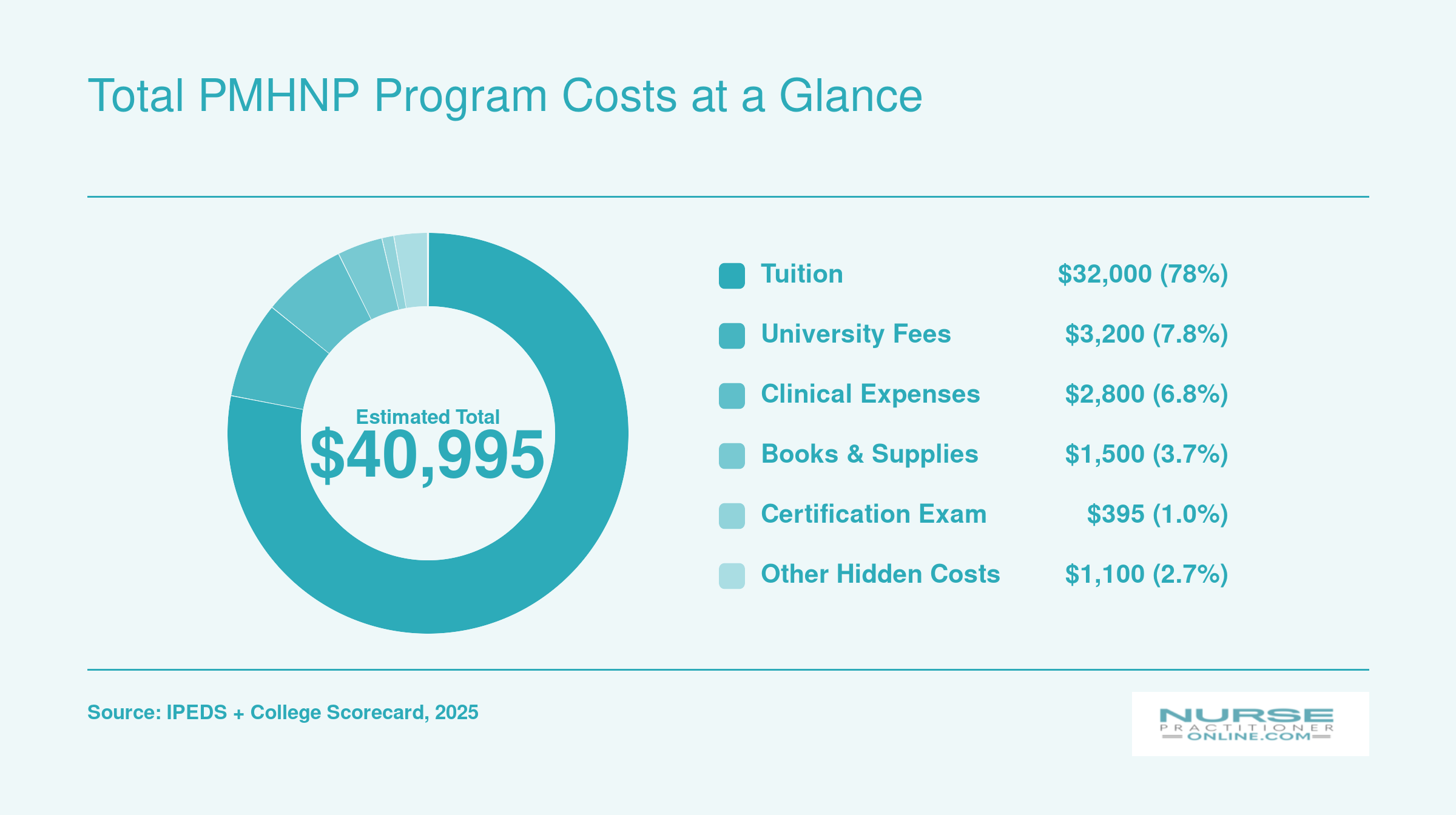
- ANCC or AANP certification exams: $395 for the actual exam, plus state licensure application fees
UNT Health Science Center explicitly notes that their published costs exclude health insurance, parking, and installment fees, a reminder to read the fine print carefully.3
Answering the Bottom-Line Question
So how much does a PMHNP program actually cost in total? For most students, expect a realistic range of $35,000 to $70,000 when you combine tuition, required fees, clinical-related expenses, and certification costs. Post-master's PMHNP certificate programs tend to land on the lower end, while BSN-to-DNP pathways often reach the higher end. If you want a broader comparison of tuition across specialties, our guide to the most affordable nurse practitioner programs is a useful starting point.
One note on financial aid estimates: you may see net price figures published for institutions, but these reflect an institution-wide average after aid for all students, not a guaranteed quote for graduate nursing programs specifically. They provide a useful benchmark for comparing overall affordability, but your actual out-of-pocket cost will depend on your specific aid package, residency status, and program length.
Total PMHNP Program Costs at a Glance
Tuition is only part of what you will pay for a PMHNP degree. Clinical supplies, technology fees, and the certification exam add thousands to your final bill. The breakdown below uses a representative mid-range estimate drawn from the programs ranked in this article. Your actual total will vary depending on the school you choose and your residency status.
In-State vs. Out-of-State Tuition: What Indianapolis Nurses Need to Calculate
The biggest tuition variable for Indianapolis nurses isn't program reputation, it's whether you're classified as an in-state resident. Public universities in Indiana offer dramatic discounts to residents, but private and online-only colleges often charge the same rate regardless of where you live. Knowing these distinctions upfront can save you $15,000 or more over a certificate or degree program.
The In-State Advantage at Indiana's Public Universities
For nurses who qualify for Indiana residency, the savings at public schools are immediate. The data shows steep differences between in-state and out-of-state tuition at the program level: - IU Indianapolis: $11,180 in-state vs. $28,964 out-of-state, a $17,784 gap per year for its BSN-DNP PMHNP track. - Purdue University, West Lafayette: $9,992 in-state vs. $28,794 out-of-state for its post-master's certificate, saving residents $18,802. - University of Southern Indiana: $11,667 in-state vs. $21,948 out-of-state for its online graduate certificate, a $10,281 difference.
These numbers assume you meet Indiana's eligibility requirements, which usually involve 12 months of domicile and intent to stay. Even a single year of in-state status can slash the total bill for a multi-year program.
Online Programs That Blur the Residency Line
Not all schools penalize out-of-state learners. Several online and private institutions charge a flat tuition rate, making them unexpectedly affordable for Indiana nurses or those moving from other states: - Indiana Wesleyan University, National & Global: Both in-state and out-of-state students pay $10,926 for its online PMHNP certificate. - Purdue University Global: Residents pay $10,211, while non-residents pay $11,241, only a $1,030 surcharge for the online certificate. - University of Saint Francis, Fort Wayne: The hybrid certificate charges a flat $26,092 regardless of residency, though its net price after aid may be lower.
Private colleges often price programs uniformly, and many public online schools (like Purdue Global) have deliberately minimized the out-of-state premium. Always confirm the per-credit-hour breakdown and whether a program's online modality triggers any additional fees.
How SARA Smooths the Path for Online Learners
Indiana participates in the State Authorization Reciprocity Agreement (SARA), a compact that lets you enroll in online programs from other SARA member states without the school needing separate approval in Indiana. This opens the door to a wider pool of affordable PMHNP programs across the country without sacrificing licensure eligibility. Before applying to an out-of-state online program, ask the admissions office if they participate through SARA and whether their curriculum meets Indiana APRN licensing requirements.
Before You Enroll: Verify Discounts and Military Rates
Even within the same state, some schools offer regional tuition breaks for residents of neighboring counties or states. For example, a university in Evansville might extend discounts to students from southern Illinois or western Kentucky. Military personnel and veterans often qualify for reduced rates or tuition waivers, so check whether the program has a dedicated military liaison.
Always reach out to the financial aid office with your specific situation. A 10-minute call can uncover pricing structures that aren't listed on program websites, potentially bringing an otherwise pricey program within reach.
Online, Campus, or Hybrid: Which PMHNP Format Costs Less?
Among the seven affordable PMHNP programs near Indianapolis featured on nursepractitioneronline.com, four are delivered fully online and three use a hybrid format. No program on this list is entirely on campus, which reflects the broader shift toward flexible delivery for working nurses. Before you assume "online" automatically means cheapest, take a closer look at the hidden expenses that can close the gap between formats.
| Factor | Fully Online Programs | Hybrid Programs |
|---|---|---|
| Programs in this list | Purdue University Global, University of Southern Indiana, Indiana Wesleyan University (National & Global), Indiana Wesleyan University | Indiana University-Indianapolis (BSN to DNP), Purdue University, University of Saint Francis (Fort Wayne) |
| Typical tuition range (in-state) | Approximately $10,200 to $11,700 per year | Approximately $9,992 to $26,092 per year |
| Out-of-state tuition difference | Minimal: several programs charge a flat rate regardless of residency | Can be significant: IU Indianapolis jumps from roughly $11,180 to nearly $28,964 |
| On-campus immersion days | Some programs labeled "online" still require short residencies. For example, Rockhurst University (a nationally available online program) requires one mandatory three-day immersion, with travel and lodging at the student's expense. West Coast University requires two mandatory two-day immersions, also self-funded. | Expect recurring in-person sessions. University of Saint Francis schedules in-person intensives twice per semester over three semesters. |
| Estimated hidden travel and lodging costs | Budget $300 to $800 per immersion for airfare, hotel, and meals if the campus is out of state | Costs vary with distance. Indianapolis-area nurses attending IU Indianapolis save on travel; those commuting to Fort Wayne or West Lafayette should factor in fuel or overnight stays multiple times per year. |
| Flexibility for working nurses | Highest flexibility: coursework is largely asynchronous, making it easier to keep full-time clinical shifts | Moderate flexibility: you will need to request specific days off for on-site intensives or lab sessions |
| Clinical placement logistics | Students typically secure their own preceptors near home, which is convenient but can be time-consuming | IU Indianapolis arranges clinical placements cooperatively, potentially reducing the burden on students |
| Networking and faculty access | Virtual interactions; student-to-faculty ratios can be higher (up to 25:1 at Purdue University Global) | Face-to-face contact builds stronger mentoring relationships; ratios tend to be lower (11:1 at University of Saint Francis) |
Related Articles
PMHNP Earnings vs. Program Debt: Calculating Your Return on Investment
Understanding whether a PMHNP program makes financial sense requires comparing the total cost you'll pay against the salary premium you'll earn. While tuition often grabs the spotlight, the full return-on-investment picture includes debt burden, local market pay, and the timeline to recoup your investment.
What PMHNPs Actually Earn in Indiana
Nationally, nurse practitioners earn a median salary of $121,610, with psychiatric-mental health NPs typically commanding a premium above that baseline due to high demand.1 In Indiana, registered nurses earn a median of $101,420 annually.2 When you step into a PMHNP role, you can reasonably expect to earn at least $20,000 more per year than you did as an RN, and often substantially more depending on your practice setting, patient volume, and whether you work in an underserved area.
Indianapolis-area PMHNPs frequently see competitive salaries that reflect the metro's growing behavioral health needs. While precise local wage data for psychiatric NPs is not yet published for 2026, Indiana's broader nurse practitioner market and the national shortage of mental health providers suggest that Indianapolis graduates can command near or above the national median.
The Payback Period: A Simple Calculation
To estimate how quickly you'll recover your program investment, divide your median debt by the annual salary increase over your current RN wages. For example, if you graduate from Indiana University Indianapolis's program with the state median debt of around $20,000 and move from an RN salary of $101,420 to a PMHNP salary of $125,000, your annual premium is roughly $23,580. That puts your payback period at less than one year.
Even if you borrow closer to $25,000 to $26,000 (as seen in several Indiana programs), and your salary premium is a conservative $20,000, you're looking at a payback window of just over one year. That's among the fastest returns on investment in graduate healthcare education. Nurses who already hold a master's degree and want to add psychiatric credentials may find even lower costs through cheapest online PMHNP certificate programs.
How Loan Forgiveness and HPSA Work Reshape ROI
Return on investment improves dramatically if you qualify for Public Service Loan Forgiveness, the NURSE Corps Loan Repayment Program, or work in a federally designated Health Professional Shortage Area. Indiana has dozens of mental health HPSAs, particularly in rural counties and urban neighborhoods around Indianapolis. PMHNPs who commit two years of service in these areas can receive up to $50,000 in loan repayment, effectively erasing most or all program debt while earning full salary.
When loan forgiveness enters the equation, your net cost drops toward zero and your ROI becomes nearly infinite. Even without formal forgiveness, many Indiana health systems offer signing bonuses, tuition reimbursement, or annual loan repayment stipends to attract psychiatric NPs, further compressing your payback timeline and boosting long-term wealth accumulation.
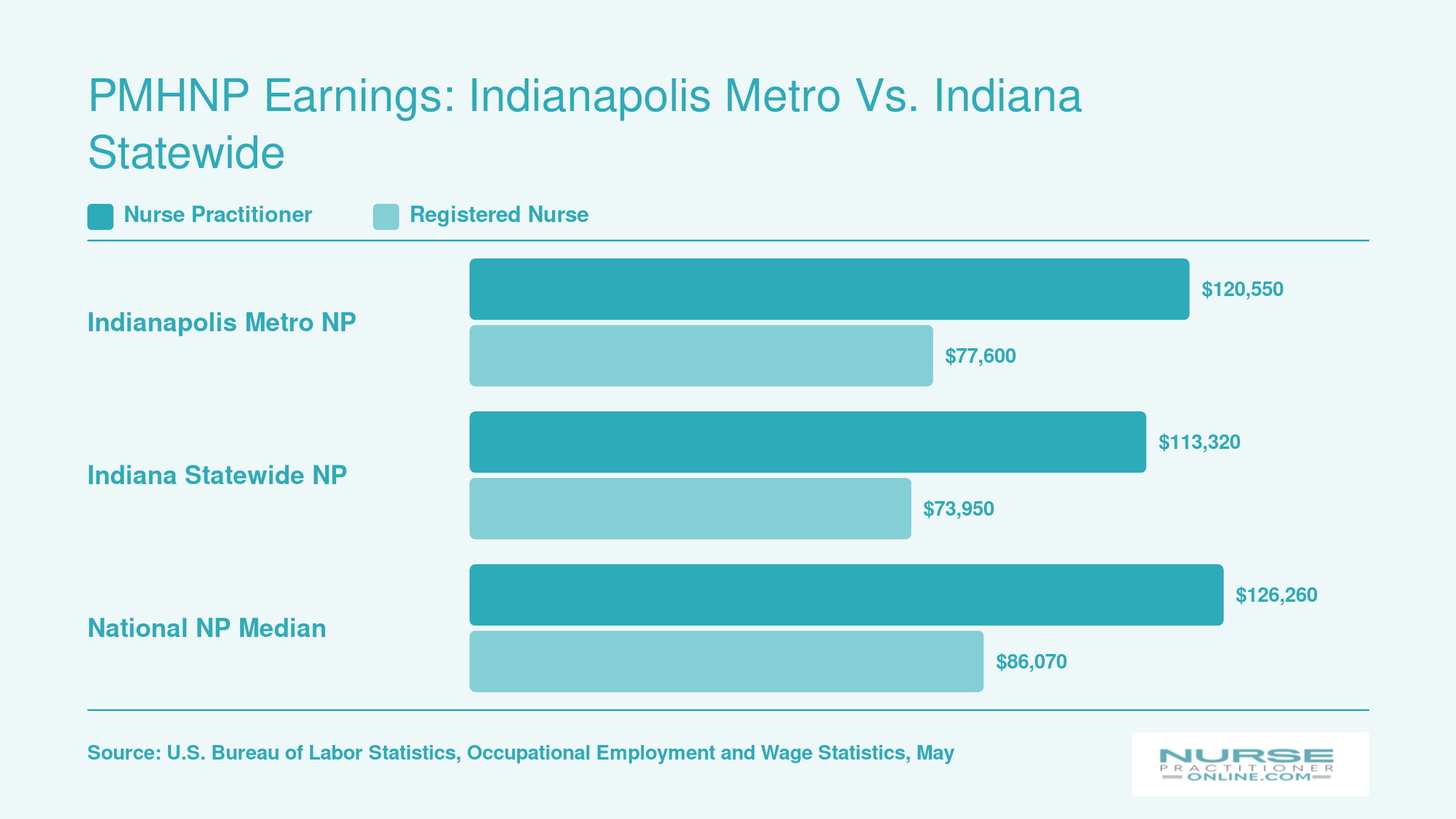
PMHNP Earnings: Indianapolis Metro vs. Indiana Statewide
Investing in a PMHNP program pays off quickly when you compare NP-level earnings to the RN salary most Indianapolis nurses currently earn. The gap between an RN baseline and NP median pay illustrates the long-term return on your education investment.
Scholarships, Loan Forgiveness, and Financial Aid for Indiana PMHNP Students
Federal and state funding streams have expanded for psychiatric nurse practitioners in 2026, reflecting national priorities to address the mental health workforce crisis. Indianapolis-area nurses can tap multiple scholarships, loan repayment programs, and institutional aid packages to reduce the cost of PMHNP training, often by tens of thousands of dollars.
Federal NURSE Corps Programs for PMHNPs
The NURSE Corps Scholarship Program covers full tuition and required fees for accepted or enrolled students in accredited nursing programs, including PMHNP tracks.1 In exchange, recipients commit to two years of full-time service at a Critical Shortage Facility located in a federally designated Health Professional Shortage Area. You must be a U.S. citizen, national, or lawful permanent resident to apply.1 For nurses already carrying debt, the NURSE Corps Loan Repayment Program offers up to 85 percent of unpaid nursing education loans, again in exchange for service at a critical-shortage site. Both programs prioritize behavioral health roles, making PMHNPs highly competitive applicants. For a broader look at repayment options, see our guide to student loan forgiveness options for nurse practitioners.
Indiana Health Service Corps and State Loan Repayment
The Indiana Health Service Corps provides loan repayment to primary care and behavioral health providers who commit to serving in underserved communities across the state. PMHNPs practicing in federally designated shortage areas in Indiana, including parts of Indianapolis and rural counties, may qualify. Awards vary by site and funding cycle, but the program often matches a portion of your federal NURSE Corps award, effectively doubling your repayment benefit. Check the Indiana State Department of Health's workforce development portal for current application windows and eligible practice sites.
HRSA Behavioral Health Workforce Grants
The Health Resources and Services Administration funds Behavioral Health Workforce Education and Training grants to schools that prepare psychiatric nurse practitioners and other mental health clinicians. While these grants typically flow to institutions rather than individual students, they often support tuition assistance, stipends, or clinical training costs for students enrolled in HRSA-funded PMHNP tracks. Ask admissions offices at Indiana University-Indianapolis, Purdue, and other ranked programs whether their PMHNP curriculum receives HRSA support and whether that funding translates into scholarships or reduced clinical fees for students.
Institutional Aid and Nursing-Specific Scholarships
When comparing programs, pay attention to each school's financial aid profile. Schools with higher shares of students receiving Pell Grants, such as Purdue University Global, Indiana Wesleyan, and Indiana University-Indianapolis, often have more robust institutional aid offices and experience navigating federal aid for working adult students. Indiana University School of Nursing awards between $500 and $10,000 per year to graduate nursing students; the application window runs from December 1 to March 31 annually. The American Association of Nurse Practitioners offers scholarships ranging from $2,500 to $5,000 and grants up to $10,000 for students enrolled in NP programs, including PMHNP tracks.
What Scholarships Are Available for PMHNP Students in Indiana?
Beyond the programs already mentioned, Indianapolis nurses should explore:
- American Association of Colleges of Nursing (AACN): Maintains a current list of national and regional scholarships for graduate nursing students.4
- Johnson & Johnson Nursing Scholarship Search: A directory listing dozens of awards for advanced practice nursing specialties.5
- Community Foundation Alliance: Local scholarships in Southwest Indiana, primarily for undergraduates but occasionally open to graduate students.6
- Fastweb: A searchable directory of scholarships for psychiatric mental health nursing majors at all degree levels.7
Apply broadly and early. Many scholarships have March or April deadlines for fall enrollment, and awards are competitive but underutilized by working nurses focused on tuition sticker prices rather than net cost after aid.
Questions to Ask Yourself
Clinical Placements and Indiana's Mental Health Workforce Shortage
Finding a clinical preceptor in a saturated metro is one challenge; finding one in a designated shortage area is a different challenge entirely, and Indiana has plenty of both. Understanding where the gaps are can actually work in your favor: shortage areas often translate to easier placement access, loan forgiveness eligibility, and strong post-graduation job offers. Indiana is, in fact, among the states with the most need for nurse practitioners.
Verify Where Indiana's Mental Health Gaps Are
The Health Resources and Services Administration maintains the official map of Mental Health Professional Shortage Areas (HPSAs). Nationally, HRSA's most recent quarterly report counts 6,959 mental health HPSA designations, with roughly 7,393 additional practitioners needed to close the gap.1 Indiana's shortage areas include a mix of geographic, population group, and facility designations.
Use the HRSA HPSA Find tool to search Indiana by county. The county-level view sorts areas into three buckets: entirely in a HPSA, partially in a HPSA, or not designated.2 This is useful both for picking a clinical site and for checking whether a future employer qualifies you for federal loan repayment.
State and Regional Workforce Data
For an Indiana-specific picture, the Indiana State Department of Health and the Indiana Area Health Education Center (AHEC) publish workforce reports on psychiatric provider supply, county-level vacancies, and rural access. AHEC in particular can connect students with rural placement opportunities that often go unfilled.
For wage and employment data, the Bureau of Labor Statistics (bls.gov) publishes Occupational Employment and Wage Statistics for nurse practitioners by state and metro area, including Indianapolis-Carmel-Anderson. The American Association of Nurse Practitioners also tracks state-level NP workforce trends.
Central Indiana Health System Partnerships
The three largest Indianapolis-area systems, IU Health, Eskenazi Health, and Community Health Network, all maintain academic partnerships with NP programs. Check each system's website directly and search terms like "nurse practitioner clinical placements" or "academic partnerships." Some programs handle placement coordination for you, but confirming a system's relationship with your school before you enroll can save months of legwork later.
In Indiana, every single county is a designated mental health Health Professional Shortage Area, according to 2025 HRSA data. That means 100% of the state, from Indianapolis to rural outposts, is facing a critical shortage of psychiatric providers. For PMHNP graduates, this translates to immediate demand and career stability anywhere you choose to practice.
Picking the Right Affordable PMHNP Program: A Decision Framework
Price is only one variable in a decision that will shape your clinical autonomy, certification eligibility, and earning power for decades. Before you commit to a program based on tuition alone, run it through four filters: accreditation, Indiana-specific licensure fit, time-to-completion, and certification pass rates.
Accreditation: Why CCNE and ACEN Both Matter
The ANCC Psychiatric-Mental Health Nurse Practitioner certification exam requires that your graduate program be accredited by either the Commission on Collegiate Nursing Education (CCNE) or the Accreditation Commission for Education in Nursing (ACEN). A cheaper program that lacks one of these credentials could leave you ineligible to sit for the exam entirely, so this filter is non-negotiable. Before comparing tuition figures, confirm accreditation status directly with the program or on the CCNE and ACEN websites.
Indiana Licensure Requirements: What You Are Agreeing To
Indiana operates under a reduced-practice model as of 2026. PMHNPs are required to hold an APRN license, and that license does carry prescriptive authority, including Schedule II through V controlled substances.2 However, practicing in Indiana means entering a written collaborative practice agreement with a physician. That agreement must describe the scope of cooperation, though you do not need prior physician approval before each patient encounter. Your prescribing activity is subject to random chart review at a 5 percent audit rate, and any prescribing documentation must be submitted within 7 days under current rules.
This matters when you are choosing a program because some out-of-state programs prepare graduates for full independent practice states. If you plan to stay in Indianapolis, confirm that your program's clinical training and curriculum align with Indiana's collaborative model, not just the broadest possible scope. Understanding how to become a nurse practitioner in your target state is a critical early step.
Program Length and Total Cost
Most MSN-to-PMHNP programs run two to three years full time, though many working nurses complete them part time over three to four years. Post-master's certificate programs, designed for nurses who already hold an MSN in another specialty, can often be completed in 12 to 24 months. The University of Southern Indiana's MSN-PMHNP program, for example, requires 44 credit hours, which is a useful benchmark when comparing programs side by side.
Shorter time-to-completion reduces indirect costs: fewer semesters of foregone advancement, lower total interest on student loans, and an earlier start on a PMHNP salary. A program that costs slightly more per credit hour but gets you done a year sooner may be the genuinely cheaper option once you run the full math.
Certification Pass Rates: Ask the Question Directly
Accreditation tells you a program meets minimum standards. Certification pass rates tell you how well graduates actually perform on the ANCC exam. Programs are not always forthcoming with this data unless you ask, so make it a direct question during any admissions conversation: what is your ANCC PMHNP certification pass rate for the most recent graduating cohort, and how does that compare to the national average? A program with low pass rates costs you more in the end, because retaking a certification exam carries fees, delays your ability to work as a PMHNP, and extends the period before your new salary begins to offset your tuition debt.