
Most important takeaways…
- Most Indiana AGACNP programs require 500 to 750 supervised clinical hours arranged in your local community.
- BSN-to-DNP acute care tracks typically take three to four years of part-time study to complete.
- ACNPs in Indiana must secure a collaborative agreement with a physician before they can practice.
- Only a handful of Indiana schools offer AGACNP pathways, so comparing tuition per credit is essential.
Hospital intensive care units and emergency departments across Indiana are adding acute care nurse practitioners at a steady pace, driven by physician shortages and expanding critical care capacity. Indiana offers fewer than half a dozen online or hybrid AGACNP programs, most housed within university nursing schools that anchor their curricula in high-acuity adult gerontology populations.
Every program requires 500 to 700 clinical hours, typically arranged by the student in hospital or intensive care settings near where you live. That flexibility is critical for working RNs who want to continue earning while in school, but it also means you bear the responsibility of securing preceptors in competitive clinical markets. Indiana operates as a reduced-practice state, so every acute care nurse practitioner must maintain a collaborative agreement with a physician, a constraint that can narrow your post-graduation job options compared to full-practice states bordering Indiana.
Program costs vary widely. Some post-master's certificates cost under $15,000 total, while full DNP tracks can exceed $50,000, a spread large enough to change your debt-to-income calculation significantly in the first years after graduation.
Indiana's Leading Online ACNP Programs: 2026 Rankings
Indiana offers a small but focused set of Adult-Gerontology Acute Care Nurse Practitioner pathways, each with a distinct format and student profile. Whether you need a fully online post-master's certificate you can complete from anywhere in the country or a hybrid DNP anchored to a major academic medical center, the programs below reflect the strongest options for distance learners in 2026. Keep in mind that graduation rates listed are institution-wide figures, not specific to the AGACNP track.
- Online accessibility and format flexibility
- Institutional graduation and retention rates
- Tuition affordability for distance learners
- Clinical placement network strength
- Accreditation and certification outcomes
- Internal program database
- NCES-IPEDS federal institutional data — nces.ed.gov
- College Scorecard graduate earnings — collegescorecard.ed.gov
- Independent program research

Indiana University-Indianapolis
Situated in Indiana's largest city and anchored to a sprawling academic health center network, IU Indianapolis delivers its AGACNP track as a hybrid BSN-to-DNP pathway with substantial on-campus expectations. Students benefit from a formal partnership with the Simulation Center at Fairbanks Hall, a shared IU Health and IU School of Medicine facility, and clinical rotations coordinated across central Indiana's high-acuity hospitals. The institution-wide graduation rate is 54.4%, and in-state tuition sits at approximately $11,180 per year, with out-of-state students paying roughly $28,964.
- Hybrid format with in-person lectures, simulation, and lab sessions
- Clinical rotations at level I trauma centers across central Indiana
- Small cohort sizes with doctoral-prepared faculty mentorship
- High-fidelity simulation at Fairbanks Hall Simulation Center
- Prepares graduates for ANCC or AACN board certification
- Board pass rates consistently exceed national averages
- Covers prescriptive authority aligned with Indiana licensure
- Specialty rotations in cardiology, neurology, critical care, and more
Adult-Gerontology Acute Care Nurse Practitioner (BSN to DNP) — Hybrid

University of Southern Indiana
The University of Southern Indiana stands out as the most distance-friendly ACNP option in the state, offering both a 100% online post-master's certificate (24 credit hours) and a fully online BSN-to-DNP pathway (78 credit hours). USI coordinates preceptors nationwide, making the program accessible to nurses well beyond southwestern Indiana. Accredited by CCNE and housed in the College of Nursing and Health Professions in Evansville, USI charges roughly $11,667 in-state and $21,948 out-of-state annually, with an institution-wide graduation rate of 48.2%.
- Fully online, 24 credit hours for MSN-prepared nurses
- Nationwide preceptor coordination for clinical placements
- CCNE-accredited program housed in Evansville
- Up to 9 transfer credits accepted
- Covers legal, ethical, and socioeconomic considerations
- Prepares graduates for acute care NP licensure exams
- 100% online with full-time and part-time scheduling
- 78 credit hours, completable in four to five years
- BSN-to-DNP pathway with acute care specialization
- Requires unencumbered RN license and minimum 3.0 GPA
- Emphasizes health promotion and chronic illness management
- CCNE accredited with strong career placement outlook
Post-Master's Certificate in Adult-Gerontology Acute Care Nurse Practitioner — Online
Doctor of Nursing Practice, Adult-Gerontology Acute Care Nurse Practitioner (BSN to DNP) — Online

Saint Mary's College
Saint Mary's College in Notre Dame brings a private-college ethos to its hybrid DNP with an AGACNP track, pairing online coursework with on-campus clinical immersions in northern Indiana. The college boasts the highest institution-wide graduation rate among these three programs at 69.3% and an intimate 9:1 student-to-faculty ratio. Tuition is $29,803 regardless of residency, reflecting its private institution status. The program is designed for working professionals who can travel periodically for intensive on-site sessions.
- Hybrid format blending online courses with campus immersions
- 9:1 student-to-faculty ratio for close mentorship
- Simulation labs on the Notre Dame, Indiana campus
- Interdisciplinary training for acute, critical, and chronic care
- Flexible scheduling built for working nursing professionals
- Positions graduates for leadership in ICUs and emergency settings
Doctor of Nursing Practice, Adult-Gerontology Acute Care Nurse Practitioner — Hybrid
Indiana AGACNP Program Comparison: Tuition, Credits & Clinical Hours
The table below offers a side-by-side look at Indiana's AGACNP program options across degree levels, credit requirements, and format. The biggest cost drivers are total credit hours and per-credit tuition, so pay close attention to both columns rather than sticker price alone. Programs marked as post-master's certificates are designed for nurses who already hold an MSN and want to add an acute care specialty without completing a full doctoral program. When it comes to clinical placement, support varies: some programs actively help you secure preceptor sites, while others expect students to arrange their own. Always confirm current clinical placement policies directly with each school before applying.
| School | Credential | Format | Total Credits | Clinical Hours | Post-Master's Certificate Available | Clinical Placement Support |
|---|---|---|---|---|---|---|
| University of Southern Indiana | MSN (AGACNP) | Online | 42 | Contact program for details | Yes (24-credit certificate option) | Yes |
| University of Southern Indiana | Post-Master's Certificate (AGACNP) | Online | 24 | 650 | N/A | Yes |
| Purdue University Global | Postgraduate Certificate (AGACNP) | Online | 57 quarter credits | Contact program for details | N/A | Contact program |
| Indiana University Indianapolis | DNP (BSN to DNP, AGACNP track) | Hybrid | Contact program for details | Contact program for details | Contact program | Contact program |
| University of Saint Francis, Fort Wayne | Post-Graduate Certificate (AGACNP) | Hybrid (in-person intensives twice per semester) | 25 | Contact program for details | N/A | Contact program |
| Saint Mary's College | DNP (AGACNP) | Hybrid | Contact program for details | Contact program for details | Contact program | Contact program |
Fully Online or Hybrid? Indiana ACNP Program Formats Explained
Indiana's AGACNP programs follow two primary delivery models: ones that combine online didactic classes with occasional on-campus intensives, and others that keep everything except clinical rotations fully remote. Your choice may come down to how much flexibility you need versus how much face-to-face instruction you want for complex acute care skills.
Understanding the Hybrid AGACNP Model
Hybrid programs deliver the bulk of coursework asynchronously online, but they also weave in short, required on-campus sessions. These intensives typically focus on advanced skills practice, high-fidelity simulations, and direct faculty feedback for procedures like central line insertion, ventilator management, or hemodynamic monitoring. The University of Indianapolis and Indiana University both use this model.1 While each school sets its own schedule, you can generally expect one to three campus visits per year, each lasting two to five days. IU's BSN-DNP AGACNP track includes on-campus immersion days spaced across the program, while UIndy's MSN pathway schedules periodic lab weekends in Indianapolis. The hybrid structure keeps you rooted in your home community most of the year while ensuring you gain hands-on competence in a controlled environment before entering clinicals. If you are weighing the DNP pathway specifically, our guide to online DNP programs in Indiana breaks down the available tracks.
Fully Online Coursework, In-Person Clinicals
A fully online AGACNP program eliminates campus travel entirely for coursework. Lectures, discussions, and assignments all happen through a learning management system. Purdue Global's post-master's certificate is offered in this format.3 Because these are post-graduate programs, they assume you already hold an MSN and have a strong clinical base. The online design works especially well for nurses who cannot relocate or take extended time off, and it allows you to complete didactic requirements from any location with reliable internet. Fully online does not mean you skip skill development, though. These programs integrate virtual simulations, video-based case analyses, and precepted clinical hours to ensure you meet the same competency standards as their hybrid counterparts.
Clinical Rotations Are Always In-Person
Regardless of whether your program is hybrid or fully online, the required clinical hours happen face-to-face with patients. Indiana AGACNP programs mandate a minimum of 500 directly supervised clinical hours in acute care settings such as intensive care units, emergency departments, or specialty inpatient units. You will work under a preceptor, an experienced acute care NP or physician, who guides your assessment, diagnostic reasoning, and management of acutely ill adults. The online status of your coursework does not change this in-person requirement. In fact, schools must verify that your clinical sites meet accreditation and state board standards. Most programs ask you to identify potential preceptors and sites early, though many also provide assistance if you encounter barriers. This ensures that every graduate enters practice with documented, real-world experience in the high-stakes acute care environment.
Questions to Ask Yourself
What Indiana AGACNP Programs Require for Admission
Indiana AGACNP programs share a core set of admission requirements, though the details can vary from one school to the next. Here is a consolidated checklist of what you should expect to prepare.
- BSN Degree with a Competitive GPAA Bachelor of Science in Nursing is universally required. Most programs set a minimum cumulative GPA of 3.0, so aim to meet or exceed that threshold before applying.
- Unencumbered RN LicensureYou will need an active, unencumbered registered nurse license. The University of Indianapolis, for example, lists this as a non-negotiable requirement for its hybrid MSN AGACNP track.
- Acute Care Bedside ExperiencePrograms typically require at least one year of acute care bedside nursing experience before you can apply. At the University of Indianapolis, you need one year at the time of application and a full two years before you begin clinical rotations, a distinction worth noting as you plan your timeline.
- Current ACLS and BLS CertificationsAdvanced Cardiovascular Life Support and Basic Life Support certifications are standard expectations. Some programs may also ask for PALS certification, so check each school's specific requirements carefully.
- Prerequisite CourseworkA statistics course with a grade of C or better is a common prerequisite across programs. Some schools require health assessment or advanced pathophysiology before enrollment, while others build those foundational courses directly into the curriculum. Verify each program's approach so you are not caught off guard.
- Letters of Recommendation and Personal StatementExpect to submit two to three professional references and a personal essay explaining your career goals and readiness for advanced practice. Strong letters from nurse managers or physicians who can speak to your clinical aptitude carry real weight.
- GRE Scores, Often WaivedMany AGACNP programs have moved away from requiring the GRE, and waivers are widely available. If a program still lists the GRE among its requirements, check whether your GPA or professional experience qualifies you for an exemption before investing time in test preparation.
- Additional Materials for International ApplicantsIf English is not your first language, TOEFL or an equivalent English proficiency exam is typically required. Contact each program's admissions office for accepted score minimums.
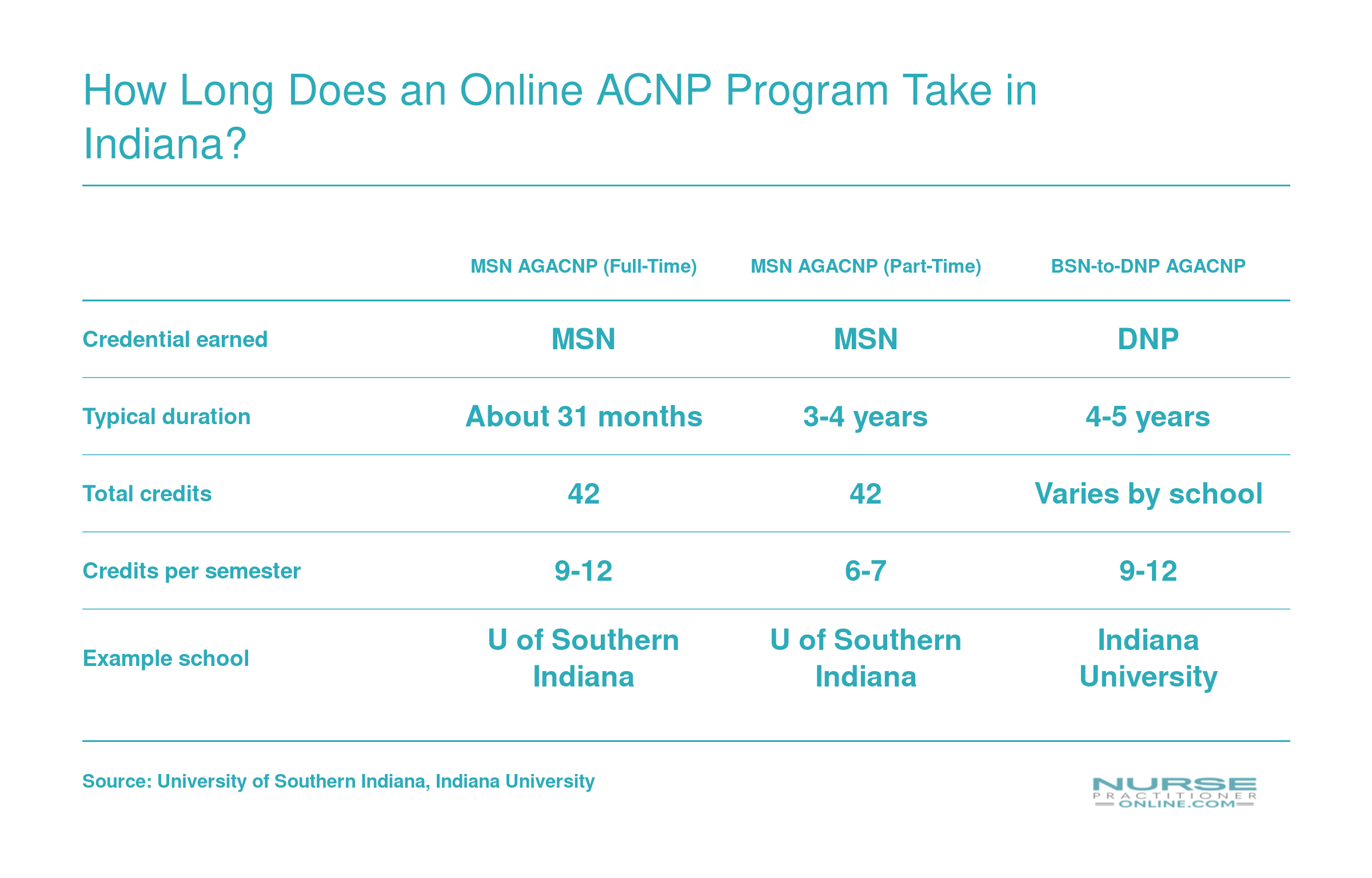
How Long Does an Online ACNP Program Take in Indiana?
Your timeline to becoming an acute care nurse practitioner in Indiana depends on whether you choose an MSN or a BSN-to-DNP track and how many credits you can manage each semester. Here is a side-by-side look at the two main pathways offered by Indiana schools so you can plan around your work schedule.
Common Questions About ACNP Programs in Indiana
Before committing to a program, most working nurses have a handful of practical questions about format, requirements, and timelines. Here are the answers to the questions we hear most often about Indiana ACNP programs.
- Are there fully online ACNP programs in Indiana, or are they all hybrid?
- Most Indiana ACNP programs use a hybrid format. Didactic coursework is delivered fully online, which is ideal for working nurses, but clinical rotations must be completed in person at approved acute care sites. Some programs, such as the University of Indianapolis offering, allow you to arrange clinical placements close to home, giving you more scheduling flexibility while still meeting hands-on training requirements.
- Can I get a post-master's ACNP certificate in Indiana?
- Yes. Several Indiana schools offer post-master's AGACNP certificates for nurses who already hold an MSN in another specialty. These certificates typically require fewer credits than a full master's degree, often ranging from around 18 to 30 credit hours, and focus specifically on acute care didactic courses and clinical hours. This is a practical route for certified family or adult primary care NPs looking to add acute care credentials.
- What are the clinical hour requirements for AGACNP programs in Indiana?
- Clinical hour requirements for Indiana AGACNP programs generally fall between 500 and 750 direct patient care hours, depending on the school and whether you are pursuing an MSN or a post-master's certificate. These hours must be completed in acute care settings such as ICUs, emergency departments, or inpatient units. Programs typically help students identify preceptors, though some expect students to secure their own clinical sites.
- How long does it take to complete an online ACNP program in Indiana?
- For most part-time students balancing work and school, an MSN-level ACNP program in Indiana takes roughly two to three years to complete. Full-time students may finish in as few as five to six semesters. Post-master's certificate students can often finish in 12 to 18 months. Program length depends on how many credits you carry per semester and how quickly you can arrange clinical rotations.
- How much do ACNPs make in Indiana?
- Acute care nurse practitioners in Indiana typically earn competitive salaries that reflect the specialized, high-acuity nature of the role. Earnings vary by employer, setting, and experience level, but ACNPs working in hospitals, trauma centers, and critical care units tend to earn at the higher end of the NP pay range. Specific salary figures shift year to year, so checking current Bureau of Labor Statistics data for Indiana is recommended.
ACNP Earnings and Employment Outlook in Indiana
Working in acute care versus primary care settings can mean a significant difference in your paycheck as a nurse practitioner in Indiana. Understanding these earning patterns helps you evaluate whether the investment in an ACNP program aligns with your financial goals.
Indiana NP Salary Overview
Nurse practitioners in Indiana earn a mean annual wage of approximately $126,600, which positions the state competitively in the Midwest region.1 The national median for nurse practitioners hovers around $121,000 annually, so Indiana practitioners typically earn slightly above the national average. This reflects strong demand for advanced practice nurses across the state's healthcare systems. For a broader look at how compensation varies by role and location, see our breakdown of nurse practitioner salary by specialty and state.
Hourly wages for Indiana NPs average around $60.86, though your actual compensation will depend heavily on your specialty, setting, and years of experience.1
Earning Range Across Experience Levels
Salary data for nurse practitioners in Indiana spans a wide range depending on where you fall in the workforce:
- Entry-level (10th percentile): Newer NPs or those in lower-paying settings typically earn in the mid-$80,000 to low-$90,000 range.
- Early career (25th percentile): With a few years of experience, earnings climb toward $100,000 to $110,000.
- Mid-career (50th percentile): Experienced practitioners often see salaries around $120,000 to $125,000.
- Senior level (75th and 90th percentiles): Top earners, particularly those in specialized acute care roles, can exceed $140,000 to $160,000 annually.
ACNP certification generally commands a premium in hospital and critical care environments compared to primary care NP roles. Acute care nurse practitioners working in intensive care units, emergency departments, and specialty surgical services often land in the upper salary percentiles.
Highest-Paying Settings for ACNPs
Hospitals remain the primary employers for acute care nurse practitioners and typically offer the strongest compensation packages. Within hospital systems, roles in critical care, trauma, cardiology, and pulmonology tend to pay at the higher end. Specialty physician practices, particularly those focused on hospitalist medicine or surgical subspecialties, also offer competitive salaries. Urgent care centers represent another growing employment sector, though compensation in these settings varies more widely.
Job Growth Projections
Indiana's outlook for nurse practitioners is exceptionally strong. Projections indicate approximately 54% job growth for NPs in the state between 2020 and 2030, translating to roughly 3,076 new positions created through expansion alone.2 When combined with replacement needs from retirements and career transitions, the state anticipates nearly 692 annual openings for nurse practitioners throughout this period.2 This growth rate outpaces the national projection of about 46%, signaling robust long-term demand for ACNPs throughout Indiana's healthcare system.3
Indiana AGACNP Licensure and Scope of Practice
Indiana AGACNP licensure is the legal gateway that allows you to practice as an acute care nurse practitioner after you earn your graduate degree and pass a national certification exam. It's not automatic with your RN license. You must apply to the Indiana State Board of Nursing and meet a set of requirements that include having a collaborative agreement in place with a physician.
The Licensure Process
To become an AGACNP in Indiana, you first need a graduate degree focused on the adult-gerontology acute care NP role. Next, you pass a national certification exam: either the ANCC AGACNP-BC or the AACN ACNPC-AG.3 Once certified, you submit an application to the Indiana State Board of Nursing for NP recognition. If you plan to prescribe, you apply separately for prescriptive authority. The board reviews your education, certification, and any disciplinary history before issuing your approval.
Collaborative Practice Agreements in Indiana
Indiana is a reduced practice state, meaning you must hold a written collaborative agreement with a licensed physician. This agreement defines how you'll work together, including the types of care you provide, how you'll review prescribing decisions, and the process for a 5% random chart audit. The agreement must specify that the physician reviews your prescribing within seven days. A collaborative agreement is not a supervisory arrangement in the day-to-day sense, but it does legally tether your practice to a collaborating physician. For a broader look at how these arrangements compare across the country, see our guide to nurse practitioner practice authority by state.
Prescriptive Authority and Controlled Substances
Once you have prescriptive authority, you can prescribe legend drugs and Schedule II through V controlled substances. You'll need a state controlled substances license and a federal DEA registration. The board requires 45 contact hours of pharmacology education as part of your initial prescriptive authority application.5 Your collaborating physician plays a role here too: the agreement outlines a timely review of your prescribing, which helps ensure safe, accountable practice.
Scope of Practice and Legislative Outlook
Even with a collaborative agreement, Indiana's AGACNPs provide a wide range of acute care services, performing assessments, ordering diagnostics, interpreting results, and managing complex patient conditions. However, the state has not enacted full practice authority as of 2026. Advocacy groups like the Indiana Rural Health Association have published white papers supporting expanded NP autonomy, but legislative efforts have not yet changed the reduced practice status. The conversation continues, driven by workforce needs in underserved areas. If you're interested in shaping that conversation, exploring how nurse practitioners get involved in politics is a practical next step. For now, you should expect to work under a collaborative agreement.
Selecting the Best Indiana ACNP Program for Your Career
How do you know which online ACNP program in Indiana will actually prepare you for the career you want? Choosing a graduate nursing program is a big investment of time and money, and the decision carries long-term consequences for your patient population, work setting, and earning potential. As a working RN, you need a program that fits your life while delivering the clinical preparation to pass certification and step confidently into an acute care nurse practitioner role. Here are the critical factors to weigh before you commit.
Clinical Placement Support: Who Finds Your Preceptors?
The single biggest logistical hurdle in any nurse practitioner program is securing clinical preceptors and rotation sites. Some Indiana programs take an active role in arranging placements, while others require you to identify, negotiate, and secure your own sites. A program that does not provide placement support can lead to significant delays if you struggle to find a preceptor in your area or a specific high-acuity setting. Before applying, ask the program coordinator directly: Do you assign clinical placements, maintain a database of affiliated sites, or offer any placement assistance? If you must self-arrange rotations, ask how soon you can start searching and what backup options exist if a site falls through.
Fully Online or Hybrid: Matching the Format to Your Lifestyle
Online ACNP programs in Indiana are not all the same. Some are fully online except for in-person clinical hours, while others include occasional on-campus intensives for simulation training or skills assessments. A fully online didactic format offers maximum flexibility for working RNs with family commitments or limited travel ability. A hybrid format with a few campus visits can provide valuable hands-on practice with advanced assessment equipment and direct faculty feedback. Consider how much time you can realistically carve out for travel and on-campus days each semester. Also check whether the program requires you to be on site for orientation or periodic testing.
Adding AGACNP Certification with a Post-Master's Certificate
If you already hold an MSN in another NP specialty, you do not need to start over. A post-master's AGACNP certificate lets you add adult-gerontology acute care certification without repeating core nursing graduate courses. Several Indiana schools offer this pathway, which typically cuts total credit hours well below a full master's program. You can explore online post-master's ACNP certificate programs to compare options across the country. Review each program's certificate requirements: you will likely need to complete the clinical specialty courses and the associated clinical hours for the acute care population. This option is ideal for experienced FNPs or primary care NPs who want to shift into hospital-based roles.
Certification Exam Pass Rates: A Quality Indicator
Certification exam first-time pass rates signal how well a program aligns its curriculum with national standards. National benchmarks provide context: in 2024, the ANCC AGACNP-BC exam had a first-time pass rate of 83%1, while the AACN ACNPC-AG exam reported 91% in 2023.2 As of 2026, the certifying bodies do not publish school-specific pass rates, so you cannot easily compare Indiana programs side by side.3 However, many programs track their own graduate outcomes. Ask each school directly for its recent AGACNP pass rates on either the ANCC or AACN exam. A consistently high pass rate suggests strong faculty, rigorous coursework, and appropriate clinical preparation.
Align Your Clinical Rotations with Your Target Practice Setting
The location and type of clinical rotation sites directly shape your readiness for a specific acute care role. If you plan to work in a medical ICU, surgical ICU, emergency department, or hospitalist service, confirm that the program can place you in those settings. A program tied to a major academic health center often provides broader exposure than one relying on rural or community sites alone. When speaking with admissions, ask for examples of recent students' clinical rotation locations and whether they have succeeded in placing students in high-acuity environments like Level I trauma centers or cardiac ICUs. Matching the program's clinical network to your career goals reduces the risk of feeling unprepared after graduation.
As you compare options, weigh each factor against your personal circumstances. A program that actively supports clinical placement, fits your schedule, and aligns with your intended practice setting will pay dividends in confidence and career mobility.