Most important takeaways…
- Five AGPCNP programs within commuting or online reach of South Bend offer flexible schedules for working RNs.
- Beacon Health System is the largest clinical placement partner for NP students in the South Bend region.
- Cross-border schools in Michigan, such as Western Michigan University, add hybrid options just minutes away.
- CCNE or ACEN accreditation is essential before applying, and most programs share similar admission requirements.
Choosing an adult gerontology primary care NP program near South Bend means weighing tuition against clinical-site access, especially when a commute across the Michigan state line can cut total costs by 20 percent or more.
Northern Indiana's over-65 population is projected to grow twice as fast as the state average over the next decade, expanding demand for providers who can manage multiple chronic conditions in community clinics and long-term care facilities.
Programs ranked here span public universities at about $450 per credit to private ones that emphasize flexibility, but cost alone doesn't distinguish them. The real differentiator is clinical placement strength in a metro where Beacon Health and Saint Joseph require signed affiliation agreements.
Ranked: AGPCNP Programs Within Reach of South Bend for 2026
These five Indiana programs were selected for working RNs in northern Indiana who want to earn an adult gerontology primary care nurse practitioner credential without relocating. Each school offers a path that can work around a nursing schedule, whether through hybrid delivery, fully online coursework, or a campus close enough for a reasonable commute from the South Bend area. Program-level earnings data are not yet available for these AGPCNP tracks, so institution-wide figures and graduate debt are used as contextual benchmarks below.
- Graduate tuition and net price
- Median institutional debt at graduation
- Institution-wide graduation rates
- Delivery format flexibility
- Regional clinical placement access
- Independent program research
- Internal program database
- NCES-IPEDS federal institutional data — nces.ed.gov
- College Scorecard graduate earnings — collegescorecard.ed.gov

Purdue University
Purdue University's hybrid post-master's AGPCNP certificate is a focused credential for nurses who already hold an MSN and want to add adult gerontology primary care to their scope. With an institution-wide graduation rate of 83.1% and median graduate debt of $19,500, Purdue stands out on both completion momentum and manageable borrowing. The university supports Indiana-wide clinical placements, so South Bend nurses can often arrange preceptors closer to home with faculty approval.
- Hybrid format with limited on-campus requirements
- Minimum 16 credit hours, up to 34 based on prior coursework
- 630 clinical hours meet national certification standards
- Requires MSN from an accredited institution
- Prepares graduates for AGNP certification exams
- Flexible credit load based on academic and clinical background
- In-state tuition: $9,992; out-of-state: $28,794
Post-Master's Adult Gerontology Primary Care Nurse Practitioner Certificate — Hybrid

Indiana University-Indianapolis
Indiana University Indianapolis offers a BSN-to-DNP pathway with an adult gerontology primary care concentration, making it a strong choice for RNs ready to earn a doctoral credential in one continuous track. The three-year, 66-credit-hour program includes 1,035 clinical hours and 750 direct patient care hours. IU's expansive health system and statewide clinical network often allow students to complete significant portions of their clinical rotations in their home communities across northern Indiana, reducing travel burdens for South Bend nurses.
- Three-year full-time hybrid program
- 66 credit hours with 1,035 total clinical hours
- 750 direct patient care hours required
- Graduates eligible for ANCC or AANP certification
- Qualifies graduates to apply for prescriptive authority in Indiana
- Focus on ambulatory and extended-care settings
- In-state tuition: $11,180; out-of-state: $28,964
- Median institutional graduate debt: $20,000
BSN-DNP Adult-Gerontology Primary Care Nurse Practitioner — Hybrid

University of Southern Indiana
The University of Southern Indiana delivers its AGPCNP track fully online, which is a significant draw for South Bend nurses who cannot attend campus regularly. The CCNE-accredited BSN-to-DNP program spans 78 to 80 credit hours with 1,000 clinical hours and can be completed in four to five years. USI commonly allows students to secure preceptors in their home communities, and its competitive in-state tuition keeps costs lower than many out-of-state online alternatives.
- 100% online didactic coursework
- 78 to 80 credit hours depending on track
- 1,000 clinical practice hours required
- Full-time and part-time enrollment options available
- CCNE-accredited program
- Covers patients from age 13 through oldest-old
- Graduates eligible for national certification
- In-state tuition: $11,667; out-of-state: $21,948
Adult Gerontology Primary Care Nurse Practitioner (BSN-to-DNP) — Online

Purdue University Global
Purdue University Global is built for working adults and offers both an MSN concentration and a postgraduate certificate in adult gerontology primary care, both delivered entirely online. The asynchronous format and ExcelTrack pacing options give South Bend nurses maximum scheduling flexibility. Clinical hours can typically be completed near the student's residence, and Indiana is among the states where the program is authorized for clinical training. Median institutional graduate debt runs higher at $26,078, so careful financial planning matters here.
- Fully online with asynchronous coursework
- 60 to 90 quarter credit hours
- ExcelTrack pacing option for faster completion
- Clinical practice with a qualified local preceptor
- Capstone and evidence-based project required
- Prepares for ANCC or AANP certification
- 2.5 minimum GPA required for admission
- Fully online postgraduate certificate
- 60 quarter credit hours of coursework and clinical practice
- Requires master's degree in nursing
- Eligible for ANCC or AANP certification upon completion
- Emphasis on culturally competent, evidence-based care
- State-specific availability applies; Indiana is authorized
Adult-Gerontology Primary Care Nurse Practitioner (MSN) — Online
Adult-Gerontology Primary Care Nurse Practitioner Postgraduate Certificate — Online

Purdue University Fort Wayne
Purdue University Fort Wayne offers a campus-based MSN in adult gerontology primary care that appeals to nurses in northeastern Indiana willing to commute from the South Bend corridor. The 46-credit-hour curriculum includes 600 supervised clinical hours and is designed for completion in eight semesters. With in-state tuition at $7,052 and a 13:1 student-to-faculty ratio, the program provides close mentorship at the lowest sticker price on this list, though the institution-wide graduation rate of 36.3% is a contextual signal worth noting.
- Campus-based program in Fort Wayne
- 46 total credit hours over eight semesters
- 600 supervised clinical hours
- Covers pharmacotherapeutics, advanced health assessment, and pathophysiology
- Focus on adult and geriatric primary care populations
- Integrates health disparities and culturally sensitive care
- Prepares for advanced practice certification exams
- Lowest in-state tuition on this list at $7,052
Adult Gerontology Primary Care Nurse Practitioner (MSN) — On-Campus
Primary Care vs. Acute Care AGNP: Which Track Fits Your Goals?
Before enrolling in an adult gerontology nurse practitioner program, you need to decide whether primary care or acute care aligns with your career vision. These tracks prepare you for fundamentally different roles, even though both serve adult and geriatric populations.
What AGPCNP (Primary Care) Prepares You For
AGPCNP programs train you to deliver comprehensive primary care to adolescents through older adults, typically starting at age 13. Your clinical training emphasizes preventive care, chronic disease management, and the ongoing health needs of community-dwelling adults. You will sit for either the ANCC AGPCNP-BC or AANP A-GNP-C certification exam after graduation.
Graduates work in outpatient primary care clinics, community health centers, geriatric practices, federally qualified health centers, VA systems, and long-term care facilities. Your schedule will likely mirror Monday-through-Friday business hours, with occasional on-call responsibilities. The patient populations you manage are stable or moderately complex, making this track ideal if you want clinic-based practice focused on adults and geriatrics without pediatric care.
What AG-ACNP (Acute Care) Prepares You For
AG-ACNP programs equip you to manage acutely ill, medically complex, or critically unstable adult patients in hospital settings. Your training centers on rapid assessment, stabilization, and procedural skills. After graduation, you pursue either the ANCC AGACNP-BC or AACN ACNPC-AG certification. You can compare curriculum details and formats across acute care nurse practitioner programs online.
Acute care NPs work in intensive care units, step-down units, emergency departments, specialty inpatient services, and critical care transport. Expect night shifts, weekends, holidays, and 12-hour rotations. This track suits RNs who thrive in fast-paced hospital environments and want to continue working with high-acuity adult patients.
FNP vs. AGNP: Does Lifespan Coverage Matter?
Family nurse practitioners cover the full lifespan, from infants to elders, which provides broader job flexibility. AGNP certification restricts you to patients 13 and older. If you know you want a career focused exclusively on adult and geriatric populations and have no interest in pediatrics or obstetrics, AGNP offers deeper specialization. For nurses planning geriatric-focused roles in long-term care or memory care, AGPCNP is often the better fit.
Among programs serving the South Bend area, AGPCNP (primary care) tracks are more widely available than AG-ACNP options, reflecting regional demand for outpatient and geriatric providers.
Questions to Ask Yourself
Tuition, Debt, and Return on Investment for AGPCNP Graduates
Graduate nursing tuition in Indiana has held relatively steady compared to national trends, but the gap between sticker price and what students actually pay remains wide enough to change your entire financial calculus. Understanding the real cost, not just the published rate, is the first step toward a smart investment in your AGPCNP career.
Published Tuition vs. What You Actually Pay
Across the Indiana programs serving the South Bend area, annual in-state tuition ranges from roughly $7,050 at Purdue University Fort Wayne to about $11,200 at IU Indianapolis, with Purdue West Lafayette, the University of Southern Indiana, and Purdue University Global falling in between at $9,992, $10,066, and $10,101 respectively. Out-of-state rates climb considerably, reaching nearly $28,800 at Purdue West Lafayette and topping $34,800 at IU Indianapolis. However, these figures represent the institution-wide published rate. The effective net price after grants, scholarships, and employer tuition benefits can drop significantly. For example, the average net price at Purdue University Global sits around $7,770, while Purdue West Lafayette averages roughly $14,600.
One important caveat: these net price figures reflect the institution as a whole, not the nursing program specifically. Graduate nursing students often qualify for different aid packages than undergraduates, so you should request a program-specific financial estimate from each school's financial aid office before comparing apples to apples.
Median Debt and the ROI Picture
Median debt at graduation for these schools ranges from $19,500 (Purdue West Lafayette) to $26,078 (Purdue University Global). When you pair that debt with median earnings reported ten years after enrollment, Purdue West Lafayette stands out with graduates earning roughly $72,400 against that $19,500 median debt, producing a strong return-on-investment ratio. IU Indianapolis follows, with ten-year median earnings of about $55,200 against $20,000 in debt. USI and Purdue Fort Wayne post similar debt loads (around $20,100 and $21,500) with ten-year earnings in the mid-to-upper $40,000 range at the institution level.
Keep in mind that institution-wide earnings data blend outcomes across all programs. AGPCNP graduates typically earn well above these medians. If you are weighing MSN versus DNP pathways, explore best online DNP nurse practitioner programs to compare how the additional investment in a doctoral degree can affect long-term earnings. Program-level earnings for these specific AGNP tracks are not yet reported, so you will want to supplement published data with salary surveys from your national or state nursing association.
The $200K NP Salary Question
A question that comes up in nearly every prospective-student forum: can an adult gerontology NP actually earn $200,000? Base salaries for AGPCNPs in Indiana generally land in the $95,000 to $120,000 range for full-time clinical roles, which means a base salary alone rarely reaches that threshold. However, total compensation tells a different story. Overtime pay, on-call differentials, specialty certifications in areas like palliative care or cardiology, and movement into leadership or administrative roles can push total annual compensation well north of $150,000. Some NPs who combine clinical hours with telehealth panels or locum tenens assignments do cross the $200,000 mark, but that figure reflects hustle and strategic career stacking rather than a standard W-2. For a broader look at AGPCNP and AGACNP tracks, review our guide to adult gerontology nurse practitioner programs.
Practical Takeaways for Your Budget
- Request a graduate-specific financial aid estimate from every school on your list. The published net price is a starting point, not a guarantee.
- Factor in total program cost, not just per-credit tuition. A 46-credit MSN and a 78-credit DNP carry very different price tags even if the per-credit rate is similar.
- Compare debt-to-first-year-earnings ratios once you have individualized aid offers. A manageable debt load is typically one year's expected salary or less.
- Think beyond base salary when projecting your payoff timeline. Certification bonuses, shift differentials, and employer loan-repayment programs can shorten your break-even point by several years.
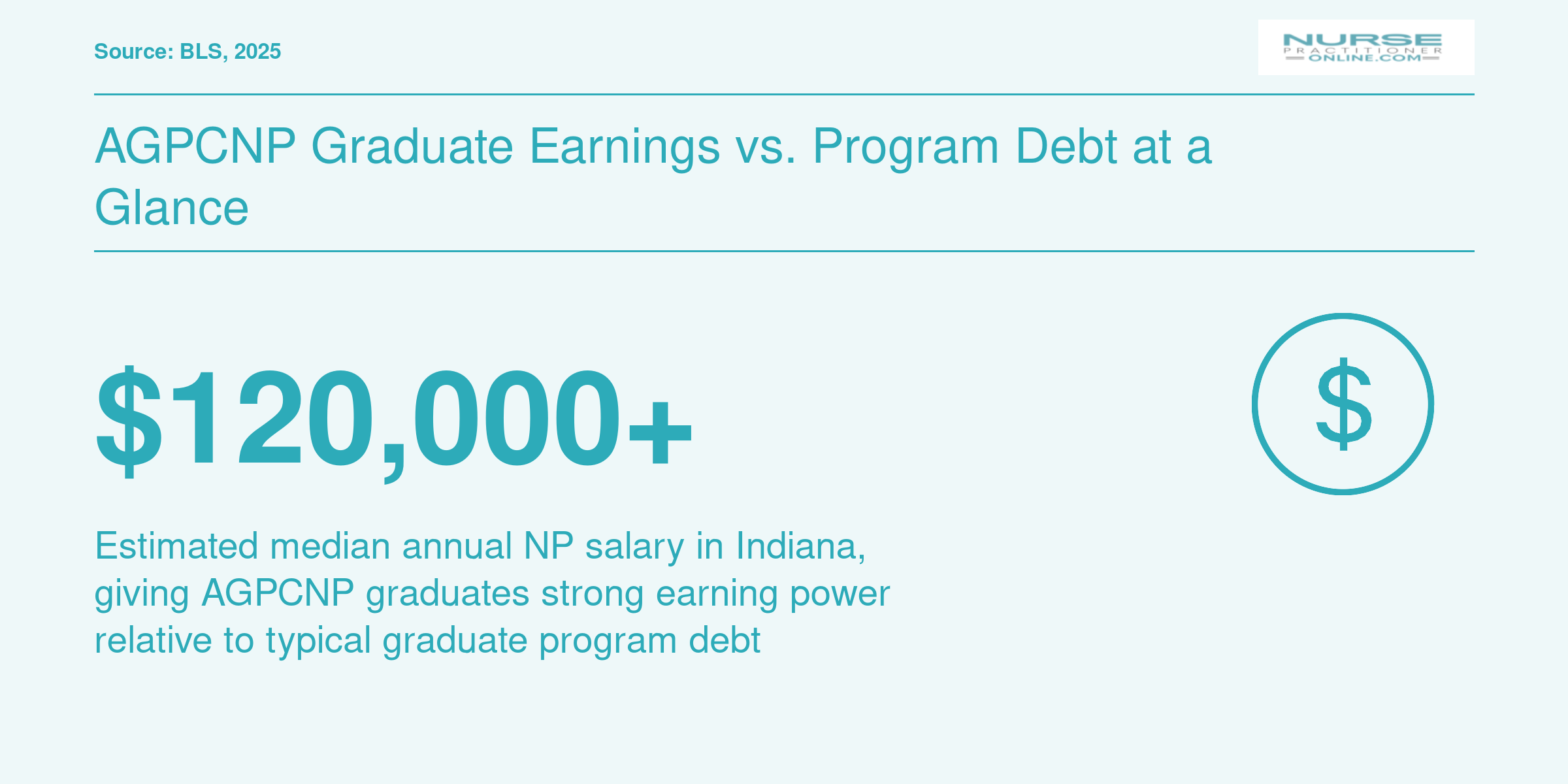
AGPCNP Graduate Earnings vs. Program Debt at a Glance
Program-level earnings and debt figures for adult gerontology primary care nurse practitioner programs near South Bend are not yet published for this cohort. Once updated federal data becomes available, nursepractitioneronline.com will add a side-by-side comparison so you can weigh each program's earnings-to-debt ratio at a glance.
Clinical Placement Partners in the South Bend Region
Beacon Health System, anchored by Memorial Hospital in downtown South Bend, is the largest clinical training partner for NP students in the region, and like every major system here, it requires a signed affiliation agreement with your school before you can set foot on a unit.1 That single requirement shapes almost everything about how AGPCNP placements work in northern Indiana.
The Core Health System Partners
Three systems do most of the heavy lifting for adult gerontology primary care rotations within a 30-minute drive of South Bend:
- Beacon Health System: Memorial Hospital and its affiliated primary care clinics offer broad exposure to adult and older adult populations. Onboarding takes time: immunizations, background check, drug screen, and EMR training are all required before your first clinical day.2
- Saint Joseph Health System (Trinity Health): Placements here are coordinated centrally and only through your school's clinical office, not by individual student outreach.1
- Spectrum Health Lakeland: Just across the Michigan line in Niles, St. Joseph, and Berrien County, Lakeland accepts NP students through school clinical education agreements, making cross-border rotations a realistic option for South Bend residents.1
Beyond the Hospital Walls
AGPCNP students need primary care hours, not inpatient ones, so the placement mix usually leans toward outpatient settings. Federally qualified health centers in the region accept students under school contracts and offer strong exposure to underserved adult populations with complex chronic disease.1 Geriatric and long-term care facilities, typically school-arranged, fill the older-adult requirement. Retail clinics such as Kroger clinical student placement sites also participate, again under affiliation agreement.3
How Placements Actually Get Arranged
This is where the structure of your program matters more than the brochure suggests. At Beacon, Saint Joseph, Spectrum Health Lakeland, and the regional FQHCs, placements are coordinated through the school's clinical placement office. You cannot walk in and arrange your own rotation at these sites. Large systems generally need one or more semesters of lead time to process paperwork, credentialing, and preceptor assignments.1
If you are a working RN, ask any program you are considering whether they handle placements for you or expect you to self-place. Some Indiana programs lean heavily on student-arranged preceptors and point students toward paid matching services like PreceptorLink, MatchNP, or NPHub.241 That can work, but it adds cost and stress on top of an already demanding clinical year.
Online, Hybrid, and On-Campus Formats for Working RNs
Most AGPCNP programs accessible from South Bend deliver didactic coursework online or in a hybrid format, while a smaller number follow a traditional on-campus model. Regardless of how lectures are delivered, every accredited program requires hands-on clinical hours with real patients. Understanding the tradeoffs of each format helps you pick the structure that fits your nursing schedule and learning style.
Pros
- Hybrid and online formats let you keep earning a paycheck at your current hospital or clinic while completing coursework on your own timeline.
- Choosing an online program widens your options well beyond Indiana, giving you access to highly ranked out-of-state AGPCNP programs without relocating from the South Bend area.
- Online cohorts often include nurses from diverse practice settings across the country, exposing you to a broader range of clinical perspectives during discussions.
- Hybrid models that blend periodic campus intensives with online learning offer a middle ground, providing some face-to-face faculty interaction without a rigid weekly commute.
Cons
- Many online and hybrid programs require students to identify and secure their own clinical preceptors, a process that can take months and adds stress on top of coursework.
- Without regular in-person class meetings, building close relationships with classmates and faculty takes more deliberate effort, which can limit peer support and professional networking.
- Clinical site quality can vary when placements are student-arranged rather than coordinated by the school, potentially affecting the depth of your hands-on training.
- Fully online didactic delivery demands strong self-discipline; nurses juggling 12-hour shifts may find it harder to stay on pace without the structure of a set class schedule.
Related Articles
What It Takes to Get In: AGPCNP Admission Requirements
Admissions criteria are broadly consistent across AGPCNP programs accessible from South Bend, though a few details vary. Use this checklist to make sure your application packet is complete before you hit submit.
- Active, unencumbered RN licenseEvery program reviewed requires a current RN license in good standing. Confirm that your license is active in Indiana (or the state where you plan to complete clinical hours) well before the application deadline.
- BSN from an accredited nursing programYou will need a Bachelor of Science in Nursing from a program accredited by CCNE, ACEN, CNEA, or NLNAC. Some schools, such as Indiana University Northwest, list all four accreditors; others simply specify an accredited institution. If your BSN program held a different accreditation, contact the admissions office early.
- Minimum cumulative GPAA 3.0 on a 4.0 scale is the most common floor, University of Indianapolis, Chamberlain University, and several online-accessible programs all set their minimum there. Indiana University Northwest posts a slightly lower threshold of 2.8, though a stronger GPA always improves your competitiveness.
- Clinical RN experienceMost programs prefer one to two years of direct-patient-care nursing experience, and some make it a hard requirement. Even where it is listed as preferred rather than required, admissions committees weigh clinical background heavily, so document your hours and specialty areas clearly on your résumé.
- GRE or other standardized examGood news: every AGPCNP program examined for this guide, including Indiana University Northwest, University of Indianapolis, Chamberlain, Adelphi, and George Washington University, has dropped the GRE requirement. This trend holds across most NP programs nationwide, so the GRE is unlikely to be a barrier.
- Prerequisite courseworkSome programs require an undergraduate statistics course. Indiana University Northwest, for example, asks for three credits of statistics with a B-minus or higher, and Adelphi University requires college-level statistics as well. Check your transcript early so you have time to complete any missing prerequisites.
- Personal statement and professional referencesExpect to write a goal-oriented personal statement and supply two to three professional references, typically from nursing supervisors or faculty who can speak to your clinical competence and leadership potential.
- Résumé or CV, background check, and immunizationsA current nursing résumé or CV is standard. Programs also require a criminal background check and up-to-date immunization records, which you may already maintain for your employer. Gather these documents early to avoid last-minute delays.
AGNP Salary and Demand in the South Bend–Elkhart Metro
Balancing salary expectations against job availability is one of the most practical calculations you will make before committing to an AGNP program. The South Bend and Elkhart metro offers a distinctive mix of healthcare systems, community clinics, and specialty practices that shape both what you can earn and how quickly you can find a position after graduation.
Regional Wage Landscape
Nurse practitioners in Indiana earn a mean annual wage of approximately $126,600, which translates to about $60.86 per hour.1 That figure sits above the national median of $121,610, making the state a competitive market for NP compensation.2 While specific wage data for the South Bend-Elkhart metropolitan statistical area is not always published separately by federal sources, regional employers typically align closely with statewide averages, with some variation based on specialty, employer type, and experience level.
To get a clearer picture of current pay in your target area, the Bureau of Labor Statistics publishes Occupational Employment and Wage Statistics for MSAs. If South Bend-Elkhart data is suppressed in a given year, the Indiana state profile provides reliable benchmarks. You can also search active job postings on Indeed, Glassdoor, or LinkedIn to see real-time salary ranges that employers are advertising right now.
Primary Care Shortage Designations
St. Joseph County and Elkhart County both have areas designated as Health Professional Shortage Areas for primary care by the Health Resources and Services Administration. These designations signal strong demand for primary care nurse practitioners, including adult gerontology nurse practitioners. Working in an HPSA can open doors to federal loan repayment programs, signing bonuses, and other incentives designed to attract clinicians to underserved communities.
You can verify current shortage designations using the HRSA HPSA finder tool. Understanding where these designations apply helps you target clinical placements and eventual job searches in communities that genuinely need your expertise.
Gauging Real-Time Demand
Beyond federal data, professional organizations offer valuable local insight. The Indiana Nurse Practitioner Association and the American Association of Nurse Practitioners publish regional salary surveys and practice environment reports that reflect what practitioners actually experience on the ground. Exploring different nurse practitioner specialties can also help you understand which practice settings are expanding and where adult gerontology NPs fit into the broader workforce picture.
The combination of competitive statewide wages, primary care shortage designations, and a diverse healthcare landscape makes South Bend and Elkhart a promising region for AGNP graduates looking to launch or advance their careers.
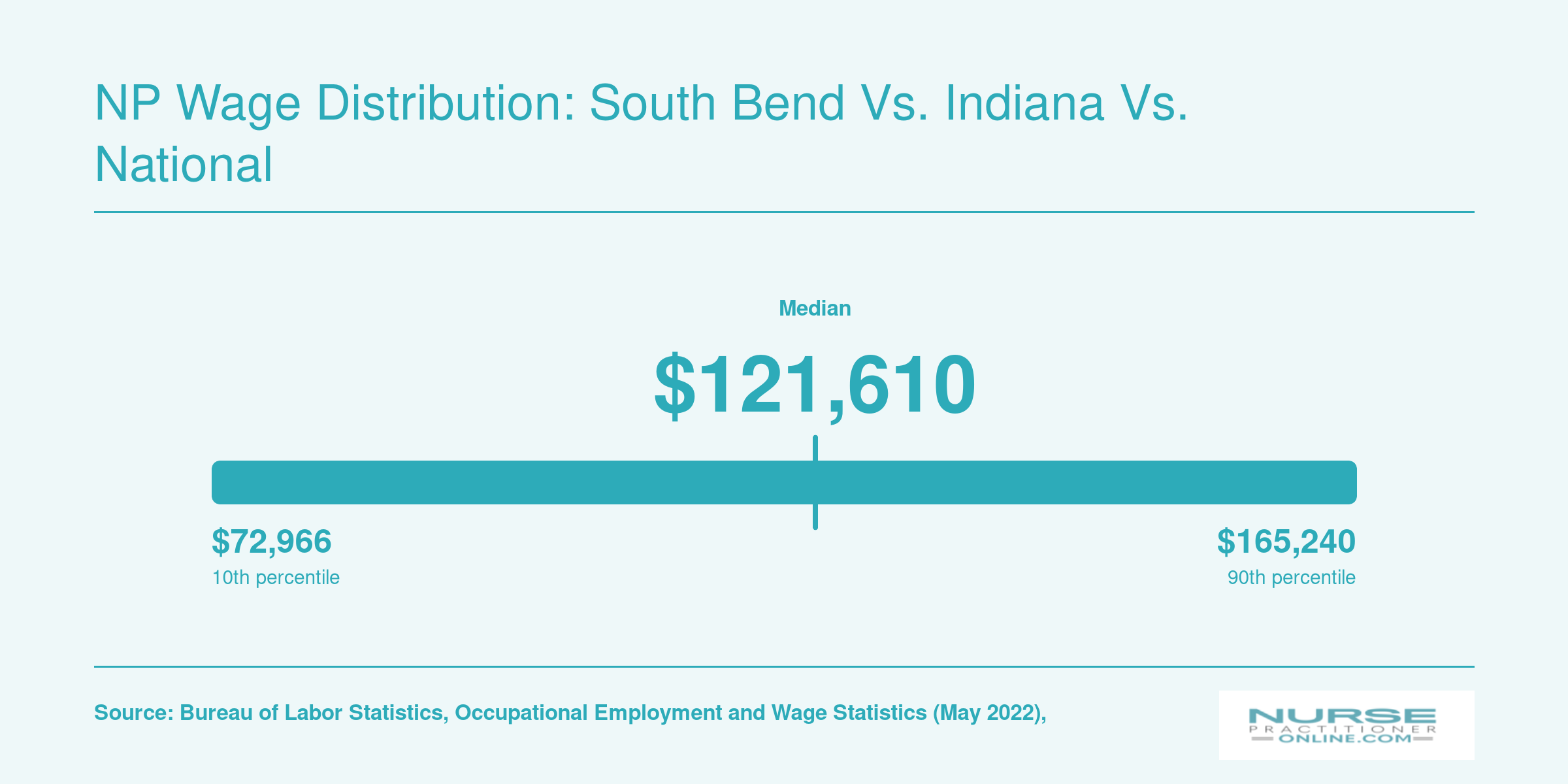
NP Wage Distribution: South Bend vs. Indiana vs. National
How does nurse practitioner pay in the South Bend area stack up? The national wage percentiles below give you a reliable baseline for what AGPCNPs can expect to earn at different experience levels. Local metro and Indiana statewide percentile data were not published in the most recent BLS release, so national figures serve as the best available benchmark for now.
Accreditation, Certification Pass Rates, and Application Timelines
Before you spend a single dollar on application fees, confirm that any AGPCNP program you are considering holds accreditation from either the Commission on Collegiate Nursing Education (CCNE) or the Accreditation Commission for Education in Nursing (ACEN). This is not a technicality. Graduates of non-accredited programs are typically ineligible to sit for either the ANCC or AANP Adult-Gerontology Primary Care NP certification exams, which means they cannot practice as nurse practitioners in Indiana or most other states.
Why Accreditation Comes First
CCNE and ACEN accreditation signals that a program has met rigorous standards for curriculum, faculty qualifications, clinical training, and student outcomes. Our nursing accreditation guide walks you through the differences between the two bodies in detail. Indiana-area programs with established nursing schools, including those at Indiana University and Valparaiso University, have historically maintained CCNE accreditation for their graduate nursing offerings, but accreditation status can change. Before you apply anywhere, run the program through the CCNE program search at ccneaccreditation.org and the ACEN directory at acenursing.org. Do not rely on a program's own marketing materials as your only confirmation.
Certification Pass Rates: What the Numbers Tell You
Once you graduate from an accredited program, you will sit for either the ANCC Adult-Gerontology Primary Care NP certification exam or the AANP equivalent. Nationally, the AANP exam carried an approximate pass rate of 85 percent in its most recent reporting period.1 The ANCC AGPCNP-BC exam reported a similar 85 percent pass rate for 2024. Program-specific pass rate data for Indiana schools is not consistently published in a centralized location, so ask each program's admissions office directly for their most recent first-attempt pass rates. A program reluctant to share that number is telling you something important.
Application Timelines and Program Length
Most AGPCNP programs near South Bend admit cohorts in the fall, with some offering spring entry. Competitive programs tend to close applications two to four months before the cohort start date, which means if you are targeting a fall 2027 start, you should be building your application file in late 2026. Full-time students typically complete an MSN-level AGPCNP program in two to three years, while part-time tracks common among working RNs extend the timeline to three to four years. If you are also weighing other NP tracks, browsing the best online nurse practitioner programs can help you compare timelines across specialties.
A practical plan of action looks like this:
- Accreditation check: Verify status at ccneaccreditation.org or acenursing.org before anything else.
- Pass rate inquiry: Email or call each program's admissions office and ask for their most recent first-attempt certification exam pass rates.
- Info packets: Request official program guides so you can compare credit hours, clinical hour requirements, and residency expectations side by side.
- Admissions counselor call: A 20-minute conversation with a counselor can surface details, like clinical placement support in the South Bend area, that never appear on the program website.
Taking these steps in order keeps you from investing months of effort in a program that cannot actually get you to the exam room.
Frequently Asked Questions About AGPCNP Programs Near South Bend
Choosing an adult gerontology primary care nurse practitioner program is a big decision, especially when you are balancing shifts, family, and finances. Below are answers to the questions South Bend area nurses ask most often when exploring AGPCNP options.
- Is an adult-gerontology nurse practitioner degree worth it?
- For most nurses, yes. AGPCNPs fill a growing need as the population ages, and the Bureau of Labor Statistics projects nurse practitioner employment to grow much faster than average through the early 2030s. In the South Bend metro, median NP salaries exceed the area's overall median household income by a wide margin. Combined with strong job security and the ability to practice with greater autonomy, the degree typically delivers a solid return on investment.
- Is it better to get an FNP or AGNP?
- It depends on your career goals. An FNP certification covers patients across the lifespan, including pediatrics, which gives broader flexibility. An AGNP focuses on adolescents through older adults, offering deeper expertise in chronic disease management and geriatric care. If you see yourself working in primary care clinics, long-term care, or geriatric specialty practices, the AGNP may give you a competitive edge in the South Bend region's aging population.
- Who gets paid more, FNP or ACNP?
- Acute care nurse practitioners (ACNPs) generally earn slightly more than family nurse practitioners because they work in higher-acuity settings such as ICUs and emergency departments. National data shows ACNPs can earn several thousand dollars more per year on average. However, total compensation varies by employer, specialty, and geographic market, so in some South Bend hospitals FNPs in specialty roles close that gap.
- How can a nurse practitioner make $200,000 a year?
- Reaching that level usually requires a combination of strategies: working in a high-demand specialty such as acute care or cardiology, taking on administrative or leadership roles, picking up overtime or per diem shifts, and negotiating productivity bonuses. Some NPs also build income through telehealth side practices or locum tenens assignments. In Indiana, practicing in underserved or rural communities can unlock additional incentive pay.
- What are the admission requirements for AGPCNP programs near South Bend?
- Most programs require an unencumbered RN license, a BSN from an accredited institution (for MSN entry), a minimum GPA around 3.0, and at least one year of clinical nursing experience. Additional items typically include a personal statement, professional references, and a current resume. Some programs also ask for GRE scores, though many have moved to GRE-optional admissions. Check each school's catalog for specific prerequisites.
- Which South Bend health systems offer AGNP clinical placements?
- Major systems in the area include Beacon Health System (Memorial Hospital of South Bend), Saint Joseph Health System (part of Trinity Health), and the VA Northern Indiana Health Care System. Many AGPCNP programs help coordinate placements at these sites, as well as at federally qualified health centers and private primary care practices in Elkhart and Mishawaka. Confirm placement support with your program before enrolling.
- Can I complete an AGPCNP program entirely online from South Bend?
- Several accredited universities offer AGPCNP programs with fully online didactic coursework, so you can complete lectures and exams from home. However, every program requires hands-on clinical hours, typically 500 to over 700 hours, which must be completed in person at approved sites. Many online programs allow you to arrange clinical rotations in the South Bend metro, making it possible to stay local for the practical component.
- Are there AGPCNP programs in Michigan within commuting distance of South Bend?
- South Bend sits just minutes from the Michigan border, so nearby Michigan campuses are worth checking. However, options are limited. Western Michigan University in Kalamazoo, for example, offers a BSN program but does not currently offer an AGPCNP track. Before counting on a Michigan commute, verify that the specific school lists an active AGNP or AGPCNP program and confirm whether its format includes required on-campus intensives.