Most important takeaways…
- Net price after grants, not listed tuition, separated the most affordable FNP programs by thousands of dollars.
- Fully online formats saved Allentown-area nurses on commuting, parking, and lost shift income compared to hybrid options.
- The federal NURSE Corps Scholarship covers full tuition plus a monthly stipend near $1,400 to $1,500 for eligible applicants.
- Programs that arrange preceptor placements can prevent months of unpaid delays that quietly inflate total degree costs.
What does an affordable FNP program actually cost a nurse working in Allentown? Sticker tuition at Pennsylvania schools can top $35,000 per year, but the net price, what students pay after grants and scholarships, tells a different story. For 2026, several accredited programs accessible without relocation carry a net price below $20,000, and one comes in under $14,000.
Standardizing costs isn't straightforward. Per-credit rates and advertised totals rarely account for clinical fees, technology charges, or the income lost during in-person intensives.
This comparison measures real affordability by weighing those hidden variables against Lehigh Valley NP salaries, so you can see which programs deliver the strongest return.
Budget-Friendly Online FNP Programs for Allentown-Area Nurses, 2026 Rankings
We weighted net price and financial aid metrics most heavily to surface programs where working nurses get real value. The nine Pennsylvania schools below all offer Family Nurse Practitioner pathways accessible to Lehigh Valley nurses, whether fully online, hybrid, or a short drive away. Graduation rates listed are institution-wide figures, not specific to each nursing program, so treat them as one data point among many.
- Net price after financial aid
- In-state and out-of-state tuition
- Institution-wide graduation rate
- Program delivery flexibility
- Graduate earnings outcomes
- Internal program database
- NCES-IPEDS federal institutional data — nces.ed.gov
- Independent program research
- College Scorecard graduate earnings — collegescorecard.ed.gov

Holy Family University
Holy Family University, a private institution in Northeast Philadelphia, posts the lowest effective net price on this list thanks to generous financial aid packaging. Its DNP with a Family Nurse Practitioner concentration uses a cohort-based hybrid model that blends online coursework with face-to-face sessions and simulation activities. The BSN-to-DNP track can be completed in as few as four years, making it a practical route for nurses who want a doctoral credential alongside FNP certification.
- Hybrid cohort model with online and in-person classes
- BSN-to-DNP track completable in about four years
- Post-APRN track completable in about two years
- Scholarly project can be conducted at your workplace
- Prepares for FNP certification exam eligibility
- Hands-on simulation activities integrated into curriculum
- Faculty-guided face-to-face coursework sessions
Doctor of Nursing Practice, Family Nurse Practitioner — Hybrid

Commonwealth University of Pennsylvania
Commonwealth University of Pennsylvania is consistently cited as one of the state's most affordable online NP programs, with a 100% online MSN that keeps commuting costs at zero for Allentown-area nurses. The 50-credit, CCNE-accredited program offers rolling admissions with fall, spring, and summer start dates, and its asynchronous format lets you keep working full-time shifts. Faculty are practicing nurse practitioners, and the curriculum covers populations from pediatric through frail older adults, with 980 clinical hours built in.
- 100% online, asynchronous core courses
- 50 credits with 980 clinical hours
- Rolling admissions with three annual start dates
- No GRE required for admission
- CCNE accredited program
- Full-time completion in roughly two and a half years
- Employer tuition deferment supported
- Prepares for ANCC and AANPCB certification exams
MSN, Family/Individual Across the Lifespan Nurse Practitioner — Online

Pennsylvania Western University
Pennsylvania Western University (PennWest) delivers one of the lowest per-credit costs for FNP training in the state, with both an MSN and a post-master's certificate available. Courses are online with optional on-campus skills workshops, and the 49-credit MSN includes 518 clinical hours. Nearly half of PennWest students receive Pell Grants, which signals strong institutional experience navigating financial aid for working adults.
- 49 semester hours with 518 clinical practice hours
- Online delivery with optional campus workshops
- Prepares for ANCC or AANPCP certification
- Includes advanced health assessment training
- Covers pediatric and women's health primary care
- 15 core credits plus 34 advanced credits
- Online certificate for MSN-prepared nurses
- Same clinical hour and certification preparation as MSN track
- Focuses on evidence-based primary care practice
- Covers pharmacology applications and clinical diagnostics
- Integrates nursing and health policy content
- Designed for career-advancing nurse practitioners
MSN, Family Nurse Practitioner — On-Campus
Post-Master's Certificate, Family Nurse Practitioner — On-Campus

Pennsylvania State University-Penn State Shenango
Penn State Shenango leverages the Penn State College of Nursing's nationally recognized curriculum while keeping class sizes small, reflected in a 7-to-1 student-to-faculty ratio. The hybrid MSN uses videoconferencing and online courses alongside clinical placements at local facilities. Full-time students can finish in four semesters, and graduates report median earnings among the highest on this list at ten years out.
- Hybrid format with videoconferencing and online courses
- Completable in four semesters full-time
- Part-time study option available
- Clinical placements at local healthcare facilities
- Prepares for national certification and state licensure
- 7-to-1 student-to-faculty ratio
- Focus on rural and community primary care needs
MSN, Family Nurse Practitioner — On-Campus

York College of Pennsylvania
York College of Pennsylvania regularly appears on statewide lists of the most affordable FNP programs. Its fully online MSN can be completed in as little as two years across six semesters, with rolling admissions three times a year. The 47-credit, CCNE-accredited curriculum prepares graduates for both ANCC and AANP certification, and the online format means Allentown nurses never need to commute to York.
- 47 credit hours delivered fully online
- Completable in as few as two years (six semesters)
- CCNE accredited with rolling admissions
- Three start dates: fall, spring, and summer
- Synchronous and asynchronous course options available
- Prepares for both ANCC and AANP certification
- Post-master's certificate track also available
- Clinical courses taken in sequential order
MSN, Family Nurse Practitioner — Online

Pennsylvania State University-Penn State Schuylkill
Penn State Schuylkill, located about an hour from Allentown, offers the same Penn State College of Nursing FNP curriculum delivered in a hybrid format. The program emphasizes rural primary care and pairs videoconferencing-based instruction with local clinical experiences. Although the institution-wide graduation rate is on the lower end, the campus's proximity to the Lehigh Valley can simplify clinical placement logistics.
- Hybrid delivery combining video and online courses
- Full-time completion in four semesters
- Part-time option for working nurses
- Local clinical experiences in the region
- Prepares for national certification and PA licensure
- Focus on addressing rural primary care gaps
MSN, Family Nurse Practitioner — Hybrid

Millersville University of Pennsylvania
Millersville University markets its online MSN as a budget-friendly, accessible option for Pennsylvania nurses. The program can be completed in about 20 months through accelerated eight-week courses, and total tuition is estimated around $27,219 for the 43-credit curriculum. A hybrid on-campus track is also available at the Millersville and Harrisburg locations, giving Allentown-area nurses a choice of formats. The program is accredited by the NLN Commission for Nursing Education Accreditation.
- 100% online with 8-week accelerated courses
- 43 credits, completable in about 20 months
- Total tuition estimated around $27,219
- NLN CNEA accredited
- Prepares for ANCC FNP-BC and AANPCB NP-C exams
- 3.0 GPA and two years clinical experience required
- Available at Millersville and Harrisburg campuses
- Fall and spring start dates
- Capstone project integrated into curriculum
- Two years of clinical nursing experience required
- Full-time and part-time scheduling options
- Pennsylvania RN licensure required for admission
MSN, Family/Individual Across the Lifespan Nurse Practitioner (Online) — Hybrid
MSN, Family/Individual Across the Lifespan Nurse Practitioner (Hybrid) — Hybrid

Pennsylvania State University-Penn State Harrisburg
Penn State Harrisburg's DNP with a Family/Individual Across the Lifespan concentration is the highest-investment option on this list, but it delivers a doctoral credential alongside FNP certification eligibility. The 65- to 68-credit program combines online coursework with three on-campus intensive sessions and 1,125 clinical practicum hours. For nurses who plan to move into leadership or faculty roles, the additional credential may justify the higher price tag.
- 65 to 68 total credits required
- Approximately $1,027 per credit hour
- Online coursework with three on-campus intensives
- 1,125 clinical practicum hours
- CCNE accredited doctoral program
- Prepares for national FNP certification
- Designed for PA-licensed nurses with a BSN or MSN
DNP, Family/Individual Across the Lifespan Nurse Practitioner — On-Campus

La Roche University
La Roche University in Pittsburgh rounds out the list with a 30-credit post-master's FNP certificate designed for nurses who already hold an MSN. The part-time program can be finished in about two years and blends online learning with virtual simulation and hands-on clinical work. It carries the highest net price among the schools here, but nurses who need only the certificate (rather than a full master's degree) may find the shorter credit load keeps total out-of-pocket costs manageable.
- 30-credit part-time certificate program
- Completable in approximately two years
- Combines online coursework with virtual simulation
- Hands-on clinical experiences included
- Eligible for national FNP certification exams
- Requires MSN from an accredited program
- 3.0 QPA minimum for admission
- Emphasizes evidence-based, patient-centered care
Post-Master's Certificate, Family Nurse Practitioner — On-Campus
How We Evaluated Affordability and Quality
Affordability rankings for FNP programs near Allentown start with a metric many prospective nurses overlook: net price, not sticker tuition. Net price represents what students actually pay after grants and scholarships, calculated from federal data for in-state, first-time, full-time undergraduates. It's the real cost after aid, and it weighted most heavily in our assessment.
Why Net Price Matters More Than Sticker Tuition
Sticker tuition often inflates expectations. For online FNP programs, published rates might range from $25,000 to $50,000 total, but net price (the sector-conditional average after institutional and federal aid) can drop significantly. We emphasized this figure because it reflects the typical out-of-pocket expense for a working nurse pursuing a degree, not the list price. Schools with generous internal scholarships or partnerships with Pennsylvania health systems often have lower effective costs, even if their base tuition appears higher. If you're comparing options beyond the Allentown area, our broader guide to best online FNP programs can help you benchmark costs nationally.
Accreditation: The Baseline Every School on This List Meets
CCNE or ACEN accreditation was a non-negotiable entry requirement, not a ranking factor. Every program included holds active, recognized accreditation, ensuring eligibility for national certification exams and state licensure. Without it, a program was excluded regardless of price.
How Earnings and Debt Data Informed Value Rankings
Beyond cost, we incorporated program-level outcomes from federal scorecard data where available. Median earnings one and four years after completion, along with median graduate debt, helped gauge return on investment. A program might charge less upfront but lead to lower earning potential, creating a false economy. Similarly, low debt with strong early-career earnings signaled efficient value, exactly what a budget-conscious nurse should target. Employment share data, when reported, further confirmed whether graduates enter the workforce in their field. These metrics painted a complete picture of what "affordable" truly means: a manageable investment that pays off quickly in Lehigh Valley's job market.
Common Questions About Affordable FNP Programs in Pennsylvania
Choosing an affordable FNP program involves more than scanning tuition tables. Below are answers to the questions Allentown-area nurses ask most often when weighing cost, quality, and logistics. Where specific figures appear, they reflect the program data we verified for our 2026 comparison; where data is limited, we say so plainly.
- What is the cheapest online FNP program in Pennsylvania?
- Among the programs we reviewed, York College of Pennsylvania stands out with estimated total tuition around $8,340 for its fully online MSN FNP track. Commonwealth University of Pennsylvania is another strong budget option, with in-state tuition starting near $12,140 for 50 credits. Actual costs vary by credit load, fees, and enrollment pace, so request a full cost sheet before committing.
- How much does an online FNP program cost in PA?
- Tuition for PA-based online FNP programs in our comparison ranges roughly from about $8,300 to over $29,000, depending on the school and whether it is public or private. Public universities such as Commonwealth University and Pennsylvania Western University tend to cluster at the lower end. Private institutions like the University of Scranton (approximately $965 per credit for 36 credits) and La Salle University charge more. Always factor in fees, books, and clinical-related expenses.
- Are the cheapest FNP programs still accredited and reputable?
- Yes. Every program in our ranking holds active accreditation from a recognized body such as CCNE, ACEN, or NLN CNEA. For example, Commonwealth University, York College, and La Salle University are all CCNE accredited. Accreditation matters because it ensures the curriculum meets national standards and qualifies you to sit for the ANCC or AANP certification exams. Always verify a program's current accreditation status before enrolling.
- How long does it take to complete an online FNP program?
- Full-time students typically finish in 24 to 36 months, while part-time students should expect 36 to 48 months. Some accelerated tracks can be completed in as few as 16 to 21 months. Most Pennsylvania programs set a maximum completion window of about five years. If you are working bedside shifts, a part-time schedule with asynchronous coursework often provides the flexibility you need without sacrificing clinical depth.
- What financial aid is available for FNP students in Pennsylvania?
- Pennsylvania nurses can tap several funding sources. Federal Direct Unsubsidized and Grad PLUS loans are widely available. The NURSE Corps Scholarship and Loan Repayment Programs serve students who commit to practicing in underserved areas. Many PA employers offer tuition reimbursement or deferment; Commonwealth University, for instance, notes employer tuition deferment as an option. Graduate assistantships and state-level grants round out the picture. Check each school's financial aid office for deadlines.
- How much does a family nurse practitioner make in PA?
- Salary data for FNPs in Pennsylvania varies by source and region, but the Bureau of Labor Statistics places the median annual wage for nurse practitioners in the state well above the national average for registered nurses. In the Lehigh Valley specifically, compensation tends to reflect the area's mix of health systems and outpatient clinics. Program-level earnings outcomes for many of these schools are not yet published, so we recommend checking current salary surveys and local job postings for the most accurate picture.
- Can I complete an FNP program entirely online from Allentown?
- Several programs in our comparison offer a fully online didactic curriculum, including Commonwealth University, York College, and La Salle University. Keep in mind that every FNP program requires supervised clinical hours, which you will arrange at approved sites near Allentown. Some schools provide clinical placement assistance; others expect you to secure your own preceptor. Hybrid programs from Penn State or Millersville may require periodic on-campus visits as well.
- What is the difference between BSN-to-FNP and post-master's FNP certificate costs?
- A BSN-to-MSN FNP track generally requires 47 to 50 credits, putting total tuition in the range of roughly $8,300 to $29,000 or more across our listed PA programs. A post-master's certificate, designed for nurses who already hold an MSN, is shorter, typically around 30 credits. La Roche University, for example, offers a 30-credit post-master's FNP certificate at about $17,600. Fewer credits means lower tuition, but the certificate path is only available if you already have an MSN from an accredited program.
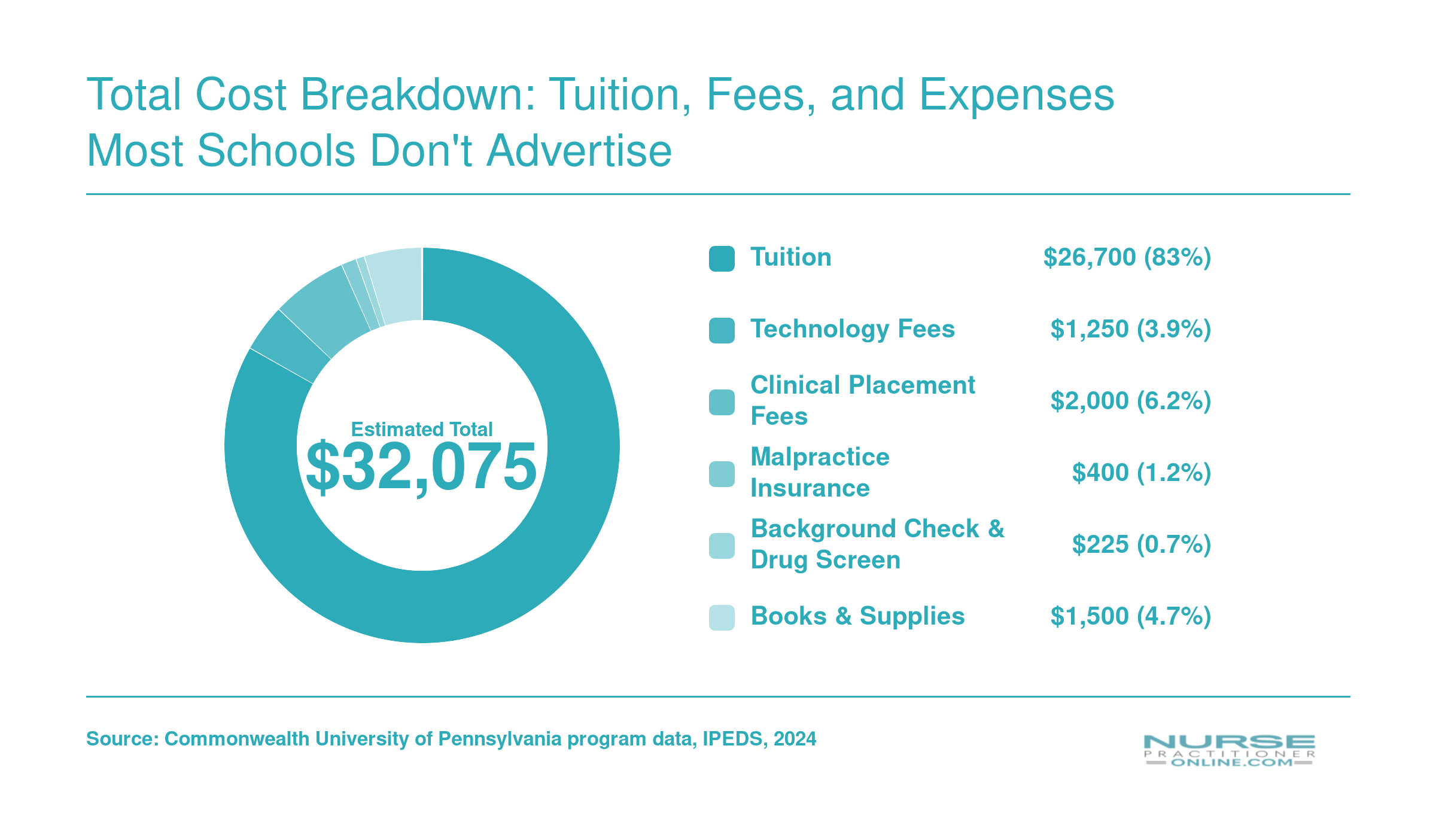
Total Cost Breakdown: Tuition, Fees, and Expenses Most Schools Don't Advertise
When you compare FNP programs, the per-credit price tag is only part of the story. A program with a lower per-credit rate but more required credits, or one that tacks on technology fees, clinical placement charges, and background screening costs, can end up costing thousands more than you expected. Here is a realistic total-cost picture using Commonwealth University of Pennsylvania's online FNP program as an example: 50 credits at $534 per credit for in-state students, plus the fees most schools bury in the fine print.
Related Articles
Questions to Ask Yourself
Online, Hybrid, or Campus-Based: How Format Shapes Your Total Cost
Tuition is only one piece of the puzzle. The delivery format you choose, whether fully online, hybrid, or campus-based, ripples into travel costs, lost shift income, technology fees, and even whether you qualify for in-state pricing. For Allentown-area nurses weighing affordability, understanding these hidden cost dimensions can save thousands over the life of a program. One important note for PA residents: Commonwealth University charges a flat rate of $614 per credit for its online DNP-FNP regardless of where you live, while several other Pennsylvania public universities maintain separate in-state and out-of-state graduate tuition tiers.
| Cost Dimension | Fully Online (e.g., Commonwealth University, York College of PA, La Salle University) | Hybrid (e.g., Penn State Schuylkill, PennWest, Millersville University) | Campus-Based (e.g., La Roche University) |
|---|---|---|---|
| Tuition per year (graduate, in-state or flat rate) | Ranges from roughly $8,340 (York College) to $29,220 (La Salle); Commonwealth University offers a flat $614/credit to all students | Ranges from roughly $11,261 (PennWest) to $25,234 (Penn State Schuylkill) for PA residents; out-of-state rates can jump 30% or more | Approximately $17,628 per year with a single rate for all students |
| In-state vs. out-of-state pricing | Commonwealth University charges the same flat rate regardless of residency; private schools like York College and La Salle set one tuition rate for all students | Public universities typically charge higher out-of-state tuition (e.g., Penn State Schuylkill: $25,234 in-state vs. $32,774 out-of-state) | La Roche, a private institution, charges one rate for all students |
| Commute and travel expenses | Minimal: no regular campus trips required beyond clinical placements in your local area | Moderate: periodic on-campus skills workshops or videoconference sessions; PennWest and Millersville may require occasional in-person visits | Highest: regular trips to the Pittsburgh campus for La Roche, which is roughly 300 miles from Allentown |
| Lost wages from campus days | Negligible: asynchronous coursework lets you study around your nursing shifts | Occasional: you may need to swap or drop shifts for scheduled on-campus intensives | Significant: fixed class schedules can conflict with full-time or part-time nursing work |
| Technology and platform fees | Expect modest per-semester technology or distance-learning fees; these are typically bundled into tuition at private schools | Similar online platform fees plus possible lab or simulation fees for on-campus components | May include lab fees, simulation center fees, and parking costs instead of online platform charges |
| Scheduling flexibility for working nurses | High: Commonwealth University and La Salle both offer asynchronous courses with part-time and full-time tracks | Moderate: online portions are flexible, but in-person sessions follow a fixed calendar | Lower: class times are set, though La Roche's post-master's certificate is a 30-credit, part-time option that may ease scheduling |
Clinical Placement Hours and Preceptor Support: A Side-by-Side View
One of the most overlooked factors when comparing affordable FNP programs is clinical placement support. The sticker price on tuition can look great, but if a program leaves you scrambling to find your own preceptors, you could spend months of unpaid effort and added stress just trying to secure a site. Here is how to research clinical requirements and placement support before you commit.
How Many Clinical Hours Should You Expect?
Nationally, FNP programs require a minimum of 500 direct patient care hours, but that floor is rising.1 Many programs now require 750 hours or more, and the typical range for family nurse practitioner tracks sits between 600 and 800 hours.2 Some Pennsylvania programs, such as York College of Pennsylvania, list 784 clinical hours across 14 credits. Others cluster closer to the 600-hour mark. The number matters because more hours often translate to more semesters of tuition, travel costs, and time away from your paying job.
Pennsylvania itself does not mandate a specific clinical hour count for CRNP licensure. Instead, the state requires graduation from an approved nurse practitioner program and passage of a national certification exam. That means your program's accrediting body, not the state board, sets the clinical hour threshold you need to meet.
Placed by the School or On Your Own?
This is the question that can make or break your experience. When you visit a program's website, look specifically for language about clinical placement assistance. Some schools maintain partnerships with health systems in the Lehigh Valley and surrounding regions and will match you with a preceptor. Others expect you to identify, contact, and secure your own clinical sites, which can be especially challenging in competitive metro areas.
Before you apply, dig into these details:
- Placement model: Does the program coordinate placements, or is it entirely self-placement? Some use a hybrid approach where the school provides a database of approved sites but you handle outreach.
- Geographic reach: If you live near Allentown, confirm that the program supports clinical sites in eastern Pennsylvania, not just near its home campus.
- Timeline: Ask when clinical placement coordination begins. Programs that start the process a full semester in advance tend to produce smoother experiences.
- Additional fees: Some schools charge a clinical placement fee on top of tuition. This can range from a few hundred dollars to over a thousand per semester.
Where to Verify This Information
School websites are your first stop; look under the FNP curriculum page or the student handbook, which often includes clinical placement policies in detail. For broader context on evolving clinical hour standards, the National League for Nursing publishes updates on trends in NP clinical education.1 Professional organizations like the American Association of Nurse Practitioners offer guidance on what strong clinical training looks like. If you are also weighing different NP specialties alongside your FNP research, our overview of adult gerontology nurse practitioner programs can help you compare clinical hour expectations across tracks. And if you want to understand how clinical preparation connects to earning potential after graduation, BLS.gov provides salary data for nurse practitioners by state and metro area.
Taking 30 minutes to compare clinical support policies across your short list of programs can save you significant time, money, and frustration down the road. A program that costs a bit more but handles placement logistics may actually be the better deal for a working nurse juggling shifts and family responsibilities near Allentown.
Scholarships, Loan Forgiveness, and Tuition Savings for PA Nurses
The federal NURSE Corps Scholarship Program pays full tuition, required fees, and a monthly living stipend (roughly $1,400 to $1,500) in exchange for a two-year full-time service commitment at a Critical Shortage Facility after graduation. For working nurses already practicing, the companion NURSE Corps Loan Repayment Program covers 60% of unpaid nursing education debt for two years of service, with an option to add a third year for another 25%. Both programs prioritize applicants with the greatest financial need, and FNP students are explicitly eligible because primary care roles align with HRSA's shortage-area mission.
What Pennsylvania State Aid Will and Won't Cover
Here is the hard truth Pennsylvania graduate students need to hear up front: the PA State Grant administered through PHEAA does not fund graduate study.1 Eligibility is restricted to students pursuing a first bachelor's degree in an approved program of at least two years.2 The newer Grow PA Scholarship Grant carries the same undergraduate-only restriction, even though nursing sits squarely on its in-demand fields list. If you are entering an FNP program, plan around federal aid (Direct Unsubsidized and Grad PLUS loans), institutional scholarships, and the service-based programs described here. PHEAA can still help with loan counseling and consolidation guidance, but not with a graduate grant.4
Employer Tuition Reimbursement in the Lehigh Valley
Both Lehigh Valley Health Network and St. Luke's University Health Network offer tuition assistance to employed nurses pursuing advanced degrees, and FNP tracks typically qualify. Benefit amounts, eligible programs, and continued-service requirements vary by role, FTE status, and bargaining unit, so confirm specifics with HR before you enroll. A common pattern is annual reimbursement applied against the IRS tax-free education benefit cap (currently $5,250), with some clinical-ladder roles eligible for more. Stacked across a three-year part-time FNP program, employer aid can offset a meaningful share of tuition.
If You Plan to Teach: HRSA's Nurse Faculty Loan Program
FNPs who think they may eventually teach should know about HRSA's Nurse Faculty Loan Program (NFLP). Schools that participate can loan up to $35,500 per year, and up to 85% of the balance is forgiven in exchange for four years of full-time nursing faculty service after graduation.
One reminder on the rankings above: the effective net price already reflects average institutional aid. Your personal package, after federal loans, employer reimbursement, and any service-based award, may land well below the listed figure.
What You Can Expect to Earn as an FNP in the Lehigh Valley
The financial return on an FNP degree in this region has become increasingly favorable as healthcare systems compete for primary care providers. Understanding what you can realistically earn helps you weigh program costs against long-term career outcomes.
Regional and Statewide NP Salary Benchmarks
Nurse practitioners in Pennsylvania earn a median annual salary between $121,000 and $122,000, according to Bureau of Labor Statistics data. While the BLS does not publish a separate figure for the Allentown-Bethlehem-Easton metropolitan area specifically, regional healthcare market conditions suggest earnings here track close to the statewide median. The national median for NPs sits at approximately $121,610, placing Pennsylvania practitioners roughly in line with the broader U.S. market.2
These figures represent median earnings across all NP specialties, including family, adult-gerontology, psychiatric, and acute care. Family nurse practitioners working in primary care settings may see slight variations depending on employer type and practice setting.
Major Employers Driving Local Demand
Two healthcare systems dominate the Lehigh Valley nursing job market:
- Lehigh Valley Health Network (LVHN): The region's largest employer, operating multiple hospitals and outpatient centers across Allentown, Bethlehem, and surrounding communities. LVHN regularly recruits FNPs for primary care clinics, urgent care facilities, and specialty practice support roles.
- St. Luke's University Health Network: A major competitor with expanding primary care footprints throughout the Lehigh Valley and into New Jersey. St. Luke's has been actively adding nurse practitioner positions as part of its community health expansion.
Both systems offer competitive salaries, benefits packages, and often provide tuition reimbursement or loan repayment assistance for employees pursuing advanced degrees.
Calculating Your Return on Investment
Program-level graduate earnings data for the FNP programs ranked in this article are not yet published in federal reporting systems. However, you can still estimate your personal return using available information.
Consider a straightforward calculation. If you graduate from a program costing between $12,000 and $40,000 in total tuition and enter a position paying the Pennsylvania median of around $121,000, you are looking at a significant income increase over your current RN salary. Pennsylvania RNs earn a median of approximately $76,000 to $80,000, depending on experience and setting. That means the jump to NP practice could represent an annual earnings boost of $40,000 or more.
Using a conservative estimate where you borrow the full tuition amount:
- A $30,000 program investment
- An annual earnings increase of $40,000
- Your breakeven point arrives in less than one year of practice
This rough calculation does not account for interest, opportunity costs, or time out of full-time work, but it illustrates why FNP education remains a sound financial decision for most working nurses in this region.
What the Numbers Mean for Your Decision
The national NP job growth projection of 40 percent through 2032 signals strong long-term demand.3 In the Lehigh Valley specifically, an aging population and primary care physician shortages continue to drive openings for family nurse practitioners. The combination of regional salary parity with statewide benchmarks, robust local hiring from major health systems, and accelerating demand makes this an opportune time to invest in your FNP education.
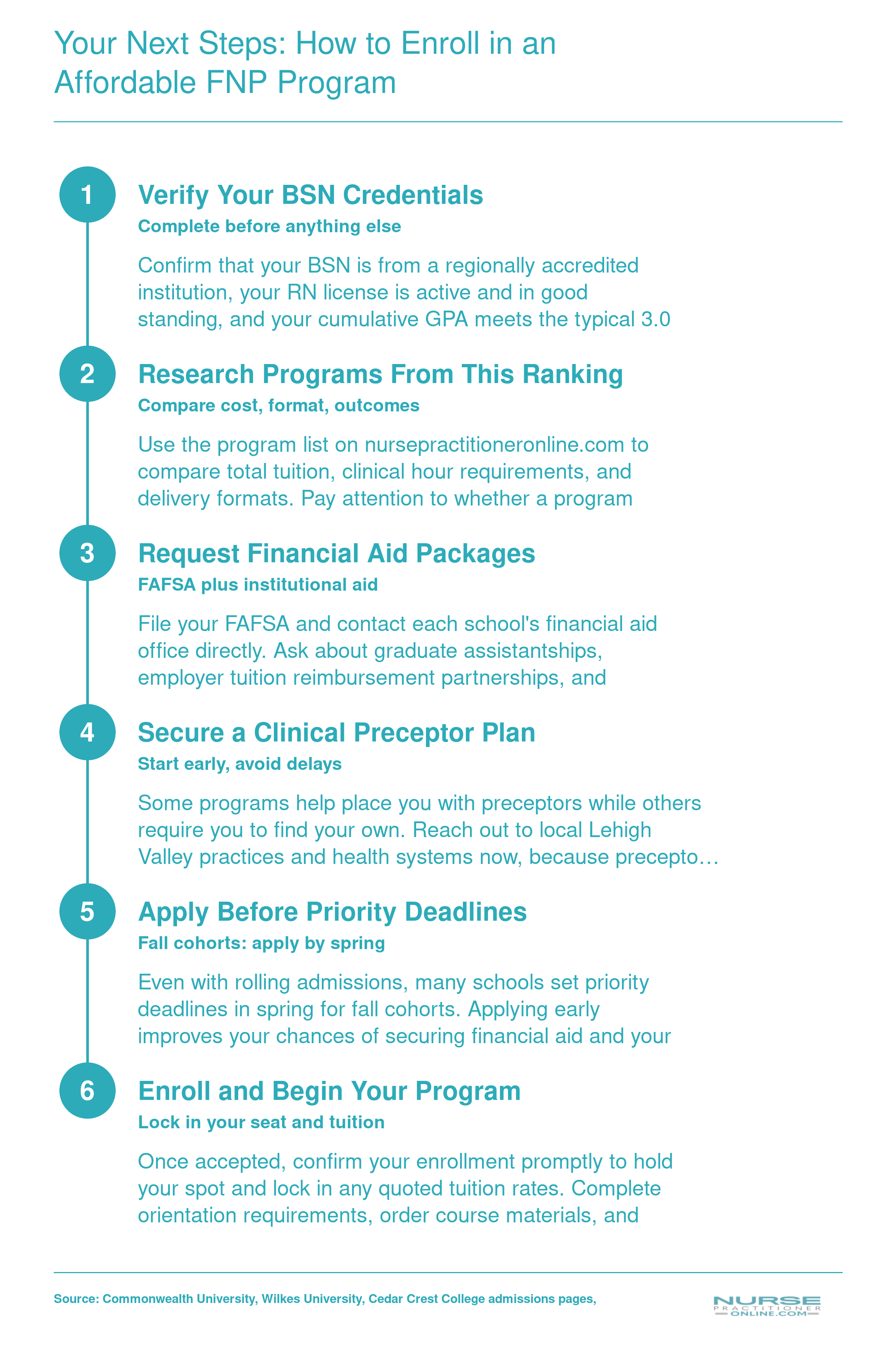
Your Next Steps: How to Enroll in an Affordable FNP Program
Ready to move forward? Most affordable FNP programs in Pennsylvania use rolling admissions, which means you do not have to wait for a single annual deadline. Programs like Commonwealth University accept applications for spring, summer, and fall starts. Waiting for the next fixed cycle when rolling options exist can cost you an entire semester. Most schools expect a cumulative GPA of 3.0 or higher, an active unencumbered RN license, and at least one year of clinical nursing experience. The good news: GRE waivers are widely available across the programs featured in our ranking.
Pennsylvania by City
- ACNP Programs in Pennsylvania
- DNP NP Programs in Pennsylvania
- FNP Programs in Pennsylvania
- Philadelphia, Pennsylvania (ACNP)
- Philadelphia, Pennsylvania (PNP)
- Philadelphia, Pennsylvania (WHNP)
- Pittsburgh, Pennsylvania (AGNP)
- Pittsburgh, Pennsylvania (CCNP)
- Pittsburgh, Pennsylvania (PMHNP)
- PMHNP Programs in Pennsylvania
- PNP Programs in Pennsylvania
- Scranton, Pennsylvania (AGNP)