Most important takeaways…
- Philadelphia-area pediatric NP programs range from CCNE-accredited MSN tracks to DNP pathways with online and hybrid options.
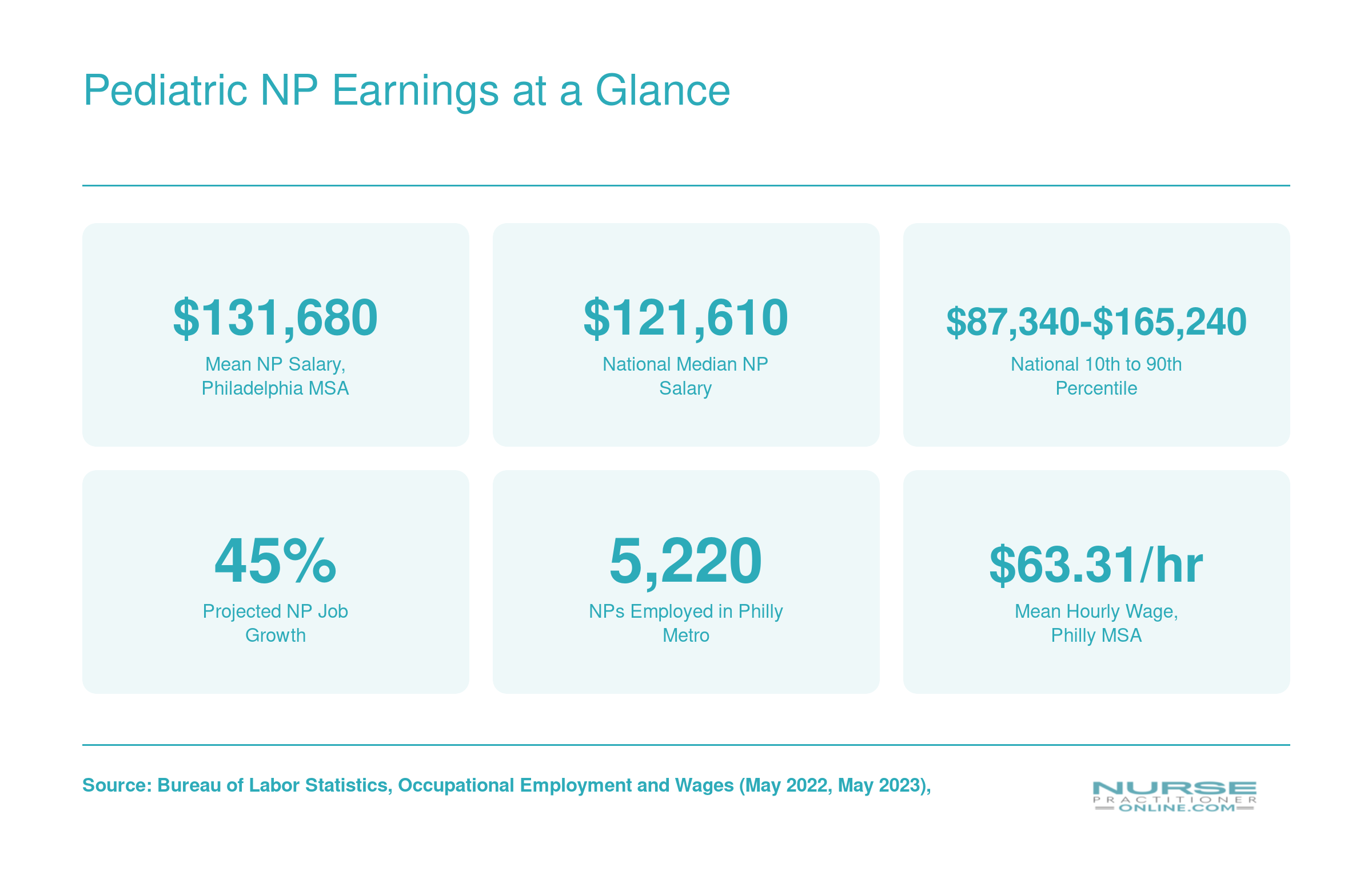
- Nurse practitioners in the Philadelphia metro earn well above the national median salary for the profession.
- Most programs require a BSN, an active RN license, a minimum 3.0 GPA, and pediatric clinical experience.
- Confirm whether a program prepares you for PNP-PC or PNP-AC certification before you apply.
Philadelphia is home to some of the nation's premier pediatric institutions, including Children's Hospital of Philadelphia (CHOP), one of the highest-ranked children's hospitals in the United States. That density of pediatric expertise translates directly into PNP training: clinical sites are plentiful, preceptor networks run deep, and the mix of primary care and subspecialty exposure gives students a range that few other regions can match.
You will find both MSN and DNP pediatric NP tracks near Philadelphia, offered across campus, hybrid, and fully online formats. Villanova, Thomas Jefferson, and Drexel all maintain CCNE-accredited programs that prepare graduates for Pediatric Primary Care Nurse Practitioner certification. Costs, credit loads, and clinical placement models vary significantly, so understanding what each program demands up front is essential.
Program completion rates, tuition structures, and median graduate debt differ widely even within the same metro area. Graduates enter a strong regional job market, but your choice of degree level, certification track, and program delivery format will influence both your earning timeline and your ability to balance work, clinical hours, and coursework over the next two to five years.
Best Pediatric NP Programs Near Philadelphia: Rankings & Comparison
The Philadelphia region offers a strong selection of pediatric nurse practitioner programs, from CCNE-accredited MSN tracks in Center City to DNP pathways across Pennsylvania. The programs below were ranked using an internal scoring model that weighs institutional quality, program-level features, and value indicators. Because details can change between application cycles, always confirm tuition, deadlines, and accreditation status directly with each school before applying.
- Institutional graduation and retention rates
- Program format and flexibility
- Tuition and net price indicators
- Accreditation and certification alignment
- Clinical training depth
- NCES-IPEDS federal institutional data — nces.ed.gov
- College Scorecard graduate earnings — collegescorecard.ed.gov
- Independent program research
- Internal program database

Villanova University
Villanova University pairs a rigorous 45-credit MSN curriculum with a hybrid delivery model that keeps core coursework online and arranges clinical placements across Pennsylvania, New Jersey, and Delaware. A 10:1 student-to-faculty ratio supports close mentorship, and a post-master's DNP option lets graduates continue their academic trajectory without switching institutions. The university reports a 91.9% institution-wide graduation rate, one of the highest among Philadelphia-area nursing schools.
- 45-credit hybrid program with online core courses
- Clinical placements coordinated across PA, NJ, and DE
- Physician and NP preceptors guide clinical learning
- Post-master's DNP pathway available on completion
- Reported CCNE accreditation per independent research
- 10:1 student-to-faculty ratio university-wide
MSN Pediatric Nurse Practitioner — Hybrid

Thomas Jefferson University
Thomas Jefferson University's MSN in Pediatric Primary Care Nurse Practitioner is built around a flexible 45-credit hybrid format, with on-campus sessions at the Center City or Dixon campus in Philadelphia and online coursework in between. Students can complete the program in two to five years, choosing full-time or part-time pacing. Graduates are prepared for the CPNP-PC certification exam, and the program offers fall, spring, and summer entry points to fit a working nurse's schedule.
- 45-credit hybrid program, 2 to 5 year completion
- On-campus sessions at Center City or Dixon campus
- Prepares graduates for the CPNP-PC certification exam
- Fall, spring, and summer start dates available
- Full-time and part-time enrollment options
- 12:1 student-to-faculty ratio university-wide
- Net price of approximately $28,928 per IPEDS data
MSN Pediatric Primary Care Nurse Practitioner — Hybrid

Drexel University
Drexel University stands out for the breadth of its pediatric NP offerings: a 52-credit online MSN in primary care, an MSN in pediatric acute care aligned with PNCB certification, and a 62-credit dual primary/acute care option that covers both inpatient and outpatient settings. All tracks are CCNE-accredited and feature synchronous online lectures with mandatory on-campus intensives. The program reports a 100% board pass rate, and clinical sites are self-coordinated, giving Philadelphia-area students flexibility to train locally.
- 52 quarter credits at $1,169 per credit
- Synchronous online classes with on-campus intensives
- CCNE-accredited with 100% reported board pass rate
- 3-year part-time timeline with flexible start terms
- Eligible for ANCC or PNCB primary care certification
- PA RN licensure required before clinical components
- Focused acute care track aligned with PNCB certification
- CCNE-accredited MSN degree level
- 9:1 student-to-faculty ratio university-wide
- State-of-the-art simulation lab access
- Part-time structure designed for working nurses
- On-campus intensive sessions required
- 62 quarter credits covering both care settings
- 1,000 clinical hours across inpatient and outpatient sites
- Dual certification eligibility upon graduation
- Hybrid format with mandatory on-campus intensives
- Average completion timeline of four years
- Advanced health assessment and pediatric pharmacology courses
MSN Pediatric Primary Care Nurse Practitioner — Online
MSN Pediatric Acute Care Nurse Practitioner — On-Campus
MSN Pediatric Primary Care and Acute Care Dual Option — Online

University of Pittsburgh-Pittsburgh
The University of Pittsburgh offers a BSN-to-DNP pathway with a Pediatric Primary Care concentration, making it the only doctoral-level program on this list. The curriculum emphasizes developmental health assessment and managing well, acutely ill, and chronically ill children from birth through emerging adulthood. While the campus is in Pittsburgh rather than Philadelphia, selected core courses are available remotely, and both full-time and part-time options are offered. Graduates are eligible for national certification through PNCB.
- Doctoral-level DNP with pediatric primary care focus
- BSN-to-DNP and MSN-to-DNP entry pathways
- Full-time and part-time scheduling options
- Selected core courses available remotely
- Prepares for PNCB national certification
- Emphasis on developmental health assessment
- In-state tuition approximately $27,580 per IPEDS data
BSN to DNP Pediatric Primary Care Nurse Practitioner — On-Campus

Gwynedd Mercy University
Gwynedd Mercy University, located in Gwynedd Valley just northwest of Philadelphia, delivers its Primary Care Pediatric NP concentration entirely online. The MSN program trains students to provide comprehensive care for children from birth through age 21, covering diagnosis, treatment, and prescriptive authority. With a net price of roughly $27,483, it is among the most affordable options in the region, though the institution-wide graduation rate of 56.9% is lower than peers on this list.
- Fully online MSN program format
- Covers pediatric care from birth through age 21
- Advanced clinical skills in diagnosis and prescribing
- Net price approximately $27,483 per IPEDS data
- 12:1 student-to-faculty ratio university-wide
- Located in Gwynedd Valley, near northwest Philadelphia
MSN Primary Care Pediatric Nurse Practitioner — Online
Program Cost Comparison for Philadelphia-Area PNP Schools
Tuition for pediatric nurse practitioner programs near Philadelphia varies widely depending on the school and degree level. The figures below reflect graduate-level tuition rates reported to federal databases, along with key financial benchmarks. Keep in mind that these are institutional tuition figures; your actual cost will also depend on credit hours required, fees, clinical expenses, and any financial aid you receive.
| School | City | Degree Level | Format | Graduate Tuition (In-State) | Graduate Tuition (Out-of-State) | Avg. Net Price | Median Graduate Debt | Student-to-Faculty Ratio |
|---|---|---|---|---|---|---|---|---|
| Gwynedd Mercy University | Gwynedd Valley, PA | Master's | Online | $15,804 | $15,804 | $27,483 | $25,000 | 12:1 |
| Thomas Jefferson University | Philadelphia, PA | Master's | Hybrid | $24,528 | $24,528 | $28,928 | $14,744 | 12:1 |
| Villanova University | Villanova, PA | Master's | Hybrid | $22,335 | $22,335 | $43,756 | $25,874 | 10:1 |
| University of Pittsburgh | Pittsburgh, PA | Doctorate (DNP) | Campus | $27,580 | $46,786 | $30,434 | $24,250 | 13:1 |
| Drexel University | Philadelphia, PA | Master's | Online | $39,261 | $39,261 | $38,509 | $25,325 | 9:1 |
Questions to Ask Yourself
MSN vs DNP Pediatric NP Tracks: Which Degree Fits Your Goals?
Choosing between an MSN and a DNP in pediatric nursing is one of the biggest decisions you will make as you plan your career advancement. Both paths lead to certification as a Pediatric Nurse Practitioner, but they differ in scope, time commitment, and long-term opportunity. Here is what to weigh as you decide.
How the Two Degrees Compare
An MSN pediatric NP track is generally the shorter route. Most programs require roughly 40 to 50 credit hours, can be completed in two to three years of part-time study, and include a minimum of 500 direct clinical hours. A DNP track typically adds systems-level coursework, evidence-based practice projects, and leadership content, which can push the total to 70 to 90 or more credits and require 1,000 or more clinical hours. Program length for the DNP often runs three to four years part-time, though post-master's DNP options can be significantly shorter if you already hold an MSN.
Because credit hours, clinical requirements, and program duration vary considerably from school to school, check the websites of accredited programs directly. Institutions like the University of Pennsylvania and Johns Hopkins publish detailed curriculum plans that will give you the most accurate picture.
Career Trajectory Differences
If your primary goal is clinical practice caring for children, an MSN will qualify you for licensure and certification in Pennsylvania. Many pediatric NPs in the Philadelphia region practice with an MSN and have fulfilling, well-compensated careers. You can compare accredited online pediatric nurse practitioner programs to see the range of MSN and DNP options available.
A DNP, on the other hand, opens additional doors. If you are interested in leadership within a health system, quality improvement, health policy, or teaching at the university level, the doctoral degree positions you well. For a broader look at doctoral options, explore our ranking of the best online DNP nurse practitioner programs. To see which credential Philadelphia employers are actually requesting, search current job postings on sites like Indeed or LinkedIn filtered to the metro area. Reviewing listings from major employers such as Children's Hospital of Philadelphia and Penn Medicine will show you whether a particular role lists a DNP as preferred or required.
The AACN DNP Recommendation
The American Association of Colleges of Nursing has long recommended the DNP as the entry-level degree for advanced practice nursing. In practice, however, MSN-prepared NPs continue to be licensed, hired, and valued across the country, including in the Philadelphia market. For the most current position on this recommendation, visit the AACN website directly. The recommendation has influenced some programs to shift toward DNP-only tracks, but many accredited schools still offer MSN pathways.
Staying Current on Licensure and Market Trends
Regulations and employer preferences evolve. Two resources can help you stay ahead:
- Pennsylvania State Board of Nursing: Contact the board for the latest on licensure requirements, which currently accept both MSN and DNP credentials for CRNP certification.
- National Association of Pediatric Nurse Practitioners (NAPNAP): This professional organization publishes guidance on workforce trends, certification updates, and continuing education that can inform your decision.
The Bureau of Labor Statistics also provides salary and employment projections for nurse practitioners nationally, which can help you understand long-term demand regardless of degree level.
Practical Advice for Working Nurses
If you are currently working full time, consider your timeline honestly. An MSN gets you into practice sooner, and you can always pursue a post-master's DNP later. If you already know you want a leadership or faculty role, starting with a DNP can save you from repeating coursework down the road. Either way, talk to admissions counselors at the programs you are considering. They can map out part-time schedules that fit around your shifts, and many Philadelphia-area programs are designed with working nurses in mind.
Online, Hybrid & Campus Options for Working Nurses
Choosing the right delivery format can make or break your ability to finish a pediatric NP program while keeping your nursing job. Philadelphia-area schools offer a genuine range of modalities, so it helps to weigh the trade-offs before you apply. Here is a practical look at the pros and cons of each approach.
Pros
- Online and hybrid formats let full-time RNs attend didactic classes on evenings or weekends, which is ideal for maintaining income while earning a PNP degree.
- No relocation is needed for programs like Drexel University's online MSN or Gwynedd Mercy University's online MSN, both of which deliver coursework virtually with synchronous sessions.
- Hybrid programs at Villanova University and Thomas Jefferson University combine online coursework with limited on-campus days, giving you face-to-face learning without a daily commute.
- Tuition for online or hybrid programs can be lower overall once you factor in reduced commuting, parking, and housing costs compared to a traditional campus program.
- Part-time pacing is available at most Philadelphia-area programs, letting you spread clinical and coursework loads across several years to match your work schedule.
Cons
- Many online and hybrid programs expect you to find and coordinate your own clinical preceptors, which can add weeks of effort before each rotation begins.
- Networking opportunities are more limited in virtual formats; campus-based programs like the University of Pittsburgh's DNP track offer more organic mentorship and peer connections.
- State-authorization rules may restrict where you can complete online coursework or clinical hours, so verify your state's eligibility before enrolling in any out-of-region program.
- Self-discipline is essential in asynchronous course components; without set class times, some students struggle to stay on pace alongside demanding nursing shifts.
- On-campus intensive days, required by programs like Drexel's online MSN, still mean occasional travel, which can be a logistical challenge for nurses living far from Philadelphia.
Clinical Rotations: Hours, Sites & Placement Support in the Philly Region
Philadelphia gives pediatric NP students one of the densest concentrations of children's hospitals on the East Coast, and that geographic advantage shapes how local programs structure clinical rotations. Where you train, who arranges those placements, and how many hours you complete will vary significantly between schools, so it pays to understand the landscape before you apply.
Where Philadelphia-Area PNP Students Rotate
Four types of sites carry the bulk of pediatric NP training in the region:
- Children's Hospital of Philadelphia (CHOP): The dominant tertiary and quaternary pediatric center, affiliated with the University of Pennsylvania. CHOP is the gold-standard acute care site, but access for students outside affiliated programs is limited.1
- St. Christopher's Hospital for Children: A safety-net pediatric hospital with longstanding medical residency and student training, and a frequent site for PNP and FNP pediatric clinical hours.2
- Nemours Children's Health Delaware Valley: A major regional pediatric system that uses a block calendar for rotations and accepts outside learners only through a structured application process.3
- FQHCs and school-based health centers: Federally Qualified Health Centers anchor primary care pediatric placements across Philadelphia's neighborhoods, and school-based health centers provide additional well-child and adolescent care experience.
Hour Requirements and Track Differences
MSN-prepared pediatric NPs typically complete 500 to 600 supervised clinical hours, while DNP students usually log 1,000 or more, with the extra hours often dedicated to a scholarly project site. If you choose the PNP-AC (acute care) track, expect rotations weighted toward inpatient units, emergency departments, and subspecialty clinics at sites like CHOP or Nemours. PNP-PC (primary care) students spend most of their time in outpatient pediatrics, FQHCs, school-based clinics, and community practices. If you are still weighing tracks, our guide to online PNP programs compares acute care and primary care curricula side by side.
Placement Support: School-Arranged vs. Student-Sourced
This is the question that separates a smooth program from a stressful one. University-based PNP programs in the Philadelphia region, including Penn Nursing, arrange core pediatric placements for students.4 School-based health center rotations must be school-arranged. Online PNP programs based outside the region typically use a student-sourced or hybrid model, meaning you are responsible for identifying preceptors and securing affiliation agreements. If you live in Philadelphia and enroll in a distance program, the local density of pediatric sites helps, but you will still do the legwork yourself.
Related Articles
Admission Requirements & Deadlines Compared
What do you actually need to apply to a pediatric NP program near Philadelphia, and when do applications close?
Admission requirements vary slightly across programs, but most Philadelphia-area pediatric NP programs share a core set of criteria. You'll need a Bachelor of Science in Nursing (BSN) from an accredited program, an active, unencumbered RN license, and a minimum undergraduate GPA that typically falls between 3.0 and 3.2. University of Pennsylvania's Pediatric Primary Care Nurse Practitioner program, for example, requires a 3.0 minimum GPA and a BSN degree.1 Seton Hall University, which serves many Philadelphia-area students, shares the same 3.0 GPA threshold but adds an additional layer: applicants must have at least one year of pediatric or acute-care RN experience, and recent BSN graduates must pass the NCLEX by August 15 to qualify for fall enrollment.2
RN Experience: How Much Do You Need?
Not all programs require prior pediatric experience, but it's increasingly common. University of Pennsylvania does not mandate a specific number of years of RN work, making it accessible to recent BSN graduates.1 In contrast, Seton Hall requires one year of clinical RN experience, ideally in pediatrics or acute care.2 If you're a new graduate or transitioning from adult care, check each program's preference carefully. Some will accept general bedside experience, while others prioritize a pediatric background.
Prerequisite Coursework and the GRE
Most programs expect you to have completed foundational coursework before you start. University of Pennsylvania requires college-level statistics.1 Seton Hall goes further, asking for statistics, nursing research, and an undergraduate physical assessment course.2 If your BSN program didn't include these, you may need to take them at a community college or online before matriculation. For a broader look at what graduate nursing programs typically expect, our guide to DNP prerequisites breaks down common requirements.
Good news on standardized testing: many Philadelphia-area programs have waived the GRE in recent years, though policies can shift. Always confirm the current year's policy on each school's admissions page.
Application Deadlines: Rolling vs. Fixed Cycles
Deadlines vary widely. University of Pennsylvania offers multiple entry points each year: October 15 for spring start, March 16 for summer, and April 1 for fall, giving you flexibility to plan around your work schedule.1 Other programs operate on a single fall-start model with firm deadlines in late winter or early spring. Rolling admissions programs may close earlier once cohorts fill, so applying early often improves your chances. If you're targeting a specific start term, mark your calendar at least six months in advance to gather letters of recommendation, draft your personal statement, and request official transcripts.
Pediatric NP Earnings at a Glance
Nurse practitioners in the Philadelphia metro area earn well above the national median, and demand for NPs continues to surge. Here is a snapshot combining occupational wage data with national benchmarks to help you gauge the financial return on your PNP investment.
Pediatric NP Salary & Job Outlook in Philadelphia
Pediatric nurse practitioner salary and job prospects in Philadelphia are shaped by the region's dense healthcare network, cost of living, and high demand for specialty pediatric care. Understanding the local market helps you set realistic expectations and target the right employers.
Where to Find Reliable Salary Data
The Bureau of Labor Statistics (BLS) reports earnings for nurse practitioners at the metropolitan level, but it does not break out pediatric NP salaries separately. However, the BLS Occupational Employment and Wage Statistics page lets you filter for the Philadelphia-Camden-Wilmington metro area to see median pay and top-paying industries for all NPs. As of the most recent release, nurse practitioners in this region earn median annual wages above the national median, reflecting the area's cost of living and concentrated provider demand.
For pediatric-specific insight, turn to job boards.
- Indeed and Glassdoor: Search for "pediatric nurse practitioner" in Philadelphia and note salary ranges posted on active listings. Many employers disclose pay bands now.
- LinkedIn Jobs: Use the salary filter to see only postings that include compensation data. You can also view salary insights based on user-reported data for similar roles.
Top Employers and Demand Signals
Philadelphia's pediatric job market is anchored by several large health systems and community-based organizations that frequently hire PNPs.
- Children's Hospital of Philadelphia (CHOP): As one of the nation's top children's hospitals, CHOP and its care networks regularly post PNP openings in primary and acute care.
- Jefferson Health and Penn Medicine: Both systems operate pediatric clinics and specialty services, often recruiting PNPs for outpatient and inpatient roles.
- Federally Qualified Health Centers (FQHCs): Sites like PHMC Health Network and Spectrum Health Services list NP openings on their websites. These positions often include loan repayment opportunities and serve high-need communities.
- School-based health programs: The School District of Philadelphia and partner organizations run school health centers that employ PNPs. These roles may not always appear on major job boards, so checking district and nonprofit sites directly is worthwhile.
Gauge Trends and Make Connections
Monitor the volume and frequency of postings. A sustained high number of listings from the same employers signals ongoing need. Set alerts on job platforms to track changes month to month.
Local professional associations offer unfiltered market intelligence.
- Pennsylvania Coalition of Nurse Practitioners (PCNP): This statewide group hosts regional meetings and maintains an active job board. Members can access salary surveys and connect with pediatric colleagues who share current demand data.
- Philadelphia-area NP networking groups: Informal meetups and Facebook groups often discuss salaries, openings, and hiring trends that never appear in formal reports.
Projected Growth
The BLS projects faster-than-average growth for nurse practitioners nationally, driven by an aging population and healthcare access expansion. Philadelphia's large pediatric population, academic medical centers, and emphasis on community health align with this trajectory. Pediatric-focused NP roles are likely to remain in high demand, especially in underserved areas where FQHCs and school-based clinics operate. For a look at how pediatric nurse practitioner jobs compare in another high-demand state, reviewing market data from multiple regions can sharpen your negotiation strategy.
Frequently Asked Questions About Philadelphia PNP Programs
Choosing the right pediatric NP program is a big decision, and it helps to have clear answers before you commit. Below are the questions working nurses ask most often about Philadelphia-area PNP programs, certification paths, and career outcomes.
- How much does a pediatric NP make in Philadelphia?
- Pediatric NP salaries in the Philadelphia metro area generally align with or exceed national NP averages, thanks to the region's dense network of children's hospitals and specialty clinics. Exact figures shift with experience, certification type, and practice setting. For the most current local data, check the Bureau of Labor Statistics wage tables for the Philadelphia metropolitan division and filter for nurse practitioners.
- How long does it take to become a pediatric nurse practitioner?
- Most MSN pediatric NP tracks take two to three years of full-time study after a BSN. If you choose a DNP pathway, expect three to four years. Part-time and online formats can extend the timeline by a year or more but make it easier to keep working. All candidates must complete at least 500 supervised clinical hours before sitting for PNCB certification.
- Can I complete a pediatric NP program online while working full time?
- Yes. Several programs in and around Philadelphia offer hybrid or largely online formats designed for working nurses. Didactic coursework is delivered asynchronously, so you can study on your own schedule. Clinical rotations, however, must be completed in person. Look for programs with flexible scheduling and strong preceptor placement support in the Philly region to avoid gaps in your clinical timeline.
- What is the difference between PNP-PC and PNP-AC certification?
- PNP-PC (Primary Care) prepares you for well-child visits, chronic disease management, and outpatient settings. PNP-AC (Acute Care) focuses on managing acutely and critically ill children in hospitals, emergency departments, and ICUs. Both PNCB exams contain 175 questions, allow three hours, and require a scaled score of 400 to pass. Your graduate concentration (primary care or acute care) determines which exam you are eligible to take.
- What are the admission requirements for pediatric NP programs in PA?
- Requirements vary by school but typically include an unencumbered RN license, a BSN from an accredited institution (for MSN entry), a competitive GPA (often 3.0 or higher), current clinical experience in pediatrics or a related area, professional references, and a personal statement. Some programs also require GRE scores, though an increasing number have made standardized testing optional. Always verify deadlines directly with each school.
- Are there CCNE-accredited pediatric NP programs near Philadelphia?
- Yes. Philadelphia and the surrounding region are home to several CCNE-accredited nursing programs that offer pediatric NP concentrations. CCNE accreditation confirms the program meets national quality standards and is recognized by PNCB for certification eligibility. When comparing schools, confirm current accreditation status on the CCNE website, because accreditation cycles do expire and must be renewed.
- What CPNP certification exam pass rate should I look for when choosing a program?
- A first-time pass rate of 80 percent or above is a solid benchmark. Nationally, the CPNP-PC first-time pass rate is roughly 81 percent, while the CPNP-AC rate is closer to 70 percent, reflecting the exam's difficulty. About 63 percent of acute care programs meet or exceed an 80 percent pass rate. School-specific rates for Philadelphia-area programs are not always publicly reported, so ask admissions offices directly for their most recent outcomes.
Pennsylvania by City
- ACNP Programs in Pennsylvania
- Allentown, Pennsylvania (FNP)
- DNP NP Programs in Pennsylvania
- FNP Programs in Pennsylvania
- Philadelphia, Pennsylvania (ACNP)
- Philadelphia, Pennsylvania (WHNP)
- Pittsburgh, Pennsylvania (AGNP)
- Pittsburgh, Pennsylvania (CCNP)
- Pittsburgh, Pennsylvania (PMHNP)
- PMHNP Programs in Pennsylvania
- PNP Programs in Pennsylvania
- Scranton, Pennsylvania (AGNP)