
Most important takeaways…
- Early EHR training raised NP student satisfaction to 3.7 out of 5.
- One in three nurses leaves their first job within a year.
- Prior EHR exposure significantly reduces student frustration during clinicals.
One in five nursing students worldwide experiences burnout, and one in three new nurses leaves their first job within a year. Yet a common frustration, electronic health record complexity, rarely receives dedicated classroom attention before clinical rotations begin.
A 2026 study published in *The Nurse Practitioner* tracked 121 graduate NP students and found that integrating EHR training into two family NP program courses led to moderate satisfaction and markedly higher preparedness perceptions among those with prior exposure. With EHR complexity and AI tools evolving rapidly, the study suggests that frontloading documentation skills may reduce the technology-driven stress pushing many NPs out of the profession.
Why EHR Systems Are a Leading Driver of NP Burnout
The Surgeon General's Wake-Up Call
In 2022, the U.S. Surgeon General issued an advisory that named electronic health record systems as a central contributor to health worker burnout. This wasn't just echoing the complaints nurses have voiced for years , it was an institutional recognition that EHR design and documentation demands are eroding clinician well-being. For nurse practitioner burnout, that burden hits differently. Where bedside nurses primarily document assessments and interventions, NPs also manage diagnostic reasoning, referrals, prescriptions, and billing within the same system. Each extra click, template search, or multi-screen workflow adds cognitive load that chips away at clinical focus.
The Numbers That Tell the Story
One survey after another paints a stark picture. In 2025, 92% of nurses reported that EHRs negatively impacted their job satisfaction1, and 69% said the technology was a direct cause of burnout.2 Turnover intention tied to EHR frustration sits at 34%, with 19% of nurses indicating they want to leave the profession entirely.1 Among clinicians broadly, 74% attributed some portion of their burnout to EHR use.3 The problem is especially acute in ambulatory settings, where 63% of practices identified documentation burden as their top pain point in 20264 , precisely the environments where many NPs deliver primary and specialty care.
Why Nurse Practitioners Face a Heavier EHR Load
For NPs, the EHR isn't just a charting tool. It's where they synthesize data for nurse practitioner differential diagnosis, coordinate with specialists, manage referral loops, and code visits for reimbursement. That adds a layer of decision fatigue in nurse practitioners that goes beyond the documentation demands of bedside nursing. While overall EHR satisfaction rates have climbed to 87%5, that figure masks the daily friction: 40% of a typical nursing shift is already spent on documentation1, and for NPs balancing panel management with patient encounters, that proportion can feel even more suffocating. When a system lacks intuitive design tailored to the NP workflow, the result is a technology that fights the clinician rather than supporting them.
Inside the UT Arlington Study: 121 Students, Two Cohorts, Clear Results
In the growing push to address nurse practitioner burnout, a small but revealing study from the University of Texas at Arlington offers concrete evidence that early EHR training improves student satisfaction and preparedness. Published in The Nurse Practitioner journal (doi: 10.1097/01.NPR.0000000000000422), the 2026 study by Rhonda Winegar and Mari Tietze tracked 121 graduate nursing students in the family nurse practitioner program.1 The researchers integrated academic EHR software into coursework for two distinct cohorts, Family I and Family II, and measured how that experience affected students' perceived readiness and overall satisfaction.
Study Design and Cohort Comparison
The study organized participants into two groups: Family I students, who were new to EHR systems, and Family II students, who had prior EHR exposure from previous coursework or clinical settings. Both cohorts received EHR training embedded directly into their family practice courses, but the differing baselines created a natural experiment. Winegar and Tietze assessed outcomes through surveys capturing satisfaction and self-reported preparedness, with a mean satisfaction score of 3.7 out of 5 across all students.1 This moderate but positive rating suggests that integrating EHR training is beneficial, yet there is room for improvement.
Confidence Gap Between New and Experienced Users
A key insight emerged when the researchers compared the two groups. Family II students, those with earlier EHR experience, consistently reported higher confidence and a smoother transition into clinical rotations. In contrast, Family I students, encountering the technology for the first time, expressed greater frustration and lower feelings of preparedness. While exact preparedness scores were not separately disclosed, the qualitative difference was stark: prior familiarity with EHR systems acts as a buffer against the steep learning curve that often triggers stress and early burnout. This pattern also resonates with broader concerns about nurse practitioners leaving primary care, where technology overwhelm is a documented contributor to attrition.
Implications and Limitations
This study provides an important empirical foundation for the argument that NP programs should embed EHR training early and often. The findings are particularly relevant for educators weighing online vs on-campus NP program design, since EHR simulation tools can be integrated into either format. However, the authors acknowledge the study's limits: a single institution, a modest sample size, and the absence of long-term burnout tracking. The researchers explicitly call for larger, multi-site studies to validate these findings.1 Still, for nurse practitioner educators and preceptors, the message is clear: even a semester of guided EHR use can meaningfully shift a student's comfort level. As EHR complexity grows and AI tools like ambient listening become standard, that early foundation may prove essential.
Why Prior EHR Exposure Makes the Difference
Prior EHR exposure isn't just a nice-to-have experience , it is the defining factor that separates confident, prepared NP students from those who struggle with technology during clinical rotations. The University of Texas at Arlington study, published in *The Nurse Practitioner* journal, demonstrates a clear dose-response pattern: students in the Family II course, who had completed prior EHR-focused coursework, reported significantly stronger perceptions of preparedness compared with the Family I group encountering the EHR for the first time. While both courses integrated EHR training and achieved moderate overall satisfaction (3.7 out of 5), the gap in confidence was unmistakable. Family II students felt ready; many Family I students described frustration and a sense of being overwhelmed.
The Science: Reducing Cognitive Load Through Repeated Practice
This finding aligns with well-established learning science. When a task is unfamiliar, it demands heavy cognitive resources. In clinical settings, a nurse practitioner student must already manage patient assessment, diagnostic reasoning, and communication. Adding a novel EHR system on top creates a split in attention that can degrade performance and fuel burnout. Scaffolded, repeated exposure builds procedural fluency, what psychologists call automaticity. By the time Family II students reached their clinical rotation, navigating the EHR required much less mental energy, freeing them to focus on patient care and clinical decision-making. New nurse practitioner confidence is built precisely through this kind of layered skill development, where technology recedes into the background and clinical judgment moves to the foreground. The earlier the exposure begins, the more robust that automaticity becomes, turning a potential stressor into a background skill.
What This Means for NP Programs
The practical takeaway is straightforward: NP programs that front-load EHR training before students ever step into a clinical site give their learners a measurable advantage. Those programs are not simply teaching software; they are shaping safer, more resilient practitioners. Conversely, delaying EHR integration until clinical rotations forces students to learn two demanding jobs at once, caring for patients and wrestling with a computer system. The study shows that this double burden is not only unnecessary but unnecessarily draining. Understanding how hard it is to become a nurse practitioner helps put this into perspective: the academic and clinical workload is already substantial, and technology friction compounds that challenge. For educators and curriculum designers, the mandate is clear: build early, iterative EHR practice into core courses so that technology becomes a tool, not a hurdle. Avoiding common mistakes when enrolling in an MSN NP program includes ensuring your program integrates EHR training well before clinical placements begin.
How EHR-Ready Students Reduce Preceptor Stress and Improve Clinical Flow
When students arrive at clinical sites without foundational EHR skills, they unknowingly shift a heavy training burden onto their preceptors. Preceptors, who are overwhelmingly volunteer clinicians, must pause patient care to teach basic navigation, documentation shortcuts, and order entry, tasks that consume time and mental energy already stretched thin.
The Hidden Cost of Unprepared Students
Preceptors absorb the role of EHR trainers in addition to their clinical teaching responsibilities. This dual role pulls focus away from critical thinking, diagnostic reasoning, and hands-on patient management. Visit times creep upward as students hunt for buttons or struggle with workflows, and the preceptor's attention splinters between the patient, the student, and the screen. The result is a less efficient clinical encounter and a preceptor who ends the day more fatigued.
How Clinical Flow Suffers
When preceptors must repeatedly correct EHR errors or walk students through workflows, the entire clinic pace slows. Patients experience longer wait times, and documentation backlogs pile up. Preceptor frustration rises, and the quality of clinical instruction dilutes. Instead of diving into complex cases, precious time is spent on tasks like finding a lab result or attaching a patient education handout. Nurse practitioner workflow improvement strategies can help programs and clinical sites address exactly these kinds of bottlenecks before they erode the learning environment.
The Ripple Effect on Future Site Placements
Because most NP preceptors are unpaid volunteers, added EHR burdens can push them to decline hosting students in the future. Clinical sites that once welcomed learners may reconsider when they see preceptor burnout climbing. This creates a vicious cycle: fewer sites mean fewer opportunities for students, and programs must scramble to find NP preceptors and secure placements. By sending students who are already EHR-competent, programs protect these valuable partnerships, preserve preceptor goodwill, and sustain a robust training pipeline that benefits the entire profession. The broader nursing shortage that starts in the classroom makes preserving every available clinical site even more critical.
What an Effective NP Program EHR Curriculum Looks Like
Neither CCNE nor ACEN standards explicitly mandate EHR training hours as of 2026, yet both require demonstration of informatics competencies for program accreditation.1 This gap means programs have flexibility, but also responsibility, to design a curriculum that prepares students for the documentation demands driving burnout.
Core Components Every EHR Curriculum Should Cover
A robust curriculum moves beyond basic navigation to include clinical documentation, electronic order entry, clinical decision support interpretation, nurse practitioner billing and coding fundamentals, patient portal messaging, and telehealth platform proficiency. Foundational informatics and human factors training helps students understand why systems are designed as they are, reducing frustration when workflows feel cumbersome.
Sequencing Models: When to Introduce EHR Skills
Three common sequencing models exist: early didactic simulation, concurrent clinical integration, and capstone-only exposure. Research and the UT Arlington study support a phased approach. Pre-clinical phases introduce foundational informatics and documentation practice in a safe sandbox. Intermediate phases layer on diagnostic reasoning, medication management, and quality metrics during FNP clinical rotations. Advanced and capstone phases add care coordination, telehealth for nurse practitioners, and complex regimen management. Concurrent integration allows students to build confidence iteratively, whereas a capstone-only burst can overwhelm learners and compound the stress EHRs produce.
Practical Benchmarks for Programs
While no accreditor prescribes EHR-specific hours, ACEN requires 750 clinical hours for NP/APRN programs and 1000 for DNP APRN programs (2025).2 Programs often embed EHR simulation within these hours. Effective curricula aim for at least 20-30 hours of guided EHR simulation before the first clinical rotation, with competency checkpoints aligned to the phases described. Students in the UTA study who had prior EHR exposure rated their preparedness significantly higher, a reminder that exposure timing matters as much as content. Pairing simulation with real-world precepted experience, and using satisfaction surveys like the 3.7/5 benchmark from the study, can help programs evaluate MSN FNP programs and continuously refine their approach.
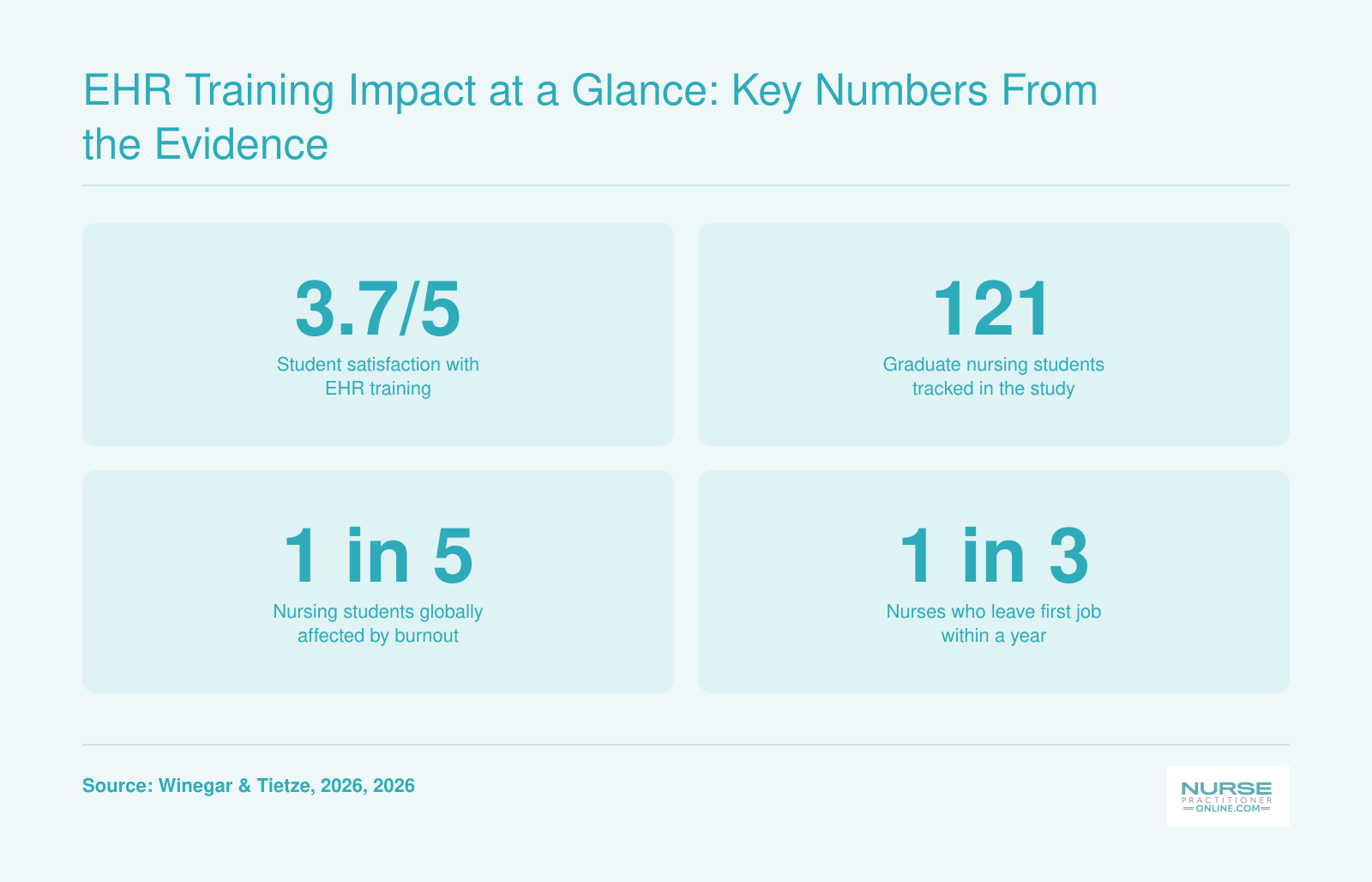
EHR Training Impact at a Glance: Key Numbers From the Evidence
A quick look at the numbers behind the connection between early EHR training and nurse practitioner burnout.
Preparing for AI and Ambient Listening in EHR Systems
The documentation workflow in primary care is shifting rapidly as ambient AI scribes move from pilot programs to standard practice. By 2026, 42% of medical group leaders reported adoption,1 and one-third of healthcare providers had access to tools such as Microsoft DAX Copilot, Abridge, and Suki.2 Uptake is accelerating: 50% of U.S. ambulatory clinics now use some form of AI tool,3 and at Mayo Clinic's primary care sites, half of clinicians have integrated ambient AI into their daily routine.4
The Shift from Data Entry to Clinical Oversight
These tools reduce the mechanical burden of typing, but they do not eliminate the need for EHR proficiency. Instead, they shift the skill set from data entry to verification, prompt management, and clinical oversight. A 2025 evaluation found that Abridge cut documentation time by 0.9 minutes per encounter; DAX shaved 0.76 minutes.5 Across a full day, clinicians saved 13.4 minutes on average, and nurses saved up to 30 minutes per shift.6 At Mass General Brigham, burnout prevalence dropped 21.2% among users.7 Yet these gains depend on a clinician's ability to critically review AI-generated notes, correct contextual errors, and manage the prompts that guide documentation. The technology introduces a new kind of cognitive load: the clinician becomes both a verifier and an editor, not just a recorder.
What This Means for NP Curricula
NP programs must evolve curricula to include AI-augmented EHR workflows, not just traditional EHR navigation. Early exposure to these tools, mirroring the UT Arlington study's finding that prior EHR experience builds confidence, can reduce technology-related stress before clinical rotations begin. Students need structured practice in reviewing and refining AI-scribed notes, understanding prompt engineering, and maintaining clinical judgment when a note is automatically populated. Northwestern Medicine reported a 112% return on investment and enough time savings to add five patient encounters per day,2 illustrating the potential for improved throughput and work-life balance. For new nurse practitioners and the educators who train them, integrating AI literacy into coursework ensures that graduates enter practice not only efficient in documentation but also fluent in the oversight that safe AI use demands. Keeping pace with these tools is one of the most practical nurse practitioner resources available to today's NP students.
Actionable Steps for NP Educators, Preceptors, and Students
Historically, EHR training has been an afterthought, squeezed into clinical rotations when students are already juggling patient loads and preceptor expectations. But the UT Arlington study flips that model: frontloading EHR skills in the first didactic semester builds confidence and dramatically reduces the technology-related stress that fuels burnout. The message is clear: early, structured exposure works. Here are concrete actions each role can take to make that shift.
For Educators: Embed EHR Training in the First Semester
Don't wait until clinicals. Introduce EHR concepts and hands-on practice in foundational courses. Use academic EHR platforms to simulate real-world charting, order entry, and clinical decision support. Start with documentation basics in semester one, then scaffold to more complex tasks like medication reconciliation and data interpretation. When students in Family I courses reported lower preparedness and greater frustration after a semester of simultaneous clinical and EHR learning, it underscored the need to separate skill-building from high-stakes patient encounters. A dedicated EHR module early on lets students build competence without the emotional weight of live clinical care.
For Preceptors: Request Competency Verification and Standardized Orientations
Before accepting an NP student, ask the program for an EHR skills checklist or competency verification. This simple step ensures that the learner arrives ready to document, retrieve results, and navigate the system, rather than fumbling while you're double-checking orders. Advocate for your clinical site to adopt a standardized EHR orientation protocol for all incoming students, one that covers site-specific templates, shortcuts, and safety alerts. When every student undergoes the same onboarding, preceptors spend less time troubleshooting and more time teaching advanced clinical reasoning, which protects your own job satisfaction and models efficient practice. If a placement isn't working despite these safeguards, knowing how to change clinical preceptors mid-program can also protect both parties.
For Students: Seek Early Hands-On Experience, Even Before Rotations
You don't need to wait for an instructor to grant you access. Many programs offer simulation training for nurse practitioner students in lab settings, so use those platforms repeatedly until charting becomes muscle memory. Seek out EHR-focused electives or workshops. During early observational hours, ask if you can have read-only access to explore the system layout, flow sheets, and common order sets. The study's Family II students, who had prior EHR exposure, reported significantly stronger preparedness; you can replicate that advantage by proactively building familiarity. Pairing EHR practice with solid NP student study habits gives you the best foundation to arrive at your first nurse practitioner clinical rotation focused on patients, not on clicking the right menus.
Frequently Asked Questions About EHR Training and NP Burnout
This FAQ addresses common questions about the link between electronic health record training and nurse practitioner burnout, drawing on a 2026 study from the University of Texas at Arlington. Discover how early EHR exposure can boost student confidence and reduce career stress.
- Does EHR training reduce nurse practitioner burnout?
- Yes. The 2026 Winegar and Tietze study at UT Arlington showed that integrating EHR training into coursework improved students' perceived preparedness and confidence. Those with prior EHR exposure reported significantly less frustration, indicating that early, hands-on training can mitigate the technology-related stress that contributes to NP burnout.
- What EHR skills should nurse practitioner students learn before clinical rotations?
- Students should focus on basic navigation, documentation, order entry, and clinical decision support tools. In the study, the Family II cohort, which had prior EHR exposure, demonstrated higher confidence and readiness. Hands-on practice with academic or simulated EHR platforms before NP clinical rotations is key to reducing the learning curve and frustration.
- How do electronic health records contribute to nursing burnout?
- The U.S. Surgeon General's 2022 advisory identified EHRs as a major burnout driver due to administrative burden and poor usability. The UT Arlington study found that novice EHR users experienced greater frustration and lower preparedness, underscoring how technology-related stress can fuel burnout in both NP students and practicing clinicians.
- How can NP programs integrate EHR training into their curriculum?
- Programs can embed EHR training in skills labs or didactic courses prior to clinical placements, as the UT Arlington study modeled. Using academic EHR platforms or simulation software lets students practice documentation and order entry safely, building confidence and easing the transition to real-world clinical settings. Understanding how hard NP school is can help students mentally prepare for that technology learning curve before rotations begin.
- What is the link between EHR usability and nurse practitioner job satisfaction?
- Poor EHR usability causes inefficiency and frustration, eroding job satisfaction. The study suggests that when students feel prepared and confident with EHRs, their clinical experiences improve. This can lead to greater career satisfaction and retention, as reduced technology stress enhances the overall work environment for nurse practitioners. Programs that also consider NP residency programs as a bridge to practice may further ease that transition.
Related Articles
Is your NP program's EHR training timeline setting students up for success, or burnout? The Winegar and Tietze study confirms what many preceptors suspected: when students arrive without foundational EHR skills, frustration and stress follow, for students and the clinicians supervising them. With 42% of medical groups now adopting ambient AI scribes, the documentation landscape is only growing more complex. Programs that delay EHR integration will widen the preparedness gap. Take stock of when your curriculum introduces hands-on EHR practice and how you collect preceptor feedback. The evidence is clear, and the advanced nursing practice expanding role of NPs makes that evidence impossible to ignore: early EHR training is a burnout prevention tool we can use today.