Most important takeaways…
- Active recall testing retains roughly 80% of material after one week, compared to just 34% for passive re-reading.
- ACNP programs carry the highest acute clinical intensity, while FNP programs demand the broadest diagnostic knowledge across the lifespan.
- Refreshing pharmacology and advanced pathophysiology before your first semester measurably smooths the transition into NP coursework.
- Treating study time as a non-negotiable, scheduled block each week is the single habit that most reliably prevents falling behind.
Most nurses who finish NP school say the same thing afterward: it was harder than expected, but not in the way they expected. The volume, the clinical reasoning demands, the shift from task-based to diagnostic thinking, none of that shows up clearly in a program brochure.
The question driving most readers here is a practical one: how hard is NP school, really? Not a motivational answer, an honest one. The difficulty is real and varies by specialty, course load, and how many clinical hours you're juggling alongside work.
This letter-style breakdown pulls from what new-grad NPs consistently say they wish they had known earlier. Passing boards does not guarantee you feel prepared on day one of practice, and that gap starts forming well before graduation. If you're still weighing program options, learning how to enroll in NP school online can help you take the first concrete step.
How Hard Is NP School, Really?
How hard is NP school compared to your BSN program, your current nursing job, or anything else you've tackled in your career? The honest answer is that difficulty sits on a spectrum shaped by three forces: academic rigor, clinical demands, and the emotional toll of juggling it all while keeping your life intact.
Academic Rigor: Graduate-Level Critical Thinking
NP school is harder than most BSN programs because the bar shifts from memorization and task mastery to synthesizing evidence, diagnosing independently, and making clinical decisions without someone double-checking your orders. You'll interpret labs, prescribe pharmacotherapy, and defend your clinical reasoning in discussion posts and case presentations. The content volume feels manageable week to week, but the cognitive load is cumulative. You're building a diagnostic framework, not cramming for a med-surg final.
First-time board pass rates give us a concrete measure of that academic bar. In 2025, the AANP reported an 81 percent first-time pass rate for the Family Nurse Practitioner exam, 82 percent for the Psychiatric-Mental Health NP exam, and 85 percent for both the Adult-Gerontology Primary Care NP and Emergency NP exams.1 ANCC figures from 2024 show similar numbers: 83 percent for FNP-BC and PMHNP-BC, and 85 percent for AGPCNP-BC.1 Those pass rates tell you that the majority of students who finish their programs do pass on the first attempt, but roughly one in five does not. The exams are passable, but they require disciplined preparation and a solid grasp of advanced pathophysiology, pharmacology, and clinical guidelines.
Clinical Demands: 500 to 1,000-Plus Hours
Most NP programs require between 500 and 1,000 clinical hours, depending on specialty and whether you're pursuing an MSN or DNP. Family and adult-gerontology tracks typically land around 600 to 720 hours. Acute care programs often push past 700. Those hours happen on top of your didactic coursework and, for many students, a part-time or full-time nursing job. Securing preceptors, coordinating schedules, and driving to clinical sites adds logistical friction that textbooks never mention. Clinical rotations are where many students feel the weight of NP school most acutely.
The Emotional and Logistical Toll
Attrition in graduate nursing programs hovers around 10 to 20 percent, and the reasons are rarely academic failure. Students withdraw because of preceptor shortages, family emergencies, financial strain, or burnout from balancing work, school, and home. The psychological load of transitioning from expert bedside nurse to novice provider while managing imposter syndrome is real and often underestimated.
DNP programs add a scholarly project and typically 30 to 40 more credit hours than MSN programs, but the clinical intensity remains comparable. The DNP workload is heavier overall, but it doesn't fundamentally change the day-to-day challenge of mastering advanced practice.
The Bottom Line
NP school is harder than BSN school. It demands more autonomy, deeper critical thinking, and better time management. But it's also designed to be completable by working nurses who show up consistently, ask for help when stuck, and protect their study time. The pass rates and completion data show that most students who commit to the process make it through. The question isn't whether you can handle it. It's whether you're ready to reorganize your life around it for the next two to three years.
NP School Vs. BSN Nursing School: What Actually Changes
If you're feeling unsettled as you transition from BSN to NP coursework, you're not imagining things. The shift is real, and it's structural, not just a pile of extra reading. Understanding what actually changes helps you anticipate the demands and pace yourself.
Content Depth and Clinical Reasoning
BSN programs focused on recognizing diseases, executing orders, and safe care delivery. NP school reframes every patient encounter around differential diagnosis, evidence-based management, and independent decision-making. You're no longer learning to follow a plan; you're learning to create it. The curriculum dives deeper into pathophysiology, pharmacology, and clinical guidelines, assuming you already have a working nurse's grasp of anatomy, assessments, and common treatments. If your foundational knowledge feels rusty, you'll need to self-review early, because programs won't pause to reteach it. Exploring best online MSN nurse practitioner programs ahead of time can help you gauge the rigor of different curricula.
Clinical Autonomy and Responsibility
In BSN clinicals, your preceptor guided each step; in NP rotations, you gradually take the lead. You'll interpret labs, prescribe medications, and communicate diagnoses, all under supervision, but with far greater accountability. That leap from doer to decision-maker is the most jarring and rewarding part of the NP journey.
Workload: Study Hours and Clinical Hours
- Study hours: Expect to invest 15 to 25 hours weekly outside of clinical, often double what you spent in a BSN. The material demands synthesis, not just memorization.
- Clinical hours: While BSN programs typically incorporate 600 to 900 total clinical hours, NP programs layer on an additional 500 to 780 hours of graduate-level precepted practice.1 Accreditation standards (CCNE, ACEN) set the floor at 500 hours2, with many FNP tracks reaching 540 to 780 hours depending on the program.3 Those hours are tightly structured and require ongoing case logs and reflective assignments.
Class Environment and Grading
Undergraduate lectures in large halls give way to small, cohort-based graduate seminars. Peers are experienced nurses who raise the bar for discussion. Grading reflects the heightened expectations: most NP programs require a B or higher to pass, and anything below a B often triggers remediation or dismissal. The standards aren't punitive; they mirror the clinical accountability you'll carry as a provider.
Questions to Ask Yourself
The Hardest Courses in NP Programs, and Why They Trip Students Up
Most NP students expect graduate school to be harder than their BSN program. What catches them off guard is how the difficulty is different, not just greater. The courses below are the ones that consistently humble otherwise strong students, and understanding why they're hard before you start gives you a real advantage.
Advanced Pharmacology
This is the course most students cite first when asked what nearly broke them. The surprise is not the volume, though there is plenty of it. The surprise is the shift in your role. As a bedside nurse, someone else chose the drug and the dose. In advanced pharmacology, you are now the one choosing, dosing, and defending that decision based on the patient's comorbidities, renal function, current medications, and cost. You are learning prescribing logic, not just drug facts. Many students find that nurse practitioner apps for drug references become indispensable study companions during this course.
Quick tip: pharmacology rewards spaced repetition over marathon cramming. More on that in the study-tips section below.
Advanced Pathophysiology
Students who expect a deeper anatomy review are in for a shock. Advanced pathophysiology asks you to think at a systems level, tracing how one dysregulated mechanism cascades across the body. Why does heart failure cause pulmonary congestion? Why does that same fluid shift affect kidney perfusion? You need to see the chain, not just memorize the links.
Quick tip: concept mapping, where you draw the connections between mechanisms, helps far more here than re-reading your notes.
Advanced Health Assessment
This course pairs clinical skills with real-time reasoning under pressure. You are not just learning to perform an exam correctly. You are expected to interpret findings and generate a preliminary differential on the spot, often during an observed clinical evaluation. The time pressure alone trips up students who are clinically competent but not yet practiced at thinking out loud.
Quick tip: treat every clinical encounter as a teaching opportunity and narrate your reasoning to your preceptor, even informally.
Secondary Courses Worth Noting
Three additional courses round out the list of common stumbling blocks:
- Differential Diagnosis: Requires synthesizing pathophysiology, assessment, and pharmacology simultaneously, which is why most programs place it later in the curriculum.
- Evidence-Based Practice and Research Methods: The statistics and study-design content feels disconnected from clinical work until you hit your scholarly project, at which point it becomes urgent.
- The DNP Scholarly Project: For DNP students, this is less a course than a years-long commitment. Scope creep and committee scheduling are the two things that delay completion most often. If you are weighing whether to pursue the DNP path, understanding the DNP prerequisites early can help you plan ahead.
None of these courses are designed to weed you out. They are designed to build the kind of thinking a safe, independent provider needs. Knowing that going in changes how you approach them.
Study Tips for Didactic Coursework: What Actually Works
Research in health professions education shows that active recall testing yields 80% retention after one week, compared to just 34% for passive re-reading.1 In NP school, didactic coursework demands more than memorization: it tests your ability to apply advanced concepts to patient scenarios. The study habits that got you through a BSN program often fall short here because exams ask you to synthesize pharmacology, pathophysiology, and clinical guidelines, not simply recognize facts.
Switch from Recognition to Application
The biggest mistake new NP students make is relying on re-reading notes and highlighting textbooks. These passive methods create a false sense of mastery, but retention plummets under exam pressure. At the graduate level, you must actively retrieve information and use it to solve clinical problems. If your study session feels comfortable, you likely are not learning at the depth required.
Evidence-Based Strategies: Spaced Repetition and Active Recall
- Spaced repetition: Review material at expanding intervals, with ideal windows at 1, 3-7, 11, and 14-25 days after initial learning.1 Use apps like Anki for pharmacology decks. The algorithm prompts you just before you would forget, strengthening long-term memory.
- Active recall: Close the book and explain a concept aloud, draw a concept map, or answer practice questions without looking at choices first. Nursing education research consistently ties these techniques to higher exam scores and faster clinical reasoning.
- Concept mapping: Especially valuable for pathophysiology. Map out disease processes, linking etiology, symptoms, diagnostics, and treatments. This builds the mental frameworks you will need to connect signs to differentials in practice.
Integrate Board-Review Resources Early
Do not wait until graduation to open a board-review question bank. Resources like the Hollier or Leik review books pair perfectly with coursework. Use them to test yourself on the same body systems you are studying in class. Pharmacology apps that offer drug-card drills or interactive quizzes help front-load the memorization that compounds across every course. Once you begin clinical rotations, understanding nurse practitioner licensing requirements early can also shape how you prioritize board-prep topics. A study group structured around case-based discussion, where each member presents a patient scenario and the group works through assessment and plan, turns passive review into active, collaborative learning.
Time Management: Front-Load and Block Study
For every credit hour, block 2-3 hours of focused study per week. If you are taking 6 credits, that is 12-18 hours of deliberate practice. Prioritize pharmacology early because it reappears in every subsequent class. Even 20 minutes of daily drug review will prevent a frantic cram session before your first big exam.
A study published on PubMed Central found that 55% of graduate healthcare students in the U.S. reported experiencing burnout symptoms, a striking reminder that the struggle is real and widespread. If you are feeling overwhelmed in NP school, you are far from alone.
Clinical Rotation Study Tips: How to Learn on the Floor
Clinical rotations are the hands-on phase of your NP program where you transition from the classroom to direct patient care, working alongside a preceptor in a real-world setting. This is where textbook knowledge meets clinical judgment, and the learning curve can feel steep. The key is to show up prepared, stay curious, and treat every shift as an opportunity to grow. For a deeper look at what's expected of you during this phase, check out our guide on NP student clinical rotations.
Pre-Clinical Preparation: Lay the Groundwork
Don't walk into a rotation cold. Before your first day, identify the top 10 diagnoses you're most likely to encounter in that specialty. For family practice, that might include hypertension, diabetes, hyperlipidemia, upper respiratory infections, and well-woman exams. Create a pocket reference, either a small notebook or a note on your phone, with a differential-diagnosis framework for common presentations. For example, under "chest pain" include cardiac, pulmonary, GI, and musculoskeletal causes with key distinguishing features. This mental scaffolding lets you focus on clinical nuances rather than scrambling to remember possibilities. Also review the pertinent physical exam: know the proper technique for a thyroid exam before your endocrinology rotation, or how to perform a thorough neurological assessment before your neurology clinic.
The Preceptor Puzzle: Finding Yours Early
One of the hardest logistics in NP school is securing preceptors, and many programs expect you to find your own. Start networking at least 6 months before your rotation begins. Reach out to colleagues, former instructors, and local alumni; a warm introduction often works better than a cold call. Contact your state's NP professional organization, as they frequently maintain member directories or can connect you with potential preceptors. If you're in an online program, our article on how online NP students arrange local clinical placements offers additional strategies. Finally, ask your program's clinical coordinator for a list of alumni who have previously precepted. When you do reach out, be professional and specific: explain your rotation dates and objectives, and offer a brief CV. Persistence pays off, so follow up politely if you don't hear back.
Reflect Daily: The Case Write-Up Habit
After each shift, write up one or two patient encounters in SOAP format. This habit cements clinical reasoning and mirrors the pattern recognition tested on board exams. Choose cases that challenged you or taught you something new. Then, look up one thing you didn't know during the day, whether it's a medication side effect, a diagnostic criterion, or a management guideline. Over time, these small daily nuggets accumulate into a robust clinical knowledge base. Keep your write-ups concise and organized; you'll thank yourself when studying for the certification exam.
Specialty-Specific Tips for Common Rotations
- FNP Rotations: Focus on bread-and-butter primary care. Master the JNC 8 hypertension guidelines, ADA diabetes standards, and IDSA treatment for common infections like strep pharyngitis and uncomplicated UTI. Practice motivational interviewing for lifestyle changes.
- PMHNP Rotations: Drill structured psychiatric interviews using tools like the Mini-International Neuropsychiatric Interview (MINI). Hone your mental status exam and suicide risk assessment. Learn to differentiate overlapping psychiatric symptoms.
- ACNP Rotations: Spend time on ventilator management variables, including modes, tidal volumes, and weaning protocols. Become fluent in interpreting hemodynamic parameters (CVP, PAOP, cardiac output) and recognizing early signs of shock or respiratory failure.
How to Prepare for NP School Before You Start
Some students show up to the first day of NP school having reviewed nothing, trusting they'll catch up. Others spend the summer beforehand quietly rebuilding their academic foundation. The second group has a noticeably easier first semester. You don't need to be perfectly prepared, but a few months of intentional prep will save you from drowning during your first round of exams.
Rebuild Your Academic Foundation
Most working nurses haven't touched a pharmacology textbook in years. Before classes start, spend a few hours a week refreshing the basics so advanced content has somewhere to land. If you're considering a doctoral track, reviewing DNP prerequisites early can also help you map out which foundational courses to prioritize.
- Anatomy and physiology: Khan Academy's free A&P series and OpenStax's open-access Anatomy and Physiology textbook are both solid. Focus on cardiac, pulmonary, renal, and neuro systems.
- Pharmacology basics: Review drug classes, mechanisms of action, and major adverse effects. You don't need to memorize doses yet, just rebuild the framework.
- Pathophysiology: If your BSN program glossed over path, this is the time to fill those gaps. It is the connective tissue of every NP course.
Set Up Your Tools Before Week One
Figuring out your study system while assignments are already due is brutal. Get the logistics handled in advance.
- Study space: A dedicated desk, decent lighting, and a door that closes. Working from the couch will not scale.
- Tablet for annotation: A used iPad with a stylus pays for itself in PDF markups, lecture notes, and clinical references.
- Clinical reference apps: Download UpToDate (often free through your school) and Epocrates. You will use both constantly in clinicals.
- Organizational system: Pick one and commit. Notion, OneNote, or a physical binder all work. The system that works is the one you actually open.
Prepare Your Mind, Money, and People
The non-academic prep matters just as much. Reach out to two or three recent NP graduates and ask them what surprised them. Their honest answers will recalibrate your expectations.
Accept now that you will feel like a novice again. Imposter syndrome hits nearly every NP student, especially experienced RNs who are used to feeling competent. That discomfort is the cost of growth, not a sign you don't belong.
Financially, drop to part-time work if you can, build a three-month expense buffer, and have direct conversations with your family and employer about what the next two to three years will look like. Understanding how long a DNP program takes can help you set realistic timelines for those conversations. The people around you cannot support a plan they don't know about.
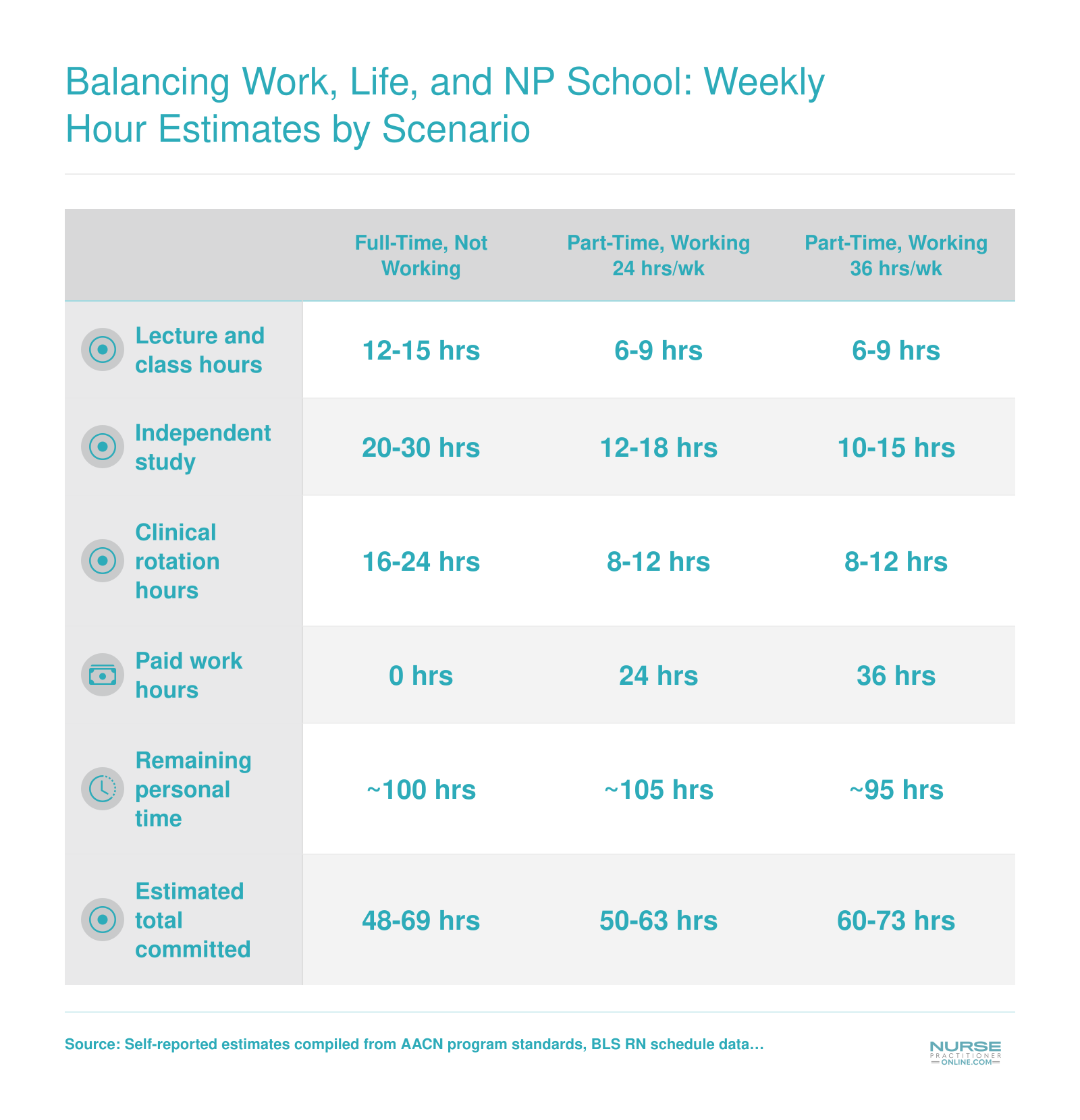
Balancing Work, Life, and NP School: Weekly Hour Estimates by Scenario
No single source publishes definitive weekly hour breakdowns for every NP program, but you can build a realistic estimate by combining your program handbook, BLS data on RN work schedules, and self-reported figures from nursing forums like allnurses.com and Reddit's r/nursepractitioner. Use this formula as a starting point: multiply your credit load by roughly 3 hours of study per lecture hour, then layer in clinical hours and any lab or orientation requirements listed in your program's accreditation documents (check AACN standards and your state board of nursing).
From NP Student to New Grad NP: What to Expect After Graduation
Most new graduate NPs report feeling underprepared during their first year in practice, even after passing boards, even after completing hundreds of clinical hours. That feeling is not a sign something went wrong. It is a predictable stage, and knowing it is coming makes it far easier to navigate.
The Post-Graduation Gauntlet
Before you see a single patient as a licensed NP, a sequence of administrative steps stands between you and practice. Board exam prep alone deserves four to eight weeks of dedicated, structured review after graduation. Beyond that, state licensing timelines vary widely, DEA registration takes additional weeks, and credentialing with hospitals or insurance panels can lag months behind your start date. The practical reality: many new grads go several weeks without income during this window. Budget for it now, while you are still a student, so it does not blindside you later.
A rough sequence to expect:
- Board prep: Four to eight weeks of focused review using practice question banks and content review courses.
- State licensure: Timelines range from a few weeks to several months depending on your state and application completeness.
- DEA registration: Plan for several weeks after submitting your application.
- Credentialing: Insurance credentialing alone can take sixty to ninety days, sometimes longer.
Choosing Your First Practice Setting Wisely
Where you land your first NP job shapes the trajectory of your early career more than almost any other decision. Seek a position that offers structured mentorship, a collaborative practice agreement with an experienced physician or NP, or both. Avoid solo or independent practice during your first year if you can. This is not about whether you are capable. It is about having a built-in resource when a clinical question is genuinely hard, and hard questions will come daily at first.
Many new grads underestimate how quickly confidence builds once they are seeing patients every day. The pace of learning in active practice is steep in the best possible way. As you gain experience, you may also discover nurse practitioner advancement opportunities that align with your evolving clinical interests.
The Study Habits You Built Will Carry You
Everything you developed in NP school (the habit of looking things up before acting, synthesizing information quickly, reviewing guidelines, translating research into practice decisions) is exactly what the NP role demands for an entire career. Continuing education requirements, evolving clinical guidelines, and expanding scopes of practice mean the learning never fully stops. The students who thrive in school tend to thrive in practice for the same reasons: curiosity, discipline, and a comfort with not knowing everything yet.
The transition is genuinely hard. It is also temporary. Most NPs report that the first year feels overwhelming and the second year feels like a turning point. Trust the process, find good mentors, and keep studying.
Frequently Asked Questions About NP School
These are the questions I hear most often from nurses thinking about NP programs, and the ones I asked myself before I started. The short answers below should point you toward reliable sources so you can make confident decisions about your own path.
- How long does NP school take, and does it vary by degree type?
- It depends on whether you pursue an MSN or a DNP, and whether you attend full time or part time. According to the American Association of Colleges of Nursing (AACN), a typical MSN program runs about two to three years full time, while a DNP program generally takes three to four years full time. Part-time tracks stretch those timelines further. Credit requirements also differ by school and specialty, so the best move is to check the official program website for the exact curriculum length, clinical hour requirements, and credit totals before you commit.
- How hard is NP school compared to nursing school?
- Most graduates, myself included, say it is a significant step up. BSN programs focus on foundational nursing skills, while NP programs demand advanced pathophysiology, pharmacology, and diagnostic reasoning at a level that requires independent clinical decision making. Weekly study hours are not standardized across programs, but informal surveys and nursing forum discussions suggest that many students spend 15 to 25 hours per week on coursework and study outside of class, sometimes more during clinical rotations. Because individual experiences vary widely, searching nursing forums or reading program reviews from current students can give you a realistic picture of the workload at a specific school.
- Can you work full time while in NP school?
- Some students do, but it is genuinely challenging. Many programs recommend reducing work hours during clinical semesters. Professional associations like the American Association of Nurse Practitioners (AANP) and the National Organization of Nurse Practitioner Faculties (NONPF) offer resources on work-life balance and strategies for managing school alongside employment. Reaching out to those organizations, or connecting with their online communities, can help you gauge whether full-time work is feasible given the specific program format you are considering.
- How many hours a week do NP students study?
- There is no single answer because programs, specialties, and individual study habits vary. That said, nursing education literature offers some useful benchmarks. Searching academic databases such as PubMed or CINAHL with terms like 'NP student workload' or 'graduate nursing time commitment' can surface surveys and studies that report actual hour ranges from real cohorts. In my own experience, I averaged around 20 hours of study and prep per week during didactic semesters and closer to 30 during clinical rotations when you factor in chart review, case preparation, and journaling.
- What is the job outlook and salary range for nurse practitioners?
- The Bureau of Labor Statistics (BLS.gov) is the most reliable public source for general NP employment projections and median salary data, and the outlook has been strong for several years. Keep in mind, though, that BLS figures represent national medians. Your actual earnings and job availability will vary by specialty, geographic region, practice setting, and experience. For the most current numbers, visit the BLS Occupational Outlook Handbook page for nurse practitioners directly.
- How do you prepare for NP school before classes start?
- Start by refreshing your knowledge of pathophysiology and pharmacology, since those subjects form the backbone of early coursework. Build strong study habits now: practice active recall, set up a distraction-free workspace, and experiment with scheduling blocks of focused study time around your shifts. If you want a deeper look at what current research says about graduate nursing workloads, academic databases like PubMed and CINAHL are great places to search for evidence-based strategies. And do not underestimate the value of connecting with NP students or recent graduates through professional associations or social media groups. Their firsthand tips were some of the most useful guidance I received before day one.
NP school is hard, but it's finite, and every practicing NP once felt exactly where you are now: overwhelmed by the volume, unsure if their study methods would hold up, wondering if they had what it takes. The strategies in this article are what actually worked: active recall for didactic coursework, pre-charting before clinical shifts, and treating study time like a non-negotiable clinical shift.
Pick one study tip from this article and implement it this week. Not all of them, just one. Build the habit, see the result, then layer in the next. You've got this. Now go study.