Most important takeaways…
- Pennsylvania offers AGACNP pathways at the MSN, post-master certificate, and BSN-to-DNP levels, all with substantial online coursework.
- Tuition per credit varies widely across PA programs, so comparing total cost including fees is essential before applying.
- Most programs require on-campus intensives or simulation days, meaning few are fully online with zero travel.
- Philadelphia-area NPs earn a mean annual wage near $121,610, with statewide medians even higher for experienced practitioners.
Pennsylvania hospital systems added acute care NP positions faster than any other advanced practice role over the past five years, driven by ICU expansion, hospitalist shortages, and ACGME residency restrictions that limit resident physician hours. The result: AGACNP-credentialed nurses are consistently among the first hires when health systems in Philadelphia, Pittsburgh, and mid-state grow their critical care floors.
The state has multiple online and hybrid AGACNP pathways, ranging from post-master's certificates to full BSN-to-DNP tracks. Format clarity matters here. A program marketed as fully online may still require campus simulation days, and cost differences between programs can exceed $30,000 in total tuition. If you are comparing acute care nurse practitioner programs nationally, Pennsylvania's options hold up well on both flexibility and outcomes.
One practical constraint shapes most decisions: AGACNP certification is population- and acuity-specific. Graduates cannot pivot to primary care without additional credentialing, which means program selection carries long-term career weight that a general NP track does not.
Frequently Asked Questions About Online AGACNP Programs in Pennsylvania
Choosing an online Adult-Gerontology Acute Care Nurse Practitioner program is a big decision, and the details matter. Below are answers to the questions working nurses ask most often about AGACNP education, clinical requirements, and practice in Pennsylvania.
- How many clinical hours are required for online ACNP programs in Pennsylvania?
- Most accredited AGACNP programs require between 500 and 750 direct patient care hours before graduation. The exact number depends on the university and its accrediting body. These hours must be completed in acute care settings, and many online programs expect students to secure placements near their home location, though some offer clinical placement support.
- What is the difference between AGACNP and AGPCNP programs?
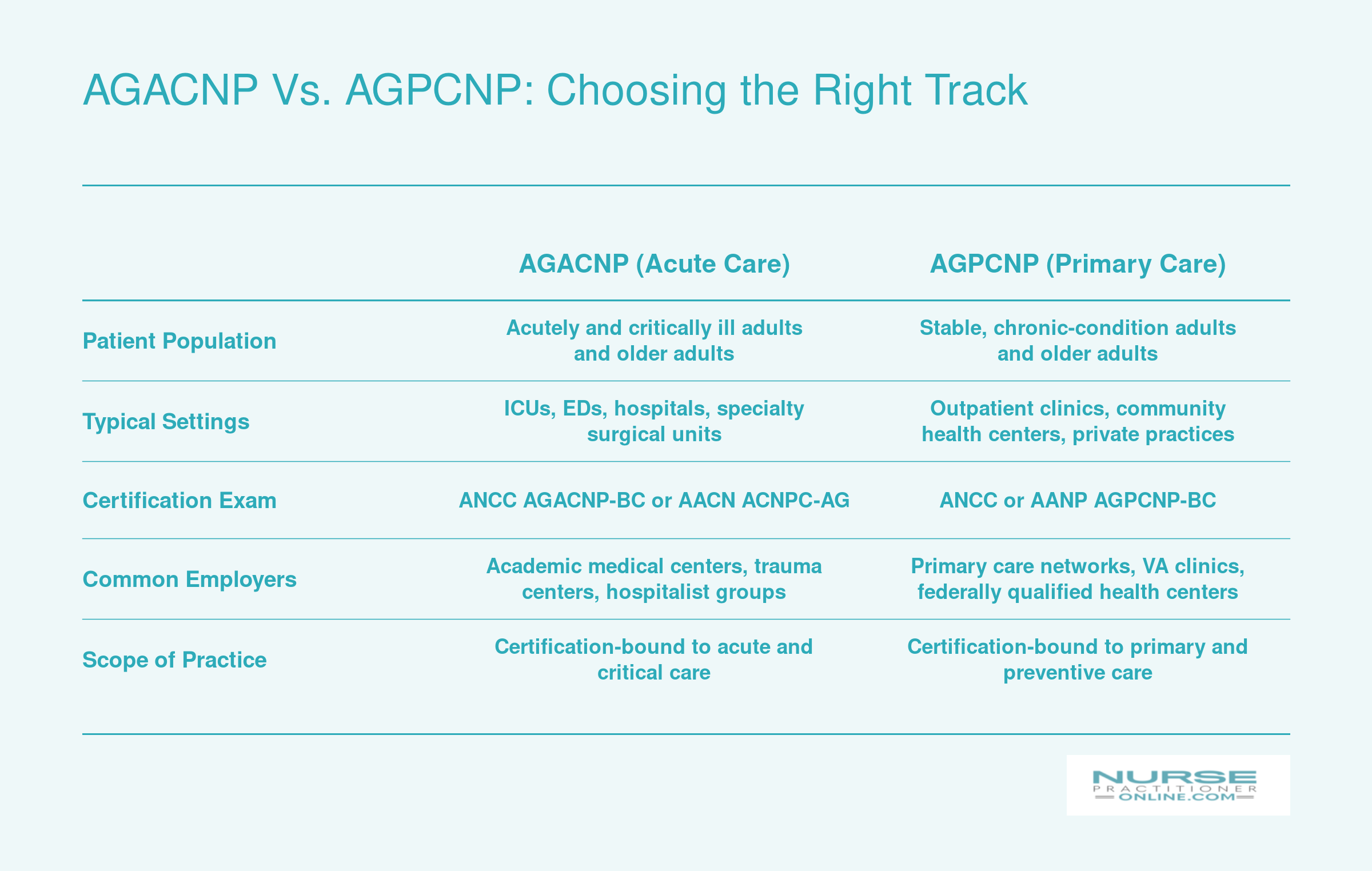
- AGACNP programs prepare you to manage acutely and critically ill adult and older adult patients in settings like ICUs, emergency departments, and surgical units. AGPCNP (Adult-Gerontology Primary Care NP) programs focus on chronic disease management, preventive care, and wellness in outpatient settings. The two tracks lead to different certification exams and distinct scopes of practice, so your clinical interests should guide your choice.
- What certification exams can AGACNP graduates take?
- Graduates of an accredited AGACNP program are eligible to sit for two national certification exams: the ANCC Adult-Gerontology Acute Care Nurse Practitioner board certification and the AACN's ACNPC-AG (Acute Care Nurse Practitioner Certification for Adult-Gerontology). Either credential satisfies Pennsylvania's requirement for CRNP licensure in the adult-gerontology acute care population focus.
- How long does it take to complete an online acute care nurse practitioner program?
- For BSN-prepared nurses, most online AGACNP master's programs take two to three years of full-time study. Part-time options can extend that to three or four years. Post-master's certificate programs for nurses who already hold an NP credential in another specialty are typically shorter, often around 12 to 18 months depending on how many clinical hours you need to complete.
- Can AGACNP-certified nurse practitioners work remotely or via telehealth?
- Yes. Pennsylvania law permits CRNPs to deliver telehealth services, including synchronous, asynchronous, and remote patient monitoring. The standard of care is the same as for in-person visits, and insurers must cover medically necessary telemedicine services. However, you still need a collaborative agreement with a physician, and if your patient is located in another state, you must hold NP licensure in that state as well.
- Do Pennsylvania AGACNP graduates need to complete additional state licensure steps beyond national certification?
- Yes. After passing a national certification exam (ANCC or AACN ACNPC-AG), you must apply for CRNP licensure through the Pennsylvania State Board of Nursing. You will also need to establish a collaborative agreement with a physician. Pennsylvania requires this agreement throughout your entire career as a CRNP, covering areas such as physician availability, emergency coverage, chart review, and prescribing parameters for Schedule II through V medications.
- Are there post-master's AGACNP certificate options for current NPs in Pennsylvania?
- Several Pennsylvania universities offer post-master's AGACNP certificates designed for nurses who already hold an NP credential in another population focus. These programs let you add acute care certification without repeating a full master's degree. You will still need to complete the required clinical hours in acute care settings and pass a national certification exam before applying for a new population focus designation on your CRNP license.
- What types of clinical sites count toward AGACNP clinical hours?
- Clinical hours must be completed in settings where you manage acutely or critically ill adult and older adult patients. Acceptable sites typically include intensive care units, step-down units, emergency departments, cardiac care units, and inpatient surgical services. Outpatient primary care clinics generally do not count toward AGACNP requirements. Check with your specific program for its approved site list and any preceptor credentialing requirements.
Best Online ACNP Programs in Pennsylvania, 2026 Rankings
We evaluated Pennsylvania's online AGACNP offerings using a composite that weights online delivery alongside graduation rates, graduate earnings, and net price to surface programs that combine accessibility with institutional quality. The list below spans graduate certificates, MSN tracks, and BSN-to-DNP pathways, so you can find the entry point that fits your current credentials and career goals.
- Online delivery accessibility
- Institutional graduation rate
- Graduate earnings outcomes
- Net price and affordability
- Clinical placement support
- NCES-IPEDS federal institutional data — nces.ed.gov
- College Scorecard graduate earnings — collegescorecard.ed.gov
- Independent program research
- Internal program database

University of Pennsylvania
The University of Pennsylvania pairs an elite nursing school reputation with a surprisingly nimble online AGACNP pathway. Its post-graduate certificate lets primary care NPs add acute care certification in about 12 months, while the hybrid MSN offers clinical concentrations in cardiology, trauma, general surgery, transplant, nephrology, and internal medicine. Penn's clinical team handles preceptor matching across the Penn Health System and other major mid-Atlantic hospitals, a significant advantage for working nurses who cannot spend weeks cold-calling sites.
- Online format with 12-month, part-time completion
- Requires BSN, MSN, and active APRN licensure
- Minimum 3.0 GPA and three months APRN experience
- Tuition approximately $7,178 per credit unit
- Year-round start semesters available
- No federal aid, but alternative loans and payment plans offered
- Prepares for national AGACNP certification exam
- Hybrid format requiring 12 course units
- Concentrations in cardiology, trauma, surgery, transplant, nephrology, internal medicine
- Immersive simulation technology and mentored clinical experience
- Full-time and part-time scheduling options
- Preceptor matching provided by Penn Nursing
- Elective minors in oncology, palliative care, forensics, and global health
Streamlined Post Graduate APRN Adult Gerontology Acute Care NP Certificate — Online
Adult Gerontology Acute Care Nurse Practitioner, MSN — Hybrid

University of Pittsburgh-Pittsburgh
The University of Pittsburgh offers a BSN-to-DNP pathway that bundles 79 credits and 1,020 clinical hours into one of the most comprehensive AGACNP curricula in the state. Synchronous online courses let you attend from anywhere in Pennsylvania, while a clinical emphasis directed study lets you customize rotations in areas like internal medicine. The program prepares graduates for both ANCC and AACN certification and Pennsylvania CRNP licensure. In-state tuition of roughly $27,580 per year makes Pitt one of the more affordable research-university options on this list.
- 79 total credit hours with full-time and part-time options
- 1,020 clinical hours including directed study elective
- Synchronous online courses with select on-campus components
- DNP scholarly project required for graduation
- Clinical emphasis areas such as internal medicine available
- Prepares for ANCC or AACN certification and PA CRNP licensure
- In-state tuition approximately $27,580 per year
Adult Gerontology Acute Care Nurse Practitioner, DNP — Hybrid

Drexel University
Drexel University runs both an online MSN and a post-graduate certificate in AGACNP, giving nurses two distinct entry points depending on their existing credentials. The quarter-based calendar (four 10-week terms per year) is especially friendly for acute care nurses juggling rotating shifts. The MSN track requires 57 credits and 800 clinical hours, while the certificate compresses to 29 credits and can be finished in about one year part-time. Both are approved by the Pennsylvania State Board of Nursing and accredited by CCNE.
- Online format with synchronous lectures and mandatory intensives
- 57 credits and 800 clinical hours required
- BSN with 3.0 GPA and two years acute care experience needed
- Quarter-based calendar with four terms per year
- Approved by Pennsylvania State Board of Nursing
- Eligible for ANCC and AACN certification exams
- Online delivery with mandatory on-campus or virtual intensives
- 29 credits, completable in one year part-time
- Master's in nursing with 3.5 GPA required for admission
- Gap analysis may reduce required coursework
- Pennsylvania RN licensure and two professional references needed
- CCNE accredited with focus on diagnostic reasoning
Adult Gerontology Acute Care Nurse Practitioner, MSN — Online
Adult Gerontology Acute Care Nurse Practitioner Post-Graduate Certificate — Online

Cedar Crest College
Cedar Crest College offers a hybrid DNP and an online BSN-to-DNP in AGACNP, both anchored by a multimillion-dollar simulation center in the Lehigh Valley. Dedicated clinical placement support sets Cedar Crest apart from programs that ask students to find their own preceptors, and flexible entry every semester means you do not have to wait months to start. With 728 clinical hours and built-in board exam preparation, the program is designed to move you from enrollment to certification efficiently.
- Hybrid format with 728 clinical hours and capstone project
- CCNE accredited with starts in fall, spring, and summer
- Dedicated clinical placement support provided
- Multimillion-dollar simulation center in Lehigh Valley
- 3.0 GPA minimum; no prior clinical experience required
- Built-in board exam preparation included
- Primarily online with a two-day campus immersion
- Clinical residency and evidence-based practice emphasis
- Flexible scheduling designed for working professionals
- Prepares for national AGACNP certification
- Eligible for practice in acute care settings upon graduation
- Asynchronous coursework accommodates shift schedules
Adult Gerontology Acute Care Nurse Practitioner, DNP — Hybrid
BSN to DNP Adult Gerontology Acute Care Nurse Practitioner — Online

DeSales University
DeSales University delivers a fully online MSN and a hybrid BSN-to-DNP in AGACNP, both distinguished by a hands-on gross anatomy lab that most online programs simply cannot match. The MSN track reports a 99.5% certification pass rate, a standout metric for nurses who want confidence before sitting for boards. The DNP pathway adds 1,200 clinical and residency hours along with a scholarly project, making it a strong option for nurses who want to earn their terminal degree in one continuous arc.
- 100% online flexible format with advanced clinical practicum
- Hands-on gross anatomy lab experience included
- 99.5% certification pass rate reported
- Specialized acute care training for adult and geriatric populations
- Tuition approximately $22,375 per year
- Designed for experienced registered nurses
- Hybrid format totaling 76 credits
- 1,200 clinical and residency hours required
- Includes DNP scholarly project
- Covers advanced assessment, pathophysiology, and pharmacology
- Leadership, informatics, and evidence-based practice coursework
- Health outcomes management and translational research emphasis
Adult Gerontology Acute Care Nurse Practitioner, MSN — Online
BSN-DNP Track Adult Gerontology Acute Care Nurse Practitioner — Online

Widener University
Widener University's hybrid MSN in AGACNP is built around a tight 45-credit curriculum with 750 clinical hours spread across three practicum courses of 250 hours each. The program targets the full adult lifespan, from young adults to frail older adults with complex chronic illness, and prepares graduates for both ANCC and AANP certification exams. Located in Chester, just outside Philadelphia, Widener draws on the region's dense network of acute care hospitals for clinical rotations.
- Hybrid format with 45 total credits
- 750 clinical hours across three practicum courses
- 27 core credits and 18 specialty credits
- Eligible for ANCC and AANP certification exams
- Courses in advanced pathophysiology, pharmacology, and health assessment
- Focus on diagnostic reasoning and management of unstable patients
- Covers health care finance, policy, and informatics
Adult Gerontology Acute Care Nurse Practitioner, MSN — Hybrid

Pennsylvania State University
Penn State's World Campus makes its AGACNP programs accessible to nurses anywhere in Pennsylvania without relocating. The 19-credit graduate certificate suits NPs who already hold an MSN and want to add acute care scope, while the DNP pathway is a three-year program with rolling admissions and access to more than 700 clinical partners. Individualized study plans and a clinical placement team help online students coordinate rotations around existing work schedules, especially useful in rural or underserved parts of the state.
- Fully online through Penn State World Campus
- 19 credits with individualized study plans
- Requires MSN from ACEN or CCNE accredited program
- Two years RN experience and prerequisite courses needed
- Professional licensure guidance for PA and other states
- Prepares for AGACNP certification
- Hybrid online and in-person over eight semesters
- 700+ clinical partners globally for practicum placement
- Rolling admissions with priority deadlines in March, June, October
- No entrance exam required; 3.0 GPA minimum
- Financial aid, scholarships, and military benefits accepted
- NLN Center of Excellence designation
Adult Gerontology Acute Care Nurse Practitioner Graduate Certificate — Online
Doctor of Nursing Practice, Adult Gerontology Acute Care Nurse Practitioner — Online

Pennsylvania State University-Penn State Harrisburg
Penn State Harrisburg delivers an online DNP in AGACNP with a transparent per-credit tuition rate of about $1,027, removing the guesswork around cost. The 65 to 78 credit curriculum includes 1,125 post-BSN practicum hours and three on-campus intensive sessions, a manageable travel commitment for most Pennsylvania-based nurses. The program is CCNE accredited and prepares graduates for the national certification exam and advanced acute care practice.
- Online format with three required on-campus intensives
- 65 to 78 credits depending on prior coursework
- $1,027 per credit flat tuition rate
- 1,125 post-BSN practicum hours required
- CCNE accredited program
- Prepares for national AGACNP certification exam
- Designed for licensed nurses with acute care hospital experience
Adult Gerontology Acute Care Nurse Practitioner, DNP — Online

Duquesne University
Duquesne University's online MSN in AGACNP is a three-year, 42-credit program grounded in evidence-based practice and ethical healthcare delivery. It is designed for working RNs who hold a BSN with a 3.0 GPA and at least one year of acute care experience. Some campus residencies supplement the online coursework, and the CCNE-accredited curriculum aligns with NONPF competencies. Duquesne's Pittsburgh location gives students access to a rich acute care clinical landscape without leaving western Pennsylvania.
- Online format with some campus residencies required
- 42 credits completed over three years
- BSN with 3.0 GPA and one year acute care experience required
- CCNE accredited and NONPF aligned curriculum
- Includes advanced pharmacology, pathophysiology, and assessment
- Board certification preparation with transfer credits accepted
- Evidence-based practice and ethics emphasis throughout
Adult Gerontology Acute Care Nurse Practitioner, MSN — Online

Neumann University
Neumann University offers an asynchronous, fully online MSN in AGACNP with 45 credits delivered in short, seven-week course terms that sync well with rotating hospital shifts. The program arranges clinical preceptors across Pennsylvania, New Jersey, and Delaware, giving tri-state nurses a regional network they can tap without traveling far from home. With a reported 100% certification pass rate in 2025, 784 clinical hours, and an ACEN-accredited curriculum, Neumann delivers a compact yet rigorous path to acute care practice.
- Fully online asynchronous format in 7-week terms
- 45 credits and 784 clinical practice hours
- Preceptors arranged across PA, NJ, and DE
- 100% certification pass rate reported in 2025
- ACEN accredited with all faculty as practicing NPs
- BSN, ACLS certification, and one year acute care experience required
- Credit-based tuition with financial aid options available
Adult Gerontology Acute Care Nurse Practitioner, MSN — Online

Saint Joseph's University
Saint Joseph's University provides both a hybrid MSN with an Adult/Gerontology Acute Care concentration and a post-master's certificate for nurses who already hold an MSN. The MSN requires 49 credits and 720 clinical hours over two to three years at $1,002 per credit, with clinicals arranged at premier Philadelphia-area locations. Rolling admissions for fall, spring, and summer starts keep the entry timeline flexible. The program reports a 100% pass rate on certification exams and is CCNE accredited.
- Hybrid online and onsite format over 2 to 3 years
- 49 credits and 720 clinical hours at $1,002 per credit
- 100% licensure pass rate on certification exams
- BSN with 3.0 GPA and two years clinical experience required
- Rolling admissions with fall, spring, and summer starts
- CCNE accredited with two specialty track options
- Military benefits accepted and financial aid available
- Hybrid format completable in 12 to 18 months
- 24 credits for current nurse practitioners; 34 for non-NPs
- $1,002 per credit with rolling admission
- Requires MSN with 3.0 GPA and unencumbered RN licensure
- Gap analysis personalizes the plan of study
- Prepares for board certification in acute care settings
Master of Science in Nursing, Adult/Gerontology Acute Care — Hybrid
Post-Master's Certificate in Adult/Gerontology Acute Care — Hybrid
How We Evaluated Pennsylvania's Online AGACNP Programs
How do program rankings account for what actually matters to working nurses weighing online AGACNP options?
Building a ranking that reflects real value for students means combining multiple data points rather than relying on reputation alone. Here is how the programs on this list were evaluated and where the data comes from.
The Eligibility Filter
Before any scoring begins, programs must meet a basic threshold: online delivery availability. Schools without a distance-friendly option for the majority of didactic coursework are filtered out. This ensures every program on the list is genuinely accessible to nurses who cannot relocate or attend weekday campus classes.
The Scoring Composite
Once eligibility is confirmed, programs are ranked using a mixed quality composite drawn from federal datasets. Four factors drive the score:
- Institution-wide graduation rate: Pulled from College Scorecard, this metric reflects how successfully a school moves students toward completion. Note that it applies to the entire institution, not specifically to AGACNP cohorts.
- Net price: Sourced from IPEDS, this is an institution-level average after financial aid. It may not match what you personally pay, but it offers a useful benchmark for comparing overall affordability.
- Graduate earnings: College Scorecard provides median earnings data for graduates, helping you gauge post-program financial outcomes.
- Debt outcomes: Also from Scorecard, this factor captures how much debt graduates typically carry and how manageable repayment tends to be.
What the Data Cannot Capture
Federal datasets are powerful but incomplete. Clinical quality, preceptor network strength, faculty expertise, and specialty mentorship are not reflected in Scorecard or IPEDS numbers. These factors matter enormously for acute care training, where hands-on skill development under experienced preceptors shapes your readiness for ICU, emergency, and hospital-based roles.
If you are also exploring terminal degree options in the state, our guide to online DNP programs in Pennsylvania covers how these same data points apply at the doctoral level. For nurses prioritizing tuition above all else, our list of the most affordable nurse practitioner programs provides another useful comparison point.
Before committing to any program, supplement these rankings with your own research. Ask schools directly about preceptor placement support, pass rates on AGACNP certification exams, and faculty credentials in acute care specialties. The numbers here give you a starting point, but your own evaluation fills in the gaps that federal data cannot reach.
Questions to Ask Yourself
Tuition and Total Cost: What Online ACNP Programs in PA Actually Charge
Tuition for online AGACNP programs in Pennsylvania can vary widely from school to school, and published per-credit rates tell only part of the story. Fees for clinical placement coordination, technology, background checks, and required materials can add thousands to the final bill. Because most programs do not publish a single all-in price, the table below shares what is currently confirmed and flags where you will need to contact admissions directly for a complete cost picture. For any program where tuition data is not yet published or verified, we encourage you to visit the school's official AGACNP program page or call the admissions office to request a detailed breakdown.
| School | Delivery Format | Confirmed Clinical Hours | Published Per-Credit Tuition | Estimated Total Credits | Where to Verify Cost Details |
|---|---|---|---|---|---|
| Cedar Crest College | Online with 2-day campus immersion | 756 hours | Contact admissions for current rate | Contact admissions | MSN: Adult Gerontology Acute Care Nurse Practitioner program page |
| Drexel University | Check program website | Contact admissions | Contact admissions | Contact admissions | Drexel College of Nursing and Health Professions website |
| University of Pittsburgh | Check program website | Contact admissions | Contact admissions | Contact admissions | Pitt School of Nursing AGACNP program page |
| Widener University | Check program website | Contact admissions | Contact admissions | Contact admissions | Widener School of Nursing program page |
| Neumann University | Check program website | Contact admissions | Contact admissions | Contact admissions | Neumann Graduate Nursing program page |
What You Need to Get In: Admission Requirements Across PA Programs
What GPA, work experience, and prerequisite coursework do Pennsylvania's online AGACNP programs actually require from applicants? While every program asks for active RN licensure and a completed BSN or MSN, the specific requirements vary enough to influence both your preparation timeline and your list of target schools. For a broader look at the application process, our guide on np school requirements walks you through each step.
GPA Minimums and Academic Standing
Most Pennsylvania AGACNP programs set their minimum undergraduate GPA at 3.0 on a 4.0 scale, a threshold used by Cedar Crest College, the University of Pennsylvania, Duquesne University, and Widener University.1234 Drexel University asks for a higher floor, requiring a 3.5 minimum GPA for applicants.5 Keep in mind that a minimum GPA is exactly that: competitive cohorts often carry averages well above the posted cutoff, especially at programs with limited seats or national reputations.
Clinical Experience: Years and Setting
Some programs accept newly minted BSN graduates, while others require at least one year of full-time RN experience before matriculation. Cedar Crest does not mandate prior work experience, making it an option for nurses transitioning quickly from a bachelor's degree.1 In contrast, both Penn Nursing and Duquesne ask for one year of RN work experience, and reviewers typically favor acute care or hospital-based roles that align with the AGACNP scope of practice.23 While most programs do not explicitly mandate ICU or emergency department experience, admissions committees do weigh the relevance of your clinical background when evaluating readiness for advanced acute care coursework.
Prerequisite Courses and Letters of Recommendation
Statistics appears as a near-universal prerequisite. Cedar Crest adds research methods and health assessment to the list, while Penn and Duquesne specify undergraduate-level statistics as sufficient.123 Cedar Crest and Duquesne both ask for two letters of recommendation; Duquesne specifies one academic and one professional or supervisory reference, a format that accommodates both recent graduates and working nurses.3 If you want tips on securing strong references, check out our advice on getting a solid nurse practitioner letter of recommendation.
Entry Pathways: BSN-to-DNP, MSN, or Certificate
If you hold a BSN and want to move directly into doctoral study, Drexel offers a BSN-to-DNP track alongside its MSN and post-master's certificate options.5 Widener similarly provides MSN, doctorate, and certificate entry points.4 Cedar Crest, Penn, and Duquesne currently offer MSN-level entry, requiring post-master's applicants to pursue certificate enrollment.123 If the DNP route interests you, reviewing general DNP admission requirements can help you understand what to expect. Understanding which pathways a program supports will shape whether you can skip an intermediate master's degree or need to complete one before advancing.
Clinical Hours and Placement Support: Who Helps You Find Sites?
The single biggest logistical hurdle in an online AGACNP program isn't the coursework; it's securing clinical placements that meet acute care requirements while juggling a nursing career. Some programs smooth the path with dedicated placement teams, while others leave the heavy lifting entirely to you. Understanding this distinction before you enroll can spare you months of frustration.
How Many Clinical Hours Are Required?
AGACNP programs typically demand between 500 and 750 direct patient care hours, though individual schools may set higher thresholds. These hours are layered across advanced health assessment, pathophysiology, pharmacology, and specialty acute care rotations. Because the hands-on experience is non-negotiable, the way a program structures placements directly shapes your workload and timeline. For a deeper look at what rotations involve day to day, see our guide to nurse practitioner student clinical rotations.
Who Finds Your Preceptor? A Critical Distinction
Clinical placement responsibility falls into three models:
- School-arranged: The program identifies, vets, and coordinates preceptors on your behalf. Cedar Crest College, for example, employs a dedicated clinical scheduler who matches students with sites, easing the burden significantly.1 Misericordia University also provides placement services, offering similar support.2
- Shared responsibility: Some hybrid programs, such as Penn State's AGACNP track, collaborate with students to locate preceptors while maintaining a network of approved sites.3 You may need to initiate contacts, but the school provides guidance and verification.
- Student-arranged: The University of Pittsburgh's AGACNP certificate places the full onus on enrollees to secure their own clinical placements.4 This model demands strong professional networks and the time to cold-call hospitals and specialty units, a challenge for nurses new to a region or balancing full-time work.
If you're considering a fully online program, ask bluntly: "Does someone on your staff find my preceptor, or am I on my own?" The answer can make or break your progress.
What Clinical Settings Qualify for AGACNP Hours?
Not all clinical experiences count. AGACNP rotations must occur in acute care environments where patients are hemodynamically unstable or at high risk for decompensation. Acceptable sites include:
- Intensive care units (medical, surgical, cardiac, neuro, trauma)
- Cardiac care units and step-down telemetry floors
- Emergency departments with acute triage and resuscitation
- Trauma centers and acute care surgery services
Hours logged in primary care offices, outpatient clinics, or community health centers will not satisfy certification requirements. Confirm early that your planned rotation sites deliver the intensity and patient acuity that certification boards expect.
Geography Matters: Out-of-State Clinicals
Online learners often assume they can complete clinical hours in their home state. Reality varies. The University of Pittsburgh restricts clinicals to Pennsylvania, limiting options for out-of-state students.4 Programs like Cedar Crest typically allow placements within the student's local area, but you must verify whether state authorization and preceptor availability align. If you're weighing acute care nurse practitioner programs online across multiple states, always check licensure reciprocity and preceptor credentials before committing to a cross-border enrollment. A program's willingness to support remote clinicals does not guarantee a feasible path.
Fully Online, Hybrid, or Campus Intensives: What Each PA Program Actually Requires
One of the biggest frustrations when researching online ACNP programs in Pennsylvania is that "online" does not always mean what you think. Several programs labeled as online still require you to travel to campus for simulation labs, skills intensives, or orientation sessions. Below is a program-by-program breakdown so you know exactly what to expect before you commit.
| Program | Degree Level | Format Label | What That Actually Means | Campus Time Details |
|---|---|---|---|---|
| Drexel University | Post-Graduate Certificate | Online (Hybrid) | Coursework is delivered online, but mandatory on-campus intensives are required each year | 4 days during summer quarter, 2 days during fall quarter (Philadelphia campus) |
| Cedar Crest College | DNP | Hybrid | Online didactic courses combined with required on-campus immersion days | 2-day on-campus intensives required (Allentown campus); simulation center access included |
| University of Pittsburgh | DNP | Hybrid | Synchronous online courses with periodic campus requirements | Campus sessions expected; program lists synchronous online delivery with clinical emphasis components on site (Pittsburgh campus) |
| Penn State (World Campus / Harrisburg) | Graduate Certificate / DNP | Online | Primarily online, but three on-campus intensive sessions are built into the DNP track | Three required on-campus intensives over the course of the program (University Park area) |
| DeSales University | MSN | Online | Described as 100% online for didactic coursework, though a hands-on gross anatomy lab is part of the curriculum | Gross anatomy lab component (Center Valley campus); verify current scheduling with admissions |
| Neumann University | MSN | Online | Fully asynchronous online format using 7-week course terms; no campus intensives listed | No required campus visits reported; clinical hours arranged in PA, NJ, or DE |
| Widener University | MSN | Hybrid | Hybrid model combining online coursework with on-campus components | On-site requirements at the Chester campus; contact the program for current immersion scheduling |
| Duquesne University | MSN | Online | Online MSN with some campus residency requirements noted in the curriculum | Limited campus residencies required (Pittsburgh campus); specific dates vary by cohort |
| Saint Joseph's University | Post-Master's Certificate | Hybrid | Hybrid format blending online learning with scheduled onsite sessions | Onsite sessions held at the Lancaster, PA location |
| University of Pennsylvania | Post-Graduate Certificate | Online | Online learning format for a 12-month, part-time certificate; clinical training is arranged separately | No campus intensives reported for didactic coursework; clinical sites must be identified by the student |
AGACNP vs. AGPCNP: Choosing the Right Track
Your certification track determines where and how you can practice. AGACNP-certified NPs cannot work in primary care settings, and AGPCNP-certified NPs cannot manage acutely ill, hospitalized patients. Choosing the wrong track means going back for additional certification later, so it pays to understand the differences now.
What ACNPs Earn in Pennsylvania: Salary Data and Career Outcomes
How much does a nurse practitioner actually earn in Pennsylvania once they finish an acute care program and step into the workforce? The answer depends on setting, metro area, and experience, but the numbers are encouraging across the board.
Pennsylvania NP Wages at a Glance
According to Bureau of Labor Statistics data, nurse practitioners in Pennsylvania earn a mean annual wage of around $132,070, with median wages ranging from roughly $129,000 to $132,000 as of 2023-2024.1 That puts Pennsylvania comfortably above the national average, driven largely by demand in dense metro health systems.
The spread across the wage distribution is wide. Nurses early in their NP careers, or those in lower-paying specialties or regions, tend to land in the $90,000 to $95,000 range at the lower end. High earners in acute care settings, particularly those with critical care experience or shift differentials, can push into the $160,000 to $170,000 range at the top.2 That ceiling matters for ACNPs specifically, because acute care roles are disproportionately represented among the highest paid nurse practitioner specialties.
Metro-Level Differences Across PA
Where you work in Pennsylvania shapes your paycheck more than most nurses expect. Philadelphia-area NPs earn a mean annual wage of approximately $124,940, reflecting a large, competitive market with both academic medical centers and community hospital systems.2 Pittsburgh NPs average somewhere in the $120,000 to $125,000 range, with strong demand tied to UPMC and Allegheny Health Network. If you are considering training in that metro, critical care nurse practitioner programs Pittsburgh are worth exploring. The Allentown-Bethlehem-Easton corridor comes in slightly lower, in the $118,000 to $123,000 range, though growing health system expansion in the Lehigh Valley is putting upward pressure on wages there.
Keep in mind these figures cover all NP specialties together. ACNPs working in ICUs, step-down units, or hospital medicine teams typically earn above the general NP median in their region, thanks to shift differentials, on-call pay, and the acuity demands of acute care.
Program-Level Earnings Data
Program-specific earnings data for the AGACNP programs listed on this site is not currently available at the program level through federal reporting systems. What is available are institution-wide graduate earnings figures, which blend outcomes from nursing and other graduate programs across the university. At Penn, for example, institution-wide median graduate earnings approximately a decade after enrollment have been reported in the six-figure range, but those numbers reflect a broad graduate population, not AGACNP completers alone. Use them as rough context, not ACNP-specific benchmarks.
Thinking About Return on Investment
Even without program-level salary data, the ROI picture for Pennsylvania AGACNP programs is generally favorable. Total program costs across the schools profiled here range from roughly $15,000 for a post-master's certificate to around $47,000 for a full MSN, with median graduate debt for individual institutions typically falling between $15,700 and $27,000. Set against a starting NP salary of $100,000 or more, even the higher-cost programs tend to pay back quickly.
The strongest ROI case is typically for nurses who enter an online post-master's ACNP certificate program, accumulate minimal additional debt, and step directly into an acute care NP role with a salary premium over their RN earnings. For BSN-to-MSN students at longer programs, the math still works, but the payback period stretches a bit further. The key variable is not tuition alone; it is how quickly you can transition into a full-time ACNP role after graduation. Pennsylvania's acute care job market, particularly in Philadelphia and Pittsburgh, gives graduates a real advantage there.
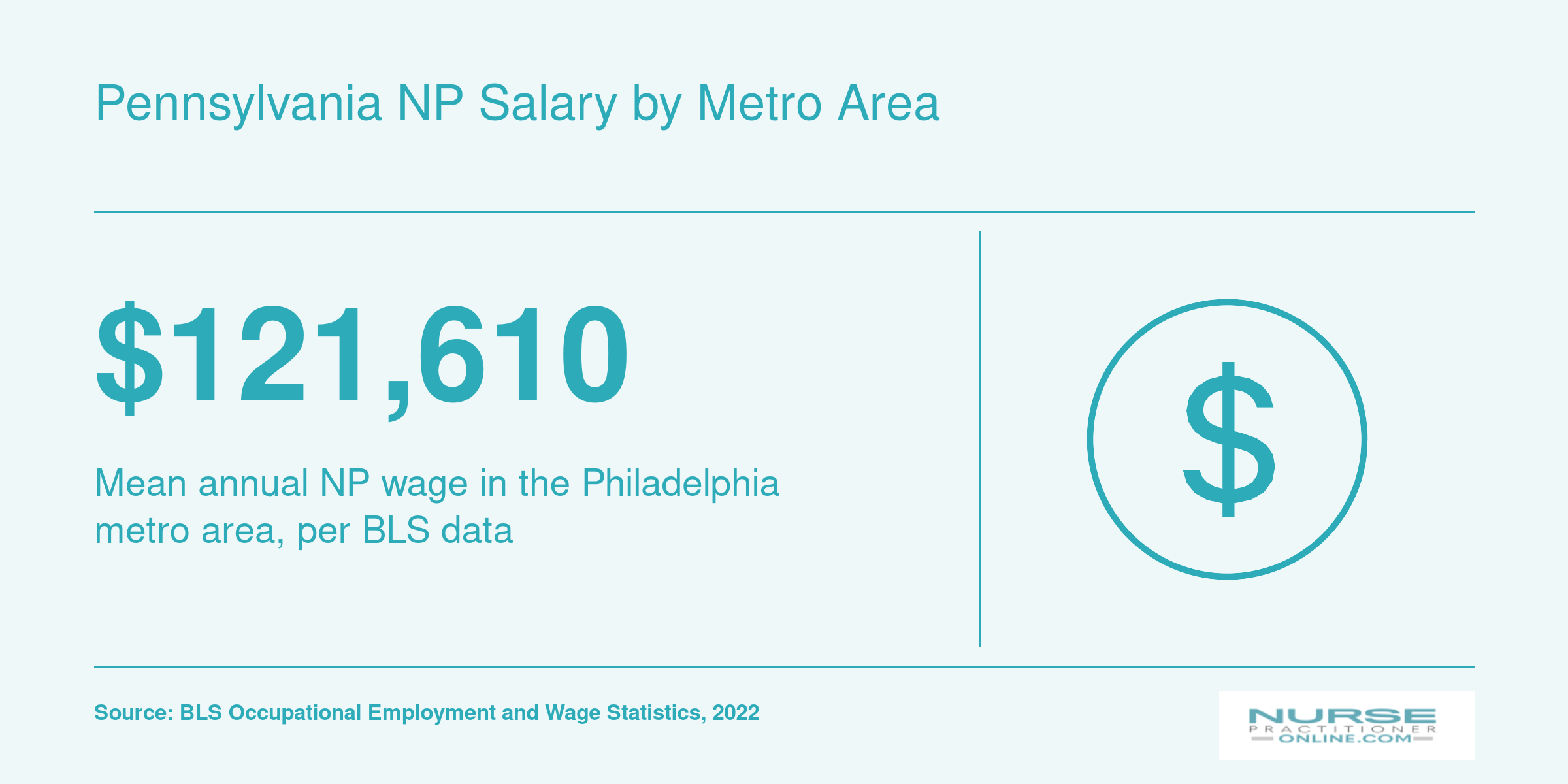
Pennsylvania NP Salary by Metro Area
Nurse practitioner salaries in Pennsylvania vary by metro area. BLS data shows the Philadelphia-Camden-Wilmington region reporting a mean annual wage of roughly $121,610 for NPs. While metro-specific medians for Pittsburgh, Allentown, Harrisburg, and Scranton are not broken out in the data we reviewed, acute care NPs working in hospital settings often earn above these occupation-wide averages due to the acuity and complexity of their patient populations.
Explore other Pennsylvania related topics
Related Articles
Pennsylvania by Specialty
- Allentown, Pennsylvania (FNP)
- DNP NP Programs in Pennsylvania
- FNP Programs in Pennsylvania
- Philadelphia, Pennsylvania (ACNP)
- Philadelphia, Pennsylvania (PNP)
- Philadelphia, Pennsylvania (WHNP)
- Pittsburgh, Pennsylvania (AGNP)
- Pittsburgh, Pennsylvania (CCNP)
- Pittsburgh, Pennsylvania (PMHNP)
- PMHNP Programs in Pennsylvania
- PNP Programs in Pennsylvania
- Scranton, Pennsylvania (AGNP)