Most important takeaways…
- CCNE or ACEN accreditation, a board pass rate above 85 percent, and clinical placement support are the three essentials to verify before enrolling.
- Post-master's certificates take roughly 18 months, so no accredited MSN-FNP program legitimately finishes in 12 months.
- Top-ranked programs in our 2026 list were scored on online flexibility, graduation rates, and affordability rather than brand reputation.
- FNP and PMHNP are the most widely available online specializations, though AGNP and neonatal tracks are expanding.
More than 40 accredited schools now offer fully online nurse practitioner programs, yet choosing among them remains surprisingly difficult. Most school websites showcase the same talking points: CCNE accreditation, flexible scheduling, clinical placement support. The actual differences, the ones that affect your wallet and your career trajectory, are harder to extract.
The programs ranked here are weighted toward online delivery flexibility, institutional graduation and retention rates, and affordability. You will find data on tuition, median graduate earnings, and return on investment, alongside breakdowns of BSN-to-NP pathways, specialization tracks, and what accreditation really means when you sit for your certification exam. Cost spreads are wide: total program tuition ranges from under $20,000 to over $70,000, and median debt at completion varies nearly as much. Clinical hour requirements, preceptor policies, and state licensure reciprocity create friction points that many nurses do not anticipate until midway through enrollment.
Top-Ranked Online Nurse Practitioner Programs for 2026
The programs below are ordered by a composite quality score that weighs online delivery flexibility, institutional outcomes such as graduation and retention rates, and affordability. No single factor drives the ranking. Whether you are looking for a BSN-to-DNP bridge, a post-graduate certificate to add a new population focus, or a psychiatric mental health specialty, each school on this list offers at least one accredited online or hybrid NP pathway designed for working nurses.
- Online delivery and flexibility
- Institutional graduation outcomes
- Tuition and net price affordability
- Breadth of NP concentrations
- Clinical placement support
- Independent program research
- College Scorecard graduate earnings — collegescorecard.ed.gov
- NCES-IPEDS federal institutional data — nces.ed.gov
- Internal program database

University of North Carolina at Chapel Hill
UNC Chapel Hill's School of Nursing offers a broad suite of NP pathways, from a distance-based MSN in Psychiatric Mental Health to an Adult Gerontology Primary Care track with an optional oncology focus. The school offering these programs has a graduation rate of 91.2%, one of the highest on this list, and in-state tuition starts at roughly $12,751. Multiple programs are delivered entirely online, with clinical hours arranged in students' home communities, making it a strong match for nurses who cannot relocate.
- Graduate certificate for MSN or DNP-prepared APRNs
- Online and in-person format options available
- Prepares graduates for national FNP certification exams
- Designed for career expansion into a new population focus
- Curriculum built for working professionals
- Eligible for North Carolina practice approval
- Distance-based online MSN program
- Oncology concentration option available
- Prepares for ANCC or AANP certification
- Five clinical courses included in the plan of study
- Covers care from adolescence through end of life
- Emphasizes diagnostic reasoning skills
- Online distance-based MSN format
- Lifespan psychiatric care focus with cultural sensitivity
- Psychopharmacology and psychotherapy curriculum
- Clinicals completed in local communities
- Prepares for PMHNP board certification
- Evidence-based practice framework throughout
- Hybrid program combining online and campus components
- Post-graduate certificate for MSN or DNP holders
- Specialized gerontology and acute care focus
- Advanced clinical training included
- Prepares for national acute care NP certification
- Designed for APRNs adding a new specialty
Family Nurse Practitioner Post-Graduate Certificate — Online
Adult Gerontology Primary Care Nurse Practitioner MSN — Online
Psychiatric Mental Health Nurse Practitioner MSN — Online
Adult Gerontology Acute Care Nurse Practitioner Post-Graduate Certificate — Hybrid

University of California-Davis
UC Davis anchors a collaborative University of California PMHNP certificate that spans multiple UC campuses, pairing virtual coursework with clinical placements across California. The school also offers a three-year hybrid DNP with a Family Nurse Practitioner concentration accredited by AACN. With in-state tuition near $15,141 and a graduation rate of 85.7%, UC Davis delivers strong value, especially for California residents looking to address the state's mental health provider shortage.
- 12-month hybrid graduate certificate, 48 units
- Prepares for ANCC PMHNP board certification
- Clinical placements located across California
- Full-time enrollment with virtual immersion sessions
- Open to NPs, CNSs, CNMs, and CRNAs
- Collaborative program with UC Irvine, UCSF, and UCLA
- Three-year full-time hybrid DNP program
- AACN-accredited curriculum
- Synchronous and asynchronous coursework options
- Four on-campus immersion experiences required
- Clinical rotations near California communities
- Capstone project and financial aid available
UC Psychiatric Mental Health Nurse Practitioner Certificate — Hybrid
Doctor of Nursing Practice, Family Nurse Practitioner — Hybrid

University of Michigan
The University of Michigan School of Nursing pairs a nationally regarded reputation with hybrid NP programs that require only about three on-campus days per term. Offerings span FNP, Pediatric NP, Adult Gerontology (both primary and acute care), and a unique combined Nurse-Midwifery/FNP track. The school has a 93.2% graduation rate, an 11-to-1 student-faculty ratio, and both two-year and three-year completion plans, giving working nurses real scheduling flexibility.
- Hybrid format with three on-campus days per term
- Two-year and three-year completion plans
- Prepares for FNP certification across the lifespan
- Digital education option for remote learners
- Clinical experience and prerequisite coursework required
- Family-centered health promotion emphasis
- Combined dual-certification MSN pathway
- Covers pregnancy, childbirth, and primary care
- Hybrid delivery with clinical preparation
- Broadens scope and career flexibility
- Accredited by CCNE
- Three-year program plan available
- Two-year hybrid program with online digital format
- On-campus intensive sessions each term
- Focus on well-baby and well-child care
- Careers in school-based and specialty pediatric clinics
- Immersive clinical experiences included
- Community health organization placements
- Six concentration options within the MSN
- Complete in two or three years
- Clinical site placement opportunities provided
- Expert faculty mentorship programs
- Rigorous theory paired with clinical experience
- Online delivery available
- First term in classroom before clinical training
- Faculty who actively practice in acute care settings
- Prepares for leadership in ICUs and specialty clinics
- Three-year and four-year plan options
- For RNs with acute or critical care experience
- Focus on diagnostic reasoning and therapeutic interventions
- Online coursework with up to three campus days per term
- Career paths include family, urgent care, and community NP
- Prepares for primary care across the lifespan
- Both online and residential options available
- Family-centered health promotion focus
- Capstone project required
Primary Care Family Nurse Practitioner MSN — Hybrid
Nurse-Midwifery and Primary Care Family Nurse Practitioner MSN — Hybrid
Primary Care Pediatric Nurse Practitioner MSN — Hybrid
Adult Gerontology Primary Care Nurse Practitioner MSN — Online
Adult Gerontology Acute Care Nurse Practitioner DNP — Hybrid
Primary Care Family Nurse Practitioner DNP — Hybrid

Florida International University
Florida International University stands out for affordability and breadth, with in-state tuition near $11,334 and a net price of roughly $9,288. FIU's College of Nursing offers post-graduate NP certificates, MSN tracks, and a BSN-to-DNP pathway across four specialty areas including FNP, PMHNP, Pediatric Primary Care, and Adult Gerontology. Many tracks are predominantly online, and students may arrange clinical placements outside Florida, a major advantage for out-of-state learners.
- Hybrid format, 36 credits required
- Builds on existing MSN from accredited program
- Prepares for national FNP certification
- Blends online and campus-based learning
- Designed for working professionals
- Fall application deadline March 1
- Online format, 32 credits required
- Leads to national pediatric NP certification eligibility
- Clinicals allowed outside Florida
- Requires MSN from ACEN or CCNE program
- Focuses on managing children's health
- Flexible for out-of-state students
- Hybrid format, 45 credits over six semesters
- Prepares for national PMHNP certification and APRN licensure
- Practice settings include clinics and crisis centers
- Fall admission only, March 1 deadline
- Option to add Nurse Educator Certificate
- Community and correctional health focus
- Predominantly online, 45 credit hours over six semesters
- Cares for adolescents through older adults
- Focuses on disease prevention and health promotion
- Clinicals allowed outside local areas
- Prepares for national NP certification
- Option to add Nurse Educator Certificate
- Hybrid DNP with four concentration options
- Primary care across the lifespan
- Fall and spring start dates available
- Clinical placements in ambulatory settings
- Prepares for national FNP certification
- Family-centered approach to care
- Online format with flexible clinical site options
- Direct BSN-to-DNP pathway
- Prepares for national pediatric NP certification
- Application via NursingCAS
- Four specialty tracks offered
- Focus on pediatric primary care
Family Nurse Practitioner Post-Graduate Certificate — Online
Pediatric Primary Care Nurse Practitioner Post-Graduate Certificate — Online
Psychiatric Mental Health Nurse Practitioner MSN — Hybrid
Adult Gerontology Primary Care Nurse Practitioner MSN — Online
Post-BSN to DNP, Family Nurse Practitioner — Online
Post-BSN to DNP, Pediatric Primary Care Nurse Practitioner — Online

University of Florida
The University of Florida's College of Nursing channels its BSN-to-DNP tracks through a hybrid model that blends online coursework with supervised clinical placements across Florida. Concentrations include FNP, PMHNP, and Adult Gerontology Acute Care. UF boasts a 91.1% graduation rate and one of the lowest net prices on this list at about $6,541, making it an exceptional value for Florida residents who want a doctoral-level credential without leaving the workforce.
- Hybrid format with full-time and part-time options
- Eligible for ANCC and AANP certification
- Community-based care across the lifespan
- Health promotion and chronic disease management focus
- Clinical placements in Florida
- Supervised precepted experience required
- Hybrid program with advanced health assessment training
- Prepares graduates to prescribe psychotropic medications
- Eligible for ANCC PMHNP certification
- Clinical placements in rural, community, and urban settings
- Full-time and part-time scheduling available
- Evidence-based psychiatric care framework
- Hybrid format requiring one year of critical care experience
- Eligible for ANCC and AACN certification
- Clinical sites within Florida only
- Individualized clinical learning experiences
- Full-time and part-time options
- Focus on high-acuity inpatient populations
BSN to DNP, Family Nurse Practitioner — Hybrid
BSN to DNP, Psychiatric Mental Health Nurse Practitioner — Hybrid
BSN to DNP, Adult Gerontology Acute Care Nurse Practitioner — Hybrid

University of South Florida
The University of South Florida's College of Nursing in Tampa offers both MSN and BSN-to-DNP pathways with family health and adult gerontology acute care concentrations. The hybrid FNP MSN spans 60 credit hours and prepares graduates for ANCC or AANPCB certification. In-state tuition is approximately $10,428, and the school's graduation rate is 76.8%. USF is a practical choice for Florida nurses seeking an affordable hybrid program with leadership and health policy coursework baked into the curriculum.
- 60 total credit hours in hybrid format
- Prepares for ANCC or AANPCB certification exams
- Comprehensive examination required at completion
- Curriculum covers research, policy, and leadership
- Clinical judgment development emphasis
- Advanced practice care across the lifespan
- Hybrid BSN-to-DNP pathway
- Prepares for ANCC or AANPCB certification
- Work in ambulatory care settings
- Comprehensive care across the lifespan
- Full-time and part-time options available
- Leadership and health policy coursework included
- Hybrid format with acute care focus
- Eligible for ANCC or AACN certification
- Part-time and full-time scheduling options
- Clinical experiences in critical care settings
- Financial aid and scholarships may apply
- Prepares for advanced practice with complex illnesses
Family Nurse Practitioner MSN — Hybrid
BS-DNP Family Health Concentration — Hybrid
BS-DNP Adult Gerontology Acute Care Concentration — Hybrid

University of California-Los Angeles
UCLA's School of Nursing participates in the multi-campus UC Psychiatric Mental Health Nurse Practitioner Certificate, a 12-month hybrid program that combines virtual classes with three immersion sessions and clinical placements across California. The school offering this program has a 92.6% graduation rate and in-state tuition near $14,476. It is specifically designed for already-licensed APRNs who want to add a PMHNP specialty, addressing California's acute mental health provider gap.
- 12-month hybrid program, 48 graduate units
- Full-time enrollment over four consecutive quarters
- Virtual classes on Wednesdays with immersion sessions
- Clinical training 16 to 24 hours per week
- Prepares for ANCC PMHNP-BC board certification
- Open to NPs, CNSs, CNMs, and CRNAs
- Addresses California mental health workforce shortage
- Interprofessional and technology-enhanced curriculum
UC Psychiatric Mental Health Nurse Practitioner Certificate — Hybrid

California State University-Long Beach
Cal State Long Beach offers a 72-unit BSN-to-DNP with concentrations in FNP, PMHNP, and Adult Gerontology Primary Care. The hybrid program includes 1,000 clinical hours and a scholarly doctoral project. In-state tuition is roughly $8,898, among the lowest in this ranking, and the CCNE-accredited curriculum spans three years. It is a standout option for budget-conscious BSN holders in Southern California who want to earn a practice doctorate while continuing to work.
- 72-unit, three-year hybrid program
- 1,000 clinical practice hours required
- Evidence-based doctoral project included
- Prepares for national FNP certification
- 3.0 minimum undergraduate GPA for admission
- Advanced clinical practice and leadership focus
- CCNE-accredited hybrid DNP
- Five NP concentration options available
- 72 total credit hours over three years
- 1,000 clinical hours required
- Electives include Medical Spanish
- Prepares for national PMHNP certification exam
- Hybrid format combining online and campus learning
- 72 units with 1,000 clinical hours
- Focus on adult and gerontology primary care
- Advanced pathophysiology and pharmacology coursework
- Doctoral project aimed at improving patient care
- BSN and active RN license required for admission
Doctor of Nursing Practice, Family Nurse Practitioner — Hybrid
Doctor of Nursing Practice, Psychiatric Mental Health Nurse Practitioner — Hybrid
Doctor of Nursing Practice, Adult Gerontology Primary Care Nurse Practitioner — Hybrid

San Jose State University
San Jose State University's MSN with an FNP concentration uses a cohort-based hybrid model that fits neatly around a work schedule: online coursework paired with Tuesday evening in-person classes and clinical rotations. The five-semester program requires a BSN, a 3.0 GPA, and an unrestricted California RN license. In-state tuition is about $9,934, and median earnings for graduates institution-wide reach roughly $78,988, offering a compelling return on a relatively modest investment.
- Five-semester full-time cohort model
- Hybrid format with Tuesday evening classes
- Fall admission only, small cohort size
- 3.0 GPA and California RN license required
- Prepares for FNP certification
- Two years of clinical experience preferred
- BSN degree required for admission
Master of Science in Nursing, Family Nurse Practitioner — Hybrid

University of Wisconsin-Madison
The University of Wisconsin-Madison's School of Nursing delivers hybrid DNP tracks in PMHNP, Pediatric Primary Care, and Adult Gerontology Primary Care, plus a focused 18-month post-graduate capstone certificate in psychiatric nursing. The PMHNP DNP boasts a reported 100% first-time ANCC pass rate. In-state tuition is approximately $12,325, and the school's 89.5% graduation rate reflects strong student support. Clinical placements are arranged by faculty, easing one of the biggest logistical headaches for online learners.
- 18-month hybrid program, 18 graduate credits
- Resident tuition approximately $670 per credit
- Focused on underserved psychiatric populations
- Board-certified faculty instructors
- Small cohort learning environment
- Requires both BSN and MSN plus RN license
- 68 total credit hours in hybrid format
- 100% first-time ANCC pass rate reported
- Three-year or four-year completion plans
- Clinical placements across Wisconsin
- LEND Fellowship and Global Health Certificate options
- Scholarly project required
- 68 credit hours with 1,000+ clinical hours expected
- Hybrid online and campus format
- No entrance exam required
- LEND Fellowship opportunity available
- Option to earn a Global Health Certificate
- Fall admission with December 1 deadline
- Hybrid format with two-to-four-year time frame
- 100% licensure pass rate reported
- Clinical placements arranged by faculty
- Synchronous and asynchronous coursework
- Post-BSN and post-MSN entry plans available
- Advanced practice certificates can be added
Post-Graduate Psychiatric Nursing Capstone Certificate — Hybrid
Nursing Practice DNP, Psychiatric Mental Health Nurse Practitioner — Hybrid
Nursing Practice DNP, Pediatric Primary Care Nurse Practitioner — Hybrid
Nursing Practice DNP, Adult Gerontology Primary Care Nurse Practitioner — Hybrid

Yale University
Yale School of Nursing's hybrid MSN in Psychiatric Mental Health Nurse Practitioner blends asynchronous online coursework with three mandatory campus immersions over a three-year timeline. Tuition is $49,500, but median graduate debt institution-wide is only about $12,975, thanks to generous financial aid. The school offering this program has a 95.7% graduation rate and median alumni earnings of roughly $100,533, yielding one of the strongest long-term return-on-investment profiles in this ranking.
- Three-year hybrid MSN for working registered nurses
- Asynchronous online coursework with three campus immersions
- Trains in diagnosis, medication prescribing, and psychotherapy
- NursingCAS application for Fall 2026 cycle
- Simulated skill demonstrations and clinical training
- Crisis intervention and collaborative care planning
- Four-day immersion sessions on campus
Psychiatric Mental Health Nurse Practitioner MSN — Online

Ohio State University
Ohio State's College of Nursing offers one of the widest NP specialty selections on this list, with ten concentration options across its BSN-to-DNP pathway plus standalone MSN tracks in AGPCNP and PMHNP. The AGPCNP program is ranked No. 5 nationally by U.S. News and is available fully online or on campus. In-state tuition is about $13,901, and the school has an 87.7% graduation rate. Students can earn an MSN en route to the DNP, a built-in safety net if plans change.
- Available online or on campus
- Ranked No. 5 nationally by U.S. News
- 16 to 20 hours of weekly clinical practice
- Comprehensive care for patients age 13 and older
- Train under expert preceptors
- Prepares for ANCC or AANP board certification
- Hybrid format with 600 clinical hours
- Lifespan mental health care focus
- Courses in neuroscience and psychopharmacology
- Preceptors provided for students in Ohio
- Includes crisis intervention training
- Available online or on campus
- Ten specialty tracks including FNP and PMHNP
- Three-year program with full-time and part-time options
- Earn MSN en route to DNP
- Synchronous online classes with minimal campus visits
- Clinical placements at Wexner Medical Center available
- Scholarly project and capstone required
- Financial aid and scholarships available
Adult Gerontology Primary Care Nurse Practitioner MSN — Online
Psychiatric Mental Health Nurse Practitioner MSN — Hybrid
BSN to Doctor of Nursing Practice (multiple concentrations) — Hybrid

University of California-Irvine
UC Irvine participates in the collaborative UC PMHNP Certificate while also offering its own three-year hybrid DNP with an FNP concentration, the first of its kind on a UC campus. In-state tuition is about $14,827, and the school's 86.9% graduation rate is paired with median alumni earnings near $80,735. The DNP-FNP track includes three on-campus intensives, interprofessional learning across UC schools, and faculty-practice clinical rotations.
- 12-month hybrid program, 48 graduate units
- Prepares for ANCC PMHNP board certification
- Clinical placements throughout California
- Full-time enrollment over four quarters
- Virtual Wednesday case conferences
- First multicampus nursing certificate in California
- Open to licensed NPs, CNSs, CNMs, and CRNAs
- Three-year full-time hybrid commitment
- First UC campus DNP-FNP program
- Synchronous and asynchronous coursework
- Three on-campus intensives required
- Interprofessional learning across UC schools
- Prepares for FNP board certification exam
- Option for NLN CNE certification
UC Psychiatric Mental Health Nurse Practitioner Certificate — Hybrid
Doctor of Nursing Practice, Family Nurse Practitioner — Hybrid

University of Minnesota-Twin Cities
The University of Minnesota-Twin Cities School of Nursing covers an unusually wide spectrum of NP specialties through its hybrid DNP, including FNP, PMHNP, Pediatric NP (primary and acute care), Adult Gerontology Primary Care, and Women's Health/Gender-Related NP. Clinical placements are arranged by the institution across a network of over 200 sites. In-state tuition is about $22,017, and at roughly $1,100 per credit for DNP coursework, costs are transparent. The school reports a 100% licensure pass rate for several of its NP tracks.
- 1,000 clinical hours with institution-arranged placements
- Flexible three-year or four-year plans
- Clinical network of 200+ sites
- Prepares for ANCC or AANPCB certification
- Close-knit cohort and active alumni network
- TA opportunities with tuition remission
- CCNE-accredited, $1,100 per credit
- 80 total credit hours in hybrid format
- One-week on-campus session each semester
- 1,000 clinical hours required
- Prepares for ANCC PMHNP certification
- Three-year or four-year completion plans
- Three-year cohort-based hybrid DNP
- 1,000 clinical hours at top children's hospitals
- LEND Fellowship and Disability Policy Certificate options
- Nationally recognized faculty mentorship
- DNP project focused on systems improvement
- Prepares for PNP Certification Examination
- 100% licensure pass rate and 100% job placement reported
- 1,000 clinical hours with institution-arranged sites
- Whole person health framework
- On-campus intensives each semester
- Prepares for NCC Board Certification Exam
- Three-year and four-year plans available
- Hybrid format for APRNs with a DNP
- 13 to 16 credits over three semesters
- Clinical hours range from 240 to 600
- Prepares for AACN or ANCC certification
- Asynchronous learning with biweekly Zoom sessions
- On-campus skills course in summer
Doctor of Nursing Practice, Family Nurse Practitioner — Hybrid
Doctor of Nursing Practice, Psychiatric Mental Health Nurse Practitioner — Hybrid
Doctor of Nursing Practice, Pediatric Nurse Practitioner Primary Care — Hybrid
Doctor of Nursing Practice, Women's Health/Gender-Related Nurse Practitioner — Hybrid
Adult Gerontological Acute Care Nurse Practitioner Post-Graduate Certificate — Hybrid

University of Washington-Tacoma Campus
The University of Washington-Tacoma offers post-graduate NP certificates in both Adult Gerontology Acute Care and Adult Gerontology Primary Care, each spanning 12 to 15 months in a hybrid format. A faculty-guided gap analysis customizes each student's curriculum, and clinical placements span both urban and rural settings. In-state tuition is about $18,987, and median alumni earnings institution-wide reach roughly $78,466. This is a targeted choice for APRNs who already hold an advanced degree and want to add a new specialty efficiently.
- 12 to 15 month hybrid program
- Faculty-guided gap analysis tailors curriculum
- Clinical experiences in urban and rural settings
- Eligible for ANCC or AACNCC certification
- CCNE-accredited, space-available admissions
- Weekly in-person classes required
- 12 to 15 month hybrid certificate for experienced APRNs
- Customized curriculum via faculty adviser collaboration
- Eligible for ANCC or AANP certification
- Covers primary care from adolescence through older adulthood
- Clinical practicum hours in varied settings
- State-based or fee-based tuition options
Adult Gerontology Acute Care Nurse Practitioner Graduate Certificate — Hybrid
Adult Gerontology Primary Care Nurse Practitioner Graduate Certificate — Hybrid
Questions to Ask Yourself
BSN-to-NP Online Pathways: Requirements, Timelines, and What to Expect
A BSN-to-NP pathway is exactly what it sounds like: a graduate program that takes a bachelor's-prepared registered nurse and trains them, through coursework and supervised clinical hours, into a board-eligible nurse practitioner. The two routes most working RNs choose are the BSN-to-MSN (master's) and the BSN-to-DNP (doctorate), and the difference between them shapes everything from how long you're in school to what your tuition bill looks like.
MSN vs. DNP: Credits and Timeline
A BSN-to-MSN FNP track typically runs around 45 credits over roughly two years of full-time study. Texas Woman's University and the University of West Florida both structure their online MSN-FNP at 45 credits12, and Texas Woman's publishes a 24-month full-time timeline with 780 required clinical hours.1 Part-time tracks are common and stretch the same coursework across three to four years so you can keep working. If speed is your priority, it's worth reviewing the fastest nurse practitioner programs to compare accelerated options.
The BSN-to-DNP route is longer and credit-heavier, usually three to four years full-time. For comparison, even a post-master's MSN-to-DNP track runs around 79 credits on its own, which gives you a sense of how much additional doctoral coursework (leadership, systems, a scholarly project) sits on top of the clinical FNP core. If you're weighing whether the DNP is right for you, our guide to DNP prerequisites breaks down what programs expect before you apply.
Admission Requirements for BSN-Prepared RNs
Expectations are fairly consistent across CCNE-accredited online programs:
- Active RN license: Required in the state where you'll complete clinical hours. Some programs (like West Florida) also run a background check.2
- Minimum GPA: A 3.0 undergraduate GPA is the common floor at Texas Woman's, West Florida, and Chamberlain.124 Competitive applicants typically exceed it.
- GRE: Increasingly waived. Chamberlain explicitly offers a GRE waiver4, and most online MSN-FNP programs no longer require it. DNP programs are more likely to still ask for the GRE or GMAT.
- Other assessments: A few programs use alternatives like the CASPer situational judgment test (Texas Woman's, Spring 2026 cycle).1
- Clinical RN experience: Many programs prefer or require one to two years of bedside experience before admission. This catches new BSN graduates off guard, so read the fine print before applying straight out of undergrad.
Post-Master's Certificates: A Different Path
If you already hold an MSN in a different specialty (say, nurse educator or CNL) and want to add FNP credentials, you don't repeat the master's. You apply to a post-master's certificate program, which awards only the specialty-specific coursework and clinical hours needed to sit for FNP boards. It's a shorter, lower-cost route than restarting a full BSN-to-MSN, and it's distinct from direct-entry pathways designed for nurses without any graduate degree yet.
Related Articles
Explore By State
- Alabama
- Alaska
- Arizona
- Arkansas
- California
- Colorado
- Connecticut
- Delaware
- Florida
- Georgia
- Hawaii
- Idaho
- Illinois
- Indiana
- Iowa
- Kansas
- Kentucky
- Louisiana
- Maine
- Maryland
- Massachusetts
- Michigan
- Minnesota
- Mississippi
- Missouri
- Montana
- Nebraska
- Nevada
- New Hampshire
- New Jersey
- New Mexico
- New York
- North Carolina
- North Dakota
- Ohio
- Oklahoma
- Oregon
- Pennsylvania
- Rhode Island
- South Carolina
- South Dakota
- Tennessee
- Texas
- Utah
- Vermont
- Virginia
- Washington
- Washington DC
- West Virginia
- Wisconsin
- Wyoming
Hybrid vs. Fully Online NP Programs: Format Differences That Actually Matter
The phrase 'online NP program' can mean very different things depending on the school. Some programs deliver every lecture asynchronously and arrange your clinical sites for you, while others expect you to attend on-campus intensives and find your own preceptors. Understanding these format differences before you apply can save you months of frustration, unexpected travel costs, and even delayed graduation.
Pros
- Fully online coursework lets you keep working full time and study on your own schedule, day or night.
- No relocation required, so you can earn an advanced degree without uprooting your family or leaving your current employer.
- Programs like Carson-Newman, Vanderbilt, Duke, and Georgetown provide dedicated clinical placement teams that help secure sites and vet preceptors for you.
- Asynchronous lectures and recorded content let you revisit complex material as many times as you need before exams.
- Schools with full placement support reduce the risk of delayed graduation caused by months spent searching for a willing preceptor.
- Geographic flexibility means you can enroll in a top-ranked program regardless of where you live.
Cons
- Almost no NP program is truly 100% online because mandatory clinical hours (typically 500 to over 1,000) must be completed in person at approved sites.
- Many large online programs, including Walden, Chamberlain, Purdue Global, and the University of South Alabama, require students to find their own clinical sites and preceptors with no guaranteed placement.
- Hybrid formats may include on-campus intensives that require travel, hotel stays, and time off work, adding costs that tuition alone does not reflect.
- Self-placement programs can delay your timeline by a semester or more if local preceptors are unavailable or already committed to other students.
- Clinical site approval processes vary widely; some schools take weeks to vet a site you have already secured, creating frustrating bottlenecks.
- Travel to distant clinical rotations or campus intensives can add thousands of dollars in expenses that rarely appear in published cost-of-attendance figures.
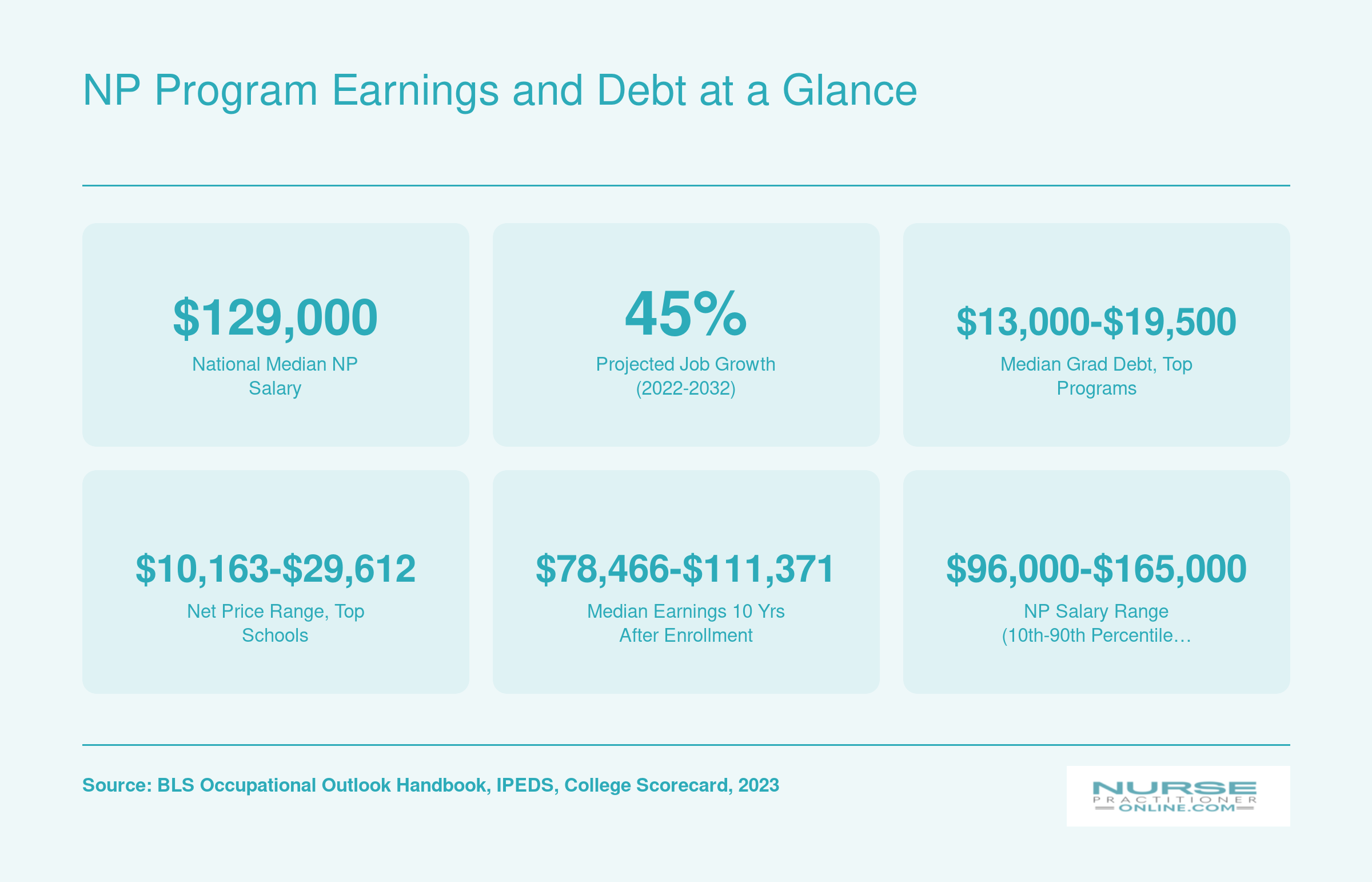
NP Program Earnings and Debt at a Glance
Before you invest in an online NP program, it helps to see the financial picture clearly. These figures pull from federal data on top-ranked programs alongside national salary benchmarks, giving you a quick snapshot of what the investment looks like and what it can return.
Tuition, Graduate Earnings, and ROI: How the Top Programs Compare
When comparing NP programs, sticker price alone can be misleading. The ROI ratio in the table below divides each school's median earnings (measured ten years after enrollment) by median graduate debt at completion. A higher ratio means graduates are earning significantly more relative to what they borrowed. For example, a ratio of 7.7 means alumni earn roughly 7.7 times their median debt each year, a decade out. This debt-to-earnings lens helps you identify programs where your investment pays off fastest, even if tuition looks high on paper. Note that program-level earnings after graduation are not yet available for these NP programs, so the earnings figures reflect institution-wide medians.
| School | In-State Tuition | Out-of-State Tuition | Median Graduate Debt | Median Earnings (10 yr) | ROI Ratio |
|---|---|---|---|---|---|
| Yale University | $49,500 | $49,500 | $12,975 | $100,533 | 7.7 |
| Duke University | $66,523 | $66,523 | $13,000 | $97,800 | 7.5 |
| University of Pennsylvania | $47,844 | $47,844 | $15,715 | $111,371 | 7.1 |
| UC Davis | $15,141 | $30,243 | $13,000 | $80,838 | 6.2 |
| UCLA | $14,476 | $29,578 | $14,000 | $82,511 | 5.9 |
| UC Irvine | $14,827 | $29,929 | $15,000 | $80,735 | 5.4 |
| UW Tacoma | $18,987 | $33,006 | $14,615 | $78,466 | 5.4 |
| San Jose State University | $9,934 | $20,014 | $15,000 | $78,988 | 5.3 |
| UNC Chapel Hill | $12,751 | $31,408 | $14,000 | $72,200 | 5.2 |
| University of Virginia | $23,526 | $37,628 | $17,500 | $86,863 | 5.0 |
The clinical hours required for most FNP programs, typically 500 to over 1,000, are the part of online NP education you cannot shortcut.
Accreditation, Certification Pass Rates, and What to Verify Before You Enroll
The real risk in choosing an NP program is not the coursework itself. It is enrolling somewhere that looks legitimate but leaves you ineligible for certification or state licensure. Before you commit tuition dollars, you need to verify three things independently, using primary sources rather than marketing materials.
Start With Accreditation Status
Every NP program you consider should hold accreditation from either the Commission on Collegiate Nursing Education (CCNE) or the Accreditation Commission for Education in Nursing (ACEN). This is non-negotiable. State boards of nursing and national certifying bodies require graduation from an accredited program before you can sit for certification exams or apply for APRN licensure.
To verify accreditation yourself, go directly to the accreditor's website. CCNE maintains a searchable directory at aacnnursing.org, and ACEN publishes its accredited programs list at acenursing.org. Do not rely on a school's claims alone. Accreditation status can change, and some programs operate under "candidacy" status, which may or may not be acceptable in your state.
Check Certification Exam Pass Rates
How well a program prepares graduates for board certification is one of the clearest indicators of educational quality. The two major FNP certifying bodies, AANP and ANCC, publish aggregate pass rate data annually.
For context, the 2025 national first-time pass rate for the AANP FNP certification exam was 81 percent, based on nearly 15,000 examinees. The ANCC FNP-BC exam reported an 83 percent first-time pass rate in 2024, drawn from over 7,700 candidates. More recent ANCC data for 2025 has not yet been released.
Individual program pass rates are harder to find. Some schools publish them on their websites; others report them only to accreditors. If a program does not disclose this information, ask the admissions office directly. A program that consistently underperforms the national average is a warning sign worth taking seriously.
Verify State Licensure Requirements
NP licensure requirements vary by state, and the rules can affect which programs make sense for your career plans. The Nurse Licensure Compact simplifies RN mobility, but APRN practice authority follows a different set of rules. Check with your state board of nursing to confirm that a program's curriculum and clinical hours meet local requirements before you enroll.
Once you have confirmed accreditation and licensure compatibility, cost becomes a practical concern. Our guide to the most affordable nurse practitioner programs can help you compare tuition across accredited schools. Professional associations like AANP also publish annual compensation surveys that can help you set realistic expectations for post-graduation earnings.
Our Ranking Criteria: How We Evaluated These Online NP Programs
Prestige rankings sort schools by reputation; we sorted by what actually matters to a working nurse paying tuition. We scored each program on a weighted composite that prioritizes verified online delivery alongside institutional quality signals, not brand recognition or peer-assessment surveys.
What Goes Into the Composite
Six factors drive the score, and each carries weight for a specific reason:
- Verified online or hybrid delivery: We confirmed that the NP track is genuinely available in a distance format, not just an on-campus program with occasional remote options.
- Institution-wide graduation rate: A proxy for how well a school supports students through to completion.
- Net price after aid: What students actually pay, not the sticker price.
- Program-level earnings outcomes: Reported graduate earnings where available at the credential level.
- Median graduate debt: What students owe at completion, drawn from federal reporting.
- Return on investment ratio: Earnings weighed against debt and net price, so a higher-cost program with strong salary outcomes can still rank well.
Where the Data Has Limits
We want to be straight with you about what these numbers can and cannot tell you. Graduation rates are reported at the institution level, not specifically for the NP program, so they reflect overall student success rather than NP cohort completion. Net price is a sector-conditional average and may not match what you personally pay after scholarships, employer tuition assistance, or military benefits. If debt load is your primary concern, you may also want to explore student loan forgiveness options for nurse practitioners. And the quality of clinical placement support, arguably the most important factor in any NP program, simply is not quantifiable in publicly available data.
What This Ranking Does Not Measure
The composite does not capture student satisfaction, faculty-to-student ratios, preceptor matching support, or how responsive a program is when you need help finding clinical hours. Those factors matter enormously, and you should verify them independently: ask current students, request placement support details from admissions, and confirm whether the program helps secure preceptors or leaves that work to you.
Online NP Programs by Specialization: FNP, PMHNP, AGNP, and More
Choosing a specialization is the single most consequential decision you will make in your NP education, and the good news is that the most in-demand tracks are also the most accessible online.
Family Nurse Practitioner (FNP)
FNP remains the most widely chosen specialization, and for practical reasons. It prepares you to treat patients across the lifespan in primary care, urgent care, and community health settings, which translates to the broadest job market of any NP track. Virtually every accredited online NP program offers an FNP option, making it the easiest pathway to find a fully online or hybrid format that fits your schedule. If you have not settled on a specialty yet, FNP gives you the most flexibility once you are licensed. For a deeper look at how FNPs and other NPs function in primary care settings, see our guide on whether a nurse practitioner can be a primary care provider.
Psychiatric Mental Health NP (PMHNP)
PMHNP has become the fastest-growing specialization in terms of employer demand, driven by a nationwide shortage of mental health providers. Fully online PMHNP programs are now as common as FNP programs, partly because psychiatric clinical hours can often be completed via telehealth placements, which opens up more preceptor options in underserved areas. If you are weighing FNP versus PMHNP, know that the mental health job market is especially tight right now, and programs in this track are actively expanding to meet it.
Adult-Gerontology NP (AGNP)
AGNP programs, which focus on adults and older adults, are widely available online and growing in popularity alongside an aging population. Demand is fast-growing, particularly in long-term care, hospital medicine, and specialty practices. Many schools offer both primary care and acute care AGNP tracks, so confirm which focus area a program covers before you apply.
Pediatric, Women's Health, and Neonatal NP
These three specializations tell a different story when it comes to online availability.
- Pediatric NP (PNP): Online programs exist but are less common. Pediatric clinical placements can be harder to secure independently, and some programs require more structured on-campus components. Demand has remained stable rather than surging.
- Women's Health NP (WHNP): Fully online options are available at select schools, but the pool is smaller than FNP or PMHNP. Clinical requirements often include specific gynecologic and obstetric settings that take more coordination to arrange.
- Neonatal NP (NNP): This is the most specialized and least commonly offered track online. NNP programs almost always require significant hands-on time in neonatal intensive care units, which limits how much of the curriculum can move online. If NNP is your goal, expect a hybrid or predominantly in-person format and a narrower list of programs.
Finding Programs by Specialization
If you already know your track, filtering by specialization from the start will save you time. Our Nurse Practitioner Specialties & Careers page organizes program listings by specialty so you can compare accredited options without sifting through programs that do not fit your clinical goals. You can also review NP salaries by specialty to understand earning potential across tracks. For nurses still deciding, the FNP and PMHNP tracks offer the strongest combination of online availability and near-term job market demand.
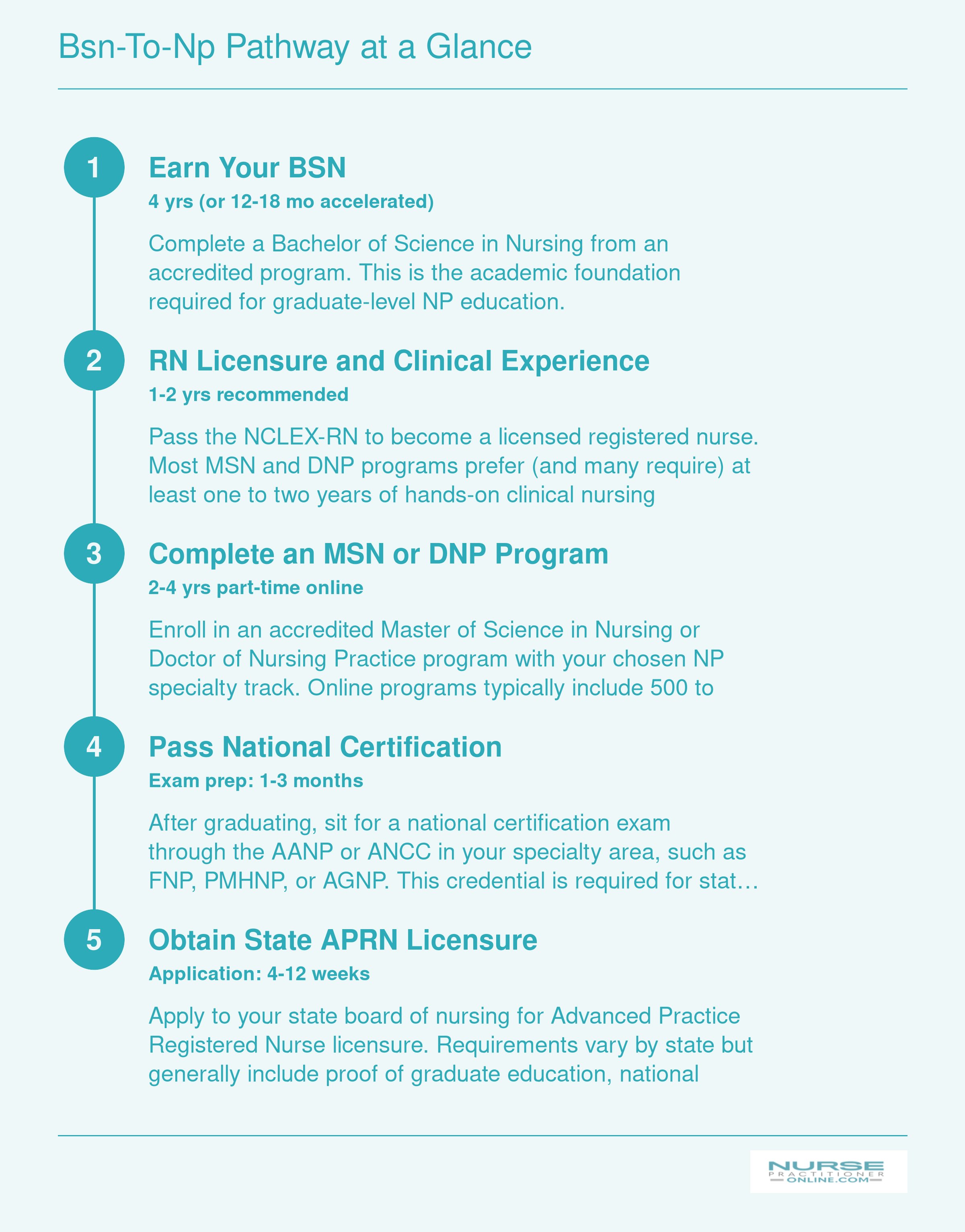
BSN-to-NP Pathway at a Glance
The journey from BSN-prepared registered nurse to fully licensed nurse practitioner follows a clear credentialing ladder. Here is a realistic look at each stage and the time you should plan for.
More Accredited Online NP Programs to Explore
These programs meet the same accreditation and delivery criteria as our top-ranked schools but fell outside our top 15 on the composite score. They are still excellent options worth considering as you explore online NP programs.
Other
Clemson University Clemson, SC · Hybrid
- Doctor of Nursing Practice (Adult/Gerontology)
- Doctor of Nursing Practice (Family Nurse Practitioner)
- Adult-Gerontology Primary Care Nurse Practitioner
Florida Atlantic University Boca Raton, FL · Hybrid
- BSN to DNP (Psychiatric Mental Health Primary Care Nurse Practitioner)
- Family Nurse Practitioner
- Post Graduate Certificate Psychiatric Mental Health Nurse Practitioner Program
- BSN to DNP (Family Nurse Practitioner)
- BSN to DNP (Psychiatric Mental Health Nurse Practitioner)
- BSN to DNP (Adult/Gerontological Nurse Practitioner)
California State University-Stanislaus Turlock, CA · Hybrid
- Post Graduate Psychiatric APRN Certificate
- Masters of Science with a Family Nurse Practitioner (FNP) concentration
Florida State University Tallahassee, FL · Online
- Family Nurse Practitioner Certificate
- Adult Gerontology Acute Care Nurse Practitioner Post-Masters Graduate Certificate
- Doctor of Nursing Practice (Family Nurse Practitioner)
- DNP- Psychiatric Mental Health Nurse Practitioner
- DNP- Adult Gerontology Acute Care Nurse Practitioner
- BSN to DNP Family Nurse Practitioner
- BSN to DNP Adult-Gerontology Acute Care Nurse Practitioner
University of Pennsylvania Philadelphia, PA · Online
- Streamlined Post Graduate APRN Adult Gerontology Acute Care NP Certificate
- Psychiatric Mental Health Nurse Practitioner
- Adult Gerontology Acute Care Nurse Practitioner, MSN (General Surgery)
- Adult Gerontology Acute Care Nurse Practitioner, MSN (Internal Medicine)
- Adult Gerontology Acute Care Nurse Practitioner, MSN
University of Virginia Charlottesville, VA · Hybrid
- Family Nurse Practitioner (FNP) Specialty
- Family Nurse Practitioner (FNP)
- Adult Gerontology Acute Care Nurse Practitioner
- Family Nurse Practitioner Certificate
- Psychiatric-Mental Health Nurse Practitioner
- Psychiatric Mental Health Nurse Practitioner
- Pediatric Nurse Practitioner - Primary Care
- Adult Gerontology Acute Care Nurse Practitioner (AGACNP)
Southern Utah University Cedar City, UT · Online
- Master of Science in Nursing in Family Nurse Practitioner
Michigan State University East Lansing, MI · Hybrid
- Adult Gerontology Primary Care Nurse Practitioner
- Post-Graduate Certificate (Family Nurse Practitioner)
- Adult-Gerontology Primary Care Nurse Practitioner
- Psychiatric Mental Health Nurse Practitioner
- Nurse Practitioner (Family Nurse Practitioner)
Duke University Durham, NC · Hybrid
- Adult-Gerontology Acute Care Nurse Practitioner Post-Graduate Certificate
- Pediatric Acute Care Nurse Practitioner MSN
- Psychiatric-Mental Health Nurse Practitioner MSN
- Women's Health Nurse Practitioner
- Family Nurse Practitioner Post-Graduate Certificate
- Psychiatric-Mental Health Nurse Practitioner Post-Graduate Certificate
- Women's Health Nurse Practitioner Post-Graduate Certificate
- Adult-Gerontology Acute Care Nurse Practitioner
- Adult-Gerontology Primary Care Nurse Practitioner MSN
- Pediatric Primary Care Nurse Practitioner MSN
- Adult-Gerontology Primary Care Nurse Practitioner Post-Graduate Certificate
University of Central Florida Orlando, FL · Hybrid
- Doctor of Nursing Practice (DNP) - Adult/Gerontology Primary Care Nurse Practitioner
- BSN to DNP: Adult/Gerontology Primary Care Nurse Practitioner
- Adult/Gerontology Primary Care Nurse Practitioner
- Adult Gerontology Primary Care Nurse Practitioner Graduate Certificate
- Adult-Gerontology Acute Care Nurse Practitioner
Explore Programs
- Best Accelerated Nurse Practitioner
- Best Affordable Nurse Practitioner Programs of
- Best Online Acute Care Nurse Practitioner (ACNP)
- Best Online Adult-Gerontology NP Programs (AGPCNP & AGACNP)
- Best Online DNP Nurse Practitioner
- Best Online Emergency Nurse Practitioner (ENP)
- Best Online FNP
- Best Online MSN Nurse Practitioner
- Best Online Neonatal Nurse Practitioner (NNP)
- Best Online PMHNP
- Best Online PNP
- Best Online Post-Master's NP Certificate
- Best Online WHNP
More Pages To Consider
- Acute Care Nurse Practitioner (ACNP)
- Adult-Gerontology Nurse Practitioner (AGNP)
- Cardiology Nurse Practitioner
- Critical Care Nurse Practitioner (CCNP)
- Dermatology Nurse Practitioner
- Emergency Nurse Practitioner (ENP)
- Family Nurse Practitioner (FNP)
- Forensic Nurse Practitioner
- Functional Medicine Nurse Practitioner
- Holistic Nurse Practitioner
- Neonatal Nurse Practitioner (NNP)
- Occupational Health Nurse Practitioner
- Oncology Nurse Practitioner
- Orthopedic Nurse Practitioner
- Palliative Care Nurse Practitioner
- Pediatric ER Nurse
- Pediatric Nurse Practitioner (PNP)
- Psychiatric-Mental Health Nurse Practitioner (PMHNP) Guide
- Trauma Nurse Practitioner
- What Do Urgent Care Nurse Practitioners Do? Role Guide
- Women's Health Nurse Practitioner (WHNP)