
Most important takeaways…
- FNPs treat patients of all ages while AGNPs focus exclusively on adults and older adults, shaping every job and credential that follows.
- NP employment is projected to grow 28 percent from 2023 to 2033, roughly five times the average for all occupations.
- Hospital and acute care settings where AGNPs concentrate typically offer higher median pay than outpatient primary care roles.
- Post-master's certificates let you add a second population focus without repeating an entire graduate degree.
The Family Nurse Practitioner credential covers patients from birth through end of life, while the Adult-Gerontology Nurse Practitioner credential is bounded at roughly age 13 on the low end and extends through frail elderly care. That single boundary line determines which patients you can legally bill for, which clinical rotations your program will arrange, and which certification exam (ANCC or AANP for FNP; ANCC or AACN for AGNP) you sit for after graduation.
The tension for most working RNs is not academic difficulty. It is fit. Picking the wrong population focus can lock you out of pediatric urgent care, school-based clinics, or hospital ICUs for years. Post-master's certificates to switch tracks typically add 12 to 24 months and several thousand clinical hours, so understanding the core differences between family nurse practitioner roles and AGNP roles before you enroll is well worth the effort.
AGNP Vs. FNP at a Glance: Side-By-Side Comparison Table
Adult-gerontology versus family: one path concentrates on patients across the adult lifespan, while the other opens the door to all ages, from newborns to seniors. Before diving into curriculum details, a clear snapshot of key differences helps frame your decision.
FNP vs. AGNP: Key Distinctions
| Aspect | Family Nurse Practitioner (FNP) | [[LINK:3 | Adult-Gerontology Nurse Practitioner]] (AGNP) |
|---|---|---|---|
| Patient Population | All ages: newborns through older adults | Adults and older adults; AGNP primary care typically sees ages 13 and up; acute care may include younger adolescents in some settings | |
| Sub-specialties | None; general primary care across the lifespan | Two tracks: Adult-Gerontology Primary Care (AGPCNP) and Adult-Gerontology Acute Care (AGACNP) | |
| Primary Care Focus | Yes, comprehensive primary care | AGPCNP focuses on primary care for adults and geriatrics; AGACNP does not provide primary care and instead manages acute, critical, and complex conditions | |
| Certification Bodies | American Nurses Credentialing Center (ANCC) and American Academy of Nurse Practitioners (AANP) | AGPCNP: ANCC and AANP; AGACNP: ANCC and American Association of Critical-Care Nurses (AACN) | |
| Typical Employment Settings | Private practice, community health centers, retail clinics, schools, family medicine offices | AGPCNP: internal medicine, specialty clinics, long-term care facilities; AGACNP: intensive care units, emergency departments, hospitalist services | |
| Median Salary (estimated) | Approximately $115,000 nationally; varies by region and setting | Approximately $120,000; acute care roles often trend higher. For current regional data, visit the Bureau of Labor Statistics (BLS.gov) | |
| Scope of Practice | Diagnose, treat, and manage acute and chronic conditions across the lifespan; emphasis on preventive care and health promotion | Manage complex acute and chronic conditions in adults/older adults; AGACNP scope includes invasive procedures, hemodynamic monitoring, and critical care interventions |
AGPCNP vs. AGACNP: Choosing the Right Adult-Gerontology Focus
The AGNP track splits into primary and acute care, a distinction that deeply shapes your daily practice. AGPCNPs serve as ongoing providers in outpatient settings, managing chronic illnesses like diabetes, hypertension, and heart disease through long-term relationships. AGACNPs work in fast-paced hospital environments, stabilizing acutely ill patients, interpreting diagnostics, and performing bedside procedures. If you are leaning toward the AGNP route, exploring the best online MSN adult gerontology nurse practitioner programs can help you compare curricula side by side. The National Organization of Nurse Practitioner Faculties (NONPF) provides detailed competency documents for each role, and reviewing these alongside program requirements often clarifies which track aligns with your clinical interests.
Where to Verify Scope, Certification, and Salary Data
Official scope-of-practice statements and certification requirements are updated directly by the AANP and ANCC; these sites outline exam eligibility, content blueprints, and renewal standards. For salary and employment outlook, BLS.gov provides the most current median wage estimates and projections by specialty and region. If you want a deeper look at what a family nurse practitioner does day to day, our dedicated guide breaks down the role, benefits, and career trajectory. Searching job postings on platforms like LinkedIn or Indeed for "FNP" and "AGNP" roles can also reveal real-time employer expectations and practice settings in your area.
Patient Population and Scope of Practice: What Each Track Actually Covers
The single biggest practical difference between an FNP and an AGNP comes down to who you will treat and in what setting, and that distinction shapes every clinical decision, credential, and job offer that follows.
What FNPs Are Trained to Do
Family nurse practitioners hold a lifespan scope of practice. That means your patient panel can run from newborns through geriatric adults, and your training covers pediatric well-child visits, obstetric care, chronic disease management in middle-aged adults, and end-of-life concerns in older patients. Most FNPs work in outpatient primary care, community health centers, retail clinics, or private practices. The breadth is a genuine advantage when a community needs one provider to serve everyone who walks through the door.
Hospitals sometimes credential FNPs for specific inpatient units, particularly in rural or underserved facilities where staffing flexibility is a priority. However, a growing number of large health systems now restrict acute care inpatient roles to NPs holding an acute care certification. If you are weighing inpatient hospital work, you will want to verify the credentialing policy at your target employer before committing to an FNP track.
What AGNPs Are Trained to Do
AGNP programs come in two distinct tracks. The adult-gerontology primary care NP (AGPCNP) credential covers outpatient and community-based care for adolescents through older adults, while the adult-gerontology acute care NP (AGACNP) credential focuses on high-acuity inpatient environments: intensive care units, hospitalist services, cardiology nurse practitioner stepdown units, and surgical specialty teams. If your goal is a hospital-based NP role managing complex or unstable patients, the AGACNP track is the path credentialing departments increasingly require. You can explore accredited adult gerontology nurse practitioner programs to compare AGPCNP and AGACNP options side by side.
How Credentialing Trends Are Shifting
Credentialing restrictions have become a practical reality in many major health systems, and the trend appears to be moving toward tighter alignment between certification type and practice setting. Professional associations, including the American Association of Nurse Practitioners (AANP) and the American Nurses Credentialing Center (ANCC), publish position statements and scope-of-practice resources that outline where each credential applies. The Bureau of Labor Statistics also maintains occupational outlook information for nurse practitioners that addresses setting-specific practice patterns.
Before choosing a track, it is worth doing three things:
- Check BLS.gov: Review the most current occupational outlook report for nurse practitioners to understand how credential requirements map to practice settings nationwide.
- Contact target employers directly: Many large hospital systems post their NP credentialing policies online, or you can call the credentialing department to ask whether AGACNP certification is required for the roles you want.
- Reach out to AANP or ANCC: Both organizations offer surveys and position papers on credentialing trends for acute care NP practice, which can help you gauge where the field is heading before you enroll.
Questions to Ask Yourself
Curriculum and Clinical Hour Differences Between FNP and AGNP Programs
MSN programs in both FNP and AGNP tracks typically require 45 to 52 total credits, but where those credits land makes all the difference in your clinical preparation and ultimate scope of practice.1 The real distinction lies not in volume but in composition: which patient populations you train with, what specialized rotations you complete, and how deeply you dive into age-specific pathophysiology and pharmacology.
Clinical Hour Requirements: The Foundation
Both FNP and AGNP programs require a minimum of 500 direct patient care hours to meet certification eligibility.1 Most accredited programs actually exceed this baseline, with many requiring 600 to 750 clinical hours to ensure graduates are practice-ready. If you pursue a DNP instead of an MSN, expect that number to climb to at least 1,000 hours.1 You can explore DNP AGNP programs if you want to see how doctoral-level programs structure those additional clinical requirements.
The Adult-Gerontology Acute Care NP (AGACNP) track often demands additional rotations beyond the standard requirement. These acute care nurse practitioner programs typically build in dedicated time in hospital-based settings, including ICUs, emergency departments, and step-down units where you manage unstable, critically ill patients. Primary care AGNP programs focus instead on ambulatory and outpatient geriatric settings.
Where Clinical Rotations Diverge
FNP curricula prepare you for the lifespan model, which means your rotations span multiple populations:
- Pediatrics: Well-child visits, developmental screenings, and common childhood illnesses
- Women's health: Prenatal care, family planning, and gynecological assessments
- Adult and geriatric care: Chronic disease management across the adult age spectrum
AGNP programs trade pediatric and women's health rotations for deeper immersion in adult and older adult care.2 You will likely complete rotations in skilled nursing facilities, geriatric clinics, or specialty practices managing complex multi-system conditions. The focus shifts from breadth to depth within the adolescent-through-older-adult population.
Pharmacology and Pathophysiology: Different Emphasis, Same Rigor
Both tracks require the same core graduate courses in advanced pharmacology, advanced pathophysiology, and advanced health assessment. The difference is contextual application.
AGNP coursework goes deeper on polypharmacy management, a critical skill when your typical patient takes eight or more daily medications. You will spend more time on multi-morbidity case studies, learning to prioritize competing diagnoses in patients with heart failure, diabetes, COPD, and cognitive decline occurring simultaneously. Age-related physiological changes, from altered drug metabolism to declining renal function, become central threads woven through every clinical decision. For a broader look at this specialty, our adult-gerontology nurse practitioner guide covers scope of practice and career pathways in detail.
FNP pharmacology, by contrast, must cover pediatric dosing calculations, pregnancy-safe prescribing, and the rapid physiological changes of early childhood alongside adult considerations. The breadth is wider, but the depth on geriatric complexity is necessarily shallower.
What This Means for Your Training
If you thrive on variety and want to treat entire families, the FNP rotation structure keeps you moving across settings and age groups. If you prefer mastering the intricate puzzle of aging bodies and complex chronic conditions, AGNP programs let you specialize earlier and go further in that direction. The credit totals look similar on paper, but the clinical hours you log and the patients you see during training will shape the NP you become.
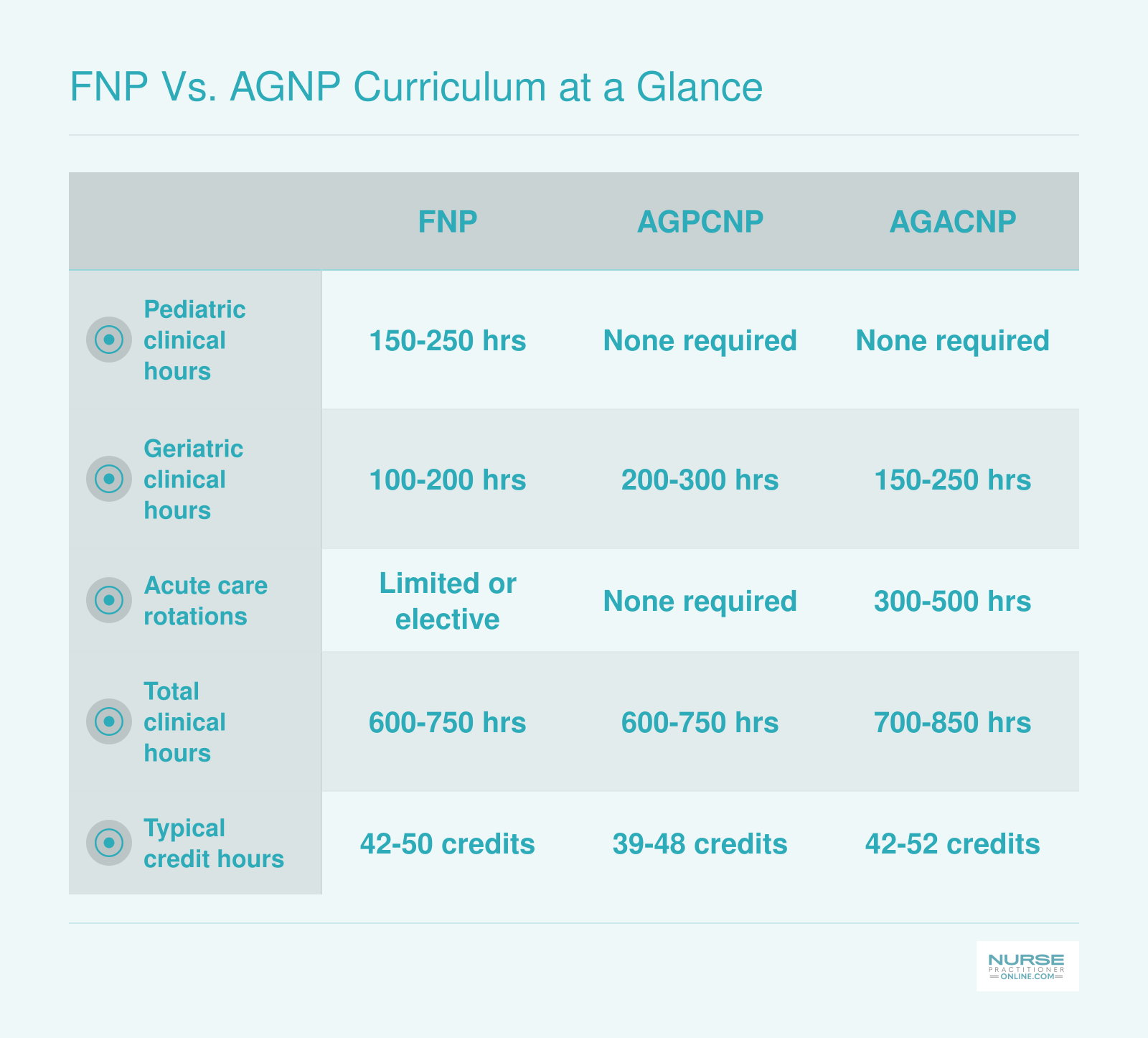
FNP Vs. AGNP Curriculum at a Glance
Not all NP tracks require the same coursework or clinical focus. This quick comparison shows how FNP, Adult-Gerontology Primary Care NP (AGPCNP), and Adult-Gerontology Acute Care NP (AGACNP) programs typically differ across core curriculum attributes. Use it to see at a glance which track aligns with your preferred patient population and clinical setting.
Certification Exams: ANCC Vs. AANP for FNP and AGNP Tracks
With pass rates stabilizing around the low 80s, the choice between ANCC and AANP certification for family nurse practitioners has become less about exam difficulty and more about career fit.
Which Exams Cover Which Population Focus?
Two certifying bodies dominate NP credentialing. The American Nurses Credentialing Center (ANCC) offers the Family Nurse Practitioner-Board Certified (FNP-BC), the Adult-Gerontology Primary Care NP-BC (AGPCNP-BC), and the Adult-Gerontology Acute Care NP-BC (AGACNP-BC). The American Association of Nurse Practitioners (AANP) awards the FNP-C and the Adult-Gerontology Nurse Practitioner (A-GNP). The A-GNP covers primary care only; if you intend to practice in acute or critical care with adults, the ANCC AGACNP-BC is your only option. For a broader look at credentialing pathways, see our nurse practitioner licensing guide.
Exam Format and Content Domains
Both boards administer computer-based exams, but the structure and question types differ. The ANCC FNP-BC includes 175 questions (with 25 unscored pretest items) delivered in 210 minutes and may feature alternate item types such as multiple correct answers or fill-in-the-blank. Content is distributed across five domains: assessment (19%), diagnosis (17%), planning (19%), implementation (29%), and evaluation (15%).2 The AANP FNP-C uses 150 scored questions in 180 minutes with a strictly multiple-choice format.3 Its blueprint dedicates roughly 32% of items to patient assessment, with the remainder balanced across diagnosis, planning, and evaluation. AGNP exams follow a comparable blueprint but concentrate on adult and geriatric clinical scenarios.
Pass Rates and What They Signal
The most recent data shows an 82% pass rate for the ANCC FNP-BC (2025) and 83% for the AANP FNP-C (2024).2 The one-point difference is not statistically meaningful; success typically reflects the alignment between your program's curriculum and the certifying body's emphasis. Pass rates for adult-gerontology certifications are not publicly tracked in the same way, but schools with strong AGNP tracks report outcomes consistent with the FNP exams.
Eligibility and Renewal Requirements
To sit for any of these exams, you must have graduated from an accredited NP program in the corresponding population focus, completed at least 500 supervised clinical hours, and passed a national criminal background check.3 Renewal cycles are identical: both ANCC and AANP require recertification every five years, with 75 continuing education (CE) hours, 25 of which must be pharmacology.2 The primary distinction is not in maintenance but in initial choice: ANCC credentials align with Magnet-designated organizations and often carry weight in academic settings, while the AANP's FNP-C is widely recognized in primary care practices nationwide. Nurses who already hold FNP certification and want to add an adult-gerontology focus can explore AGNP post-master's certificate online programs to expand their scope without completing a full degree.
Related Articles
Salary and Job Outlook: FNP Vs. AGNP Earnings Compared
The Bureau of Labor Statistics projects nurse practitioner employment to grow 28 percent from 2023 to 2033, nearly five times faster than the average for all occupations. That headline figure applies to the entire SOC 29-1171 category, meaning it covers FNPs, AGNPs, and every other NP specialty together. The practical question is how earnings and demand break down within that broad outlook.
Start with the BLS, Then Dig Deeper
The BLS Occupational Employment and Wages page for nurse practitioners is your most reliable starting point. It publishes a national median wage alongside state-level and metropolitan-area breakdowns, which lets you compare earnings in your target geography rather than relying on a single national number. Keep in mind the BLS does not separate FNP and AGNP salaries. Both roll up into the same occupational code, so specialty-level comparisons require other sources.
For that level of detail, salary aggregation tools fill the gap. Searching "FNP salary" versus "AGACNP salary" or "AGNP salary" on Payscale, ZipRecruiter, and Glassdoor surfaces self-reported figures filtered by years of experience and employment setting. Results vary considerably by contributor pool and region, so treat any single figure as a directional range rather than a precise benchmark. Cross-referencing two or three platforms gives you a more grounded picture.
The AANP Compensation Survey and Practice-Setting Differences
The AANP National NP Compensation Survey is the most granular resource available for specialty-level comparisons. It breaks down compensation by practice setting, including outpatient primary care, inpatient acute care, urgent care, and specialty clinics. Members can access the full report, and even the publicly released summary data is worth reviewing before you commit to a track. AGNPs working in inpatient acute or critical care settings often report higher base salaries than their outpatient counterparts, largely reflecting the acuity premium hospitals attach to those roles. If you are weighing online acute care nurse practitioner programs, this salary differential is worth factoring in. FNPs concentrated in primary care or community health may see a different ceiling, though high-demand rural and underserved markets can close that gap meaningfully.
Cross-Reference School-Level Outcomes
A step that many prospective students skip: checking graduate employment and salary outcomes published directly by programs. Schools like Duke and Johns Hopkins make program-specific data available on their NP program pages. This is especially useful because it ties earnings context to a specific curriculum, clinical training model, and graduate profile rather than relying on population-wide averages. When you are comparing programs, look for outcome reporting that distinguishes between FNP and AGNP tracks rather than combining all NP graduates into a single figure.
Putting these sources together (BLS for macro trends and geographic context, Payscale or ZipRecruiter for specialty-level comparisons, AANP survey data for setting-based differences, and school outcome pages for program-specific snapshots) gives you a layered view that no single source can provide on its own.
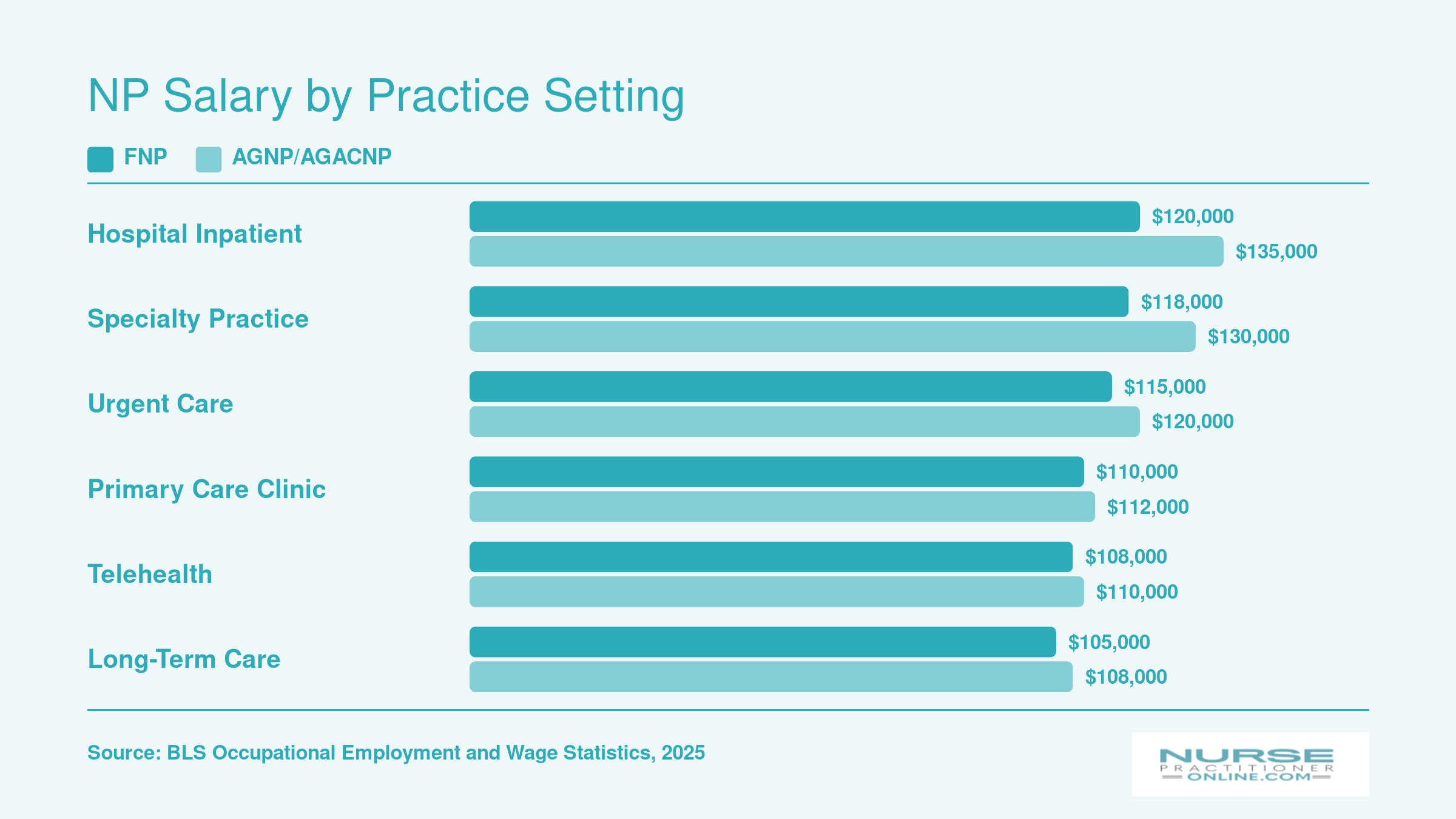
NP Salary by Practice Setting
Compensation for nurse practitioners varies significantly depending on the clinical environment. Hospital and acute care settings, where AGNPs and AGACNPs concentrate, tend to offer higher median pay than primary care or community-based roles more commonly filled by FNPs.
Career Settings and Employer Demand for FNPs and AGNPs
The setting where you want to work is often the clearest dividing line between selecting an FNP or an AGNP track. Nurse practitioners gravitate toward distinct practice environments depending on their population focus, and employer hiring patterns reinforce those boundaries.
Where FNPs and AGNPs Practice
- Outpatient primary care, community health, retail clinics, and school-based health: Dominated by FNPs, who manage patients across the entire lifespan in non-acute settings.
- Internal medicine and geriatric clinics: Common for adult-gerontology primary care NPs (AGPCNPs), whose adult-only focus aligns with these specialties.
- Hospitals, ICUs, surgical services, and emergency departments: The domain of adult-gerontology acute care NPs (AGACNPs), who are trained for complex, unstable patient populations.
The FNP Versatility Advantage, and Its Limits
Family nurse practitioner remains the most commonly held NP certification. With over 70% of NP job searches targeting family practice roles, FNPs open the widest range of outpatient positions and can see patients from infancy through end of life.1 This breadth is especially valuable in rural and underserved primary care, where employers need a clinician who can treat any patient who walks through the door. However, that versatility comes at a cost: most hospitals now require acute care nurse practitioner certification for hospitalist, ICU, or emergency department NP roles, effectively closing inpatient doors to FNPs.
Employer Demand Is Shifting Toward Specialized Acute Care
Hospital systems are aligning NP hiring with population-specific certifications. AGACNP job postings have grown as health systems expand hospitalist teams and assign nurse practitioners to critical care, surgical services, and emergency departments. A growing number of NP hospitalist programs explicitly list AGACNP certification as a requirement. Meanwhile, FNP demand remains robust in primary care, retail clinics, and school-based health centers, where they account for the vast majority of NP openings. The rise of telemedicine and urgent care has also widened FNP opportunities, but FNPs who want to work inside the hospital must understand the certification barrier.
State Practice Authority Adds Another Layer
Where you practice can make either certification even more powerful. In full-practice-authority states, FNPs can evaluate, diagnose, and treat patients independently without physician oversight, making the already-broad FNP credential exceptionally flexible for running a primary care practice.3 In restricted states, both FNPs and AGNPs operate under supervision, but the underlying certification still dictates which job doors open. For NPs considering relocation, matching your certification to a state's scope-of-practice laws can maximize career options and earnings. Comparing nurse practitioner salary by specialty can help you weigh the financial side of that decision.
Dual Certification and Post-Master's Certificate Pathways
What Dual NP Certification Actually Means
Dual NP certification means completing formal graduate-level preparation in two distinct population foci, such as family nurse practitioner (FNP) and adult-gerontology acute care nurse practitioner (AGACNP), and then passing two separate national certification exams. This is not the same as taking a handful of extra courses; schools typically structure these as combined degree or dual-track programs that embed the coursework and clinical hours for both specialties into a single plan of study. Compared with a single-track MSN or DNP, a combined FNP/AGACNP program commonly adds 12 to 24 credit hours and 500 to 700 additional clinical hours. The precise numbers vary by institution, so treating any single range as universal would be misleading.
Many working nurses find that pursuing a combined track upfront adds a semester or two but eliminates the need to return later for a post-master's certificate. That appeal, one enrollment, one clinical placement coordination cycle, one comprehensive degree, often outweighs the heavier load.
Post-Master's Certificate Pathways for Adding a Second Population Focus
If you already hold one NP certification and want to add a second, the post-master's NP certificate is the designed path. These certificates focus entirely on the didactic and clinical content of the new population focus without repeating core advanced practice nursing courses you already completed. For example, an FNP looking to add acute care expertise can explore online post masters FNP programs or equivalent AGACNP certificates depending on the direction of expansion. Credit hour requirements commonly fall in the 15- to 25-credit range, and clinical hours tend to land between 500 and 650, though some programs run higher if state regulations demand it. Because every state board of nursing interprets "equivalent preparation" independently, the same certificate program might satisfy one state's requirements and fall short in another. This makes direct conversation with both the school and your state board non-negotiable early in the process.
How to Research Program Details Effectively
Program websites are the most accurate source for the credit and clinical hour structure of dual tracks and post-master's certificates. Search for terms like "post-master's certificate NP [population focus]" or "dual NP certification FNP AGACNP" directly on university nursing pages. When you locate a program, reach out to the admissions office or coordinator; these contacts can confirm whether the curriculum map reflects upcoming catalog changes and whether the school has articulation agreements with clinical sites in your state. For broad employment trends, the Bureau of Labor Statistics (BLS.gov) offers reliable occupation-level projections, but it will not tell you which schools offer combined tracks or how many clinical hours a state requires. Certification bodies like the American Association of Nurse Practitioners (AANP) and the American Nurses Credentialing Center (ANCC) publish eligibility requirements for each exam; those pages are essential for verifying that a post-master's certificate will indeed make you exam-eligible for the second certifications for nurse practitioners.
Planning Your Timeline and Credits
Adding a second population focus through a post-master's certificate often takes 12 to 18 months of part-time study, though some accelerated options shorten this to as little as three semesters. If you are weighing a combined program from the outset, expect total credit hours for a BSN-to-DNP dual track to push well above 80, which can extend the program by a full academic year compared with a single-focus pathway. Keep in mind that clinical placements, particularly for acute care hours, can be the bottleneck: programs in rural or highly competitive metro areas may have waiting lists for preceptor sites. Asking about average time-to-placement before you apply can spare you an unexpected delay.
How to Choose Between FNP and AGNP: A Decision Framework
Some nurses know their ideal patient population from day one: newborns through geriatrics, or exclusively adults in high-acuity settings. For the rest of us, the choice between FNP and AGNP tracks demands a more deliberate look at where we want to practice, whom we want to treat, and how much flexibility we need for career pivots down the line.
Neither path is objectively better. The right answer depends entirely on your clinical interests, preferred work environment, and long-term career vision. Here is a structured way to think through the decision.
Preferred Patient Population
This is the most fundamental question. If you want to care for patients across the lifespan, including children, adolescents, and pregnant women, FNP is your only option. The family nurse practitioner track prepares you to manage wellness visits, chronic disease, and acute minor illness in patients from birth through end of life.
Lean AGNP if you prefer treating adults exclusively and have no interest in pediatrics or women's health. Adult-gerontology tracks focus on patients aged 13 or older (primary care) or adults in acute and critical care settings (AGACNP). If your favorite shifts as a bedside nurse involved managing sepsis, post-op complications, or ventilator weaning, the acute-care AGNP track builds directly on that foundation.
Desired Practice Setting
FNPs thrive in ambulatory environments: family medicine clinics, retail health, urgent care, and telehealth platforms. If you envision yourself managing a panel of patients in a community health center or opening your own practice in a rural area, FNP delivers the breadth and regulatory acceptance you need.
Lean AGNP if you want to stay hospital-based. AGACNPs work in ICUs, EDs, specialty consult services, and hospitalist teams. If you loved the pace and complexity of acute care nursing and want to remain in that setting as an advanced practitioner, the acute-care track is the natural extension.
Long-Term Career Goals and Geographic Flexibility
FNP certification opens doors in nearly every state and every setting that employs NPs. Employers recognize the credential, insurers credential it readily, and scope-of-practice laws are well-established. If you plan to move frequently, work locum tenens, or practice in underserved areas, FNP maximizes portability.
Lean AGNP if your career ambitions center on hospital medicine, specialty care, or academic medical centers. AGACNPs command strong demand in urban hospitals and specialty practices, but job opportunities thin out in rural markets where family medicine dominates.
State Scope-of-Practice Environment
Before committing to either track, review your state's scope-of-practice laws. Some states grant full practice authority to all NPs, while others require physician collaboration or supervision. A handful of states impose additional restrictions on AGACNPs working in primary care settings or FNPs attempting to manage hospitalized patients. Confirm that your intended practice model aligns with your state's regulations.
Appetite for Dual Certification or Future Pivots
If you are genuinely torn or foresee wanting both skill sets, consider starting with one track and pursuing a post-master's certificate in the other later. Many NPs earn dual FNP and AGACNP certification to maximize clinical versatility and job opportunities. This path takes longer and costs more, but it eliminates the need to choose a single lane permanently. Exploring the full range of nurse practitioner specialties can also help you identify which combination best aligns with your goals.
Actionable Next Steps
Before you apply, shadow at least one FNP and one AGNP in their actual practice settings. Observe a full day in a family clinic and a full shift in a hospital ICU or ED. The difference in pace, decision-making rhythm, and patient interaction will clarify your instincts quickly.
Review your state's nurse practice act and any recent legislative updates. Contact the state board of nursing if scope-of-practice rules are unclear.
Finally, reach out to admissions offices at schools offering both FNP and AGNP tracks. Ask about clinical rotation requirements, preceptor support, and whether students in each track can observe or rotate through the other setting. Programs with strong clinical infrastructure often offer more flexibility to explore both worlds before committing fully.
Common Questions About AGNP Vs. FNP Programs
Choosing between AGNP and FNP tracks raises plenty of practical questions about scope, salary, and flexibility. Below are answers to the questions nurses ask most often when weighing these two paths.
- Can I work in a hospital with an FNP certification, or do I need AGACNP?
- FNPs can work in some hospital departments, such as outpatient clinics and emergency departments in certain states, but most acute inpatient roles require an Adult-Gerontology Acute Care NP (AGACNP) certification. Hospital credentialing committees typically mandate that providers hold a certification matching the acuity level of the patient population. If your goal is ICU, trauma, or hospitalist work, the AGACNP track is the safer choice.
- Which certification exam should I take for FNP vs. AGNP: ANCC or AANP?
- For FNPs, both the ANCC and AANP offer nationally recognized certification exams. AGNPs certified through the primary care track (AGPCNP) can sit for either the ANCC or AANP exam, while acute care AGNPs (AGACNP) currently certify exclusively through the ANCC. Check your state board of nursing requirements and your program's alignment before deciding, because some states or employers prefer one credential over the other.
- What is the salary difference between FNP and AGNP nurse practitioners?
- The Bureau of Labor Statistics reports a median annual salary of roughly $126,260 for nurse practitioners as of 2024, but it does not break out FNP and AGNP separately. In practice, AGACNPs working in hospital and critical care settings often earn slightly more due to shift differentials and higher acuity demand. FNPs in specialty or urgent care clinics can close that gap. Geographic location and practice setting tend to influence pay more than the specific certification.
- Can I switch from FNP to AGNP with a post-master's certificate?
- Yes. Many accredited programs offer post-master's certificates that let you add an AGNP credential (either primary care or acute care) without completing an entirely new master's degree. These certificates typically require 15 to 25 credit hours and additional clinical hours specific to the adult-gerontology population. This is also a common route for nurses who want dual certification to maximize career flexibility.
- Is FNP or AGNP better for job flexibility and long-term career options?
- FNP certification generally offers the broadest flexibility because it covers patients across the lifespan, from pediatrics through geriatrics, and is accepted in the widest range of outpatient settings. AGNP certification provides deeper specialization in adult and older adult care, which can be an advantage in hospital systems and geriatric-focused practices. If you value the ability to move between settings and patient populations, FNP is usually the more versatile choice.
- What is the difference between AGPCNP and AGACNP?
- Both fall under the AGNP umbrella but serve different acuity levels. The Adult-Gerontology Primary Care NP (AGPCNP) manages chronic conditions, wellness visits, and preventive care for adults and older adults in outpatient settings. The Adult-Gerontology Acute Care NP (AGACNP) treats acutely and critically ill adults in hospitals, ICUs, and emergency departments. Each has its own certification exam and distinct clinical training requirements.
- Do FNP and AGNP programs require the same number of clinical hours?
- Most accredited programs require a minimum of 500 direct patient care clinical hours for either track, though many schools exceed that baseline with 600 to 750 hours or more. The key difference is where those hours are completed. FNP students rotate through family practice, pediatric, and women's health sites, while AGNP students focus clinical time on adult and geriatric primary care or acute care settings, depending on their subspecialty.