Most important takeaways…
- MSN-FNP and DNP-FNP graduates earn the same national certification and share identical scope of practice in every state.
- DNP-prepared NPs typically earn 10 to 15 percent more than MSN-prepared NPs, with the gap widening in leadership roles.
- Post-master's DNP programs require only 30 to 40 extra credits and can be finished in 12 to 24 months.
- Most nurses break even on the added DNP tuition cost within three to five years of graduating.
As of 2026, over 40,000 nurses enroll in Doctor of Nursing Practice (DNP) programs annually, a stark contrast to the 70 students who launched the first DNP programs in 2003. The AACN's long-standing push for the DNP as the terminal practice degree, with an initial target of 2025, has fueled a decade-long debate that only intensified as that target passed and more working nurses faced the MSN or DNP decision.
Both the MSN and DNP qualify a nurse practitioner to sit for national certification and obtain state licensure. The decision is about career strategy, not eligibility. For most NPs, the DNP's financial return is modest at the bedside, but the degree is a prerequisite for faculty, executive, and policy roles.
MSN Vs. DNP at a Glance: Side-By-Side Comparison
For nurses weighing the MSN versus DNP pathway, a clear side-by-side look at the core program differences helps frame the decision. Both degrees lead to FNP certification and clinical practice, but they differ in time commitment, credit load, clinical hours, and cost. Below is a head-to-head snapshot based on typical 2025-2026 program requirements.1
Program Length and Credit Requirements
- MSN-FNP: Full-time students generally complete the degree in 24 to 36 months, with a total of 40 to 55 credits required. Part-time options can extend the timeline, making it a flexible choice for working nurses.
- DNP-FNP: A full-time BSN-to-DNP pathway usually takes 36 to 48 months and demands 65 to 85 credits. The added depth comes from leadership, evidence-based practice, and project work that characterizes doctoral education.
Clinical Hours and Certification Eligibility
- MSN-FNP: Clinical immersion involves 500 to 700 patient-care hours. This meets national certification board requirements and qualifies graduates to sit for the FNP exam.
- DNP-FNP: DNP programs require at least 1,000 clinical hours, offering more hands-on practice and a scholarly project. Graduates are equally eligible for FNP certification; the DNP does not alter the RN license scope but signals advanced preparation.
Cost and Accreditation
- MSN-FNP: Total program costs typically range from $35,000 to $70,000. Programs are accredited by either the CCNE or ACEN, ensuring quality standards and financial aid eligibility.
- DNP-FNP: Costs often fall between $40,000 and $70,000, meaning the DNP can be comparable in price to some MSN programs. Look for CCNE or ACEN accreditation, as both paths must meet rigorous educational criteria to qualify for NP licensure.
Both pathways align with current AACN expectations for NP preparation.1 Once you have decided which degree fits your goals, our guide on how to enroll in NP school online walks you through the application process step by step. The choice ultimately hinges on how much time and credit investment you are ready to make right now, and whether the additional clinical and leadership training in a DNP aligns with your long-term career goals.
What Is an MSN? Degree Overview for Aspiring NPs
What does it actually take to become a nurse practitioner through an MSN program, and how do you know if a program meets professional standards?
The Master of Science in Nursing with a Family Nurse Practitioner concentration (MSN-FNP) remains the traditional entry point into advanced practice nursing. This graduate degree prepares registered nurses to diagnose conditions, prescribe medications, and manage patient care independently or collaboratively, depending on state regulations.
Program Structure and Clinical Requirements
MSN-FNP programs typically require between 36 and 50 total credit hours, though this varies by institution. Most programs can be completed in two to three years of full-time study, with part-time options extending that timeline to accommodate working nurses.
Clinical hours represent a critical component of your training. The current standard range for MSN-FNP programs falls between 500 and 750 direct patient care hours. These hours must be completed under the supervision of qualified preceptors and cover populations across the lifespan. Some programs require students to secure their own clinical placements, while others provide placement assistance.
Finding Reliable Program Information
To evaluate specific programs, start with the school's official website and look for curriculum guides, student handbooks, or program fact sheets. These documents outline credit requirements, clinical hour expectations, and course sequences. You can also browse our ranked list of the best online MSN FNP programs to compare options side by side.
Accreditation status should be your next checkpoint. Two primary bodies accredit nursing programs:
- CCNE: The Commission on Collegiate Nursing Education (ccneaccreditation.org) sets standards for baccalaureate and graduate nursing programs.
- ACEN: The Accreditation Commission for Education in Nursing (acenursing.org) accredits programs at all levels.
While these organizations establish quality benchmarks, specific minimum clinical hour requirements vary and are best confirmed directly with individual programs.
Professional Resources for Career Guidance
Professional associations offer valuable context for program expectations. The American Association of Nurse Practitioners (AANP) and the American Nurses Association (ANA) publish guidance on educational standards and typical program benchmarks. The Bureau of Labor Statistics (BLS.gov) provides general career outlook data for nurse practitioners, though it does not detail program structures.
For working nurses balancing careers and education, online family nurse practitioner programs offer flexibility without compromising clinical training standards. You complete didactic coursework remotely while arranging clinical rotations in your local community. If you're already weighing long-term options, it's worth understanding the momentum behind DNP entry-to-practice requirements, which could shape future credentialing expectations.
What Is a DNP? Degree Overview for Aspiring NPs
The central question for many nurses considering advanced practice is whether to pursue the highest clinical degree available or enter practice sooner with a master's degree. The Doctor of Nursing Practice answers that question for those who want the terminal practice credential, positioning themselves at the top of the clinical nursing hierarchy.
The DNP as a Practice-Focused Terminal Degree
The DNP is nursing's terminal practice degree, designed to prepare nurse practitioners, nurse anesthetists, and other advanced practice nurses for the highest level of clinical leadership. Unlike the PhD in nursing, which emphasizes original research and academic scholarship, the DNP focuses on translating evidence into practice, improving healthcare systems, and leading quality initiatives.
This distinction matters for career planning. The DNP parallels other practice doctorates in healthcare: the MD for physicians, the PharmD for pharmacists, and the DPT for physical therapists. If your goal is clinical excellence and systems leadership rather than conducting bench research or pursuing a tenure-track faculty position, the DNP is the appropriate terminal credential.
Expanded Coursework Beyond MSN Content
DNP programs build on the clinical foundation of master's-level NP training, then add substantial coursework in areas that prepare graduates for leadership and population-level impact:
- Systems leadership: Managing healthcare teams, navigating organizational change, and influencing institutional decision-making
- Healthcare policy: Analyzing legislation, advocating for nursing practice authority, and shaping reimbursement structures
- Population health: Designing interventions that improve outcomes across communities rather than individual patients alone
- Quality improvement: Applying frameworks like Lean and Six Sigma to reduce errors, improve efficiency, and measure outcomes
The capstone requirement distinguishes DNP programs from MSN curricula. Rather than a traditional research dissertation, DNP students complete a scholarly project that solves a real clinical or systems problem. These projects often involve implementing evidence-based protocols, evaluating quality metrics, or piloting new care delivery models in partnership with healthcare organizations.
Clinical Hours and Program Timeline
BSN-to-DNP programs in the Family Nurse Practitioner specialty typically require 1,000 or more supervised clinical hours, roughly double what most MSN programs mandate. This extended clinical preparation reflects the doctoral level of the degree and ensures graduates enter practice with deeper hands-on experience. If you're still mapping out the full journey, our guide on how to become a nurse practitioner covers each step from BSN onward.
For full-time students, expect a BSN-to-DNP-FNP program to take three to four years. Part-time options stretch that timeline but allow working nurses to maintain employment throughout their studies. The additional time investment compared to an MSN is significant, so weighing that commitment against your career timeline and financial situation is essential.
Same Certification, Same Initial Scope
Despite the additional education, DNP graduates sit for the same national certification exams as their MSN-prepared peers. The ANCC and AANP exams do not differentiate by degree level, meaning a newly certified DNP-FNP and a newly certified MSN-FNP have identical clinical scope of practice upon entry. The DNP credential does not expand prescriptive authority or grant additional procedures by itself. What it does provide is deeper preparation for leadership roles, scholarly contributions, and long-term career advancement that may not be immediately visible at the start of practice. Specialties like psychiatric mental health and pediatrics offer their own DNP PMHNP programs and DNP pediatric nurse practitioner programs for nurses who want doctoral preparation in a focused population.
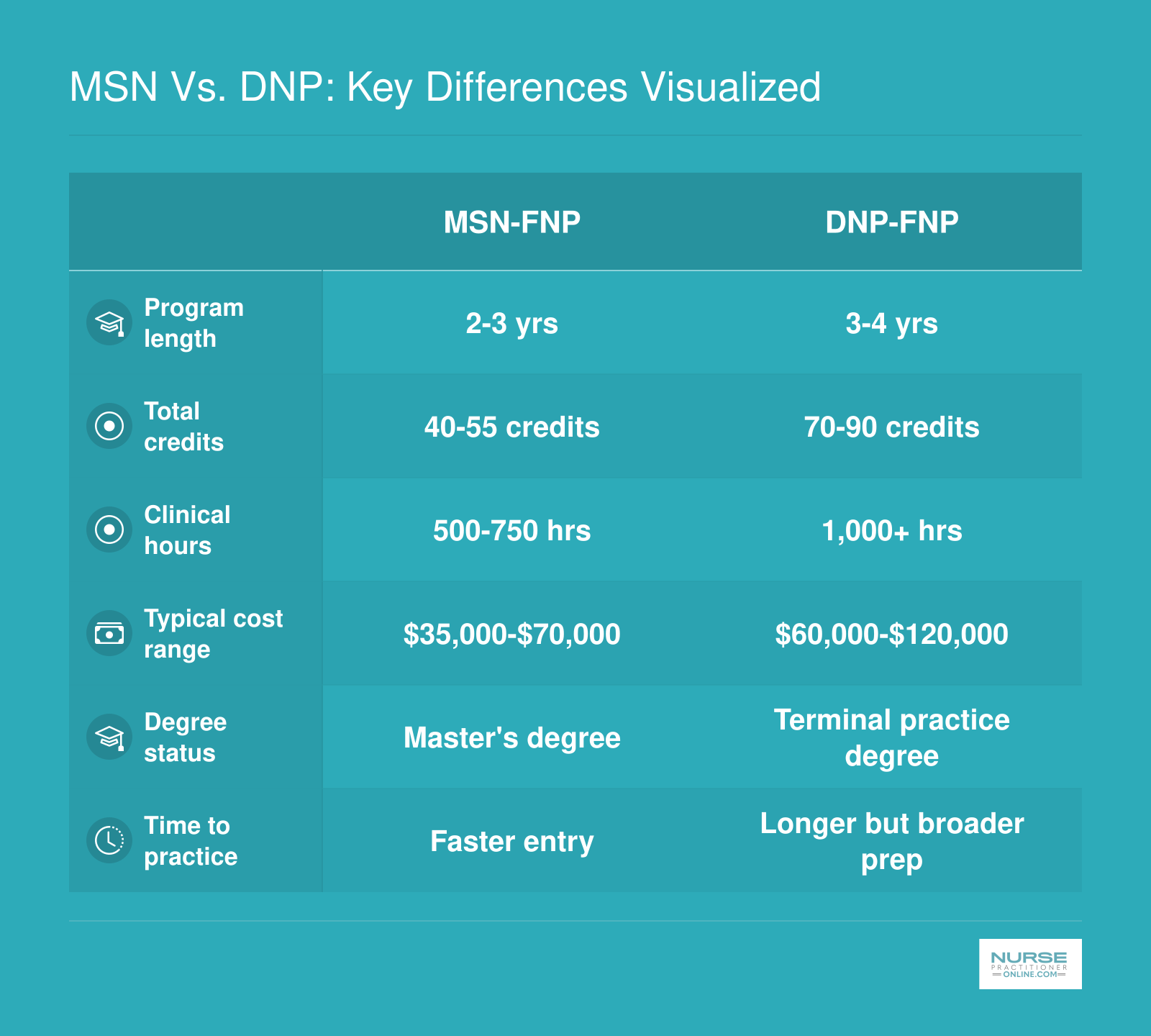
MSN Vs. DNP: Key Differences Visualized
Choosing between an MSN-FNP and a DNP-FNP comes down to a handful of measurable factors. This side-by-side snapshot distills the most important differences so you can quickly see how each pathway stacks up before diving deeper into cost, salary, and scope of practice.
MSN Vs. DNP Salary: How Much More Do DNP-Prepared NPs Earn?
A DNP after your name versus an MSN: does the extra credential translate into a noticeably bigger paycheck, or is the salary difference more modest than you might expect? The honest answer falls somewhere in between, and it depends heavily on where you work, what you specialize in, and how you use the degree.
The Baseline: What NPs Earn Overall
According to Bureau of Labor Statistics data, the median annual wage for nurse practitioners nationally was $129,210 as of 2024, with a mean of roughly $133,646.1 Salary ranges for 2025 and 2026 have trended upward, with many NPs earning between $130,000 and $145,000 depending on specialty. For context, family NPs currently see mean earnings around $105,898, while critical care nurse practitioners can reach approximately $172,199. Psychiatric-mental health NPs typically fall in the $128,000 to $140,000 range.4 These figures reflect all NPs regardless of degree level.
The DNP Premium: Real but Modest for Most Roles
Most compensation surveys that break out earnings by highest degree earned show a DNP salary premium in the range of $5,000 to $15,000 per year. That is meaningful over a career, but it is not the dramatic jump some prospective students hope for. For bedside FNP roles in primary care settings, the gap between an MSN-prepared NP and a DNP-prepared NP is often negligible. Employers in these settings typically base pay on experience, certification, and productivity rather than terminal degree status.
The premium tends to show up more clearly in career trajectory than in starting pay. Over time, DNP holders may move into roles that command higher compensation, but the degree itself is rarely the sole driver of a raise in a clinical position.
Where the DNP Pay Advantage Is Most Pronounced
Certain settings and roles do reward the DNP credential more directly:
- Academic positions: Universities increasingly require or strongly prefer a DNP (or PhD) for faculty roles, which come with their own salary scales and often include benefits like tuition remission.
- Hospital system leadership: Director-level and chief NP roles in large health systems frequently list a DNP as preferred, and these positions carry salaries well above clinical averages.
- VA system: The Department of Veterans Affairs uses General Schedule pay grades, and a doctoral degree can affect GS-level placement, resulting in a concrete bump in base pay.
- Full practice authority states: In states where NPs practice independently, DNP-prepared NPs may find it easier to launch or lead independent practices, which can significantly increase earning potential beyond a salaried position.
Specialty Matters More Than Degree Level
It is worth noting that specialty choice often has a far greater impact on compensation than whether you hold an MSN or DNP. For a deeper look at how pay varies across specialties, see our breakdown of nurse practitioner salary by specialty. The gap between a family NP earning around $110,000 to $120,000 and a critical care NP earning north of $170,000 dwarfs the typical DNP premium.4 If maximizing salary is a primary goal, your choice of population focus and practice setting will likely move the needle more than the degree level alone.
The bottom line: a DNP can open doors to higher-paying leadership, academic, and systems-level roles over time, but if you plan to practice as a clinical FNP in a primary care office, expect the salary difference to be modest in the early years of your career. Think of the DNP as a long-game investment in career flexibility rather than an immediate pay raise.
Total Cost and ROI: Is the DNP Worth the Extra Investment?
Does the higher salary that DNP-prepared NPs sometimes earn actually outweigh the additional tuition costs?
Typical Tuition Ranges for MSN vs. DNP
The price difference starts with the program type. A Master of Science in Nursing (MSN) with FNP specialization from a public university can be as low as $17,380 in-state (Columbus State University, 44 credits) or $22,320 (Auburn University at Montgomery, 48 credits).1 Out-of-state MSN students at public schools may see totals around $50,112. Private university MSN programs often fall in the $18,000 to $57,000 range.2
BSN-to-DNP programs, which combine master's and doctoral work, carry a higher sticker price. An affordable DNP benchmark from 2025 to 2026 data is $57,118, while the maximum NP program cost can reach $100,000.1 Private DNP programs tend to be at the upper end. The extra credits and clinical hours drive the difference.
Student Debt and the DNP Premium
Many graduate nursing students finance a significant portion of their degree. While precise average debt figures vary, it is common for MSN graduates to carry debt proportional to the program costs above. DNP students may take on $30,000 to $50,000 more in loans than their MSN counterparts. However, because NP salaries are strong, this additional borrowing sits within a manageable debt-to-income picture for most full-time clinicians.
Break-Even Analysis: When Does the DNP Pay Off?
A simple payback calculation shows the trade-off. If a DNP costs $30,000 to $50,000 extra and leads to an annual salary bump of $5,000 to $15,000, the break-even point falls between 3 and 8 years. For example:
- $30,000 extra cost / $10,000 higher salary: Payback in 3 years
- $50,000 extra cost / $5,000 higher salary: Payback in 10 years (still early in a 25+ year career)
The actual return depends on your specialty, region, and employer, but the long-term math favors the DNP for many nurses who plan to stay in clinical practice or leadership.
Cost-Saving Strategies to Narrow the Gap
You do not always have to pay the full list price. Often-overlooked ways to reduce out-of-pocket spending include:
- Employer tuition reimbursement: Many hospitals and health systems offer $3,000 to $5,000 per year toward graduate nursing education
- Post-master's DNP path: Completing an MSN first and then a shorter DNP program (often 18 to 24 months) costs less overall than a single BSN-to-DNP
- Public university pricing: In-state tuition at state schools consistently ranks as the most affordable option
- Assistantships and scholarships: DNP students may qualify for teaching or research assistantships that offset tuition while providing stipends
Another cost-conscious approach is earning your MSN first, then adding a post master's certificate FNP to expand your scope before deciding whether the DNP is worth pursuing. Combining two or more of these tactics can bring the net DNP cost within a few thousand dollars of an MSN, making the upgrade far more accessible.
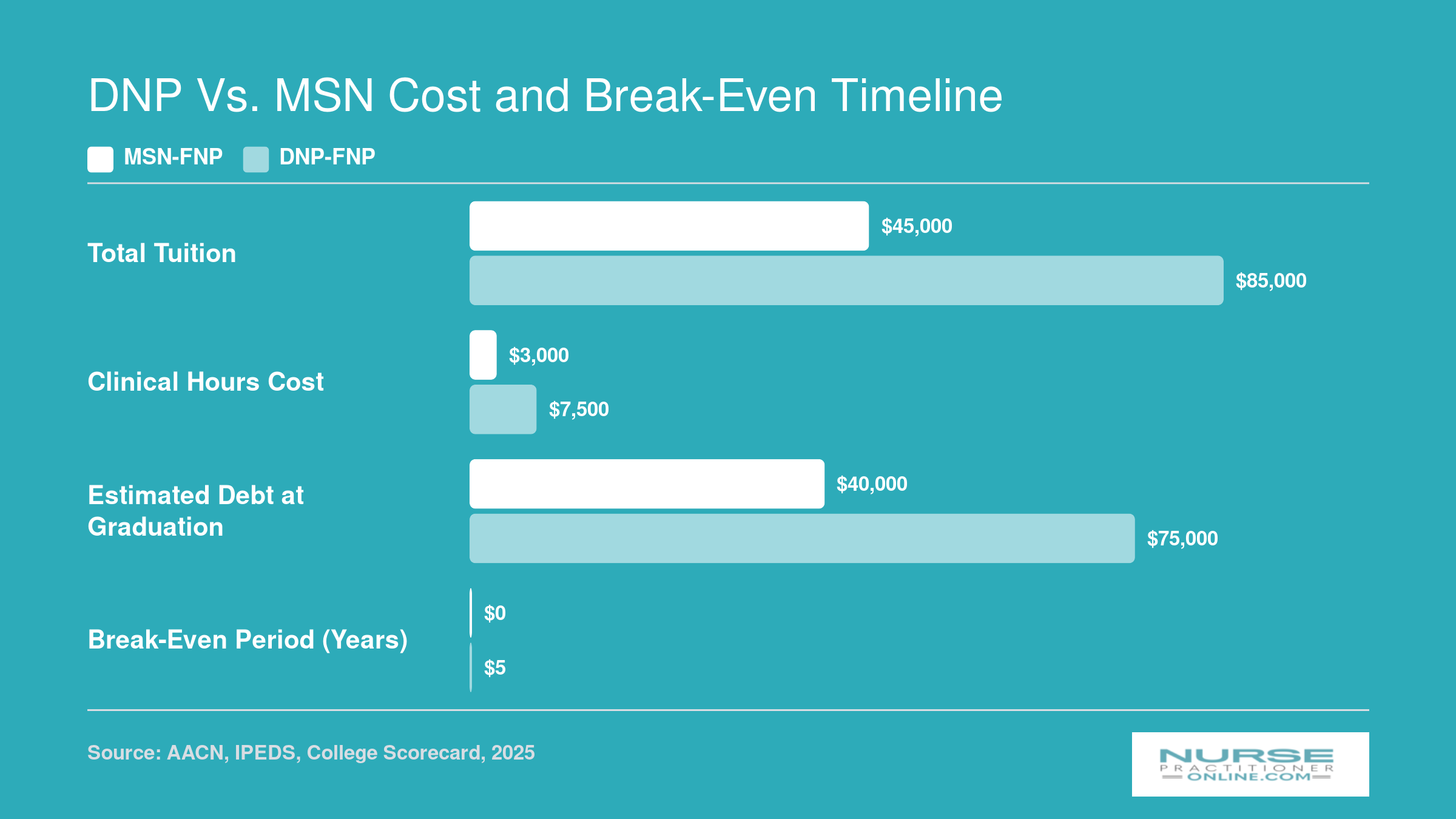
DNP Vs. MSN Cost and Break-Even Timeline
How do the financial commitments of an MSN-FNP and a DNP-FNP stack up? This comparison highlights average tuition, clinical-hour expenses, estimated graduation debt, and the approximate time it takes for the DNP salary premium to offset the extra investment.
MSN-FNP Vs. DNP-FNP: Does the Degree Level Change Your Scope of Practice?
Your scope of practice as a family nurse practitioner is determined by the state where you hold your license and the national certification you carry, not by the letters after your name. Whether you graduate from an MSN-FNP program or a DNP-FNP program, you sit for the same board exam, either through AANP or ANCC, and you receive the same FNP credential upon passing.
The Certification and Licensure Reality
As of 2026, no state requires a DNP to obtain NP licensure.1 MSN-prepared NPs remain fully eligible to practice across all fifty states and the District of Columbia.2 The American Association of Colleges of Nursing has maintained its position that the DNP should be the preferred entry-level degree for advanced practice nursing, and the National Organization of Nurse Practitioner Faculties similarly called for a DNP entry-to-practice standard.3 Those are professional advocacy positions, not legal mandates. The legislative landscape has not caught up, and the conversation about whether any state will move toward a DNP requirement continues without resolution at the moment.
It is also worth noting that nursing organizations are not entirely aligned on this question. The National Association of Neonatal Nurses, for example, does not endorse a mandatory DNP requirement for neonatal NP practice, which signals that specialty contexts matter and consensus is still forming.4 If you are interested in that specialty, you can explore online NNP programs to compare MSN and DNP options side by side.
Clinical Hours and Practical Confidence
Where the two degrees do differ in a meaningful way is clinical preparation. DNP programs typically require substantially more supervised clinical hours than MSN programs, often roughly double. That additional time in clinical settings can translate into greater confidence when entering practice and may make a DNP graduate feel more competitive on the job market, particularly in complex or acute care nurse practitioner environments. To be clear, though, those hours do not grant a broader legal scope of practice. They reflect program depth, not regulatory authority.
Employer Preferences: A Shifting Landscape
Some large health systems and academic medical centers have begun expressing a preference for DNP-prepared NPs when filling leadership roles, faculty positions, or preceptor responsibilities. For frontline clinical FNP positions, however, that preference is not yet widespread. Most employers continue to hire MSN-prepared and DNP-prepared FNPs for the same clinical roles and evaluate candidates on certification, experience, and fit rather than degree level alone.
The bottom line: both pathways lead to the same credential and the same legal authority to practice. The degree level shapes your preparation and may influence certain opportunities down the road, but it does not open or close the clinical doors that state law controls.
Questions to Ask Yourself
Should I Get a DNP or MSN? A Decision Framework for Working Nurses
Is a DNP really better than an MSN for my nursing career, or am I better off starting with the master's? The answer depends less on the degree name and more on where you want your NP career to take you. Use this four-factor framework to weigh your options.
Factor 1: Career Goals, Clinical vs. Leadership
Start with your endgame. If your primary aim is to provide direct patient care as a family nurse practitioner and you have no immediate interest in teaching, administration, or health policy, the MSN is a direct and efficient path. It equips you with advanced clinical skills and qualifies you for board certification. A DNP, by contrast, layers on systems-level leadership, quality improvement, and evidence-based practice translation. It makes more sense if you envision yourself shaping clinical programs, leading quality initiatives, or moving into faculty roles. Both degrees prepare you for the same NP scope of practice at the bedside, so the clinical difference is small, but the career doors beyond the clinic are where the DNP pulls ahead.
Factor 2: Timeline, How Soon Do You Want to Practice?
For working nurses eager to transition into an NP role and start earning that higher salary, timeline matters. An MSN program typically takes 2 to 3 years full-time. A BSN-to-DNP program commonly requires 3 to 4 years. Those extra semesters represent delayed income and additional living expenses. If your personal or financial situation rewards speed, the MSN gets you licensed and practicing sooner. The DNP is a longer commitment, but it may be worth the wait if leadership roles are on your horizon.
Factor 3: Financial Situation, Can You Afford the Extra Investment?
DNP programs cost more in total tuition simply because they involve more credits. The price difference can range from $15,000 to $30,000 or more depending on the school. Beyond tuition, you forgo additional months or years of NP-level salary while still in school. Crunch the numbers against your own budget and projected earnings. If you have limited savings or support, the MSN may be the safer financial move. If you can absorb the extra cost, the DNP's long-term salary bump may offset it over a full career.
Factor 4: Work-Life Balance, Managing School and Life
Both MSN and DNP programs are built for working RNs, with part-time, online, and hybrid formats. But the DNP adds a scholarly project that demands significant time for literature review, implementation, and evaluation. That project often stretches over multiple semesters and can feel like a second job. While some MSN programs include a capstone, the DNP project is more rigorous and may intensify the juggle between work, family, and school.
The Reality of Working While Earning Your Degree
Most online and hybrid programs allow you to keep your nursing job, but clinical rotation hours still require in-person time. MSN-FNP tracks typically demand 500 to 700 clinical hours; DNP tracks often exceed 1,000 hours. That extra clinical burden, combined with the scholarly project, makes the DNP harder to manage while working full-time. If you need steady income and minimal disruption, the MSN's lighter clinical load gives you more breathing room.
A Clear Decision Framework
If your goal is to become a practicing NP as quickly and affordably as possible, choose the MSN. It is the efficient vehicle for board certification and clinical practice. If you want to position yourself for leadership, teaching, health policy, or advanced quality roles, the DNP pays career-long dividends. Those interested in the doctoral route can explore DNP FNP programs online to compare options and costs. Recognize that the MSN-first path does not close doors. Many schools offer post-master's DNP programs that are shorter and cheaper than the BSN-to-DNP route, letting you earn a doctorate after you have already established your NP career and income. This sequential approach combines the best of both worlds: you start working sooner and still gain the DNP credential when the time is right.
MSN Vs. DNP: Pros and Cons for Aspiring FNPs
Both the MSN and DNP can qualify you to practice as a family nurse practitioner, but each pathway comes with distinct trade-offs. Weighing these pros and cons against your personal goals, timeline, and financial situation will help you choose the degree that fits your career best.
Pros
- MSN programs typically take two to three years, getting you into practice sooner than a DNP pathway.
- MSN tuition costs are generally lower overall, reducing student loan burden and shortening your break-even timeline.
- DNP graduates may command higher salaries and are often preferred for leadership, faculty, and executive roles.
- A DNP prepares you with advanced evidence-based practice and systems-level skills that strengthen your clinical decision-making.
- Earning a DNP now positions you ahead of potential future degree requirements that nursing organizations have discussed.
- DNP holders often have a competitive edge when applying for roles in academic medical centers or health policy organizations.
Cons
- MSN-prepared NPs may face pressure to return for a DNP later if doctoral-level preparation becomes the expected standard.
- An MSN alone may limit your competitiveness for tenure-track faculty positions at universities that prefer doctoral credentials.
- DNP programs require one to two additional years beyond the MSN, which delays full-time earning potential.
- The added tuition and opportunity cost of a DNP can take several years to recoup, especially for NPs in lower-paying regions.
- DNP clinical scholarship projects demand significant time and effort on top of coursework and clinical hours.
- Not all employers differentiate between MSN and DNP credentials when setting NP salaries, which can reduce the financial payoff of the longer program.
Post-Master's DNP: Is It Worth Going Back After Your MSN?
Most post-master's DNP programs require just 30 to 40 additional credits and can be completed in 12 to 24 months, making them a far shorter commitment than a full BSN-to-DNP track.1 If you already hold an MSN and are weighing whether to go back, here is what the pathway actually looks like and who stands to gain the most.
How the Post-Master's DNP Pathway Works
Because you have already completed graduate-level coursework and clinical hours during your MSN, a post-master's DNP builds on that foundation rather than duplicating it. The AACN expects 1,000 total post-baccalaureate practice hours for the DNP, and your prior MSN clinical work typically transfers.2 That means you may need only a few hundred additional clinical or immersion hours rather than the full complement required of a BSN-to-DNP student.
Program structures vary, but two examples illustrate the range:
- UNC Greensboro: 30 credits completed in roughly 15 months, with requirements for 1,000 advanced practicum hours and 300 immersion hours.3
- University of Colorado Colorado Springs: 33 credits, designed for working APRNs seeking a flexible completion timeline.4
Most programs are offered partially or fully online, which makes them manageable alongside a clinical practice schedule.
Cost Context
Post-master's DNP tuition generally falls between $20,000 and $40,000, with per-credit costs averaging around $561 at representative programs.5 That is substantially less than the $80,000 or more that a full BSN-to-DNP can cost. Some employers offer tuition assistance or loan forgiveness for nurses pursuing doctoral education, so it is worth checking with your organization before you pay out of pocket.
Who Benefits Most
The career payoff of a post-master's DNP is most tangible for MSN-prepared NPs who want to step beyond direct patient care:
- Academic careers: Many nursing schools now require or strongly prefer the DNP for clinical faculty positions, a trend that is only accelerating.
- Health-system leadership: Roles in quality improvement, executive nursing administration, and health policy increasingly list the DNP as a preferred credential.
- Future-proofing: Some NPs choose to complete the degree now, ahead of any potential mandate that the DNP become the standard entry credential for advanced practice.
If your primary goal is to remain in clinical practice, the credential alone is unlikely to change your scope, your prescriptive authority, or your reimbursement rates. The MSN and DNP confer the same practice privileges in every state.
Weighing the Opportunity Cost
Even a part-time, 12-to-24-month program demands real time and energy from a working NP. You will be balancing coursework, a DNP scholarly project, and possibly additional clinical hours on top of your existing patient panel. Specialties like the DNP AGNP pathway offer structured options for those who want to combine doctoral study with a population focus. Before committing, ask yourself whether the roles you want truly require or reward the doctoral credential, or whether your career goals can be met with targeted certifications or leadership experience instead. The post-master's DNP is a smart investment for the right career trajectory, but it is not a universal must-have for every practicing nurse practitioner.
When the first DNP programs launched in 2003, total enrollment across the country was just 70 students. Today, tens of thousands of nurses enroll in DNP programs each year, according to AACN annual data reports, reflecting massive demand for doctoral-level nurse practitioner preparation.
Frequently Asked Questions About MSN Vs. DNP for Nurse Practitioners
Choosing between an MSN and a DNP is one of the biggest decisions you will make as an aspiring or current nurse practitioner. Below are answers to the questions working nurses ask most often, drawn from the key comparisons covered earlier in this guide.
- Can you practice as a nurse practitioner with just an MSN?
- Yes. An MSN is the minimum degree required for NP licensure in every U.S. state as of 2026. MSN-prepared nurse practitioners sit for the same national certification exams, hold the same prescriptive authority, and practice in the same clinical settings as their DNP-prepared peers. An MSN remains the most common and fastest path into NP practice.
- Are any states requiring a DNP for nurse practitioner practice?
- No state currently mandates a DNP for NP entry to practice. The American Association of Colleges of Nursing (AACN) has recommended the DNP as the preferred entry-level degree, yet no legislature has enacted that requirement. Some employers and academic medical centers may prefer or incentivize a DNP, but it is not a legal prerequisite for licensure anywhere in the country.
- How much longer does a DNP take compared to an MSN?
- A BSN-to-MSN program typically takes two to three years, while a BSN-to-DNP program runs three to four years. If you already hold an MSN, a post-master's DNP usually adds one to two years. The extra time accounts for additional coursework in evidence-based practice, healthcare policy, and leadership, plus a doctoral scholarly project.
- Do DNP-prepared nurse practitioners earn more than MSN-prepared NPs?
- On average, yes, though the gap varies by setting and specialty. Surveys suggest DNP holders earn roughly $10,000 to $15,000 more per year than MSN-prepared NPs. The premium tends to be largest in academic, administrative, and health-system leadership roles. In purely clinical positions, salary differences are often smaller because pay is tied more closely to specialty and patient volume.
- Is a DNP better than an MSN for FNP careers?
- It depends on your goals. For direct patient care as a family nurse practitioner, an MSN and a DNP confer identical scope of practice and certification. A DNP becomes more advantageous if you plan to pursue leadership positions, teach at research universities, influence healthcare policy, or position yourself for long-term career flexibility. If your priority is entering practice quickly, the MSN is a practical and fully credentialed choice.
- Can I work full-time while earning an MSN-FNP or DNP-FNP?
- Many online programs are designed with working nurses in mind, offering asynchronous coursework and flexible clinical scheduling. Most students find that full-time work is manageable during didactic semesters, though clinical rotations often require reduced hours. DNP programs demand more total credit hours and a scholarly project, so balancing a full-time schedule can be more challenging in the final year. Planning ahead with your employer can make either pathway realistic.