Most important takeaways…
- AGACNP graduates from top 2026 ranked programs report median first-year salaries above $120,000.
- Nurse practitioner employment is projected to grow 46% between 2023 and 2033 per the Bureau of Labor Statistics.
- Most online AGNP programs require between 500 and 750 direct patient care clinical hours.
- Choosing AGPCNP versus AGACNP determines your practice setting, patient population, and certification exam.
Adults 65 and older now account for roughly one in six Americans, and that share keeps climbing. For RNs considering graduate study, that demographic shift translates directly into hiring demand: hospitals, outpatient clinics, and long-term care facilities are actively competing for nurse practitioners who can manage complex adult and aging patients across the acuity spectrum.
The specialty splits into two distinct tracks. The Adult-Gerontology Primary Care NP (AGPCNP) focuses on chronic disease management and prevention in community settings, while the Adult-Gerontology Acute Care NP (AGACNP) is credentialed for high-acuity inpatient and critical care environments. The clinical training, certification exams, and scope of practice differ enough that choosing the wrong track early can cost you months of remediation.
Online delivery has made both tracks more accessible to working nurses, but program quality, clinical placement support, and cost vary considerably. AGACNP programs in particular carry tighter clinical hour requirements and narrower preceptor networks, which matters most if you already work in a region with limited academic medical centers.
Best Online Adult-Gerontology Nurse Practitioner Programs for 2026
We evaluated every accredited online AGNP program using a composite that balances graduate earnings, debt load, institutional graduation rates, and online delivery strength, then sorted by overall quality score. The list below covers both Adult-Gerontology Primary Care (AGPCNP) and Acute Care (AGACNP) tracks delivered primarily online or in a hybrid format. Whether you are a working RN looking for a flexible MSN, a post-master's certificate, or a BSN-to-DNP pathway, these programs represent the strongest combination of accessibility, affordability, and outcomes in 2026.
- Graduate earnings after completion
- Student debt at graduation
- Institutional graduation rates
- Online delivery accessibility
- Overall affordability and net price
- College Scorecard graduate earnings — collegescorecard.ed.gov
- NCES-IPEDS federal institutional data — nces.ed.gov
- Internal program database
- Independent program research

University of North Carolina at Chapel Hill
UNC Chapel Hill's School of Nursing delivers a distance-based AGPCNP program consistently ranked among the nation's best MSN offerings. Coursework covers advanced diagnostic reasoning and management of common and complex adult health conditions from adolescence through end of life. A distinctive oncology focus option prepares graduates for cancer survivorship care in outpatient and community settings, a specialty rarely available online. Strong ties with UNC Health and affiliated community practices give students access to high-quality clinical placements, particularly across North Carolina's rural and underserved counties.
- Distance-based online format designed for working RNs
- Five clinical courses emphasizing diagnostic reasoning
- Optional oncology concentration for survivorship care
- Prepares for ANCC or AANP national certification
- Clinical sites linked to UNC Health network in NC
- Ranked among top MSN programs nationally
- In-state tuition approximately $12,751; out-of-state $31,408
- Median graduate debt of $14,000 at the institutional level
- Dedicated oncology primary care curriculum
- Focus on symptom management and care coordination
- Evidence-based approach to complex oncology populations
- Same distance-based delivery as the standard AGPCNP track
- Designed for outpatient and community cancer care roles
- Eligible for ANCC or AANP certification upon completion
Adult-Gerontology Primary Care Nurse Practitioner (MSN) — Online
Adult-Gerontology Primary Care Nurse Practitioner, Oncology Concentration (MSN) — Online

Florida International University
Florida International University offers AGPCNP pathways at the MSN, DNP, and post-graduate certificate levels, all delivered predominantly online with no mandatory campus intensives. The six-semester MSN track totals 45 credit hours, while the certificate program requires 32 credits for nurses who already hold an MSN. FIU is closely aligned with South Florida's Health Professional Shortage Areas and emphasizes bilingual, multicultural primary care training for diverse older-adult populations. An optional Nurse Educator Certificate add-on addresses the regional shortage of nurse faculty.
- 45 total credit hours across six semesters
- Predominantly online with no required campus visits
- Focus on disease prevention and chronic condition management
- Clinicals allowed outside the South Florida region
- Option to add a Nurse Educator Certificate
- Prepares for national NP certification (ANCC or AANP)
- In-state tuition approximately $11,334; out-of-state $24,439
- Financial aid available; net price around $9,288
- 32 credit hours for MSN-prepared nurses
- Fully online format with flexible clinical placement
- Builds on existing MSN for AGPCNP certification eligibility
- Fall application deadline is March 1
- Students identify clinical sites with institutional contract
- No campus visits required
- Four concentration options within the DNP
- Online format for AGPCNP track
- Prepares for national certification exams
- Fall deadline March 1; spring deadline August 1
- Clinicals permitted outside traditional service areas
- Designed for nurses seeking terminal practice degree
Adult-Gerontology Primary Care Nurse Practitioner (MSN) — Online
Post-Graduate Nurse Practitioner Certificate (AGPCNP) — Online
Doctor of Nursing Practice, AGPCNP Concentration — Online

California State University-Long Beach
Cal State Long Beach offers one of the few public, CCNE-accredited DNP programs in California with an AGPCNP specialization. The hybrid format blends online coursework with campus-based learning over three years and 72 units, including 1,000 clinical hours that satisfy both California and national certification requirements. The program is oriented toward Southern California's safety-net clinics and Medi-Cal populations, with strong partnerships among Los Angeles County community health centers. For in-state RNs, tuition of roughly $8,898 makes it one of the most affordable DNP pathways in the state.
- 72 units completed over three years in hybrid format
- 1,000 clinical hours meeting CA and national standards
- Covers advanced pathophysiology, pharmacology, and assessment
- Doctoral project focused on improving patient outcomes
- BSN and active RN license required; 3.0 GPA minimum
- Partnerships with Southern California community health centers
- In-state tuition approximately $8,898; out-of-state $18,978
- Net price around $10,440 with institutional aid
Doctor of Nursing Practice, Adult Gerontology Primary Care NP — Hybrid

Purdue University
Purdue University's post-master's AGPCNP certificate is a targeted hybrid option for MSN-prepared nurses who want to add an adult-gerontology primary care population focus without completing a full graduate degree. Credit requirements range from 16 to 34 hours depending on prior coursework, with a minimum of 630 clinical hours for certification eligibility. The program is especially relevant for Midwestern nurses in rural communities who need an NP credential for local primary care roles. Faculty work with students to approve clinical sites across Indiana and neighboring states.
- Hybrid delivery with flexible credit requirements (16 to 34 hours)
- 630 clinical hours required for certification eligibility
- Requires MSN from an accredited institution
- Credits adjusted based on prior academic record
- Focus on adult and geriatric primary care populations
- Prepares for AGNP national certification
- In-state tuition approximately $9,992; out-of-state $28,794
- Faculty-guided clinical site approval process
Post-Master's Adult Gerontology Primary Care NP Certificate — Hybrid

University of Central Florida
The University of Central Florida provides multiple AGPCNP entry points: a 19-credit post-master's certificate, a BSN-to-DNP pathway, and a standalone DNP track, all delivered in a hybrid format with twice-yearly campus intensives in Orlando. Clinical sites are assigned by faculty coordinators through partnerships with Orlando Health, AdventHealth, VA facilities, and county health departments across Central Florida. The BSN-to-DNP route requires up to 1,200 clinical hours and includes a capstone project, while the certificate track is tailored for advanced practice nurses already holding Florida APRN licensure.
- 19 credit hours in hybrid format
- Up to 660 clinical hours in primary and geriatric settings
- Requires BSN, MSN, and Florida APRN licensure
- Includes women's health and gerontologic care courses
- Prepares for state licensure and national certification
- Designed for working professionals seeking career change
- 73 to 74 total credit hours with fall start
- Up to 1,200 clinical hours in Central Florida
- CCNE accredited with capstone project required
- Full-time and part-time study options available
- Hybrid with twice-yearly on-campus intensives
- Fellowships and scholarships available for qualified students
- Bridge option for non-nursing bachelor's degree holders
- Minimum 3.0 GPA required for progression
Adult Gerontology Primary Care NP Graduate Certificate — Hybrid
Doctor of Nursing Practice, AGPCNP (BSN-to-DNP) — Hybrid

University of Michigan
The University of Michigan School of Nursing offers its AGPCNP track as both an MSN and a DNP, with a redesigned online and hybrid model that limits real-time sessions and requires only three on-campus days per term in Ann Arbor. Faculty mentorship and expert preceptor networks are central to the experience, with clinical placement assistance particularly strong across Michigan and surrounding Midwestern states. The program is community-based care focused, training graduates for patient-centered medical homes that serve medically underserved urban and rural populations. State authorization requirements apply, so distance students should verify eligibility before applying.
- Online format with only three on-campus days per term
- Complete in two or three years depending on plan
- Six concentration options within the MSN
- Clinical site placement with expert preceptors
- Rigorous theory-to-practice curriculum
- Faculty mentorship throughout the program
- In-state tuition approximately $28,886; out-of-state $57,776
- Hybrid model: flexible online plus limited residentials
- Community-based primary care focus
- Designed by faculty and national experts
- Rigor matches the residential program
- Prepares for patient-centered medical home practice
- State authorization required for distance enrollment
Adult-Gerontology Primary Care Nurse Practitioner (MSN) — Online
Adult-Gerontology Primary Care Nurse Practitioner (DNP) — Online

Ohio State University
Ohio State University's AGPCNP program is available online and on campus, with a top-five national ranking for online graduate nursing. MSN students complete 16 to 20 hours of clinical practice each week under expert preceptors in outpatient settings tied to The Ohio State University Wexner Medical Center. A BSN-to-DNP pathway lets students earn an MSN en route, offering a cost- and time-efficient path to the terminal practice degree. Clinical placement assistance is strongest in central Ohio, but distance students may secure faculty-approved sites near home.
- Available fully online or on campus
- 16 to 20 hours of weekly clinical practice
- Prepares for ANCC or AANP board certification
- Comprehensive care for patients ages 13 and older
- Evidence-based training with expert faculty
- In-state tuition approximately $13,901; out-of-state $42,740
- Earn MSN en route to DNP in three-year pathway
- Synchronous online classes with hybrid clinical components
- Clinical placements at Wexner Medical Center and affiliates
- 10 concentration options within the DNP
- Two application rounds per year with fall start
- Recorded online interview required for admission
- Financial aid and scholarships available
- Capstone project required for completion
Adult-Gerontology Primary Care Nurse Practitioner (MSN) — Online
Adult-Gerontology Primary Care Nurse Practitioner (BSN-to-DNP) — Online

Binghamton University
Binghamton University's Decker College offers a 77-credit DNP with an Adult-Gerontological Primary Care specialization delivered through a mix of synchronous online, asynchronous, and campus-based instruction. The program is tailored to BSN-prepared RNs in New York State, with clinical experiences in regional hospitals, federally qualified health centers, and long-term care facilities across the Southern Tier and upstate New York. As a SUNY institution, Binghamton provides public-university tuition rates that make it a cost-effective DNP option compared with private alternatives. Graduates complete a DNP Scholarly Project focused on translating evidence-based practice to improve patient outcomes.
- 77 total credit hours with full-time and part-time options
- Hybrid: synchronous online, asynchronous, and campus sessions
- DNP Scholarly Project capstone required
- Prepares for ANCC or AANPCP national certification
- Focus on health policy, leadership, and diagnostics
- Clinical sites in upstate NY hospitals and FQHCs
- In-state tuition approximately $13,950; out-of-state $27,140
- 3.0 GPA minimum and three letters of recommendation
Doctor of Nursing Practice, Adult-Gerontological Primary Care NP — On-Campus

Vanderbilt University
Vanderbilt University's School of Nursing delivers an AGPCNP MSN with a mature hybrid model that combines online coursework with short intensive blocks in Nashville. A dedicated clinical placement team secures sites in students' home communities across the U.S., supported by a national partner network of academic medical centers and community clinics. Unique subspecialty certificate options in dermatology and cardiology, plus a dual AGPCNP/WHGRNP track, set Vanderbilt apart for nurses who want to deepen their scope within adult-gerontology primary care. The program reports a 100% first-time licensure pass rate in recent cohorts.
- Four-semester hybrid program with rolling admissions
- Over 500 supervised clinical hours with placement team support
- 100% first-time licensure pass rate in recent cohorts
- Subspecialty certificates in dermatology and cardiology
- Dual AGPCNP/WHGRNP track available
- Small class sizes with 8:1 student-to-faculty ratio
- No entrance exam required; test-optional admissions
- Prepares for both ANCC and AANP certification exams
Adult-Gerontology Primary Care Nurse Practitioner (MSN) — Hybrid

University of Illinois Chicago
UIC's BSN-to-DNP AGPCNP program is a part-time hybrid option spanning four Illinois campuses: Chicago, Quad Cities, Rockford, and Urbana. This multi-site reach makes it one of the most geographically accessible public AGPCNP programs in Illinois, addressing the state's primary care and geriatric provider shortage. A standout benefit is that faculty arrange all 1,000 clinical placement hours, including 675 hours in AGPCNP-specific settings, at sites such as UI Health, VA facilities, and community clinics. The 77-credit curriculum covers preventive, chronic, and acute care across the adult lifespan.
- 77 total credit hours in part-time hybrid format
- 1,000 clinical hours with 675 in AGPCNP settings
- Faculty arrange all clinical placements statewide
- Available at four UIC campuses across Illinois
- Prepares for ANCC national certification
- In-state tuition approximately $17,550; out-of-state $27,748
- Evidence-based practice and leadership emphasis
- Designed for working nurses with flexible scheduling
Doctor of Nursing Practice, Adult-Gerontology Primary Care NP (BSN-to-DNP) — Hybrid

Stony Brook University
Stony Brook University offers AGPCNP preparation through both a post-master's advanced certificate and a DNP, delivered in a hybrid format combining distance education with on-site requirements. The advanced certificate typically takes about two and a half years to complete, while the DNP requires 42 credit hours and 500 clinical hours for advanced-standing applicants. Stony Brook's curriculum emphasizes scientific integration, ethical data use, and culturally relevant primary care, drawing on clinical partnerships across Long Island and the broader New York region. As a SUNY institution, it provides competitive public-university tuition for New York residents.
- Hybrid format with approximately 2.4 years to complete
- Focus on scientific integration and evidence-based practice
- Leadership, quality, and safety principles emphasized
- Cultural relevance and interprofessional collaboration training
- Prepares for primary care roles with adult and older-adult patients
- In-state tuition approximately $14,222; out-of-state $29,242
- 42 total credit hours for advanced-standing applicants
- 500 clinical hours with capstone project required
- Seven concentration options within the DNP
- Distance education with on-site requirements
- Collaborative, mentorship-focused faculty model
- Quality improvement or evidence-based practice project
- Financial aid available through SUNY system
Adult-Gerontology Primary Care NP Advanced Certificate — Hybrid
Nursing DNP: Adult-Gerontology Primary Care NP — Hybrid
AGPCNP vs. AGACNP: Choosing Between Primary Care and Acute Care
The track you choose within adult-gerontology nursing shapes nearly every aspect of your practice: the patients you see, the settings you work in, and the certification exam you sit for after graduation. Understanding the distinction between primary care and acute care before you apply saves time, tuition dollars, and the frustration of realizing mid-program that you enrolled in the wrong specialty.
Two Tracks, Two Patient Populations
Adult-Gerontology Primary Care Nurse Practitioners (AGPCNPs) manage chronic conditions, preventive health, and wellness visits for adults across the lifespan. Think outpatient clinics, community health centers, and long-term care facilities where patients walk in under their own power and return home the same day. To learn more about the scope of this role, our article on whether a nurse practitioner can be a primary care provider is a helpful starting point.
Adult-Gerontology Acute Care Nurse Practitioners (AGACNPs) work with patients experiencing sudden, severe, or life-threatening conditions. Hospital ICUs, emergency departments, trauma centers, and specialty inpatient units are the typical workplaces. If a patient is intubated, post-surgical, or hemodynamically unstable, an AGACNP is the NP at the bedside. For a deeper comparison of these roles, see our breakdown of Acute Care Nurse Practitioner vs. Adult-Gerontology Nurse Practitioner.
The Bureau of Labor Statistics groups both roles under nurse practitioners but notes differences in practice settings and day-to-day responsibilities. Reviewing job postings on BLS.gov or major healthcare job boards reveals how employers distinguish between the two credentials.
Which Certification Exam You Will Take
Your program track dictates which board certification exam you qualify for. The American Nurses Credentialing Center (ANCC) and the American Academy of Nurse Practitioners Certification Board (AANPCB) both offer AGPCNP certification exams. For acute care, only ANCC currently offers the AGACNP certification. Our nurse practitioner licensing guide walks through the full credentialing process step by step.
Both organizations publish exam handbooks and statistical reports on their websites. Pass rates fluctuate by testing year and candidate pool, so visiting ANCC.org and AANP.org directly gives you the most current numbers. Program websites often specify which certification their curriculum prepares you to sit for, and many schools post historical first-time pass rates for their graduates.
Choosing the Right Fit
Before committing, consider:
- Your current experience: ICU, step-down, or ED nurses often gravitate toward acute care tracks. Those with outpatient, clinic, or home health backgrounds may feel more at home in primary care.
- Your long-term career vision: Do you want to round in a hospital every day, or does managing a panel of patients with diabetes and hypertension appeal more?
- State scope of practice: Some states grant broader prescriptive authority or collaborative practice agreements depending on specialty. Check your state board of nursing.
Professional associations offer guidance as you weigh options. The American Association of Nurse Practitioners provides career resources and policy updates, while the Gerontological Advanced Practice Nurses Association focuses specifically on caring for older adults. Both organizations maintain member forums where working AGNPs share firsthand insights.
Reviewing curricula across several programs reveals subtle differences in clinical hour requirements, specialty rotations, and elective options. Spend time on school websites comparing course sequences before you apply. The upfront research pays off when you graduate aligned with the career you actually want.
Questions to Ask Yourself
How to Pick an Online AGNP Program That Fits Your Career
The surge in online AGNP programs has created more choices than ever, but not every program delivers the same value for working nurses balancing shifts, family, and tuition bills. Knowing which factors actually matter can save you months of frustration and thousands of dollars.
Start With Accreditation: Your Non-Negotiable Filter
Before you compare anything else, verify that a program holds accreditation from either CCNE (Commission on Collegiate Nursing Education) or ACEN (Accreditation Commission for Education in Nursing). Both are recognized by the U.S. Department of Education, and either one qualifies you to sit for national certification exams through ANCC or AANP. Without proper accreditation, you cannot become certified, and your degree loses its professional currency. For a deeper comparison of what each accrediting body requires, see our guide on ACEN vs. CCNE nursing accreditation.
To verify, visit each accrediting body's website and search by school name. If a program claims "candidacy status" or "pursuing accreditation," proceed with caution. Candidacy is not the same as full accreditation, and you risk completing a program that cannot support your certification path.
Weigh Format Trade-Offs: Online, Hybrid, or Intensive
Online AGNP programs fall into several structural categories, each with practical consequences:
- Fully online coursework with local clinicals: You complete all didactic content remotely and arrange clinical hours in your community. This offers maximum flexibility for nurses who cannot relocate or take extended leave.
- Hybrid with on-campus intensives: Some programs require periodic campus visits, often lasting several days, for simulation labs or skills checkoffs. Budget for travel, lodging, and time away from work.
- Programs with set synchronous sessions: Live virtual classes at fixed times can conflict with rotating shift schedules. Ask whether lectures are recorded and attendance policies are flexible.
For nurses working 12-hour shifts or night rotations, asynchronous programs with flexible deadlines often prove more sustainable than those requiring real-time participation.
Evaluate Clinical Placement Support Carefully
This single factor can add months to your completion timeline or save you from scrambling. Programs vary widely:
- Some guarantee preceptor placement, meaning the school secures clinical sites and supervising providers on your behalf.
- Others require students to find their own placements, which can be challenging in competitive metropolitan areas or rural regions with few specialty providers.
Ask admissions directly: Does the program place students, or is placement the student's responsibility? What happens if you cannot find a preceptor within a certain timeframe? Schools with dedicated clinical placement teams reduce your risk of delays. If you are still early in the application process, our step-by-step guide on how to enroll in NP school online walks you through each milestone.
Use Cost and Outcomes as Final Filters
Tuition sticker prices rarely tell the full story. Focus on net price, which reflects the actual cost after scholarships, grants, and institutional aid. Two programs with similar advertised tuition can differ by thousands of dollars once financial aid is factored in.
Post-graduation earnings also vary meaningfully across programs. Some graduates report median first-year earnings well above $100,000, while others land closer to entry-level NP salaries. Compare outcomes data when available, and weigh those earnings against the debt you would carry. A moderately priced program with strong salary outcomes often delivers better long-term value than a bargain degree with uncertain job placement.
Explore By State
What You Need to Get In: Admissions Requirements for AGNP Programs
Every adult-gerontology nurse practitioner program sets its own admissions bar, and those requirements can shift from school to school in ways that meaningfully affect your timeline, budget, and readiness. Understanding exactly what each program demands before you apply saves time, reduces surprise rejections, and helps you sequence prerequisite coursework or certifications efficiently.
Start With the Official Program Pages
The best source for current, binding admissions criteria is always the program's own website. Navigate to pages labeled Admissions, Program Requirements, or How to Apply. There you'll find hard minimums: cumulative undergraduate GPA (commonly 3.0 or 3.2), minimum RN experience measured in hours or years (often 1,000 clinical hours or one to two years in acute or gerontological settings), and any required prerequisite courses. Some programs mandate a statistics course or undergraduate pathophysiology; others accept applicants without them and fold those topics into the graduate curriculum. You cannot assume uniformity, so check each school individually.
GRE Policies Are in Flux
Graduate nursing programs have moved away from the GRE at varying speeds. Many AGNP programs waived the exam during the pandemic and kept the policy in place; others still require or recommend it for applicants whose undergraduate GPA falls below a threshold. Because policies change semester to semester, confirm the current stance on each program's admissions page. If you want broader context on national trends, the American Association of Colleges of Nursing (AACN) and the National Organization of Nurse Practitioner Faculties (NONPF) publish periodic surveys and position statements on standardized testing in graduate nursing admissions.
Certifications and Licensure
Most programs require a current, unencumbered RN license in the state where you'll complete clinical rotations. Many also ask for Basic Life Support (BLS) certification before matriculation, and acute-care tracks routinely expect Advanced Cardiovascular Life Support (ACLS) before or during the first clinical semester. Always verify these prerequisites on the school's checklist or by contacting the admissions office directly. Showing up without a required certification can delay your start date by months.
Professional Associations Offer Additional Guidance
Beyond individual program pages, tap into resources from the American Nurses Association (ANA) and the Gerontological Advanced Practice Nurses Association (GAPNA). Both maintain directories, accreditation primers, and specialty-specific admission advice that help you benchmark what competitive applicants bring to the table. If you're still mapping out the full journey from RN to NP, our guide on how to become a nurse practitioner breaks down the steps, time, and cost involved. For broader career outlook data that informs your decision, the Bureau of Labor Statistics publishes employment projections and wage estimates for nurse practitioners at BLS.gov.
AGNP Curriculum, Credit Hours, and Clinical Requirements
Most online adult-gerontology nurse practitioner programs require between 500 and 750 direct patient care hours, with specific programs like Duke University's AGPCNP track mandating 560 hours1 and William Paterson University's AGNP program requiring 510.2 The exact number varies by university and accrediting body standards, but CCNE and ACEN accreditation generally sets a baseline that shapes these clinical requirements.
Credit Ranges and Program Formats
Credit hours depend on the degree level and whether you pursue primary or acute care. The numbers below represent typical ranges seen across accredited programs; always check a school's specific curriculum because credit structures differ.
- MSN programs: Most fall between 40 and 50 credits. For example, a full-time AGPCNP path may pack 45 credits into two years of intensive coursework and clinicals.
- DNP programs: These stretch from 70 to over 90 credits when combining advanced practice preparation with doctoral-level courses in leadership, policy, and evidence-based practice.
- Post-master's certificates: If you already hold an MSN, certificate options often land in the 18- to 30-credit range, focusing tightly on advanced clinical and pathophysiological content for the new population focus.
Core Coursework and Specialized Tracks
Regardless of the track, you will encounter three advanced practice pillars: advanced pathophysiology, advanced pharmacology, and advanced health assessment. Beyond that, curricula diverge quickly based on whether you choose acute care (AGACNP) or primary care (AGPCNP).
- AGACNP coursework dives into acute care management, complex stabilization, critical care pharmacology, and procedures for the acutely ill aging adult in hospital and ICU settings.
- AGPCNP coursework emphasizes chronic disease management, geriatric syndromes, preventive care, and holistic primary care across community clinics, long-term care, and outpatient settings.
Both tracks include population-specific courses on geriatric syndromes, polypharmacy, and palliative care, but the clinical focus determines how deeply you study each area.
Clinical Hours and Immersion Requirements
The 500- to 750-hour range is the norm for master's and certificate programs. Some DNP programs push higher, often above 1,000 hours when including scholarly project hours. Accreditation bodies require that these hours be direct patient care under preceptor supervision. Many online programs build in on-campus immersion components to reinforce clinical skills:
- West Coast University's MSN AGPCNP holds two weekend immersions during the entire program.3
- The University of Tennessee Health Science Center's post-graduate AGACNP certificate includes two on-campus sessions per year.4
- Duke University's AGPCNP program leverages over 2,000 clinical partnership sites to secure placements, though students still must work closely with their clinical placement team.1
Preceptor Placement Models: The Stress Point for Online Students
One of the biggest friction points for online NP students is finding a qualified preceptor who matches their track and schedule. Schools generally use one of three models:
- Self-placement with faculty approval: You find a preceptor, and the program vets them. This is the most common model in online AGNP programs, but it can be exhausting if you lack local professional connections.
- Program-arranged placement: A clinical placement coordinator identifies and secures your preceptor and site. This removes the burden from you but is less widespread; Duke's extensive partnership network is a notable exception.1
- Hybrid approach: The program provides a list of potential preceptors or a coordinator assists, but you still initiate contact and finalize arrangements.
If you are considering a self-placement program, start asking colleagues and networking early. The preceptor search often adds months to your timeline and can delay graduation if you are not proactive.
Completion Timelines: Full-Time vs. Part-Time
Your pace shapes the time commitment, but the clinical hour and credit totals remain constant. If you are exploring accelerated options, you may want to review fastest nurse practitioner programs to compare timelines across specialties.
- Full-time MSN: 2 to 3 years; some accelerated formats compress this into 6 or 7 consecutive semesters.
- Part-time MSN: 3 to 4 years, which is more manageable for working nurses who cannot pause their income.
- DNP full-time: 3 to 4 years; part-time options may extend to 5 or 6 years.
- Post-master's certificate: As little as 1 to 2 years, depending on transfer credits and part-time status.
What AGNP Programs Cost, and What Graduates Earn
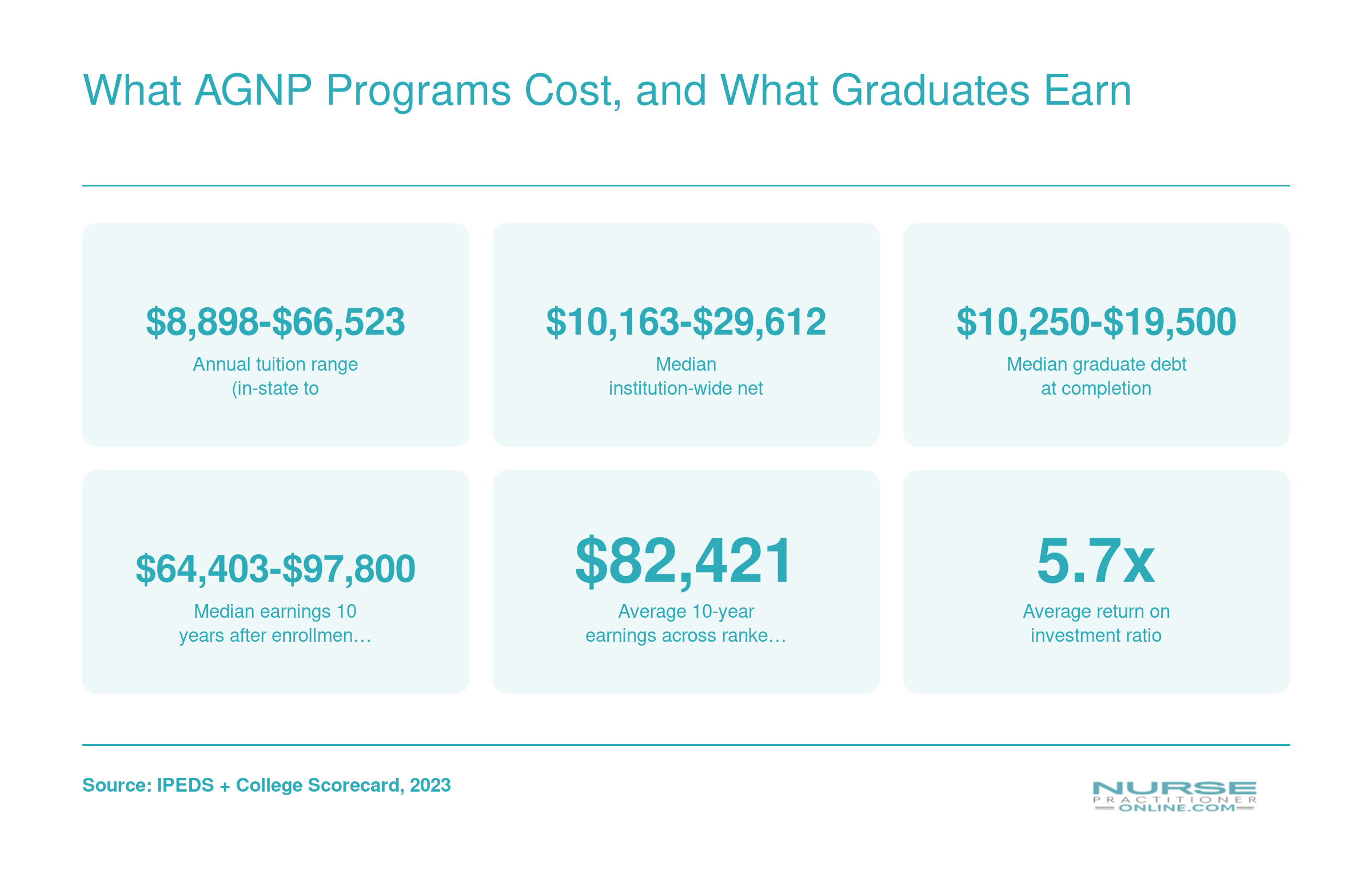
The figures below are drawn from the ranked programs on this list and give you a quick snapshot of the financial picture. Keep in mind that net price is an institution-wide average that factors in grants and scholarships, so your actual out-of-pocket cost will depend on your specific program, residency status, and financial aid package.
Tuition, Financial Aid, and Return on Investment for AGNP Programs
The table below compares annual tuition, median graduate debt, ten-year median earnings, and estimated ROI ratio for the AGNP programs featured in our ranking. Note that program-level earnings data is not yet available for these specific AGNP tracks, so the earnings and ROI figures shown reflect institution-wide medians. Public universities with low in-state tuition, such as Cal State Long Beach and UNC Chapel Hill, offer some of the lowest debt burdens, while Johns Hopkins delivers the strongest overall ROI ratio thanks to remarkably low median debt relative to earnings. Beyond tuition alone, be sure to explore the HRSA Nurse Corps Scholarship Program, which covers tuition, fees, books, and even a monthly stipend for AGNP students who commit to serving at a critical shortage facility after graduation. Many employers also offer tuition reimbursement for nurses pursuing advanced practice degrees, and states such as California, New York, and North Carolina run loan forgiveness programs specifically for NPs practicing in underserved areas.
| School | In-State Tuition | Out-of-State Tuition | Net Price | Median Graduate Debt | Median Earnings (10 yr) | ROI Ratio |
|---|---|---|---|---|---|---|
| Johns Hopkins University | $64,730 | $64,730 | $18,809 | $10,250 | $87,555 | 8.5 |
| Duke University | $66,523 | $66,523 | $29,612 | $13,000 | $97,800 | 7.5 |
| UTHealth Houston | $11,367 | $34,403 | N/A | $13,063 | $88,757 | 6.8 |
| Vanderbilt University | $57,868 | $57,868 | $15,846 | $14,000 | $91,565 | 6.5 |
| UW Tacoma | $18,987 | $33,006 | $10,163 | $14,615 | $78,466 | 5.4 |
| Univ. of Arkansas for Medical Sciences | $12,460 | $21,505 | N/A | $14,000 | $73,827 | 5.3 |
| UNC Chapel Hill | $12,751 | $31,408 | $11,655 | $14,000 | $72,200 | 5.2 |
| Cal State Long Beach | $8,898 | $18,978 | $10,440 | $14,289 | $64,403 | 4.5 |
| Emory University | $48,750 | $48,750 | $22,585 | $18,250 | $80,137 | 4.4 |
| Binghamton University | $13,950 | $27,140 | $21,620 | $18,500 | $80,596 | 4.4 |
| University of Michigan | $28,886 | $57,776 | $13,138 | $19,500 | $83,648 | 4.3 |
Career Outlook and Salary for Adult-Gerontology Nurse Practitioners
The honest tradeoff for any nurse weighing an AGNP degree is this: the upfront cost and clinical hours are real and concrete, while the payoff stretches over decades of higher earnings, broader autonomy, and demand that shows no sign of slowing. The good news is that the long-run math tilts strongly in the graduate's favor, and the occupational data backs it up.
What the National Numbers Say
The Bureau of Labor Statistics tracks nurse practitioners under occupational code 29-1171, and the figures are striking.1 As of 2023, the national median annual wage for NPs sat at $126,260, with the top 25 percent earning more than $135,470 and the top 10 percent clearing $165,240.2 Even at the entry end, the 10th percentile wage was $87,340, comfortably above what most staff RNs earn.2
Employment is projected to grow 35 percent between 2023 and 2033, one of the fastest growth rates of any occupation BLS tracks.1 That translates to roughly 32,700 openings per year and builds on a base of about 258,230 NPs employed nationwide as of 2022.2 For adult-gerontology specialists specifically, an aging U.S. population, where adults 65 and older are projected to outnumber children by 2034, creates a structural demand floor that is unlikely to soften.
Where AGNPs Actually Work
Practice settings shape both day-to-day work and earnings. AGPCNPs tend to land in outpatient primary care clinics, internal medicine groups, community health centers, and increasingly telehealth platforms serving older adults. AGACNPs cluster in hospitals, including ICUs, step-down units, hospitalist services, and specialty practices like cardiology, pulmonology, and oncology. Long-term care facilities and skilled nursing settings hire both, often at premium wages because the patient acuity is high and the provider supply is thin. You can explore the states with the most need for nurse practitioners to see where shortages are most acute.
Scope of Practice Changes the Math
Where you practice matters as much as what you specialize in. According to the American Association of Nurse Practitioners, 28 states (plus D.C.) currently grant NPs full practice authority, meaning you can evaluate patients, order tests, and prescribe without physician oversight.3 In reduced or restricted practice states, you'll need a collaborative agreement, which can cap your earnings and limit where you work.
BLS wage data describes the broader NP occupation, while the graduate earnings reported by individual programs reflect what alumni of specific schools earn in their early careers. Both data sources tell a consistent story: AGNP credentials translate into durable, well-paid clinical careers, with meaningful upside for graduates who land in full-practice states or higher-acuity settings.
According to the Bureau of Labor Statistics Occupational Outlook Handbook, nurse practitioners are projected to see 46% job growth between 2023 and 2033, compared to just 4% for all occupations combined. That makes NP one of the fastest-growing careers in the country by a wide margin.
Steps to Becoming an Adult-Gerontology Nurse Practitioner
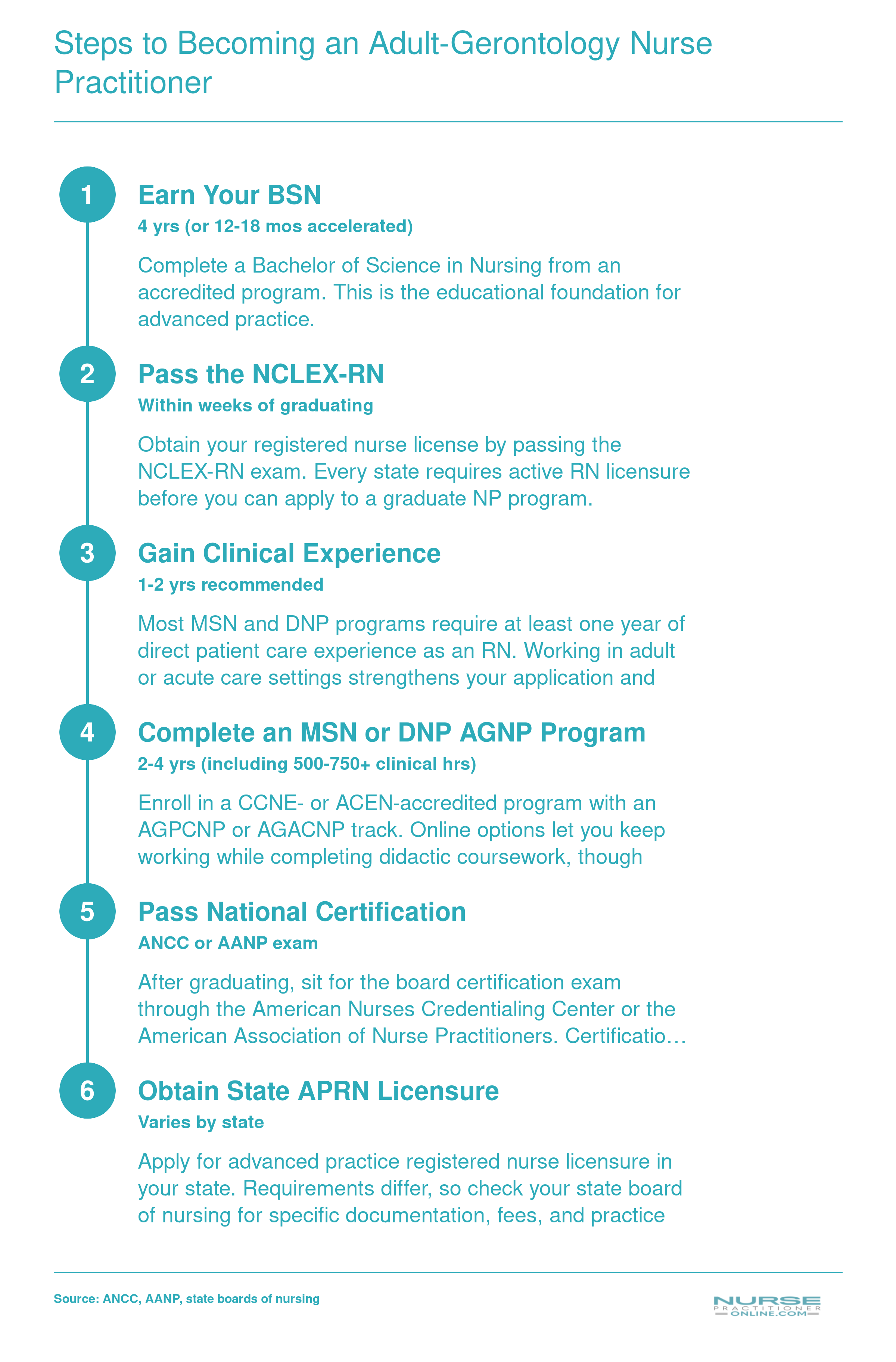
The path from bedside nurse to adult-gerontology nurse practitioner follows a clear credentialing ladder. Here is the typical timeline, from your first nursing degree through independent practice.
More Online AGNP Programs Worth Exploring
These programs didn't crack our top list but still hold accreditation and offer flexible online formats. Explore the directory below to find additional options that may fit your career goals.
Other
University of Minnesota-Twin Cities Minneapolis, MN · Hybrid
- Post-Graduate Certificate (Adult/Gerontological Primary Care Nurse Practitioner)
- Adult Gerontological Primary Care Nurse Practitioner DNP
University of Washington-Tacoma Campus Tacoma, WA · Hybrid
- Adult-Gerontology Primary Care Nurse Practitioner Certificate
Johns Hopkins University Baltimore, MD · Hybrid
- DNP: Adult-Gerontological Primary Care Nurse Practitioner
Clemson University Clemson, SC · Hybrid
- Adult-Gerontology Primary Care Nurse Practitioner
University of Wisconsin-Madison Madison, WI · Hybrid
- Adult/Gerontology Primary Care Nurse Practitioner, DNP
- Adult-Gerontology Primary Care DNP
Rutgers University New Brunswick, NJ · Hybrid
- Adult-Gerontology Primary Care Nurse Practitioner
University at Buffalo Buffalo, NY · Hybrid
- Adult/Gerontology Nurse Practitioner DNP
Arizona State University Tempe, AZ · Hybrid
- Advanced Nursing Practice (Adult-Gerontology Nurse Practitioner)
Michigan State University East Lansing, MI · Hybrid
- Adult Gerontology Primary Care Nurse Practitioner
- Adult-Gerontology Primary Care Nurse Practitioner
Duke University Durham, NC · Hybrid
- Adult-Gerontology Primary Care Nurse Practitioner Post-Graduate Certificate
- Adult-Gerontology Primary Care Nurse Practitioner MSN
The University of Texas Health Science Center at Houston Houston, TX · Hybrid
- Adult/Gerontology Primary Care Nurse Practitioner
Florida Atlantic University Boca Raton, FL · Hybrid
- BSN to DNP (Adult/Gerontological Nurse Practitioner)
Emory University Atlanta, GA · Hybrid
- Adult-Gerontology Primary Care Nurse Practitioner
University of North Carolina Wilmington Wilmington, NC · Hybrid
- Doctor of Nursing Practice (Adult-Gerontology Primary Care Nurse Practitioner)
Explore Programs
Explore Programs
- Best Accelerated Nurse Practitioner
- Best Affordable Nurse Practitioner Programs of
- Best Online Acute Care Nurse Practitioner (ACNP)
- Best Online DNP Nurse Practitioner
- Best Online Emergency Nurse Practitioner (ENP)
- Best Online FNP
- Best Online MSN Nurse Practitioner
- Best Online Neonatal Nurse Practitioner (NNP)
- Best Online PMHNP
- Best Online PNP
- Best Online Post-Master's NP Certificate
- Best Online WHNP