Most important takeaways…
- Two-thirds of primary care shortage areas are rural, fueling demand for acute care NPs.
- Marquette’s AGACNP program guarantees preceptor placement for all students, eliminating a common barrier.
- The program requires 750 clinical hours and targets 6–8 rural-based graduates per cohort.
- Federal loan repayment offers up to $75,000 for AGACNPs serving in rural shortage areas.
Two-thirds of communities facing primary healthcare worker shortages are rural, yet most adult-gerontology nurse practitioner programs in Wisconsin cluster in metro areas. In Wisconsin, that mismatch leaves emergency departments relying on rotating locums and an ICU workforce where the average nurse is over 51 years old.
Marquette University's AGACNP Rural Health Initiative responds by offering hybrid coursework and guaranteed preceptors to nurses living outside southeastern Wisconsin. With cohorts of six to eight students, the program lets working RNs earn acute care certification without relocating, building a pipeline of NPs who stay rooted in the communities they serve.
Why Rural Health Needs More Acute Care Nurse Practitioners
Two-thirds of communities facing primary healthcare worker shortages are classified as rural, according to the Rural Health Information Hub.1 This statistic exposes a deepening crisis: as urban hospitals expand specialty services, rural facilities struggle to recruit and retain providers who can manage complex, acute conditions. In Wisconsin, the gap is particularly stark , federally designated Health Professional Shortage Areas (HPSAs) now number in the hundreds, reflecting widespread deficits in primary and acute care access.2
The Depth of Rural Provider Shortages
The Health Resources and Services Administration (HRSA) reports that 66% of rural census tracts nationwide are designated HPSAs.2 These designations mean that residents often travel long distances for emergency care, critical follow-up visits, or inpatient management of conditions like heart failure, sepsis, or postoperative complications. When acute care nurse practitioners (ACNPs) are absent, small rural hospitals lean heavily on rotating locum tenens physicians or transfer patients to distant regional centers, delaying care and adding financial strain to families already facing geographic isolation.
Why Acute Care NPs Matter in Rural Areas
Adult-gerontology acute care nurse practitioners (AGACNPs) are trained to manage rapidly changing clinical conditions, interpret advanced diagnostics, and perform invasive procedures. In a rural critical access hospital, an AGACNP often serves as the sole provider overnight, manages ventilators, and coordinates with telehealth specialists. Without them, patients with acute exacerbations of chronic diseases (so common in older rural populations) face higher risks of readmission and mortality. The Chartis Group's 2026 Rural Health State of the State report underscores that rural closures of hospital units are accelerating precisely where AGACNP coverage is thinnest.
Wisconsin's Aging Nursing Workforce
Wisconsin's rural communities face a compounding factor: an aging nursing workforce. In some northern counties, the average nurse age exceeds 51, and retirements are outpacing new graduates. State-level workforce data from the Wisconsin Department of Health Services reveal that rural acute care settings report vacancy rates above 15% for advanced practice roles. Meanwhile, the Rural Health Transformation Program, a federal funding opportunity launched in 2026, aims to incentivize training positions specifically in rural acute care, signaling that policymakers recognize the urgency of placing AGACNPs where they are needed most.4 which states need nurse practitioners the most can vary widely, but rural regions consistently rank among the highest-need areas regardless of geography.
Without a robust pipeline of acute care NPs willing to practice in rural Wisconsin, health systems will continue to rely on costly temporary staffing and risk further unit closures. Programs like Marquette's are designed to bridge that gap by enabling nurses already rooted in these communities to gain the advanced skills needed to keep local hospitals functioning.
Inside Marquette's AGACNP Rural Health Initiative
For many nurses, the decision to become an acute care nurse practitioner pits long-term career growth against short-term disruption: relocating to a university town means leaving behind the communities that need them most. Marquette University's new AGACNP Rural Health Initiative offers an alternative, one that lets you earn your credential while staying rooted in the places you serve.
A Pandemic Pivot Becomes Permanent
The Adult-Gerontology Acute Care Nurse Practitioner (AGACNP) program at Marquette University was conceived during a time when in-person education ground to a halt. As COVID-19 forced universities to rethink delivery, Dr. Debra Casper, clinical instructor and AGACNP program director, saw an opportunity. Remote learning was not just a temporary fix; it proved that rigorous clinical graduate education could thrive outside the traditional classroom. That insight became the foundation for a rural health initiative designed to address Wisconsin's acute care shortages head-on.
How the Hybrid Model Works
Marquette's AGACNP program now operates as a hybrid model, not a fully online one. Students outside southeastern Wisconsin complete didactic coursework remotely, logging into live, interactive classes from their home communities. They are still required to attend occasional on-campus sessions, typically for intensive skill labs, simulations, and in-person assessments that cement their acute care competencies. The clinical rotations, however, happen locally. Students find preceptors near their rural homes, often in the very facilities where they already work, which keeps them embedded in the communities that need them.
Cohort Size and Preceptor Guarantee
The program deliberately keeps its rural-targeted cohorts small: just six to eight students per cohort from outside southeastern Wisconsin. This intimate size allows faculty to provide close mentorship and adapt placements to each student's location. Perhaps the most significant barrier this initiative removes is the preceptor search. Marquette guarantees preceptor placement for all AGACNP students,1 a promise that carries real weight in rural settings where local preceptors are scarce and often overwhelmed. It means nurses no longer have to cold-call clinics or delay graduation because they cannot find a qualified mentor. For Wisconsin nurses exploring doctoral-level options alongside this program, online DNP programs in Wisconsin offer another pathway worth comparing.
The structure rests on a simple premise: train nurses where they live, and they are far more likely to stay and practice where they are needed most. By removing the friction of relocation and the preceptor puzzle, Marquette's hybrid AGACNP program opens a viable path for rural nurses to advance their careers without leaving their patients behind.
Questions to Ask Yourself
AGACNP Program Pathways: MSN, DNP, and Post-Master's Certificate
For nurses exploring Marquette's AGACNP program, the first decision is often choosing between a master's degree, a doctoral degree, or a post-master's certificate. Each pathway serves a distinct career stage, and the university's hybrid rural health model extends to all three, letting you train close to home.1
Master of Science in Nursing (MSN)
- Credit Hours: 42
- Duration: 30 to 48 months
- Tuition per Credit: $1,400
- Best For: BSN-prepared nurses ready to step directly into acute care practice without committing to a doctoral program. The MSN aligns well with working professionals who want to become certified AGACNPs on a steady, part-time timeline.
Doctor of Nursing Practice (DNP)
- Credit Hours: 69
- Duration: 48 to 60 months
- Tuition per Credit: $1,400
- Best For: BSN-holders aiming for the terminal clinical degree. The DNP integrates leadership, evidence-based practice, and advanced clinical training, making it ideal for nurses who may later move into systems-level roles while still practicing at the bedside in rural or critical access hospitals. If you are weighing the two graduate options, a closer look at MSN vs DNP differences can help clarify which credential fits your long-term goals.
Post-Master's Certificate
- Credit Hours: 12 to 30 (varies based on academic review)
- Duration: 12 to 36 months
- Tuition per Credit: $1,400
- Best For: Nurses who already hold an MSN (or higher) in another specialty and want to add adult-gerontology acute care certification. This pathway is the shortest and most targeted route for experienced NPs shifting into acute or rural roles.
How the Rural Hybrid Model Works Across All Pathways
Every pathway operates with the same hybrid, distance-friendly structure. Core coursework is completed online, and clinical rotations happen in or near your home community. Marquette guarantees preceptor placement, a standout feature for rural students who often struggle to secure clinical sites.1 Whether you choose the MSN, DNP, or certificate route, you can remain in a small town like Fond du Lac or Minocqua, continue working, and still access the full AGACNP curriculum without relocating.
Admission Requirements and How to Apply
- Minimum GPAA cumulative 3.0 GPA or higher from an accredited BSN program.
- Prerequisite DegreeA Bachelor of Science in Nursing (BSN) degree.
- Prerequisite CoursesUndergraduate nursing research, statistics (completed within the last five years), and health assessment.
- RN Work ExperienceAt least two years of acute care registered nursing experience.
- GRE RequirementThe GRE is not required; Marquette offers a waiver.
- Application DeadlinesSpring start: November 15. Fall start: February 15.
- Application MaterialsOnline application, official transcripts, three letters of recommendation, resume, written statement of professional goals, and a possible interview.
- Rural-Track ApplicantsNo additional requirements beyond the standard admission criteria; the program actively recruits nurses who live or intend to practice in rural areas.
- AGACNP vs. AGPCNPMarquette's AGACNP track prepares you for acute, unstable, or complex patients in inpatient/high-acuity settings. The Adult-Gerontology Primary Care NP (AGPCNP) track focuses on longitudinal primary care in outpatient settings, choose the one that aligns with your practice goals.
Clinical Hours, Preceptor Placement, and Rural Rotations
How do clinical hours and preceptor placements work when you're training in a rural area?
The 750-Hour Standard and Why It Matters
Marquette's AGACNP program requires 750 supervised clinical practice hours, a number that mirrors the national standard set by the American Association of Colleges of Nursing and aligns with certification eligibility through organizations like the American Nurses Credentialing Center and the American Association of Critical-Care Nurses. This total is not arbitrary. It ensures graduates have ample exposure to complex acute care scenarios before stepping into independent practice. For rural students, every hour is deliberately structured around local resources so you never have to piece together disjointed experiences on your own.
Guaranteed Preceptor Placement: How It Works in Rural Communities
One of the biggest hurdles in any nurse practitioner program is finding a qualified NP clinical preceptor. Marquette removes this barrier entirely by guaranteeing preceptor placement for every AGACNP student. For those living outside southeastern Wisconsin, the clinical placement team actively builds relationships with acute care facilities near your community, often within a commutable radius. They handle the logistics of securing board-certified acute care nurse practitioners, physicians, or hospitalists who meet program standards. This means you won't spend weeks cold-calling offices or driving hours to a metro area simply to fulfill a requirement.
Clinical Settings and Site Diversity in Non-Metro Areas
Rural rotations mirror the urban experience as closely as possible. Students typically rotate through intensive care units, emergency departments, hospitalist services, and step-down or progressive care units. Even in smaller communities, critical access hospitals and regional medical centers often house these units. Marquette's clinical coordinators work to maintain diversity by sequencing nurse practitioner clinical rotations across different specialties, for example pairing an ICU experience with time on a rapid response or trauma team. This exposure is how you build the broad diagnostic and procedural skill set expected of an acute care NP, regardless of zip code.
What If There's No Qualifying Acute Care Facility Nearby?
It's a realistic concern: what happens when the nearest qualifying facility is an hour away? Marquette addresses this early in the placement process. If a truly local option isn't available, the team maps a limited number of slightly farther rotations, often clustered so travel is manageable. They also help coordinate schedules with your employer if you work in a health system that extends across multiple sites. The program's hybrid design, combining remote coursework with in-person clinicals, means you remain rooted in your community for most of the week, traveling only when the best learning opportunity requires it.
Related Articles
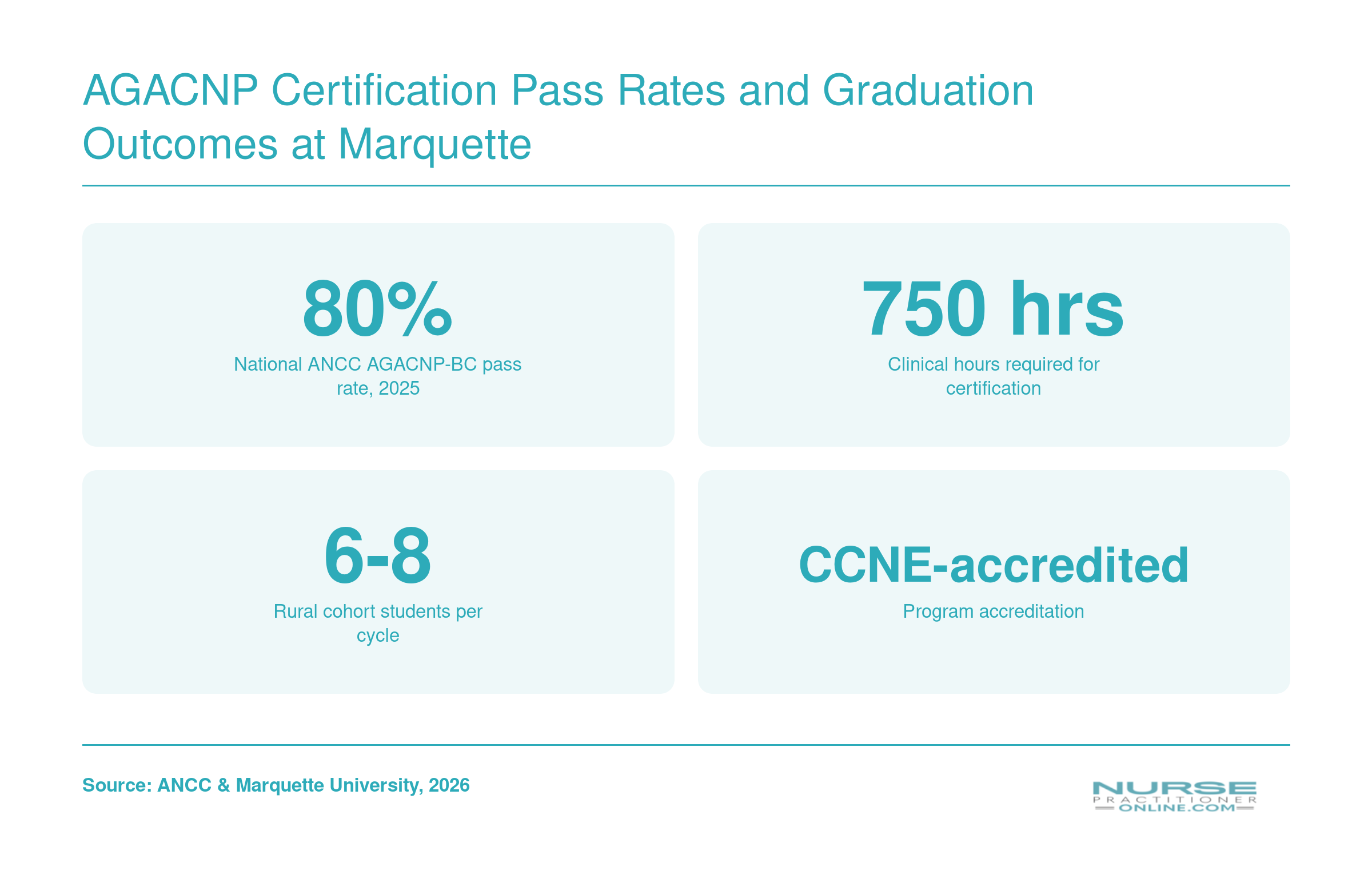
AGACNP Certification Pass Rates and Graduation Outcomes at Marquette
NP Salary by Metro Area in Wisconsin
NP salaries across Wisconsin metro areas show that earnings remain strong even outside Milwaukee. In fact, several smaller markets offer median pay exceeding $125,000, making rural and mid-sized communities financially attractive options for AGACNPs. Data from the Bureau of Labor Statistics (2024) highlights competitive pay from Green Bay to Wausau.
| Metro Area | Employment | 25th Percentile | Median Annual Salary | 75th Percentile |
|---|---|---|---|---|
| Milwaukee-Waukesha, WI | 1,940 | $114,070 | $129,760 | $133,480 |
| Madison, WI | 460 | $124,820 | $134,200 | $154,300 |
| Green Bay, WI | 270 | $109,110 | $125,000 | $133,070 |
| Eau Claire, WI | 160 | $118,040 | $127,770 | $145,600 |
| Oshkosh-Neenah, WI | 160 | $113,140 | $126,580 | $134,590 |
| Wausau, WI | 150 | $108,760 | $127,370 | $139,430 |
| Appleton, WI | 140 | $118,050 | $130,000 | $140,720 |
| Kenosha, WI | 110 | $119,630 | $128,270 | $140,650 |
| Racine-Mount Pleasant, WI | 100 | $115,010 | $128,050 | $134,730 |
| Janesville-Beloit, WI | 90 | $117,640 | $131,040 | $139,990 |
Financial Aid, Loan Repayment, and Rural Practice Incentives
Federal Loan Repayment Programs: What AGACNPs Need to Know
The National Health Service Corps (NHSC) Loan Repayment Program provides up to $75,000 in tax-free funds for a two-year full-time service commitment in a Health Professional Shortage Area (HPSA).1 However, the standard NHSC program does not currently list Adult-Gerontology Acute Care Nurse Practitioners (AGACNPs) among eligible specialties.2 Primary care disciplines like family, adult-gerontology primary care, psychiatric-mental health, and women's health qualify, but acute care is not included.
A separate federal initiative, the NHSC Rural Community Loan Repayment Program, may offer a path for AGACNPs willing to practice in rural settings. This program awards up to $100,000 for a three-year full-time commitment and often has broader eligibility criteria.3 While AGACNPs are not explicitly guaranteed inclusion, practitioners who provide essential acute care services in underserved rural hospitals or clinics may qualify. Prospective applicants should verify current eligibility requirements directly with the program before counting on these funds. nurse practitioner loan repayment programs covers the full landscape of options worth exploring.
- NHSC Loan Repayment: Up to $75,000 for 2 years; AGACNPs are not currently eligible.2
- NHSC Rural Community Loan Repayment: Up to $100,000 for 3 years; eligibility may include acute care NPs, so confirm directly.3
Wisconsin-Specific Incentives for Rural Practitioners
Wisconsin does not currently operate a statewide loan repayment program specifically for nurse practitioners.4 However, Marquette graduates serving in rural areas might still access federal awards like the NHSC Rural Community program. Additionally, the Wisconsin Office of Rural Health provides resources and guidance, including information on employer-sponsored repayment assistance at critical access hospitals.
Pro Tip: Many rural health systems offer their own signing bonuses or loan repayment as recruitment incentives. When comparing job offers, factor these into your overall compensation package.
Marquette Financial Aid: Scholarships, Assistantships, and Loans
Marquette University's College of Nursing offers multiple financial support avenues for graduate AGACNP students:
- Merit-based scholarships: Awarded upon admission based on academic achievement; no separate application is usually required.
- Graduate assistantships: Provide tuition remission and a stipend in exchange for research or teaching duties, a great way to reduce costs while gaining experience.
- Federal Direct Unsubsidized Loans: Available to graduate students up to the cost of attendance; these are not need-based but accrue interest during enrollment.
- Grad PLUS Loans: If needed, these can cover remaining expenses after other aid is applied.
Be sure to file the FAFSA early and contact Marquette's financial aid office to discuss your specific situation.
Weighing the Return on Investment: Tuition, Salary, and Loan Repayment
Marquette's AGACNP program tuition is competitive with top-tier private universities. While exact figures depend on the pathway (MSN, DNP, or certificate), total tuition for a master's-level track often falls in the $40,000, $60,000 range. Combined with living expenses, many students graduate with significant debt, but the earning potential quickly offsets it.
AGACNPs in Wisconsin earn a median salary of approximately $120,000, $130,000, with higher pay in acute care and rural settings where demand is strong. Even without full loan repayment, the salary bump from an RN role to an AGACNP can make loan payments manageable. If you secure a $100,000 NHSC Rural Community award, your debt could be substantially wiped out within three years, leaving you with a high-income career and minimal financial burden.
- Estimated tuition: $40,000, $60,000 (MSN pathway)
- Typical AGACNP salary in WI: $120,000+ (median)
- Potential loan repayment: Up to $100,000
- Net effect: Strong positive ROI, especially with a rural service commitment
Studying While Serving Rural Communities: Student Perspectives
What is it really like to pursue an adult-gerontology acute care nurse practitioner degree while embedded in a rural Wisconsin community? For students in Marquette's AGACNP program, the answer is rooted in real lives and pressing local needs.
From Neurotrauma ICU to Fond du Lac: Ashley Wilson's Path
Ashley Wilson traded the high-intensity neurotrauma ICU at Baltimore's renowned R Adams Cowley Shock Trauma Center for the quieter rhythms of Fond du Lac, Wisconsin, a city of roughly 44,500 people. The move could have paused her advanced practice aspirations. Instead, Marquette's hybrid model let her stay clinically active in a smaller setting while completing didactic coursework remotely and fulfilling the program's 750 required clinical hours close to home. Wilson's story demonstrates that rural relocation does not have to mean career sacrifice; it can open a door to acute care practice in a community that deeply needs it.
A Local Solution for Minocqua: Kelli Koch's Commitment
In Minocqua, where the nursing workforce's average age already tops 51, Kelli Koch represents a new generation of locally rooted providers. Rather than uproot her life for an urban campus, she is earning her AGACNP credential right in the northwoods, completing clinical rotations at nearby facilities that rely on a pipeline of fresh talent. Koch's decision matters urgently: as experienced nurses in rural areas approach retirement, the demand for nurse practitioners in rural healthcare grows sharper each year. The program's guarantee of preceptor placement removes a hurdle that often derails rural students, ensuring Koch can focus on skill-building rather than logistics.
Growing Providers Where They Are Needed
Neither Wilson nor Koch is simply collecting a diploma. They are becoming the acute care providers their communities will lean on, managing complex, hospitalized patients in settings where a single NP often carries an outsized clinical footprint. Marquette's design trusts that investing in local nurses is the fastest route to filling workforce gaps. With two-thirds of primary healthcare shortage communities classified as rural, the presence of homegrown NPs like Wilson and Koch isn't just convenient; it's essential. The program's remote participation pilot, born during the pandemic, has turned into a deliberate strategy: nurture talent where it lives, and rural health systems gain a durable asset, not a temporary visitor.
Could Marquette's Hybrid Rural Model Reshape AGACNP Education Nationwide?
Marquette's hybrid rural AGACNP model demonstrates that remote participation can work, but scaling it nationwide requires tackling deep-rooted structural barriers. The program's early success offers a blueprint, yet the path from pilot to broad adoption is littered with logistical, regulatory, and financial hurdles.
What Other Programs Can Learn from Marquette's Model
Marquette's most transferable innovation is its guarantee of preceptor placement, a pain point that derails many NP students. By building and maintaining its own clinical network, the program removes a barrier that often falls on students in traditional tracks. For rural-focused programs, this approach is critical because finding NP preceptors in remote areas is genuinely difficult. Replicating it requires dedicated staff to cultivate and sustain clinical site partnerships, a resource many nursing schools lack. Remote didactic instruction is easier to copy: most universities already have online course infrastructure. The harder lift is blending synchronous and asynchronous elements while ensuring students feel connected to faculty and peers. Marquette's small cohort size (6, 8 students) fosters that connection, but larger programs may struggle to replicate the intimacy without significant investment in instructional design and student support.
The Demand Side: Why This Model Matters
Rural America is losing healthcare providers at an alarming rate, and NP employment is projected to grow 40% between 2023 and 2033, according to federal labor projections, far outpacing most occupations. The evolving role of nurse practitioners makes the Adult-Gerontology Acute Care track particularly vital, since rural hospitals and specialty clinics often lack providers who can manage complex acute conditions. A hybrid model that lets nurses earn their AGACNP credential while staying in their communities directly addresses the geographic maldistribution of providers. If even a fraction of NP programs adopted a rural hybrid design, the cumulative impact on workforce distribution could be transformative.
Obstacles to National Replication
- Clinical partnerships: Scaling Marquette's guaranteed-preceptor model demands contractual relationships with hundreds of clinical sites, many in underserved areas that already have limited training capacity. Site recruitment, vetting, and ongoing quality assurance require dedicated personnel and legal resources.
- Accreditation flexibility: While accrediting bodies have embraced online education since the pandemic, onsite clinical hour requirements remain rigid (Marquette requires 750 hours). Programs must navigate varying state board of nursing regulations for tele-supervision and remote precepting, especially across state lines.
- Faculty bandwidth: Remote instruction for clinical courses demands faculty who are not only clinically expert but also adept at virtual teaching, simulation design, and one-on-one mentoring. Many schools face a faculty shortage, making it hard to staff a low student-to-faculty ratio that a rural hybrid track requires.
- Financial sustainability: Small rural cohorts may not generate enough tuition revenue to cover the high-touch support model. Grants or institutional subsidies may be necessary, and not every university has access to such funding.
Looking Ahead: Promise vs. Reality
Marquette's initiative proves that a hybrid rural AGACNP pathway is feasible, impactful, and responsive to a genuine crisis. But the leap from a single program to a national movement depends on solving the preceptor supply problem at scale, securing consistent funding, and convincing accreditors and state regulators to streamline remote-clinical supervision. This model is a critical piece of the rural health puzzle, but it will take institutional courage, not just curriculum tweaks, to make it a standard option.
Frequently Asked Questions About Marquette's AGACNP Program
Planning to pursue Marquette's adult-gerontology acute care nurse practitioner program and want the details that matter most? From clinical hours to certification, here are straight answers to the questions working nurses ask when considering this rural health-focused hybrid program.
- How many clinical hours are required for Marquette's AGACNP program?
- All students must complete 750 hours of supervised clinical practice to meet certification requirements. These hours are integrated into the curriculum, with acute care rotations arranged in hospitals and specialty settings across Wisconsin, including rural health systems, so you gain experience relevant to your community.
- Does Marquette guarantee preceptor placement for AGACNP students?
- Absolutely. Marquette guarantees preceptor placement for every AGACNP student, removing a common source of stress. The program's clinical placement team works directly with you to secure qualified preceptors near your home, ensuring a seamless experience from your first rotation.
- Can you complete Marquette's AGACNP program online from a rural area?
- Yes. The program was designed with a hybrid structure that combines online didactic coursework with in-person clinical rotations. This allows you to live anywhere in Wisconsin, complete lectures remotely, and perform clinical hours at sites close to your rural community.
- What is the difference between AGACNP and AGPCNP at Marquette?
- AGACNP focuses on acute and critical care for adults, preparing you to manage hospitalized patients with urgent or unstable conditions. AGPCNP emphasizes primary care across the adult lifespan, delivering comprehensive health services in outpatient clinics. Both pathways lead to different certification exams and scopes of practice.
- How much does the Marquette AGACNP program cost per credit?
- Per-credit tuition rates vary by degree track (MSN, DNP, or post-master's certificate) and are set annually. For the most accurate, up-to-date costs, visit Marquette's graduate nursing tuition page or contact the financial aid office. Many students also qualify for federal loans, scholarships, or rural workforce incentive programs.
- What certification exams can Marquette AGACNP graduates sit for?
- Marquette's AGACNP program prepares you to sit for the ANCC Adult-Gerontology Acute Care Nurse Practitioner board certification or the AACN Acute Care Nurse Practitioner (ACNPC-AG) credential. Both certifications are nationally recognized and meet licensure requirements across the country.