
Most important takeaways…
- Most FNP programs require 500 to 750 supervised clinical hours, with 500 as the national certification minimum.
- State boards of nursing, not federal agencies, set the final clinical hour requirements for FNP licensure.
- Expect to see eight to fifteen patients per day during rotations across pediatric, adult, and women's health specialties.
- Many online FNP programs require students to find their own preceptors, making early outreach essential.
Most FNP students are experienced RNs who have handled high-stakes clinical situations for years, yet clinical rotations still catch them off guard. The reason is straightforward: supervised FNP clinical hours require you to shift from executing orders to independently assessing, diagnosing, and managing patients across the lifespan, all while logging 500 to 750-plus hours around a full-time job and family obligations.
The tension is real and specific. Finding a qualified preceptor, meeting your state board's licensure requirements, and satisfying your certification body's hour minimums are three separate hurdles that do not always align neatly. Online students face this pressure acutely because most programs expect self-placement.
What follows addresses each piece of that puzzle: hour requirements, rotation types, preceptor sourcing, state and certification body rules, evaluation standards, and practical strategies for turning rotations into your first NP job offer. Along the way, we touch on how different nurse practitioner specialties shape rotation expectations. The preceptor shortage is not easing, and programs with built-in placement support remain a genuine differentiator in the current market.
What Are FNP Clinical Rotations and Why Do They Matter?
What exactly are clinical rotations in an FNP program, and how do they differ from the clinical hours you completed in nursing school?
Clinical rotations are supervised, hands-on patient care experiences embedded in every accredited Master of Science in Nursing-Family Nurse Practitioner (MSN-FNP) curriculum. Unlike the clinical shifts you completed as a nursing student, FNP rotations focus on advanced-practice competencies: conducting comprehensive assessments, ordering and interpreting diagnostic tests, formulating differential diagnoses, prescribing medications, and managing patient panels across the lifespan. Your registered nurse experience provides invaluable context, but those RN clinical hours do not count toward your FNP program requirements. You are starting a new clinical chapter, one that trains you to function as an autonomous provider. If you are still comparing curricula, our roundup of best online MSN FNP programs can help you weigh clinical-hour requirements side by side.
Why FNP Programs Require Clinical Rotations
Rotations exist to bridge the gap between bedside nursing and independent advanced-practice decision-making. As an RN, you collaborate with physicians and execute care plans. As a family nurse practitioner, you will create those plans, prescribe treatments, and carry legal accountability for patient outcomes. Clinical rotations immerse you in real-world scenarios under the guidance of experienced preceptors (physicians, nurse practitioners, or physician assistants) who mentor you through diagnosis, treatment, and follow-up care.
Clinical Rotations Are Not Optional
Every FNP program accredited by the Commission on Collegiate Nursing Education (CCNE) or the Accreditation Commission for Education in Nursing (ACEN) must include supervised clinical training. Understanding the difference between ACEN vs CCNE accreditation can help you evaluate program quality before you enroll. National certifying bodies, including the American Academy of Nurse Practitioners Certification Board (AANP) and the American Nurses Credentialing Center (ANCC), will not permit you to sit for the FNP exam without proof of completed clinical hours. There is no workaround, no portfolio exemption, and no credit for years of RN experience.
The Practical Challenge: Juggling Rotations and Work
Most FNP students continue working full-time as registered nurses while enrolled. Scheduling clinical rotations around shift work, family obligations, and coursework is often the single largest stressor reported by students. Clinics and preceptors operate during standard business hours, which may conflict directly with your hospital or unit schedule. Planning ahead, communicating with your employer, and building flexibility into your program timeline are essential strategies for navigating this reality without burning out.
How Many Clinical Hours Do FNP Programs Require?
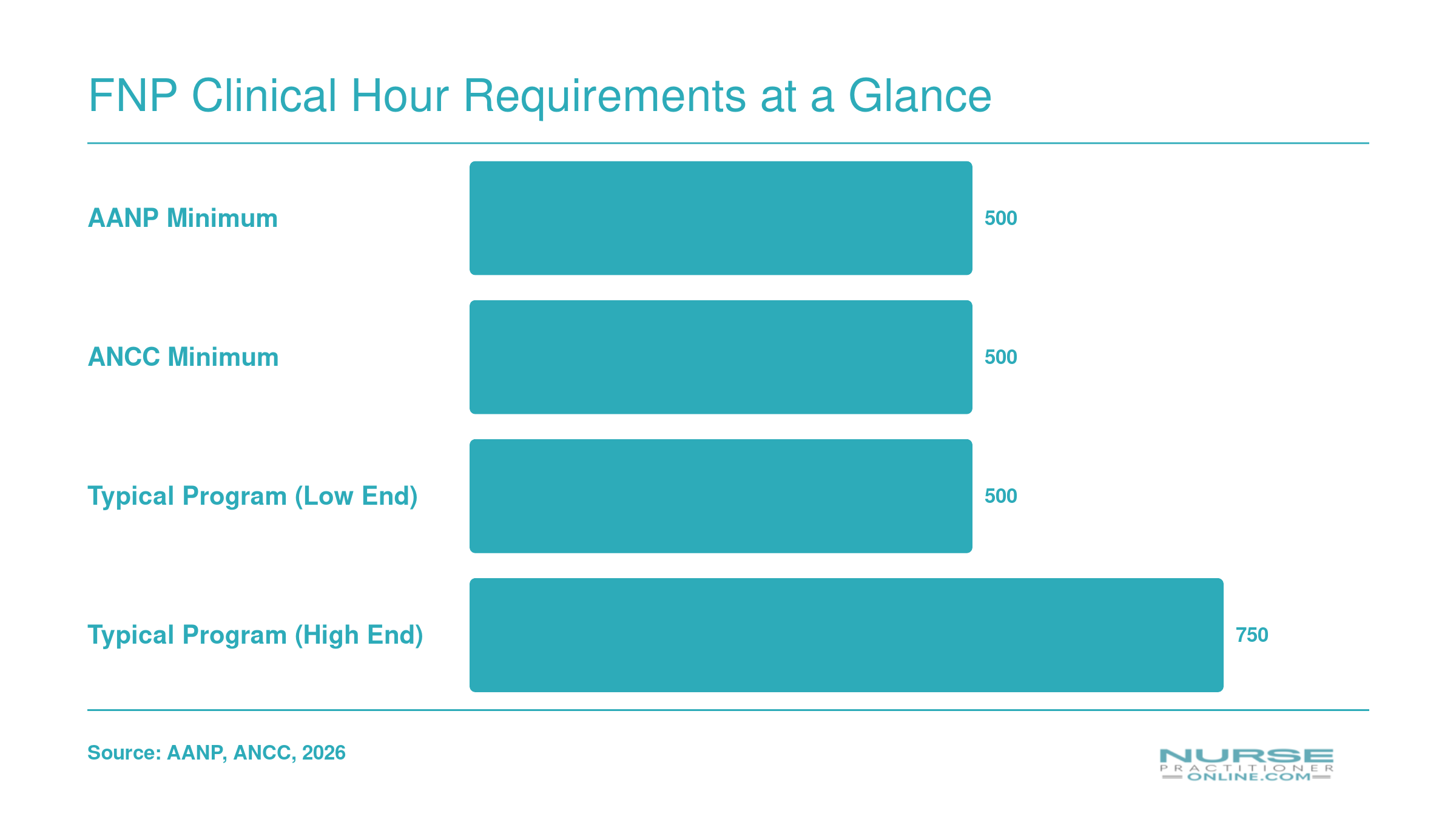
Here's the short answer: most family nurse practitioner programs require between 500 and 750 hours of direct patient care, with 500 hours serving as the national floor set by the certification bodies. If you graduate with fewer than 500 supervised clinical hours, you won't be eligible to sit for either national FNP exam, period.
The 500-Hour Certification Floor
Both the American Association of Nurse Practitioners Certification Board (AANPCB), which grants the FNP-C credential, and the American Nurses Credentialing Center (ANCC), which grants the FNP-BC, require a minimum of 500 faculty-supervised clinical hours for 2025-2026 exam eligibility.12 The two bodies are aligned on the headline number, and neither has announced changes to this threshold for the current cycle.
Where candidates sometimes get tripped up is in the fine print: both certifiers expect those hours to be embedded in your accredited FNP program and signed off by faculty, not logged independently or counted retroactively from RN experience. Simulation hours are a gray area. Neither AANPCB nor ANCC has published a confirmed simulation percentage that universally counts toward the 500-hour minimum, so the safe assumption is that hands-on, in-person patient contact is what your transcript needs to show.
Why Many Programs Require 600 to 750+ Hours
The 2021 AACN Essentials shifted graduate nursing education toward competency-based assessment, meaning programs must demonstrate that students have actually mastered the FNP role, not just clocked seat time. In practice, schools still build their curricula around hour thresholds because certification eligibility demands it, and competency takes time to develop.
Many FNP programs intentionally exceed the 500-hour floor, landing somewhere between 600 and 750 hours, for three reasons:
- State board requirements: A handful of state nursing boards expect more than 500 hours for licensure as an APRN.
- Accreditor expectations: CCNE and ACEN-accredited programs often build in a buffer to ensure every graduate clears certification eligibility comfortably.
- Program philosophy: Faculty frequently believe additional hours produce stronger, more confident new NPs, especially across the full family practice lifespan.
What Actually Counts as a Clinical Hour
A clinical hour means direct patient contact under a qualified preceptor: assessing, diagnosing, prescribing, counseling, and documenting in real time on a real patient. What does not count includes simulation lab work (unless your program has specific approval), orientation and onboarding sessions, time spent charting after the patient leaves, or shadowing without hands-on participation. When in doubt, ask your program coordinator before you log the hour. If you're still early in the process and mapping out the full path, our guide on how to become a nurse practitioner breaks down each step from RN to NP licensure.
FNP Clinical Hour Requirements at a Glance
Clinical hour requirements vary depending on which certification you pursue and how your program is structured. Most FNP programs require between 500 and 750 or more supervised clinical hours. Note that simulation hours are typically capped at a portion of total clinicals, often around 50 hours or less, depending on the program and accreditor.
Types of FNP Clinical Rotations by Specialty
FNP programs today increasingly recognize that a well-rounded clinician needs structured exposure across the lifespan, not just generic primary care hours. That principle shapes how most programs organize clinical rotations into distinct specialty blocks, each designed to build competency with a different patient population and clinical setting.
Core Rotation Categories
Most MSN-FNP programs divide their required clinical hours (typically 500 to 800, depending on the program) across five core rotation types:1
- Family/Adult Primary Care: The largest block, usually 160 to 240 hours. You will see patients across the entire age spectrum in primary care clinics, managing everything from wellness visits to chronic disease. This rotation forms the backbone of your FNP training.
- Adult/Internal Medicine: Expect 120 to 160 hours in internal medicine practices focused on adult through older adult patients. Here you will sharpen your diagnostic reasoning for complex, multi-system conditions.
- Pediatrics: Typically 80 to 120 hours in pediatric clinics, covering infant through adolescent care. You will gain confidence with developmental milestones, immunization schedules, and common childhood illnesses.
- Women's Health/OB-GYN: Another 80 to 120 hours dedicated to reproductive and women's health in specialized clinics. Rotations often include prenatal screenings, contraceptive counseling, and gynecological exams.
- Geriatrics: Usually 80 to 120 hours in long-term care facilities or geriatric clinics, where you will manage age-related conditions, polypharmacy, and functional assessments for older adults.
If you are particularly interested in the geriatric population, exploring the adult gerontology nurse practitioner track may also be worth considering as you plan your career trajectory.
Elective and Specialty Rotations
After completing core requirements, many programs allocate 40 to 80 additional hours for an optional or specialty rotation.1 Common options include urgent care, behavioral health, or dermatology. This is where you can tailor your training to match your career goals. If you are drawn to psychiatric presentations in primary care, for example, a behavioral health elective can be invaluable.
How Programs Differ
Hour splits vary significantly from one program to another. Some schools, like the University of Colorado Anschutz MS-FNP program, mandate specific hour distributions across each specialty.1 Others set minimum thresholds for core rotations and then give students flexibility to allocate remaining hours toward electives or to deepen experience in a particular area.
Before you enroll, review the program handbook carefully. Ask whether clinical hour distributions are fixed or flexible, and whether you can request specialty placements that align with your interests. Programs with rigid structures ensure broad competency, while those with elective options let you build a niche. Neither approach is inherently better; the right fit depends on your career plans and how much clinical variety you already bring from your nursing background. Understanding the difference between acute care vs. primary care tracks can also help you decide which rotation structure suits your goals.
Understanding these rotation types early helps you plan your schedule, identify the preceptors you will need, and set realistic expectations for each phase of your clinical education.
Questions to Ask Yourself
How to Find Clinical Sites and Preceptors for FNP Rotations
Student self-placement is the most common model in FNP education as of 2025, and it is the single biggest source of stress for online students.1 The majority of online FNP programs expect you to find your own preceptors and clinical sites, with varying levels of support from the school. A minority of programs (often marketed as a competitive advantage) guarantee placement. On-campus programs are more likely to use hybrid models, where faculty or a clinical coordinator leverages regional partnerships with local health systems to place students.2
School-Arranged vs. Self-Placed: What to Expect
There are roughly four core placement models in use right now: fully school-arranged, hybrid (school identifies some sites, you find others), fully self-placed with school approval, and third-party recruited.2 If your program is fully self-placed, the school still has to approve every site and preceptor, and faculty must maintain oversight and evaluation of your clinical learning even when day-to-day supervision is handled by a preceptor in the field. That faculty oversight is a CCNE accreditation requirement, not optional.3
Practical Strategies for Self-Placement
Start with the people who already know your work. Your existing RN network is the highest-yield source: charge nurses, NPs you have rounded with, physicians in clinics where you have floated. For a deeper look at this process, see our guide on how online nursing programs arrange local clinical placements. From there, work outward:
- Cold-call family practice offices, community health centers, urgent care clinics, and rural health clinics in your area. These are the approved settings for FNP rotations.4
- Reach out to your state and local NP professional organizations, which often maintain informal preceptor lists for members.
- Ask your program for its school-approved site list and prior-student placement history.
- Consider third-party services: Preceptor Link, ClickClinicals, and NPHub all match NP students with preceptors nationally. These charge fees (often several thousand dollars per rotation), and policies vary on whether your school will accept a paid match, so verify before purchasing.5
Preceptor Qualifications and Affiliation Agreements
Most programs accept NPs, MDs, DOs, and PAs as preceptors, with a minimum of one to two years of clinical experience and an active, unencumbered license.5 Some states layer on additional requirements. Before you can start, your preceptor will go through a formal approval process: CV review, license verification, malpractice insurance confirmation, and a signed clinical affiliation agreement between the university and the clinical site.4
That agreement is where timelines get painful. Affiliation agreements routinely take 6 to 12 weeks (sometimes longer) because they pass through legal review on both sides. Start the conversation at least four to six months before your rotation is scheduled to begin. Waiting until the semester before is the most common reason students have to delay a rotation.
School-Arranged vs. Self-Placed Clinical Rotations
Most FNP programs fall into one of two categories when it comes to clinical placements: the school handles the arrangements for you, or you find your own sites and preceptors. Both models have real advantages, and the best choice depends on your location, professional network, and how much flexibility you need. Here is a practical breakdown to help you weigh your options.
Pros
- School-arranged placements reduce student stress by handling site outreach, affiliation agreements, and preceptor vetting on your behalf.
- Established clinical partnerships mean faster onboarding, so you spend less time on paperwork and more time learning.
- Self-placed rotations give you full control over location, specialty focus, and scheduling, which is ideal for nurses balancing work and family.
- If you live in a rural or underserved area, self-placement lets you leverage local professional relationships that a distant school may not have.
- Self-placed students can tailor rotations to match specific career goals, such as pediatrics or women's health, rather than accepting a preset assignment.
Cons
- School-arranged sites may limit your choices to the program's existing geographic footprint, which can be a problem if you live outside that region.
- Popular school-arranged rotations sometimes have waitlists, potentially delaying your graduation timeline by a semester or more.
- Self-placement is time-consuming: researching sites, cold-calling preceptors, and negotiating affiliation agreements can take months of effort.
- With self-placed rotations, you bear the risk of last-minute site cancellations and may need to coordinate your own liability insurance coverage.
- Affiliation agreement delays between your chosen site and your school can stall a self-placed rotation, even after a preceptor has already agreed to work with you.
FNP Clinical Rotation Requirements by State and Certification Body
State boards of nursing, not federal agencies, hold the final authority over clinical hour requirements for FNP licensure, and these standards vary more than many students expect. Before committing to a program, you need to understand both your state's mandates and the certification bodies' expectations to ensure your clinical hours will count toward licensure wherever you plan to practice.
Why State Requirements Differ
Each state board of nursing sets its own minimum standards for nurse practitioner education, including clinical hours. While most states accept the clinical hour requirements embedded in nationally accredited programs, some impose additional mandates. The result is a patchwork of rules that can affect where and how you complete your rotations.
Among the states with the largest NP workforces, requirements generally align with national accreditation standards of 500 to 750 direct patient care hours. However, specifics matter. Some states require a certain percentage of hours in primary care settings, while others mandate specific population-focused rotations. California, Texas, Florida, and New York each maintain their own board of nursing websites where you can find current requirements.
Simulation hours present another variable. Some state boards accept a limited percentage of simulation toward clinical totals, often capping it at 10 to 25 percent of required hours. Others require all hours to involve direct patient care. This distinction can significantly impact your program selection if you are considering online programs that incorporate virtual patient encounters.
Certification Body Standards
Beyond state boards, the two primary certification bodies for FNPs set their own clinical hour benchmarks. The American Academy of Nurse Practitioners Certification Board and the American Nurses Credentialing Center both require completion of a graduate program that includes supervised clinical hours, though they defer to accredited program standards rather than specifying exact hour counts.
What matters most is that your program holds accreditation from the Commission on Collegiate Nursing Education (CCNE) or the Accreditation Commission for Education in Nursing (ACEN). These accrediting bodies establish clinical hour minimums that certification organizations accept. If you want a deeper look at how these two accreditors compare, our nursing accreditation guide breaks it all down.
Where to Find Authoritative Information
Your most reliable sources for clinical hour requirements include:
- State board of nursing websites: These provide official, up-to-date requirements for your licensing state. Search for your state's board directly rather than relying on third-party summaries.
- American Association of Nurse Practitioners: This professional organization maintains state-by-state practice environment summaries and licensure updates.
- Program directors and admissions offices: Contact them directly to confirm how their clinical hours align with your target state's requirements, especially regarding simulation hour policies.
The Bureau of Labor Statistics offers valuable workforce data and salary information for nurse practitioners, but it does not track clinical hour requirements. For those specifics, state nursing boards and accredited programs remain your definitive resources.
Planning for Interstate Practice
If you may relocate after graduation, research clinical requirements in multiple states before enrolling. Completing more clinical hours than your current state requires can provide flexibility. Some nurses strategically exceed minimum requirements to ensure their credentials transfer smoothly across state lines. This is particularly important given the Nurse Licensure Compact does not override individual state board education requirements for advanced practice licensure.
More than 248,000 nurse practitioners are currently working across the United States, according to the American Association of Nurse Practitioners. Every one of them logged hundreds of supervised clinical hours to get there, joining one of the fastest-growing advanced practice roles in healthcare today.
What to Expect During Your FNP Clinical Rotations
Eight to fifteen patients per day is the typical caseload you can expect during FNP clinical rotations, though this number fluctuates based on your rotation site, specialty focus, and progression through your program. Understanding what a clinical day actually looks like helps you prepare mentally and logistically for this intensive phase of your education.
A Typical Clinical Day
Most clinical days begin between 7:00 and 8:00 a.m., depending on your site's workflow. You will likely spend 8 to 12 hours on site during a typical shift. Early in your rotations, expect to arrive before your preceptor to review the day's schedule and familiarize yourself with incoming patients.
Your day will involve taking patient histories, performing physical examinations, developing differential diagnoses, and creating treatment plans under supervision. Between patient encounters, you will complete documentation, which often takes longer than the visits themselves when you are learning. Charting and electronic health record documentation can easily consume 30 to 45 minutes per patient initially, though this time decreases as you gain proficiency.
Progression from Shadowing to Independence
Early rotations focus heavily on observation and guided practice. During your first clinical experiences, you will shadow your preceptor closely, watching how they conduct assessments, communicate diagnoses, and manage complex cases. You may perform portions of patient encounters while your preceptor observes and provides real-time feedback. For a deeper look at what this learning relationship involves, see our guide on the nurse practitioner student clinical rotations process.
As you advance through your program, your autonomy increases significantly. By your final rotations, you should be managing patients nearly independently, presenting your assessment and plan to your preceptor for approval before finalizing care. This gradual transition mirrors how you will eventually practice as a licensed primary care nurse practitioner, building both competence and confidence over time.
Documentation and Logging Requirements
Most FNP programs require you to track every patient encounter using clinical logging software such as Typhon, Meditrek, or E*Value. These platforms record patient demographics, chief complaints, diagnoses using ICD codes, procedures performed, and the amount of time spent with each patient. Your program uses this data to verify you have met clinical hour requirements and gained exposure to diverse patient populations and conditions.
Expect to log encounters daily or weekly, depending on your program's policies. Falling behind on documentation creates significant stress, so building a habit of logging immediately after each clinical day saves time and ensures accuracy.
Online Program Coordination Differences
If you are enrolled in an online or hybrid FNP program, you will likely travel independently to clinical sites, sometimes across different cities or regions. This arrangement offers flexibility in choosing rotations that match your interests or future career plans, but it also places more responsibility on you for scheduling, housing, and transportation logistics.
Students in traditional on-campus programs may rotate through affiliated health systems as part of a cohort, with clinical placements coordinated more centrally. Either model can provide excellent training, but understanding your program's structure helps you plan appropriately.
Liability and Malpractice Coverage
Before beginning any clinical rotation, you will need student malpractice insurance coverage. Many programs include this in tuition or arrange group policies for enrolled students. Others require you to purchase your own policy through organizations like the Nurses Service Organization or similar providers. Annual premiums for student policies typically range from $30 to $100.
Verify your coverage requirements early, as clinical sites will not permit you to see patients without proof of current liability insurance. Keep documentation of your policy readily accessible, since sites may request verification at any time during your rotation.
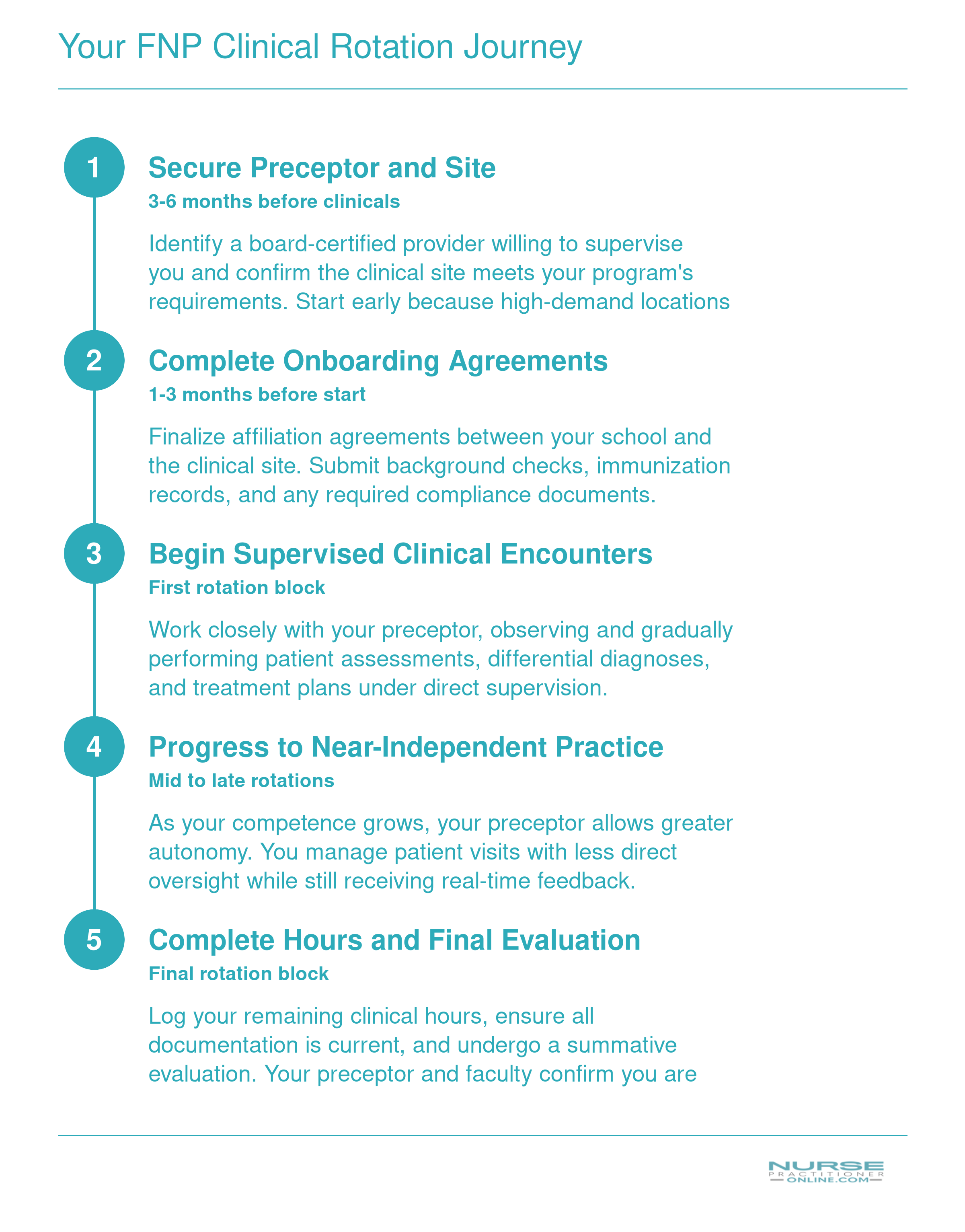
Your FNP Clinical Rotation Journey
From your first preceptor search to your final evaluation, FNP clinical rotations follow a clear progression. Here is a practical look at each phase so you can plan your timeline with confidence.
How FNP Clinical Performance Is Evaluated
How exactly do FNP programs measure whether you are ready to practice independently? The answer is a layered system that looks at your skills from multiple angles, not just a single grade at the end.
Preceptor Evaluations and Faculty Oversight
Your preceptor is your primary evaluator during rotations. Most programs build in both a midpoint and a final evaluation, giving you a checkpoint to course-correct before the rotation ends.1 Faculty add another layer through site visits, phone or video check-ins, and reviews of your clinical logs. Platforms like Typhon and Meditrek are commonly used to record your patient encounters, procedures, hours, and site details.2 These logs do more than track numbers: they verify that your encounter mix meets program and nursing accreditation requirements and that your progression is on track.
The Frameworks Behind the Feedback
The specific criteria your preceptor uses typically draw from two widely recognized frameworks. The first is the NONPF Core Competency Assessment, which organizes expectations across domains including scientific foundation, quality, practice inquiry, technology and information literacy, policy, collaboration, and independent practice.3 Preceptors rate students at midterm and at the final, asking whether each domain is being met at the expected level.
The second framework involves Entrustable Professional Activities, commonly called EPAs. Where competency domains describe what you should know and value, EPAs translate those expectations into observable tasks.3 The guiding question is practical: can you perform this task safely, and does the level of supervision you need match where you should be in your training? EPA-based assessment is developmental, meaning evaluators look for growth across rotation levels rather than perfection from day one.
OSCEs: A Different Kind of Assessment
Many programs also use Objective Structured Clinical Examinations, or OSCEs, to assess clinical skills under controlled, standardized conditions. Unlike day-to-day preceptor feedback, which varies with each patient encounter, an OSCE presents every student with the same scenario and scores performance against a checklist or global rating scale. Programs typically schedule OSCEs before the practicum begins, again at a midpoint, and once more before graduation.5
When Students Struggle
Struggling during your first rotation is more common than most students expect, and it does not automatically put your program completion at risk. When a student falls short, programs generally respond with a remediation plan, which might include extended time at a site, additional skill labs, or a preceptor reassignment. Only when concerns persist despite structured support do programs consider more serious consequences such as dismissal. The system is designed to identify problems early so that recoverable gaps are addressed long before you sit for your certification exam.
Tips to Succeed and Leverage Your Rotations for Certification and Jobs
Clinical rotations are the bridge between being a nursing student and practicing as a credentialed family nurse practitioner. The patients you see, the preceptors you work with, and the notes you keep during these months directly shape how you perform on certification exams and how quickly you land your first NP job. Treat rotations as more than a graduation requirement, and they become your single best preparation tool for the AANP or ANCC boards and your most efficient job search strategy.
Build a Case Log That Doubles as Board Prep
Both the AANP and ANCC family nurse practitioner exams test clinical decision-making, not just memorized facts. Students who actively review their own cases during rotations consistently report feeling more prepared on exam day. Keep a personal case log that goes beyond what your program requires for Typhon or E*Value tracking. For each patient, jot down the chief complaint, your differential, the final diagnosis, and one thing you would do differently. By your final semester, this log becomes a custom study guide that points directly to your weak areas in diagnostic reasoning.
Treat Every Rotation Like a Job Interview
Your preceptors talk to each other, and many FNPs get their first job offer from a rotation site. Show up fifteen minutes early, ask for feedback at the end of each week, and volunteer for procedures other students might avoid: suturing, joint injections, IUD placements, complex med reconciliations. Before your last day at any site, ask your preceptor directly if they would be willing to serve as a professional reference. Most will say yes if you ask, and almost none will offer unprompted.
Diversify Your Sites and Your Network
Aim for a mix of settings across your rotations: urban and rural, private practice and federally qualified health centers, hospital outpatient clinics and community health. A varied résumé signals adaptability to hiring managers and helps you meet the broadest range of state licensure expectations. Stay in touch with classmates and preceptors through LinkedIn or your state NP association. The NP community is smaller than you think, and the relationships you build during clinicals often surface as job leads, mentorship, or collaborating physician introductions years down the road. If you are considering adding a specialty after your FNP, a post-master's FNP certificate program can formalize additional training built on your rotation experience.
Start Boards Prep During Your Final Rotation
Do not wait until graduation to crack open a review book. Begin a structured certification study plan during your last clinical semester, using your case log to target gaps. Twenty focused minutes a day for three months beats cramming after you finish.
Common Questions About FNP Clinical Rotations
Clinical rotations raise plenty of practical questions, especially if you are balancing coursework with a nursing career. Below are straightforward answers to the concerns we hear most often from working RNs pursuing their FNP.
- How many clinical hours do you need to become a nurse practitioner?
- Most FNP programs require a minimum of 500 direct patient care clinical hours, though many programs set the bar at 600 to over 750 hours. The exact total depends on your program, your chosen certification body (AANP or ANCC), and your state board of nursing. Always confirm the requirement with your specific program, because falling short can delay graduation and certification eligibility.
- Can you complete FNP clinical rotations while working full-time as an RN?
- It is possible, but it takes careful planning. Many online FNP students negotiate part-time or per diem RN schedules during clinical semesters. Some rotate on weekends or evenings when preceptor sites allow it. Talk to your program early about scheduling flexibility, and build in buffer time so unexpected changes at work or at your clinical site do not derail your progress.
- Do FNP clinical rotation requirements vary by state?
- Yes. While national certification bodies set baseline hour minimums, individual state boards of nursing may impose additional requirements, such as higher hour totals or mandated rotations in specific populations. If you plan to practice in a different state from where you attend school, verify that state's board requirements before you begin rotations so you do not need to log extra hours later.
- What happens if I can't find a preceptor for my FNP clinical rotation?
- Start by contacting your program's clinical placement office, because many schools maintain preceptor databases or partnerships with health systems. You can also reach out to local clinics, federally qualified health centers, and professional NP organizations for leads. Networking with alumni and classmates often uncovers openings. Begin your search at least two to three months before the rotation starts to avoid delays.
- Do online FNP programs arrange clinical placements for you?
- It varies widely. Some programs guarantee placement and handle all site coordination, while others expect students to secure their own preceptors. A middle ground is common: the school provides a list of affiliated sites and support resources but asks you to confirm the final arrangement. Review each program's clinical placement policy before you enroll so you know what level of support to expect.
- Can simulation hours count toward FNP clinical hour requirements?
- In limited cases, yes. Some programs and state boards allow a small percentage of total clinical hours to come from high-fidelity simulation. However, the majority of your hours must involve direct, in-person patient care under a qualified preceptor. Certification bodies typically cap simulation at roughly 10 to 15 percent of the total. Check with your program and state board for the most current policy.
- How are FNP students evaluated during clinical rotations?
- Evaluation usually combines preceptor feedback, clinical competency checklists, patient encounter logs, and faculty site visits or check-ins. Many programs also require reflective journals or case presentations. Your preceptor rates skills like history-taking, differential diagnosis, patient communication, and clinical decision-making. Midpoint and final evaluations help identify areas for growth and confirm you are meeting program milestones before certification.