Most important takeaways…
- Four ECU Health NPs graduated from the inaugural AGACNP program.
- ECU Health invested $1.5 million to launch the acute care certificate.
- North Carolina’s 65+ population near 18% drives acute NP demand.
Nearly 18% of North Carolina’s population is over 65, yet the nurse practitioner shortage in acute care hasn’t kept pace.
The recent graduation of four AGACNPs from East Carolina University’s inaugural program, backed by a $1.5 million health system investment, shows how targeted partnerships can accelerate workforce growth. With national demand for acute care NPs soaring, such models offer a path to closing critical gaps in hospital-based geriatric care, a reflection of the evolving role of nurse practitioners.
The Inaugural Graduates: A Case Study in AGACNP Expansion
How can health systems and nursing schools partner to rapidly expand the acute care NP workforce?
The recent graduation of four nurse practitioners from East Carolina University's inaugural Adult Gerontology Acute Care Nurse Practitioner (AGACNP) program offers a compelling answer. On July 23, 2026, Charlsie Woodard, Hunter Venters, Rachel Ferrell, and Richa Dhungana became the first to complete this post-graduate certificate program, a direct result of a $1.5 million investment from ECU Health over five years. The funding, channeled through the ECU Health Foundation, expanded faculty, resources, and student financial support, creating a pipeline of specialized providers for a region with a pressing need.
Meeting the Geriatric Care Challenge
The program's focus is laser-targeted: preparing NPs to manage complex acute conditions in older adults. With nearly 18% of North Carolina's population aged 65 or older, according to the U.S. Census Bureau, the demand for clinicians who can navigate geriatric syndromes, polypharmacy, and intensive care transitions is acute. These four graduates, having trained under program director and practicing trauma NP Dr. Kristie Hertel, are now equipped to step into high-acuity roles across eastern North Carolina's hospitals and specialty units. Their training directly addresses a critical shortage of acute care geriatric experts, a gap that geriatric nurse practitioner programs are designed to fill, in a largely rural and medically underserved area.
A Model That Other Regions Can Follow
The ECU Health, ECU College of Nursing partnership demonstrates a replicable blueprint for closing specialty NP gaps. By pooling clinical and academic resources, the program embeds working RNs and NPs into a structured pathway that respects their existing experience while layering on advanced, role-specific competencies. The investment model is particularly noteworthy: the health system's upfront commitment underwrites program growth rather than burdening students, and graduates emerge ready to deliver care that improves outcomes and reduces readmissions. For other health systems facing similar workforce pressures, the lesson is clear. Collaborative investment in acute care nurse practitioner programs, aligned with the Licensure, Accreditation, Certification, and Education (LACE) model, creates a sustainable homegrown solution.
AGACNP Program Structure and Clinical Training Requirements
Becoming an Adult-Gerontology Acute Care Nurse Practitioner (AGACNP) means stepping into a role built for high-stakes, fast-paced environments. The training is deliberately intensive, blending advanced classroom knowledge with hundreds of hours of direct patient care in hospitals and critical care units.
Core Curriculum and Coursework
Every AGACNP program is anchored in three foundational courses recognized by national certifying bodies: advanced pathophysiology, advanced health assessment, and advanced pharmacology.1 These courses go well beyond basic nursing education, diving deep into disease mechanisms at the cellular level, comprehensive nursing differential diagnosis, and complex pharmacotherapeutics for acutely ill adults and older adults. From there, the curriculum pivots to acute-care clinical management, where you learn to perform procedures, interpret diagnostic data, and manage rapidly changing patient conditions. Coursework often covers ventilator management, hemodynamic monitoring, and coordination of care across specialty inpatient services.
Clinical Hour Requirements
To sit for the ANCC AGACNP certification exam, you must complete at least 500 faculty-supervised clinical hours directly managing the care of adult-gerontology patients in acute or complex care settings.1 However, many accredited acute care nurse practitioner online programs build in significantly more hands-on practice. For example, Youngstown State University requires 540 hours,2 Bradley University’s post-master’s certificate calls for 600 hours,3 Mercer University mandates 780 hours,4 and Cedarville University’s program includes 800 hours.5 These additional hours are a deliberate effort to help you develop confidence and clinical judgment under preceptor guidance. Your clinical sites will typically include intensive care units, step-down units, emergency departments, and specialty acute care floors.2
How AGACNP Differs from Other NP Tracks
Unlike a Family Nurse Practitioner (FNP), who is trained to see patients across the lifespan in primary care, the AGACNP population focus is strictly adult to older adult, which reflects the difference between fnp and agnp. While an FNP learns to manage chronic and acute conditions in outpatient clinics, an AGACNP is prepared to handle unstable, decompensating patients who require rapid intervention. The geriatric emphasis is also more pronounced, reflecting the growing proportion of older adults who experience acute illness episodes. This specialized lens makes the AGACNP a critical player on hospital rapid response teams, ICU rounds, and specialty consult services, a clear example of the acute vs primary care distinction.
Questions to Ask Yourself
Workforce Demand for Acute Care NPs: Job Outlook and Growth
Demand for nurse practitioners has never been stronger, with acute care roles at the center of historic advanced practice nursing trends.
Aging Population Fuels Acute Care Needs
The U.S. is aging rapidly. The Census Bureau counted 56.7 million adults aged 65 and older in 20221, and by 2030 all baby boomers will be at least 65. In North Carolina, nearly 18% of residents are already in this age group. Older adults require complex care for multiple chronic conditions, and when hospitalized, they need providers trained in geriatric and acute medicine. Adult-gerontology acute care NPs (AGACNPs) fill that exact niche, making their skill set one of the most sought-after in health care today.
Projected Growth Outpaces Most Other Professions
The Bureau of Labor Statistics projects a 45% growth in NP employment from 2022 to 2032,2 outpacing the broader APRN category at 38%. This amounts to roughly 29,200 annual openings for advanced practice nurses over the decade.3 While not all of these are acute care roles, industry reports consistently identify acute care NP positions as a primary growth engine. A Becker’s Hospital Review analysis notes that the NP workforce could nearly double by 2032, driven by hospital demand and expanded practice authority, reflecting how NPs are reshaping healthcare.4
Hospital Demand and Shortage Pressures
Hospital surveys paint a clear picture of acute care shortages. As health systems shift toward team-based care and focus on high-acuity settings, AGACNPs are among the most recruited specialties. Vacancy rates in acute care units often exceed national averages for nursing, and many hospitals report difficulty filling these roles. The ECU Health AGACNP program, for instance, was created specifically to address a nursing shortage in eastern North Carolina, where the growing geriatric population was outpacing the supply of qualified acute care providers. This model is spreading as regions nationwide confront similar gaps.
A Career Path Built on Structural Need
Unlike some specialties that fluctuate with market trends, the demand for acute care NPs is grounded in demographic inevitability. As the over-65 population expands, projected to reach 73 million by 2030, the need for AGACNPs will only intensify. For nurses considering a career pivot, this stability offers a strong foundation for nurse practitioner advancement opportunities.
NP Job Growth: By the Numbers
The demand for nurse practitioners continues to surge, with the U.S. Bureau of Labor Statistics forecasting unprecedented growth. For those pursuing the Adult-Gerontology Acute Care NP (AGACNP) track, this translates to strong job security in hospitals and critical care settings.
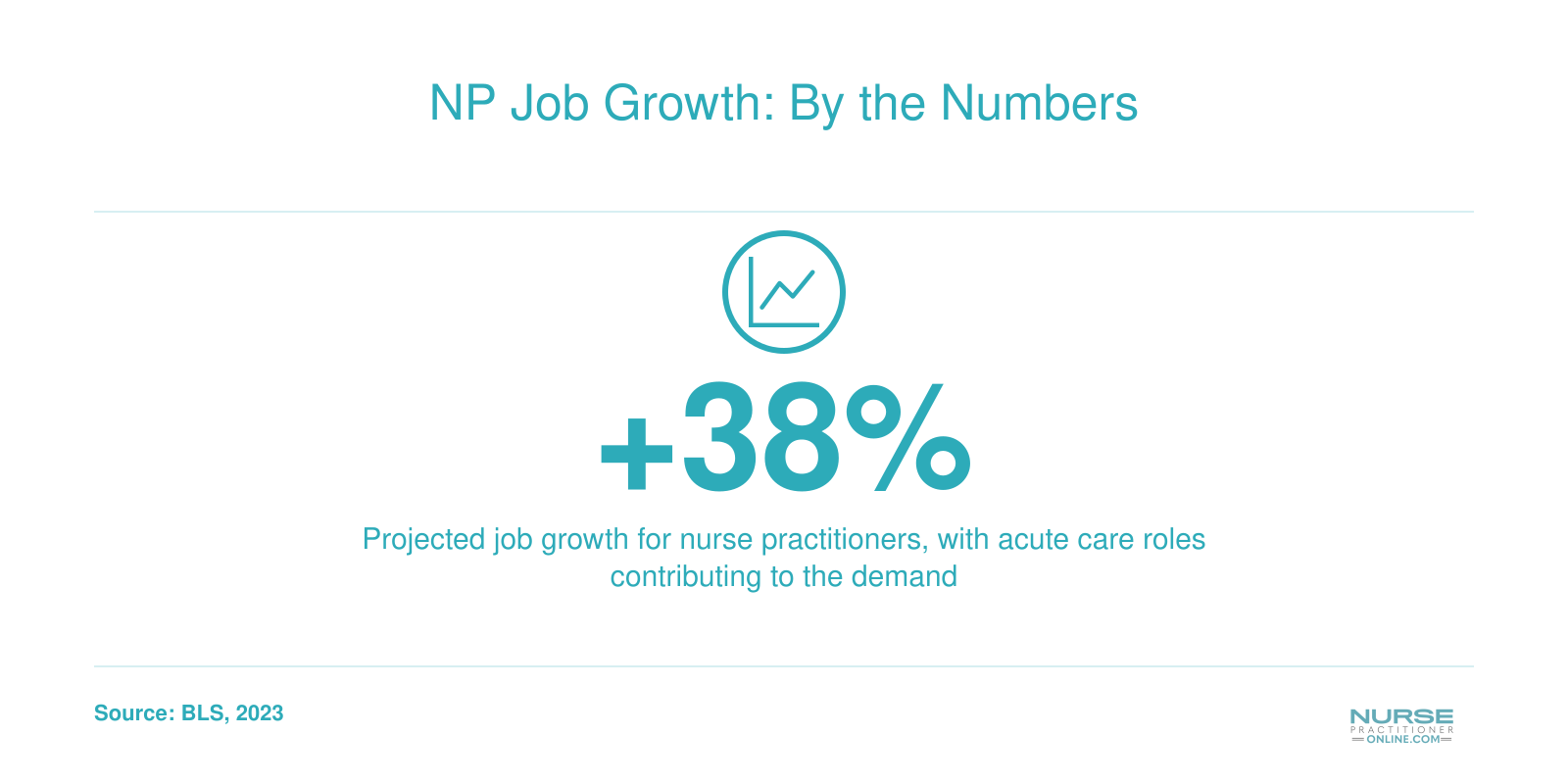
There are currently 28 accredited online or hybrid AGACNP certificate programs nationwide, as of 2026. This number, reported by the American Association of Colleges of Nursing, underscores the rapid growth in training options designed to meet the increasing need for acute care NPs in an aging society.
AGACNP Salary: What You Can Expect to Earn
Salaries for Adult-Gerontology Acute Care Nurse Practitioners reflect their specialized hospital-based training and the growing demand for their skills. While earnings vary by location, experience, and clinical setting, AGACNPs consistently report compensation above the national average for all nurse practitioners.
National Benchmarks: BLS Data for Nurse Practitioners
The U.S. Bureau of Labor Statistics (BLS) reports a median annual wage of $129,210 for nurse practitioners across all specialties. The middle half of NPs earn between $109,940 and $149,570, while the profession's strong projected growth continues to push wages upward. These figures provide a useful baseline, but AGACNP salaries often exceed the general NP median due to the acute care focus, as shown in our nurse practitioner salary by specialty data.
AGACNP-Specific Earnings Data
Detailed compensation surveys paint a more precise picture for acute care specialists. The median annual salary for an AGACNP is approximately $138,000, with a common range falling between $125,000 and $160,000.1 At the entry level and in lower-cost markets, the 25th percentile lands around $88,000, while the 75th percentile reaches about $113,000.2 In high-demand regions such as California, mean annual wages climb to $162,194.3 These numbers underscore the premium attached to managing complex hospital patients.
How AGACNP Pay Compares to Other NP Specialties
AGACNPs generally earn more than many other NP roles, particularly in procedure-heavy subspecialties, and are among the highest paid nurse practitioner specialties. The acute care skill set commands higher compensation in intensive care units, surgical services, and hospitalist groups where procedural competency and critical decision-making are essential.
Setting Drives Salary Potential
Practice environment is a major determinant of take-home pay: - ICUs and Surgical Units: These high-acuity areas tend to offer salaries at the top of the AGACNP range, often above $150,000, because they require advanced procedures and rapid response capabilities. - Hospitalist Medicine: Working on general medicine floors or step-down units yields solid earnings in the $125,000, $145,000 bracket, with potential for shift differentials. - Outpatient Specialties: While less common for AGACNPs, roles in cardiology clinics or pre-admission testing centers still pay competitively, though typically below inpatient pay.
Compared to primary care or psychiatric NP roles, AGACNPs benefit from hospital-based compensation structures, including overtime, on-call pay, and performance bonuses, which further widen the gap over time.
Comparing Top AGACNP Programs: Tuition, Clinical Hours, and More
When evaluating AGACNP programs, the right fit depends on more than just cost. Below, we compare East Carolina University's program with two other well-regarded options to illustrate the range of formats, tuition, and clinical support. (Note: Tuition and clinical hours are approximate and based on publicly available 2025-2026 data; always confirm with the program.) Key considerations include local clinical placement partnerships, especially important in acute care settings, flexibility for working nurses, and total program cost relative to any financial support offered. ECU's partnership with ECU Health exemplifies how employer-backed initiatives can reduce barriers, while nationally recognized programs like Penn offer prestigious networks but at a higher price point. Ultimately, look for CCNE accreditation, a curriculum aligned with ANCC exam requirements, and clinical hour structures that fit your schedule.
| Program | Total Tuition | Credit Hours | Length | Format | Clinical Hours | Key Differentiator |
|---|---|---|---|---|---|---|
| East Carolina University AGACNP Post-Master's Certificate (Online) | Array | |||||
| University of Cincinnati AGACNP MSN (Online) | Array | |||||
| University of Pennsylvania AGACNP Post-Master's Certificate (Hybrid) | Array |
Transition to Practice: What New AGACNPs Should Expect
Transitioning into practice as a new adult-gerontology acute care nurse practitioner (AGACNP) means stepping into a role where you independently manage complex, acutely ill older adults across hospital settings. This shift from student or RN to provider is both exciting and demanding, as the inaugural graduates from East Carolina University’s AGACNP program are discovering right now.
Practical First-Year Advice
- Seek structured support: Look for formal mentorship or nurse practitioner residency programs. Many health systems, including ECU Health, offer transition-to-practice fellowships that pair new AGACNPs with experienced acute care NPs and physician collaborators.
- Lean on your network: The relationships formed during clinical rotations become invaluable peer support. Don't hesitate to call a senior AGACNP for a second opinion on a decompensating patient.
Common Clinical Challenges
New AGACNPs often face rapid decision-making under pressure: when a septic patient's blood pressure drops, you must act within minutes. Managing complex polypharmacy in older adults with multiple comorbidities and adjusting medications for renal or hepatic function demands meticulous attention. The pace of acute care rounds, admissions, and discharges can feel relentless, but with time, you'll develop systematic routines and confidence in nursing practice.
Building on a Supportive Foundation
The ECU graduates enter practice with a strong advantage: they trained within the same health system where they now work, already familiar with protocols, electronic health records, and specialist teams. This continuity smooths the transition, reduces onboarding friction, and allows them to focus on clinical growth rather than learning a new environment. For any new AGACNP, choosing a workplace that mirrors your training setting can ease this critical first year.
The Future of AGACNP Education and Workforce Expansion
Deciding to specialize as an Adult-Gerontology Acute Care Nurse Practitioner often comes down to weighing the upfront investment of time and money against a career that promises growing demand and resilience. As the population ages, the calculus is shifting, and the future of AGACNP education is being shaped by innovative partnerships, flexible delivery models, and evolving state policies.
Academic-Practice Partnerships Will Multiply
The success of programs like the one at East Carolina University and ECU Health demonstrates that healthcare systems see direct returns when they invest in training their own acute care NPs. Over the next decade, expect more hospitals to fund similar post-graduate certificate tracks, reducing the need for student loan forgiveness for nurse practitioners while building a loyal, specialized workforce. The $1.5 million commitment that launched ECU's program is a fraction of the long-term cost of locum tenens or recruiting from outside a region, and administrators are paying attention.
Online and Hybrid Programs Bring AGACNP Training to Underserved Areas
Geography should not dictate who can become an acute care NP. The rise of distance-based AGACNP programs, which combine online didactic courses with strategically placed clinical rotations, is already expanding access for nurse practitioners in rural healthcare. These models let nurses stay in their home communities, complete preceptorships at local or regional hospitals, and graduate ready to serve the same populations they know well. As technology improves and clinical placement networks grow, hybrid programs will become a mainstay, not a novelty.
Full Practice Authority Could Accelerate AGACNP Hiring
Policy debates around nurse practitioner scope of practice directly affect acute care workforce trends. States that have adopted full practice authority for nurse practitioners have seen faster integration of NPs into hospital teams, including in specialty areas like ICU and step-down units. As more states move toward removing collaborative practice requirements, health systems may become even more motivated to invest in AGACNP pipelines, knowing their graduates can practice to the full extent of their training. This regulatory momentum, combined with demographic pressures, points to a future where AGACNPs are not just a niche role but a central pillar of acute care delivery.
FAQs About AGACNP Programs and Careers
Here are answers to common questions about AGACNP education, certification, and career paths.
- What is the job outlook for AGACNPs?
- The demand for acute care nurse practitioners is strong. NP employment is projected to grow 40% through 2034. An aging population, particularly in states like North Carolina where nearly 18% of residents are 65 or older, intensifies demand in hospitals and rural areas.
- How many AGACNP programs are there in the U.S.?
- Over 60 accredited AGACNP programs exist nationally at the MSN, DNP, and post-graduate levels. Formats include online, hybrid, and on-campus, including online DNP acute care nurse practitioner programs, offering flexibility for working nurses.
- What clinical hours are required for AGACNP certification?
- ANCC and AACN require a minimum of 500 supervised clinical hours in the acute care role for certification1. Most programs mandate 500-750 direct patient care hours in nurse practitioner clinical rotations2.
- How do I choose the right AGACNP program?
- Choose a program with CCNE, ACEN, or CNEA accreditation, required for ANCC certification after 20261. Compare tuition, total cost, clinical placement support, and program format. Dedicated placement assistance is crucial if you lack a sponsoring hospital.
- What is the average salary for an AGACNP?
- AGACNP salaries typically range from $110,000 to $140,000, with top earners above $150,000. Pay varies by geography, experience, and practice setting.
- What are the certification requirements for AGACNPs?
- After an accredited program, pass the ANCC AGACNP-BC or AACN ACNPC-AG exam, then obtain state APRN licensure3. As of 2026, program accreditation is mandatory for ANCC certification1.
- What should new AGACNPs expect during transition to practice?
- New AGACNPs benefit from structured residencies or fellowships, like ECU Health's mentorship program. Ongoing education and clinical preceptorships ease the transition into acute care practice.