Most important takeaways…
- Only two Colorado universities, CU Anschutz and UNC, currently offer AG-ACNP programs for 2026.
- CU Anschutz reports a 100 percent first-time board certification pass rate for its AG-ACNP graduates.
- AG-ACNP clinical requirements range from 500 to 750 hours, with DNP tracks requiring the most.
- Colorado ACNPs in high-acuity ICU or surgical roles can approach $200,000 with premium pay.
Colorado is home to exactly two universities offering an online AG-ACNP program, which turns the application process into a high-stakes decision from day one. With so few options, fit matters as much as admission odds. Choose wrong, and you may wait a year or more for the next cycle.
Full practice authority makes Colorado a magnet for acute care nurse practitioners. But that independence places the entire weight of preparation on your graduate education. There is no physician collaboration requirement to buffer gaps in training, so the program you pick either equips you for full clinical responsibility or leaves you scrambling after graduation.
Hospitals along the Front Range are expanding their ACNP teams in ICUs and specialty surgical services, putting a premium on graduates who hit the floor ready to manage complex, decompensating patients without hand-holding.
Top Online AG-ACNP Programs in Colorado for 2026
Colorado's roster of online Adult Gerontology Acute Care Nurse Practitioner programs is small, with just two universities currently offering the specialty. That limited field actually works in your favor: each program is well established, and the differences between them are clear enough to match against your career goals, budget, and timeline. Below, we break down what each school brings to the table so you can make a confident decision.
- Online and hybrid accessibility
- Institutional graduation and retention rates
- Tuition affordability and regional pricing
- Clinical placement support
- Faculty ratio and program structure
- Independent program research
- Internal program database
- NCES-IPEDS federal institutional data — nces.ed.gov
- College Scorecard graduate earnings — collegescorecard.ed.gov

University of Colorado Denver/Anschutz Medical Campus
CU Anschutz is Colorado's flagship health sciences campus and houses the state's most comprehensive AG-ACNP offering. The program is available at both the master's and BS-to-DNP levels, giving applicants two clear entry points depending on where they are in their education. Denver-metro students benefit from coordinated clinical placements, and residents of eligible western states can lock in Colorado-resident tuition rates through a regional reciprocity arrangement, making the program financially competitive even for out-of-state learners.
- Hybrid format with some in-person sessions at the Aurora campus
- 1,170 total clinical hours built into the curriculum
- School coordinates clinical placements for Denver-metro students
- BS-to-DNP pathway available as a single continuous admission
- Western-state residents may qualify for in-state tuition rates
- Nationally ranked (No. 33) nursing program
- Applications submitted through the NursingCAS platform
- Graduates eligible for APRN licensure in all 50 states
Adult Gerontology Acute Care Nurse Practitioner (DNP) — Hybrid

University of Northern Colorado
The University of Northern Colorado offers an MSN with an AG-ACNP concentration through a hybrid online format based in Greeley. UNC stands out for its flat per-credit tuition of $734, which applies to all students regardless of residency, removing much of the cost uncertainty that out-of-state applicants face elsewhere. With a 14-to-1 student-to-faculty ratio, the program is positioned for more individualized mentorship during coursework and clinical preparation.
- Hybrid online program with a specialized AGACNP concentration
- Flat tuition of $734 per credit for all students
- 14-to-1 student-to-faculty ratio for closer mentorship
- Post-bachelor's DNP pathway available for continued study
- No additional student fees beyond per-credit tuition
- Institution-wide graduation rate of 51.2% (not program-specific)
Nursing M.S., Adult Gerontology Acute Care Nurse Practitioner — Hybrid
Colorado AG-ACNP Tuition: MSN, DNP, and Certificate Cost Breakdown
Tuition for AG-ACNP programs in Colorado varies significantly depending on the degree level, the institution, and your residency status. The table below compares published costs for MSN, DNP, and post-master's certificate options at Colorado schools offering an acute care NP track. Keep in mind that institution-level average net price figures reflect aid across all students at the university, not a guaranteed quote for your specific graduate program. Also note that out-of-state online students at CU Anschutz who reside in eligible western states may qualify for the same rate as Colorado residents, so it is worth confirming your eligibility before assuming you will pay out-of-state tuition.
| School | Program Type | In-State Tuition (Annual or Total) | Out-of-State Tuition (Annual or Total) | Avg. Net Price (Institution Level) | Notes |
|---|---|---|---|---|---|
| University of Colorado Anschutz | BSN-to-DNP AG-ACNP | Approx. $60,075 (total program) | Contact school for details | Approx. $11,900/yr (all students, after aid) | Hybrid format; 1,170 total clinical hours; ranked #33 nationally |
| University of Colorado Anschutz | Post-Master's Certificate AG-ACNP | Approx. $12,816 (total, 12 months) | Approx. $20,768 (total, 12 months) | N/A | Western state residents may pay in-state rate; add roughly $1,187 in mandatory fees plus $2,000 for books and supplies |
| University of Northern Colorado | MSN AG-ACNP | Approx. $15,376/yr | Approx. $26,446/yr | Approx. $17,760/yr (all students, after aid) | Hybrid online format; flat tuition reported at $734/credit; DNP pathway also available |
| CSU Pueblo | Post-Master's Certificate AG-ACNP | Approx. $7,920 (total, 24 to 26 credits) | Contact school for details | N/A | Requires 585 clinical hours; one of the most affordable certificate options in the state |
Questions to Ask Yourself
Online vs. Hybrid: What 'Fully Online' Actually Means for Colorado ACNPs
The phrase 'fully online' appears in nearly every AG-ACNP program brochure, but the fine print reveals a spectrum of in-person requirements that can shape your schedule and your ability to hold onto your current shift work. For Colorado-based nurses evaluating University of Colorado Anschutz or out-of-state alternatives, understanding what happens on campus (and how often) is essential to planning childcare, PTO requests, and travel logistics.
Colorado's In-State Programs Are Hybrid, Not Fully Online
University of Colorado Anschutz offers three AG-ACNP pathways: an MS, a BS-to-DNP, and a post-graduate certificate. All three run in hybrid format, meaning the majority of didactic coursework occurs asynchronously online, but periodic on-campus visits are mandatory. The post-graduate certificate requires at least eight hours of in-person classroom time, and both the MS and BS-to-DNP include immersion days for simulation labs, orientation weekends, and clinical skills practicums. Anschutz does not publish exact immersion day counts publicly, so prospective students should contact the admissions office for the current academic year's calendar. Plan for two to four multi-day visits per year, depending on the program and clinical cohort.
University of Northern Colorado does not currently offer an AG-ACNP program, leaving Anschutz as the sole in-state option for acute care specialty preparation. If you are considering a DNP pathway instead, our guide to online DNP programs Colorado covers the broader landscape.
Out-of-State Fully Online Options Authorized in Colorado
Nurses who cannot travel to Aurora multiple times a year have legitimate alternatives. NC-SARA authorization allows several out-of-state universities to enroll Colorado residents in fully online ACNP programs without requiring campus visits for didactic content. University of South Alabama, Walden University, and Georgetown University each offer AG-ACNP tracks delivered entirely online for classroom and lecture components. These programs still mandate in-person clinical rotations in your local market, but you will never board a plane for a simulation lab or orientation. For a broader comparison of acute care nurse practitioner programs online, our national directory can help you weigh additional options.
Clinical Hours Are Always In-Person, Regardless of Program Format
No AG-ACNP program, whether based in Colorado or nationally accredited online, can waive the face-to-face patient-care requirement. CU Anschutz requires 675 clinical hours for the MS track and 360 hours for the post-graduate certificate. Fully online programs typically require 500 to 700 hours, depending on whether you enter with prior NP certification. These hours occur in ICUs, step-down units, and emergency departments near your home or workplace. You are responsible for identifying preceptors, securing clinical sites, and completing affiliation agreements, regardless of whether your lectures stream from Colorado or Alabama.
What 'Fully Online' Excludes
When a program markets itself as fully online, it means didactic coursework only. You will still appear in person for clinical rotations, skills check-offs, and sometimes final capstone presentations. If a program advertises zero campus visits, confirm whether that excludes orientation, simulation, or OSCE practicums before you commit.
What Colorado AG-ACNP Programs Require for Admission
Colorado's AG-ACNP programs set clear, rigorous admission benchmarks that separate the prepared from the hopeful. Here's exactly what you'll need to get your application read.
Programs at a Glance: MSN, DNP, and Certificate Options
Both CU Anschutz and UNC offer multiple entry points. At CU, you can pursue the MS AG-ACNP (fall 2027 start), the BS-DNP AG-ACNP (fall 2026 start), or a post-graduate certificate (spring 2027 start). UNC structures its tracks similarly, though exact pathways and timelines may vary. Each program type, whether master's, doctorate, or certificate, carries slightly different admission hurdles, but the core expectations around clinical readiness remain consistent.
Clinical Experience Requirements: The Acute-Care Edge
This is where programs draw a hard line. CU Anschutz requires a minimum of one year of full-time RN experience in an acute or critical care setting, with a strong preference for two years or more. The experience must be recent and hands-on: ambulatory surgery, post-anesthesia care, and emergency department roles often count, but outpatient clinic work generally does not. UNC maintains a similar requirement, aiming for at least one year of acute-care bedside experience. Neither program broadly accepts non-acute-care RNs without additional prerequisites; however, if your background includes a mix of inpatient and specialty care, reach out to the program director to discuss whether your experience qualifies or if bridge coursework is available.
Academic Prerequisites and Certification Must-Haves
Before you apply, verify these boxes are checked: - GPA: A cumulative undergraduate GPA of 3.0 or higher is standard. Competitive applicants often present 3.2 or above. - Prerequisite courses: Pathophysiology, health assessment, and statistics are mandatory at both schools. These must be completed with a grade of B or better within the last five to seven years. - Active RN license: An unencumbered Colorado RN license (or compact state equivalent) is required. - Certifications: Current BLS and ACLS are non-negotiable. PALS is highly recommended and may be required for certain clinical placements at CU Anschutz.
If you're considering a doctoral pathway, reviewing DNP prerequisites before you apply can help you identify any gaps early. UNC's published prerequisites mirror these closely, though specific recency requirements can differ. Always confirm directly with each program.
Application Deadlines and Standardized Test Policies
Timing matters as much as credentials. For CU Anschutz: - MS AG-ACNP: Opens August 15, 2026; priority deadline January 15, 2027. - BS-DNP AG-ACNP: Opens August 15, 2025; priority deadline January 15, 2026. - Post-Graduate Certificate: Opens January 15, 2026; priority deadline July 1, 2026.
Missing a priority deadline doesn't always close the door, but it can mean a delayed start or waitlist. GRE scores are not required by CU; UNC also waives the GRE for most applicants. For broader guidance on building a strong application, our NP school requirements guide walks you through each step. Focus on a polished personal statement that demonstrates your understanding of acute-care NP practice.
Clinical Hours and Finding Preceptors Across Colorado
Most AG-ACNP programs require somewhere between 500 and 750 supervised clinical hours, with DNP tracks typically landing at the higher end of that range. Before you apply anywhere, confirm the exact requirement directly with the program, because the number matters for planning your schedule and securing enough placement sites.
Know What Your Program Expects
Programs at the University of Colorado Anschutz Medical Campus and the University of Northern Colorado each publish clinical hour requirements in their curriculum guides or clinical handbooks. Review those documents carefully. Pay attention not just to the total hours, but to how those hours must be distributed across settings (ICU, step-down, or emergency environments), since AG-ACNP competencies require exposure to genuinely acute patient populations. For a broader look at what these rotations involve, our guide to nurse practitioner student clinical rotations breaks down the typical structure and expectations.
Equally important: find out whether the program assists with placement or expects you to secure your own preceptor. Policies vary, and some programs take a hybrid approach where they maintain a list of affiliated sites but leave the final outreach to the student. If the program's website does not spell this out clearly, a 15-minute call with the program advisor will. Advisors frequently know which local hospital systems have a track record of hosting students even when that information is not published anywhere publicly. Our step-by-step guide on how to find NP preceptors covers the outreach process in detail.
Colorado Hospital Systems Worth Exploring
Colorado has several large health systems whose graduate medical education and nursing education offices are worth contacting directly. UCHealth, Denver Health, and Centura Health all operate across the state and work with advanced practice students in various capacities. Check the nursing education or GME pages on their websites for information about clinical affiliations or preceptor programs. Smaller regional systems and critical access hospitals can also be strong options, particularly if you are already employed there and can formalize an existing relationship.
Professional Resources for Placement Guidance
Beyond the program and individual hospitals, two resources can help you think through site selection strategically:
- Certifying body guidance: Both the American Association of Critical-Care Nurses and the American Nurses Credentialing Center publish standards for AG-ACNP clinical preparation. Reviewing these helps you evaluate whether a proposed site genuinely meets competency requirements.
- Colorado Advanced Practice Nurse Alliance: This state organization connects APRNs across specialties and can be a practical networking channel when you need introductions to potential preceptors or want candid insight from nurses who have navigated this process locally.
Starting your preceptor search early, ideally before your first clinical semester begins, is the single most consistent piece of advice you will hear from nurses who have completed these programs. Colorado's acute care settings are busy, and preceptor availability shifts with staffing cycles, so giving yourself a long runway pays off.
Explore other Colorado related topics
Related Articles
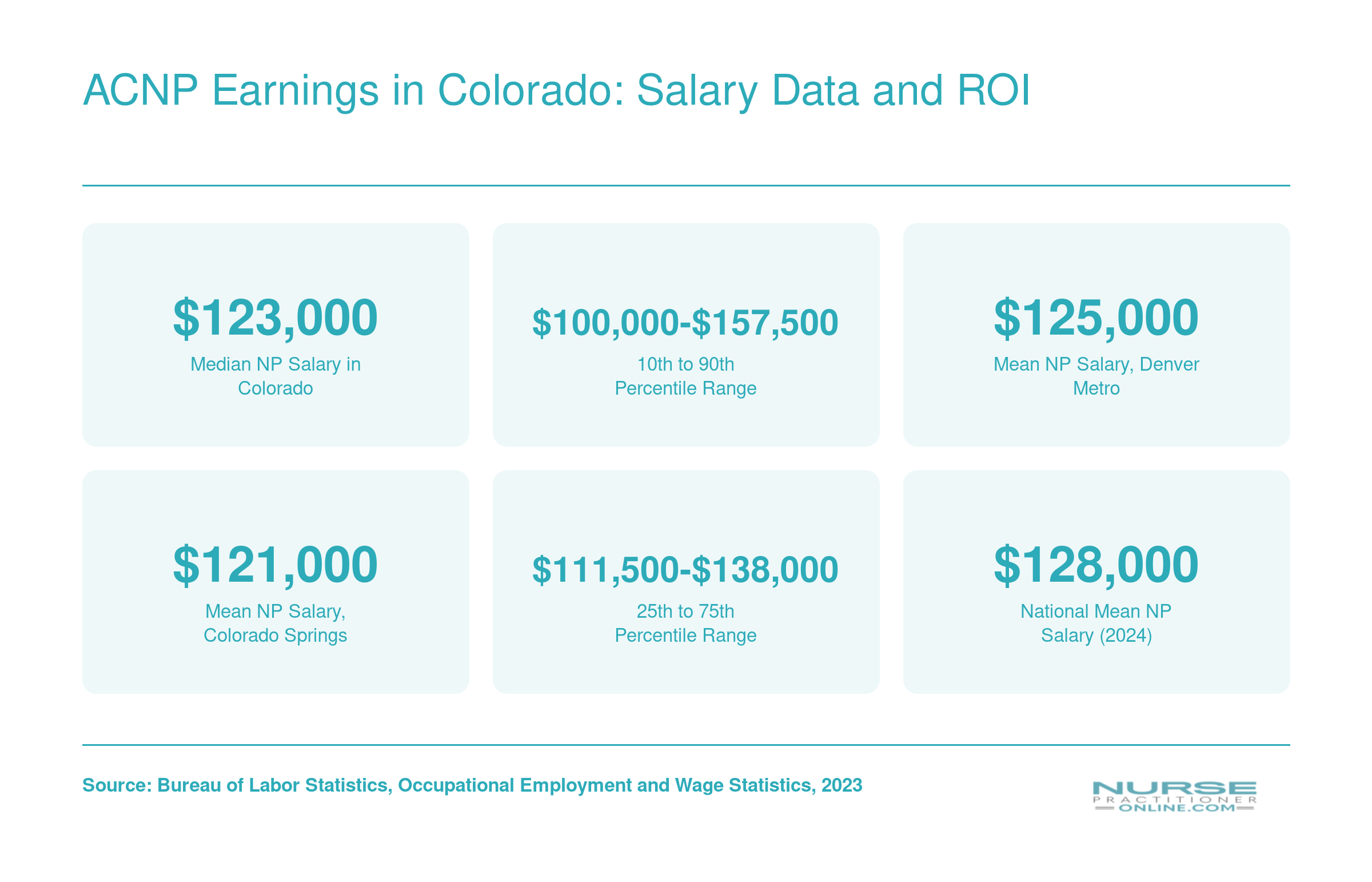
ACNP Earnings in Colorado: Salary Data and ROI
Colorado nurse practitioners earn competitive salaries that can more than justify the investment in an AG-ACNP program. The figures below reflect statewide NP wages across all specialties, since acute care NP earnings are not reported separately. That said, ACNPs who work in high-acuity settings such as ICUs, trauma centers, and emergency departments often command premium pay through shift differentials, overtime, and locum tenens assignments. Reaching the $200,000 mark is realistic for Colorado ACNPs who combine a full-time hospital role with locum shifts or who negotiate specialty differentials in critical care. Compared to FNPs, ACNPs in acute settings generally report higher base salaries, though published data does not yet break out the exact dollar difference at the state level.
From Graduation to Practice: Colorado APRN Licensure for ACNPs
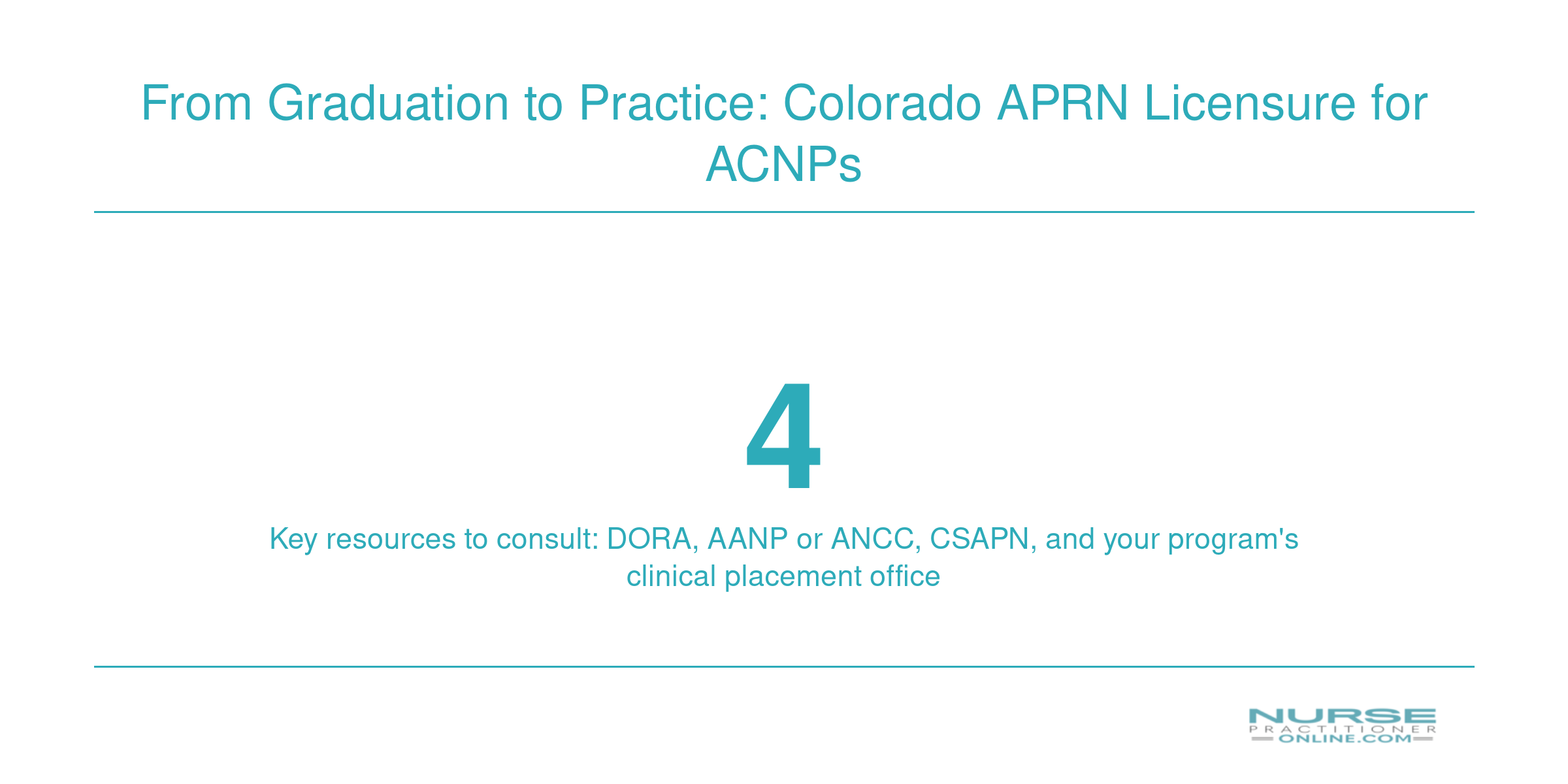
Earning your AG-ACNP degree is a major milestone, but you still need to navigate Colorado's licensure process before you can practice. The Colorado Department of Regulatory Agencies (DORA) oversees APRN applications through its nursing board. Visit dora.colorado.gov/professional-licensing for the most current application steps, required documents, fees, and processing timelines. For prescriptive authority guidance and transition-to-practice details, check the state policy pages maintained by the American Association of Nurse Practitioners (AANP) or the American Nurses Credentialing Center (ANCC). The Colorado Society of Advanced Practice Nurses (CSAPN) and ACNP-specific listservs are excellent resources for tracking 2025 and 2026 scope-of-practice bills in real time. Finally, reach out to your AG-ACNP program's clinical placement office or a state-level APRN organization for help meeting any mentorship or transition-to-practice requirements that apply to new graduates.
ACNP vs. FNP in Colorado: Choosing the Right Track
One of the most common questions nurses ask is whether ACNP is 'better' than FNP. The honest answer: neither track is objectively superior. The right choice depends on where you want to practice, which patient populations energize you, and how you define long-term career satisfaction. Here is how the two tracks compare for Colorado nurses weighing their options in 2026.
Pros
- ACNP opens doors to high-acuity roles in ICUs, emergency departments, and hospitalist teams, which are growing across Colorado's major medical centers.
- Fewer AG-ACNP programs in Colorado means less competition for coveted acute-care clinical placement sites.
- Hospital-based ACNP roles often carry higher base pay and shift differentials compared to primary care FNP positions.
- Specializing in acute care can position you for leadership roles in critical care and surgical services as Colorado's hospital systems expand.
- ACNPs fill a distinct workforce gap, so demand from employers tends to be strong and targeted rather than diluted across settings.
Cons
- ACNP scope is narrower: you cannot practice primary care or treat pediatric patients, which limits flexibility if your career goals shift.
- Colorado offers fewer ACNP program options than FNP tracks, so you may need to consider out-of-state online programs.
- Most AG-ACNP programs require current acute-care RN experience (typically ICU, ED, or step-down), which can be a barrier for nurses working outside hospital settings.
- FNP graduates enjoy broader scope and strong demand in rural Colorado, where primary care provider shortages persist across dozens of counties.
- The FNP track has more program choices and scheduling flexibility, making it easier to compare tuition costs and find the right fit.
- FNP's primary care market in the Denver metro area is increasingly saturated, which can drive down starting salaries and make job searches more competitive in urban areas.
AG-ACNP Certification Pass Rates and Program Outcomes in Colorado
What percentage of graduates from Colorado AG-ACNP programs pass their board certification exams on the first try?
University of Colorado Anschutz reports a 100 percent board certification pass rate across both its MS AG-ACNP program and its post-graduate certificate track.1 That perfect record covers graduates sitting for either the ANCC AGACNP-BC exam or the AACN ACNPC-AG exam, the two certification pathways required for acute care nurse practitioner licensure in Colorado.2 Against the national backdrop (an 80 percent first-time pass rate for the ANCC exam and 74 percent for the AACN exam4 in 2025), CU Anschutz's outcomes stand well above average.
University of Northern Colorado does not publish program-specific certification pass rates, so prospective students should contact the College of Natural and Health Sciences directly for the most current data.
Why Pass Rates Matter for ROI
A strong certification pass rate signals rigorous curriculum design, robust clinical training, and effective test preparation. When 100 percent of a cohort passes on the first attempt, you avoid the cost and delay of retesting (exam fees run around $350 to $390 per attempt) and you enter practice months sooner. That translates directly to earnings: Colorado ACNPs averaged $119,570 annually in 2024, meaning each month of delay costs nearly $10,000 in forgone income.
Perfect pass rates also suggest that a program selects candidates carefully, supports them throughout clinical rotations, and prepares them comprehensively for the certification exam's content domains: pharmacology, pathophysiology, advanced health assessment, and acute-care diagnostics.
Program Length and the Fastest Path to Certification
MSN AG-ACNP programs typically require two to three years of part-time enrollment, balancing clinical hours with coursework. Post-master's certificate tracks condense the same clinical and didactic content into one to two years, making them the fastest option for nurses who already hold a master's degree in another nursing specialty. If you are comparing options nationally, our roundup of online post-master's ACNP certificate programs can help you benchmark Colorado offerings against programs in other states. CU Anschutz's certificate program, for example, requires 600 clinical hours and can be completed in as few as 18 months when enrolled full-time.
No program shortchanges clinical depth to speed completion. Colorado's Board of Nursing mandates a minimum of 500 supervised clinical hours for APRN licensure, and accredited AG-ACNP programs typically exceed that threshold. Speed matters, but outcome quality matters more: a short program with a 60 percent pass rate delays your earnings far longer than a rigorous two-year track with a 100 percent pass rate.