Most important takeaways…
- New Jersey NPs earn a median salary of roughly $143,250, nearly $17,000 above the national median.
- Five NJ schools offer seven AG-ACNP pathways spanning MSN, DNP, and post-master's certificate options.
- Clinical practicum placements in acute care are increasingly competitive, so placement support varies widely by school.
- MSN programs provide the faster route to practice, while the DNP adds leadership and systems-level preparation.
How many New Jersey schools actually offer an AG-ACNP track a working RN can complete largely online? The answer is a short list: five institutions, seven distinct pathways across the MSN, DNP, and post-master's certificate levels.
Demand on the employer side is harder to ignore. NJ hospital systems, from academic medical centers in Newark and New Brunswick to community ICUs along the shore, continue to post acute care NP openings tied to ICU, step-down, and rapid response coverage. Online and hybrid formats have become the practical route for bedside RNs who cannot leave full-time shifts to attend daytime didactics. If you are already weighing online post-master's ACNP certificate programs, a New Jersey-based option may simplify clinical placement logistics.
The constraint is rarely coursework. It is clinical placement capacity, which has tightened across the Northeast as preceptor pools shrink.
Best Online ACNP Programs in New Jersey, 2026 Rankings
We evaluated every NJ AG-ACNP program accepting online students, weighting online accessibility alongside graduation rates, graduate debt, and post-completion earnings to surface the strongest options for working nurses. The five schools below offer seven distinct pathways, from MSN and DNP degrees to post-master's certificates, each with flexible online or hybrid formats built around your schedule.
- Online delivery accessibility
- Institutional graduation rates
- Graduate debt levels
- Post-completion earnings
- Retention and student outcomes
- Independent program research
- NCES-IPEDS federal institutional data — nces.ed.gov
- Internal program database
- College Scorecard graduate earnings — collegescorecard.ed.gov

Rutgers University
Rutgers School of Nursing in New Brunswick pairs a strong research university reputation with a focused post-master's certificate in Adult-Gerontology Acute Care. The hybrid format blends online didactic coursework with hands-on clinical experiences across multiple NJ campus locations, making it practical for nurses who already hold a master's or doctoral degree. With a university-wide graduation rate of 83.6% and in-state tuition around $23,241, it offers a high-value pathway to specialty certification.
- Designed for nurses with a master's or doctoral nursing degree
- Hybrid format: online coursework plus in-person clinical hours
- Leads to AG-ACNP specialty certification eligibility
- Multiple NJ campus locations support clinical placements
- Curriculum emphasizes evidence-based acute care management
- Advanced training for complex adult and older adult populations
- In-state tuition approximately $23,241; out-of-state $37,689
Post-Master's Certificate in Adult-Gerontology Acute Care Nurse Practitioner — Hybrid

Rutgers University-Newark
Rutgers Newark delivers the only BSN-to-DNP AG-ACNP track in the state, covering 73 credit hours through a hybrid model with either a 4-year or 5-year study plan. Rolling admissions with a priority deadline of March 1 (final deadline July 1) give applicants scheduling flexibility. The school, which has an institution-wide graduation rate of 63.8% and a 14:1 student-to-faculty ratio, sits in a major metro area with deep acute care clinical partnerships.
- 73 total credit hours in a hybrid online format
- Choose a 4-year or 5-year completion plan
- Rolling admissions with fall start each year
- Priority application deadline March 1; final deadline July 1
- Graduates eligible for national board certification
- Training covers complex, acute, and critical health conditions
- In-state tuition approximately $23,221; out-of-state $37,669
- 14:1 student-to-faculty ratio supports individualized attention
Post-Baccalaureate DNP in Adult-Gerontology Acute Care Nurse Practitioner — Hybrid

Rowan University
Rowan University in Glassboro stands out for offering two distinct AG-ACNP pathways, an MSN and a post-master's certificate, both featuring 100% online coursework at a competitive per-credit rate. Updated for the 2026 to 2027 academic year at $899 per credit, Rowan keeps total costs manageable while providing fall, spring, and summer start dates. The university's 67.4% graduation rate and strong clinical preparation round out a practical, budget-friendly option.
- 36 to 53 graduate credits depending on background
- $899 per credit for the 2026 to 2027 academic year
- 100% online coursework with asynchronous delivery
- Fall, spring, and summer entry points available
- Covers advanced pharmacology, health assessment, and research
- Prepares graduates for the AGACNP certification exam
- 22 graduate credits at $899 per credit
- Completable in approximately 24 months
- 100% online coursework designed for working nurses
- Requires an MSN and current NJ RN licensure
- Includes didactic and clinical course components
- Graduates eligible for the AGACNP certification exam
Master of Science in Nursing, Adult-Gerontology Acute Care Nurse Practitioner — Hybrid
Certificate of Advanced Graduate Study in Adult-Gerontology Acute Care Nurse Practitioner — Hybrid

Saint Peter's University
Saint Peter's University in Jersey City offers a fully online MSN with an Adult-Gerontology NP concentration that can be completed in as few as two years. The 39-credit program is CCNE accredited and includes 600 clinical practice hours, with small class sizes and personalized faculty mentorship that reflect the school's Jesuit focus on whole-person development. Saint Peter's reports strong post-graduation employment rates, and its 12:1 student-to-faculty ratio is the lowest among NJ AG-ACNP programs.
- 39 credit hours in a fully online format
- Completable in approximately 2 years
- 600 required clinical practice hours
- CCNE accredited with small class sizes
- 12:1 student-to-faculty ratio for personalized mentorship
- Prepares graduates for certification and doctoral study
- High employment rate reported after graduation
Master of Science in Nursing, Adult-Gerontology Nurse Practitioner — Online

Seton Hall University
Seton Hall University in South Orange provides both an online MSN and a post-master's certificate in AG-ACNP, both accredited by CCNE. The MSN track requires 48 credits and 675 clinical hours, boasting a 95% certification exam pass rate. The post-master's certificate ranges from 18 to 39 credits based on a gap analysis, making it adaptable for nurses with varying prior coursework. With a 69.5% institution-wide graduation rate and tuition of $37,470, Seton Hall positions itself as a premium, outcomes-focused option.
- 48-credit fully online MSN program
- 675 total clinical hours across multiple specialties
- 95% certification exam pass rate reported
- One year of nursing experience required for admission
- CCNE accredited; prepares for ANCC and AACN exams
- Flexible online coursework for working professionals
- Tuition approximately $37,470 per year
- 18 to 39 credits determined by individualized gap analysis
- Fully online format with didactic and clinical courses
- CCNE accredited program
- Designed for nurses holding a master's degree in nursing
- Prepares graduates for AG-ACNP specialty certification
- Flexible scheduling supports career advancement
Master of Science in Nursing, Adult-Gerontology Acute Care Nurse Practitioner — Online
Post-Master's Certificate in Adult-Gerontology Acute Care Nurse Practitioner — Online
NJ AG-ACNP Programs at a Glance: Credits, Tuition, and Format
New Jersey's AG-ACNP landscape spans multiple credential levels, from post-master's certificates to the DNP, so the right fit depends on where you are in your education and where you want to go. The table below compares each ranked program on degree type, estimated credits, published tuition rates, approximate net price, and graduation rate. Net price figures shown are institution-wide averages reported to the federal government; your actual cost will vary based on financial aid, enrollment status, and the number of credits you take.
| School | Credential | Est. Credits | Est. Duration | In-State Tuition | Out-of-State Tuition | Approx. Net Price (Institution Avg.) | Graduation Rate | Format |
|---|---|---|---|---|---|---|---|---|
| Saint Peter's University | MSN | 39 | About 2 years | $16,035 | $16,035 | $12,199 | 58.3% | Online |
| Rutgers University, Newark | Post-Baccalaureate DNP | 73 | 4 to 5 years (part-time plans available) | $23,221 | $37,669 | $19,703 | 63.8% | Hybrid |
| Rowan University | Post-Master's Certificate (CAGS) | 22 | About 24 months | $18,607 | $18,607 | $22,408 | 67.4% | Hybrid (online coursework) |
| Rutgers University, New Brunswick | Post-Master's Certificate | 30 | Varies by study plan | $23,241 | $37,689 | $24,406 | 83.6% | Hybrid |
| Seton Hall University | Post-Master's Certificate | 18 to 39 (gap analysis determines total) | Varies by credit requirement | $37,470 | $37,470 | $31,446 | 69.5% | Online |
Admission Requirements for Online AG-ACNP Programs in NJ
New Jersey AG-ACNP programs share a common set of admission expectations, though specifics vary by school and degree level. Here is what you should have ready before you apply.
- BSN from an accredited institutionAll NJ AG-ACNP programs require a Bachelor of Science in Nursing from a program accredited by CCNE or ACEN. Post-master's certificate applicants will instead need a completed MSN with prerequisite coursework in advanced health assessment, pathophysiology, and pharmacology.
- Active, unencumbered RN licenseYou must hold a current RN license without restrictions. Rutgers, for example, requires licensure in New Jersey or a compact state by the end of your first semester. Confirm each school's specific timeline for license verification.
- Minimum GPAMost programs expect a cumulative GPA of 3.0 or higher. Rutgers sets the bar slightly higher at 3.2 for its DNP pathway. If your GPA falls just below the cutoff, some schools may still consider your application holistically.
- Acute care clinical experienceDirect patient care experience in an acute or critical care setting is a common expectation. Seton Hall requires at least one year of clinical nursing experience along with a current ACLS certification. Other programs may be flexible on the exact timeframe but strongly favor ICU, ED, or step-down unit backgrounds.
- Application componentsPlan to submit official transcripts from all previous institutions, a current resume or CV highlighting your clinical background, a personal statement describing your professional goals, and two to three professional references, ideally from supervisors or faculty who can speak to your clinical competence.
- GRE/MAT requirementsStandardized entrance exams are increasingly waived across NJ nursing programs. Neither Rutgers nor Seton Hall lists a GRE or MAT requirement for their AG-ACNP tracks based on available information, but policies can change, so verify directly with your target school before applying.
- Out-of-state student eligibilitySeton Hall's online MSN AG-ACNP program is designed to accommodate distance learners, and many online NJ programs do accept out-of-state applicants. However, state authorization regulations and clinical placement logistics may limit availability in certain states. Contact the program's admissions office to confirm your state is approved before investing time in an application.
Questions to Ask Yourself
Clinical Practicum Hours and Placement Support in NJ
Securing acute care clinical placements has become one of the most competitive aspects of AG-ACNP education, with hospitals tightening preceptor availability even as program enrollment grows. For working nurses considering online programs, understanding each school's clinical hour requirements and placement support can mean the difference between graduating on time and facing costly delays.
Clinical Hour Requirements by Program
New Jersey AG-ACNP programs require substantial direct patient care hours, though the totals vary based on degree level:
- Rutgers DNP (AG-ACNP): 752 clinical practicum hours, with a minimum of 1,000 total hours when including the DNP scholarly project1
- Rutgers Post-Master's Certificate: 540 clinical hours for nurses who already hold an MSN and want to add the AG-ACNP specialty2
These hours must be completed in acute care settings under qualified preceptors. Most programs require you to work with board-certified acute care nurse practitioners or physicians who specialize in critical care, hospitalist medicine, or emergency services.
Clinical Placement Support
Whether a program helps you find preceptors or expects you to secure your own sites is a critical consideration. Rutgers provides clinical placement coordination through its nursing school, though students are encouraged to leverage existing professional connections at their workplaces. Many working nurses find success by approaching nurse managers or medical directors at their current hospitals early in the program. For a broader look at how this process works across online programs, see our guide on how online nursing programs arrange local clinical placements.
For out-of-state placements, policies vary. Some programs allow clinical hours at facilities outside New Jersey, which can be helpful if you live near the Pennsylvania or New York borders. If you are exploring options across state lines, you may also want to review online ACNP programs in Pennsylvania. Confirm placement flexibility with your program coordinator before enrolling, especially if your hospital system operates across state lines.
Expected Clinical Settings
AG-ACNP students complete rotations in high-acuity environments where patients face complex, rapidly changing conditions. Typical settings include:
- Medical and surgical ICUs
- Cardiac care units and step-down floors
- Emergency departments (particularly for critical presentations)
- Specialty units such as neurology, trauma, or oncology acute care
Some programs incorporate simulation hours into the total, though these typically represent a small portion. Campus-based intensives at Rutgers may include simulation labs for procedural skills like central line placement or ventilator management, but the majority of your hours will involve direct patient encounters.
Tips for Working Nurses
Finding acute care preceptors takes persistence and planning. Start networking at least six months before your first clinical semester. Consider these strategies:
- Talk to your unit's nurse practitioners about their willingness to precept
- Reach out to hospitalist groups or intensivists who work with NP students
- Ask your program for a list of previously approved sites in your region
- Join state NP organizations where members often share preceptor leads
If you work night shifts, discuss scheduling flexibility with potential preceptors early. Many are willing to accommodate nontraditional hours, but the conversation needs to happen before paperwork begins.
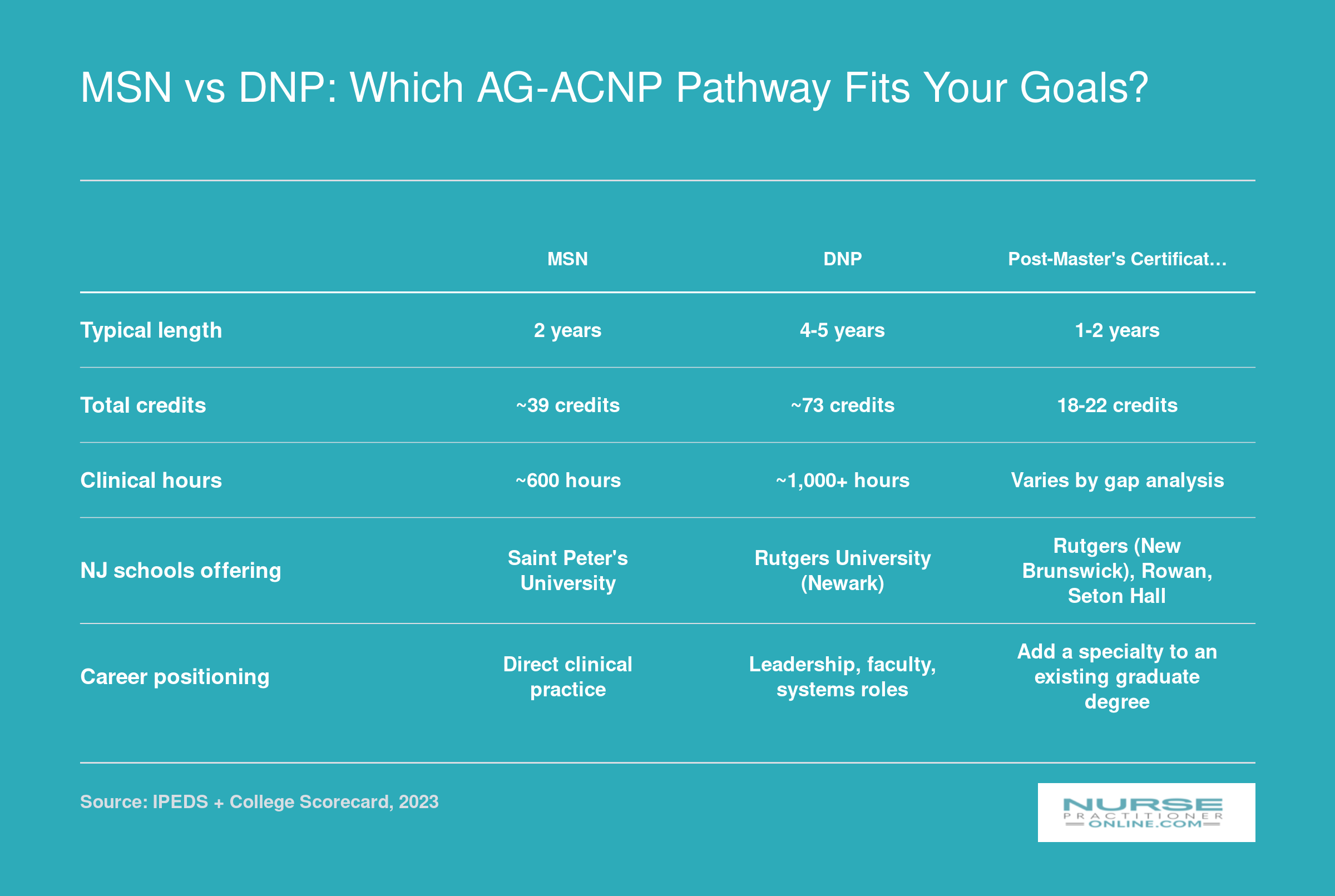
MSN vs DNP: Which AG-ACNP Pathway Fits Your Goals?
Choosing between an MSN and a DNP shapes everything from how long you are in school to the roles you qualify for after graduation. The MSN is the faster, more affordable route into clinical practice, while the DNP prepares you for leadership, faculty, and systems-level positions. Keep in mind that the AACN has endorsed the DNP as the preferred entry level for advanced practice nursing, though MSN-prepared NPs remain fully eligible for certification and licensure in New Jersey.
Post-Master's AG-ACNP Certificate Options in New Jersey
A post-master's certificate appeals to nurses who already hold an MSN and want to add acute care NP credentials without completing a full degree program from scratch. If you fall into that category, the honest starting point is that confirmed post-master's AG-ACNP certificate options at New Jersey schools are limited in the current published record, and a few important distinctions are worth unpacking before you start contacting programs.
What the Current Data Shows
Rutgers University, one of the largest nursing schools in New Jersey, structures its Adult-Gerontology Acute Care NP pathway as a post-baccalaureate DNP rather than a post-master's certificate.1 That program requires 75 credits and 1,000 total hours of supervised clinical experience, including 752 precepted practicum hours. If you already hold a master's degree, Rutgers may offer an accelerated path, but you would still be working toward a doctoral credential, not a standalone certificate.
Felician University does offer a post-master's certificate in adult-gerontology nursing, though it is important to flag the distinction: Felician's certificate targets primary care, not acute care. The program runs approximately 24 months in a hybrid format, carries 37 credits, and requires 750 clinical hours. It is a solid credential for the right student, but it will not prepare you for the AGACNP-BC exam that acute care practice requires.
How to Find Current Offerings
Program offerings change more quickly than published directories can track. Here is a practical approach to finding what is actually available in 2026:
- Check school websites directly: Look for a curriculum guide, program handbook, or FAQ page on the nursing school sites at Rutgers, Rowan University, Seton Hall, and Felician. Search for terms like "post-master's certificate" and "acute care" together.
- Call or email the admissions office: Program coordinators can confirm current credit requirements, online availability, cohort start dates, and whether the school assists with clinical placement. These details rarely appear on the main program page.
- Use accreditation databases: The Commission on Collegiate Nursing Education (CCNE) and the American Association of Colleges of Nursing (AACN) maintain searchable program directories. Cross-referencing those lists against individual school sites is one of the most reliable ways to confirm a program's current status. For more context on what these accreditors mean for your education, see our guide on nursing program accreditation.
- Check professional organizations: The American Association of Nurse Practitioners (AANP) publishes resources and program listings that can surface options you might otherwise overlook.
A Realistic Expectation
Post-master's AG-ACNP certificates do exist nationally, but New Jersey schools have historically favored full MSN or DNP pathways for acute care specialization. If no local certificate program fits your timeline or budget, some regionally accredited programs in neighboring states offer fully online formats that accept NJ-licensed nurses and support clinical placements within the state. You may also want to explore the broader landscape of nurse practitioner programs in New Jersey to compare your options before committing to an application.
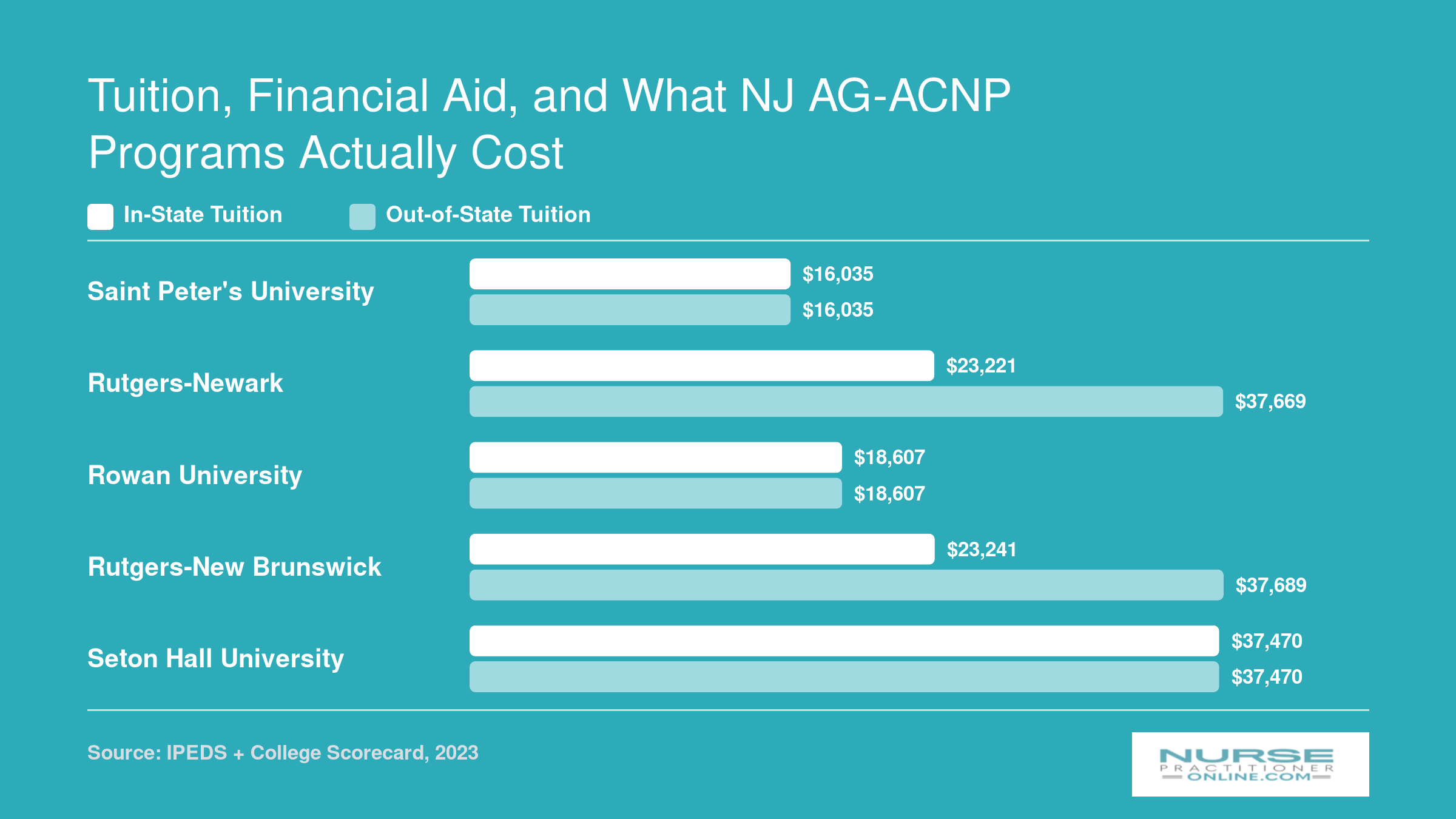
Tuition, Financial Aid, and What NJ AG-ACNP Programs Actually Cost
Sticker price is only part of the picture. The tuition figures below reflect per-credit or annual graduate nursing rates reported to IPEDS, not the institution-wide net price after aid. Each school also publishes an average net price (the amount students actually pay after grants and scholarships), which runs significantly lower: roughly $12,200 at Saint Peter's University, $19,700 at Rutgers-Newark, $22,400 at Rowan, $24,400 at Rutgers-New Brunswick, and $31,400 at Seton Hall. Keep in mind those averages are institution-wide and include undergraduates, so your graduate cost may differ. Median graduate debt across these schools ranges from about $20,500 to $22,750, again reflecting all graduate programs at the institution. To bring your out-of-pocket cost down, look into employer tuition reimbursement, HRSA Nurse Corps Scholarships, federal Direct Unsubsidized and Grad PLUS loans, and New Jersey-specific programs such as the NJ STARS and state-funded tuition aid grants.
Acute Care NP Salary and Job Market in New Jersey
What do acute care nurse practitioners actually earn in New Jersey, and how does the Garden State stack up against the rest of the country?
NJ Nurse Practitioner Salaries: The Numbers
New Jersey ranks among the top-paying states for nurse practitioners. According to BLS occupational data, nurse practitioners in New Jersey earn a mean annual wage of approximately $155,750, which translates to roughly $74.88 per hour.1 Compare that to the national median of about $138,137, and you see NJ practitioners earning roughly 13 percent more than their counterparts elsewhere.2
While program-level earnings specifically for AG-ACNP graduates are not yet published for most New Jersey schools, the statewide figures for all NPs provide a reliable benchmark. Acute care NPs often command salaries at or above these figures given the specialized nature of their work in high-acuity settings like ICUs, trauma centers, and specialty hospitals.
Where NJ Acute Care NPs Find Top-Paying Opportunities
The highest-paying positions for acute care NPs in New Jersey tend to cluster around major medical centers and health systems in urban corridors. The Newark-Jersey City metropolitan area, home to large academic medical centers and Level I trauma hospitals, consistently offers competitive compensation packages. Northern New Jersey facilities serving the greater New York City region also draw premium salaries due to cost-of-living adjustments and competition for specialized talent.
Hospital systems with robust critical care, cardiology, and surgical programs actively recruit AG-ACNPs for intensivist support, hospitalist teams, and procedural roles. Facilities in Camden, New Brunswick, and Hackensack represent major employers in acute care specialties.
Understanding NJ Practice Authority
New Jersey currently operates under reduced practice authority for nurse practitioners, meaning NPs must maintain a collaborative agreement with a physician for prescribing and certain aspects of medical management.1 As of 2026, full practice authority legislation has not been enacted in New Jersey, though advocacy efforts continue at the state level. For a broader look at how regulations vary across the country, see this nurse practitioner scope of practice guide.
For AG-ACNP graduates, this collaborative requirement typically integrates naturally into hospital-based practice where physician partnerships are already embedded in care models. Many acute care NPs find the collaborative framework functions smoothly within inpatient settings, though it does shape scope considerations for those exploring independent practice opportunities.
Job Market Outlook
Nationally, nurse practitioner employment exceeds 185,000 positions, with demand projected to grow substantially as healthcare systems expand advanced practice roles.2 New Jersey benefits from its dense population, aging demographics, and concentration of academic medical centers, all factors driving sustained demand for acute care specialists. Graduates from programs at institutions like Rutgers University, Seton Hall University, and Rowan University enter a market where their specialized training aligns directly with workforce needs in critical care, cardiopulmonary, and emergency medicine settings.
Selecting the Right Online AG-ACNP Program for You
Choosing an AG-ACNP program means weighing several practical factors against your personal circumstances, career timeline, and learning preferences. The best program on paper may not be the best program for your life, so a structured approach to comparison helps you avoid costly mismatches.
Start With Accreditation and Certification Outcomes
CCNE accreditation should be your baseline filter. Programs without it may create licensing headaches or limit your job prospects. Beyond accreditation, dig into certification exam pass rates for ANCC or AACN credentials. Schools often publish aggregate pass rates, but ask admissions representatives for program-specific data if AG-ACNP numbers are not broken out. A program with a 95 percent pass rate signals strong curriculum alignment with board expectations, while rates below 80 percent warrant questions.
Evaluate Clinical Placement Support Honestly
Clinical practicum logistics can make or break your experience. Some programs offer robust placement coordination with established preceptor networks across New Jersey. Others expect you to secure your own sites, a time-consuming process that can delay graduation if placements fall through. If you work full-time night shifts and cannot spend weeks cold-calling ICU directors, self-placement may be a dealbreaker. Ask current students about their placement experiences before committing.
MSN or DNP: Match the Degree to Your Five-Year Plan
If direct patient care in acute settings is your goal, an MSN provides faster entry to practice, typically in two to three years. For a broader look at MSN pathways, explore the best online MSN nurse practitioner programs available nationally. If you see yourself moving into leadership, health policy, or academic roles, a DNP builds the foundation for those trajectories. Some nurses complete an MSN first and add a DNP later, though this path costs more overall. Consider where you want to be in 2031 and work backward.
Check State Authorization and Program Flexibility
If you are considering out-of-state online programs, verify that the school holds authorization to offer distance education in New Jersey. Without it, you may face licensing complications after graduation. For shift workers, examine how synchronous sessions are scheduled. A program with mandatory live classes at 2 p.m. on weekdays may not fit your rotating schedule.
Look Beyond Rankings: Cohort Size and Faculty Ratios
Smaller cohorts and lower faculty-to-student ratios often translate to more personalized feedback and stronger mentorship. A program with 15 students per faculty member will likely offer a different experience than one with 40. These details rarely appear in marketing materials, so ask directly during information sessions.
Common Questions About Online ACNP Programs in New Jersey
Below are some of the most common questions nurses ask when exploring online adult gerontology acute care nurse practitioner programs in New Jersey. Each answer draws on the details covered throughout this guide.
- What are the requirements for online ACNP programs in New Jersey?
- Most NJ programs require an active, unencumbered RN license, a BSN from an accredited institution (with a minimum GPA around 3.0), and at least one to two years of clinical nursing experience, ideally in an acute care setting. You will also need official transcripts, professional references, a goal statement, and sometimes a statistics or health assessment prerequisite course.
- How many clinical hours are required for an AG-ACNP program?
- AG-ACNP programs in New Jersey typically require a minimum of 500 direct patient care clinical hours, though DNP tracks often exceed 1,000 hours. These practica must take place in acute care environments such as ICUs, emergency departments, or specialty inpatient units. Some schools help arrange placements, while others expect students to secure their own preceptors.
- Can out-of-state students enroll in NJ online ACNP programs?
- Yes, many NJ programs accept out-of-state applicants. However, you should confirm that the school holds authorization to offer distance education in your state through SARA or an individual state agreement. You will also need to arrange clinical rotations in your home area, so check whether the program provides placement assistance outside New Jersey.
- What is the difference between an MSN and DNP for acute care nurse practitioners?
- An MSN is a master's level pathway that prepares you for clinical certification as an AG-ACNP in fewer credits and less time, usually two to three years part time. A DNP adds doctoral-level coursework in leadership, evidence-based practice, and quality improvement, often requiring a scholarly project. The DNP is ideal if you plan to pursue executive roles, teaching positions, or systems-level practice.