Most important takeaways…
- NPs in the Newark and Jersey City metro earn a median salary of $149,000, well above the national median.
- Rutgers, Monmouth, FDU, Seton Hall, and Felician all offer AGNP MSN programs serving the Jersey City area.
- Jersey City Medical Center provides centralized clinical rotation placement for AGNP students in Hudson County.
- New Jersey grants APNs independent practice and prescriptive authority after meeting post-graduation licensing steps.
Adult Gerontology Primary Care Nurse Practitioners fill a widening gap in North Jersey's healthcare system, where adults over 65 now represent more than 16 percent of the population and that share continues to climb. Eight accredited MSN programs in New Jersey prepare RNs for this specialty, with total tuition ranging from roughly $17,000 at William Paterson to over $37,000 at Seton Hall.
Formats split between fully online and hybrid, and clinical hour requirements span 500 to 750 depending on the school. New Jersey granted full practice authority to APNs in 2022, removing collaborative agreement mandates and making the state one of the more favorable markets for independent primary care practice.
Best AGNP MSN Programs Near Jersey City, NJ, 2026 Rankings
Choosing the right Adult Gerontology Primary Care Nurse Practitioner program is a big decision, especially when you're balancing shifts, family, and long-term career goals. The programs below are all based in New Jersey and serve the Jersey City metro through online or hybrid delivery, with clinical placement networks that extend into North Jersey and the broader NYC corridor. We evaluated each school on a blend of cost, graduate outcomes, format flexibility, and program-level details so you can compare them with confidence.
- Total cost and median debt
- Graduate earnings after completion
- Program format and flexibility
- Clinical hour requirements
- Institutional graduation outcomes
- College Scorecard graduate earnings — collegescorecard.ed.gov
- NCES-IPEDS federal institutional data — nces.ed.gov
- Internal program database
- Independent program research

Fairleigh Dickinson University-Metropolitan Campus
Fairleigh Dickinson University's Metropolitan Campus in Teaneck is one of the closest AGNP options to Jersey City, making it a natural fit for Hudson County nurses. Its hybrid MSN format blends online coursework with synchronous sessions, and students regularly secure clinical placements across Bergen, Hudson, Passaic, and Essex counties. FDU Metro's evening and online scheduling is built around 12-hour shift workers in the NYC metro, and rolling admissions with three annual start dates keep the entry process flexible.
- 43 total credit hours with part-time pacing
- 750 clinical hours in primary care settings
- Rolling admissions with fall, spring, or summer starts
- Synchronous and asynchronous class options
- Prepares for ANCC, AANP, or NCC certification
- Median graduate debt of $25,000
- 2.8 minimum GPA required for admission
Nurse Practitioner MSN, Adult Gerontology Primary Care — Hybrid

Seton Hall University
Seton Hall University, located just 30 to 40 minutes from Jersey City in South Orange, delivers a 48-credit online MSN with a strong reputation in adult gerontology primary care. The program reports a 100% AANPCB exam pass rate and draws on deep relationships with major North Jersey health systems and community clinics for clinical placements. Its no-set-class-times format and 3 to 4 year completion timeline give working RNs significant scheduling control, while its values-based curriculum emphasizes ethical, patient-centered care across specialties like cardiology, neurology, and oncology.
- 48 total credit hours, 100% online coursework
- 600 clinical hours in diverse healthcare settings
- 100% AANPCB exam pass rate reported
- CCNE accredited program
- No set class times for maximum flexibility
- 3 to 4 year expected completion timeline
- Immersive clinical experiences across multiple specialties
- Median graduate debt of $22,750
MSN, Adult-Gerontology Primary Care Nurse Practitioner — On-Campus

William Paterson University of New Jersey
William Paterson University stands out for Jersey City nurses who want speed and affordability. Its 100% online, CCNE-accredited AGNP track can be completed in as few as 16 months, and total program tuition is listed at roughly $29,600, among the lowest on this list. With six start dates per year and 7-week course terms, the pay-by-the-course model is designed for RNs who are currently employed. The university also offers an RN-to-MSN pathway for nurses who hold an associate degree, broadening access for a wider range of candidates.
- CCNE accredited, 39 credit hours total
- 16-month completion possible at full pace
- $759 per credit, pay-by-the-course tuition
- 510 clinical hours in North Jersey settings
- Six start dates per year with 7-week terms
- 100% online coursework, no campus visits required
- Current RN employment and 3.0 GPA required
- Prepares for Adult-Gero Primary Care certification exam
- 24-month program with embedded BSN curricula
- 57 total credit hours, 100% online
- 660 clinical practice hours included
- Total tuition approximately $30,352
- Six annual start dates for flexible entry
- CCNE accredited, prepares for certification exam
MSN, Adult Gerontology Nurse Practitioner — Online
RN to MSN, Adult Gerontology Nurse Practitioner — Online

Stockton University
Stockton University offers a CCNE-accredited MSN with an Adult Gerontology Primary Care NP concentration in a blended online format with on-campus intensives once per semester. As a public university, it carries the lowest posted in-state tuition on this list at about $17,262, with a median graduate debt of $20,500. Students choose between a 24-month full-time or 33-month part-time track, and clinical placements are coordinated within 1.5 hours of the student's location. Stockton's focus on serving New Jersey's medically underserved communities aligns well with primary care workforce needs statewide.
- 46 total credit hours, blended online format
- 750 supervised clinical hours in primary care
- Full-time (24 months) or part-time (33 months) tracks
- No entrance exam (GRE) required
- On-campus intensives once per semester
- 3.2 GPA minimum, two letters of recommendation
- Transfer up to 9 credits accepted
- Healthcare partner tuition discount available
MSN, Adult Gerontology Primary Care Nurse Practitioner — Hybrid

Fairleigh Dickinson University
Fairleigh Dickinson University's Madison campus delivers a fully online AGNP MSN with synchronous class sessions. The 43-credit program covers advanced pharmacology, pathophysiology, health assessment, and three sequential adult gerontology clinical courses totaling 750 hours. With an 11:1 student-to-faculty ratio, FDU Madison offers more individualized attention than many competitors. Rolling admissions and three annual start dates keep the process accommodating for nurses with unpredictable schedules.
- 43 credit hours, fully online with synchronous sessions
- 750 direct care clinical hours in primary care
- Rolling admissions with fall, spring, or summer entry
- Part-time pacing at roughly two courses per semester
- Prepares for ANCC, AANP, or NCC certification
- 2.8 GPA minimum, health assessment prerequisite required
- 11:1 student-to-faculty ratio institution-wide
Nurse Practitioner MSN, Adult Gerontology Primary Care — Online

Monmouth University
Monmouth University's 39-credit online AGNP program is CCNE-accredited and built for working RNs, with fully asynchronous classes and a dedicated clinical placement coordinator. The school boasts over 500 clinical partners across New Jersey, including sites reachable from the northern metro region. Monmouth's institution-wide graduation rate of 71.9% is the highest among the schools ranked here, and its median 10-year earnings figure of roughly $67,991 reflects strong long-term outcomes for graduates.
- 39 credit hours, 100% asynchronous online classes
- 500+ clinical partners across New Jersey
- CCNE accredited with personalized placement coordinator
- 3.0 GPA minimum, work experience required
- Fall start with July 15 application deadline
- Financial aid available for qualifying students
- Designed specifically for currently working RNs
Adult-Gerontological Primary Care Nurse Practitioner MSN — Online

Rider University
Rider University's online MSN features 100% online coursework with a single in-person residency, giving working nurses near-total location flexibility. Faculty coordinate clinical placements across New Jersey, which can help Jersey City area students secure sites close to home rather than near Rider's Lawrenceville campus. The CCNE-accredited program emphasizes career autonomy and preparation for national certification exams, with 750 clinical hours spread across specializations.
- 100% online coursework with one in-person residency
- 750 clinical hours with faculty-coordinated placements
- CCNE accredited, part-time program design
- Three concentration options within the MSN
- Preparation for national NP certification exams
- Median graduate debt of $26,130
Adult-Gerontology Primary Care Nurse Practitioner MSN — Online

Felician University
Felician University in Lodi offers a fully online, 37-credit AGNP MSN grounded in a Franciscan tradition of serving diverse and underserved urban populations, a mission that resonates with Jersey City's multiethnic communities. The program can be completed in about three years with rolling admissions, and 585 clinical hours are completed in ambulatory and long-term care settings. Doctoral-prepared faculty guide students throughout, and a Post Master's Certificate option is available for nurses who already hold an MSN.
- 37 credit hours, fully online delivery
- 585 clinical hours in ambulatory and long-term care
- Rolling admissions, approximately 3-year completion
- CCNE accredited, prepares for ANCC or AANP certification
- Doctoral-prepared faculty mentorship throughout
- Post Master's Certificate option also available
- Emphasis on care for diverse, underserved populations
MSN, Adult-Gerontology Nurse Practitioner in Primary Care — On-Campus
Side-by-Side Comparison: Credits, Tuition & Clinical Hours
The table below puts the most important cost and program structure details for each AGNP MSN program in one place. For graduate students, the per-credit tuition rate usually matters more than the institution-wide average net price, which reflects undergraduate financial aid packages and may not match what you will actually pay. Focus on the graduate tuition column and multiply by total credits for a rough program cost estimate. Median graduate debt gives you a realistic snapshot of what recent graduates borrowed across all programs at each school. Program-level earnings data is not yet available for these programs, so we have omitted that column rather than leave it blank.
| School | Total Credits | Clinical Hours | Graduate Tuition (per year) | Institution Avg. Net Price* | Median Graduate Debt | Format |
|---|---|---|---|---|---|---|
| FDU, Metropolitan Campus (Teaneck) | 43 | 750 | $19,068 | $15,404 | $25,000 | Hybrid |
| William Paterson University | 39 | 510 | $16,963 (in-state) / $24,211 (out-of-state) | $18,745 | $22,334 | Online |
| Stockton University | 46 | 750 | $17,262 (in-state) / $24,264 (out-of-state) | $20,670 | $20,500 | Hybrid |
| FDU, Florham Campus (Madison) | 43 | 750 | $25,628 | $22,829 | $25,000 | Online |
| Rider University | Not published | 750 | $20,220 | $24,792 | $26,130 | Online |
| Monmouth University | 39 | Not published | $26,918 | $30,988 | $27,000 | Online |
| Seton Hall University | 48 | 600 | $37,470 | $31,446 | $22,750 | Online |
| Felician University | 37 | 585 | $22,520 | $40,045 | $25,000 | Online |
Questions to Ask Yourself
Clinical Training Sites & Placement Support Near Jersey City
Jersey City Medical Center, part of the RWJBarnabas Health system, runs a centralized clinical rotations process through its Educational Center for Professional Development, making it one of the most accessible training sites for AGNP students in Hudson County.1 Understanding where you can train, and how your program helps you get there, is one of the most important factors in choosing the right MSN pathway.
Major Health Systems Accepting NP Students
The greater Jersey City metro spans Hudson, Essex, and Bergen counties, and several large health systems in this corridor have infrastructure for hosting graduate nursing students in clinical rotations.
- Jersey City Medical Center (RWJBarnabas Health): Accepts students through a centralized rotations office. Your program must hold an affiliation agreement with the facility, and all requests go through that formal channel.1
- Hackensack Meridian Health: One of the largest systems in northern New Jersey, with hospitals and outpatient practices across Bergen and Hudson counties. Graduate nursing students can often access primary care, specialty, and acute care sites within the network.
- Valley Health System: Maintains a dedicated Student Clinical Rotations page and requires schools to submit formal paperwork and cohort requests. Slots depend on available contracts and preceptor capacity.2
- CarePoint Health (Hudson County): While CarePoint actively employs nurse practitioners, its public information focuses more on NP hiring than structured student rotation programs.3 Working RNs already employed in CarePoint facilities may find it easier to arrange preceptorships informally, but confirm availability directly.
Program-Arranged vs. Self-Placement
This is a critical distinction that many prospective students overlook. Some New Jersey AGNP programs maintain standing affiliation agreements with area hospitals and clinics, meaning the school coordinates your placement. Others, particularly fully online programs based out of state, require you to find your own preceptor and clinical site.
Before you enroll, ask the admissions office directly: does the program have active clinical partnerships in the Jersey City metro? How many students are already competing for slots at the same sites? Online programs that draw applicants from across the region can saturate local preceptor availability quickly, so getting a clear answer early protects you from delays later in your program.
Federally Qualified Health Centers as AGPCNP Training Sites
Federally qualified health centers in the Jersey City and Newark metro area are particularly well suited for adult gerontology primary care NP students. FQHCs serve diverse, underserved populations and provide the kind of longitudinal primary care experience that aligns closely with the AGPCNP scope of practice. Sites such as Metropolitan Family Health Network in Jersey City and Newark Community Health Centers offer exposure to chronic disease management, preventive care, and health equity challenges you will encounter throughout your career.
Confirm Site Availability Before You Commit
Regardless of how a program describes its clinical support, take this step before submitting your application: contact the clinical placement coordinator and ask for specifics. Find out how many affiliation agreements the school holds in Hudson, Essex, and Bergen counties, whether those agreements are current, and what the typical timeline looks like for securing a site. Programs with strong local partnerships will be transparent about this. If a program is vague or tells you placement is entirely your responsibility, factor that added workload into your decision. Securing a quality preceptor can take weeks or even months, and that is time you could spend on coursework and patient care instead.
Online vs. Hybrid AGNP Programs: Format Breakdown
Choosing between a fully online and a hybrid AGNP MSN program comes down to how you work, how you learn, and how much help you want securing clinical sites near Jersey City. Both formats can prepare you for the same certification exams, but the day-to-day experience differs in ways that matter when you are juggling 12-hour shifts. Here is what to weigh as you compare your options.
Pros
- Fully online programs like William Paterson, Seton Hall, and Rider let you complete coursework on your own schedule with no required campus visits.
- Online enrollment opens the door to nationally accredited programs beyond New Jersey, giving you more choices in tuition and start dates.
- Asynchronous classes, offered at schools such as Monmouth and Seton Hall, mean you can study between shifts without logging in at a fixed time.
- Hybrid programs like Ramapo College and Stockton University maintain clinical partnerships and simulation labs close to the Jersey City metro area.
- On-campus intensives, typically once per semester at Stockton, provide hands-on skills practice and stronger faculty mentorship during clinical rotations.
- Hybrid cohorts often build peer study networks naturally, which can help with exam prep and professional referrals after graduation.
Cons
- Many fully online programs expect you to find and secure your own preceptor sites, which can be time-consuming in a competitive clinical market like northern New Jersey.
- Without scheduled face-to-face sessions, online students may feel isolated; some programs offset this with synchronous webinars, but participation can still feel limited.
- National online programs such as Graceland or George Washington may require brief on-campus intensives at a distant location, adding travel costs.
- Hybrid schedules with fixed class days or on-campus simulation sessions can conflict with rotating hospital shifts, reducing flexibility for bedside nurses.
- Choosing a hybrid format generally limits you to NJ-based schools, narrowing tuition options compared to the broader online marketplace.
- Some synchronous online sessions at schools like Fairleigh Dickinson are held at set times, so verify whether the schedule aligns with your shift pattern before applying.
Related Articles
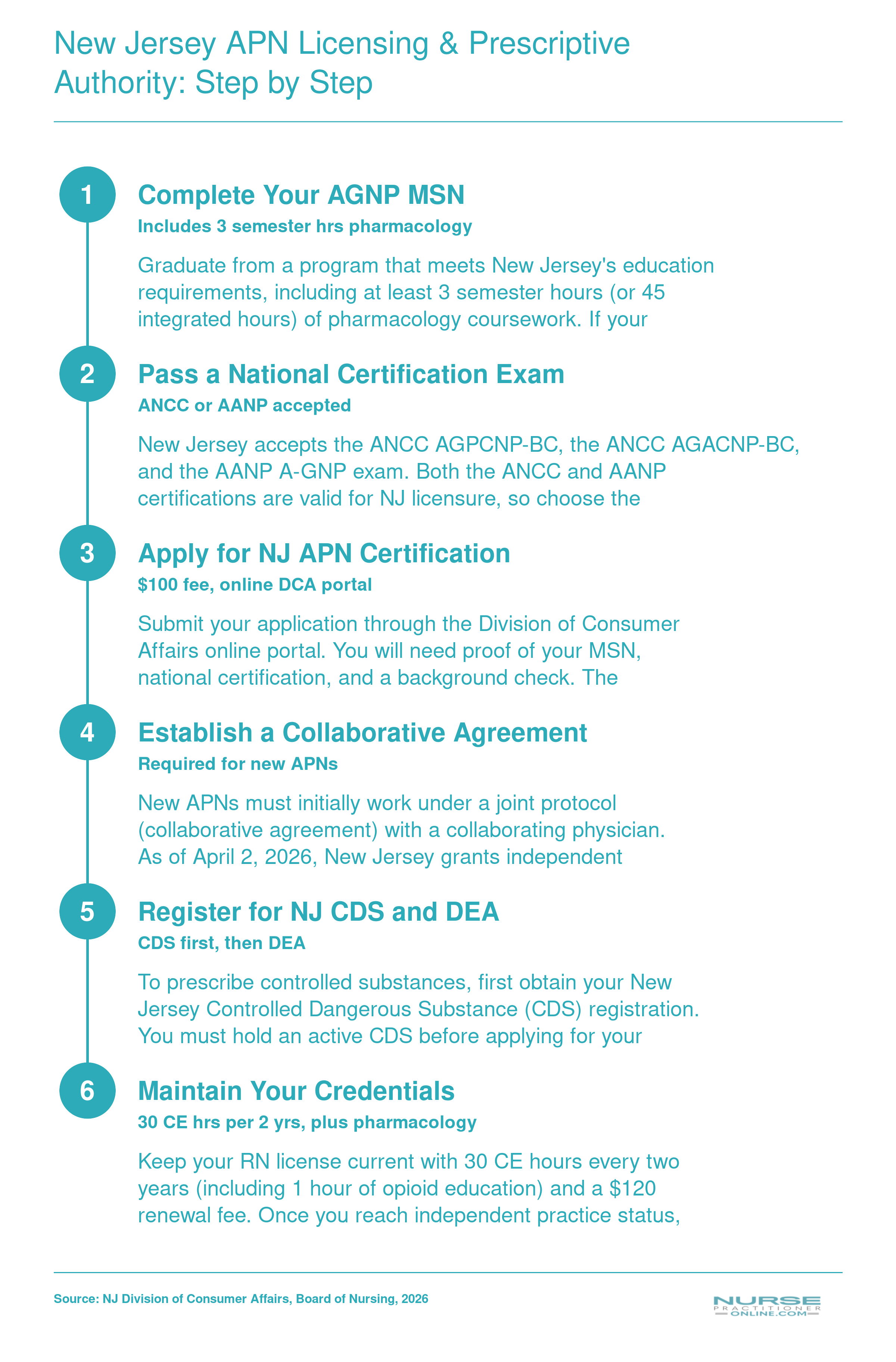
New Jersey APN Licensing & Prescriptive Authority: Step by Step
Earning your MSN is just the starting line. New Jersey requires several post-graduation steps before you can practice and prescribe as an Advanced Practice Nurse. Here is the full credentialing ladder for AGNP graduates, updated to reflect the landmark independent-practice law that took effect in April 2026.
AGNP Salary & Career ROI in the Jersey City Metro
Nurse practitioners in the Newark-Jersey City-White Plains metro division earn a median annual salary of $149,000, according to Bureau of Labor Statistics data from 2022.1 That figure places the region well above the national NP median of $126,260 (2024),2 reflecting the premium commanded by advanced practice nurses in North Jersey's high-cost, high-demand healthcare market. The 10th percentile earns roughly $100,000, while experienced AGPCNPs at the 90th percentile command upward of $193,000.1 With approximately 2,700 nurse practitioners employed across the metro division, the market supports both entry-level and senior roles in diverse settings.
Translating AGNP Tuition Into Take-Home ROI
Program costs in New Jersey range widely. William Paterson University's online AGNP MSN totals $16,963 in tuition, while Felician University's program runs $22,520 and Seton Hall's online track costs $37,470. When you pair those figures with median graduate debt (between $20,500 and $27,000 across the schools listed here), the payback period remains manageable. Most RNs see a six-figure salary within the first year of certification, turning graduate debt into a short-term investment rather than a long-term burden. Program-level earnings data for individual AGNP concentrations are not yet published by the College Scorecard, but institution-wide health profession outcomes show median early-career wages clustering between $57,000 and $70,000 for all nursing graduates, a conservative baseline that AGNP certification quickly surpasses.
High-Demand Settings for AGPCNPs in North Jersey
Adult-Gerontology Primary Care Nurse Practitioners find steady demand in federally qualified health centers, geriatric clinics, long-term care facilities, and primary-care practices serving older adults. Hudson County's aging population, combined with chronic shortages of primary-care physicians, has pushed FQHCs and community health networks to recruit AGPCNPs for chronic disease management, wellness visits, and preventive care. Long-term care operators in Bergen and Passaic counties likewise compete for AGPCNP talent to staff assisted living and skilled nursing facilities, where scope-of-practice regulations permit independent patient management under collaborative agreements.
AGPCNP vs. AGACNP: Scope and Salary Differences
New Jersey distinguishes between Adult-Gerontology Primary Care (AGPCNP) and Adult-Gerontology Acute Care (AGACNP) certification, and each carries distinct practice settings and earning trajectories. AGPCNPs deliver ambulatory, outpatient, and preventive services to adults across the lifespan, focusing on wellness, chronic disease, and health maintenance in clinics and community settings. AGACNPs work in hospitals, ICUs, emergency departments, and specialty inpatient units, managing acutely ill patients. If you're weighing both options, our guide to adult gerontology nurse practitioner programs compares curricula and clinical requirements side by side. While both tracks enjoy strong salaries in North Jersey, acute-care roles sometimes edge higher at the 90th percentile due to shift differentials, on-call requirements, and critical-care premiums. That said, AGPCNP positions often offer more predictable schedules and greater work-life balance, a trade many experienced RNs prioritize when choosing a specialty track.
Admissions Requirements & Tips for Working RNs
AGNP MSN programs near Jersey City share a common core of admissions criteria, though specifics vary. Here is a checklist to help you prepare a competitive application.
- Unencumbered RN licenseEvery program requires an active, unrestricted New Jersey RN license (or eligibility for one) at the time of enrollment. Verify your license is in good standing well before the application deadline.
- BSN from an accredited institutionA BSN is the standard prerequisite at schools such as Felician University, Seton Hall University, and William Paterson University. If you hold an ADN or diploma, look into RN-to-MSN bridge pathways offered by some universities, though note that several NJ programs near Jersey City, including Felician, Seton Hall, and William Paterson, do not currently offer a bridge option for AGNP tracks specifically. Broader searches on nursepractitioneronline.com can help you identify bridge-friendly programs elsewhere.
- Minimum GPAA cumulative GPA of 3.0 is a common baseline, Felician University requires a 3.0, for example, but some programs set the bar higher. Rutgers requires a 3.2 for its adult-gerontology advanced-practice track. Check each school's catalog, and if your GPA falls just below the threshold, ask about conditional admission or prerequisite coursework that can strengthen your profile.
- Clinical RN experienceMost programs prefer one to two years of direct-care nursing experience, ideally with adult or geriatric populations. Seton Hall asks for at least one year, while Rutgers expects a minimum of two years. Even where experience is not mandatory, admissions committees view bedside time favorably.
- Professional references & goal statementPlan on two or three professional references, supervisors or nurse educators who can speak to your clinical judgment and leadership potential. Pair them with a clear goal statement that connects your RN background to your AGNP career plans.
- GRE statusThe trend across New Jersey AGNP programs is away from standardized testing. Both Rutgers and William Paterson offer GRE waivers, and many other programs have dropped the requirement entirely. Always confirm the current policy on each school's admissions page, but do not let GRE anxiety delay your application.
- Prerequisite coursesSome programs require specific coursework completed before or early in the program. Felician University, for instance, lists nursing research, statistics, and health assessment as prerequisites. Review prerequisite lists early so you can knock out any gaps while still working.
- Tip for ADN-prepared nursesIf you do not yet hold a BSN, prioritize completing an accredited RN-to-BSN program first, then apply to an MSN AGNP track. This two-step path is often the most practical route for nurses near Jersey City, given that local AGNP programs generally require a BSN for direct entry.
Frequently Asked Questions About AGNP MSN Programs in NJ
Below are answers to the questions working RNs most often ask when exploring adult gerontology nurse practitioner programs near Jersey City. If you need program-specific details, nursepractitioneronline.com maintains updated profiles for every school featured in this guide.
- How much does an adult gerontology nurse practitioner make in New Jersey?
- Nurse practitioners in New Jersey earn a median annual salary that typically falls above the national NP average, reflecting the state's high cost of living and strong demand for primary care providers. In the Jersey City metro area, compensation can trend even higher because of proximity to major health systems. Exact figures shift year to year, so check the latest Bureau of Labor Statistics data for the most current numbers.
- How do I become a gerontology nurse practitioner in New Jersey?
- Start with an active RN license, then complete a CCNE- or ACEN-accredited MSN program with an adult gerontology primary care (AGPCNP) or acute care (AGACNP) focus. After graduating, pass the corresponding ANCC or AANP certification exam. Finally, apply for Advanced Practice Nurse (APN) certification through the New Jersey Board of Nursing, which also grants prescriptive authority once you meet additional requirements.
- How many clinical hours are required for an AGNP MSN program?
- Most AGNP MSN programs require a minimum of 500 direct patient care clinical hours, and many programs set the bar at 600 to 700 hours. National certification bodies (ANCC and AANP) use the 500-hour benchmark for exam eligibility. Clinical rotations are typically spread across several semesters so you can maintain your work schedule while gaining hands-on experience with adult and older adult populations.
- Can I complete an AGNP MSN program fully online in New Jersey?
- Several nationally accredited universities offer AGNP MSN programs with fully online didactic coursework that New Jersey residents can access. However, every program still requires in-person clinical hours, which you complete at approved sites in or near Jersey City. Some schools also schedule brief on-campus intensives or simulation labs once or twice a year. True 100-percent online completion, with no face-to-face component, is not available.
- What is the difference between AGPCNP and AGACNP programs?
- AGPCNP (Adult Gerontology Primary Care Nurse Practitioner) programs prepare you to manage chronic conditions, wellness visits, and preventive care in outpatient settings. AGACNP (Adult Gerontology Acute Care Nurse Practitioner) programs focus on complex, acute, and critical illness management in hospitals and emergency departments. Each track leads to a different certification exam, and your choice should align with the patient population and care setting where you plan to practice.
- What are the NJ licensing requirements for an AGNP?
- New Jersey requires an unencumbered RN license, a graduate degree from an accredited NP program, and a passing score on an approved national certification exam (ANCC or AANP). You then apply for APN certification through the NJ Board of Nursing. For prescriptive authority, you must establish a joint protocol with a collaborating physician and submit a separate application. New Jersey also mandates continuing education for APN renewal.
- Do NJ AGNP programs help with clinical placements or is it self-placement?
- It varies by school. Some programs near Jersey City maintain clinical partnerships with local health systems and assign preceptors on your behalf. Others follow a self-placement model, meaning you are responsible for securing your own clinical sites and preceptors, though the school typically provides guidance and must approve each site. Before enrolling, ask each program directly about placement support, because this factor significantly affects your timeline and stress level.